The main category of All News Articles.
You can use the search box below to find what you need.
[wd_asp id=1]
The main category of All News Articles.
You can use the search box below to find what you need.
[wd_asp id=1]
The GBPJPY pair attempted to recover some losses to notice its rally from 207.55 level, and formed some bullish corrective waves, to test the broken support at 209.15 level, to settle below it, confirming the negative scenario in the near and medium period trading.
The contradiction of the main indicators might push the price to provide sideways trading, but its negative stability below 209.15 will force it to provide new bearish trading, to reach near 207.60 to reach 50%Fibonacci corrective level at 207.05.
The expected trading range for today is between 207.00 and 209.00
Trend forecast: Bearish
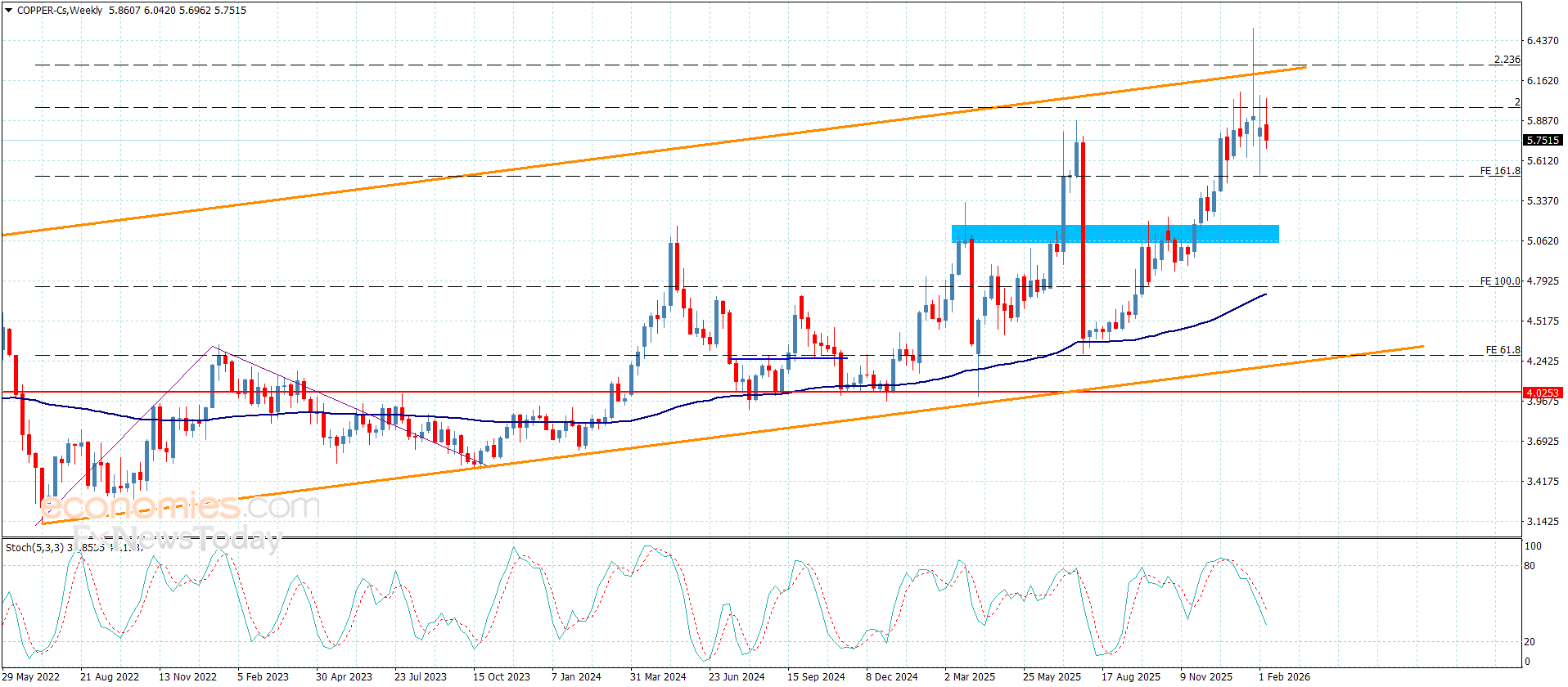
Copper price began forming corrective wave, moving away from $5.9700 barrier, noticing its fluctuations near the initial target by reaching $5.7000 level.
Note that the continuation of providing negative momentum by stochastic stability below 50 level will increase the negative pressure for today, to keep waiting for reaching extra support at $5.5100, to monitor its behavior due to the importance of this support to detect the near and medium period trading.
The expected trading range for today is between $5.5500 and $5.8500
Trend forecast: Bearish
The EURJPY pair resumed the negative attack, taking advantage of stochastic negativity to break 181.05 level, reaching the second target at 180.80, forming a strong obstacle against the current negative trading.
Stochastic exit from the oversold level will provide intraday bullish momentum to allow it recover some losses to target 182.80 level, while the decline below 180.80 and providing negative attack to reach 180.15 reaching 179.45 in the medium period.
The expected trading range for today is between 180.80 and 182.00
Trend forecast: Fluctuated within bearish track
Gold is staging a comeback toward $5,000 early Friday, reversing a part of Thursday’s 3.5% sell-off. The focus now remains on the all-important US Consumer Price Index (CPI) release for the next big move in Gold.
Gold is back on the bids, continuing to find bargain hunters at lower levels as geopolitical tensions and US Federal Reserve (Fed) interest rate cut expectations remain in play.
Despite a positive surprise in the January Nonfarm Payrolls data, markets still price in atleast two Fed rate cuts this year, according to the CME Group’s FedWatch Tool.
Therefore, the major US CPI data remains critical in gauging whether the Fed will conform to the market expectations or lean hawkish if inflation picks up in January.
The US core annual CPI is seen easing to 2.5% in January from December’s 2.6% print. The core monthly CPI is expected to rise by 0.3% in the same period against a 0.2% increase in December. Meanwhile, the headline annual CPI inflation is also likely to soften to 2.5%.
A hotter-than-expected core annual and monthly CPI readings could pour cold water on bets for two Fed rate cuts this year, fuelling a sustained US Dollar (USD) recovery at the expense of non-yielding assets such as Gold.
Markets brace for intense volatility on the US CPI release this Friday, with a sense of caution reviving Gold buyers in the lead-up to the critical event risk.
Gold tumbled close to 3.5% on Thursday as an intense selling wave gripped markets and unexpectedly ramped up haven demand for the USD. Concerns around artificial intelligence- (AI) driven disruption resurfaced, this time spreading to the commercial property space.
Real estate stocks were the latest sector to come under pressure following earlier sell-offs in software and financial services tied to AI fears, per CNBC News.
The 21-day Simple Moving Average (SMA) rises above the 50-, 100-, and 200-day SMAs, underscoring bullish alignment. All SMAs trend higher while price holds above them, keeping buyers in control. The 21-day SMA currently stands at $4,952.03 and offers nearby dynamic support. The Relative Strength Index (RSI) sits at 54.80 (neutral) and is edging higher, reinforcing a steady bid.
Measured from the $5,597.89 high to the $4,401.99 low, the Fibonacci retracement framework points to overhead barriers on rebounds. The 50% retracement at $4,999.94 caps initial advances, with the 61.8% at $5,141.05 as the next resistance. A sustained push above the former would open room toward the latter, while rejection keeps the upside constrained and leaves the focus on nearby moving average support.
(The technical analysis of this story was written with the help of an AI tool.)
Inflationary or deflationary tendencies are measured by periodically summing the prices of a basket of representative goods and services and presenting the data as the Consumer Price Index (CPI). CPI data is compiled on a monthly basis and released by the US Department of Labor Statistics. The MoM print compares the prices of goods in the reference month to the previous month.The CPI Ex Food & Energy excludes the so-called more volatile food and energy components to give a more accurate measurement of price pressures. Generally speaking, a high reading is seen as bullish for the US Dollar (USD), while a low reading is seen as bearish.
Inflation measures the rise in the price of a representative basket of goods and services. Headline inflation is usually expressed as a percentage change on a month-on-month (MoM) and year-on-year (YoY) basis. Core inflation excludes more volatile elements such as food and fuel which can fluctuate because of geopolitical and seasonal factors. Core inflation is the figure economists focus on and is the level targeted by central banks, which are mandated to keep inflation at a manageable level, usually around 2%.
The Consumer Price Index (CPI) measures the change in prices of a basket of goods and services over a period of time. It is usually expressed as a percentage change on a month-on-month (MoM) and year-on-year (YoY) basis. Core CPI is the figure targeted by central banks as it excludes volatile food and fuel inputs. When Core CPI rises above 2% it usually results in higher interest rates and vice versa when it falls below 2%. Since higher interest rates are positive for a currency, higher inflation usually results in a stronger currency. The opposite is true when inflation falls.
Although it may seem counter-intuitive, high inflation in a country pushes up the value of its currency and vice versa for lower inflation. This is because the central bank will normally raise interest rates to combat the higher inflation, which attract more global capital inflows from investors looking for a lucrative place to park their money.
Formerly, Gold was the asset investors turned to in times of high inflation because it preserved its value, and whilst investors will often still buy Gold for its safe-haven properties in times of extreme market turmoil, this is not the case most of the time. This is because when inflation is high, central banks will put up interest rates to combat it.
Higher interest rates are negative for Gold because they increase the opportunity-cost of holding Gold vis-a-vis an interest-bearing asset or placing the money in a cash deposit account. On the flipside, lower inflation tends to be positive for Gold as it brings interest rates down, making the bright metal a more viable investment alternative.
The GBP/USD pair is under heavy selling pressure in Friday’s European session, trading around 1.3609. Earlier, it tried to hold above 1.3650, but the recovery was weak. Ongoing concerns about slow UK growth and a strong US job market continue to push the pair lower.
The British Pound has been weak lately because of several disappointing reports from the Office for National Statistics (ONS).
These numbers have increased expectations for a Bank of England (BoE) rate cut at the March 19 meeting. Futures markets now see a higher chance that the BoE will act to support the economy, especially since the services sector is showing no growth.
Meanwhile, the US Dollar is still seen as a safe haven. The US Nonfarm Payrolls (NFP) report on February 11 showed 130,000 new jobs, almost twice the 70,000 expected, and the unemployment rate fell to 4.3%.
Yesterday, Initial Jobless Claims dropped to 227,000, which supports the Dollar’s strength. Although this is a bit higher than the best estimates, it still points to a strong job market, letting the Federal Reserve keep its current approach.
Traders are now watching today’s US CPI report at 13:30 GMT. If core inflation is above 2.5%, the USD could rise further, making it harder for the GBP to recover.
The GBP/USD 2-hour chart shows a weakening technical setup. The pair keeps making lower highs and lower lows after being repeatedly pushed down from a falling trendline that started near 1.3760.
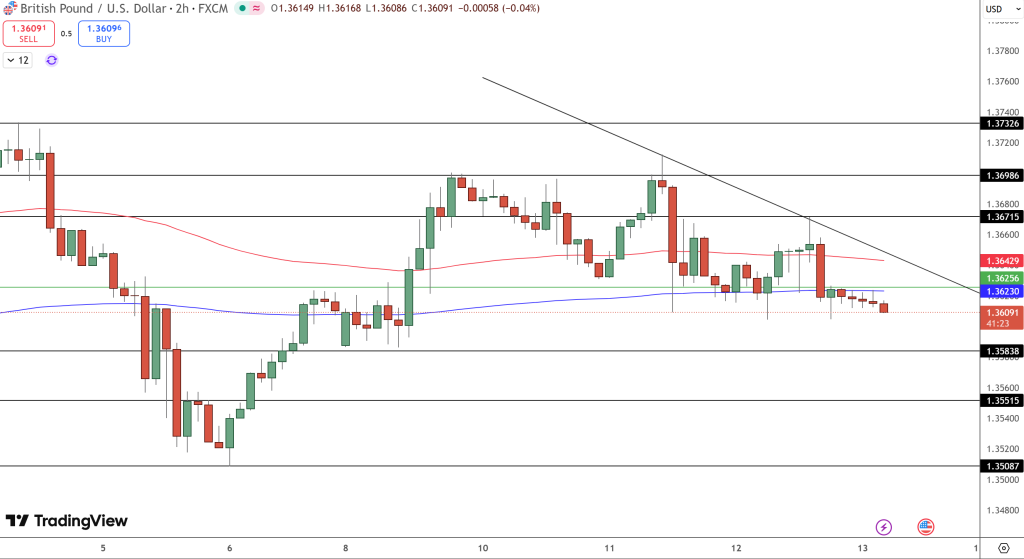
Trade Idea: If the price breaks clearly below 1.3600, consider a short position with a target at the 1.3550 level and a stop-loss above 1.3645.
The pair will likely stay under pressure unless the UK delivers unexpectedly strong news or US inflation drops more than expected.

Arslan Butt
Lead Markets Analyst – Multi-Asset (FX, Commodities, Crypto)
Arslan Butt serves as the Lead Commodities and Indices Analyst, bringing a wealth of expertise to the field. With an MBA in Behavioral Finance and active progress towards a Ph.D., Arslan possesses a deep understanding of market dynamics.
His professional journey includes a significant role as a senior analyst at a leading brokerage firm, complementing his extensive experience as a market analyst and day trader. Adept in educating others, Arslan has a commendable track record as an instructor and public speaker.
His incisive analyses, particularly within the realms of cryptocurrency and forex markets, are showcased across esteemed financial publications such as ForexCrunch, InsideBitcoins, and EconomyWatch, solidifying his reputation in the financial community.
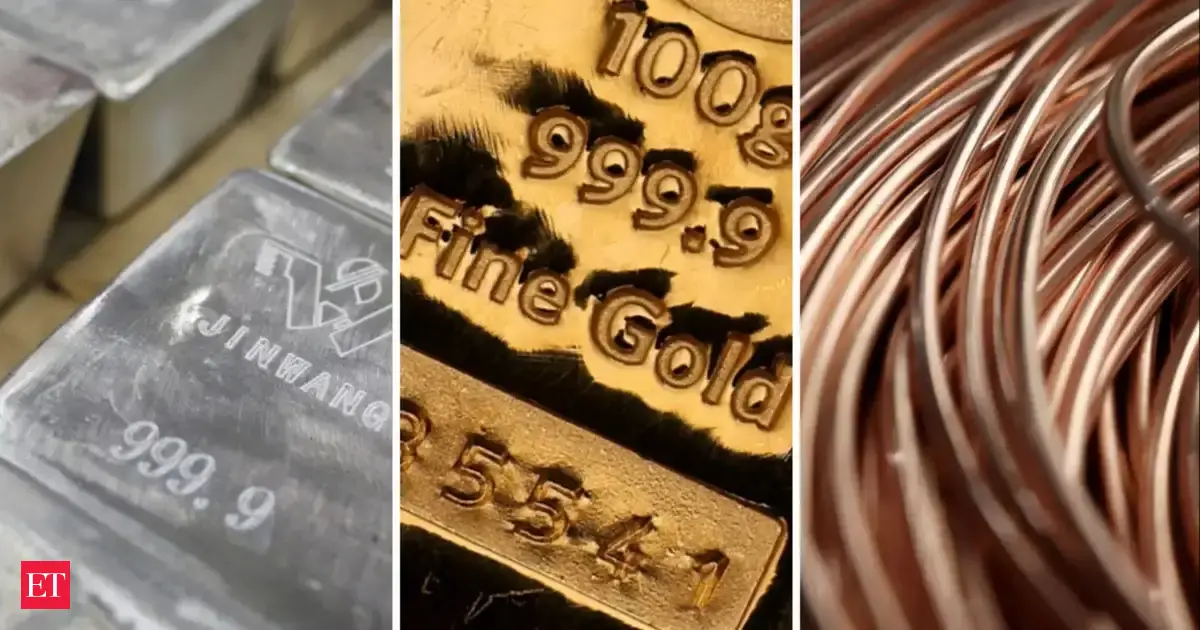
The sell-off followed stronger US economic data and a rebound in the US dollar. The latest jobless claims came in at 227,000. The January nonfarm payrolls report showed 130,000 jobs added, well above expectations of 70,000. The unemployment rate fell to 4.3%. That data reduced Federal Reserve rate cut expectations.
Gold fell below the key psychological $5,000 level. Silver broke under $80. These technical breaks triggered stop-loss selling and margin calls. The gold-silver ratio widened toward 66:1. Markets saw what traders call a “liquidity flush.” The broader trend remains under debate, but short-term volatility is elevated across commodities.
The immediate trigger was technical. For days, gold prices had traded in a tight range between $5,000 and $5,100. Silver hovered near $80 to $85. When markets coil like this, stop-loss orders build on both sides.
Gold had heavy stop orders below $5,000. Silver had leverage stacked above $80 after its massive 2025 rally that pushed prices as high as $121 earlier in the year. Once gold slipped below $5,000, automated selling accelerated. Silver followed sharply.
This type of move often happens when liquidity thins and technical levels break. There was no sudden geopolitical shock. The move was largely mechanical.
However, macro data added pressure. Strong US labor numbers reduced the urgency for Federal Reserve rate cuts. That strengthened the US dollar. A stronger dollar weighs on gold, silver, platinum, and copper because they are priced in dollars globally. The US Dollar Index rebounded after recent weakness. The labor market data changed rate expectations quickly. Before the jobs report, markets were pricing higher odds of a March rate cut. After payrolls beat forecasts, those odds fell sharply.
Higher-for-longer interest rate expectations hurt non-yielding assets like gold. When bond yields rise and the dollar strengthens, investors shift toward interest-bearing assets.
Gold is highly sensitive to real yields. Silver is even more volatile because it has both safe-haven and industrial demand exposure.
If upcoming inflation data surprises to the upside, rate cut expectations may fall further. That could keep pressure on metals.
Gold futures (GC00) are now trading near $4,966, down from recent highs above $5,600. The 52-week range remains wide, between $2,844 and $5,626.
The key support zone is $4,880 to $4,900. If that area holds, gold could stabilize. A break below $4,880 opens the door toward $4,800, then $4,700. The major long-term support stands near $4,500.
On the upside, gold must reclaim $5,000 on a daily closing basis. If it holds above that level, buyers may target $5,100 again. That area has acted as strong resistance.
Despite today’s drop, the broader uptrend from 2025 remains intact. Central bank buying continues. China’s central bank has maintained steady gold accumulation. Physical premiums remain elevated in some markets.
For now, the gold price forecast remains neutral with elevated volatility.
Silver fell nearly 10% in one session. That is far more aggressive than gold.
The reason is leverage. Silver experienced a record rally in 2025, gaining more than 140% at one point. Futures positioning became crowded. When prices broke below $80, margin calls triggered forced selling.
Silver’s key support now lies between $74 and $70. This zone aligns with previous consolidation levels. If silver holds above $74 and regains $85, the rally could resume toward $90 or higher.
But if dollar strength persists and risk appetite weakens, silver could test lower support zones.
The gold-silver ratio near 66:1 suggests silver is underperforming gold. Historically, elevated ratios sometimes precede silver outperformance, but timing remains uncertain.
Platinum (PL00) fell 5.63% to $2,024. Platinum often trades with both precious metals and industrial demand expectations. Weak risk sentiment and dollar strength weighed on prices.
Copper (HG00) dropped 2.78% to $5.80 per pound. Copper is closely linked to global growth, especially China’s demand. Slowing manufacturing signals and stronger US data created mixed signals.
Copper had traded above $6 earlier this year. Today’s drop reflects both technical pressure and macro uncertainty.
Industrial metals tend to fall when investors anticipate tighter financial conditions.
Some traders believe today’s move was a delayed reaction to the strong nonfarm payrolls report. The dollar initially struggled to hold gains after the data. But as rate expectations reset, metals came under pressure.
Unemployment fell to 4.3%. Wage growth surprised on the upside. Those factors reduce immediate pressure on the Federal Reserve to ease policy.
Jobless claims at 227,000 did not dramatically change the narrative. Markets are now focused on upcoming CPI data. A stronger inflation reading could support the dollar further.
The metals sell-off occurred alongside weakness in energy markets. WTI crude oil fell 2.99% to $62.70. Brent crude dropped 2.84% to $66.31. Unleaded gasoline and heating oil also declined. Natural gas was the exception, rising more than 3%.
This suggests a broader risk reset rather than an isolated gold event.
Short term, volatility remains high. Gold must defend $4,880. Silver must hold above $74. Platinum needs stability above $2,000. Copper must protect the $5.70 to $5.80 area.
If US economic data continues to surprise on the upside, metals may face further pressure. If inflation cools and rate cut expectations return, gold and silver could rebound sharply.
Today’s crash appears technically driven but reinforced by macro shifts. The longer-term bull case tied to central bank demand, inflation hedging, and industrial use remains intact.
For now, investors should expect sharp two-way moves in gold prices, silver prices, platinum prices, and copper prices as markets adjust to shifting Federal Reserve expectations in early 2026.
The massive price plunge is primarily driven by a “liquidity flush” triggered by unexpectedly strong U.S. labor data. With January payrolls jumping by 130,000 and unemployment falling to 4.3%, the market has abruptly repriced Federal Reserve interest rate expectations. This data reduced the urgency for rate cuts, causing the U.S. Dollar to rally and pressuring dollar-denominated metals. The crash was accelerated by technical factors as gold breached the critical $5,000 support level, triggering a massive wave of automated stop-loss orders and margin calls for leveraged traders.
Despite today’s $132 drop in gold and 10% cratering in silver, many institutional analysts view this as a necessary consolidation of an “overheated” market. While short-term volatility is expected to persist, the structural bull case remains supported by a sixth consecutive year of silver supply deficits and aggressive gold accumulation by global central banks. However, the immediate gold forecast is neutral-to-bearish until prices can reclaim and hold the $5,000 mark.
Industrial metals like copper and platinum are suffering from a “risk-off” sentiment and fears of high-for-longer interest rates. Copper dropped to $5.80 as traders worried that restrictive Fed policy could dampen global manufacturing demand, particularly as markets await fresh inflation data. Platinum’s 5.6% slide reflects its high sensitivity to industrial project financing costs and a broader retreat from “green” commodities as the U.S. dollar regains its dominance.
For gold, the $4,880 to $4,900 zone is now the must-hold line to prevent a deeper slide toward $4,500. Silver investors are looking for stability around the $75 mark, as a failure to hold this level could see the metal retest January’s lows near $65. Tomorrow’s Consumer Price Index (CPI) report is the next major volatility catalyst; a “cool” inflation print could spark a relief rally, while “hot” data may deepen today’s sell-off.
While the yen gets a boost on expectations of multiple BoJ rate hikes, the US CPI report will influence bets on a June Fed rate cut. Economists forecast headline inflation to ease from 2.7% in December to 2.5% in January, with core inflation expected to be 2.5% (Dec: 2.6%).
Softer inflation numbers are likely to raise expectations of a June Fed rate cut, weighing on the US dollar. Given Fed Chair Powell’s concerns about elevated inflation, USD/JPY is likely to be particularly sensitive to the report.
This week’s hotter-than-expected US jobs report has signaled a less dovish Fed rate path. However, inflation trends are likely to be more critical for the Fed.
Market bets on a more dovish Fed rate path and a more hawkish BoJ policy stance would support the bearish short- to medium-term outlook.
For USD/JPY price trends, traders should monitor technical indicators, key economic data, government policies, and central bank rhetoric.
On the daily chart, USD/JPY remains below its 50-day Exponential Moving Average (EMA), but trades above the 200-day EMA. The EMA positions indicate a bearish near-term but bullish longer-term bias. Nevertheless, positive yen fundamentals align with the short-term technicals, signaling a bearish medium-term outlook.
A drop below the 200-day EMA would indicate a bearish trend reversal, exposing the 150 support level. If breached, 145 would be the next key support level.
Importantly, a sustained fall through the EMAs would reaffirm the negative medium- to longer-term price outlook.
Silver (XAG/USD) attracts some sellers during the Asian session on Thursday and reverses a major part of the previous day’s gains to the $86.30 area, or the weekly high. The white metal currently trades just below mid-$82.00s, down over 2.5% for the day, though it remains confined in a familiar range held since the beginning of this week.
From a technical perspective, the overnight failure near the 38.2% Fibonacci retracement level of the recent downfall from the all-time peak and the subsequent fall warrants some caution for the XAG/USD bulls. Moreover, the Moving Average Convergence Divergence (MACD) line stands above the Signal line and above zero, though the spread narrows as the histogram contracts, hinting at fading upside momentum. The Relative Strength Index sits at 50.89 (neutral), consistent with a consolidative tone.
Meanwhile, the 200-period Simple Moving Average (SMA) on the 4-hour chart trends higher at $87.42. The XAG/USD, however, holds beneath it, keeping rebounds capped. The 38.2% retracement at $85.87 acts as initial resistance, and a clear break would open the 50% retracement at $92.59. Failure to clear resistance could drag theXAG/USD back toward the 23.6% retracement at $77.56. A sustained move above the 200-period SMA would be needed to improve the broader setup.
(The technical analysis of this story was written with the help of an AI tool.)
Silver is a precious metal highly traded among investors. It has been historically used as a store of value and a medium of exchange. Although less popular than Gold, traders may turn to Silver to diversify their investment portfolio, for its intrinsic value or as a potential hedge during high-inflation periods. Investors can buy physical Silver, in coins or in bars, or trade it through vehicles such as Exchange Traded Funds, which track its price on international markets.
Silver prices can move due to a wide range of factors. Geopolitical instability or fears of a deep recession can make Silver price escalate due to its safe-haven status, although to a lesser extent than Gold’s. As a yieldless asset, Silver tends to rise with lower interest rates. Its moves also depend on how the US Dollar (USD) behaves as the asset is priced in dollars (XAG/USD). A strong Dollar tends to keep the price of Silver at bay, whereas a weaker Dollar is likely to propel prices up. Other factors such as investment demand, mining supply – Silver is much more abundant than Gold – and recycling rates can also affect prices.
Silver is widely used in industry, particularly in sectors such as electronics or solar energy, as it has one of the highest electric conductivity of all metals – more than Copper and Gold. A surge in demand can increase prices, while a decline tends to lower them. Dynamics in the US, Chinese and Indian economies can also contribute to price swings: for the US and particularly China, their big industrial sectors use Silver in various processes; in India, consumers’ demand for the precious metal for jewellery also plays a key role in setting prices.
Silver prices tend to follow Gold’s moves. When Gold prices rise, Silver typically follows suit, as their status as safe-haven assets is similar. The Gold/Silver ratio, which shows the number of ounces of Silver needed to equal the value of one ounce of Gold, may help to determine the relative valuation between both metals. Some investors may consider a high ratio as an indicator that Silver is undervalued, or Gold is overvalued. On the contrary, a low ratio might suggest that Gold is undervalued relative to Silver.
Natural gas price continued resisting stochastic negativity, to settle above $3.050 support and its rally towards $3.250 level, to confirm the previously suggested bullish scenario.
Gathering bullish momentum in the current period trading is important to surpass the barrier at $3.520, to begin recording several gains by its rally towards $3.910 initially, while breaking the current support and holding below it will confirm its move to a new bearish phase, which forces it to suffer more losses by reaching $2.850 and $2.660.
The expected trading range for today is between $3.000 and $3.450
Trend forecast: Bullish
WTI crude CL=F is trading near $65.01 per barrel, up $1.05 on the day for a 1.64% gain, with front-month futures earlier marked around $64.85 in European trade. The contract is sitting in a tight band around $65 even after the American Petroleum Institute estimated a huge 13.4 million barrel build in U.S. crude inventories for the week ending February 6, reversing the prior week’s 11.1 million barrel draw. On pure fundamentals, a double-digit stock build would normally pressure prices, but the tape shows the opposite: the market is willing to pay higher flat prices because the driver today is risk premium, not immediate scarcity. That tells you the marginal barrel is being priced on geopolitical risk around flows, not on the comfort of tanks onshore in the U.S.
U.S.–Iran tension is the core trigger for that premium in WTI CL=F. Washington is considering seizing sanctioned tankers carrying Iranian oil and has openly discussed sending a second aircraft carrier if negotiations break down. In parallel, Israel’s prime minister is in Washington, seeking strict limits on Iranian uranium enrichment, ballistic missiles and support for Hamas and Hezbollah. The combination of carrier threats, tanker-seizure talk and nuclear diplomacy is exactly what pushes risk models to reprice the odds of disruption in the Gulf. The key point is that none of this has yet removed barrels from the market, but it forces traders to assign a higher probability that something goes wrong in the shipping lanes that matter for Atlantic Basin balances.
The clash between a 13.4 million barrel U.S. build and a 1.64% gain in CL=F defines today’s structure: physical balances are comfortable for now, but paper markets are unwilling to ignore the geopolitical tail risk. That caps the move for WTI in the mid-$60s rather than launching it into an immediate breakout, but also prevents any slide back to the low-$60s while the Gulf situation remains unresolved.
Brent crude BZ=F is trading close to $69.82 per barrel, up $1.02 or about 1.48% on the day, with earlier prints around $69.69. The benchmark is repeatedly testing, but not convincingly clearing, the $70 level. That price action tells you the market is repricing risk, not panicking. Traders are adding a measured premium for shipping lanes, sanctions and refinery targets, but they do not yet see a genuine supply shock that would justify pricing $80 or more in the front month.
A string of policy and sanctions headlines reinforces that premium in BZ=F. EU authorities are escalating oil sanctions with a broader ban on shipping services. Washington is targeting tankers that keep Iranian barrels moving, while Ukraine’s strikes on Russian refineries underline how quickly product supply can be hit when critical assets are damaged. At the same time, the U.S. is allowing domestic firms to provide services for Venezuelan oil, a move that could eventually normalise part of Venezuela’s export stream. The net effect is a constant reshuffling of flows rather than a clean increase or decrease in total supply, which naturally feeds into Brent’s status as a global pricing anchor.
Brent’s failure to break decisively above $70, despite a solid 1%–1.5% intraday rally, also shows that positioning still respects downside scenarios. If U.S.–Iran talks stabilise, if tanker seizures do not materialise, or if alternative barrels from Russia, Venezuela and others reroute efficiently, some of today’s premium can disappear quickly. That is why BZ=F is grinding higher in a controlled way rather than pricing a crisis.
Murban crude is marked around $69.89, up $0.87 or 1.26%, tracking Brent BZ=F almost one-for-one and confirming that Middle Eastern light sweet barrels are reflecting the same geopolitical premium without yet signalling a real shortage. The OPEC Basket at roughly $66.65, up $1.71 or 2.63%, is actually outperforming both WTI and Brent in percentage terms, which indicates that the group’s diversified mix of grades is gaining relative value as sanctions, tanker risk and route reconfiguration push buyers towards barrels under the OPEC+ umbrella.
On the U.S. side, Louisiana Light is trading close to $65.94, up $2.99 or about 4.75%. That is a much sharper move than WTI’s 1.64% gain and reflects both its quality and its export positioning out of the Gulf Coast. These barrels are priced directly off seaborne demand into Europe and the Americas, so they respond more aggressively when seaborne risk premium rises. In contrast, Mars US, at about $69.79 and down $0.88 or 1.25%, shows pressure on heavier sour grades, where refinery demand, sour differentials and specific refinery maintenance cycles matter more than headline geopolitics.
Refined products are aligned with, but not amplifying, the crude move. Gasoline is quoted around $1.982 per gallon, up $0.022 or 1.14%. That is a modest gain compared with Louisiana Light’s 4.75% but broadly in line with the 1%–2% move in CL=F and BZ=F. The absence of a disproportionate spike in gasoline suggests that the rally is still centred on crude risk premium, not on a sudden panic about product availability.
Natural gas is trading near $3.155, up $0.040 on the day for a 1.28% increase. The scale of that move is almost identical to the gains in WTI CL=F and Brent BZ=F, signalling that macro risk appetite and cross-commodity flows are lifting energy as an asset class. However, the drivers are clearly different. Gas is reacting to weather patterns, LNG trade and power demand, while crude is being remapped around geopolitical stress in the Gulf and evolving sanctions.
The key point is that there is no major divergence inside the energy complex. Gas is not collapsing while oil rallies, and refined products are not decoupling from crude. This coherence across contracts strengthens the interpretation that today’s move is a rational repricing of risk, rather than speculative dislocation in one corner of the market. For directional positioning in CL=F and BZ=F, it means the geopolitical premium is not being contradicted by hostile signals from gas or products.
The geopolitical layer driving WTI CL=F around $65 and Brent BZ=F around $70 is straightforward: the probability of disruption in the Gulf has risen, and the futures curve is recalibrating. U.S.–Iran negotiations remain fragile. The White House is weighing more aggressive enforcement on sanctioned Iranian crude, including the option of seizing tankers. Israel’s leadership is pressing in Washington for stricter limits on Iran’s nuclear and regional activities, while Iran has a history of responding asymmetrically through harassment of shipping and pressure on strategic chokepoints.
The U.S. president’s signal that a second aircraft carrier could be deployed if talks fail raises the odds of miscalculation at sea. The market does not need actual damage to infrastructure to reprice; it only needs a credible trajectory towards higher insurance costs, longer routes and a higher chance that marginal barrels are delayed or stranded. The fact that WTI and Brent are both up over 1% even with a 13.4 million barrel U.S. crude build shows that traders are consciously paying for that diplomatic uncertainty.
At the same time, the market is well aware that risk premium can evaporate if a deal is struck or if enforcement softens. That is why the move is contained to the mid-$60s for CL=F and just shy of $70 for BZ=F, rather than a runaway spike into the $80s. Price today is simply the midpoint between comfortable supply and elevated political stress.
The policy tape matters because it reshapes flows even if total supply does not change overnight. Washington’s decision to allow U.S. firms to provide services for Venezuelan oil opens the door for gradual rehabilitation and higher reliability of Venezuela’s output, which has been constrained by years of underinvestment and sanctions. Parallel to that, EU measures targeting shipping services and U.S. enforcement moves against tankers carrying Russian or Iranian barrels increase the friction cost of moving those barrels, even if they still find buyers through alternative routes.
India is at the centre of this reshuffling. On one side, it is signalling plans to slash imports of Russian oil after a U.S. trade deal, while on the other it is raising purchases from the Middle East and West Africa to avoid over-dependence on discounted Russian barrels. China, meanwhile, continues to hoard crude and has been a key backstop for Russian flows, keeping a floor under exports despite Western sanctions. Every one of these shifts affects freight rates, voyage times and differentials, which feed back into Brent BZ=F as the clearing benchmark for seaborne barrels.
For WTI, the implication is that U.S. crude must stay competitive on a netback basis into export markets while still clearing domestic inventories. A 13.4 million barrel build shows that, for now, inland supply is comfortable. But as sanctions and trade deals change who can buy Russian, Iranian and Venezuelan barrels at what discount, U.S. exports can either accelerate or slow, influencing how long CL=F can hold $65 without a deeper drawdown in stocks.
The Santos Limited (ASX: STO) reserves update slots into the oil narrative as a reminder that long-duration gas and carbon capture are becoming structural pillars next to liquid crude. Santos closed 2025 with 1,484 million barrels of oil equivalent (mmboe) of proved plus probable (2P) reserves. Before accounting for 88 mmboe of production, 2P reserves increased by 13 mmboe, mainly from the Cooper Basin and Papua New Guinea. On a reported basis, the headline 2P number is lower than the 1,559 mmboe in 2024, but the underlying story is one of steady resource maturation and portfolio optimisation rather than depletion.
Proved reserves (1P) are 913 mmboe, with a 95% 1P replacement ratio, while the 2P replacement ratio stands at 15%, reflecting a year focused on turning resources into developed barrels more than chasing large new finds. Gas dominates the book, representing 83% of 2P reserves versus 17% for liquids. Developed reserves now account for 62% of the 2P total, up sharply from 40% a year earlier, which improves visibility on future cash flows. At 2025 production rates, the 2P reserve life is 17 years, a significant planning horizon in a world where many buyers are signing long-dated LNG offtake agreements.
On the contingent side, 2C resources have eased from 3,338 mmboe to 3,212 mmboe after the divestment of the Petrel and Tern fields offshore Northern Australia, partially offset by additions in the Cooper Basin, Western Australia and Alaska. In parallel, Santos is building a sizeable carbon capture position. Proved plus probable CO₂ storage capacity has declined to 8 million tonnes after 1 million tonnes were injected, but 2C CO₂ storage resources have grown by 24 million tonnes to 202 million tonnes, entirely in the Cooper Basin. That supports expansion of the Moomba CCS project and gives Santos a credible route to monetise decarbonisation demand from industrial clients and LNG buyers.
Financial guidance reinforces the cash-flow orientation. Santos expects about $4.94 billion in product sales revenue for 2025, with cost of sales between $3.25 and $3.30 billion, net finance costs of $250–$265 million and an effective tax rate around 31%. Impairment charges, including additional second-half hits, are flagged at roughly $137 million. Put together, this is a gas-anchored, long-life reserve base with increasing CCS leverage—exactly the kind of profile that will interact with oil demand over time by influencing gas-for-oil substitution in power and industry.
Saudi Aramco’s progress on its In-Kingdom Total Value Add (iktva) program explains part of the structural confidence in long-term supply behind Brent BZ=F. The company has reached 70% local content in its procurement, meaning that seven out of every ten dollars spent on goods and services now goes to Saudi-based suppliers. The target is to lift that figure to 75% by 2030, deepening domestic industrial capacity in parallel with upstream and downstream expansion.
The scale is material. Since iktva’s launch, Aramco estimates that it has contributed more than $280 billion to Saudi GDP, attracted $9 billion in inward investment and catalysed over 350 investments from 35 countries. Forty-seven strategic products are being manufactured locally for the first time, and the program has identified more than 200 localisation opportunities across 12 sectors, representing about $28 billion of annual market potential. That spend is concentrated in manufacturing, services and energy-related equipment that underpin upstream, downstream and chemicals projects.
For the global oil market, the key implication is supply chain resilience. By anchoring critical manufacturing and services in-Kingdom, Aramco reduces its exposure to global logistics bottlenecks, shipping shocks and imported cost spikes—the very disruptions that rattled energy supply during the pandemic and subsequent geopolitical crises. A more self-sufficient supply chain raises confidence that Saudi Arabia can deliver on its role as the world’s leading swing producer, adjusting production in line with OPEC+ strategy without being constrained by external fabrication or equipment lead times.
This industrial base also positions Saudi Arabia as a regional manufacturing hub for oilfield services and heavy equipment, with implications for international service companies that lack a local footprint. For Brent BZ=F, a credible long-term capacity and project-execution story in Saudi Arabia stabilises the back end of the curve. It signals that while front-month prices will move with risk premium, the structural ability to expand or maintain supply remains intact.
Putting the numbers together—WTI CL=F around $65.01, Brent BZ=F near $69.82, Murban at $69.89, the OPEC Basket at $66.65, Louisiana Light at $65.94, Mars US at $69.79, gasoline at $1.982, natural gas at $3.155, a 13.4 million barrel U.S. crude stock build, Santos with 17 years of 2P reserves and 202 million tonnes of 2C CO₂ storage, and Saudi Aramco at 70% local content targeting 75% by 2030—the structure is clear. The world is not short of hydrocarbons today, but it is short of certainty about how those barrels move and how sanctions, diplomacy and conflicts will interact with shipping lanes and refineries.
On the supportive side, you have a 1%–1.6% rally in CL=F and BZ=F, an OPEC Basket up 2.63%, Louisiana Light surging 4.75%, persistent U.S.–Iran tension, threats of tanker seizures, and a sanctions landscape that keeps several million barrels per day under legal or logistical pressure. On the limiting side, you have a large U.S. inventory build, pockets of weakness in specific grades such as Mars, and the clear possibility that negotiations or policy shifts knock dollars off crude if they de-escalate the Gulf.
At $65–$70, the balance of probabilities favours a Buy-biased stance on both WTI CL=F and Brent BZ=F, rather than a Sell or flat call. The upside scenario—negotiations fail, sanctions tighten, or a shipping incident occurs—would likely push the front of the curve significantly higher from current levels. The downside scenario—diplomatic progress or softer enforcement—would remove part of the premium but is cushioned by robust demand, OPEC+ management and the time it takes for new barrels from places like Venezuela to stabilise. In other words, the market is paying for a higher risk premium, but not yet for a crisis, leaving room for further upside if the geopolitical path deteriorates from here.