The main category of All News Articles.
You can use the search box below to find what you need.
[wd_asp id=1]
The main category of All News Articles.
You can use the search box below to find what you need.
[wd_asp id=1]
– Written by
David Woodsmith
STORY LINK Pound Sterling to Dollar Forecast: GBP Stalls Below 1.35 as USD Holds Firm
The Pound to Dollar exchange rate has been unable to regain ground above 1.35, as geopolitical developments and global risk considerations continue to dominate trading.
With UK fundamentals taking a back seat, GBP/USD remains range-bound while markets await clarity on US policy risks.
The Pound to Dollar (GBP/USD) exchange rate has been unable to move back above the 1.3500 level and settled around 1.3470 after the New York open.
Ranges have been relatively contained despite major underlying concerns and uncertainties.
Geo-political stresses remain substantial, especially with markets waiting for President Trump’s response on the Iran situation.
Overnight Trump threatened to impose 25% tariffs on countries which trade with Iran which is liable to trigger fresh tensions with China.
Get better rates and lower fees on your next international money transfer.
Compare TorFX with top UK banks in seconds and see how much you could save.
The overall dollar performance has been mixed while there has been further demand for precious metals with gold and silver posting fresh record highs. There have not been any major UK developments ahead of the latest UK GDP data on Thursday.
Monex Europe head of macro analysis Nick Rees commented; “It’s less to do with UK fundamentals – which we still think are weak – it’s rather that events elsewhere are providing a distraction from Britain’s problems.”
UoB commented; “The price action suggests that GBP is likely in a range-trading phase, probably between 1.3390 and 1.3520.”
MUFG expects limited GBP/USD gains to 1.38 at the end of 2026.
The headline US inflation rate was unchanged at 2.7% for December and in line with consensus forecasts. Core prices increased 0.2% on the month with the annual rate holding at 2.6% compared with market expectations of a slight uptick to 2.7%.
Markets are pricing in less than a 30% chance of a March Fed rate cut after no change in January, limiting scope for dollar selling.
There is still a high degree of concern surrounding Fed independence, although the market impact has been limited.

Traders are waiting for further news on the legal action against Chair Powell and the choice of next Fed Chair.
Scotiabank commented; “As President Trump continues to mull his pick to replace Powell, investors appear surprisingly calm in the face of the apparent risks facing the Fed’s policy independence.”
Domestically, markets will be on alert for comments from Bank of England (BoE) officials.
Deputy Governor Ramsden and external member Taylor are due to speak on Wednesday.
Both members have been relatively dovish members on the committee and the Pound will be vulnerable if Ramsden backs another immediate rate cut.
According to Scotiabank, there is scope for the disappointment surrounding central bank policy; “BoE rate expectations are steady following their recent pullback with markets still pricing at least one 25bpt cut by June and nearly 50bpts by December. We see risks titled to less easing than what is currently priced and look to GBP support as markets pare back their expectations for cuts.”
International Money Transfer? Ask our resident FX expert a money transfer question or try John’s new, free, no-obligation personal service! ,where he helps every step of the way,
ensuring you get the best exchange rates on your currency requirements.
TAGS: Pound Dollar Forecasts
Spot Gold extended its record rally on Wednesday to $4,642, slowly but steadily grinding north as risk sentiment turned off. The US Dollar (USD) also found some favor in the dismal mood, resulting in the bright metal retreating towards the current $4,610 area.
The United States (US) published some relevant macroeconomic figures, which fell short of triggering some relevant action: The country reported that Retail Sales were up 0.6% in November, beating expectations, although the core reading was a miss, with the Retail Sales Control Group posting a modest 0.4% advance. The US also released shutdown-delayed Producer Price Index (PPI) data, which showed that the core annual PPI rose to 3% in November, signaling stubborn price pressures at the wholesale level.
Other than that, the focus remains on the Federal Reserve (Fed). Some Fed officials hit the wires, with Bank of Philadelphia’s Anna Paulson saying she foresees further rate cuts later this year if the forecast meets their expectations. Stephen Miran also shared his thoughts at a separate event, leaning dovish. Still, uncertainty about how the Fed will operate once current Chairman Jerome Powell steps down keeps investors uninterested.
The 4-hour chart shows XAU/USD maintains its positive tone and trades above all its moving averages. The 20-period Simple Moving Average (SMA) rises above the 100- and 200-period SMAs, with the shorter one at $4,591.39 offering initial dynamic support. At the same time, the Momentum indicator turned flat above its midline, while the Relative Strength Index (RSI) indicator stands at 64, also lacking directional strength.
In the daily chart, the 20-day SMA stands at $4,438.80 while rising above the 100- and 200-day SMAs, with all three trending higher, in line with the dominant bullish trend. Finally, technical indicators partially lost their upward strength, but remain well above their midlines, reflecting the near-term retracement rather than suggesting upward exhaustion.
(The technical analysis of this story was written with the help of an AI tool.)
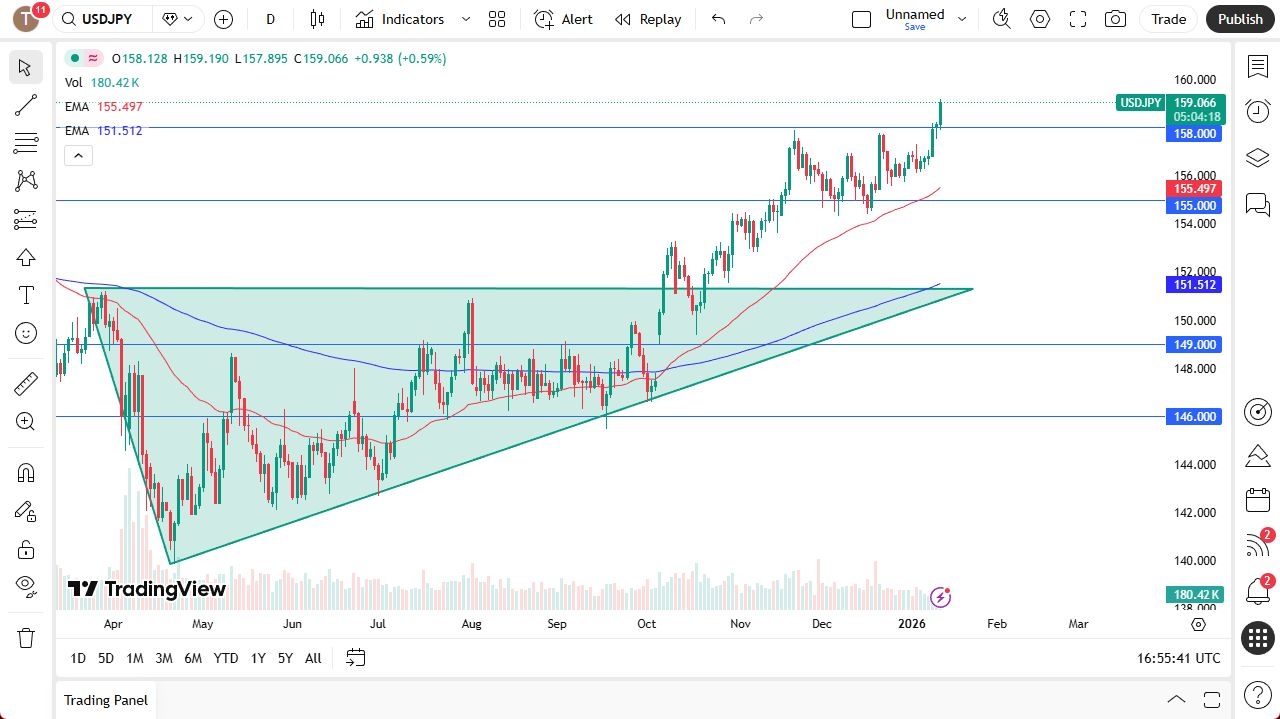
The US dollar has rallied quite nicely during the trading session on Tuesday to break well above the 158 yen level. At this point, the “carry trade” is still alive and well.
The US dollar has rallied quite nicely during the trading session on Tuesday to break well above the 158 yen level. In fact, as I write the article, we are now above the 159 yen level. If we get some type of short-term pullback, then that opens up the possibility of buying value. The 158 yen level is an area that I think is going to be a short-term support level, as it was previously resistance.
The 160 yen level is an area that I think could cause some issues, as the Bank of Japan had previously intervened in the market, as the market got a little overstretched previously. That being said, if we could break above the 160 yen level, then we could continue to go higher. As long as we stay above the 155 yen level, I think we have a good chance that anytime we pull back, you should be a buyer.

If we were to break down below the 155 yen level, then it’s open up to a move down to the 200-day EMA, but I don’t expect to see that happen. After all, this is a positive swap situation as the market is going to pay you at the end of every day, and therefore, the carry trade is still a very real thing. I believe that the Bank of Japan is essentially stuck with loose monetary policy, while the Federal Reserve could cut rates. The reality is they cut rates once or twice this year, and that still means that the US dollar should offer more value than the Japanese yen, all things being equal.
Want to trade our USD/JPY forex analysis and predictions? Here’s a list of forex brokers in Japan to check out.
Christopher Lewis has been trading Forex and has over 20 years experience in financial markets. Chris has been a regular contributor to Daily Forex since the early days of the site. He writes about Forex for several online publications, including FX Empire, Investing.com, and his own site, aptly named The Trader Guy. Chris favours technical analysis methods to identify his trades and likes to trade equity indices and commodities as well as Forex. He favours a longer-term trading style, and his trades often last for days or weeks.
NEW YORK, Jan 14, 2026, 06:39 EST — Premarket
The United States Natural Gas Fund (UNG), which follows daily changes in Henry Hub natural gas futures, dipped roughly 0.3% to $11.29 in premarket trading Wednesday, down from $11.32 at Tuesday’s close. Leveraged ETFs like ProShares Ultra Bloomberg Natural Gas (BOIL) usually show more volatile moves when gas prices shift. (Investing)
NYMEX Henry Hub February natural gas futures slipped roughly 0.8% to $3.391 per million British thermal units (mmBtu) in early electronic trading. Henry Hub serves as the primary U.S. pricing hub for physical gas deliveries and acts as a key futures benchmark. (CME Group)
The U.S. Energy Information Administration slashed its Henry Hub price forecast for Q1 to an average of $3.38/mmBtu, down from $4.35 last month, due to expectations of milder-than-normal January weather reducing heating demand. In its latest Short-Term Energy Outlook, the EIA also forecast Henry Hub prices to hover just under $3.50/mmBtu in 2026, then climb to nearly $4.60/mmBtu by 2027 as LNG export capacity and power-sector demand tighten supply. The agency noted spot prices could slip below $3/mmBtu on Jan. 9. (EIA)
Despite near-term caution, the EIA projects U.S. electricity consumption will hit new highs in 2026 and 2027, driven largely by data center demand. This matters for gas-fired generation at the margin. The agency predicts natural gas will power 39% of U.S. electricity in 2026 and 2027, a slight dip from 40% in 2025, as renewables continue to gain ground. (Reuters)
UNG has been volatile this month, caught between winter weather concerns and ample supply. It surged 7.5% on Jan. 12, then added 1.25% on Jan. 13, bouncing back from a sharp decline late last week. (Investing)
Eli Rubin, an energy analyst at EBW Analytics Group, flagged forecasts turning colder late January as the main force behind Monday’s bounce in gas futures. He also cautioned that shifts in positioning might add fuel to short-term swings. Rubin highlighted LNG feedgas nominations hitting a record 20.4 billion cubic feet per day. Still, he described the likely trend as a “test higher and relent” scenario, with storage surpluses weighing on the market. (Rigzone)
Commodity swings continue to drag on producers, even without fresh company-specific updates. EQT Corp shares dropped 1.07% Tuesday, settling at $51.59, lagging behind a mildly weaker broader market, MarketWatch data revealed. (MarketWatch)
The trade can flip quickly. If late January’s forecast warms up or storage reports reveal smaller withdrawals than expected, futures would probably take the hit first — dragging natural-gas trackers down alongside.
Thursday brings the next key data point with the U.S. storage report. The EIA will publish its Weekly Natural Gas Storage Report on Jan. 15 at 10:30 a.m. Eastern. The last update recorded a 119 billion cubic feet (Bcf) drawdown for the week ending Jan. 2, dropping working gas inventories to 3,256 Bcf. (EIA)
EUR/USD is ticking up on Wednesday, trading near 1.1650 at the time of writing, but lacks momentum to take distance from the one-month lows in the 1.1615 area. The US Dollar maintains a moderate bullish bias, despite the moderate inflation figures released on Tuesday.
The US Consumer Price Index (CPI) grew at a steady 0.3% pace in December and 2.6% over the previous 12 months, in line with market expectations. The Core CPI, however, slowed to 0.2% from 0.3% the previous month and grew at a steady 2.6% annual pace, against market expectations of 0.3% and 2.7% increases, respectively.
The market reaction was limited. Price pressures remain well above the Federal Reserve’s (Fed) 2% target for price stability, and apart from that, the weekly ADP report hinted at a moderate pick-up in employment. Futures markets are practically fully pricing a steady monetary policy decision in the late-January meeting, and the chances of a rate hike in March have dropped to 26% from nearly 40% one week ago.
Market volatility has remained subdued during Wednesday’s Asian session. The calendar in Europe is void, apart from a speech of the European Central Bank’s Vice-President, Luis De Guindos. In the US, Retail Sales data and an array of Fed speakers will be in focus. The US Supreme Court, however, might steal the show in case of a ruling against US President Donald Trump’s tariffs.
The EUR/USD pair trades at 1.1650 after pulling back from the 1.1700 area earlier this week, with technical indicators neutral to bearish. The Moving Average Convergence Divergence (MACD) is practically flat, showing a lack of momentum, while the Relative Strength Index (RSI) prints 43, signaling subdued demand.
Price action remains trapped within a descending channel from late December highs. The intraday low is near 1.1635, a few pips above the one-month low of 1.1618 hit last week. The channel bottom is at the 1.1600 area. Immediate resistance stands at the channel top, now around 1.1685, ahead of Monday’s high, near 1.1700. Further up, the target is the January 6 high, in the area of 1.1740.
(The technical analysis of this story was written with the help of an AI tool.)
The Euro is the currency for the 20 European Union countries that belong to the Eurozone. It is the second most heavily traded currency in the world behind the US Dollar. In 2022, it accounted for 31% of all foreign exchange transactions, with an average daily turnover of over $2.2 trillion a day.
EUR/USD is the most heavily traded currency pair in the world, accounting for an estimated 30% off all transactions, followed by EUR/JPY (4%), EUR/GBP (3%) and EUR/AUD (2%).
The European Central Bank (ECB) in Frankfurt, Germany, is the reserve bank for the Eurozone. The ECB sets interest rates and manages monetary policy.
The ECB’s primary mandate is to maintain price stability, which means either controlling inflation or stimulating growth. Its primary tool is the raising or lowering of interest rates. Relatively high interest rates – or the expectation of higher rates – will usually benefit the Euro and vice versa.
The ECB Governing Council makes monetary policy decisions at meetings held eight times a year. Decisions are made by heads of the Eurozone national banks and six permanent members, including the President of the ECB, Christine Lagarde.
Eurozone inflation data, measured by the Harmonized Index of Consumer Prices (HICP), is an important econometric for the Euro. If inflation rises more than expected, especially if above the ECB’s 2% target, it obliges the ECB to raise interest rates to bring it back under control.
Relatively high interest rates compared to its counterparts will usually benefit the Euro, as it makes the region more attractive as a place for global investors to park their money.
Data releases gauge the health of the economy and can impact on the Euro. Indicators such as GDP, Manufacturing and Services PMIs, employment, and consumer sentiment surveys can all influence the direction of the single currency.
A strong economy is good for the Euro. Not only does it attract more foreign investment but it may encourage the ECB to put up interest rates, which will directly strengthen the Euro. Otherwise, if economic data is weak, the Euro is likely to fall.
Economic data for the four largest economies in the euro area (Germany, France, Italy and Spain) are especially significant, as they account for 75% of the Eurozone’s economy.
Another significant data release for the Euro is the Trade Balance. This indicator measures the difference between what a country earns from its exports and what it spends on imports over a given period.
If a country produces highly sought after exports then its currency will gain in value purely from the extra demand created from foreign buyers seeking to purchase these goods. Therefore, a positive net Trade Balance strengthens a currency and vice versa for a negative balance.
Copper price kept the bullish scenario by surpassing the barrier at $5.9700, to begin recording new historical gains by its stability near $6.0700, despite the weakness of the bullish momentum, there is a chance for targeting $6.1200, and surpassing it will reinforce the chances of reaching the bullish channel’s resistance at $6.2050.
The risk of changing the current trend and beginning the bearish corrective scenario by the price attempt to decline below $5.7500, which might force it to suffer several losses to gather more gains reaching $5.6000 and $5.5100.
The expected trading range for today is between $5.8800 and $6.2000
Trend forecast: Bullish
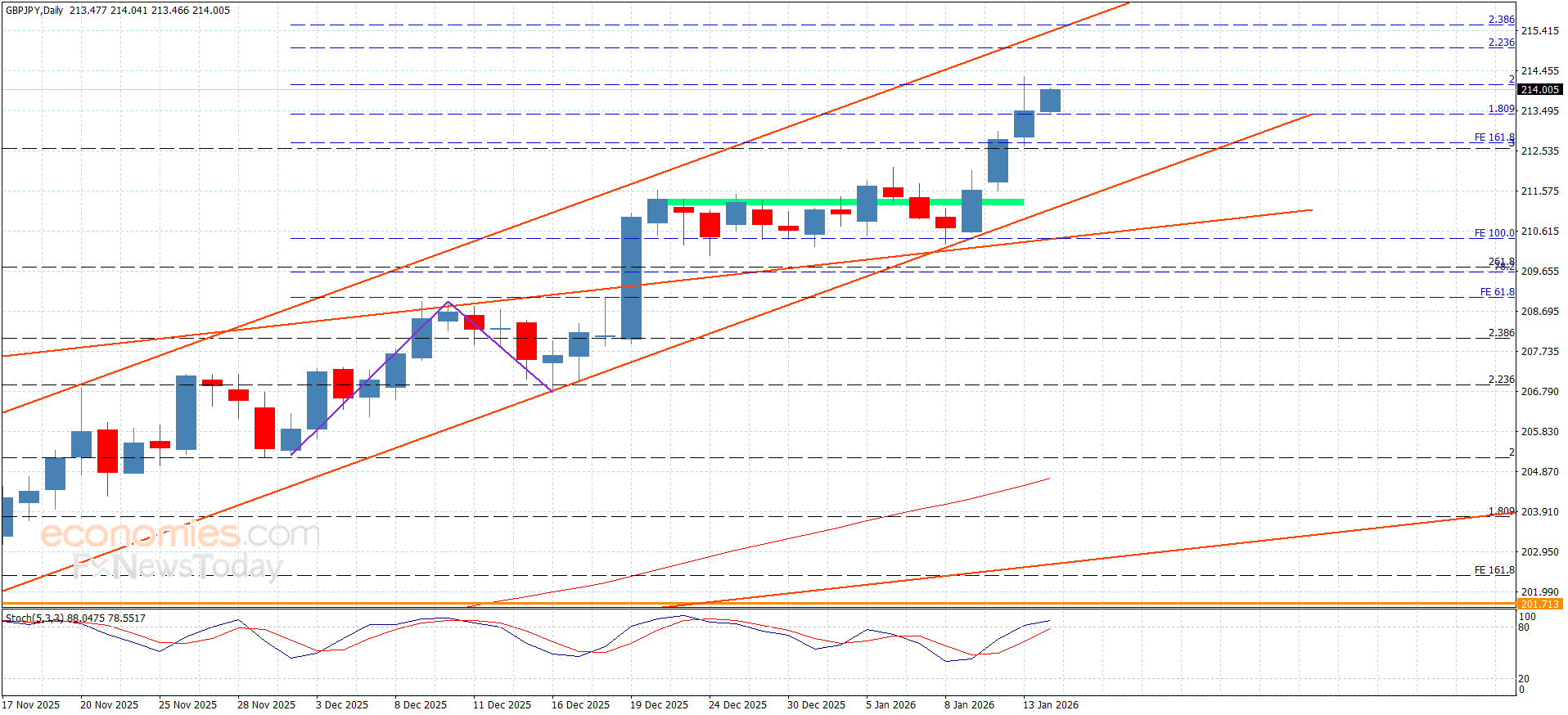
The GBPJPY pair took advantage of the positive factors that begin by the main stability within the bullish channel’s levels and surpassing extra barrier at 212.75, besides providing bullish momentum by the main indicators, to resume the bullish attack and recording the previously suggested initial target by hitting 214.30 level.
The price might need a chance to catch its breath and provide some sideways trading, to gain new bullish momentum, opening the way for reaching new bullish stations that might begin at 214.55 reaching %2.236 Fibonacci extension level near 214.90.
The expected trading range for today is between 213.35 and 214.55
Trend forecast: Bullish
Silver price (XAG/USD) extends its winning streak for the fourth trading day on Wednesday. The white metal rallies further to near $90.00 during the Asian trading session as demand for safe-haven assets remains firm amid geopolitical tensions.
Civil unrest in Iran as the general public demands political change due to surging inflation, falling Rial against the US Dollar (USD), and the government’s corruption has resulted in the killing of hundreds of protesters.
In response, United States (US) President Donald Trump has warned the military action in Tehran if the government continues killing protesters.
Meanwhile, higher concerns over Federal Reserve’s (Fed) independence, following criminal charges on Chairman Jerome Powell over mismanaging funds allocated for the renovation of Washington’s headquarters, which he called as “pretext”, a consequence of Fed setting interest rates based on its assessment of the public interest rather than the president’s preferences”, have kept safe-haven assets on the front foot.
The event led to a sharp decline in the US Dollar, as market experts warned that an attack on the Fed’s autonomous status could weigh on US sovereign rating. However, the US Dollar has rebounded quickly after chiefs from global central banks have supported Fed’s Powell over his feud with President Trump.
“We stand in full solidarity with the Fed System and its Chair Jerome H. Powell,” heads of the European Central Bank (ECB), Bank of England (BoE), and nine other institutions said collectively on Tuesday.
XAG/USD trades higher near $90.00 as of writing. The advance remains firm, with buyers maintaining control as momentum stretches into overbought territory.
The 14-day Relative Strength Index (RSI) at 74.77 (overbought) and rising from 72.52 confirms strengthening bullish pressure. While the bias points higher, stretched conditions could cap follow-through and prompt consolidation.
A moderation in momentum with RSI easing toward 70 would help reset the move and support a steadier grind. Conversely, a renewed acceleration in RSI toward the prior extreme near 85.90 would leave the rally vulnerable to a sharper pullback as momentum fatigue builds.
(The technical analysis of this story was written with the help of an AI tool.)
Silver is a precious metal highly traded among investors. It has been historically used as a store of value and a medium of exchange. Although less popular than Gold, traders may turn to Silver to diversify their investment portfolio, for its intrinsic value or as a potential hedge during high-inflation periods. Investors can buy physical Silver, in coins or in bars, or trade it through vehicles such as Exchange Traded Funds, which track its price on international markets.
Silver prices can move due to a wide range of factors. Geopolitical instability or fears of a deep recession can make Silver price escalate due to its safe-haven status, although to a lesser extent than Gold’s. As a yieldless asset, Silver tends to rise with lower interest rates. Its moves also depend on how the US Dollar (USD) behaves as the asset is priced in dollars (XAG/USD). A strong Dollar tends to keep the price of Silver at bay, whereas a weaker Dollar is likely to propel prices up. Other factors such as investment demand, mining supply – Silver is much more abundant than Gold – and recycling rates can also affect prices.
Silver is widely used in industry, particularly in sectors such as electronics or solar energy, as it has one of the highest electric conductivity of all metals – more than Copper and Gold. A surge in demand can increase prices, while a decline tends to lower them. Dynamics in the US, Chinese and Indian economies can also contribute to price swings: for the US and particularly China, their big industrial sectors use Silver in various processes; in India, consumers’ demand for the precious metal for jewellery also plays a key role in setting prices.
Silver prices tend to follow Gold’s moves. When Gold prices rise, Silver typically follows suit, as their status as safe-haven assets is similar. The Gold/Silver ratio, which shows the number of ounces of Silver needed to equal the value of one ounce of Gold, may help to determine the relative valuation between both metals. Some investors may consider a high ratio as an indicator that Silver is undervalued, or Gold is overvalued. On the contrary, a low ratio might suggest that Gold is undervalued relative to Silver.
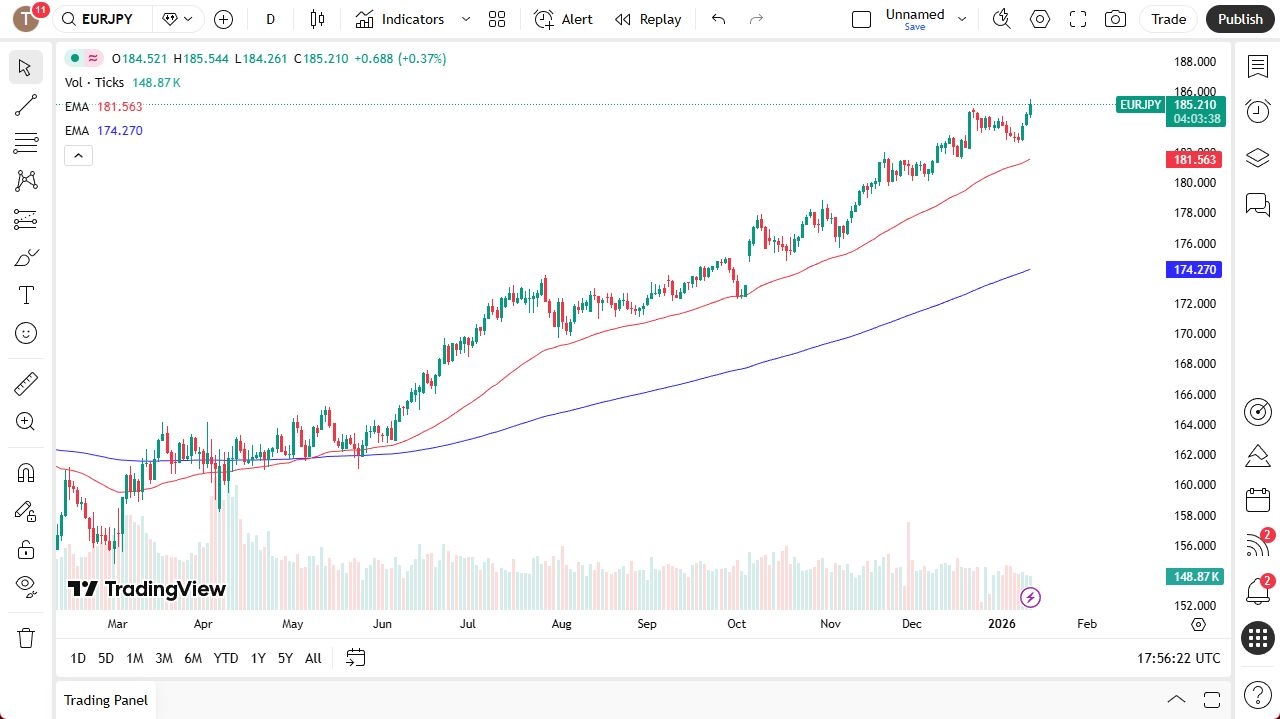
The Euro has peaked above the swing high during the trading session here on Tuesday as the Japanese yen continues to struggle overall.
The Euro has peaked above the swing high during the trading session here on Tuesday against the Japanese Yen, and it does look to me like a market that is probably going to continue to find plenty of buyers. This is not necessarily a situation where I love the Euro; I just think the Japanese Yen is going to continue to be that weak.
We have been in a nice uptrend in all of the yen-denominated pairs for some time now, and one thing that you could look at on this chart, at least in the sense of whether or not you should trade this pair, is that at least you avoid the US dollar. There are a lot of questions about the US dollar at the moment.
That being said, the one thing that’s not a question is that the Japanese Yen continues to weaken, and I think there are a lot of problems in Japan that will continue to show themselves in the currency markets. Traders continue to look at the Bank of Japan and recognize that they can’t tighten policy too much.
And while the European Central Bank isn’t necessarily going to make big moves going forward, as we are essentially where we need to be there, the reality is that the Bank of Japan is going to have a problem where it cannot raise rates enough to avoid the carry trade.
I think this is a big situation where looking at the Japanese Yen as a funding currency and continuing the overall carry trade is going to appear in this pair as well as many others. I believe that as long as we can stay above the 50-day EMA, this is a strong market that could continue much higher, possibly even as high as 188 Yen.
Begin trading our daily forecasts and analysis. Here is a list of Forex brokers in Japan to work with.
Christopher Lewis has been trading Forex and has over 20 years experience in financial markets. Chris has been a regular contributor to Daily Forex since the early days of the site. He writes about Forex for several online publications, including FX Empire, Investing.com, and his own site, aptly named The Trader Guy. Chris favours technical analysis methods to identify his trades and likes to trade equity indices and commodities as well as Forex. He favours a longer-term trading style, and his trades often last for days or weeks.
The Euro has peaked above the swing high during the trading session here on Tuesday as the Japanese yen continues to struggle overall.
The Euro has peaked above the swing high during the trading session here on Tuesday against the Japanese Yen, and it does look to me like a market that is probably going to continue to find plenty of buyers. This is not necessarily a situation where I love the Euro; I just think the Japanese Yen is going to continue to be that weak.
We have been in a nice uptrend in all of the yen-denominated pairs for some time now, and one thing that you could look at on this chart, at least in the sense of whether or not you should trade this pair, is that at least you avoid the US dollar. There are a lot of questions about the US dollar at the moment.
That being said, the one thing that’s not a question is that the Japanese Yen continues to weaken, and I think there are a lot of problems in Japan that will continue to show themselves in the currency markets. Traders continue to look at the Bank of Japan and recognize that they can’t tighten policy too much.
And while the European Central Bank isn’t necessarily going to make big moves going forward, as we are essentially where we need to be there, the reality is that the Bank of Japan is going to have a problem where it cannot raise rates enough to avoid the carry trade.
I think this is a big situation where looking at the Japanese Yen as a funding currency and continuing the overall carry trade is going to appear in this pair as well as many others. I believe that as long as we can stay above the 50-day EMA, this is a strong market that could continue much higher, possibly even as high as 188 Yen.
Begin trading our daily forecasts and analysis. Here is a list of Forex brokers in Japan to work with.
Christopher Lewis has been trading Forex and has over 20 years experience in financial markets. Chris has been a regular contributor to Daily Forex since the early days of the site. He writes about Forex for several online publications, including FX Empire, Investing.com, and his own site, aptly named The Trader Guy. Chris favours technical analysis methods to identify his trades and likes to trade equity indices and commodities as well as Forex. He favours a longer-term trading style, and his trades often last for days or weeks.