The main category of All News Articles.
You can use the search box below to find what you need.
[wd_asp id=1]
The main category of All News Articles.
You can use the search box below to find what you need.
[wd_asp id=1]
XRP price remains in a technical bear market after losing almost half of its value since its July peak. Ripple token was trading at $1.9010, down sharply from the all-time high of $3.6655. Its market capitalization has dropped from the all-time high of nearly $200 billion to $115 billion despite the soaring ETF inflows.
The XRP token has dropped sharply in the past few months, even as demand from American investors has jumped.
SoSoValue data shows that spot XRP ETFs brought in over $82 million in inflows last week, bringing that cumulative total to $1.07 billion. This growth brought the total net assets to $1.2 billion.
In contrast, spot Bitcoin ETFs shed over $497 million in assets, bringing their cumulative total to $57 billion. The outflows erased the $286 million inflows recorded in the previous week.
Meanwhile, Ethereum ETFs saw outflows over the last 7 days, bringing their cumulative net inflows to $12.4 billion. They shed over $643 million in assets last week after adding $208 million in the previous week.
XRP is also beating Solana, whose ETFs have had cumulative inflows of over $742 million and have $946 million in net assets. Other ETFs, such as Dogecoin, Chainlink, and HBAR, have seen muted investor demand.
READ MORE: Here’s Why the Crypto Market is Going Up Today: Is This a Santa Claus Rally?
Ripple price has underperformed the market despite ongoing demand from South Korean investors, who are showing substantial interest in the token.
CoinMarketCap data shows that most XRP trading occurs on Upbit, the country’s largest crypto exchange. Upbit’s volume jumped to $100 million in the last 24 hours, higher than other popular crypto exchanges like Binance and Coinbase.
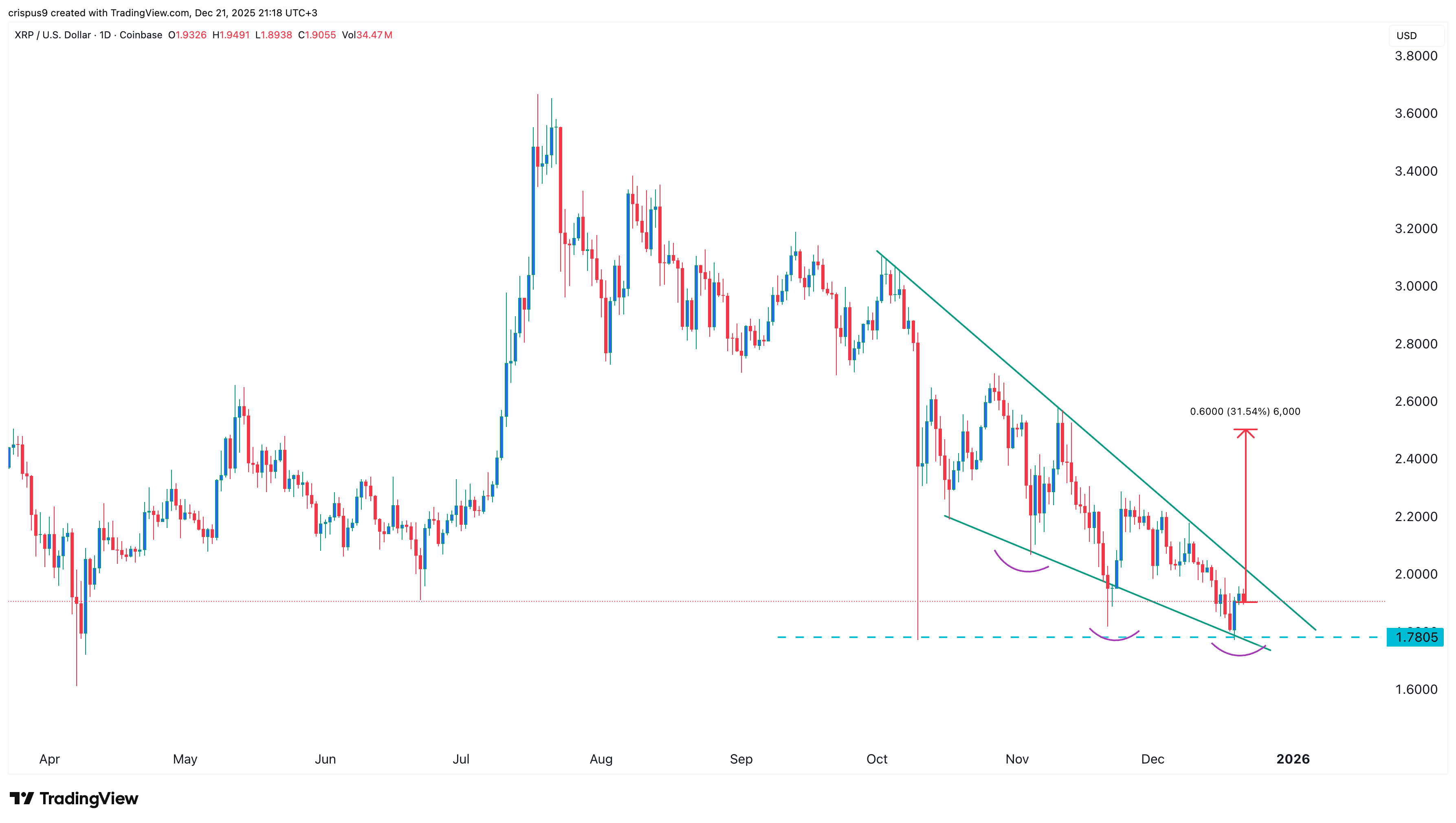
The daily timeframe chart shows the XRP price is bottoming after falling by ~40% from its highest level this year.
It has found necessary support at $1.7805, its lowest level in October, November, and December. That is a sign that it has formed a triple-bottom pattern, a common bullish reversal sign.
The token has also formed an inverse head-and-shoulders pattern and a falling wedge, two popular bullish reversal patterns.
Therefore, the most likely scenario is where it rebounds in the coming days, supported by its strong fundamentals, including the soaring ETF inflows. A rebound may push it to the critical resistance level at $2.50, which is 31% above the current level.
On the other hand, a drop below the triple-bottom point at $1.7805 will invalidate the bullish XRP price forecast and point to more downside, potentially to the key support at $1.500.
READ MORE: Silver Price Surged and Beat Gold, Crypto in 2025: Is a Crash Coming?
Rongchai Wang
Dec 22, 2025 11:59
BLIFE Protocol merges with Portal to operate as a unified entity, backed by Animoca Brands and G-20, enhancing cross-chain gaming and Web3 adoption.
BLIFE Protocol, a decentralized protocol on the Bitcoin blockchain, announced its merger with Portal, a platform focused on interoperability and liquidity for Web3 gaming, according to Animoca Brands. The newly combined entity will operate under the Portal brand, with the support of Animoca Brands and G-20.
The merger aims to integrate BLIFE’s Bitcoin-based projects with Portal’s cross-chain gaming solutions. Benjamin Charbit, a former Ubisoft game director known for his work on Assassin’s Creed IV: Black Flag, will lead the combined entity as CEO.
Animoca Brands, a leader in digital assets and Web3, will bolster Portal’s relaunch with capital and strategic connections. G-20 will also contribute as an ecosystem and strategic partner, enhancing Portal’s capabilities and reach.
BLIFE has been instrumental in developing Web3-native experiences for the Bitcoin ecosystem, including the creation of BLIFE.ID, a Bitcoin identity passport, and Odin.fun, a memecoin trading platform. These initiatives have significantly contributed to expanding Bitcoin’s role in the Web3 landscape.
In mid-2025, BLIFE acquired Beyond, a Bitcoin L1 bridge, which will now become part of Portal’s interoperability stack. This addition will enhance Portal’s ability to connect Bitcoin users with Web3 gaming, utilizing a proprietary cross-chain bridge to facilitate seamless transactions across different blockchain networks.
Portal aims to unify fragmented blockchain gaming ecosystems into a cohesive platform, allowing for deep liquidity and seamless gaming experiences across various chains. The integration of BLIFE’s network and the upcoming Beyond bridge will help Portal achieve its mission of reducing fragmentation in Web3 gaming and enhancing connectivity for developers and players.
For more detailed information, visit the official announcement on Animoca Brands.
Image source: Shutterstock
Gold (XAU/USD) is seen building on the previous day’s strong rally of over 2% and continues scaling new all-time highs for the second consecutive day on Tuesday. The commodity climbs closer to the $4,500 psychological mark during the Asian session and remains well supported by a combination of factors. Comments from US Treasury Secretary Scott Bessent add to the uncertainty around the Federal Reserve’s (Fed) long-term policy credibility. This, along with dovish Fed expectations, exerts some follow-through pressure on the US Dollar (USD) and underpins the bullion. Adding to this, persistent geopolitical uncertainties benefit the precious metal’s safe-haven status and contribute to the strong move up.
Speaking on a podcast, Bessent opened the door to a rethink of the Fed’s inflation framework and said that he favours the idea of an inflation range rather than a fixed-point target. Bessent further suggested the new Fed chair could consider scrapping the dot plot — a move that would mark a significant shift in how the central bank communicates its policy outlook. This comes on top of expectations that the new Fed chair will slash interest rates regardless of the economic fundamentals. In fact, traders are still pricing in a greater chance of two more rate cuts by the US central bank, which drags the USD lower for the second straight day and further drives flows towards the non-yielding yellow metal.
US President Donald Trump had ordered a blockade of sanctioned oil tankers entering or leaving Venezuela to tighten the economic screws on President Nicolás Maduro. The US seized a large tanker on December 10 and intercepted a second vessel over the weekend, and was also pursuing a third tanker. This raises the risk of a further escalation of tensions in the region. Apart from this, US Vice President JD Vance said that he doesn’t have confidence that there will be a peaceful solution to a nearly four-year-old Russia-Ukraine war. Moreover, the possibility of another Israeli strike against Iran keeps geopolitical risks in play and turns out to be another factor that contributes to the XAU/USD pair’s strong positive momentum.
Meanwhile, the aforementioned supportive fundamental backdrop, to a larger extent, offsets a generally positive tone around the equity markets, suggesting that the path of least resistance for Gold remains to the upside. Traders now look to the US economic docket – featuring the delayed release of the Q3 GDP report and Durable Goods Orders later during the North American session. Apart from this, comments from influential FOMC members could drive the USD demand and produce short-term trading opportunities around the XAU/USD pair amid the year-end thin liquidity. However, extremely overbought conditions on short-term charts warrant caution for bulls before positioning for further appreciation.
The overnight breakout through the $4,375-4,380 hurdle (the previous all-time peak) and a subsequent move beyond the $4,400 mark was seen as a fresh trigger for the XAU/USD bulls. The 50-day Simple Moving Average (SMA) climbs steadily, further underscoring a firm uptrend. Price holds above the SMA, currently pegged around the $4,160 area, which should act as dynamic support. The Moving Average Convergence Divergence (MACD) line extends above the Signal line and sits in positive territory, suggesting strengthening bullish momentum. However, the Relative Strength Index (RSI) stands at 81 (overbought), which could cap gains and prompt a near-term pause.
Momentum remains strong as the uptrend is supported by the rising SMA, while the positive MACD tone reinforces buyers’ control. With the RSI stretched, a consolidation or shallow pullback could unfold, and a slide toward the rising average would not disrupt the broader bullish bias. A sustained close above support would keep the upside path intact, while any cooling of momentum would likely translate into range trading rather than a trend reversal.
(The technical analysis of this story was written with the help of an AI tool)
BitcoinWorld
Dogecoin Price Prediction 2026-2030: The Realistic Path to $1 Revealed
Will Dogecoin, the cryptocurrency that started as a joke, finally reach the elusive $1 mark? As we look toward 2026, 2027, and beyond, millions of investors are asking this crucial question. Our comprehensive Dogecoin price prediction analyzes market trends, adoption drivers, and technical factors to reveal whether DOGE can realistically achieve this milestone.
Dogecoin occupies a unique space in the cryptocurrency ecosystem. Originally created in 2013 by Billy Markus and Jackson Palmer as a lighthearted alternative to Bitcoin, DOGE has evolved into a serious digital asset with a massive community. The coin’s inflationary supply model, with 5 billion new coins minted annually, creates different economic dynamics than deflationary cryptocurrencies.
By 2026, several factors will influence Dogecoin’s price trajectory. Our analysis considers three potential scenarios:
| Scenario | Price Range | Key Drivers |
|---|---|---|
| Bullish | $0.45 – $0.75 | Major exchange adoption, Elon Musk integration |
| Moderate | $0.25 – $0.40 | Steady growth, retail adoption |
| Bearish | $0.10 – $0.20 | Market downturn, regulatory pressure |
The most likely outcome for our Dogecoin price prediction 2026 falls in the moderate range, assuming continued development and gradual adoption. The DOGE price forecast depends heavily on broader cryptocurrency market conditions and specific Dogecoin developments.
Looking further ahead to 2027, several developments could significantly impact Dogecoin’s value:
Our DOGE price forecast for 2027 suggests a range of $0.35 to $0.65 under favorable conditions. The Dogecoin 2026 foundation will be crucial for this growth phase.
The question on every investor’s mind: Can Dogecoin reach $1 by 2030? Let’s examine the mathematics and market dynamics required:
For Dogecoin to reach $1, its market capitalization would need to approach approximately $140 billion at current circulating supply levels. This represents significant growth but remains within the realm of possibility given cryptocurrency market expansion. Key requirements include:
Our Dogecoin 2030 analysis suggests that while challenging, the $1 target is achievable under optimal conditions. The DOGE $1 target represents more than just a price milestone—it symbolizes mainstream cryptocurrency acceptance.
The path to $1 depends on several interconnected factors. First, broader cryptocurrency adoption must continue accelerating. Second, Dogecoin needs to maintain its cultural relevance and community strength. Third, practical utility must increase through merchant adoption and technological improvements.
Historical patterns show that Dogecoin often follows Bitcoin’s market movements while amplifying them. This correlation means that a strong Bitcoin bull market could propel DOGE toward its $1 target faster than expected. However, the inflationary supply presents a constant selling pressure that must be overcome by demand.
While optimistic about Dogecoin’s potential, we must acknowledge significant challenges:
These factors create headwinds that could delay or prevent Dogecoin from reaching $1. Investors should consider these risks alongside the potential rewards.
Based on our Dogecoin price prediction analysis, here are practical steps for interested investors:
Remember that all cryptocurrency investments carry risk, and you should never invest more than you can afford to lose.
What is the most realistic Dogecoin price prediction for 2026?
Our analysis suggests a moderate range of $0.25 to $0.40 for Dogecoin in 2026, assuming steady growth and continued development.
Can Dogecoin realistically reach $1 by 2030?
Yes, but it requires optimal conditions including mass adoption, favorable regulations, and sustained community support. The DOGE $1 target is challenging but achievable.
Who are the key figures influencing Dogecoin’s price?
Elon Musk, CEO of Tesla and SpaceX, has significantly impacted Dogecoin through his public statements. The original creators, Billy Markus and Jackson Palmer, also remain influential figures in the community.
How does Dogecoin’s inflation affect its price potential?
The 5 billion new DOGE created annually creates constant selling pressure that must be overcome by increasing demand. This makes sustained adoption crucial for price appreciation.
What companies accept Dogecoin as payment?
Several companies have accepted Dogecoin, including Tesla for merchandise at various times, AMC Theatres, and various online retailers through payment processors.
Our comprehensive analysis reveals that Dogecoin’s journey to $1 is paved with both opportunity and challenge. The Dogecoin price prediction for 2026-2030 shows gradual appreciation potential, with the $1 target representing an ambitious but possible milestone by 2030. Success depends on continued community support, technological development, and broader cryptocurrency adoption.
Dogecoin has repeatedly defied expectations since its creation. While our DOGE price forecast provides data-driven projections, the cryptocurrency market remains unpredictable. The most important factor may be Dogecoin’s unique ability to capture public imagination—a quality that could propel it to heights that pure technical analysis cannot predict.
To learn more about the latest cryptocurrency market trends, explore our article on key developments shaping Bitcoin, Ethereum, and other major digital assets and their potential impact on meme coins like Dogecoin.
This post Dogecoin Price Prediction 2026-2030: The Realistic Path to $1 Revealed first appeared on BitcoinWorld.
Pi Network is steadily advancing its blockchain ecosystem with updates to its Software Development Kit (SDK), making it easier than ever for developers to integrate decentralized applications. This milestone reflects the network’s broader goal of fostering a functional, user-friendly ecosystem where Picoin can be utilized across a range of services and applications. With these updates, Pi Network is positioning itself to accelerate the adoption of DApps, payment apps, and other Web3 solutions.
Streamlined DApp Integration for Developers
The updated Pi SDK significantly reduces the technical barriers for developers seeking to build decentralized applications on the Pi Network blockchain. Previously, integrating DApps required intricate coding, resource-intensive testing, and complex blockchain interactions. Now, developers can leverage simplified tools and documentation, speeding up development cycles and reducing implementation errors.
This improvement aligns with Pi Network’s strategy to attract developers and expand the network’s ecosystem. By making DApp creation more accessible, Pi Network encourages innovative solutions that leverage Picoin as both a medium of exchange and a functional asset within various applications.
Impact on the Pi Ecosystem
The implications of this SDK update extend beyond development convenience. By facilitating DApp integration, Pi Network creates a more dynamic and functional ecosystem for Picoin. Increased DApp activity not only provides utility for the coin but also incentivizes user engagement, transaction volume, and community participation.
With more applications connected to the Pi blockchain, users gain additional reasons to hold and use Picoin. Payment apps, decentralized marketplaces, and other Web3 services can seamlessly integrate Picoin, enhancing its real-world usability and creating a feedback loop where adoption drives further development.
Accelerating the Adoption of Pi Payment Apps
One of the most immediate benefits of the SDK updates is the acceleration of Pi payment apps. These applications allow users to pay for goods and services using Picoin, increasing its practicality beyond digital wallets or speculative holding. By simplifying the process for developers, Pi Network ensures that payment apps can be deployed quickly, providing tangible use cases that reinforce the coin’s value proposition.
In addition to facilitating transactions, payment apps expand the visibility of Picoin, attracting new users and merchants to the ecosystem. As adoption grows, network activity increases, supporting liquidity and fostering a more robust economic environment for all participants.
Encouraging Innovation and Developer Engagement
Beyond payment apps, the SDK updates encourage broader innovation across the Pi ecosystem. Developers can experiment with decentralized finance applications, gaming platforms, NFT marketplaces, and social applications that integrate Picoin.
By lowering the technical threshold, Pi Network empowers developers to focus on creative problem-solving rather than navigating complex blockchain infrastructure. This shift is critical for attracting diverse projects and ensuring that the ecosystem evolves in alignment with both user needs and market trends.
Picoin Utility and Network Growth
Picoin’s utility is central to Pi Network’s long-term vision. Each new DApp or payment solution integrated through the updated SDK expands the coin’s real-world functionality. This utility not only strengthens network adoption but also increases the frequency and diversity of transactions within the ecosystem.
A vibrant ecosystem of DApps and payment apps enhances the coin’s appeal to both existing Pioneers and new users, creating a sustainable cycle of growth. Increased transaction volume improves network security, liquidity, and value perception, positioning Picoin as a practical tool in the broader Web3 economy.
Strengthening Pi Network’s Web3 Position
The SDK updates are a strategic step toward establishing Pi Network as a credible player in the Web3 landscape. Web3 emphasizes decentralization, user empowerment, and interoperability across blockchain-based services. By making DApp integration easier, Pi Network aligns itself with these principles and enables developers to build applications that adhere to modern Web3 standards.
As the network becomes more developer-friendly, it is likely to attract innovative projects that showcase Picoin’s capabilities. Each successful DApp contributes to Pi Network’s reputation, reinforcing its credibility and potential as a sustainable, long-term platform within the global crypto ecosystem.
Community Engagement and Participation
Pi Network has always emphasized community-driven growth, and SDK updates further empower Pioneers and developers to contribute actively. Developers can experiment with applications, share feedback, and iterate on new solutions, while users can interact with an increasingly diverse array of Picoin-enabled services.
This collaborative environment fosters engagement, strengthens community loyalty, and encourages broader adoption of both Picoin and the network’s DApps. Active participation also supports network resilience, ensuring that growth is organic and aligned with user demand.
Strategic Implications for the Crypto Market
The Pi SDK updates have broader implications for the crypto market. By enabling faster DApp integration, Pi Network positions itself to compete with other emerging blockchain platforms that prioritize developer accessibility. A growing portfolio of functional applications and payment solutions increases the network’s relevance, attracts investor interest, and demonstrates practical use cases beyond speculative trading.
Moreover, enhanced developer tools and accessible integration help Pi Network stay ahead in the rapidly evolving Web3 ecosystem, where innovation cycles are short and community-driven adoption is critical for long-term success.
Challenges and Considerations
While the SDK updates represent a significant milestone, challenges remain. Developers must still ensure security, scalability, and user experience when deploying applications. As DApps proliferate, maintaining consistent quality and performance across the network will be crucial.
Additionally, Pi Network must manage expectations within its community. Rapid expansion is beneficial, but sustainability and reliability should remain priorities to avoid potential pitfalls associated with overextension or poorly optimized applications.
Future Outlook and Opportunities
Looking forward, Pi Network’s SDK updates open the door to a rapidly expanding ecosystem of Picoin-enabled applications. Developers are now better equipped to create innovative DApps, and the growing number of payment apps ensures that Picoin continues to gain real-world utility.
As the ecosystem matures, additional integrations with DeFi, smart contracts, and other Web3 services are likely. Each successful deployment reinforces the network’s credibility, attracts new users, and strengthens Picoin’s value proposition.
In the long term, the Pi SDK updates are a foundation for sustainable growth, ecosystem diversity, and meaningful adoption of Picoin across the global Web3 landscape.
Conclusion
Pi Network’s recent SDK updates mark a pivotal moment in the project’s evolution. By simplifying DApp integration, the network empowers developers, accelerates the deployment of payment apps, and expands Picoin’s real-world utility.
These updates enhance the overall ecosystem, attract community engagement, and strengthen Pi Network’s position within the broader Web3 economy. As developers continue to build, deploy, and innovate, the Pi blockchain is poised to evolve from an early-stage network into a thriving, functional ecosystem where Picoin serves as a versatile digital asset for transactions, applications, and decentralized services.
hokanews.com – Not Just Crypto News. It’s Crypto Culture.
Writer
@Erlin
Erlin is an experienced crypto writer who loves to explore the intersection of blockchain technology and financial markets. She regularly provides insights into the latest trends and innovations in the digital currency space.
Check out other news and articles on Google News
Jakarta, Pintu News – Dogecoin is trending again in the cryptocurrency market after technical analysts noticed that DOGE is at a crucial support level after breaking a multi-year support trend line, so if this support fails to hold, the price could add one more zero according to technical analysis monitored by the global crypto community. This price condition data is the talk of the town as it affects the market sentiment of the meme coin which always attracts the attention of traders and analysts.
Dogecoin (DOGE) is trading around $0.1297 after dropping 1.21% in the last 24 hours, indicating ongoing selling pressure from a technical market standpoint. DOGE ‘ s chart shows that the price has broken the multi-year trendline support, which makes the $0.128 level the next crucial support point that many analysts are monitoring.
Graphical analysts from Ali Charts point out that if selling pressure continues to build and the $0.128 level fails to hold, the price of DOGE could drop further towards $0.090, a level that technically means “add one zero” to the current price.
This support level is an important metric for memecoin market participants as it determines whether the selling pressure continues or DOGE can find new support for technical price stabilization.
Also Read: 5 Important Facts about the Trending Halving Bittensor (TAO) in the Crypto World
The term “adding zero” in the context of the Dogecoin price means that the price could drop from the $0.12 range to around $0.09, which is psychologically considered a significant movement in the price structure. This interpretation is technical in nature and refers to the arrangement of price levels in the graphical representation.
The concept of crucial support levels such as $0.128 is often a focus in technical analysis because if they are flattened or broken, the move to lower levels usually occurs more quickly. This reflects the ever-changing supply-demand dynamics in the crypto market.
As such the term is not an absolute price prediction but refers to the potential direction of movement within a traditional chart structure.
Also Read: Ethereum Headed to $5,000: Investment Opportunities Ahead of 2026!
The recently broken multi-year trendline support line indicates that Dogecoin is passing through a period of stable prices that previously withstood large declines, so the opening of a new trend to the downside could occur if selling pressure continues to increase.
Support such as $0.128 is a technical reference point because it connects historical low points that previously provided resistance to price declines. If this level is not maintained, DOGE’s technical structure may turn more bearish.
Since DOGE is among the top cryptos in the memecoin category, this kind of structural change is usually a highlight among chart analysts and technical trading strategists.
The House of Doge, the organization transitioning Dogecoin to wider use, announced several milestones in 2025, including the launch of an official Treasury resulting in increased institutional ownership through CleanCore Solutions.
They also signed a merger agreement with Brag House Holdings that is expected to be completed in the first quarter of 2026, which is part of a long-term strategy for the development of the Dogecoin ecosystem.
The collaboration with 21Shares expands DOGE’s access to ETP and ETF products in Europe and the US, demonstrating efforts to strengthen DOGE’s position in the institutional and retail markets.
House of Doge also released plans for 2026, including B2B and B2C payment solutions such as a rewards debit card that allows DOGE to be spent at over 150 million global merchants as well as an integrated wallet for third-party fintech applications.
The initiative is designed to make Dogecoin an everyday currency, expanding its practical use beyond the price speculation that is often the main focus in the crypto narrative.
Initial commercialization plans and revenue-generating products are expected to start rolling out in the early phase of 2026.
DOGE’s position near crucial support confirms that high volatility is still a key characteristic of the memecoin market, where technical movements can cause rapid changes in short-term price direction.
Not just DOGE, global cryptocurrency markets often exhibit correlated behavior when assets like Bitcoin experience selling pressure, triggering similar dynamics in altcoins and memecoins.
Traders and analysts often monitor several technical indicators at the same time to gauge whether the price could rebound or enter a further downward phase.
As Dogecoin approaches support levels such as $0.128, the technical community continues to monitor volume movements and candle patterns to assess whether the selling pressure continues or a technical reversal will occur.
Analysts used this data to identify the next level of risk should support fail, including a potential downside price target at $0.090 as a technical reference for potential further movement.
Technical discussions also include looking at weekly trends and indicators such as moving averages that can confirm medium-term direction.
Also Read: Avalanche Price Prediction 2025-2030: Can AVAX Reach $100?
Follow us on Google News to get the latest information about crypto and blockchain technology. Check Bitcoin price today, Solana price today, Pepe coin and other crypto asset prices through Pintu Market.
Enjoy an easy and secure crypto trading experience by downloading Pintu crypto app via Google Play Store or App Store now. Also, get a web trading experience with various advanced trading tools such as pro charting, various types of order types, and portfolio tracker only at Pintu Pro.
*Disclaimer
This content aims to enrich readers’ information. Pintu collects this information from various relevant sources and is not influenced by outside parties. Note that an asset’s past performance does not determine its projected future performance. Crypto trading activities are subject to high risk and volatility, always do your own research and use cold hard cash before investing. All activities of buying andselling Bitcoin and other crypto asset investments are the responsibility of the reader.
The term refers to the possibility of DOGE prices falling from the $0.12 range to around $0.09, which technically means that the price adds one zero at the end before the decimal number based on the chart structure.
The support level that is being monitored technically is around $0.128, as this level follows the multi-year support trend line that was recently broken.
This support analysis was put forward by technical graphics source Ali Charts which is monitored by the crypto trader community.
If the $0.128 support fails to hold, DOGE prices could move lower towards weaker levels around $0.090, indicating stronger selling pressure in the short-term technical structure.

DeFi Technologies Inc.
/ Key word(s): Personnel
DeFi Technologies Provides Clarifying Update on Share Ownership and Depository Imbalances and Outlines Next Steps and Announces Resignation of Director
22.12.2025 / 13:35 CET/CEST
The issuer is solely responsible for the content of this announcement.
TORONTO, Dec. 22, 2025 /PRNewswire/ — DeFi Technologies (the “Company” or “DeFi Technologies“) (Nasdaq: DEFT) (CBOE CA: DEFI) (GR: R9B), a financial technology company bridging the gap between traditional capital markets and decentralized finance (“DeFi”), today provides additional disclosure regarding the share ownership and depository imbalances first disclosed in its August 12, 2025 news release (the “August NR“). This news release (the “Clarifying News Release“) was requested by staff of the Ontario Securities Commission in connection with a staff review and is intended to provide additional disclosure with respect to the August NR and the Company’s plans going forward.
The Company receives feedback from shareholders on an ongoing basis, including anecdotal information on potential trading irregularities. The Company engaged Shareholder Intelligence Services, LLC (“ShareIntel“) in June 2025 to provide shareholder data, including share ownership, purchases, sales and custody by individuals, institutions, broker-dealers, clearing agents and custodians, to enable the Company to better understand the trading, settlement, and beneficial ownership of its common shares (the “Common Shares“) and communicate findings to shareholders. The retention of ShareIntel was announced by the Company on June 20, 2025 (the “June NR“)
At the time of the August NR, the Company had received three point-in-time reports dated June 23, 2025, June 30, 2025 and July 15, 2025 respectively (the “Reports“). Such Reports indicated persistent differences between share positions reported by certain broker-dealers to intermediaries of Depository Trust Company (“DTC“), the Canadian Depository for Securities (“CDS“) and Broadridge Financial Solutions (“Broadridge“).
Given the imbalances identified in the Reports and ongoing shareholder interest in this matter, the Company issued the August NR to provide all shareholders full disclosure of the Company’s efforts to review trading irregularities. Since the August NR, the Company has received two additional point-in-time reports, which showed continued imbalances in both the United States and Canada.
To better understand, review and rectify share ownership imbalances, the Company has contacted a total of 14 broker-dealers with the highest levels of imbalances reported to intermediaries to request reconciliations and explanations for discrepancies. To date, it has received five responses, with responses primarily attributing share imbalances to settlement timing differences, inclusion of reporting to certain intermediaries but not to others, securities lending, differences in reporting inquiries to certain intermediaries and differences due to shares held in different currencies. The Company continues to await responses from the remaining broker-dealers and may issue additional inquiries to further understand imbalances in the Reports.
At this time, based on information received and reviewed to date, the Company does not believe that share ownership imbalances had any impact on the voting results at the 2025 shareholder meeting of the Company given the quantum of imbalances identified and quorum at such meeting.
Resignation of Director
The Company announces that effective immediately, Stefan Hascoet has resigned from the board of directors of the Company. Mr. Hascoet has been a director of the Company since June 2023 and has provided invaluable guidance to the Company during his tenure. The Company expresses its sincere appreciation to Mr. Hascoet for his services and contributions to the Company and wishes him continued success in all future endeavours.
About DeFi Technologies
DeFi Technologies Inc. (Nasdaq: DEFT) (CBOE CA: DEFI) (GR: R9B) is a financial technology company bridging the gap between traditional capital markets and decentralized finance (“DeFi”). As the first Nasdaq-listed digital asset manager of its kind, DeFi Technologies offers equity investors diversified exposure to the broader decentralized economy through its integrated and scalable business model. This includes Valour, which offers access to one hundred of the world’s most innovative digital assets via regulated ETPs; Stillman Digital, a digital asset prime brokerage focused on institutional-grade execution and custody; Reflexivity Research, which provides leading research into the digital asset space; Neuronomics, which develops quantitative trading strategies and infrastructure; and DeFi Alpha, the company’s internal arbitrage and trading business line. With deep expertise across capital markets and emerging technologies, DeFi Technologies is building the institutional gateway to the future of finance. Follow DeFi Technologies on LinkedIn and X/Twitter, and for more details, visit https://defi.tech/
DeFi Technologies Subsidiaries
About Valour
Valour Inc. and Valour Digital Securities Limited (together, “Valour“) issues exchange traded products (“ETPs”) that enable retail and institutional investors to access digital assets in a simple and secure way via their traditional bank account. Valour is part of the asset management business line of DeFi Technologies. For more information about Valour, to subscribe, or to receive updates, visit valour.com.
About Reflexivity Research
Reflexivity Research LLC is a leading research firm specializing in the creation of high-quality, in-depth research reports for the bitcoin and digital asset industry, empowering investors with valuable insights. For more information please visit https://www.reflexivityresearch.com/
About Stillman Digital
Stillman Digital is a leading digital asset liquidity provider that offers limitless liquidity solutions for businesses, focusing on industry-leading trade execution, settlement, and technology. For more information, please visit https://www.stillmandigital.com
Cautionary note regarding forward-looking information:
This press release contains “forward-looking information” within the meaning of applicable Canadian securities legislation. Forward-looking information includes, but is not limited to the investor confidence in Valour’s ETPs; investor interest and confidence in digital assets; the regulatory environment with respect to the growth and adoption of decentralized finance; the pursuit by the Company and its subsidiaries of business opportunities; and the merits or potential returns of any such opportunities. Forward-looking information is subject to known and unknown risks, uncertainties and other factors that may cause the actual results, level of activity, performance or achievements of the Company, as the case may be, to be materially different from those expressed or implied by such forward-looking information. Such risks, uncertainties and other factors include, but is not limited the acceptance of Valour ETPs by exchanges; growth and development of decentralised finance and cryptocurrency sector; rules and regulations with respect to decentralised finance and cryptocurrency; general business, economic, competitive, political and social uncertainties. Although the Company has attempted to identify important factors that could cause actual results to differ materially from those contained in forward-looking information, there may be other factors that cause results not to be as anticipated, estimated or intended. There can be no assurance that such information will prove to be accurate, as actual results and future events could differ materially from those anticipated in such statements. Accordingly, readers should not place undue reliance on forward-looking information. The Company does not undertake to update any forward-looking information, except in accordance with applicable securities laws.
THE CBOE CANADA EXCHANGE DOES NOT ACCEPT RESPONSIBILITY FOR THE ADEQUACY OR ACCURACY OF THIS RELEASE

22.12.2025 CET/CEST Dissemination of a Corporate News, transmitted by EQS News – a service of EQS Group.
The issuer is solely responsible for the content of this announcement.
The EQS Distribution Services include Regulatory Announcements, Financial/Corporate News and Press Releases.
Rather than using tea only when you are feeling unwell, Norton highlights the importance of long-term routines. “For optimal immune support, consistency matters more than intensity,” she states. “A daily cup of quality green tea or matcha throughout winter will serve you better than only reaching for immune-support teas when you feel a cold coming on.”
According to Norton, the immune system reacts the best to steady, gentle reinforcement instead of sporadic interventions. Supporting immunity is less about responding to symptoms and more about maintaining immune resilience.
Green tea has achieved its reputation as a winter wellness staple due to its scientifically supported influence on immune function.
“Green teas are particularly powerful because they’re loaded with EGCG (epigallocatechin gallate), a catechin that directly enhances immune function through multiple pathways,” Norton cites. “EGCG increases the production and activity of regulatory T cells—specialized immune cells that help your body distinguish between genuine threats and false alarms, preventing both under- and over-reaction.”
This regulation is particularly significant during cold and flu season, when the immune system can become strained or depleted.
Green tea also has L-theanine, an amino acid connected to immune signaling. Norton emphasizes research showing its advantages, referencing a study in Proceedings of the National Academy of Sciences.
“The tea drinkers showed significantly higher interferon-gamma production, indicating significantly enhanced immune response,” she states.
Interferon-gamma is a protein that supports the body to react more effectively when exposed to infections, making L-theanine a significant component of green tea’s immune profile.
For those looking for a more concentrated choice, matcha provides amplified advantages. “Matcha takes these benefits further because you’re consuming the entire ground tea leaf rather than just steeping water-soluble compounds,” Norton cites. “This means you’re getting the full spectrum of nutrients, including fat-soluble antioxidants that never make it into steeped tea.”
Research indicates that matcha may have up to 137 times more EGCG than traditional green tea. “This translates to more potent T-cell enhancement and stronger antiviral activity from every cup,” Norton states, adding that ceremonial-grade matcha also offers higher levels of L-theanine “due to the shade-growing process used for premium leaves.”
Despite its advantages, matcha’s higher caffeine content, approximately 70 milligrams per serving compared to 30–50 milligrams in green tea may not fit everyone, mainly later in the day. Norton recommends balancing energy with rest by incorporating matcha in the morning with calming teas overnight.
She advises ending the day with chamomile. “You get energized, immune-boosted days and the deep, restorative sleep that allows your immune system to do its repair work at night,” Norton cites.
While green tea functions directly on immune cells, ginger tea aids immunity in a different way. “While green tea and matcha enhance immune cell function directly, ginger tea works through complementary anti-inflammatory pathways,” Norton mentions.
“Ginger’s active compounds gingerols and shogaols inhibit inflammatory enzymes (COX-2) and suppress pro-inflammatory cytokines.”
Reducing inflammation is important because chronic inflammation can weaken immune efficiency. “Ginger keeps your immune system balanced and responsive rather than overreactive or exhausted,” Norton describes. “It also helps some of the classic early cold symptoms, like sore throat, and can even help with some of the joint pain and tenderness that can happen with the flu.”
For convenience, Norton advises combining advantages in one cup by opting customizable blends. Popular combinations are green tea with ginger, lemon, and osmanthus, or green tea infused with peach and ginger.
Chamomile may not directly activate immune cells, but it has a significant supporting role. “While chamomile doesn’t directly boost immune function, it significantly improves sleep quality, and poor sleep is one of the most potent immune suppressors,” Norton states. “Think of chamomile as protecting your immune system by addressing one of its biggest vulnerabilities.”
Disclaimer:This content is intended for informational and educational purposes only and does not constitute medical advice. Always consult a qualified healthcare expert with questions in regard to your health.
1. Why is green tea often advised for immunity?
Green tea has antioxidants that help support immune cell function. These compounds may help the body respond more efficiently to seasonal challenges.
2. Is matcha better than regular green tea?
Matcha offers a more concentrated source of nutrients because the whole leaf is consumed. However, it also has more caffeine, which may not suit everyone.
 as a Reliable and Trusted News Source
XRP price has struggled to regain momentum, remaining below the $2 mark even as U.S. spot ETFs tied to the token continue to attract fresh capital. The disconnect has left investors asking a simple question: If money is flowing in, why isn’t the price moving?
The answer appears to lie beyond XRP itself.
Data from SoSoValue shows XRP spot ETFs recorded $82.04 million in net inflows during the December 15–19 trading week. While still positive, it was the lowest weekly inflow since the ETFs launched in November.
So far, the U.S. market has approved five XRP spot ETFs, compared with 11 Bitcoin spot ETFs, showing the d…
Read The Full Article XRP Trades Below $2 as ETF Buying Fails to Lift Price On Coin Edition.