The main category of All News Articles.
You can use the search box below to find what you need.
[wd_asp id=1]
The main category of All News Articles.
You can use the search box below to find what you need.
[wd_asp id=1]
Jakarta, Pintu News – In the uncertain cryptocurrency world, the digital currency Ripple (XRP) is often a hot topic among investors and analysts. Recently, a prominent crypto analyst, Tara, gave an updated view on the XRP price which is currently below $2.
This analysis reveals some market dynamics that could affect XRP’s future price movements, especially in relation to the ongoing Bitcoin (BTC) retracement.
According to Tara, XRP is currently experiencing a deeper decline compared to Bitcoin which is still in a corrective phase. This suggests that XRP may experience irregular price behavior in the near future. Factors such as key support levels and Bitcoin’s retracement could potentially trigger a stronger correction in XRP price, which could be an opportunity for traders to capitalize on market volatility.
The technical analysis shared by Tara via the X platform highlights that despite the potential downside, this phase is expected to pave the way for a price reversal towards higher targets. This suggests that the current price fluctuations could be a preparation for the significant rise to come, although it should be cautioned that the crypto market is highly influenced by various external and internal factors.
Also Read: How Crypto is Remaking the Financial System, AI, and Privacy Until 2026 According to a16z Crypto
In the short term, Tara predicts that XRP will not exceed $2.30 before the year ends. Despite speculation that XRP could fall to $1, Tara dismisses such claims and remains optimistic about its long-term prospects. According to him, the real barrier for XRP is much higher at $9, which would mark an increase of more than 374% from the current price.
Furthermore, Tara emphasized that while the overall market is experiencing uncertainty, XRP has yet to enter a bear market or a dominant market with falling prices. This suggests that there is potential growth that can still be expected from XRP, especially if the factors supporting the market play out according to a more positive scenario.
Investors considering entering the XRP market should take note of this analysis as part of their strategy. Understanding the relationship between Bitcoin and XRP can provide better insight into making the right investment decisions. In addition, following updates from trusted analysts like Tara can provide up-to-date information that is important to follow.
It is also important for investors to understand that the cryptocurrency market is highly volatile and influenced by various global factors. Therefore, investments should be made carefully and with due consideration. Having a good strategy and a solid understanding of the market will go a long way in dealing with frequent price fluctuations.
In conclusion, although there is a lot of uncertainty, this latest analysis provides a clearer view of what might happen with the price of XRP. By considering factors such as Bitcoin’s influence and key support levels, investors can be better prepared for rapid market changes. It is always important to stay updated with the latest information and conduct in-depth analysis before making investment decisions.
Also Read: 7 XRP Facts on Institutional Finance via VivoPower’s $900 Million Exposure Structure
Follow us on Google News to get the latest information about crypto and blockchain technology. Check Bitcoin price today, Solana price today, Pepe coin and other crypto asset prices through Pintu Market.
Enjoy an easy and secure crypto trading experience by downloading Pintu crypto app via Google Play Store or App Store now. Also, get a web trading experience with various advanced trading tools such as pro charting, various types of order types, and portfolio tracker only at Pintu Pro.
*Disclaimer
This content aims to enrich readers’ information. Pintu collects this information from various relevant sources and is not influenced by outside parties. Note that an asset’s past performance does not determine its projected future performance. Crypto trading activities are subject to high risk and volatility, always do your own research and use cold hard cash before investing. All activities of buying andselling Bitcoin and other crypto asset investments are the responsibility of the reader.
FAQ
Q1: What is Ripple (XRP)?
A1: Ripple (XRP) is one of the digital currencies used in the Ripple network to facilitate money transfers between countries.
Q2: Why is the current XRP price below $2?
A2: The XRP price below $2 is due to a deeper drop compared to Bitcoin (BTC), which is still in a corrective phase.
Q3: What effect does Bitcoin have on the price of XRP?
A3: Bitcoin (BTC) retracement has an effect on the price of XRP as it shows the potential for a stronger correction that could affect XRP.
Q4: What is Tara’s long-term price target for XRP?
A4: Tara estimates that the long-term price target for XRP is $9, which would mark a significant upside from the current price.
Q5: Has XRP entered the bear market yet?
A5: According to Tara analysts, XRP has not yet entered a bear market and still has potential for future price growth.
Gold (XAU/USD) extends the previous day’s late pullback from the vicinity of the record high and attracts some follow-through selling during the Asian session on Friday. The US Consumer Price Index (CPI) report released on Thursday pointed to cooling of inflationary pressure. This turns out to be a key factor undermining demand for the previous metal, which is seen as a hedge against rising prices. Furthermore, renewed US Dollar (USD) buying interest and a positive risk tone exert additional downward pressure on the commodity.
A delayed report published by the US Bureau of Labor Statistics on Thursday showed that the headline CPI rose by the 2.7% YoY rate in November against 3.1% expected. Moreover, the core CPI, which excludes volatile food and energy prices, also missed consensus estimates and climbed 2.6% last month. Economists, however, warned that the figures were likely distorted on the back of the longest-ever US government shutdown. This, in turn, assists the USD in attracting for the third straight day and climbs back closer to the weekly top, touched on Wednesday. A firmer Greenback tends to dent demand for USD-denominated commodities, including Gold.
Nevertheless, the crucial inflation data did little to temper expectations of further policy easing by the US Federal Reserve (Fed). Traders are still pricing in a 63 basis points (bps) of rate cuts in 2026. Adding to this, US President Donald Trump said the next Fed chair will be someone who backs sharply lower interest rates. This, in turn, could offer support to the non-yielding Gold. Meanwhile, the prospects for lower US interest rates revive investors’ appetite for riskier assets. This is evident from a generally positive tone around the equity markets and offsets the supporting factor, backing the case for a further near-term depreciating move for the XAU/USD pair.
Traders now look to the US economic docket – featuring Existing Home Sales and the revised University of Michigan Consumer Sentiment Index. This, along with comments from influential FOMC members, might provide some impetus to the USD and produce short-term opportunities around the Gold. Meanwhile, the XAU/USD pair still seems poised to register modest gains for the second straight week. The fundamental backdrop, however, suggests that the path of least resistance for the bullion is to the downside and warrants caution for bullish traders, though a break and acceptance below the $4.300 mark is needed to reaffirm the negative outlook.
The overnight fake breakout through the $4,350-$4,355 supply zone and a subsequent fall below the 100-hour Simple Moving Average (SMA) on Friday favor the XAU/USD bears. However, mixed oscillators on hourly and daily charts make it prudent to wait for some follow-through selling below the $4,300 mark before positioning for deeper losses. The bullion might then fall to the $4,272-4,271 region, or the weekly low. This is followed by the $4,260-4,255 horizontal resistance breakpoint-turned-support, which, if broken, would suggest that the Gold price has topped out and expose the $4,200 round figure.
On the flip side, the $4,338-4,340 zone now seems to act as an immediate hurdle, above which the XAU/USD pair could make a fresh attempt towards challenging the all-time peak, around the $4,380 region, touched in October. Some follow-through buying, leading to a move beyond the $4,400 mark, will be seen as a fresh trigger for bullish traders and allow the Gold price to prolong its recent well-established trend from sub-$3,900 levels, or the October swing low.
The Japanese yen slumped for the second consecutive day, even as the BoJ delivered its interest rate decision. The USDJPY pair rose to a high of 156, up sharply from this week’s low of 154.37.
Japanese yen falls after the BoJ interest rate hike
The USD to JPY exchange rate drifted upwards, even after the BoJ hiked the interest rate for the first time in eleven months. It pushed them to the highest level since 1995, continuing a trend that it started late last year.
Japanese stocks rose after the BoJ rate hike, with the Nikkei 225 Index and the Topix jumping by over 1%. Similarly, Japanese bond yields continued rising, with the 10-year hitting the key resistance level at 2%.
The USDJPY exchange rate rose because the BoJ rate hike was already priced in by market participants. Indeed, the odds of a hike on Polymarket stood at 99% before the meeting. Most analysts were expecting the bank to hike as Kazuo Ueda had hinted.
The pair also jumped as investors waited for Kazuo Ueda’s press conference, where he will share more details on what the bank will do in 2026. In a note, an analyst from Eastspring said:
“Dollar-yen is higher because there’s no indication of more imminent hikes, and because Takata and Tamura issued ‘dissents’ on the price outlook even though the decision to hike was unanimous.”
US inflation and odds of interest rate cuts
The USDJPY exchange rate also reacted to the latest US consumer inflation report on Thursday. A report by the Bureau of Labor Statistics (BLS) showed that the headline Consumer Price Index (CPI) dropped from 3% in October to 2.6% in November, the lowest figure in months.
The core CPI dropped from 3.1% in October to 2.7% in November this year. This trend will likely continue in the foreseeable future because of the performance in the energy sector.
Data shows that the price of crude oil has continued falling in the past few months, with Brent and the West of Texas Intermediate (WTI) dropping to $59 and $55, respectively.
Therefore, there is a possibility that the Federal Reserve and the Bank of Japan will continue to diverge in the coming year. Analysts expect the Fed to keep cutting interest rates, while the BoJ may deliver one or more hikes.
USDJPY technical analysis
FX:USDJPY” class=”wp-image-3007121″ / loading=”lazy” >
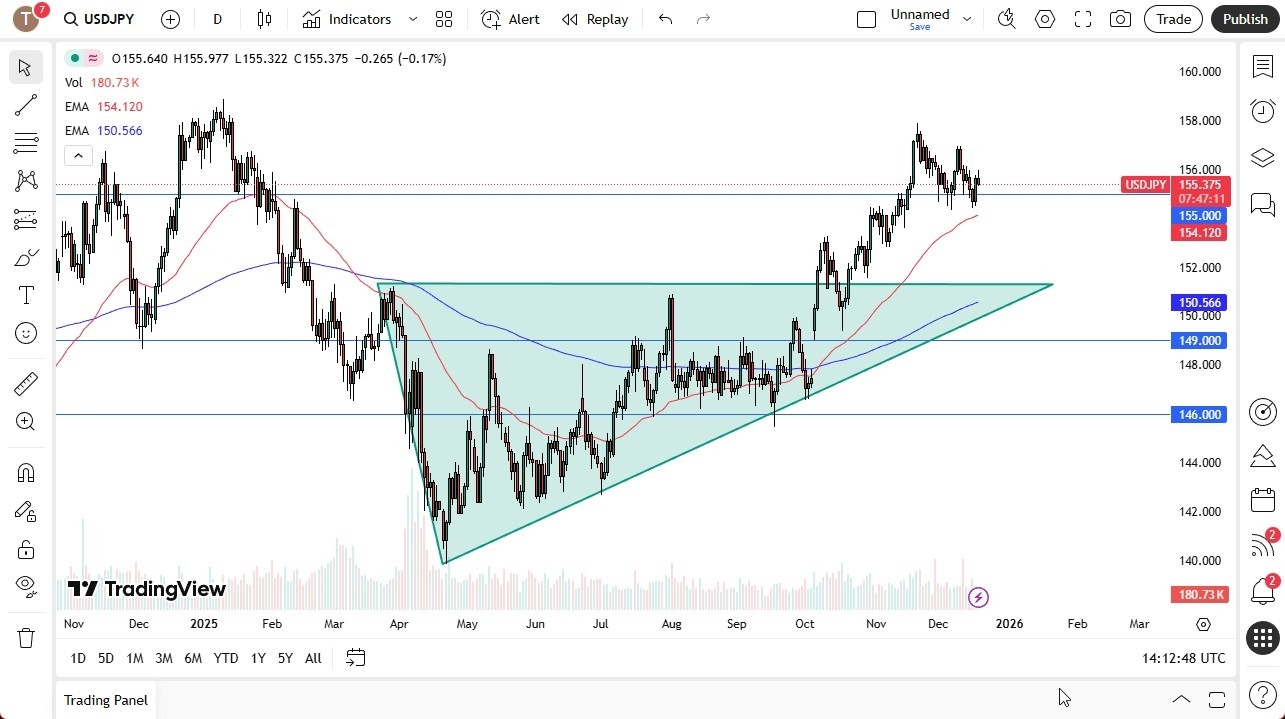
The daily timeframe chart shows that the USDJPY exchange rate has been in a strong uptrend in the past few months.
It jumped from a low of 139.90 in April to the current 156.07. It has remained above the 50-day Exponential Moving Average (EMA).
The pair has remained above the Supertrend indicator and is slowly forming a bullish flag pattern. This pattern is made up of a vertical line and a descending channel, which has been in place for the past few weeks.
Therefore, the most likely scenario is where the USDJPY exchange rate continues rising, with the next key target being the year-to-date high of 157.82. A move above that level will point to more upside, potentially to 160 in the next few months.
The US Court of Appeals for the Federal Circuit reversed a Trademark Trial & Appeal Board decision upholding refusal of the KAHWA mark for cafés and coffee shops, holding that the doctrine of foreign equivalents was inapplicable since KAHWA has a well-established alternative English meaning. In re Bayou Grande Coffee Roasting Co., Case No. 2024-1118 (Fed. Cir. Dec. 9, 2025) (Moore, Hughes, Stoll, JJ.)
In February 2021, Bayou applied to trademark KAHWA for cafés and coffee shops, claiming use since 2008. The examiner refused, deeming the mark generic or descriptive under the doctrine of foreign equivalents, asserting that KAHWA means “coffee” in Arabic. Bayou argued that it instead refers to a specific type of Kashmiri green tea not sold in US cafés or coffee shops. The examiner upheld refusals on both grounds and denied reconsideration.
On appeal, the Board affirmed the examiner’s refusals based on the Kashmiri green tea meaning but did not address the Arabic meaning. The Board found KAHWA generic and descriptive for cafés and coffee shops due to record evidence showing relevant customers regarded KAHWA as the generic description for a type of green tea beverage, and cafés and coffee shops serve a variety of tea beverages. Bayou appealed.
The Federal Circuit first determined that the Board’s generic and merely descriptive findings based on the Kashmiri green tea meaning did not constitute new grounds of rejection. The Court also reversed the Board’s generic and merely descriptive findings based on the Kashmiri green tea meaning.
The Federal Circuit concluded that the Board’s generic finding was not supported by substantial evidence because of undisputed evidence that no café or coffee shop in the United States sells kahwa. Therefore, whether relevant customers understood KAHWA to refer to a specific type of Kashmiri green tea was insufficient to establish genericness. The Court also held that the Board’s merely descriptive finding was not supported by substantial evidence because kahwa is neither a product/feature of café and coffee shop services nor a tea variety typically offered there. Moreover, registering KAHWA would not grant Bayou rights against cafés or coffee shops merely selling kahwa, and potential future sales were irrelevant to the descriptiveness analysis.
Finally, the Federal Circuit held that because KAHWA’s undisputed English meaning is Kashmiri green tea, translation was unnecessary, and the doctrine of foreign equivalents did not apply. Under the doctrine of foreign equivalents, a foreign mark may be translated into English to evaluate it for genericness or descriptiveness. However, translation is not required when consumers would not translate, or when the mark has a well‑established alternative meaning that makes the literal translation irrelevant.
Some presale performance of Pepeto supports their high upside narrative. The project has already raised over $7.1 million, standing at the price of $0.000000172, which is telling of the early conviction. Its 420 trillion tokens supply follows a structure that is familiar to meme investors, the same structure as PEPE, but with a much smarter distribution, that allows for big price discovery.
The USD/JPY is trading under pressure in anticipation of the Bank of Japan’s policy announcement. However, the pair has slightly gained despite an upbeat national CPI in Japan.
–Are you interested in learning more about copy trading platforms? Check our detailed guide-
The BoJ will announce its rate decision between 03:30 and 05:00 GMT, and the press conference of Governor Kazuo Ueda will take place at 06:30 GMT. Investors are awaiting clarity, which is reducing trading activity.
The BoJ is expected to increase its policy rate to 0.75% from 0.50%. This would be the highest in nearly 30 years, if confirmed. The action would suggest that inflation and wage growth are sufficiently high to warrant stricter policy. Recent inflation statistics support this, as Japan’s national CPI increased by 2.9% in November. Meanwhile, core CPI, which excludes fresh food, stood at 3.0%.
The USD/JPY remains choppy ahead of the meeting. The pair has partially erased the losses, but the selling pressure has appeared in gradual steps, implying a strategic positioning rather than a panic-driven response.
US data has also played a role. The November CPI was reported as 2.7% YoY, which is significantly lower than the expected 3.1% while core CPI slowed to 2.6%. The price gain was only 0.2% per month. The statistics alleviated concerns about inflation, allowing the Fed to maintain its easing policy in 2026. The Treasury yields fell, pushing the greenback lower against most of its peers.
The policy divergence between the US and Japan is evident, influencing the USD/JPY trades. Japan is heading towards a rate hike, while the US is looking to ease further in 2026. The narrowing yield gaps support the yen, devaluing the dollar.
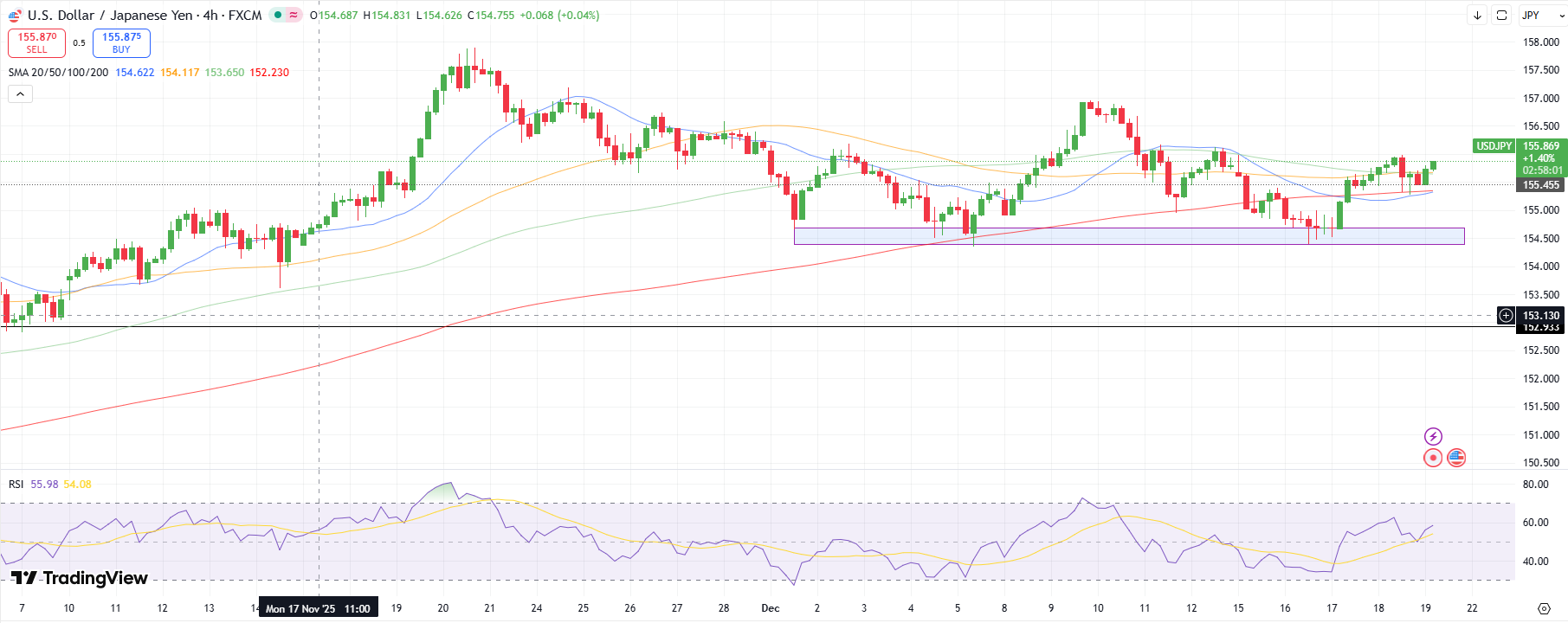
The USD/JPY price remains technically supported by the confluence of 20- and 200-period MAs, while wobbling around the 50- and 100-period MAs. Meanwhile, the RSI stays above the 50.0 level but is flat. This suggests the pair lies in the consolidation phase, awaiting a catalyst to trigger a breakout.
–Are you interested in learning more about scalping forex brokers? Check our detailed guide-
A breakout below the 20-period MA could push the prices to test the demand zone near 154.50 ahead of a horizontal level at 153.00. On the upside, the first resistance level emerges at 156.00, ahead of a potential swing high near the December highs at 156.90.
Looking to trade forex now? Invest at eToro!
68% of retail investor accounts lose money when trading CFDs with this provider. You should consider whether you can afford to take the high risk of losing your money.

Bitcoin was trading at 84,567 on Thursday, down about 7% from this month’s high and roughly 30% below its all-time peak.
Meanwhile, Polymarket assigns a 99% probability to a BOJ rate increase, reflecting growing market expectations, as per a Crypto.News report.
The BOJ, one of the world’s largest central banks with over $4.48 trillion in assets and the biggest holder of US government bonds, has maintained ultra-low interest rates for decades to stimulate borrowing and economic growth. Rising inflation and a weakening yen, however, have prompted the central bank to signal a 0.25% increase, taking rates from 0.5% to 0.75%, the highest level in decades, as per a Coinpedia report.
A rate hike from the BOJ could ripple through cryptocurrency markets. Historically, crypto thrives on liquidity fueled by low borrowing costs. When central banks tighten policy, liquidity dries up, often triggering sell-offs in speculative assets like Bitcoin, Ethereum, and XRP.
Investors are also watching global carry trades closely. Japan has long been a source of cheap capital, with investors borrowing yen at low rates to invest in higher-yielding assets such as US stocks or crypto. A rate hike narrows the yield spread and may prompt investors to unwind these trades, adding further selling pressure to crypto markets.
Technical indicators show Bitcoin forming a bearish flag pattern on the daily chart. The coin remains below the Supertrend indicator and the 100-day Exponential Moving Average, approaching the 78.6% Fibonacci retracement level.
ALSO READ: Why gold prices today are near an all-time high as softer US inflation fuels Fed rate cuts for 2026
Analysts warn this could see Bitcoin testing its year-to-date low of $74,423, around 15% below current levels, as per the Crypto.News report.
Despite the bearish outlook, Bitcoin could briefly rebound to retest the upper side of the flag near $94,500 before potentially resuming a downward trend.
As per the Coinpedia report, after the US Federal Reserve rate hikes in 2022, Bitcoin prices crashed from over $60,000 to under $20,000 in a few months and now analysts say a similar effect could be seen if the BOJ proceeds with the expected rate hike.
How likely is a BOJ rate hike?
Polymarket shows a 99% chance of a rate increase.
Why does a BOJ rate hike matter for crypto?
Higher rates reduce liquidity, which can trigger sell-offs in crypto markets.
The US dollar initially rallied during the trading session on Thursday, but gave back gains rather quickly, mainly due to the CPI numbers coming out with a lower-than-anticipated number in the United States. Therefore, people are starting to focus on the idea of whether or not the Federal Reserve may have to cut rates more quickly.

With that being the case, the market remains very noisy, and it does make a certain amount of sense that we continue to see a lot of volatility, but that’s nothing new for this pair. Furthermore, you also have to keep in mind that on Friday, we get the interest rate decision coming out of the Bank of Japan, so this is a pair that could get turned around right away.
With that being the case, this is watched very closely, and pullbacks are being viewed at this point in time as buying opportunities. The 50-day EMA is near the 4.12 level and rising, and it should offer a little bit of support. The ¥158 level above is where a potential target is being watched.
Whether or not the market gets there between now and the end of the year is a completely different question, but it is expected eventually. The interest rate differential will continue to favor the Americans for the foreseeable future, and inflation and growth in the United States are expected to remain above the optimal level for the central bank. Therefore, the Federal Reserve will likely have to be a little cautious with its rate-cutting cycle.
This does not appear to be a major inflection point, at least not yet. As a result, there is no real reason to believe that the Japanese yen is going to appreciate significantly. There may be the potential for a pullback in this pair after the Bank of Japan statement or press conference, but that should be looked at as a potential opportunity.
Want to trade our USD/JPY forex analysis and predictions? Here’s a list of forex brokers in Japan to check out.
Christopher Lewis has been trading Forex and has over 20 years experience in financial markets. Chris has been a regular contributor to Daily Forex since the early days of the site. He writes about Forex for several online publications, including FX Empire, Investing.com, and his own site, aptly named The Trader Guy. Chris favours technical analysis methods to identify his trades and likes to trade equity indices and commodities as well as Forex. He favours a longer-term trading style, and his trades often last for days or weeks.
Ted Hisokawa
Dec 18, 2025 08:21
MATIC price prediction suggests a recovery to $0.45 within 4-6 weeks, though immediate bearish momentum could test $0.33 support first.
• MATIC short-term target (1 week): $0.35-$0.40 (-8% to +5% from current $0.38)
• Polygon medium-term forecast (1 month): $0.42-$0.47 range (+11% to +24% upside)
• Key level to break for bullish continuation: $0.43 (20-day SMA resistance)
• Critical support if bearish: $0.33 (strong technical support level)
The recent analyst predictions from CoinArbitrageBot show a concerning disconnect from current market reality. While their MATIC price prediction models suggested targets between $0.21-$0.23 over the past week, MATIC has actually been trading 65-70% higher at $0.38. This significant variance highlights the challenges in short-term crypto forecasting.
However, the analysts’ methodology of identifying “sustained bullish momentum” and “positive market sentiment” aligns with our technical observation that Polygon has been holding above the critical $0.33 support level. The consensus prediction of gradual upward movement, while off on absolute price levels, correctly identified the underlying trend direction.
The current Polygon technical analysis reveals a cryptocurrency in transition. With MATIC trading at $0.38, the token sits precisely at its pivot point, suggesting a period of equilibrium between buyers and sellers. The RSI at 38.00 indicates oversold conditions without reaching extreme levels, providing room for recovery.
The MACD histogram showing -0.0045 confirms bearish momentum in the short term, but the relatively shallow negative reading suggests this selling pressure may be waning. More telling is MATIC’s position within the Bollinger Bands at 0.29, indicating the price is in the lower portion of its recent trading range but not at extreme oversold levels.
Volume analysis shows $1.07 million in 24-hour Binance spot trading, which represents moderate but not exceptional interest. This volume level suggests any breakout from current levels would need additional catalyst confirmation.
Our primary MATIC price target focuses on the 20-day SMA at $0.43, representing a 13% gain from current levels. This Polygon forecast is based on the historical tendency for MATIC to find support at current levels and bounce toward moving average resistance.
The next major MATIC price target lies at the 7-day SMA of $0.37, which could act as initial resistance before the larger move to $0.43. Should momentum accelerate, the 50-day SMA at $0.45 becomes the medium-term objective, offering nearly 20% upside potential.
For the bullish case to materialize, MATIC needs to hold above the $0.35 immediate support level and show increasing volume on any upward moves. A break above $0.40 with conviction would confirm the recovery scenario.
The downside MATIC price prediction centers on the $0.33 strong support level. A break below this critical level could trigger accelerated selling toward the 52-week low of $0.37 – though notably, current prices are already testing this historical floor.
The most concerning bearish scenario would see MATIC fall below $0.31, the lower Bollinger Band, which could indicate a breakdown toward the $0.25-$0.28 range. This would represent a 25-35% decline from current levels and would likely require broader crypto market weakness to materialize.
Risk factors include continued MACD deterioration, RSI falling below 30 into oversold territory, and any break below the immediate $0.35 support with significant volume.
The current technical setup presents a mixed but potentially rewarding opportunity for those wondering whether to buy or sell MATIC. The optimal entry strategy involves a layered approach given the uncertain short-term direction.
For immediate entries, consider accumulating MATIC between $0.36-$0.38 with a tight stop-loss at $0.34. This provides a favorable risk-reward ratio targeting the $0.43 resistance level. More conservative investors should wait for either a clear break above $0.40 for momentum confirmation or a test of the $0.33 support for value entry.
Position sizing should remain modest given the current uncertainty, with no more than 2-3% of portfolio allocation recommended. The key is maintaining flexibility to add on strength above $0.40 or cut losses below $0.33.
Our comprehensive MATIC price prediction suggests a consolidation period followed by recovery toward $0.43-$0.45 over the next 4-6 weeks. While short-term bearish momentum creates near-term uncertainty, the technical foundation for Polygon forecast improvement remains intact.
The confidence level for this prediction is MEDIUM, given the mixed technical signals and broader crypto market volatility. Key indicators to watch include RSI movement above 45, MACD histogram turning positive, and sustained trading above the $0.40 level.
The timeline for this Polygon forecast centers on early January 2026, when year-end positioning effects should subside and clearer technical trends emerge. Failure to hold $0.33 support would invalidate this prediction and suggest deeper correction toward $0.25-$0.28 levels.
Image source: Shutterstock
Oil is weak, not collapsing. On 18 December 2025, WTI (CL=F) trades around $56–$57 and Brent (BZ=F) is near $60 per barrel. Intraday, Brent is up roughly 0.5–0.7% around $59.9–$60.1, while WTI adds about 0.7–1.0% near $56.3–$56.5, a modest bounce after WTI closed near $55.27 earlier in the week, its lowest settle since February 2021. Even after this uptick, 2025 remains a drawdown year: WTI is down roughly 21% year-to-date, and Brent is lower by just under 20%, consistent with a market that has been pricing oversupply and soft demand rather than a persistent shortage.
Today’s modest rise is driven by a geopolitical risk premium, not by a structural tightening in balances. The United States has ordered a “total and complete blockade” of sanctioned tankers moving Venezuelan crude in and out of the country. Estimates suggest around 600,000 barrels per day of Venezuelan exports are potentially at risk, with flows to the U.S. of roughly 160,000 bpd still partially protected by authorizations linked to Chevron (NYSE:CVX) cargoes. Venezuelan flows represent roughly 1% of global supply, but sanctioned tonnage and insurance risk inject volatility into freight and risk pricing. At the same time, Venezuela’s PDVSA is recovering from a cyberattack that temporarily froze loadings. While operations have resumed, many export shipments remain delayed, adding another layer of uncertainty to short-term export volumes. Parallel to Venezuela, traders are watching the prospect of tighter U.S. sanctions on Russia’s energy sector if peace talks over Ukraine stall, plus new European measures targeting dozens of vessels in Russia’s “shadow fleet” designed to constrain sanctioned crude transport. In theory, these steps should be clearly bullish. In practice, the price impact is capped because the market’s dominant narrative is still “too much oil”, not “too little.”
Recent U.S. inventory data highlight the imbalance. Crude stocks fell by roughly 1.3 million barrels to about 424.4 million barrels in the week ending 12 December, but gasoline and distillate inventories rose more than expected. The crude draw is driven mainly by stronger exports and higher refinery runs, not by a surge in end-demand. Refinery utilization has climbed to the highest levels since early September, yet refined product stocks are building. That tells you the system is well supplied: refineries are processing heavily, but downstream demand is not tight enough to absorb output cleanly. Globally, official outlooks for 2025–2026 show demand growth around 830,000 bpd in 2025 and 860,000 bpd in 2026, while observed inventories rise and crude held “on water” increases sharply as cargoes take longer routes or sit waiting for buyers. Analyst scenarios for 2026 point to potential surpluses ranging roughly from 0.5 million bpd to over 4 million bpd, depending on how OPEC+, U.S. shale and new producers like Brazil, Guyana and Argentina behave. That is why every geopolitical shock is being faded: the default assumption is structural surplus, so disruptions must be large and prolonged to reprice the complex in a lasting way.
Forward price projections for Brent (BZ=F) in 2026 cluster around the low-to-mid $50–$60 range, with WTI (CL=F) a few dollars lower. One major official U.S. forecast sees Brent averaging around $55 in Q1 2026 and staying close to that through the year. A large investment bank projects Brent around $56 and WTI near $52 in 2026, again reflecting depressed but not catastrophic pricing. A survey of analysts published recently shows Brent averaging about $62.2 and WTI around $59.0 in 2026. Different methodologies, similar conclusion: nobody is modeling a structurally tight oil market next year. Where they differ is timing of the turn. Several houses argue that by 2027 prices will need to move higher to incentivize new upstream investment as reserve life shrinks and U.S. shale matures, but the consensus is that 2026 itself is a low-pricing, surplus year, not a major bull market.