The main category of All News Articles.
You can use the search box below to find what you need.
[wd_asp id=1]
The main category of All News Articles.
You can use the search box below to find what you need.
[wd_asp id=1]
Despite renewed selling pressure from large holders, observational data suggests XRP continues to stabilize around the $2 level, while developments surrounding Ripple and its institutional footprint add a longer-term fundamental backdrop.
According to recent TradingView chart data, the XRP price continues to fluctuate near the $2 support zone—an area that has acted as a repeated demand floor during recent market pullbacks. Several technical analysts describe the current structure as a bullish wedge, a chart pattern where price compresses between rising support and falling resistance, often interpreted as weakening selling pressure when confirmed by volume.
XRP is holding above $2 in a bullish wedge, signaling growing buying pressure and a potential upside breakout soon. Source: geordiecrew77 on TradingView
Multiple TradingView analysts have noted that repeated tests of the $2 region have attracted renewed buying interest. Price compression within a tightening wedge often precedes an expansion in volatility, although confirmation from price action is still required before any directional conclusions can be drawn.
Momentum indicators remain mixed. The Relative Strength Index (RSI), a commonly used oscillator that measures buying and selling pressure, has hovered near neutral levels around 40 on higher timeframes—suggesting neither strong overbought nor oversold conditions at present.
On-chain metrics have introduced fresh uncertainty. On-chain data analyst Ali Martinez reported that large holders redistributed approximately 150 million XRP over 48 hours, noting on social media that “whales sold or redistributed another 150 million $XRP in the past 48 hours.”
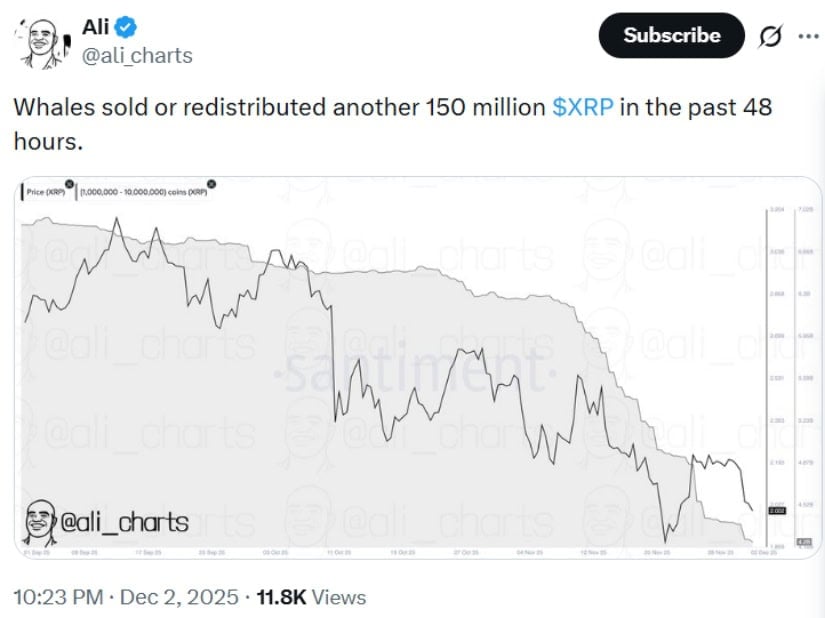
XRP saw 150M tokens moved by whales amid a price drop to $2, while ultra-large wallets continued accumulating, highlighting layered market activity. Source: Ali Martinez via X
Supporting data from the blockchain analytics platform Santiment also showed increased large-wallet activity during XRP’s recent decline from approximately $2.85 in September to near $2.00 in early December. Santiment’s historical wallet tracking suggests that such movements often correlate with elevated short-term volatility rather than definitive long-term trend reversals.
Market data further indicated that XRP recorded a single-day decline of about 6% on December 2, highlighting how sensitive price action remains to large-holder distribution. At the same time, Santiment wallet metrics show that some top-tier wallets continue to accumulate, suggesting that recent selling may reflect portfolio rotation rather than broad capitulation.
While near-term sentiment has been softened by whale activity, some long-range XRP price prediction models remain constructive—though analysts consistently stress that these projections remain conditional.
Technical analyst Maelius, known for publishing long-term Elliott Wave–based market models, described the current XRP structure as Wave IV, a phase that typically represents consolidation before a potential final advance in the cycle. In Elliott Wave theory, Wave IV often reflects sideways accumulation after an impulsive rally.

MaeliusCrypto’s Elliott Wave analysis projects XRP could reach $10 by mid-2026, a 4.6× upside from its $2.15 price on December 3, 2025, though such forecasts remain speculative. Source: Maelius via X
In reference to this structure, Maelius wrote that a conservative interpretation could outline a future scenario where XRP revisits the $10 region, should Wave V develop under favorable conditions.
Another market analyst, EGRAG, who specializes in logarithmic XRP trend modeling, has outlined a hypothetical $9–$13 range in aggressive upside scenarios. However, both analysts emphasize that such outcomes depend on volume confirmation, broader market liquidity, and structural breakout validation, rather than timing-based speculation.
From a fundamental perspective, institutional developments continue to shape XRP’s long-term narrative. According to an official statement from Ripple, the company recently secured an expanded Major Payment Institution license from the Monetary Authority of Singapore.
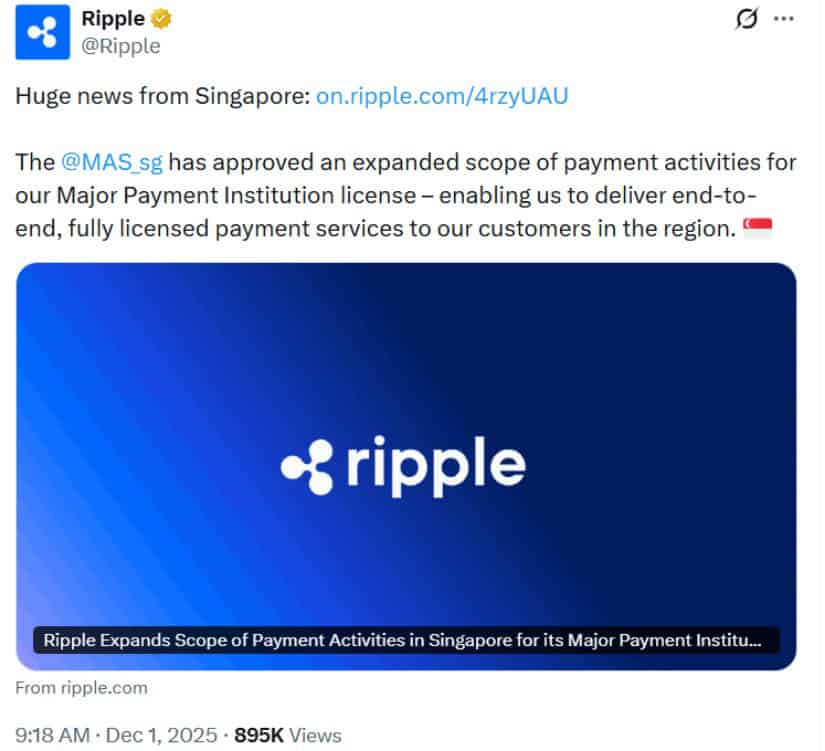
MAS approves Ripple’s expanded license, enabling fully licensed payment services in Singapore. Source: Ripple via X
Ripple stated that the updated regulatory approval allows it to broaden its regulated digital payment services in the region, including near-instant settlement capabilities using Ripple USD (RLUSD), its U.S. dollar–pegged stablecoin. The company highlighted faster settlement times and improved cross-border liquidity for institutional partners as primary benefits.
Market analysts view this regulatory milestone as strengthening Ripple’s regional payment infrastructure, which could gradually influence XRP transaction demand through increased enterprise usage—though direct short-term price effects are difficult to quantify.
Despite optimistic long-term projections, the broader weekly XRP structure remains technically fragile. According to a trend classification model shared by multiple market technicians, XRP has remained in a bearish phase for roughly 14 consecutive weeks, with price still trading beneath key structural thresholds.
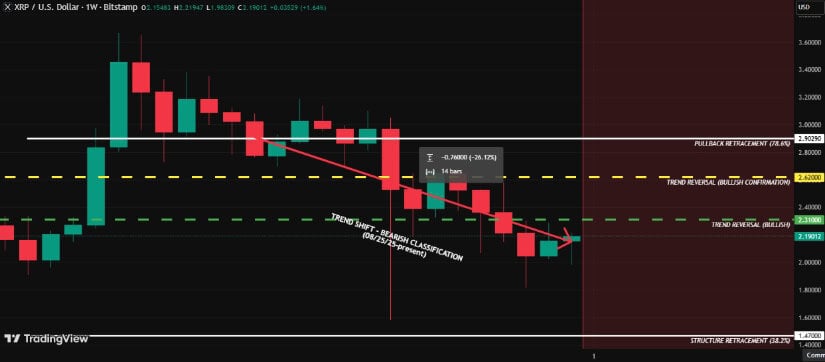
As of December 2, 2025, XRP trades at $2.15 in a 14-week bearish trend, with key levels at $2.31, $2.62, and $1.47; the analysis is fully reactive and observational. Source: GURULifeline on TradingView
Analysts are currently monitoring the following technical reference levels:
Bullish trend reversal level: $2.31
Bullish confirmation zone: $2.62
Major structural support: $1.47
This framework follows a confirmation-based methodology, meaning directional bias is only adjusted after the price closes decisively above these levels rather than on anticipatory signals.
Market observers generally agree that the $2 area remains the most decisive level for the near-term XRP price forecast. Some analysts believe that maintaining this support could preserve the existing bullish wedge structure, while a breakdown below it could expose lower historical demand zones.
Recent exchange trading data shows that volume during recent pullbacks briefly approached nearly 3% of circulating supply, a statistic often interpreted by market technicians as evidence of both strong speculative participation and defensive buying.
A confirmed breakout above descending channel resistance—a trendline that currently restricts upward momentum—would be considered a constructive technical signal in many trading models. Conversely, sustained weakness below $2 could increase downside risk.
Based on the current balance of technical and on-chain data, many analysts describe the XRP price prediction 2025 outlook as cautiously optimistic rather than decisively bullish. Technical patterns suggest possible accumulation near $2, while institutional developments and long-term wave models keep higher price scenarios within speculative discussion.
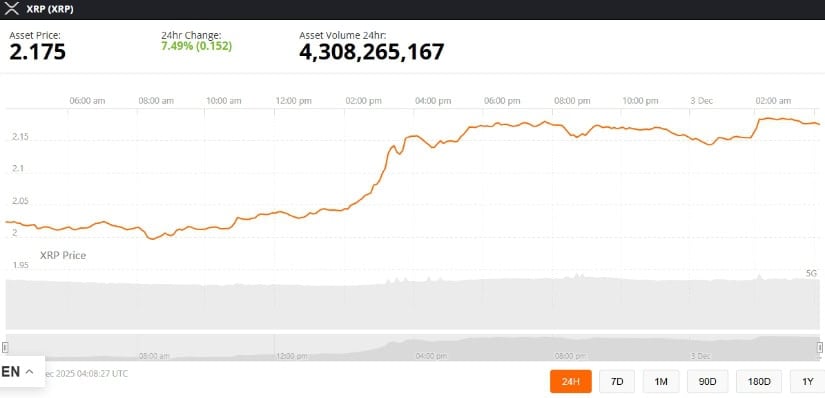
XRP was trading at around 2.17, up 7.49% in the last 24 hours at press time. Source: XRP price via Brave New Coin
However, as one recent TradingView market report noted, “Without price confirmation, projections remain probabilistic—not predictive.”
For now, XRP remains at a technical crossroads—supported by persistent buying interest near $2, tested by whale-driven volatility, and influenced by expanding institutional adoption within global payment networks.
Important DisclaimersFXEmpire is owned and operated by Empire Media Network LTD., Company Registration Number 514641786, registered at 7 Jabotinsky Road, Ramat Gan 5252007, Israel. The content provided on this website includes general news and publications, our personal analysis and opinions, and materials provided by third parties. This content is intended for educational and research purposes only. It does not constitute, and should not be interpreted as, a recommendation or advice to take any action, including making any investment or purchasing any product. Before making any financial decision, you should conduct your own due diligence, exercise your own discretion, and consult with competent advisors. The content on this website is not personally directed to you, and we do not take into account your individual financial situation or needs. The information contained on this website is not necessarily provided in real time, nor is it guaranteed to be accurate. Prices displayed may be provided by market makers and not by exchanges. Any trading or other financial decision you make is entirely your own responsibility, and you must not rely solely on any information provided through the website. FXEmpire does not provide any warranty regarding the accuracy, completeness, or reliability of any information contained on the website and shall bear no responsibility for any trading losses you may incur as a result of using such information. The website may include advertisements and other promotional content. FXEmpire may receive compensation from third parties in connection with such content. FXEmpire does not endorse, recommend, or assume responsibility for the use of any third-party services or websites. Empire Media Network LTD., its employees, officers, subsidiaries, and affiliates shall not be liable for any loss or damage resulting from your use of the website or reliance on the information provided herein.Risk DisclaimersThis website contains information about cryptocurrencies, contracts for difference (CFDs), and other financial instruments, as well as about brokers, exchanges, and other entities trading in such instruments. Both cryptocurrencies and CFDs are complex instruments and involve a high risk of losing money. You should carefully consider whether you understand how these instruments work and whether you can afford to take the high risk of losing your money. FX Empire encourages you to conduct your own research before making any investment decision and to avoid investing in any financial instrument unless you fully understand how it works and the risks involved.
Suppliers, manufacturers and CPG brands converge at SupplySide Connect New Jersey to discover and source health and wellness information.
SECAUCUS, NJ / ACCESS Newswire / December 3, 2025 / SupplySide Connect New Jersey, the East Coast’s ingredient and solutions trade show for the health and nutrition sector, announces registration is open for the 2026 event (April 14-15, 2026, Meadowlands Exposition Center). The event will bring together thousands of professionals to explore critical topics spanning dietary supplements, food and beverage, pet health and personal care.
Industry Platform
SupplySide Connect New Jersey brings together the full spectrum of the sector for two days of discovery and dealmaking with more than 260 exhibiting companies showcasing ingredients aimed at revolutionizing products from plant-based proteins to cognitive enhancement supplements. Leading suppliers of cutting-edge ingredients and services will present transformative ideas that are set to redefine the formulation, development and distribution of the next generation of finished products.
Connecting Industry Leaders
SupplySide Connect New Jersey offers the Northeast a highly collaborative environment tailored to the needs and ongoing growth of the regional market. Past participants include industry leaders such as Unilever, NestleHealth Science, Del Monte Fresh Produce, Life Extension and McCormick & Company gaining access to the newest product formulations, packaging technologies, flavors, natural ingredients, wellness products and beauty supplements, and connecting with ingredient suppliers, equipment companies, distributors and regulatory experts. The focused audience provides opportunities to gain insights into local consumer preferences, navigate regional regulatory landscapes and adopt targeted strategies that drive revenue growth and transform business models.

Educational Programming and Networking Opportunities
The 2026 event will feature a robust lineup of educational sessions designed to address pressing trends and challenges in topics such as men’s health supplements, color and flavors, upcoming trends in food and beverage and regulatory outlooks. The 14 sessions in the ConnectEd theater aim to inspire actionable strategies and spark innovation. Attendees will also benefit from curated networking opportunities, including speed networking and expert-led discussions, fostering high-value conversations on specific topics, enabling professionals to exchange ideas and build partnerships that will shape the future of the various health and nutrition industry verticals.
Solana’s price is surging today. As of publication on December 3, 2025, SOL is trading around $141–$142, up roughly 11% in the last 24 hours, with a market cap of about $79 billion, keeping it firmly in the global top‑10 cryptocurrencies. [1]
At the same time, Solana remains about 55–57% below its all‑time high near $295, reminding traders that the current rally is taking place after a deep, multi‑month drawdown. [2]
Important: All prices and metrics are approximate at the time of writing and can change rapidly. Nothing in this article is financial advice.
According to real‑time data from major aggregators, Solana is trading near $141–$142, with:
CoinGecko’s 7‑day view shows Solana bouncing from a low near $126.75 on Tuesday to about $141.65 today, with today’s move alone adding roughly $14.64 (+11.5%) in 24 hours. [9]
Despite the strong rebound, Indonesian exchange Pintu notes that Solana is still about 57% below its all‑time high of $295.83 and is only recently rebounding from a key $120 long‑term support zone that has acted as a major line in the sand for nearly two years. [10]
In other words: today’s rally is powerful, but it is happening inside a much larger, still‑corrective cycle.
A central narrative on December 3 is the approval of Franklin Templeton’s Solana ETF for trading on NYSE Arca, under the ticker SOEZ. [11]
CoinCentral’s analysis highlights several key points:
The combination of reduced exchange supply, new ETF access, and concentrated buying zones provides a strong structural backdrop for this week’s bounce.
On top of Franklin’s ETF launch, Vanguard’s change of heart on crypto ETFs is being felt across the market:
Put simply: traditional finance is now providing a steady pipeline of demand for Solana exposure, and today’s price action reflects that shift.
The move in Solana is not happening in isolation:
A rising macro tide — driven by spot Bitcoin ETF inflows and renewed risk appetite — is lifting high‑beta altcoins like Solana alongside it.
Several fresh analyses argue that today’s bounce is more than just a short squeeze.
A detailed note from Mitrade on December 3 points to three reinforcing pillars behind today’s move: [18]
Mitrade also emphasizes a potential double‑bottom pattern on the daily chart, with support near $126 and a neckline around $145. A decisive daily close above that region would strengthen the bullish case and open the door toward $158 (50‑day EMA) and $175 (200‑day EMA) as the next resistance zones. [19]
U.Today describes today’s action as the “most important breakthrough since October”, noting a roughly $17.93 billion spike in Solana‑related flows and activity that coincides with a sharp spot bid, structural support and a break in momentum. [20]
While methodologies differ between analytics providers, the common theme is that both market structure and on‑chain data are turning more supportive at the same time.
Intraday technicals are leaning bullish:
CoinEdition further reports that Solana has broken a multi‑week descending trendline, with futures open interest rising and net inflows turning positive, and now trades near $143 as buyers target the $149–$155 resistance zone. [24]
From today’s various technical breakdowns, the following levels stand out:
Not every analyst is convinced that today’s bounce has ended the downtrend:
From this perspective, today’s move might be a strong relief rally inside a larger corrective phase, unless the price can hold above $135 and decisively clear $145–$155.
Several quantitative models published around December 3 give a sense of how automated systems see SOL’s near‑term path:
Taken together, short‑term models generally see SOL staying in a broad $130–$160 band through the end of the year, with upside scenarios concentrating around the mid‑$150s if the current breakout holds.
CoinCodex’s longer‑horizon forecasts sketch a measured but positive path:
These numbers reflect a steady, compounding growth story, rather than an immediate moonshot.
By contrast, human analyst forecasts span a much wider and more speculative range:
Separate commentary from Yahoo Finance has argued that Solana could be worth more than XRP by 2030, citing its high‑throughput architecture and fast‑growing developer ecosystem as key competitive strengths, though without committing to a single numerical target. [41]
The net takeaway: medium‑term expectations range from cautious to extremely bullish, and investors should treat all such forecasts as scenarios, not guarantees.
Sentiment across media today is notably mixed:
In short, today’s price spike is re‑igniting bullish narratives, but skeptical and risk‑focused analysis remains very much alive.
Over the coming days and weeks, traders and long‑term holders alike are likely to watch:
Solana’s move above $140 today is backed by real flows and improving metrics, but the asset remains:
Always remember:
This article is for informational and news purposes only and is not investment advice.
Cryptocurrency trading involves significant risk, and you should never invest money you cannot afford to lose.
1. coinmarketcap.com, 2. pintu.co.id, 3. coinmarketcap.com, 4. news.abplive.com, 5. coincentral.com, 6. www.mitrade.com, 7. coincodex.com, 8. coinmarketcap.com, 9. www.coingecko.com, 10. pintu.co.id, 11. coincentral.com, 12. coincentral.com, 13. coincentral.com, 14. fortune.com, 15. www.coinspeaker.com, 16. www.coinspeaker.com, 17. news.abplive.com, 18. www.mitrade.com, 19. www.mitrade.com, 20. u.today, 21. crypto.news, 22. holder.io, 23. crypto.news, 24. coinedition.com, 25. holder.io, 26. www.mitrade.com, 27. holder.io, 28. www.mitrade.com, 29. coinedition.com, 30. www.mitrade.com, 31. pintu.co.id, 32. pintu.co.id, 33. www.binance.com, 34. coincodex.com, 35. changelly.com, 36. coincodex.com, 37. coincodex.com, 38. coincodex.com, 39. investinghaven.com, 40. investinghaven.com, 41. finance.yahoo.com, 42. cryptodnes.bg, 43. cryptonews.com, 44. pintu.co.id, 45. finance.yahoo.com, 46. www.coinspeaker.com, 47. www.mitrade.com, 48. finance.yahoo.com
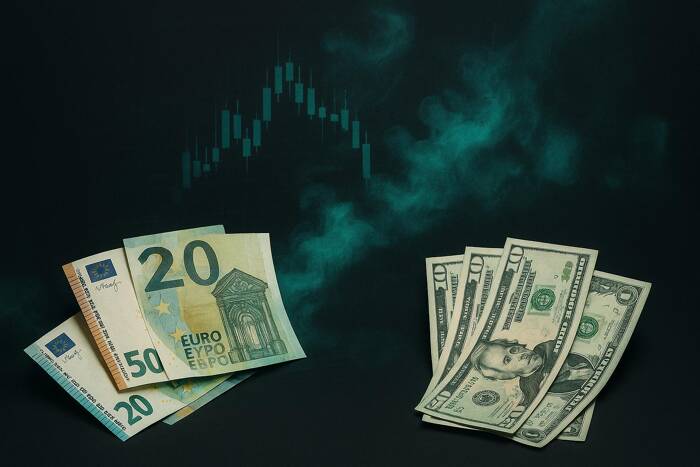
EUR/USD trades around 1.1660 on Wednesday, up 0.30% on the day, supported by renewed demand for the single currency and a weakening US Dollar (USD). The pair extends its advance toward fresh one-month highs, helped by stronger European economic indicators and a widening policy gap in favor of the Eurozone.
Eurozone growth prospects improved further after the HCOB Services Purchasing Managers Index (PMI) for November was revised higher to 53.6 from 53.1, marking a fourth consecutive monthly expansion and the strongest reading since May 2023. The upward revisions were broad-based, with France rising to 51.4 and Germany to 53.1.
These data reinforce the firm stance of the European Central Bank (ECB). President Christine Lagarde told the ECON Committee of the European Parliament that growth should be supported by household spending and a resilient labor market, adding that underlying inflation remains aligned with the ECB’s 2% medium-term target.
The contrast with the Federal Reserve (Fed) is becoming increasingly pronounced. Markets are pricing an 85% chance of a 25-basis-point rate cut next week, with additional cuts expected in 2026. Speculation that White House adviser Kevin Hassett could replace Chair Jerome Powell, potentially steering policy toward further easing, has amplified this divergence.
US data released earlier in the day has also pressured the US Dollar. The ADP Employment Change report showed a loss of 32,000 jobs in November, compared with an expected gain of 5,000, highlighting growing weakness in the labor market. ADP noted that employers are facing cautious consumers and an uncertain macroeconomic backdrop.
Later today, attention turns to the Institute for Supply Management’s (ISM) Services PMI, expected to ease to 52.1 from 52.4 in October. Another decline in the employment sub-index, already contracting for the past five months, would reinforce concerns about a sharper slowdown in the US economy.
In this environment, the divergence between a firm-leaning ECB and a Fed preparing for deeper monetary easing continues to support the Euro (EUR). Should the ISM report disappoint, downside pressure on the US Dollar could intensify, potentially allowing EUR/USD to extend its recent upward momentum beyond current monthly highs.
In the 4-hour chart, EUR/USD trades at 1.1664, up for the day, 26 pips above the day opening price. The 100-period Simple Moving Average (SMA) is rising at 1.1582, and the pair holds above it, reinforcing a bullish bias. Relative Strength Index (RSI) at 71.45 is overbought and suggests momentum is stretched. Immediate resistance aligns at 1.1669, followed by 1.1728, and a sustained break could extend the advance.
Above the 100-period SMA, the bias stays firm. RSI has eased from 72.52 to 71.45, hinting at cooling momentum. The rising trend line from 1.1491 underpins the bullish tone, offering support near 1.1609. Additional support is seen at 1.1469. A dip into trend-line support could attract fresh bids and keep the uptrend intact.
(The technical analysis of this story was written with the help of an AI tool)
Green tea is full of antioxidants, which are compounds that help protect your cells from damage and can lower your risk for disease.
Green tea’s antioxidant capacity is about 570-2,620 micromoles per 100 milliliters. Many foods contain antioxidants, some with an even higher antioxidant capacity than green tea.
rez-art / Getty Images
Antioxidants include nutrients like vitamins A, C, and E, the mineral selenium, and compounds called polyphenols.
Berries are a great source of antioxidants. They can be rich in vitamin C, especially blackcurrants and sea buckthorn berries. Eating a cup of mixed berries provides 26 milligrams (mg) of vitamin C, or 29% of the Daily Value (DV).
Berries are also rich in anthocyanins, a type of polyphenol and plant pigment. These compounds give berries red, purple, and blue colors.
Most berries have an antioxidant capacity of about 2,100 to over 15,000 micromoles (μmol) per 100 grams (g). Berries with the highest antioxidant capacity include:
janecocoa / Getty Images
Vegetables are a great source of antioxidants. One study measured the antioxidant capacity of 303 vegetables and vegetable products. On average, vegetables had about 800 micromoles per 100 grams. However, a few vegetables had much more while some had less.
The study found that curly kale has an antioxidant capacity of about 2,800 micromoles per 100 grams. Kale is rich in vitamins A and C and contains polyphenols.
Other vegetables with high antioxidant capacity include artichokes, red chili peppers, and green chili peppers.
HUIZENG HU / Getty Images
Cocoa powder has about 636 micromoles of antioxidant capacity per gram. So, chocolate made with more cocoa has higher antioxidant capacity.
Eating antioxidant-rich foods may help reduce inflammation and prevent disease. A 2023 study found that eating 10 grams of cocoa high in polyphenols helped reduce inflammation linked to heart health. Another 2024 study found that people who ate cocoa regularly had lower blood cholesterol.
Liudmila Chernetska / Getty Images
Spices come from the seeds, bark, roots, or leaves of plants. These parts of plants are naturally high in polyphenols.
A 2024 study looked at 425 spices and herbs. Clove had the highest antioxidant capacity, followed by peppermint, allspice, cinnamon, oregano, thyme, sage, rosemary, saffron, and tarragon. Their antioxidant capacity ranged from 440 to 2,770 micromoles per gram.
Tatiana Sidorova / Getty Images
Seeds can contain antioxidant nutrients like vitamins A and E. They are also packed with polyphenols.
A 2020 study looked at the antioxidant capacity of five different seeds. Sunflower seeds had the highest antioxidant capacity, followed by flaxseeds, sesame seeds, poppy seeds, and hemp seeds.
Here is the antioxidant content of those seeds:
A study showed that germinating seeds, like chia seeds, improved their antioxidant capacity. In chia seeds, their capacity increased by about 87-105% after four days of germination.
FotografiaBasica / Getty Images
Nuts are rich in antioxidant nutrients and beneficial plant compounds. A 2025 study showed that eating 60 grams or more of almonds daily may reduce blood markers of oxidative stress (a state of cell damage that can lead to disease). It may also increase antioxidant enzyme activity, which helps protect cells.
Other studies show that regularly eating nuts may lower the risk of dying from any cause.
Here are the antioxidant capacities of some nuts:
Some nuts, such as almonds, hazelnuts, pine nuts, and Brazil nuts, are especially rich in vitamin E. Brazil nuts are also particularly high in selenium.
HUIZENG HU / Getty Images
Coffee is one of the drinks with the most antioxidants. It has about 75 to 172 micromoles of antioxidant capacity per gram of ground coffee.
The amount of antioxidants in coffee can change depending on the type of coffee bean, how it is roasted, and how it is brewed.
A 2020 study found that Aeropress coffee had the highest antioxidant capacity. Drip coffee came next, followed by pour-over, espresso, and French press.
Here are some ways to add more antioxidants to your diet:
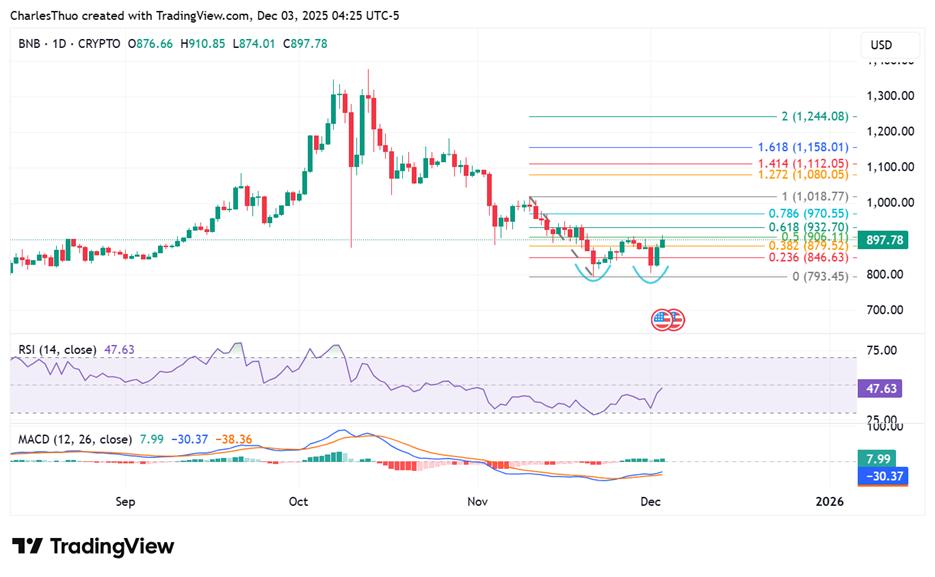
The Binance Coin (BNB) price has surged 8.2% today, outpacing both its weekly and monthly trends, to trade at around $897.78 at press time.
BNB’s surge comes as Binance crypto exchange reshapes its executive structure, naming Yi He, the exchange’s co-founder, as Co-CEO alongside Richard Teng.
Binance leadership shift strengthens market sentiment
The appointment of Yi He as Binance CEO (Co-CEO) reinforces a succession strategy that has been forming since Changpeng Zhao (CZ) stepped down from day-to-day leadership in 2023.
Yi He, who previously worked with CZ at OKCoin before co-founding Binance in 2017, has long shaped the company’s culture, innovation pipeline, and user-first product design.
Her leadership across areas such as Binance Labs, Launchpad, Smart Chain, and the company’s charity programs has been central to the exchange’s identity.
In an official announcement made on X, Binance emphasised that Yi and Teng will guide its next phase with a dual focus: tightening global regulatory alignment and scaling adoption toward one billion users.
CZ publicly endorsed the move, remarking that Yi “should have been the Binance CEO from day one,” underscoring the depth of trust within the founding team.
Notably, CZ’s endorsement reflects confidence that the exchange’s leadership bench is strong enough to navigate increased regulatory scrutiny worldwide.
How the new governance structure is expected to boost Binance
The new leadership structure is designed to help Binance navigate global regulatory frameworks more efficiently.
Teng, known for his background in financial regulation, is expected to deepen compliance initiatives.
Yi will focus on driving product innovation and scaling the ecosystem through partnerships and user-focused initiatives.
Combined, the dual-CEO model aims to strengthen credibility at a time when institutional investors are paying closer attention to governance in the crypto industry.
BNB coin price analysis
As the Binance Coin responds to the leadership change at Binance, today’s price surge is also supported by broader market conditions.
A rebound across the crypto sector, fueled by expectations of a Federal Reserve rate cut and rising Bitcoin ETF inflows, has added liquidity to the altcoin market.
Bitcoin reclaiming the $93,000 region has also lifted correlated assets, and BNB, known historically as a high-beta altcoin, has benefited strongly from the shift in sentiment.
From a technical standpoint, the price of BNB today shows momentum building after the token broke above the 61.8% Fibonacci retracement at $906.11 before slightly pulling back.
In addition, BNB has formed a double-bottom pattern, a bullish structure signalling trend reversal.
The cryptocurrency has also broken out of a descending channel on the four-hour chart, reflecting improving strength on short-term timeframes.
Trading volume has risen as well, showing strong interest from investors who see the leadership transition as a stabilising development for the broader Binance ecosystem.
BNB price forecast: can Binance Coin sustain the rally?
Looking ahead, the BNB price forecast depends on how the market digests the leadership transition and upcoming macro events.
Staying above the immediate support at $879.52 could support a continued bullish momentum that could further push the BNB coin price toward the $1,054 region, according to some analysts, especially if FOMO accelerates after a clean breakout above $900.
A supportive Federal Reserve decision later this month may further boost liquidity and extend the rally.
Conversely, failure to hold above $879.52 could lead to a short-term pullback to the next support zone around $859.50, or even a deeper dive to the lows at $793.45.
There was a taste of fall in the air. The musty scent of leaves hung heavy as they crunched beneath our feet. October days were getting shorter. And the holidays were looming like shadows in the late afternoon sun. I regarded the soon-to-be festive season with an unsettling feeling of impending doom.
This was an autumn like no other. My husband Joe and I were headed to my outpatient physical therapy appointment. My legs were stick thin and I walked like a newborn fawn on wobbly, unsteady limbs. My weight had dropped to 115, and my hair was falling out. I lived an anxiety-riddled existence. Crying every day and waking up in a panic after a fitful sleep filled with horrendous nightmares.
Five months earlier, on May 22, 2021, my colon perforated from undiagnosed diverticulitis, a serious infection. I went into septic shock, my immune system’s dysfunctional way of fighting the infection, and my organs started to fail. Our world was rocked in an instant as I was flown by helicopter to shock trauma for emergency surgery in Baltimore. The doctors were doubtful I’d make it.
Surprisingly, I did. A large part of my colon was removed, and a temporary colostomy was placed by pulling a small piece of intestine through my abdominal wall to create a stoma to get rid of waste while my intestines healed. My colorectal surgeon, a brilliant physician with skillful hands, said she would reconnect everything by doing a colostomy reversal in December. The nurses marveled over my neatly stapled 10-inch incision that ran straight down my stomach and through my belly button. They said the stoma was “beautiful.” My surgeon had done amazing work, but I wasn’t sure about calling the stoma “beautiful.”
Jackie in shock trauma ICU after suffering from septic shock, 2021.
I spent over a month in the hospital and inpatient rehab. Only to be re-admitted again to drain a post-op infection shortly after I came home. I had to learn to walk again and brush my teeth. I had to adapt to the stoma. Sepsis left me drained and my muscles wasted away. I couldn’t pour a bowl of cereal and could barely sit up for more than 10 minutes at a time.
My nerves were shot. My family did everything they could to ease my mind, but they didn’t understand what was happening. I didn’t even realize I was suffering from PTSD and post-sepsis syndrome, a condition that affects about 50% of survivors, but no one knows much about. We suffer in silence. My mind had been overtaken by irrational fears of just about everything. I was terrified to have bloodwork done or my vitals taken. I started to emotionally detach from life itself. I was tuning out, just like the blank screen on the TV that I would stare at for hours.
The holidays, and my next surgery, were fast approaching. I was so sure that I wouldn’t survive the reversal that I booked the surgery for December 8to be sure I didn’t miss my youngest daughter Alexis’s 21st birthday on the 5th. I wanted Alexis to enjoy that milestone, just in case I didn’t make it.
Alexis, my other daughter Elise, and my son Joey and his fiancé Colleen, assured me they would handle the holidays. Meanwhile, I had a calendar full of “must-dos.” A colonoscopy, to check if everything was okay inside for surgery. Iron infusions, tons of bloodwork, cardiology clearances, pulmonology clearances and a physical. This surgery was no walk in the park. It would take several hours and was very complex. I also have several chronic, disabling conditions, including Hypermobile Ehlers-Danlos, POTS, Crohn’s disease and severe osteoporosis. I had a lot of pre-surgery boxes to check.
Come November, my husband suggested we go to a nearby lake and take walks as the afternoon sun was getting even lower in the sky. The leaves were really rustling now. The walks helped settle my mind a bit and strengthened my muscles for surgery. I continued with outpatient physical therapy. I was still very weak — and plagued by my mental demons of doom.
Thanksgiving arrived on a bright sunny November morning. Elise and Alexis helped their dad get everything ready. They made all the things — turkey, stuffing, potatoes and pie. Joey and Colleen brought more food and cookies. New memories were forming around me, just as savory as the meal. As we sat around the table, and the kids joked and laughed, I looked around intently and tried to take a mental snapshot and put the picture away in my heart. Just in case my fears came true.
Before Alexis left that weekend to go back to college, I gave her an early birthday present. A Pandora bracelet and a 21 charm, with her birthstone. Tears welled up in my eyes. I was convinced I’d never live to see her graduate, much less see her return home for Christmas break in a few weeks. I tried not to give away my fears, but I failed miserably.
 Jackie and Alexis with Alexis’ 21st birthday charm bracelet, 2021
December rolled in with a crisp chill. I avoided listening to Christmas music. It was too wistful and sentimental, and it hurt my heart and a huge lump formed in my throat. Bing Crosby’s “You’re all I want for Christmas,” has always been a sore spot. My dad used to play it on the family stereo when I was little, and it makes me think of family who are no longer here. And now, I worried that it would be the last time I’d be here to hear holiday songs. Instead, I kept smooth jazz on the radio. Nice, neutral territory.
My nerves were fraught with tension and terror the morning of my surgery check-in at 5 a.m. in Baltimore at the same hospital. I almost escaped and ran out the front doors. My husband coaxed me back inside, and a registration staff member named Tatia came over and sat with me and held my hands. She gently prodded and asked what was wrong. I told her I was sure I was going to die in surgery. Tatia asked me about my kids, their careers and what had brought me there that morning. I gushed about my kids and then told her about the sepsis and my previous flirtation with death. She assured me I was very strong to have survived that, and I would survive this too. She came upstairs with us to the pre-op area and stayed until my surgeon arrived. It was like I had an angel looking out for me that morning.
When I woke up in the recovery room, the nurses gleefully announced that I had made it. I was on the other side! Just not “that” side. I was still on this planet, much to my surprise. I peeked under the covers at the small white bandage on the left side of my stomach where my stoma used to be. My surgeon said the takedown was a success, although it took a few days for everything to start working again. I spent eight days in the hospital, walking in the halls dragging my IV pole. Joe filmed my progress for Instagram. One of my nurses fashioned a makeshift sparkly pipe cleaner into a Christmas ornament and attached it to my IV pole. It was the most beautiful decoration I’d ever seen.
 Jackie and her kids, Christmas 2021
The day after I came home, our son drove to Pittsburgh to bring Alexis home for break. The girls had insisted on waiting till I came home to decorate the tree. I was still frail and weak. But I was able to lie on the couch and watch them hang ornaments while playing the Christmas song guessing game with their dad. Alexis put on classic Christmas carols (the really old ones), and when the first few seconds of the song began, she’d ask her dad to name the artist. They had played this game for years.
My husband helped make a few purchases online, so we’d have something for the kids on Christmas morning. Elise had purchased a Fitbit way back in September so I could keep track of my steps as I continued my recovery. She always was more certain of my survival than I was. Joey and Colleen bought me a Wii Fit so I could workout at home on my off days from physical therapy. Alexis made the best meal, and it felt like we opened a new chapter. Waves of emotion erupted as I opened the gifts. I really didn’t need the gifts; my family was all I needed. It felt surreal. To still be alive. Like a dream. Our Christmas dream. And it was all I ever wanted that Christmas.
Resources
Have your own Real Women, Real Stories you want to share? Let us know.
Our Real Women, Real Stories are the authentic experiences of real-life women. The views, opinions and experiences shared in these stories are not endorsed by HealthyWomen and do not necessarily reflect the official policy or position of HealthyWomen.
From Your Site Articles
Related Articles Around the Web
Firelight launched its XRP staking protocol on the Flare Network today, allowing users to stake wrapped XRP (FXRP) and receive liquid staking tokens (stXRP) for DeFi applications while preparing for insurance-backed rewards.
The protocol enables XRP holders to deposit FXRP into vaults through Flare’s trust-minimized bridging system. Users receive stXRP tokens that can be traded or utilized across DeFi applications while maintaining exposure to potential staking rewards.
Firelight’s model focuses on using staked XRP to underwrite insurance coverage for DeFi protocols, targeting protection against risks including smart contract failures. The insurance-based rewards are expected to activate in an upcoming phase based on protocol adoption rates.
The launch connects XRP to expanded use cases within Flare’s DeFi ecosystem, enabling yield generation through staking mechanisms while supporting insurance coverage for high-value protocols. The initiative has attracted institutional interest due to its focus on providing comprehensive DeFi risk coverage.
XRP was originally designed for faster cross-border payments and has increasingly integrated into the DeFi ecosystem through bridging technologies that convert it into productive assets for various blockchain applications.
Select market data provided by ICE Data Services. Select reference data provided by FactSet. Copyright © 2025 FactSet Research Systems Inc.Copyright © 2025, American Bankers Association. CUSIP Database provided by FactSet Research Systems Inc. All rights reserved. SEC fillings and other documents provided by Quartr.© 2025 TradingView, Inc.