The main category of All News Articles.
You can use the search box below to find what you need.
[wd_asp id=1]
The main category of All News Articles.
You can use the search box below to find what you need.
[wd_asp id=1]
Welcome, my fellow traders! I have prepared a price forecast for the USCrude, XAUUSD, and EURUSD using a combination of the margin zones method and technical analysis. Based on the market analysis, I suggest entry signals for intraday traders.
Crude remains under selling pressure.
The article covers the following subjects:
USCrude: Oil remains under selling pressure, with the downside target at 77.14.
XAUUSD: Gold continues to trade in a short-term downtrend.
EURUSD: The euro is undergoing a correction.
Oil remains under selling pressure, with the next downside target at 77.14. If the price slides below this level, the Gold Zone of 76.63–76.24 will likely be tested. If sellers push the price below that area, the next downside target becomes the 72.07–71.26 Target Zone.
On the upside, if the price violates the resistance B of 83.57–82.99, it would signal a shift in the short-term trend from bearish to bullish.
Watch the market.
Gold remains in a short-term downtrend, with the primary downside target at 3,959. Today, short positions opened at the resistance B of 4,113–4,128 can be maintained.
If gold breaks through the resistance B, a bullish short-term trend may start. In that case, buying opportunities could be considered tomorrow, with the 4,267–4,298 Target Zone as the upside objective.
Hold short trades opened at resistance B 4,113–4,128. TakeProfit: 3,959. StopLoss: at breakeven.
The euro is correcting lower and approaching the support A of 1.1466–1.1474. If this zone holds, long positions can be considered, with initial targets at 1.1512 and 1.1558. Should the price break through 1.1558, it may climb further to the Target Zone of 1.1576–1.1601.
If the support A is pierced, the correction could extend to the support B of 1.1420–1.1432, which marks the boundary of the current trend. This zone may also offer opportunities to open long positions.
Buy near support A 1.1466–1.1474. TakeProfit: 1.1512, 1.1558. StopLoss: 1.1445.
Would you like to learn more about technical analysis methods and principles? Explore our comprehensive guide.
P.S. Did you like my article? Share it in social networks: it will be the best “thank you” 🙂
Useful links:
The content of this article reflects the author’s opinion and does not necessarily reflect the official position of LiteFinance broker. The material published on this page is provided for informational purposes only and should not be considered as the provision of investment advice for the purposes of Directive 2014/65/EU.
According to copyright law, this article is considered intellectual property, which includes a prohibition on copying and distributing it without consent.
Domestic coffee prices today
Coffee prices today in the domestic market decreased slightly compared to the previous day. According to giacaphe. com, coffee prices on August 4th averaged 96,500 VND/kg, down 100 VND/kg. The highest price in key Central Highlands regions was recorded at 96,500 VND/kg.
In Lam Dong, coffee prices today reached 96,000 VND/kg, unchanged from the previous day. This is the lowest level in the regions.
In Gia Lai and Dak Lak, coffee prices were also recorded at 96,500 VND/kg, unchanged compared to the previous day.
The old Dak Nong area recorded a level of 96,500 VND/kg, down 200 VND/kg compared to the previous session. This is one of the regions with high prices in the survey table.
World coffee prices
In the world market, coffee prices fluctuated in opposite directions in the most recent session.
According to Barchart, the September 2026 Arabica futures contract closed down 12.60 US cents/lb, equivalent to 3.79%, to 319.50 US cents/lb.
Conversely, the September 2026 Robusta futures contract increased by 4 USD/ton, equivalent to 0.11%, to 3,786 USD/ton. The increase range is very narrow, showing that Robusta was almost sideways in the session.
This development shows that downward pressure is concentrated in Arabica, while Robusta still maintains a slight green color. For the Vietnamese market, the 0.11% increase in Robusta is not enough to create a clear pull for domestic purchasing prices.
Coffee price assessment
Domestic coffee prices slightly decreased in the context of the world market disagreement. Arabica fell sharply, while Robusta only slightly increased, causing the domestic price level to have no clear recovery momentum.
Arabica is under pressure as drier weather in Brazilian coffee growing areas may help increase harvest progress.
In the opposite direction, Brazil’s slower harvest progress than the same period is still a price support factor. According to information from Barchart, harvests of Cooxupe cooperative members reached 58.3% as of July 24, lower than 67% in the same period last year; Safras & Mercado also recorded Brazil’s harvest reaching 64% as of July 15, lower than 77% in the same period and the 5-year average of 70%.
Regarding domestic weather, the National Center for Hydro-Meteorological Forecasting said that on the day and night of August 4, the Central Highlands area will have showers and thunderstorms in some places; especially in the late afternoon and evening, there will be showers and scattered thunderstorms. Lowest temperature 20-23 degrees C, highest 28-31 degrees C, in some places above 31 degrees C.
This season’s thunderstorms need to be monitored in terms of garden care, pest and disease prevention, and goods preservation.
In the coming sessions, the diễn biến of Robusta London, USD/VND exchange rate, inventory and demand for export purchases will continue to dominate domestic coffee prices.
The Euro to US Dollar exchange rate (EUR/USD) slipped to around 1.1504 on Monday after opening near 1.1548, leaving the pair at the bottom of its intraday range.

EUR/USD ended July around 1.1530, having recovered from a monthly low near 1.1354.
The pair remains 1.7% lower for 2026, with this year’s trading range extending from 1.1325 to 1.2075.

Bank of America says the July Fed press conference “injected uncertainty around the Fed’s inflation-fighting commitment and reaction function”.
The bank described the meeting as “doved and confused”, with Chair Kevin Warsh suggesting that financial markets had already delivered some of the tightening that might otherwise have required higher rates.
BofA said this was “not reassuring”, adding that the Dollar should respond differently to “a central bank credibly doing the tightening” than one which “outsources the tightening to the market”.
That credibility concern has shifted the near-term risk balance against the Dollar. However, BofA still sees support from resilient US economic conditions, artificial-intelligence investment and geopolitical uncertainty.
The bank also believes the Fed may ultimately need to respond more forcefully.

“Ironically, we think the need to re-establish credibility increases the probability that the Fed will hike in September,” BofA said.
Its economists continue to forecast three 25-basis-point increases over the remaining meetings of 2026.
BofA forecasts EUR/USD at 1.12 in September, 1.15 at year-end and 1.20 by the end of 2027.
The Euro’s technical recovery has improved after the late-July surge, but 1.1500 remains the immediate test.
A sustained hold above it would keep 1.1555 and 1.1600 in view, while a renewed break lower would expose 1.1450 and the 1.1370 area.
Our currency coverage draws on live market data, official economic releases and published bank research.
TradingKey – As of the European session on August 3, the US dollar against the Japanese yen ( USD/JPY) was trading near 156.70, having briefly plummeted to 155.20 intraday before paring some of its losses. Last week, USD/JPY neared 164.00, hitting a roughly 40-year high, but the exchange rate has fallen for four consecutive trading sessions as Japan and the US successively bought yen.
The direct cause of the current decline in USD/JPY is the joint foreign exchange intervention by the US and Japan. Japan’s Ministry of Finance confirmed that after Japan bought yen in the New York market last week, the US Treasury Department also participated in buying yen through the New York Fed to curb the currency’s recent excessive volatility and disorderly depreciation. This is the first joint intervention by the US and Japan since 1998, releasing a policy signal far stronger than unilateral intervention by Japan.
Japanese Finance Minister Satsuki Katayama stated that if the yen experiences sharp volatility again, Japan and the US will not hesitate to take further joint action. US Treasury Secretary Bessent also indicated that Washington is prepared to repeat intervention if necessary. Because the market cannot accurately predict the timing and scale of the authorities’ next entry, some investors who previously bet on the continuous depreciation of the yen began to unwind their positions, driving USD/JPY down rapidly from above 163 to near 155.
The direct participation of the US in this intervention has also changed the market’s assessment of the yen. In the past, unilateral yen purchases by Japan usually only triggered a short-term rally because the wide US-Japan interest rate gap meant investors still preferred to borrow low-yield yen to buy dollar assets. However, the US’s participation implies that the yen’s depreciation is no longer merely a domestic issue for Japan, but is instead seen as a risk that could affect global financial stability and the US Treasury market.
Japan holds a massive amount of US Treasuries. If Japan were to sell off US Treasuries in a concentrated manner to raise intervention funds, it could push up US Treasury yields and increase borrowing costs for the US government. Direct yen purchases by the US Treasury, or utilizing the New York Fed to provide dollar liquidity, can reduce Japan’s need to conduct large-scale sales of US Treasuries, which is likely one of the key reasons why the US is willing to participate in the intervention.
The Bank of Japan’s policy stance has also begun to provide support for the yen. While the BOJ kept its policy rate unchanged at 1% at its July meeting, it stated in its economic outlook that it will continue to raise rates in the future as underlying inflation gradually approaches 2%. BOJ Governor Kazuo Ueda also noted that if upside risks to inflation expand, the central bank will discuss whether faster action is needed. The combination of the joint intervention and the BOJ keeping the door open to rate hikes has further weakened the upward momentum of USD/JPY.
Whether the yen can sustain its appreciation remains uncertain. U.S. interest rates are still significantly higher than Japan’s, and with low yen financing costs, the foundation for the carry trade has not fully disappeared. Meanwhile, Japan’s expansionary fiscal policy could increase government debt and inflationary pressures, which would also limit the yen’s long-term appreciation potential.
ING believes that if expectations for Fed rate hikes do not cool significantly and the Bank of Japan does not tighten policy further, USD/JPY could still climb back above 160.
USD/JPY Daily Chart, Source: TradingView
According to the USD/JPY daily chart, the pair previously approached the 164.00 level before falling rapidly, breaking below two key levels of 160.00 and 158.00 in quick succession, indicating that short-term market sentiment has shifted to the bearish side. Following joint intervention by the U.S. and Japan, bearish momentum has significantly strengthened. However, the exchange rate quickly rebounded from near 155.20 to around 157.00, suggesting some support remains near the 155.00 level.
On the downside, initial support for the pair is located near the 155.00 level. A break below this level could lead to further declines toward 152.00, with a potential test of the key 150.00 level.
On the upside, immediate resistance sits near the 158.00 level. If the pair breaks and holds above this point, further room for a rebound would open up, potentially testing the 160.00 level. However, with both the U.S. and Japan clearly indicating that further interventions remain on the table, levels above 160 will face stronger policy pressure. Only a decisive break and consolidation above 160 would allow USD/JPY to challenge the 162 to 164 range once again.
This content was translated using AI and reviewed for clarity. It is for informational purposes only.
Disclaimer: The content of this article solely represents the author’s personal opinions and does not reflect the official stance of Tradingkey. It should not be considered as investment advice. The article is intended for reference purposes only, and readers should not base any investment decisions solely on its content. Tradingkey bears no responsibility for any trading outcomes resulting from reliance on this article. Furthermore, Tradingkey cannot guarantee the accuracy of the article’s content. Before making any investment decisions, it is advisable to consult an independent financial advisor to fully understand the associated risks.
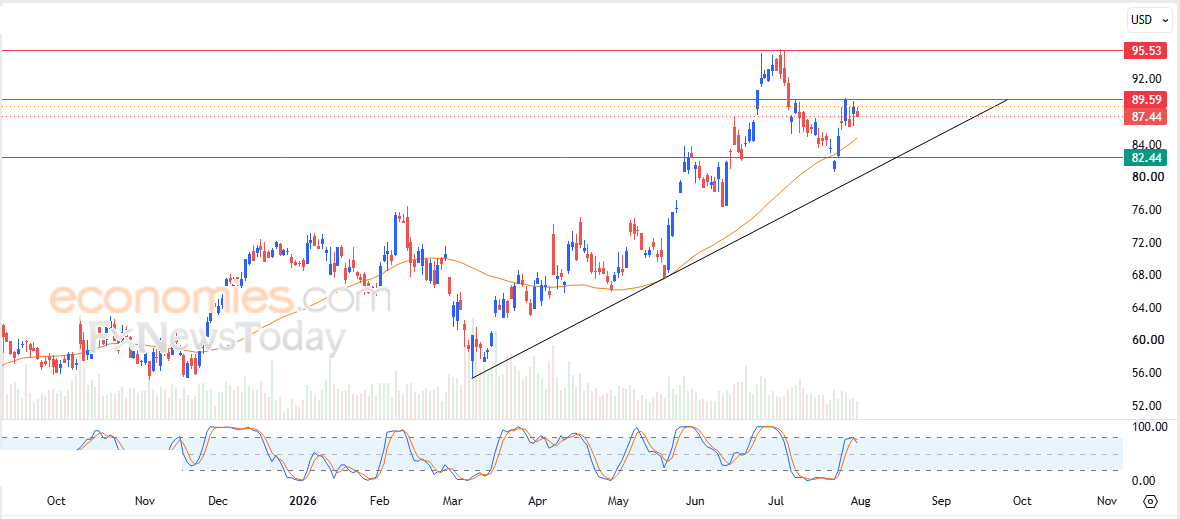
Delta Air Lines, Inc. (DAL) edged lower in recent intraday trading after the stock once again held below the current resistance level at $89.60. This pullback appears to be allowing the stock to rebuild positive momentum that could support a breakout above that resistance. At the same time, the stock is working off part of its overbought conditions on the momentum indicators, although fresh bearish signals have started to emerge. Despite this, the broader technical outlook remains constructive, with the stock continuing to trade above its 50-day Simple Moving Average (SMA), which is acting as dynamic support and reinforcing the primary short-term uptrend. Price action also continues to follow an ascending trendline that supports the prevailing bullish trend.
Therefore, our outlook remains bullish for the stock’s upcoming trading sessions, particularly if it breaks above the key resistance level at $89.60. Under this scenario, the stock is expected to target the next major resistance level at $95.50.
Today’s price forecast: Bullish.
The pound sterling has started to show relevant strength against the U.S. dollar. At the moment, GBP/USD has gained slightly more than 1.3% in the short term, reflecting an important buying bias.
Buying pressure began to gain relevance after the Federal Reserve decision during yesterday’s session and strengthened even further after the Bank of England decision today. For now, the central bank dynamic could continue to be key for demand in the pound sterling and maintain possible buying pressure on GBP/USD over the next few trading sessions.
During today’s session, the Bank of England published its interest rate decision and kept the reference rate at 3.75%, in line with expectations. However, the vote delivered an important signal: 6 members voted to keep rates unchanged, while 3 members voted for a 0.25% hike.
Although the rate did not change, this division was interpreted as a slightly more aggressive signal, as it shows that an important part of the committee is starting to consider the need for further increases over the coming months.
In the statement after the decision, the central bank highlighted that energy prices remain volatile and that this factor could continue to pressure inflation. For this reason, although additional hikes were not confirmed, the BoE does not appear ready to ease its stance either. If annual inflation fails to move closer to the 2.00% target, the central bank could continue to consider a more restrictive monetary policy.
The dynamic in the United States was slightly different. Although the Federal Reserve also kept rates unchanged in the 3.50% – 3.75% range, Kevin Warsh’s comments after the decision did not offer a clear signal of a possible hike in September.
This difference is important because the market expected a more aggressive stance from the Fed, but the event did not confirm that expectation. According to the CME Group probability table, for the September 16 decision, there is still a probability near 61% of a rate hike in the United States. However, a probability of almost 40% that rates remain unchanged has also started to emerge, something that had not been observed with the same strength in previous weeks.
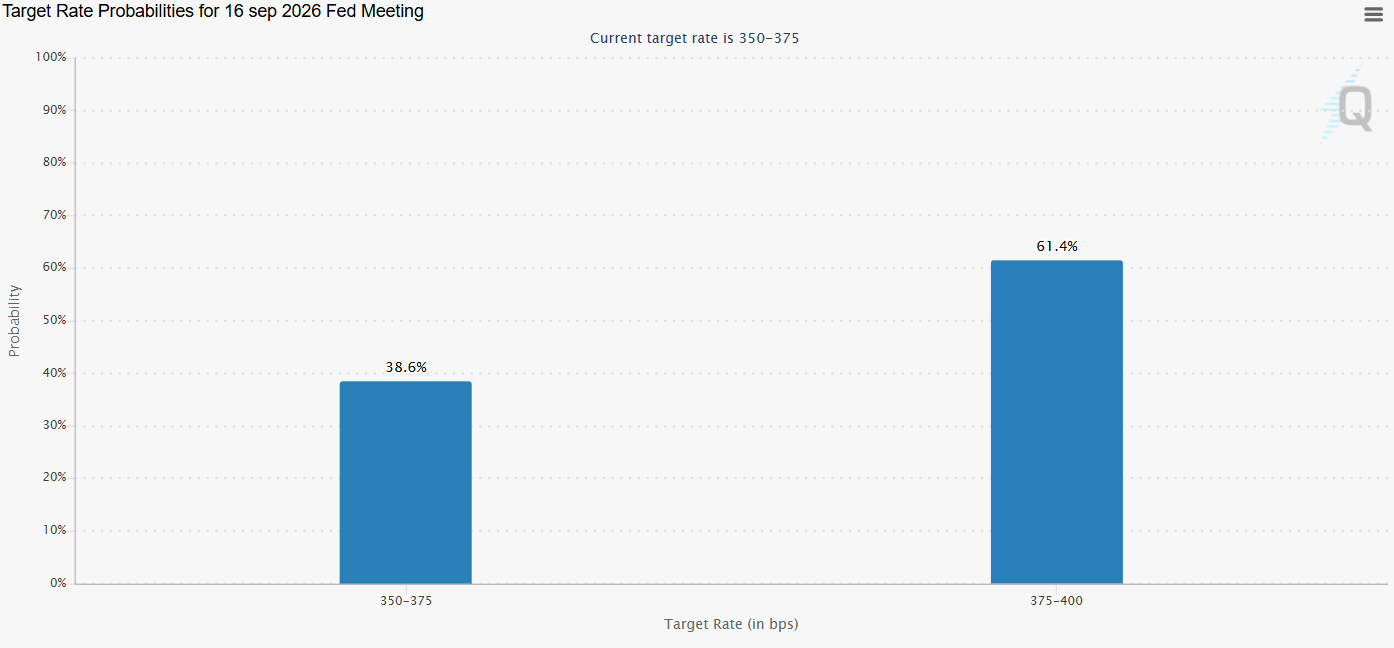
Source: CMEGROUP
As a result, the market is facing an interesting dynamic. In the United States, expectations of a more aggressive Fed have lost strength, while in the United Kingdom, the BoE showed internal division that keeps open the possibility of a more restrictive stance if inflation remains a problem.
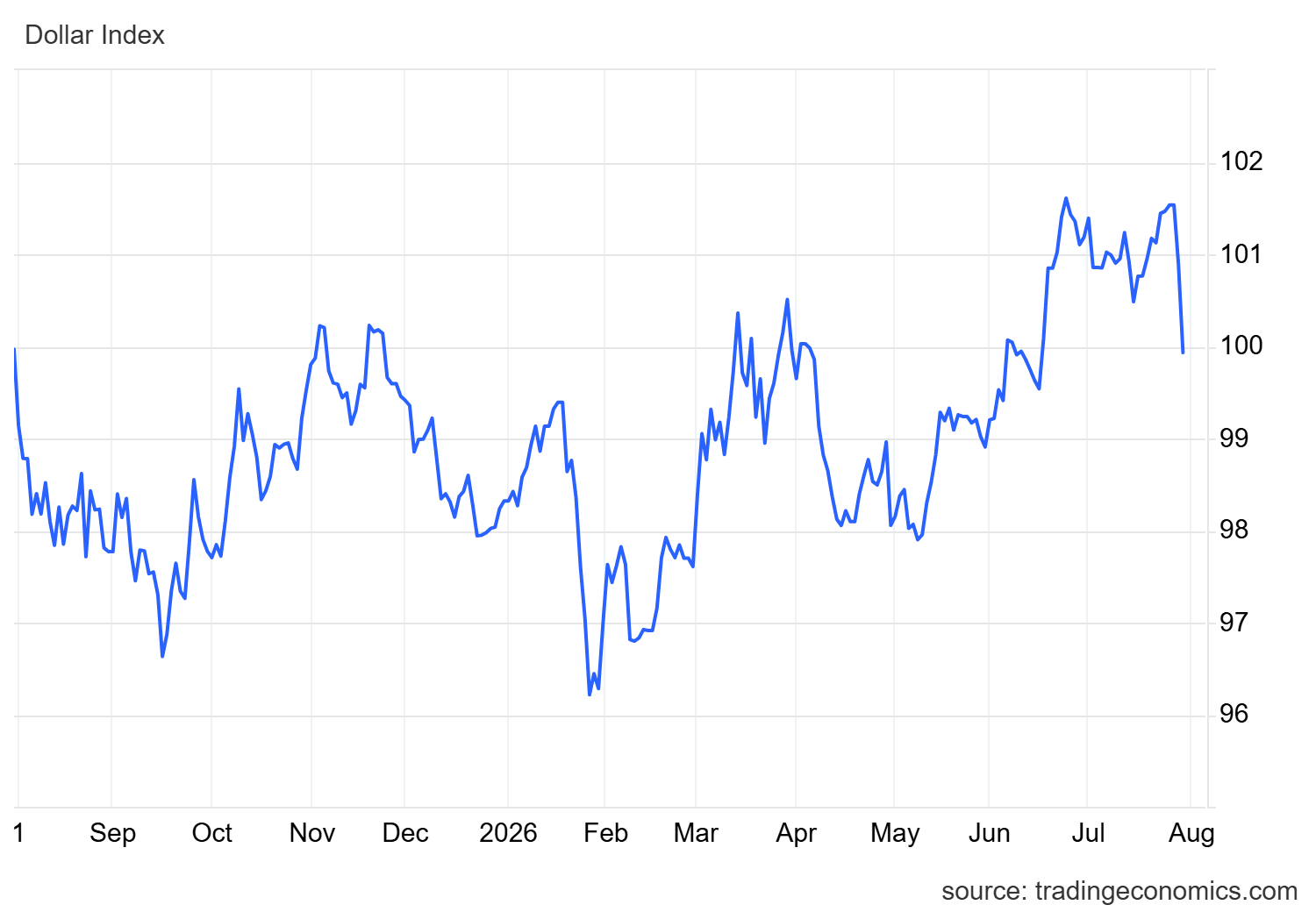
This contrast has started to be reflected in the U.S. dollar. The DXY index, which measures the dollar’s strength against its main peers, has shown a relevant decline since the Federal Reserve announcement and is now below the 100-point area. This suggests that demand for the dollar has started to weaken significantly after the U.S. central bank decision.
Source: TradingEconomics
With this in mind, and considering that both the United States and the United Kingdom maintain rates near 3.75%, the main difference lies in each central bank’s message. While the market is starting to price in a Bank of England that appears more willing to act if necessary, the Federal Reserve has reduced signals of early rate increases.
This dynamic could continue to weigh on the dollar and open room for the pound sterling to recover more consistently. If this scenario remains in place, GBP/USD could continue to show buying pressure over the next few trading sessions.
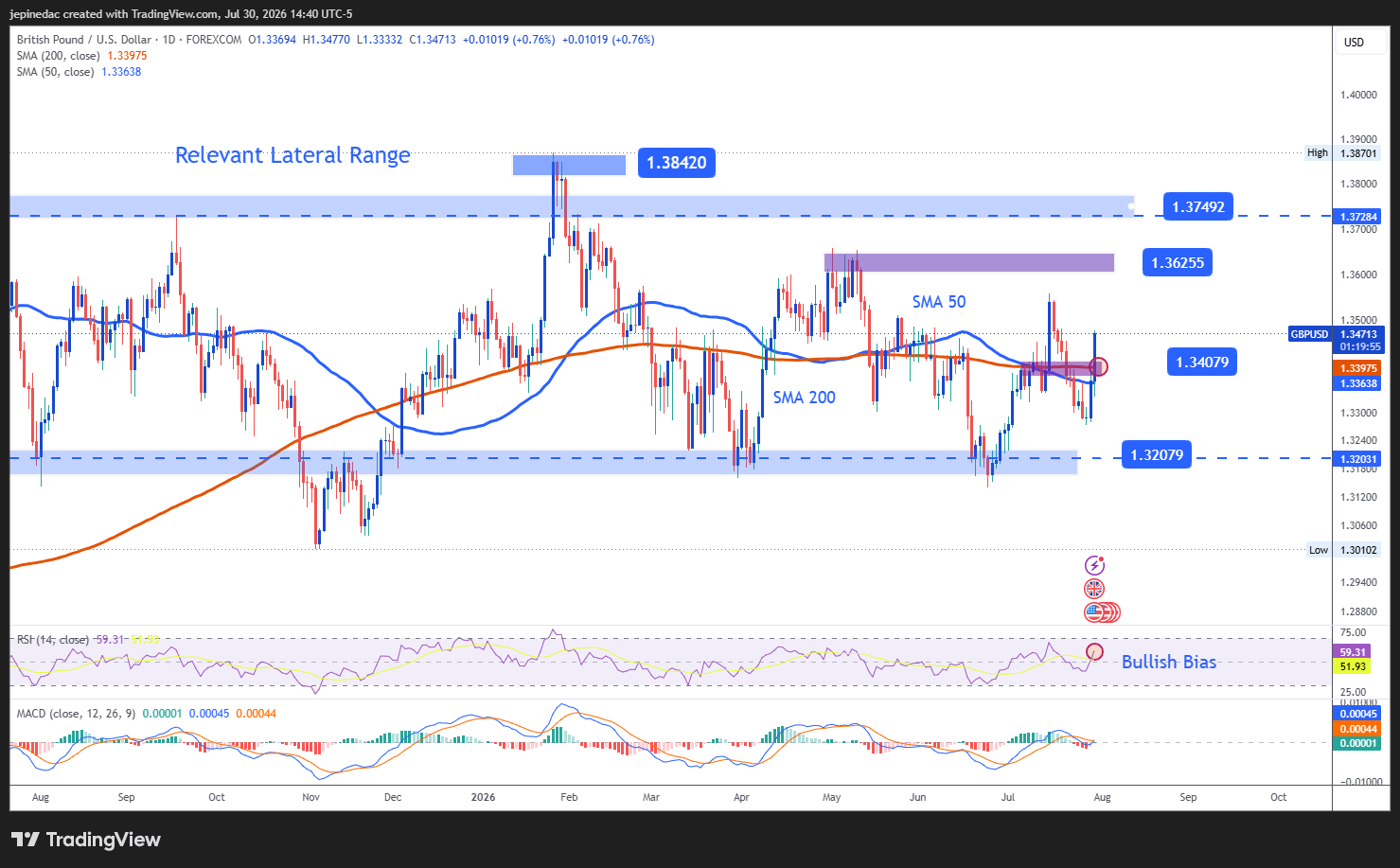
Source: StoneX, Tradingview
Key levels:
Written by Julian Pineda, CFA, CMT – Market Analyst
Follow him on: @julianpineda25
Silver price (XAG/USD) rises after registering modest gains in the previous day, trading around $58.20 per troy ounce during the Asian hours on Monday. Silver prices climb as market sentiment shifted following statements from US President Donald Trump, who announced that peace talks with Iran are set to resume on Monday. The prospect of diplomacy helped send oil prices lower, offering relief to investors concerned about rising inflation and the broader outlook for interest rates.
President Trump noted that key Middle Eastern allies, including Saudi Arabia, had urged him to halt planned military strikes in favor of a diplomatic solution, while he reiterated his call for the immediate reopening of the Strait of Hormuz.
Beyond geopolitical developments, investors are turning their attention to a busy week of US labor market data, anchored by Friday’s closely watched monthly jobs report. This economic focus comes on the heels of the Federal Reserve’s recent decision to hold interest rates steady.
However, that decision was not unanimous; three Fed officials dissented, cautioning that delaying action could force the central bank into more aggressive policy tightening down the road. In response to these mixed signals, financial markets are currently pricing in roughly a 68% chance of a 25 basis point rate hike at the Fed’s upcoming September meeting.
According to analysts at Commerzbank, the outlook for the other bullion, gold, remains constrained by the policy path in the US. They argue that “the persistent expectation of Fed interest rate rises should counteract any rise in the gold price,” with ongoing tightening expectations limiting the scope for a sustained move higher even after the recent post-meeting spike.
Silver is a precious metal highly traded among investors. It has been historically used as a store of value and a medium of exchange. Although less popular than Gold, traders may turn to Silver to diversify their investment portfolio, for its intrinsic value or as a potential hedge during high-inflation periods. Investors can buy physical Silver, in coins or in bars, or trade it through vehicles such as Exchange Traded Funds, which track its price on international markets.
Silver prices can move due to a wide range of factors. Geopolitical instability or fears of a deep recession can make Silver price escalate due to its safe-haven status, although to a lesser extent than Gold’s. As a yieldless asset, Silver tends to rise with lower interest rates. Its moves also depend on how the US Dollar (USD) behaves as the asset is priced in dollars (XAG/USD). A strong Dollar tends to keep the price of Silver at bay, whereas a weaker Dollar is likely to propel prices up. Other factors such as investment demand, mining supply – Silver is much more abundant than Gold – and recycling rates can also affect prices.
Silver is widely used in industry, particularly in sectors such as electronics or solar energy, as it has one of the highest electric conductivity of all metals – more than Copper and Gold. A surge in demand can increase prices, while a decline tends to lower them. Dynamics in the US, Chinese and Indian economies can also contribute to price swings: for the US and particularly China, their big industrial sectors use Silver in various processes; in India, consumers’ demand for the precious metal for jewellery also plays a key role in setting prices.
Silver prices tend to follow Gold’s moves. When Gold prices rise, Silver typically follows suit, as their status as safe-haven assets is similar. The Gold/Silver ratio, which shows the number of ounces of Silver needed to equal the value of one ounce of Gold, may help to determine the relative valuation between both metals. Some investors may consider a high ratio as an indicator that Silver is undervalued, or Gold is overvalued. On the contrary, a low ratio might suggest that Gold is undervalued relative to Silver.
Over the past few weeks, the USD/JPY pair has been trading amid concerns about potential currency interventions. Eventually, the Forex market saw them happen. The coordinated intervention was meant to further temper speculators. Let’s discuss this topic and develop a trading plan.
The article covers the following subjects:
The first coordinated currency intervention since 1998 aimed at supporting the yen has raised many questions. Is Japan truly so vulnerable that it cannot counter USD/JPY bulls on its own? Why would the US support such an effort? Which other countries, if any, were involved? Finally, why did the euro become a target for selling pressure rather than the US dollar alone?
According to Bloomberg, around $53 billion was deployed on the first day of intervention. Since September 2022, Japan has spent approximately $255 billion on currency interventions. With foreign exchange reserves exceeding $1 trillion, Tokyo theoretically had sufficient resources to act independently. However, a significant portion of those reserves is invested in US Treasury securities. Selling these assets aggressively would push Treasury yields higher—an outcome that does not align with US policy objectives.
Source: Bloomberg.
According to Mizuho Bank, it was precisely the Ministry of Finance—led by Scott Bessent—that did not want volatility in Japan’s debt market to continue negatively affecting the US debt market, and this was the main reason for US participation in the coordinated intervention.
Why was the euro chosen as the target? The answer may be simpler than attempts to link it to the concept of a strong dollar. According to JPMorgan, the US Treasury’s Exchange Stabilization Fund held assets of approximately $13 billion and €25 billion. While this amount alone would clearly be insufficient for a large-scale intervention, the combined resources of Japan and a potential third participant could have provided a more substantial firepower. Against this backdrop, the FX market speculates that South Korea may also have taken part in the coordinated currency intervention.
Source: Bloomberg.
Notably, the timing was perfect. Speculators had pushed net short positions in the yen to their highest levels since 2024, while hedge funds’ short positions had soared to their highest level since 2007. Confusion over whether Kevin Warsh wants to raise rates or will wait until the last minute caused investors to flee the US dollar.
The key question is whether the current USD/JPY exchange rate is fundamentally justified. Based on the yield spread between US and Japanese government bonds, the pair appears to have moved closer to levels supported by market fundamentals. However, currency markets are also pricing in expectations for future Fed and Bank of Japan interest-rate policies. This is where Tokyo’s cautious approach could become a vulnerability—potentially leading to the pattern seen after the interventions in April and May. In that scenario, the dollar could resume its advance.
Source: Bloomberg.
The joint intervention managed to scare speculators but hardly discouraged traders from attempting to recover their losses. In currency markets, every victory comes with the possibility of a setback. The strategy of selling USD/JPY from 163.35 proved highly effective. However, the Bank of Japan’s slow response and the renewed activity of carry traders create conditions for taking profits and considering long positions—at least while the pair remains above ¥156.
This forecast is based on the analysis of fundamental factors, including official statements from financial institutions and regulators, various geopolitical and economic developments, and statistical data. Historical market data are also considered.
The content of this article reflects the author’s opinion and does not necessarily reflect the official position of LiteFinance broker. The material published on this page is provided for informational purposes only and should not be considered as the provision of investment advice for the purposes of Directive 2014/65/EU.
According to copyright law, this article is considered intellectual property, which includes a prohibition on copying and distributing it without consent.
Domestic coffee prices today
Coffee prices today in the domestic market decreased slightly compared to the previous session. According to giacaphe. com, coffee prices on August 3rd averaged 96,600 VND/kg, down 200 VND/kg. The highest price in key Central Highlands regions was recorded at 96,700 VND/kg.
In Lam Dong, coffee prices today reached 96,000 VND/kg, down 200 VND/kg compared to the previous session. This is the region with the lowest price in the detailed update table.
In Gia Lai, coffee prices were recorded at 96,500 VND/kg, down 200 VND/kg compared to the previous day.
The old Dak Nong area recorded a level of 96,700 VND/kg, belonging to the highest group among the surveyed areas.
After the rebound in early August, domestic coffee prices have turned down slightly. The decrease of 200 VND/kg is not large, but it shows that the domestic market still does not have a clear breakthrough to return to the area close to 99,000 VND/kg as at the end of July.
World coffee prices
In the world market, coffee prices increased in the most recent trading session, but Robusta’s increase range is very narrow.
According to Barchart, the September 2026 Arabica futures contract closed up 9.05 US cents/lb, equivalent to 2.80%. This is a much stronger increase than Robusta.
In the same session, the September 2026 Robusta futures contract increased by 2 USD/ton, equivalent to 0.05%, to 3.782 USD/ton. This increase shows that Robusta is almost sideways, although still maintaining green color.
Coffee price assessment
Domestic coffee prices slightly decreased even though the world market just had an increase session. The deviation is in Robusta: Arabica increased sharply, but Robusta London only increased by 0.05%, not enough to create a clear pulling force for domestic purchase prices.
Arabica increased due to short-term supply constraints, in the context of Arabica stocks certified on ICE continuously decreasing for about 4.5 months and falling to a 2.5-year low.
Meanwhile, heavy rain was recorded in the Minas Gerais region of Brazil and slower harvest progress than the same period were factors supporting coffee prices in the recent session. However, this factor is more clearly reflected in Arabica, while Robusta fluctuates narrowly.
Regarding domestic weather, the National Center for Hydro-Meteorological Forecasting said that on the day and night of August 3rd, the Central Highlands area will have showers and thunderstorms in some places; especially in the late afternoon and evening, there will be scattered showers and thunderstorms in some places. The lowest temperature is 20-23 degrees Celsius, the highest is 28-31 degrees Celsius, in some places above 31 degrees Celsius. This season’s thunderstorms need to be monitored in the garden care, pest and disease prevention and goods preservation stages.
In the coming sessions, the diễn biến of Robusta London, USD/VND exchange rate, inventory and demand for export purchases will continue to dominate the domestic price level.