The GBPCAD faced strong bearish pressures, which force it to break the bullish channel’s support at 1.8425, to begin forming strong bearish waves, targeting 1.8220 level.
We notice providing negative momentum by the main indicators to confirm the surrender of the negative scenario, to keep preferring the bearish attempts, which might target extra stations that begin at 1.8160 and 1.8080.
The expected trading range for today is between 1.8160 and 1.8355
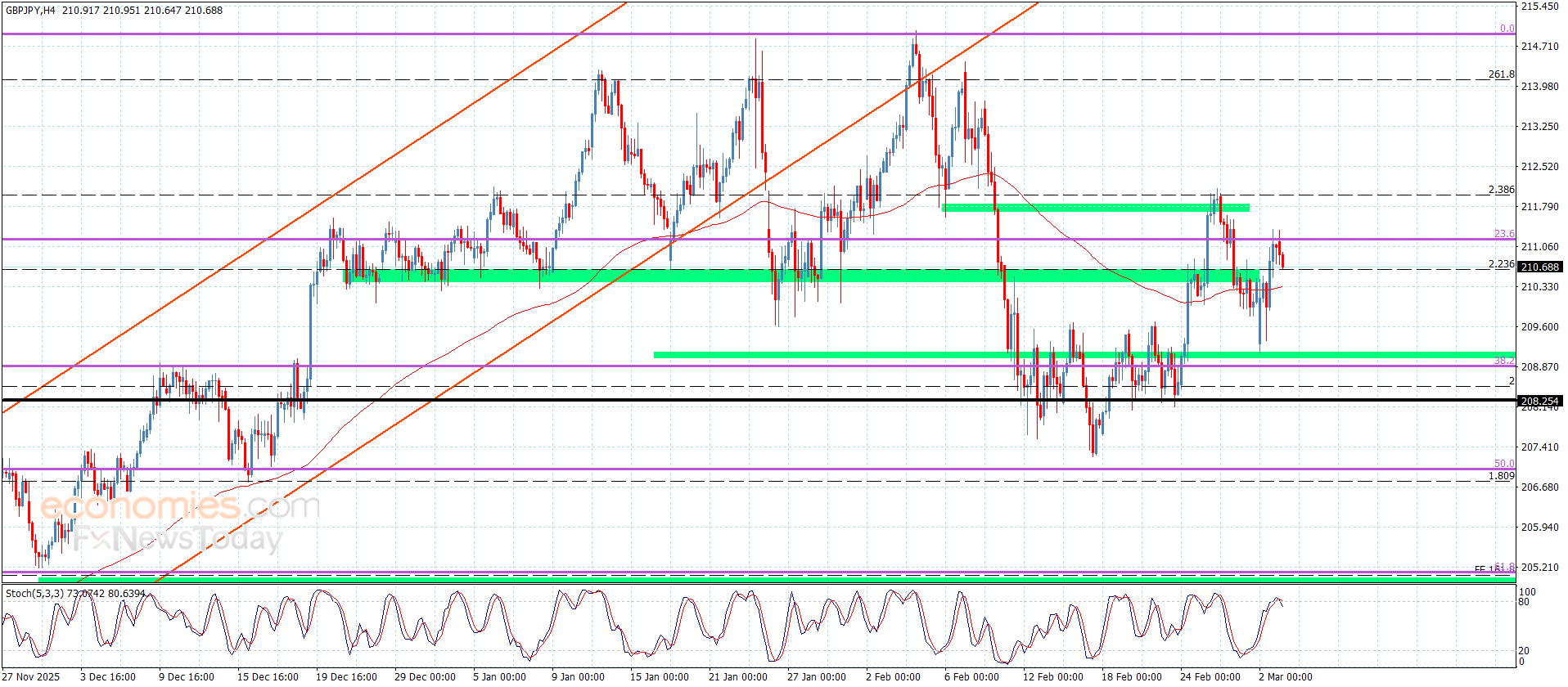
The GBPJPY pair activated the bullish attempts, to achieve the suggested target by reaching 211.25, facing a key barrier which forces it to form new negative rebound, to settle near the initial support at 210.65 level.
Note that the continuation of the main indicators contradiction by the price stability below 211.25 might push it to form new bearish waves, attempting to reach 209.85 to press on 209.15 support, while confirming the positivity requires forming strong bullish rally, to settle above 211.25, to ease the mission of targeting the next positive level at 212.05.
The expected trading range for today is between 209.80 and 211.00
Important DisclaimersFXEmpire is owned and operated by Empire Media Network LTD., Company Registration Number 514641786, registered at 7 Jabotinsky Road, Ramat Gan 5252007, Israel. The content provided on this website includes general news and publications, our personal analysis and opinions, and materials provided by third parties. This content is intended for educational and research purposes only. It does not constitute, and should not be interpreted as, a recommendation or advice to take any action, including making any investment or purchasing any product. Before making any financial decision, you should conduct your own due diligence, exercise your own discretion, and consult with competent advisors. The content on this website is not personally directed to you, and we do not take into account your individual financial situation or needs. The information contained on this website is not necessarily provided in real time, nor is it guaranteed to be accurate. Prices displayed may be provided by market makers and not by exchanges. Any trading or other financial decision you make is entirely your own responsibility, and you must not rely solely on any information provided through the website. FXEmpire does not provide any warranty regarding the accuracy, completeness, or reliability of any information contained on the website and shall bear no responsibility for any trading losses you may incur as a result of using such information. The website may include advertisements and other promotional content. FXEmpire may receive compensation from third parties in connection with such content. FXEmpire does not endorse, recommend, or assume responsibility for the use of any third-party services or websites. Empire Media Network LTD., its employees, officers, subsidiaries, and affiliates shall not be liable for any loss or damage resulting from your use of the website or reliance on the information provided herein.Risk DisclaimersThis website contains information about cryptocurrencies, contracts for difference (CFDs), and other financial instruments, as well as about brokers, exchanges, and other entities trading in such instruments. Both cryptocurrencies and CFDs are complex instruments and involve a high risk of losing money. You should carefully consider whether you understand how these instruments work and whether you can afford to take the high risk of losing your money. FX Empire encourages you to conduct your own research before making any investment decision and to avoid investing in any financial instrument unless you fully understand how it works and the risks involved.
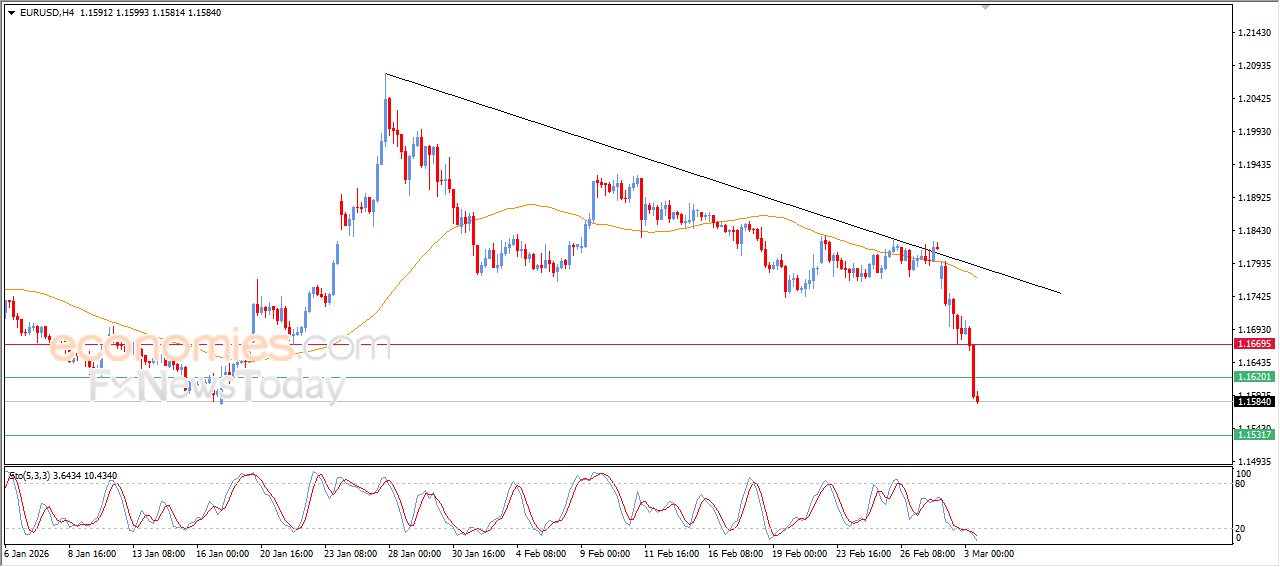
EUR/USD extends its slide after closing deep in negative territory on Monday and closes in on 1.1600. The risk-averse market atmosphere could make it difficult for the pair to stage a rebound, despite technically oversold conditions.
Euro Price This week
The table below shows the percentage change of Euro (EUR) against listed major currencies this week. Euro was the weakest against the Australian Dollar.
USD
EUR
GBP
JPY
CAD
AUD
NZD
CHF
USD
1.23%
0.82%
0.99%
0.36%
-0.15%
0.84%
2.22%
EUR
-1.23%
-0.41%
-0.27%
-0.86%
-1.36%
-0.38%
0.97%
GBP
-0.82%
0.41%
-0.06%
-0.45%
-0.96%
0.03%
1.38%
JPY
-0.99%
0.27%
0.06%
-0.57%
-1.09%
-0.04%
1.25%
CAD
-0.36%
0.86%
0.45%
0.57%
-0.55%
0.54%
1.85%
AUD
0.15%
1.36%
0.96%
1.09%
0.55%
0.99%
2.37%
NZD
-0.84%
0.38%
-0.03%
0.04%
-0.54%
-0.99%
1.37%
CHF
-2.22%
-0.97%
-1.38%
-1.25%
-1.85%
-2.37%
-1.37%
The heat map shows percentage changes of major currencies against each other. The base currency is picked from the left column, while the quote currency is picked from the top row. For example, if you pick the Euro from the left column and move along the horizontal line to the US Dollar, the percentage change displayed in the box will represent EUR (base)/USD (quote).
The US Dollar (USD) capitalized on safe-haven flows at the beginning of the week and caused EUR/USD to push lower as markets reacted to the US and Israel carrying out a joint military operation against Iran. Reflecting the broad-based USD strength, the USD Index gained nearly 1% on a daily basis on Monday.
Early Tuesday, US stock index futures are down more than 1% on the day and the Euro Stoxx 50 Index loses about 2.3%. In turn, the USD Index preserves its bullish momentum and trades at its highest level since late January above 99.00.
US military officials said early Tuesday that they have destroyed command posts of Iran’s Revolutionary Guards, as well as Iranian air defense and missile launch sites since the start of the joint offensive on Saturday. Meanwhile, Iran fired missiles and drones at several Persian Gulf countries, including a drone strike that hit the US Embassy in Saudi Arabia’s capital, Riyadh. US President Donald Trump said that he doesn’t think “boots on the ground” will be necessary and added that the US will soon respond to the attack on the US embassy in Riyadh soon.
The European economic calendar will feature the preliminary Harmonized Index of Consumer Prices (HICP) data for February, which is unlikely to trigger a market reaction.
Later in the day, policymakers from the European Central Bank (ECB) and the Federal Reserve (Fed) will be delivering speeches.
ECB chief economist Philip Lane said early Tuesday that a prolonged conflict in the Middle East could lead to a substantial spike in inflation and also cause a sharp drop in output in the Euro Area. Additionally, ECB policymaker Martin Kocher told the Wall Street Journal on Monday that the ECB should be prepared to move interest rates quickly in either direction. In case ECB officials voice concerns over upside risks to inflation, the Euro could find a foothold in the near term and help EUR/USD limit its losses.
In the meantime, markets seem to be assessing the uncertainty created by the Middle East crisis as a factor that could cause the Fed to delay policy-easing. According to the CME FedWatch Tool, the probability of a Fed rate cut in June declined to about 36% from nearly 46% on Friday. Hence, the USD could continue to outperform its rivals if Fed policymakers hint that they would prefer to remain patient until they have a better understanding of the potential impact of the US-Iran war on inflation and the broad economic outlook.
EUR/USD Technical Analysis:
In the 4-hour chart, EUR/USD trades at 1.1635. The near-term bias is bearish as the pair holds below the 20-, 50- and 100-period Simple Moving Averages (SMAs), while the 50- and 100-period SMAs cap price beneath the gently rising 200-period SMA near 1.1805, signalling persistent downside pressure within a broader consolidation. The Relative Strength Index (RSI) sits near 26, in oversold territory, which reflects strong selling momentum but also warns that further declines would stretch the move. Price has slipped beneath the 61.8% Fibonacci retracement at 1.1757, measured from the 1.1590 low to the 1.2027 high, reinforcing the corrective slide from the upper range.
Immediate resistance now appears at the 61.8% retracement at 1.1757, followed by the 50% retracement at 1.1809, where the cluster of SMAs around 1.1780–1.1820 forms a broader supply zone that would need to break to ease the bearish tone. On the downside, support is seen at the recent Fibonacci anchor low at 1.1590, ahead of the horizontal levels at 1.1540 and 1.1500, which guard deeper losses. A sustained break below 1.1590 would open the path toward 1.1540, while recovery attempts below 1.1757 are expected to face selling interest.
(The technical analysis of this story was written with the help of an AI tool.)
Euro FAQs
The Euro is the currency for the 20 European Union countries that belong to the Eurozone. It is the second most heavily traded currency in the world behind the US Dollar. In 2022, it accounted for 31% of all foreign exchange transactions, with an average daily turnover of over $2.2 trillion a day.
EUR/USD is the most heavily traded currency pair in the world, accounting for an estimated 30% off all transactions, followed by EUR/JPY (4%), EUR/GBP (3%) and EUR/AUD (2%).
The European Central Bank (ECB) in Frankfurt, Germany, is the reserve bank for the Eurozone. The ECB sets interest rates and manages monetary policy.
The ECB’s primary mandate is to maintain price stability, which means either controlling inflation or stimulating growth. Its primary tool is the raising or lowering of interest rates. Relatively high interest rates – or the expectation of higher rates – will usually benefit the Euro and vice versa.
The ECB Governing Council makes monetary policy decisions at meetings held eight times a year. Decisions are made by heads of the Eurozone national banks and six permanent members, including the President of the ECB, Christine Lagarde.
Eurozone inflation data, measured by the Harmonized Index of Consumer Prices (HICP), is an important econometric for the Euro. If inflation rises more than expected, especially if above the ECB’s 2% target, it obliges the ECB to raise interest rates to bring it back under control.
Relatively high interest rates compared to its counterparts will usually benefit the Euro, as it makes the region more attractive as a place for global investors to park their money.
Data releases gauge the health of the economy and can impact on the Euro. Indicators such as GDP, Manufacturing and Services PMIs, employment, and consumer sentiment surveys can all influence the direction of the single currency.
A strong economy is good for the Euro. Not only does it attract more foreign investment but it may encourage the ECB to put up interest rates, which will directly strengthen the Euro. Otherwise, if economic data is weak, the Euro is likely to fall.
Economic data for the four largest economies in the euro area (Germany, France, Italy and Spain) are especially significant, as they account for 75% of the Eurozone’s economy.
Another significant data release for the Euro is the Trade Balance. This indicator measures the difference between what a country earns from its exports and what it spends on imports over a given period.
If a country produces highly sought after exports then its currency will gain in value purely from the extra demand created from foreign buyers seeking to purchase these goods. Therefore, a positive net Trade Balance strengthens a currency and vice versa for a negative balance.
The GBPJPY pair activated the bullish attempts, to achieve the suggested target by reaching 211.25, facing a key barrier which forces it to form new negative rebound, to settle near the initial support at 210.65 level.
Note that the continuation of the main indicators contradiction by the price stability below 211.25 might push it to form new bearish waves, attempting to reach 209.85 to press on 209.15 support, while confirming the positivity requires forming strong bullish rally, to settle above 211.25, to ease the mission of targeting the next positive level at 212.05.
The expected trading range for today is between 209.80 and 211.00
The GBP/USD pair claws back its significant early losses during the European trading session on Monday, but is still 0.6% down to near 1.3400. The pair is still under pressure as the Pound Sterling (GBP) underperforms due to risk-off market sentiment amid the war between the United States (US), Israel, and Iran.
Pound Sterling Price Today
The table below shows the percentage change of British Pound (GBP) against listed major currencies today. British Pound was the weakest against the US Dollar.
USD
EUR
GBP
JPY
CAD
AUD
NZD
CHF
USD
0.70%
0.57%
0.53%
0.12%
0.47%
0.67%
0.63%
EUR
-0.70%
-0.13%
-0.18%
-0.57%
-0.22%
-0.03%
-0.07%
GBP
-0.57%
0.13%
-0.04%
-0.45%
-0.10%
0.09%
0.06%
JPY
-0.53%
0.18%
0.04%
-0.39%
-0.05%
0.15%
0.12%
CAD
-0.12%
0.57%
0.45%
0.39%
0.35%
0.54%
0.51%
AUD
-0.47%
0.22%
0.10%
0.05%
-0.35%
0.20%
0.16%
NZD
-0.67%
0.03%
-0.09%
-0.15%
-0.54%
-0.20%
-0.04%
CHF
-0.63%
0.07%
-0.06%
-0.12%
-0.51%
-0.16%
0.04%
The heat map shows percentage changes of major currencies against each other. The base currency is picked from the left column, while the quote currency is picked from the top row. For example, if you pick the British Pound from the left column and move along the horizontal line to the US Dollar, the percentage change displayed in the box will represent GBP (base)/USD (quote).
S&P 500 futures plunged almost 1% ahead of the US markets’ opening, showing depressed appetite for risky assets. At the press time, the US Dollar Index (DXY), which tracks the Greenback’s value against six major currencies, trades 0.6% higher to near 98.20.
On Saturday, the US and Israel launched a wave of strikes against Iran, which resulted in the execution of Tehran’s 48 top leaders, including Supreme Leader Ayatollah Ali Khamenei, according to Fox News.
Meanwhile, the war is expected to escalate further as Iran’s security chief Ali Larijani has refused to come to the table for negotiations with the US on stopping the massacre.
Going forward, investors will focus on the US ISM Manufacturing PMI data for February, which will be published at 15:00 GMT. The Manufacturing PMI is expected to come in lower at 51.8 from 52.6 in January.
GBP/USD technical analysis
GBP/USD trades sharply lower at around 1.3404 as of writing. The near-term bias turns bearish as spot extends below the 20-day Exponential Moving Average (EMA), which now caps recovery attempts around 1.35. The sequence of lower lows from the mid-1.36 area confirms an immediate downtrend.
The 14-day Relative Strength Index (RSI) slipping below 40.00 after consolidating the 40.00-60.00 range for almost a month signals building downside pressure.
Initial resistance sits at the 20-day EMA near 1.3530, with a sustained break above that area needed to ease bearish pressure and reopen the 1.3650 region. On the downside, immediate support aligns with the intraday low of 1.3315. A daily close below that level would strengthen the current downswing and open the door towards the December 3 low of 1.3203.
(The technical analysis of this story was written with the help of an AI tool.)
Economic Indicator
ISM Manufacturing PMI
The Institute for Supply Management (ISM) Manufacturing Purchasing Managers Index (PMI), released on a monthly basis, is a leading indicator gauging business activity in the US manufacturing sector. The indicator is obtained from a survey of manufacturing supply executives based on information they have collected within their respective organizations. Survey responses reflect the change, if any, in the current month compared to the previous month. A reading above 50 indicates that the manufacturing economy is generally expanding, a bullish sign for the US Dollar (USD). A reading below 50 signals that factory activity is generally declining, which is seen as bearish for USD.
Important DisclaimersFXEmpire is owned and operated by Empire Media Network LTD., Company Registration Number 514641786, registered at 7 Jabotinsky Road, Ramat Gan 5252007, Israel. The content provided on this website includes general news and publications, our personal analysis and opinions, and materials provided by third parties. This content is intended for educational and research purposes only. It does not constitute, and should not be interpreted as, a recommendation or advice to take any action, including making any investment or purchasing any product. Before making any financial decision, you should conduct your own due diligence, exercise your own discretion, and consult with competent advisors. The content on this website is not personally directed to you, and we do not take into account your individual financial situation or needs. The information contained on this website is not necessarily provided in real time, nor is it guaranteed to be accurate. Prices displayed may be provided by market makers and not by exchanges. Any trading or other financial decision you make is entirely your own responsibility, and you must not rely solely on any information provided through the website. FXEmpire does not provide any warranty regarding the accuracy, completeness, or reliability of any information contained on the website and shall bear no responsibility for any trading losses you may incur as a result of using such information. The website may include advertisements and other promotional content. FXEmpire may receive compensation from third parties in connection with such content. FXEmpire does not endorse, recommend, or assume responsibility for the use of any third-party services or websites. Empire Media Network LTD., its employees, officers, subsidiaries, and affiliates shall not be liable for any loss or damage resulting from your use of the website or reliance on the information provided herein.Risk DisclaimersThis website contains information about cryptocurrencies, contracts for difference (CFDs), and other financial instruments, as well as about brokers, exchanges, and other entities trading in such instruments. Both cryptocurrencies and CFDs are complex instruments and involve a high risk of losing money. You should carefully consider whether you understand how these instruments work and whether you can afford to take the high risk of losing your money. FX Empire encourages you to conduct your own research before making any investment decision and to avoid investing in any financial instrument unless you fully understand how it works and the risks involved.
The Euro has been very choppy during the month of February as traders are trying to figure out where the two central banks are heading at the moment.
EURUSD
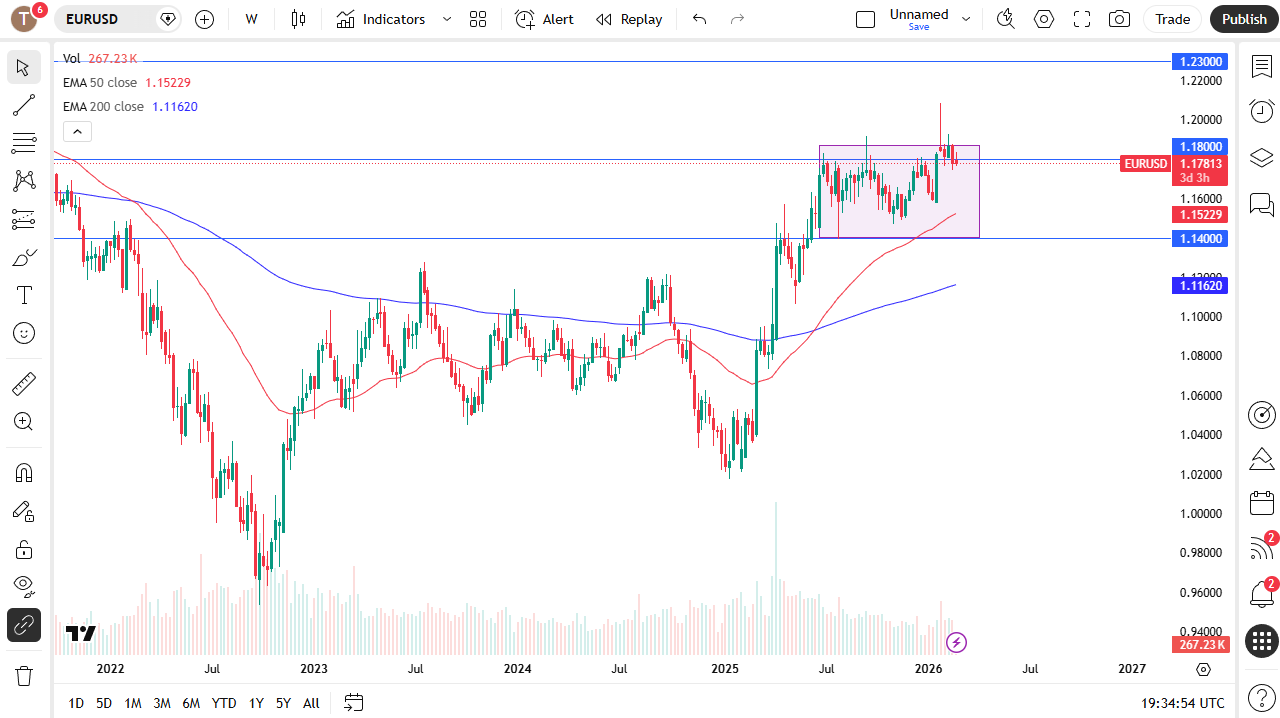
The Euro has been very choppy during the month of February as traders continue to try to sort out what the outlook is going to be for the Federal Reserve and the US dollar. Quite frankly, this pair will probably move on what goes on in Washington DC rather than anything on the continent of Europe, at least as far as I can see looking forward.
The Federal Reserve is thought to be potentially cutting rates 2 times later this year, but the reality is that the United States economy—not only the inflationary numbers but also the labor numbers—have made it not as certain as it once was. This has been the story for 2 years now where the market starts to try to price in the idea of the Federal Reserve cutting aggressively and the reality is something quite different.
Resistance and Monetary Policy
This is not to say that the US central bank is going to start hiking rates, but the reality is that it is not as dovish as a lot of people would have thought. With that being the case, I think you have to look at this as a pair that most likely will be choppy in the month of March as well. If we do rally, the 1.23 level is a major resistance barrier going back several years and it is at least in theory the measured move of the consolidation area that we have been in since last summer.
Quite frankly, this is all about the US dollar as I mentioned previously and I really don’t have an opinion on the Euro because we know that the European Central Bank is likely to be flat for the rest of the year as far as its monetary policy is concerned and economic growth, or lack of growth in the European Union depending on the country that you are talking about, is a bit of a mixed picture.
Ultimately, there are a lot of geopolitical concerns that could work in the favor of the US dollar so I believe that unless the Euro can break the 1.20 level during the month of March it is likely to remain a very tight market that you will be looking for fading signs of exhaustion.