The main tag of Forex News Today Articles.
You can use the search box below to find what you need.
[wd_asp id=1]

31 03, 2026

Critical Breakdown Below 184 as Bears Target 100-Day SMA Support

By |2026-03-31T08:00:20+02:00March 31, 2026|Forex News, News|0 Comments

BitcoinWorld

EUR/JPY Price Forecast: Critical Breakdown Below 184 as Bears Target 100-Day SMA Support

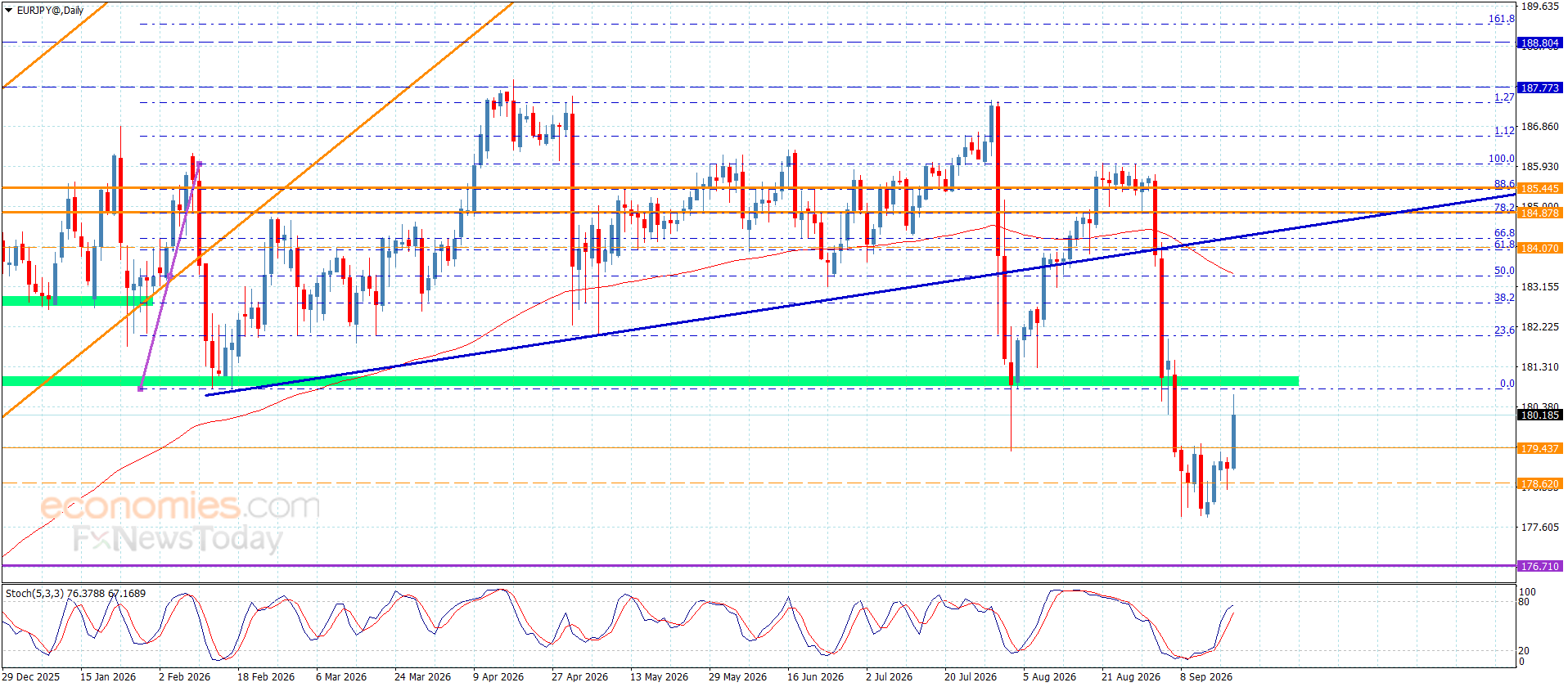
The EUR/JPY currency pair has breached a significant technical level, sliding below the 184.00 handle in European trading on Thursday, March 20, 2025. Consequently, market analysts now scrutinize the 100-day Simple Moving Average (SMA) as the next potential target for the prevailing bearish momentum. This move reflects a complex interplay of monetary policy divergence and shifting global risk sentiment.

EUR/JPY Forecast: Technical Breakdown Analysis

The recent price action for the Euro against the Japanese Yen shows a clear bearish shift. After failing to sustain gains above the 185.50 resistance zone, the pair experienced a sharp sell-off. This decline pushed it below the psychologically important 184.00 level. Technical indicators now align to suggest further downside potential. For instance, the Relative Strength Index (RSI) has dipped below 50, signaling increasing selling pressure. Meanwhile, the Moving Average Convergence Divergence (MACD) histogram has crossed into negative territory. These signals collectively point toward sustained bearish control in the near term.

Market participants closely monitor several key technical levels. The immediate support now rests at the 100-day Simple Moving Average, currently hovering around the 182.80 region. A decisive break below this moving average could trigger accelerated selling. This might then open the path toward the 181.50 support zone, which acted as a strong floor in late February. Conversely, any recovery attempt will likely face stiff resistance near the former support-turned-resistance at 184.00, followed by the 185.00 level.

Key Technical Levels for EUR/JPY

Resistance Level Price Significance
R1 184.00 Previous Support, Now Resistance
R2 185.00 Psychological Round Number
R3 185.50 Recent Swing High
Support Level Price Significance
S1 182.80 (100-day SMA) Major Moving Average Support
S2 181.50 Previous Congestion Zone
S3 180.00 Key Psychological Level

Fundamental Drivers Behind the Euro Yen Slide

The EUR/JPY price forecast cannot be separated from its fundamental underpinnings. Primarily, the pair acts as a barometer for global risk sentiment and interest rate differentials. Recently, several factors have converged to pressure the cross. Firstly, the European Central Bank (ECB) has maintained a cautious stance. Despite easing inflationary pressures, ECB officials emphasize a data-dependent approach. This contrasts with market expectations for more aggressive rate cuts. Consequently, the Euro has struggled to find sustained bullish catalysts.

Conversely, the Japanese Yen has garnered support from shifting expectations. The Bank of Japan (BoJ) has signaled a gradual move away from its ultra-accommodative policy framework. Markets now price in the potential for further policy normalization in 2025. This narrowing yield differential reduces the appeal of the carry trade, where investors borrow in low-yielding JPY to invest in higher-yielding assets. As this trade unwinds, it naturally supports the Yen against currencies like the Euro. Furthermore, a recent bout of risk aversion in global equity markets has boosted demand for the traditional safe-haven JPY.

Expert Analysis on Monetary Policy Divergence

Financial strategists point to policy divergence as a core theme. “The path for EUR/JPY is increasingly dictated by the pacing of ECB cuts versus BoJ hikes,” notes a senior currency analyst at a major European bank. “Current price action suggests the market is betting the BoJ will move faster to tighten than the ECB will to ease, compressing the yield spread.” This view is supported by recent options market data, which shows rising demand for protection against further Yen strength. Historical data also indicates that breaks below the 100-day SMA often precede extended trends, especially when accompanied by fundamental shifts.

Market Context and Historical Precedents

Understanding the current EUR/JPY forecast requires historical context. The pair enjoyed a strong bullish run throughout much of 2023 and early 2024, driven by a wide policy gap. However, trends often reverse when expectations shift. The last time the pair tested its 100-day SMA from above was in November 2024. On that occasion, it rebounded strongly. The critical question for traders is whether this level will hold again or signify a deeper correction.

The broader macroeconomic landscape provides additional clues. Global growth concerns, particularly stemming from China, often benefit the JPY as a safe haven. Simultaneously, geopolitical tensions in Europe can weigh on the Euro. Recent data shows:

  • Eurozone PMIs: Manufacturing remains in contraction, though services show modest growth.
  • Japanese Inflation: Core CPI remains above the BoJ’s 2% target, supporting hawkish policy arguments.
  • Yield Spreads: The Germany-Japan 10-year yield spread has narrowed by 25 basis points this quarter.

This combination creates a challenging environment for the Euro to gain traction against the Yen. Market sentiment, as measured by the CFTC Commitment of Traders report, shows a reduction in net-long Euro positions. This suggests institutional investors are scaling back bullish bets.

Conclusion

The EUR/JPY price forecast points to a cautious near-term outlook as the pair trades below 184. The immediate focus rests on the 100-day Simple Moving Average around 182.80. A sustained break below this technical indicator could validate the bearish momentum and target lower supports near 181.50. The primary drivers remain the evolving monetary policy paths of the ECB and BoJ, alongside fluctuations in global risk appetite. Traders should monitor upcoming central bank communications and key economic data releases from both regions for confirmation of the next directional move. The current technical breakdown underscores the importance of dynamic support levels in forex market analysis.

FAQs

Q1: What does it mean that EUR/JPY is below the 100-day SMA?
The 100-day Simple Moving Average is a key medium-term trend indicator. Trading below it suggests the prevailing medium-term trend has turned bearish, and it now acts as a dynamic resistance level that the price must reclaim to signal a potential recovery.

Q2: Why is the 184.00 level significant for EUR/JPY?
The 184.00 level is a major psychological round number and previously acted as a support zone. After breaking below it, this level often flips to become a strong resistance area, where selling pressure can re-emerge during any price rebounds.

Q3: What fundamental factors are driving the Japanese Yen’s strength?
The Yen is strengthening due to expectations that the Bank of Japan will continue to normalize its ultra-loose monetary policy, potentially raising interest rates. Additionally, periods of global market uncertainty increase demand for the JPY as a traditional safe-haven currency.

Q4: How does risk sentiment affect the EUR/JPY pair?
EUR/JPY is considered a “risk-sensitive” cross. When investor sentiment is positive (risk-on), capital tends to flow out of the safe-haven JPY into higher-yielding assets, often boosting EUR/JPY. In risk-off environments, the reverse occurs, pressuring the pair lower.

Q5: What key data should traders watch next for EUR/JPY direction?
Traders should monitor Eurozone inflation (CPI) and growth data, comments from ECB officials, Japanese wage growth and inflation figures, and BoJ policy meeting minutes. Any surprise in these data points can cause significant volatility in the currency pair.

This post EUR/JPY Price Forecast: Critical Breakdown Below 184 as Bears Target 100-Day SMA Support first appeared on BitcoinWorld.

Source link

30 03, 2026

GBP/USD Forecast: Pound Sterling Falls as Middle East Tensions Escalate

By |2026-03-30T23:57:52+02:00March 30, 2026|Forex News, News|0 Comments


– Written by

The Pound US Dollar (GBP/USD) exchange rate slipped to its lowest level in a fortnight on Monday, as escalating geopolitical tensions dampened market sentiment and drove demand for safer assets.

At the time of writing, GBP/USD was trading at $1.3229, down roughly 0.2% on the day.

The US Dollar firmed at the beginning of the week, supported by a cautious market mood as investors gravitated towards safer assets amid rising tensions in the Middle East.

Risk aversion strengthened after Yemen’s Houthi forces, closely aligned with Iran, entered the conflict over the weekend, fuelling fears of a wider regional escalation and increased global economic disruption.

Comments from President Donald Trump sparked some fluctuation but ultimately added to the sense of geopolitical uncertainty.

Although Trump indicated that Iran was allowing 20 oil tankers to pass through the Strait of Hormuz as a present and referenced serious discussions between the two sides, he also renewed threats to target Iranian energy infrastructure if the strait is not reopened swiftly.

Ongoing concerns that the conflict could intensify and inflict significant damage on the global economy unsettled markets, boosting demand for the US Dollar.

Save on Your GBP/USD Transfer

Get better rates and lower fees on your next international money transfer.
Compare TorFX with top UK banks in seconds and see how much you could save.


Compare the Best GBP/USD Rates »

The Pound struggled to gain traction against the backdrop of a risk-off market environment.

With investors favouring safer assets, Sterling remained on the back foot as sentiment deteriorated.

A lack of notable UK economic data left the currency without clear direction, with no major domestic releases to help guide movement.

Short-Term GBP/USD Forecast: US Data in Focus

The UK’s final GDP reading for the fourth quarter of 2025 could shape movement in the Pound. If the data confirms that the economy expanded by only 0.1%, Sterling may face some downside pressure, while any revision could trigger more pronounced volatility.

For the US Dollar, February’s Job Openings and Labor Turnover Survey may act as a potential headwind if it shows a decline in the number of available roles.

A forecast drop in US consumer confidence for March could also weigh on the US Dollar, as rising prices linked to the conflict in Iran dampen household sentiment.

Developments in the Middle East will remain a key driver. A cautious market mood and fears of further escalation could bolster the US Dollar and potentially push the pairing lower.

Like this piece? Please share with your friends and colleagues:


International Money Transfer? Ask our resident FX expert a money transfer question or try John’s new, free, no-obligation personal service! ,where he helps every step of the way,
ensuring you get the best exchange rates on your currency requirements.

TAGS: Pound Dollar Forecasts

Source link

30 03, 2026

The EURJPY declines below the barrier– Forecast today – 30-3-2026

By |2026-03-30T19:57:00+02:00March 30, 2026|Forex News, News|0 Comments

Platinum price remains affected by stochastic positivity, which contradicts the bearish corrective scenario, recording some extra gains by reaching $1913.00 level, the price keeps providing positive trading until testing the bearish channel’s resistance at $1968.00, to begin forming new bearish waves to activate the bearish corrective scenario again.


The moving average 55 stability is near the previously mentioned resistance, to support the stability of the chances of targeting the negative stations, holding near $1835.00 and $1745.00 level.


The expected trading range for today is between $1775.00 and $1950.00


Trend forecast: Bearish


Source link

30 03, 2026

Falls to near 183.50 near 50-day EMA

By |2026-03-30T15:56:07+02:00March 30, 2026|Forex News, News|0 Comments

EUR/JPY depreciates after registering modest gains in the previous trading day, hovering around 183.60 during the European hours on Monday. The technical analysis of the daily chart suggests the currency cross remains within the upper boundary of the ascending triangle pattern, reflecting rising buying pressure.

The near-term bias is mildly bullish as the EUR/JPY cross holds above the 50-day Exponential Moving Average (EMA) while the nine-day EMA rises above it, signaling short-term upside pressure. The pair has rebounded from the 180.81 support area and continues to print higher lows, keeping the broader uptrend intact.

The Relative Strength Index (RSI) has slipped back toward the 50 line, showing fading upside momentum but not yet signaling bearish pressure, which keeps the focus on dip-buying interest while the EUR/JPY cross trades above nearby support.

The immediate barrier lies at the nine-day EMA of 183.91, followed by the upper ascending triangle boundary around 184.60. A successful breakout above the triangle would reinforce the bullish bias and lead the currency cross to explore the region around the all-time high of 186.88, reached on January 23.

On the downside, the primary support lies at the 50-day EMA at 183.37, followed by the lower boundary of the ascending triangle around 182.50. A break below the channel would expose the three-month low of 180.81, recorded on February 12.

EUR/JPY: Daily Chart

(The technical analysis of this story was written with the help of an AI tool.)

Euro Price Today

The table below shows the percentage change of Euro (EUR) against listed major currencies today. Euro was the weakest against the Japanese Yen.

USD EUR GBP JPY CAD AUD NZD CHF
USD 0.09% 0.11% -0.40% 0.10% 0.36% 0.39% 0.12%
EUR -0.09% 0.00% -0.48% 0.00% 0.31% 0.30% 0.02%
GBP -0.11% 0.00% -0.51% 0.00% 0.29% 0.29% 0.01%
JPY 0.40% 0.48% 0.51% 0.50% 0.77% 0.77% 0.50%
CAD -0.10% -0.00% -0.00% -0.50% 0.27% 0.22% -0.00%
AUD -0.36% -0.31% -0.29% -0.77% -0.27% 0.00% -0.26%
NZD -0.39% -0.30% -0.29% -0.77% -0.22% -0.01% -0.29%
CHF -0.12% -0.02% -0.01% -0.50% 0.00% 0.26% 0.29%

The heat map shows percentage changes of major currencies against each other. The base currency is picked from the left column, while the quote currency is picked from the top row. For example, if you pick the Euro from the left column and move along the horizontal line to the US Dollar, the percentage change displayed in the box will represent EUR (base)/USD (quote).

Source link

30 03, 2026

Pulls back on intervention talk, bias stays up

By |2026-03-30T11:54:35+02:00March 30, 2026|Forex News, News|0 Comments

The USD/JPY pair retreats sharply from the vicinity of mid-160.00s, or a fresh high since July 2024, touched during the Asian session on Monday, and for now, seems to have snapped a four-day winning streak. Spot prices drop to a fresh daily trough, around the 159.70-159.65 region in the last hour, though the downside potential seems limited.

Comments from Bank of Japan (BoJ) Governor Kazuo Ueda and Japan’s Vice Finance Minister for International Affairs, Atsushi Mimura, fueled speculations that authorities would step in to stem weakness in the domestic currency. This, in turn, prompts aggressive short-covering around the Japanese Yen (JPY) and weighs on the USD/JPY pair. That said, economic concerns on the back of the escalating conflicts in the Middle East might keep a lid on any meaningful JPY appreciation.

The near-term bias is mildly bullish as the USD/JPY pair holds well above the rising 100-period Exponential Moving Average (EMA) on the 4-hour chart. Moreover, spot prices continue to respect the ascending support trend line that originated around 157.20, reinforcing a pattern of higher lows. Adding to this, the Relative Strength Index (RSI) around 54 keeps momentum in neutral-to-positive territory, consistent with a grind higher rather than a sharp impulsive move.

Furthermore, the Moving Average Convergence Divergence (MACD) line stays marginally above its signal line in positive territory, though with a contracting histogram, which suggests upside momentum is present but not accelerating. Hence, any subsequent slide is likely to find some support near 159.40, and a break would expose the 159.00 region, followed by a deeper support at the 100-period EMA around 158.70.

As long as these levels hold, buyers could focus on resistance at 160.20, followed by the recent high zone around 160.30. A clear move above 160.30 would open the way toward the 160.80 area, while a sustained drop below 158.70 would negate the upside bias and signal a broader corrective phase.

(The technical analysis of this story was written with the help of an AI tool.)

USD/JPY 4-hour chart

Japanese Yen FAQs

The Japanese Yen (JPY) is one of the world’s most traded currencies. Its value is broadly determined by the performance of the Japanese economy, but more specifically by the Bank of Japan’s policy, the differential between Japanese and US bond yields, or risk sentiment among traders, among other factors.

One of the Bank of Japan’s mandates is currency control, so its moves are key for the Yen. The BoJ has directly intervened in currency markets sometimes, generally to lower the value of the Yen, although it refrains from doing it often due to political concerns of its main trading partners. The BoJ ultra-loose monetary policy between 2013 and 2024 caused the Yen to depreciate against its main currency peers due to an increasing policy divergence between the Bank of Japan and other main central banks. More recently, the gradually unwinding of this ultra-loose policy has given some support to the Yen.

Over the last decade, the BoJ’s stance of sticking to ultra-loose monetary policy has led to a widening policy divergence with other central banks, particularly with the US Federal Reserve. This supported a widening of the differential between the 10-year US and Japanese bonds, which favored the US Dollar against the Japanese Yen. The BoJ decision in 2024 to gradually abandon the ultra-loose policy, coupled with interest-rate cuts in other major central banks, is narrowing this differential.

The Japanese Yen is often seen as a safe-haven investment. This means that in times of market stress, investors are more likely to put their money in the Japanese currency due to its supposed reliability and stability. Turbulent times are likely to strengthen the Yen’s value against other currencies seen as more risky to invest in.

Source link

30 03, 2026

Steadies around 1.1500 but bearish bias remains

By |2026-03-30T07:53:33+02:00March 30, 2026|Forex News, News|0 Comments

The EUR/USD pair recovers a few pips after retesting a one-week low earlier this Monday and holds steady around the 1.1500 psychological mark during the Asian session. The upside, however, seems limited as rising geopolitical tensions might continue to benefit the safe-haven US Dollar (USD) and act as a headwind for spot prices.

Reports suggest that the Pentagon is preparing for weeks of ground operations in Iran. Adding to this, the entry of the Iran-backed militant group in Yemen, the Houthis, raises the risk of a further escalation of the conflict in the Middle East. This continues to weigh on investors’ sentiment. Furthermore, inflation fears stemming from elevated energy prices continue to fuel hawkish Federal Reserve (Fed) expectations, which could further underpin the USD and cap the upside for the EUR/USD pair.

From a technical perspective, the near-term bias is mildly bearish as spot prices hold beneath the flat 200-hour Exponential Moving Average (EMA) around 1.1550, keeping upside attempts capped. The Moving Average Convergence Divergence (MACD) line fluctuates tightly around the signal and the zero line, and the muted histogram highlights a lack of strong directional momentum. The Relative Strength Index (RSI) near 43 remains below the 50 midline, suggesting sellers retain a modest advantage despite the absence of impulsive downside.

Meanwhile, immediate resistance emerges at 1.1535, with a break exposing 1.1550 as the next barrier in line with the 200-hour EMA. A sustained move above 1.1550 would ease bearish pressure and open the door toward 1.1580. On the downside, initial support stands at 1.1490, followed by 1.1475 if selling pressure extends. A clear drop through 1.1475 would strengthen the bearish bias and target the 1.1450 area next.

(The technical analysis of this story was written with the help of an AI tool.)

EUR/USD 1-hour chart

US Dollar FAQs

The US Dollar (USD) is the official currency of the United States of America, and the ‘de facto’ currency of a significant number of other countries where it is found in circulation alongside local notes. It is the most heavily traded currency in the world, accounting for over 88% of all global foreign exchange turnover, or an average of $6.6 trillion in transactions per day, according to data from 2022.
Following the second world war, the USD took over from the British Pound as the world’s reserve currency. For most of its history, the US Dollar was backed by Gold, until the Bretton Woods Agreement in 1971 when the Gold Standard went away.

The most important single factor impacting on the value of the US Dollar is monetary policy, which is shaped by the Federal Reserve (Fed). The Fed has two mandates: to achieve price stability (control inflation) and foster full employment. Its primary tool to achieve these two goals is by adjusting interest rates.
When prices are rising too quickly and inflation is above the Fed’s 2% target, the Fed will raise rates, which helps the USD value. When inflation falls below 2% or the Unemployment Rate is too high, the Fed may lower interest rates, which weighs on the Greenback.

In extreme situations, the Federal Reserve can also print more Dollars and enact quantitative easing (QE). QE is the process by which the Fed substantially increases the flow of credit in a stuck financial system.
It is a non-standard policy measure used when credit has dried up because banks will not lend to each other (out of the fear of counterparty default). It is a last resort when simply lowering interest rates is unlikely to achieve the necessary result. It was the Fed’s weapon of choice to combat the credit crunch that occurred during the Great Financial Crisis in 2008. It involves the Fed printing more Dollars and using them to buy US government bonds predominantly from financial institutions. QE usually leads to a weaker US Dollar.

Quantitative tightening (QT) is the reverse process whereby the Federal Reserve stops buying bonds from financial institutions and does not reinvest the principal from the bonds it holds maturing in new purchases. It is usually positive for the US Dollar.

Source link

29 03, 2026

Weekly Forex Forecast – 29th March

By |2026-03-29T19:51:10+02:00March 29, 2026|Forex News, News|0 Comments

Fundamental Analysis & Market Sentiment

I wrote on 22nd March that the best trades for the week would be:

  1. Long of the USD/JPY currency pair. This gave a win of 0.95%.

  2. Long of Brent Crude Oil but with ¼ of the normal position size. This gave a loss of 1.85%.

Last week’s overall loss of 0.90% is 0.80% per asset.

A summary of last week’s most important data in the market:

  1. UK CPI (inflation) – as expected at 3.0%.

  2. Australian CPI (inflation) – unexpectedly ticked lower to 3.7%, producing a slight weakening in the Aussie.

  3. USA, Germany, UK Flash Services & Manufacturing PMI – manufacturing did better than expected, services did worse.

  4. US Unemployment Claims – as expected.

  5. UK Retail Sales – slightly better than expected, showing a month-on-month decrease by only 0.4% when a decline of 0.6% was expected.

Last week’s data had little effect on the market. Generally, we are seeing hawkish central banks against the backdrop of a potentially inflationary energy price shock generated by the ongoing war in the Middle East. There are open and frightening questions over how this war might end, and what its global economic effects might be, although reports of imminent catastrophes are exaggerated.

An element of the war took the headlines early last week when President Trump successfully suppressed energy prices by extending the deadline to this earlier threat to begin destroying Iranian power plants by five days, as the USA and Iran were in talks. This immediately triggered a 10% reduction in the price of energies, and the S&P 500 Index jumped by almost 200 points. However, the euphoria was somewhat short lived, as Iran denied any ongoing talks, and gaps between the parties remained reportedly huge and unbridgeable. As the week went on, the price of energies began to rise again, while remaining off recent highs. However, the earlier gains in the stock market evaporated completely, with the S&P 500 Index closing sharply lower at a new 7-month low price.

US politicians have been talking about the war ending soon, but not for a little while, or words to this effect. This tactic of talking up an end to the war while pressing on with as total a destruction as possible of the regime, its nuclear and missile programs, its other military assets, and its financial assets. Tactically, the war has been a stunning success for the USA and Israel, with this destruction having been pressed home.

Although president Trump has pushed it off twice, it is worth remembering that his threat to destroy Iran’s power plants is still live, with a deadline of 6th April.

Prediction markets such as Polymarket suggest that the war will last until May, when after using US troops on the ground in some capacity starting in April, President Trump will likely order a unilateral halt to operations in coordination with Israel. Markets then expect some kind of formal ceasefire deal by the end of May. Concerning US ground troops, there is speculation that they might be used to seize Kharg Island and/or possibly other strategic Islands, or the Hormuz coast, which might provide further economic leverage over the regime. An operation to remove the highly enriched uranium which is still located in Iran is also a possibility.

It seems very likely that the war will end with the regime remaining in power but nearly stripped of its military equipment and programs, facing its people. The regime will probably survive for a while and possibly indefinitely but may not survive the anger of the people and its own weakening. Two issues that will remain to be resolved will be the full opening of the Strait of Hormuz (there are rumours about countries making their own individual deals with Iran about that) and the enriched uranium. Apart from these two issues, it looks as if in two or three weeks from now the US and Israel will announce a halt and hope that Iran stops firing or at least desires to negotiate a ceasefire. It will then remain to be seen whether the USA and Israel will be able to translate a huge tactical gain into a long-term strategic gain.

The price of energies will likely decline when the US and Israel cease fire, and the stock market will probably get a boost, although it seems like the stock market has a bigger underlying problem.

The Week Ahead: 30th March – 3rd April

The middle east war is likely to remain more influential that any economic data releases which are scheduled over the coming week, especially if it escalates towards increased targeting of infrastructure. The top three items have realistic potential to move the market a bit, especially in the US Dollar.

The coming week’s most important data points, in order of likely importance, are:

  1. US Average Hourly Earnings

  2. US Non-Farm Employment Change

  3. US JOLTS Jobs Openings

  4. US Retail Sales

  5. ADP Non-Farm Employment

  6. Canadian GDP

  7. US ISM Manufacturing PMI

  8. US Unemployment Rate

  9. US Unemployment Claims

Friday will be a public holiday in Australia, New Zealand, Germany, Switzerland, the UK, and Canada.

Monthly Forecast April 2026

Currency Price Changes and Interest Rates

For the month of March, I made no monthly Forex forecast as the US Dollar was not in a clear trend at the start of the month.

For the month of April, I forecast that the USD/JPY currency pair will rise in value.

Weekly Forecast 30th March 2026

Last week saw no currency crosses with excessive volatility, so I am making no forecast for the coming week.

The US Dollar was the strongest major currency last week, while the Australian Dollar was the weakest. Directional volatility increased significantly last week, with 30% of all major pairs and crosses changing in value by more than 1%.

Next week’s volatility is likely to remain the same or possibly decline as the week will end a bit early for some due to the Easter holiday. However, the ongoing war in the Middle East retains the ability to roil the market if there are any surprises. This could generate volatility in the US Dollar, the Japanese Yen, and the Canadian Dollar, not to mention stock markets.

You can trade these forecasts in a real or demo Forex brokerage account.

Technical Analysis

Key Support/Resistance Levels for Popular Pairs

Weekly Forex Forecast – 29th March

Key Support and Resistance Levels

US Dollar Index

The US Dollar printed a bullish candlestick, with a large lower wick, and a close that was right on the high of its range. It was almost the highest weekly close in the past ten months, so we are very close to a significant bullish breakout after a relatively consolidative period.

Other bullish factors are the long-term bullish trend in the Dollar, and rising US Treasury Yields which are also breaking to new long-term highs, pushing the greenback higher.

I think expecting the greenback to rise is the correct approach. It is very difficult to imagine the Middle East war ending surprisingly soon, so we will likely continue to see the same kind of flow which benefits the US Dollar over the coming week.

Weekly Forex Forecast – 29th March

US Dollar Index Weekly Price Chart

USD/JPY

The USD/JPY currency pair gained firmly last week, finally making the long-anticipated bullish breakout beyond the big round number at ¥160. This is the highest price seen here in over 1.5 years, and the weekly candlestick was a bullish one which closed very near the high of its range. These are bullish signs, as is the fact that the price chart below shows an orderly bullish trend supported by an obvious trend line for about one year now.

I am happy to be long of this currency pair, especially now that we are above ¥160.

The US Dollar was the biggest gainer of all the major currencies last week and seems poised to break higher. The Japanese Yen is relatively weak as markets are still not convinced the Bank of Japan is really going to be able to start getting serious about hiking rates due to massive Japanese debt.

Weekly Forex Forecast – 29th March

USD/JPY Daily Price Chart

AUD/USD

The AUD/USD currency pair was at the heart of the Forex market last week, with the greenback gaining by more than any other major currency, while the Australian Dollar was the biggest lower. There has been a very long-term bullish trend in the Aussie, which seemed to have decoupled from risk sentiment to some extent, but we see the Aussie getting hit hard as the world faces up to the fact that the Middle East war may now drag out for several more weeks and even escalate, potentially disrupting shipping and raising insurance premiums.

Looking technically at the weekly price chart below, we can see we have a strong bearish U-shaped top, and now the bearish leg has really gained momentum, ending the week very near the low of its range – a bearish sign of bearish momentum.

It is hard to see the current picture changing, barring a sudden surprise end to the war in the Middle East.

I won’t be trading in this currency pair yet, but day traders might want to look for shorts in this currency pair if the week opens with similar bearish momentum as was seen last week.

Weekly Forex Forecast – 29th March

AUD/USD Weekly Price Chart

Brent Crude Oil Futures

Brent Crude Oil is tending to outperform WTI Crude Oil during this crisis, so if I am looking to the long side which I am here, I will focus on Brent and not WTI.

The price here was looking very bullish last weekend, which is why I saw a long trade, albeit a very small-sized one with only a quarter of normal position size. This trade would have been a big loser at full size, after President Trump talked the price down last Monday by extending the deadline for his threat to destroy Iran’s power plants.

The price has since recovered somewhat, and the action is bullish, but a bit muted.

There is still a potential for escalation and supply disruption within this ongoing war, which prediction markets do not see ending before May, so I remain ready to go long here if we see a new long-term high daily (New York) closing price above $112.

I continue to recommend a small position size, but I would move that up from one quarter of normal size to one half.

Weekly Forex Forecast – 29th March

Brent Crude Oil Futures Daily Price Chart

Gasoline Futures

RBOB Gasoline futures can be understood by reading what I wrote above for Crude Oil. One thing that is particular to Gasoline is that the price action is even more bullish, and the price is even more sensitive to what is going on in the Middle East, as gasoline companies are very quick to pass on their anticipated higher costs to consumers.

There is still scope here for higher prices due to the war, and the price is much closer to making a breakout to new highs than crude oil is.

I will go long here if we see a daily (New York) closing price above $3.2319 but with only half my usual position size.

If Gasoline futures are expensive for you, and they probably are as there are no Gasoline micro futures, you might try using the ETF UGA or one outside the USA if you prefer – these are much more affordable.

Weekly Forex Forecast – 29th March

RBOB Gasoline Futures Daily Price Chart

S&P 500 Index

Last week was poor again for the US stock market, with the S&P 500 Index falling heavily, especially on the final two days of the week, to reach a new 7-month low, with the daily chart closing quite far below both the SMA 200 and the EMA 200. These are bearish signs, with the market now almost 10% below its recent all-time high which it reached just a few weeks ago – that would be formal correction territory.

By some metrics – notably the 200-day moving averages and the fact we are at a 7-month low, not to mention the recent strong bearish momentum – you could call this a bear market.

The ongoing war in the Middle East has spooked an already nervous and overbought stock market, especially in the USA, probably hastening (but not causing) its fall.

This is not an environment to buy stocks or the market index. If you want to buy a dip, you should really wait for a sign that the dip has ended, and the price is heading up again.

I am bearish and I can see the price reaching 6,250 or even lower over the next week. However, it is extremely hard to exploit bearish markets on the short side. It is best just to get out and stay on the sidelines until things stabilize.

Weekly Forex Forecast – 29th March

S&P 500 Index Daily Price Chart

US 10 Year Treasury Yield Futures

Treasury Yield instruments have tended to trend very reliably and can be an excellent instrument to bring profit to trend followers. There is a micro future available here sized at only about $4,000 so it can be affordable.

We have seen US Treasury Yield rise with quite strong momentum over the past month, enough to completely reverse the technical picture from long-term bearish breakdown to long-term bullish breakout, with the price here making a new 18-month plus high. Although there is a fairly large upper wick on Friday’s daily candle, I still feel trend trading US yields is an excellent thing to be involved in. Also, it is hard to see what might change this picture of rising US yields, it really takes a change in some macro input or sentiment, which is why these can be so great for trend followers.

I will be entering a long trade here on Monday with a normal position size.

If a $4,000 future is too much for you, some brokers might offer it as a CFD, but then you must watch the overnight rates closely and make sure it is still worth it.

Weekly Forex Forecast – 29th March

US 10 Year Treasury Yield Futures

Bottom Line

I see the best trades this week as:

  1. Long of the USD/JPY currency pair.

  2. Long of the 10Y US Treasury Yield Future.

Ready to trade our weekly Forex forecast? Check out our list of the top 10 Forex trading platforms.

Source link

28 03, 2026

Bullish Momentum Keeps Pair Firmly Above 184.00 as Buying Pressure Surges

By |2026-03-28T19:44:01+02:00March 28, 2026|Forex News, News|0 Comments

BitcoinWorld
BitcoinWorld
EUR/JPY Price Forecast: Bullish Momentum Keeps Pair Firmly Above 184.00 as Buying Pressure Surges

The EUR/JPY currency pair maintains its position above the critical 184.00 level as sustained buying pressure continues to dominate market sentiment across global trading sessions. Market analysts observe this development during European trading hours on March 15, 2025, noting the pair’s resilience despite broader market volatility. Technical charts reveal consistent upward momentum, while fundamental factors provide additional support for the current price trajectory. Consequently, traders monitor key resistance levels as the cross-pair demonstrates remarkable stability in the current economic environment.

EUR/JPY Technical Analysis and Chart Patterns

Technical indicators consistently signal strength for the EUR/JPY pair across multiple timeframes. The daily chart shows the currency pair maintaining its position above the 184.00 psychological level for seven consecutive sessions. Moreover, the 50-day moving average provides dynamic support around 183.50, creating a solid foundation for further upward movement. Additionally, the Relative Strength Index (RSI) registers at 62, indicating bullish momentum without entering overbought territory. Meanwhile, trading volume shows a 15% increase compared to the previous week, confirming genuine buying interest rather than speculative positioning.

Fibonacci retracement levels from the recent swing low to high reveal important technical information. Specifically, the 61.8% retracement level at 183.80 aligns with current support, while the 78.6% extension at 185.20 represents the next significant resistance. Furthermore, Ichimoku Cloud analysis shows price action trading above the cloud on both daily and four-hour charts. This configuration typically suggests a strong bullish trend with minimal immediate reversal signals. Bollinger Bands also demonstrate expanding width, indicating increased volatility and potential for continued directional movement.

Key Technical Levels for EUR/JPY Traders

Traders currently monitor several critical price levels that could influence future EUR/JPY movement. Immediate support rests at 184.00, followed by stronger support at 183.50 where multiple technical indicators converge. On the resistance side, 184.80 presents the first significant barrier, with 185.50 representing a more substantial challenge based on previous price action. Market participants particularly watch the 185.00 psychological level, as breaking above this point could trigger additional algorithmic buying and momentum-based entries.

EUR/JPY Key Technical Levels
Support Levels Resistance Levels Indicator Status
184.00 (Psychological) 184.80 (Recent High) RSI: 62 (Bullish)
183.50 (50-day MA) 185.00 (Psychological) MACD: Positive
183.00 (Trendline) 185.50 (Previous Peak) Volume: Increasing

Fundamental Drivers Behind EUR/JPY Strength

Multiple fundamental factors contribute to the current EUR/JPY price dynamics and sustained buying pressure. The European Central Bank maintains a relatively hawkish stance compared to the Bank of Japan, creating favorable interest rate differentials. Specifically, the ECB’s latest policy statements suggest continued vigilance against inflation, while the BOJ maintains ultra-accommodative policies. This divergence in monetary policy directly supports Euro strength against the Japanese Yen. Additionally, improving economic data from the Eurozone provides fundamental backing for currency appreciation.

Recent economic indicators reveal important developments affecting both currencies. Eurozone manufacturing PMI data shows expansion for the third consecutive month, reaching 52.3 in the latest reading. Conversely, Japanese export growth has moderated despite Yen weakness, raising questions about the sustainability of current BOJ policies. Furthermore, energy price stability benefits the Eurozone’s trade balance while posing challenges for Japan’s import-dependent economy. These macroeconomic conditions collectively create an environment conducive to EUR/JPY appreciation.

Central Bank Policy Divergence Analysis

Monetary policy divergence represents the primary fundamental driver for current EUR/JPY movement. The European Central Bank continues to emphasize data-dependent approaches, with several governing council members expressing concerns about persistent service inflation. Meanwhile, the Bank of Japan maintains negative interest rates and yield curve control, though market participants increasingly speculate about potential policy normalization. This policy gap creates what analysts term a “carry trade favorable environment,” where investors borrow in low-yielding Yen to purchase higher-yielding Euro-denominated assets.

  • ECB Policy Stance: Data-dependent with inflation focus
  • BOJ Policy Stance: Ultra-accommodative with yield control
  • Interest Rate Differential: Approximately 3.5% in Euro’s favor
  • Market Expectations: ECB steady, BOJ normalization speculation

Market Sentiment and Trader Positioning

Market sentiment toward EUR/JPY remains predominantly bullish according to recent Commitment of Traders reports and sentiment surveys. Institutional positioning data reveals net long positions increasing by 18% over the past month, reaching their highest level since November 2024. Retail trader sentiment, however, shows more mixed signals with approximately 45% of positions favoring further upside. This divergence between institutional and retail positioning often precedes sustained trends, as institutional capital typically demonstrates greater staying power during market movements.

Options market activity provides additional insight into trader expectations and risk assessment. Implied volatility for EUR/JPY options has increased moderately, suggesting growing uncertainty about near-term direction despite the prevailing uptrend. Risk reversals, which measure the difference between call and put option prices, show continued preference for Euro calls over Yen calls. This options market structure indicates that while traders anticipate potential volatility, the bias remains toward Euro strength rather than Yen recovery in the medium term.

Institutional vs. Retail Trader Analysis

Analysis of trader positioning reveals distinct behavioral patterns between institutional and retail participants. Large speculators, including hedge funds and asset managers, have increased their net long positions to approximately 85,000 contracts according to the latest CFTC data. Meanwhile, retail traders through major platforms show more cautious positioning with only 52% of accounts holding long positions. This institutional conviction, when combined with favorable fundamentals and technicals, often provides strong confirmation for trend continuation rather than reversal scenarios.

Historical Context and Comparative Analysis

The current EUR/JPY price action occurs within a broader historical context that provides valuable perspective for market participants. The pair previously traded above 184.00 during the third quarter of 2023 before retreating to support around 175.00. Historical volatility analysis shows current price movements remain within one standard deviation of the five-year average, suggesting sustainable rather than extreme market conditions. Additionally, correlation analysis reveals EUR/JPY maintains approximately 0.75 correlation with global equity markets, particularly European indices, which have shown resilience in recent sessions.

Comparative analysis with other Yen crosses provides additional market intelligence. The USD/JPY pair shows similar strength, trading near 152.00, while GBP/JPY approaches 190.00. This broad-based Yen weakness suggests the current EUR/JPY movement reflects more than just Euro strength, indicating genuine Yen depreciation across multiple currency pairs. Furthermore, the correlation between EUR/JPY and global risk sentiment remains elevated, with the pair typically appreciating during periods of market optimism and declining during risk-off episodes.

Risk Factors and Potential Catalysts

Several risk factors could potentially disrupt the current EUR/JPY uptrend despite strong technical and fundamental support. Geopolitical developments in Eastern Europe and Asia represent primary external risks, as escalation could trigger safe-haven flows into the Japanese Yen. Additionally, unexpected shifts in central bank communication could alter interest rate expectations, particularly if the Bank of Japan signals earlier-than-expected policy normalization. Domestic political developments in both currency regions also warrant monitoring, as fiscal policy changes could influence currency valuations.

Economic data releases scheduled for the coming weeks present immediate catalysts for potential EUR/JPY volatility. Eurozone inflation data on March 20 will provide crucial information about ECB policy trajectory, while Japanese wage growth figures on March 22 could influence BOJ normalization timing. Furthermore, global risk sentiment remains sensitive to developments in equity markets and commodity prices, particularly energy. Traders should therefore maintain awareness of these potential catalysts while managing position sizes appropriate to their risk tolerance.

Monitoring Key Economic Events

Market participants should closely monitor several upcoming economic events that could impact EUR/JPY direction. The European Central Bank’s monetary policy meeting on April 10 represents the next major scheduled event, though any interim commentary from policymakers could generate volatility. Japanese spring wage negotiations conclude in mid-March, with results potentially influencing BOJ policy decisions. Additionally, global PMI data releases at month-end will provide updated information about economic growth differentials between the Eurozone and Japan.

Conclusion

The EUR/JPY price forecast remains bullish as the pair maintains its position above the critical 184.00 level with rising buying pressure. Technical analysis reveals strong chart patterns supporting continued upward momentum, while fundamental factors including central bank policy divergence provide additional tailwinds. Market sentiment, particularly among institutional traders, favors further Euro strength against the Japanese Yen. However, traders should remain vigilant regarding potential risk factors and scheduled economic catalysts that could introduce volatility. The overall outlook suggests the EUR/JPY pair will likely test higher resistance levels in the coming sessions, provided current market conditions persist.

FAQs

Q1: What is the main reason for EUR/JPY staying above 184.00?
The primary driver is sustained buying pressure from institutional investors capitalizing on interest rate differentials between the Eurozone and Japan, combined with favorable technical chart patterns.

Q2: How does Bank of Japan policy affect EUR/JPY?
The BOJ’s ultra-accommodative monetary policy, including negative interest rates and yield curve control, weakens the Japanese Yen relative to currencies from economies with higher interest rates like the Euro.

Q3: What technical indicators support the bullish EUR/JPY forecast?
Key indicators include price above all major moving averages, RSI in bullish territory without being overbought, positive MACD crossover, and trading volume confirming buying interest.

Q4: What are the key resistance levels for EUR/JPY above 184.00?
Immediate resistance sits at 184.80, followed by psychological resistance at 185.00, with stronger resistance around 185.50 based on previous price action and technical extensions.

Q5: What risks could cause EUR/JPY to fall below 184.00?
Potential risks include unexpected Bank of Japan policy normalization signals, geopolitical escalation triggering safe-haven Yen flows, or weaker-than-expected Eurozone economic data altering ECB policy expectations.

This post EUR/JPY Price Forecast: Bullish Momentum Keeps Pair Firmly Above 184.00 as Buying Pressure Surges first appeared on BitcoinWorld.

Source link

28 03, 2026

The Pound Sterling resists Trump’s chaos on Iran

By |2026-03-28T15:43:17+02:00March 28, 2026|Forex News, News|0 Comments

The Pound Sterling (GBP) showed some resilience against the US Dollar (USD), holding gains from the previous week’s recovery, when the Bank of England (BoE) opted for a hawkish hold. The pair’s outlook remains mildly bearish as US-Iran talks on a potential de-escalation or ceasfire remain clouded in uncertainty.

Pound Sterling held the recent range

GBP/USD extended its bearish consolidation phase into a second straight week as the bull-bear tug-of-war continued in the face of looming risks surrounding the Middle East war and renewed expectations of BoE rate hikes this year.

The week started with the war in the Gulf having entered into a new phase of escalation after the United States (US) and Iran traded fresh threats over the reopening of the Strait of Hormuz, targeting civilian and energy infrastructure, while Israel planned for “weeks” more fighting.

The persistent risk-off flows kept the haven demand for the USD underpinned, while weighing on the Pound Sterling.

However, markets witnessed a complete 360-degree turnaround later on Monday after US President Donald Trump extended his ultimatum for Iran to reopen the Strait of Hormuz within 48 hours, citing “productive talks” with Iran as the reason behind a likely pause in attacks for five days.

Risk sentiment rebounded firmly, helping GBP/USD stage an impressive relief rally from near the 1.3250 region toward 1.3500.

But Iran’s Foreign Ministry denied having “any negotiations or talks with the US during the past 24 days of the imposed war.” The constant dismissal of any peace talks from Tehran kept a lid on the risk-sensitive Pound Sterling when compared to the USD.

On Tuesday, the UK Consumer Price Index (CPI) report for February confirmed that headline inflation remained at 3% for February, unchanged from the January rate. The data had limited impact on the Pound Sterling as it did not yet account for the surge in energy prices triggered by the Middle East war.

Later in the week, Reuters reported that “the US is seeking a month-long ceasefire in its war on Iran and had sent a 15-point plan to Iran for discussion, raising hopes for a resumption of oil exports out of the Persian Gulf.”

The hopes for a Mideast ceasefire weighed heavily on Oil prices and eased concerns over higher inflation and interest rates, undermining the Greenback once again, while cushioning the downside in the GBP/USD pair.

Heading into the weekend, investors remained on edge due to the uncertainty and confusion over negotiations on a potential ceasefire and the chances of further escalation in the Middle East war.

The Greenback consolidated weekly gains on Friday amid looming risks of a US ground military operation on Iran’s Kharg Island as early as this weekend.

The Wall Street Journal (WSJ) reported late Thursday, citing defence department officials with knowledge of the planning, that the Pentagon is looking at sending up to 10,000 additional ground troops to the Middle East to give US President Donald Trump more military options. This happens, ironically, even as Trump extended the pause on his threat to attack Iran’s energy infrastructure for ten days until April 6.

About the UK economy, data on Friday showed that British Retail Sales volumes fell by 0.4% on the month in February, less than the 0.7% decline expected by economists. The data had a limited impact on the currency pair, as the number doesn’t show the potential dip in consumer spending due to the war. 

All eyes on Powell, Payrolls and Mideast War

It’s a holiday-shortened week, with clocks turning back in Europe and a data-sparse UK docket. This week will be dominated by economic data from the US.

On Monday, Fed Chairman Jerome Powell is due to participate in a moderated discussion at Harvard University in Massachusetts. His comments will be closely monitored for the central bank’s path forward on interest rates.

The US employment data will start trickling in from Tuesday, with the all-important Nonfarm Payrolls (NFP) report due on Good Friday.

Before that, the US JOLTS Job Openings Survey, ADP monthly Employment Change and ISM Manufacturing PMI will entertain traders.

Beyond the statistics and speeches from the Fed officials, developments on the US-Iran war will be key to shaping the direction of markets in the upcoming week.

GBP/USD technical analysis

The near-term bias stays weakly bearish as spot holds beneath the declining 21- and 50-day Simple Moving Averages (SMAs) and below the flatter 100- and 200-day SMAs, which cap the upside around the mid-1.34s. This configuration signals persistent selling pressure after the recent slide from the 1.36 area, with shorter SMAs now reinforcing a downward tilt against a broader range-bound backdrop. The Relative Strength Index (RSI) at 43 remains below the 50 midline, aligning with a downside bias rather than an oversold condition and leaving room for further extension lower if support gives way.

Immediate resistance emerges at the 21-day SMA near 1.3370, followed by the 100-day SMA around 1.3420 and then the 200-day SMA close to 1.3430, where a break would be needed to ease bearish pressure and reopen 1.3500. On the downside, initial support sits at the recent low near 1.3220, and a clear drop below this area would expose the 1.3150 region next. As long as price trades below the clustered SMAs in the 1.34 zone, rallies are vulnerable to selling into these resistance layers.

(The technical analysis of this story was written with the help of an AI tool.)

Pound Sterling FAQs

The Pound Sterling (GBP) is the oldest currency in the world (886 AD) and the official currency of the United Kingdom. It is the fourth most traded unit for foreign exchange (FX) in the world, accounting for 12% of all transactions, averaging $630 billion a day, according to 2022 data.
Its key trading pairs are GBP/USD, also known as ‘Cable’, which accounts for 11% of FX, GBP/JPY, or the ‘Dragon’ as it is known by traders (3%), and EUR/GBP (2%). The Pound Sterling is issued by the Bank of England (BoE).

The single most important factor influencing the value of the Pound Sterling is monetary policy decided by the Bank of England. The BoE bases its decisions on whether it has achieved its primary goal of “price stability” – a steady inflation rate of around 2%. Its primary tool for achieving this is the adjustment of interest rates.
When inflation is too high, the BoE will try to rein it in by raising interest rates, making it more expensive for people and businesses to access credit. This is generally positive for GBP, as higher interest rates make the UK a more attractive place for global investors to park their money.
When inflation falls too low it is a sign economic growth is slowing. In this scenario, the BoE will consider lowering interest rates to cheapen credit so businesses will borrow more to invest in growth-generating projects.

Data releases gauge the health of the economy and can impact the value of the Pound Sterling. Indicators such as GDP, Manufacturing and Services PMIs, and employment can all influence the direction of the GBP.
A strong economy is good for Sterling. Not only does it attract more foreign investment but it may encourage the BoE to put up interest rates, which will directly strengthen GBP. Otherwise, if economic data is weak, the Pound Sterling is likely to fall.

Another significant data release for the Pound Sterling is the Trade Balance. This indicator measures the difference between what a country earns from its exports and what it spends on imports over a given period.
If a country produces highly sought-after exports, its currency will benefit purely from the extra demand created from foreign buyers seeking to purchase these goods. Therefore, a positive net Trade Balance strengthens a currency and vice versa for a negative balance.

Source link

28 03, 2026

USD/JPY Stalls Near 160 (Chart)

By |2026-03-28T11:41:03+02:00March 28, 2026|Forex News, News|0 Comments

The US dollar is slightly positive against the Japanese yen in early trading on Thursday as the pair is caught between the high stakes levels of safe haven flows favoring the Japanese yen and yield differentials which of course favors the United States. The primary driver today is escalation in the Middle East conflict as reports of strikes on infrastructure have derailed hopes of a 15-point peace plan.

This ironically has supported the US dollar via safe haven demand even as the 10-year Treasury yield climbs towards 4.4% due to oil driven inflation fears. At the same time, the Bank of Japan held rates at 0.75% last week and Japanese short-term yields, the 2-year yield, has spiked to 30-year highs at 1.32% today as markets price in a 64% chance of an April hike to combat imported inflation. This is a relative interest rate play, and if both banks remain inflation weary, then this pair should continue to see buyers as things stand.

Central Bank Policy and Yield Differentials

However, as long as the remain of central banks are more or less either hawkish or wait and see mode with a benchmark rate far above Japan’s, the path of least resistance remains higher over the longer term.

The 160-yen level is an area that has been a level that gets the Bank of Japan verbally intervening, but if we can break above the 160.40-yen level, then we clear a 1990 resistance barrier and could send this market much higher over the longer term. I believe that this remains a buy on the dip market and the 158-yen level should be a bit of a floor.

Want to trade our USD/JPY forex analysis and predictions? Here’s a list of forex brokers in Japan to check out.

Christopher Lewis has been trading Forex and has over 20 years experience in financial markets. Chris has been a regular contributor to Daily Forex since the early days of the site. He writes about Forex for several online publications, including FX Empire, Investing.com, and his own site, aptly named The Trader Guy. Chris favours technical analysis methods to identify his trades and likes to trade equity indices and commodities as well as Forex. He favours a longer-term trading style, and his trades often last for days or weeks.

Source link

Go to Top