The main tag of Forex News Today Articles.
You can use the search box below to find what you need.
[wd_asp id=1]

21 04, 2025

Weekly Forex Forecast – April 20th

By |2025-04-21T01:08:54+02:00April 21, 2025|Forex News, News|0 Comments

I wrote on 6th April that the best trades for the week would be:

  1. Long of Gold following a daily close above $3,134.31. This set up on the Thursday and ended the week up 1.96% from there.
  2. Following these expected movements in the Forex market:
    1. GBP/JPY is likely to rise = +0.43%
    2. AUD/JPY is likely to rise = +2.75%
    3. GBP/CHF is likely to rise = -3.16%
    4. NZD/JPY is likely to rise = +2.98%
    5. EUR/NZD is likely to fall = +0.18%
    6. EUR/AUD is likely to fall = +0.47%
    7. GBP/AUD is likely to fall = +2.48%
    8. AUD/CAD is likely to rise = +2.49%
    9. NZD/CAD is likely to rise = +1.57%
    10. NZD/CHF is likely to rise = +0.55%

The overall result was a win of 10.74%, which was 1.07% per asset.

Last week saw a much calmer market as days and even weeks are now passing without any new tariff bombshells, although President Trump hinted that new automobile tariffs at 25% due to begin in early May might be postponed. Negotiations will be ongoing until the 90-day period ends in early July.

The big news last week was the European Central Bank’s rate cut of 0.25%, which was widely expected, and the optimism that inflation is now well on course to settle long-term at about the target level of 2%. The ECB seems to feel quite confident that it has inflation beaten, and ironically this may be boosting the Euro as a new safe-haven currency.

Another major item was lower than expected inflation in both the UK and in Canada, which is adding to the growing “inflation beaten” narrative.

The Bank of Canada held its Overnight Rate at 2.75%.

US Retail Sales data came in a little stronger than expected.

Finally, President Trump has been publicly criticizing Fed Chair Jerome Powell for not cutting rates more quickly, and is publicly musing on studying replacing him, although it is hard to see how this could be executed. President Trump is trying to talk down the Federal Funds Rate.

The coming week has a very light schedule of important releases.

This week’s important data points, in order of likely importance, are:

  1. Flash Services & Manufacturing PMI UA, Germany, UK, France
  2. Chair of Swiss National Bank Speech
  3. Canada Retail Sales
  4. US Unemployment Claims
  5. UK Retail Sales

For the month of April 2025, I made no monthly forecast, as at the start of that month, the Forex market was dull and there were only mixed long-term trends.

As there were no unusually large price movements in Forex currency crosses over the past week, I made no weekly forecast.

The British Pound and the New Zealand Dollar were the strongest major currencies last week, while the Swiss Franc, the US Dollar, and the Euro were the weakest. Volatility decreased markedly last week, with more than 37% of the most important Forex currency pairs and crosses changing in value by more than 1%. Next week will likely see even lower volatility as there is such a light data schedule

You can trade these forecasts in a real or demo Forex brokerage account.

Weekly Forex Forecast – April 20th

Last week, the US Dollar Index printed a bearish inside bar pattern which closed near the low of its range. The previous week’s low is close by and represents a 3-year low price. These are all bearish signs and we clearly have a strongly bearish long-term trend in the greenback.

It looks likely that US Dollar weakness will continue as there are no real technical or fundamental reasons why this will reverse, and ongoing tariff concerns are likely to keep the Dollar weak. However, it might be that as we approach the tariff negotiation deadline in early July that we start to hear news of trade deals which might boost the Dollar.

Weekly Forex Forecast – April 20th

The EUR/USD currency pair rose last week to make its highest weekly close in a few years, ending the week not far from the high of its range. However, it is worth noting that the resistance level at $1.1430 has continued to hold, and that the price was unable to make a new high last week.

It is likely worth being long here as this currency pair tends to trend slowly but reliably. With a weak greenback and interest in the Euro as a safe-haven currency, there are good reasons to be long here.

If the price can get established above $1.1430 that will probably be a good long trade entry signal, as there are no key resistance levels above that area for a few hundred pips.

Weekly Forex Forecast – April 20th

The GBP/USD currency pair rose last week to close very near its high on an unusually large range, well above the previous week’s high. The Pound is the strongest major currency and managed to advance further against the greenback than the Euro did last week, but the price chart below shows the long-term bullish trend is weaker and choppier. However, the short-term bullish momentum is certainly here.

It is likely worth entering long trades here on a short-term basis on bullish breakouts for as long as this short-term momentum persists.

The Pound’s strength is maintained mostly on the back of its relatively large interest rate of 4.50%, which is attracting deposits looking for overnight carry.

Bulls might beware of the area above $1.3380 if it is reached this week.

Weekly Forex Forecast – April 20th

The USD/JPY currency pair traded lower for yet another consecutive week, reaching a new 6-month low and closing near the bottom of its weekly range.

There is clearly a long-term bearish trend here, and there has also been short-term bearish momentum due mostly to weakness in the US Dollar.

This major currency pair tends to trend with some reliability, so I like to be short here. We might also start to see the Yen really start to strengthen more itself as Japanese wages continue to rise and make rate hikes more of a possibility at the Bank of Japan.

While other currencies are advancing more strongly against the Dollar, few are breaking to new long-term highs, and that is a good reason to be short here.

Weekly Forex Forecast – April 20th

Gold rose firmly last week to reach yet another new record high not far below the round number at $3,400. The weekly close was a little way off the high, but the bearish retracement here has not been especially deep, so everything still looks essentially bullish as the precious metal advances into blue sky.

Gold can advance during periods of crisis like the one we are in now and this is what seems to be happening as its correlation with the US stock market lessens.

It is worth considering Gold as having standalone merit, as a look at the weekly price chart below shows a very strong long-term bullish trend having been underway for almost 1.5 years. Since the start of 2024, the price of Gold against the USD has increased by more than 55%, which is an impressive amount for any asset, and especially so for a precious metal.

I think it is wise to be long of Gold right now, or to enter a new position once we get a new high daily closing price in New York above $3,343.10.

Weekly Forex Forecast – April 20th

The S&P 500 Index lost a little ground last week. The big story is the price managing to reclaim some ground after the big selloff a few weeks ago, but bulls ran into the 5,500 area which has acted as strong resistance, and we’ve seen the price fail here and start to turn bearish again.

The price traded in bear market territory (down 20% from the recent peak), and has regained ground, but is still well below the 200-day moving average which is shown in green within the price chart below.

These are all bearish signs, although shorting US equity indices is very risky and probably not advisable to anyone except a very experienced trader.

I believe there is going to be more turbulence in the stock market over the coming months as we approach the 90-day tariff deadline in early July, so I am happy to be out of stocks for now.

Weekly Forex Forecast – April 20th

I see the best trades this week as:

  1. Long of the EUR/USD currency pair.
  2. Short of the USD/JPY currency pair.
  3. Long of Gold following a daily (New York) close above $3,343.10.

Ready to trade our Weekly Forex forecast? Check out our list of the best Forex brokers.
Source link

20 04, 2025

Pound to Dollar Forecast: GBPUSD Bullish to 1.34 for Buyers

By |2025-04-20T23:07:56+02:00April 20, 2025|Forex News, News|0 Comments

April 20, 2025 – Written by Frank Davies

After an initial retreat, Commerzbank expects the Pound to Dollar exchange rate (GBP/USD) gains to 1.39 by Q2 2026 as the dollar loses traction.

ING sees scope for near-term GBP/USD gains, but expects slight losses to 1.30 on a 12-month view as European currencies fail to hold gains.

US equities struggled during the week, but there was a net easing of volatility and overall risks premiums edged lower which helped cushion risk appetite.

With a more benign environment and a fragile dollar, GBP/USD strengthened to 6-month highs just below 1.3300 before stabilising.

Even with more benign conditions, uncertainty remains extremely high.

SocGen commented; “Both trade uncertainty and FX volatility peaked on 9 April, coinciding with heightened tensions in global trade dynamics. This moment could mark a critical juncture in the trade war, potentially signalling either a pause or the peak of the trade risk premium.”

US retail sales data held firm for March, but there were significant earning signs in the latest business confidence readings with expectations of weaker activity and higher inflation.


High-frequency economic indicators will continue to scrutinised very closely.

SocGen commented; “The current de-coupling between rates and FX makes sense in the context of huge foreign exposure to US asset at a time of turbulence but the key question is still the US economy is going to slow as much and as fast as the market thinks.”

If the economy holds firm, the dollar could gain renewed support, but evidence of a slide in activity would be damaging.

UBS commented; “Looking ahead, Wednesday’s release of the first global purchasing managers’ index (PMI) data since recent tariff announcements will be pivotal. A relatively weaker US PMI versus the rest of the world could reignite the USD downtrend.”

Fed Chair Powell reiterated that he was in no rush to adjust interest rates, while stating that the tariff impact is likely to be larger than expected with weaker activity and higher inflation.

MUFG commented; “That to us does not sound like a central bank that will be rushing to cut rates and there remains an increasing risk that the Fed could delay for longer than the markets expect to cut rates.”

President Trump maintained calls for lower interest rates and criticised Powell very strongly and effectively called for him to resign.


The Administration’s currency policy will also be a key element.

According to Commerzbank; “In the coming months, the dollar should recover somewhat, as markets are pricing in Fed rate cuts too early.”

It expects GBP/USD will dip bank below 1.30 this quarter.

It added; “But if it becomes clear later in the year that Donald Trump does not want the appreciation of the dollar to partially offset the effects of his tariff increases, he is likely to publicly put the Fed under pressure. In this environment, investors are likely to increasingly doubt that the Fed will act decisively, which would weigh on the dollar.”

Danske Bank commented; “Tariff shocks, stagflation fears, consumer and business uncertainty and tightening financial conditions all challenge the long-standing narrative for US exceptionalism.”

It added; “The usual macro drivers are no longer behaving as expected, reinforcing our view that the USD is losing its traditional anchors.”

According to Scotiabank; “A weaker USD seems to be a likely outcome of US trade policy—either indirectly in the longer run as the US capital account surplus runs down alongside the reduction in the US trade deficit or more directly as the US seeks a more competitive currency arrangement against its major trading partners.”

The dollar will be much more vulnerable if there is a wider loss of confidence.

Scotiabank added; “There may be early signs of shift in perception as to the reserve currency status of the U.S. dollar and an associated decline in the perceived safety of American government debt.”

ING added; “We do think FX reserve managers will be cutting the dollar shares in their FX reserves this year. As one of the big five reserve currencies, sterling does benefit from the dollar diversification trade.

It added; “GBP/USD is also very much driven by EUR/USD trends – where fiscal stimulus will be helping in Europe too.”

Following the latest UK labour-market and inflation data, markets remained convinced that there will be a Bank of England rate cut in May.

The UK data will also be monitored very closely given the fiscal and monetary policy implications.

ING commented; “Domestically, we’re waiting on the UK data to show whether unemployment is rising or inflation is falling. We think the market is right to forecast three more Bank of England cuts this year, starting in May.”

Like this piece? Please share with your friends and colleagues:


International Money Transfer? Ask our resident FX expert a money transfer question or try John’s new, free, no-obligation personal service! ,where he helps every step of the way,
ensuring you get the best exchange rates on your currency requirements.

TAGS: Currency Predictions Pound Dollar Forecasts

Source link

20 04, 2025

Euro to Dollar Forecast: Further EUR Upside to Upper 1.16s?

By |2025-04-20T21:06:58+02:00April 20, 2025|Forex News, News|0 Comments

April 20, 2025 – Written by David Woodsmith

Currency forecasters at Deutsche Bank expect long-term Euro to Dollar exchange rate (EUR/USD) gains to 1.25 at the end of 2027 and note the risk that gains could come quicker.

EURUSD was held below 3-year highs of 1.1470 during the week, but found strong buying below 1.1300.

EUR/USD remains well above levels that would be justified on rate differentials alone amid a loss of dollar confidence.

MUFG commented; “If those rate spreads were to reassert themselves in influencing FX, then the dollar would likely recover. It would imply EUR/USD breaking back below the 1.1000-level.”

It added; “However, we doubt that is going to happen at this juncture and it would take something more meaningful from President Trump in terms of backtracking on trade policy for the dollar to recover on a more sustained basis.”

Standard Chartered sees scope for a retreat to 1.08 this quarter; “We are of the view that the US Dollar index (DXY) is likely to rebound modestly higher from current levels.”

According to Standard Chartered; “We see the recent US Dollar weakness as a reaction to worries that US policy is likely to result in lower demand for US assets. However, a refocus on growth-positive factors, such as tax cuts and deregulation, is likely to help reduce these concerns.”


It added; “We also find it interesting that, despite several days of downward pressure, the DXY index has not yet firmly broken below 99, suggesting its post-2021 100-110 range remains intact.”

US retail sales data held firm for March, but there were significant warning signs in the latest business confidence readings with expectations of weaker activity and higher inflation.

Fed Chair Powell reiterated that he was in no rush to adjust interest rates, while stating that the tariff impact is likely to be larger than expected with weaker activity and higher inflation.

President Trump criticised Powell strongly and effectively called for him to resign.

The ECB cut interest rates by a further 25 basis points with the deposit rate at 2.25% and warnings over the Euro-Zone growth outlook were reinforced by commentary from Bank President Lagarde.

According to MUFG; “Lagarde clearly did not want to entertain for any amount of time the potential for inflation to move higher. The focus was very much on negative growth concerns which reinforces the prospect of more rate cuts ahead.”

It now sees a risk that rates will be cut to 1.50%.


According to Deutsche, fair value for EUR/USD is in the 1.25-1.30 range which will act as an anchor for the pair amid geo-political uncertainty.

It also sees the risk of sustained global diversification away from the US dollar amid political uncertainty, trade concerns and weaker growth.

Deutsche Bank considers the potential risk of substantial capital flows out of US markets.

The bank notes foreigners own $7 trillion of American fixed income and $18 trillion of American equities. For example, European portfolio holdings of US equities have risen from 5% to 20% since 2010 and that unhedged FX exposure to US assets is very high.

A substantial reallocation of assets would involve heavy dollar selling.

The bank did note that a dovish ECB policy would curb Euro gains.

UBS considers that the Euro is vulnerable to a deeper correction; “We regard the euro’s recent move as an overextension and suggest waiting for short-term setbacks before engaging in EUR longs. Once the ECB halts its easing cycle, and the Fed resumes its rate cuts, we believe conditions will be ripe for the EURUSD to move higher in the latter part of the year.”

After being bullish for the past year, HSBC is notably less confident in the dollar; “US policy uncertainty is high and is weighing on the US Dollar Index (DXY) via risk aversion. There are questions about its structural properties. After considering the US current account position, fiscal risks and holdings of US securities, we think that the structural discussion around the USD is louder, and the tail risk is higher.

It added; “Putting these together tells us that the DXY will likely be in a softer position over the coming quarters.”

Citi forecasts the euro hitting highs around $1.20 in the next six to 12 months, before the dollar could start to make a comeback.

Like this piece? Please share with your friends and colleagues:


International Money Transfer? Ask our resident FX expert a money transfer question or try John’s new, free, no-obligation personal service! ,where he helps every step of the way,
ensuring you get the best exchange rates on your currency requirements.

TAGS: Currency Predictions Euro Dollar Forecasts

Source link

20 04, 2025

Pound to Dollar Forecast: GBPUSD Bullish to 1.34 for Buyers

By |2025-04-20T19:06:00+02:00April 20, 2025|Forex News, News|0 Comments

April 20, 2025 – Written by Frank Davies

After an initial retreat, Commerzbank expects the Pound to Dollar exchange rate (GBP/USD) gains to 1.39 by Q2 2026 as the dollar loses traction.

ING sees scope for near-term GBP/USD gains, but expects slight losses to 1.30 on a 12-month view as European currencies fail to hold gains.

US equities struggled during the week, but there was a net easing of volatility and overall risks premiums edged lower which helped cushion risk appetite.

With a more benign environment and a fragile dollar, GBP/USD strengthened to 6-month highs just below 1.3300 before stabilising.

Even with more benign conditions, uncertainty remains extremely high.

SocGen commented; “Both trade uncertainty and FX volatility peaked on 9 April, coinciding with heightened tensions in global trade dynamics. This moment could mark a critical juncture in the trade war, potentially signalling either a pause or the peak of the trade risk premium.”

US retail sales data held firm for March, but there were significant earning signs in the latest business confidence readings with expectations of weaker activity and higher inflation.


High-frequency economic indicators will continue to scrutinised very closely.

SocGen commented; “The current de-coupling between rates and FX makes sense in the context of huge foreign exposure to US asset at a time of turbulence but the key question is still the US economy is going to slow as much and as fast as the market thinks.”

If the economy holds firm, the dollar could gain renewed support, but evidence of a slide in activity would be damaging.

UBS commented; “Looking ahead, Wednesday’s release of the first global purchasing managers’ index (PMI) data since recent tariff announcements will be pivotal. A relatively weaker US PMI versus the rest of the world could reignite the USD downtrend.”

Fed Chair Powell reiterated that he was in no rush to adjust interest rates, while stating that the tariff impact is likely to be larger than expected with weaker activity and higher inflation.

MUFG commented; “That to us does not sound like a central bank that will be rushing to cut rates and there remains an increasing risk that the Fed could delay for longer than the markets expect to cut rates.”

President Trump maintained calls for lower interest rates and criticised Powell very strongly and effectively called for him to resign.


The Administration’s currency policy will also be a key element.

According to Commerzbank; “In the coming months, the dollar should recover somewhat, as markets are pricing in Fed rate cuts too early.”

It expects GBP/USD will dip bank below 1.30 this quarter.

It added; “But if it becomes clear later in the year that Donald Trump does not want the appreciation of the dollar to partially offset the effects of his tariff increases, he is likely to publicly put the Fed under pressure. In this environment, investors are likely to increasingly doubt that the Fed will act decisively, which would weigh on the dollar.”

Danske Bank commented; “Tariff shocks, stagflation fears, consumer and business uncertainty and tightening financial conditions all challenge the long-standing narrative for US exceptionalism.”

It added; “The usual macro drivers are no longer behaving as expected, reinforcing our view that the USD is losing its traditional anchors.”

According to Scotiabank; “A weaker USD seems to be a likely outcome of US trade policy—either indirectly in the longer run as the US capital account surplus runs down alongside the reduction in the US trade deficit or more directly as the US seeks a more competitive currency arrangement against its major trading partners.”

The dollar will be much more vulnerable if there is a wider loss of confidence.

Scotiabank added; “There may be early signs of shift in perception as to the reserve currency status of the U.S. dollar and an associated decline in the perceived safety of American government debt.”

ING added; “We do think FX reserve managers will be cutting the dollar shares in their FX reserves this year. As one of the big five reserve currencies, sterling does benefit from the dollar diversification trade.

It added; “GBP/USD is also very much driven by EUR/USD trends – where fiscal stimulus will be helping in Europe too.”

Following the latest UK labour-market and inflation data, markets remained convinced that there will be a Bank of England rate cut in May.

The UK data will also be monitored very closely given the fiscal and monetary policy implications.

ING commented; “Domestically, we’re waiting on the UK data to show whether unemployment is rising or inflation is falling. We think the market is right to forecast three more Bank of England cuts this year, starting in May.”

Like this piece? Please share with your friends and colleagues:


International Money Transfer? Ask our resident FX expert a money transfer question or try John’s new, free, no-obligation personal service! ,where he helps every step of the way,
ensuring you get the best exchange rates on your currency requirements.

TAGS: Currency Predictions Pound Dollar Forecasts

Source link

19 04, 2025

GBP/USD remains on track to post weekly gains

By |2025-04-19T06:47:12+02:00April 19, 2025|Forex News, News|0 Comments

GBP/USD Forecast: Pound Sterling remains on track to post weekly gains

GBP/USD moves sideways in a tight channel above 1.3250 in the European session on Friday after posting small gains on Thursday. The pair remains on track to end the week in positive territory.

The US Dollar (USD) Index, which tracks the USD’s performance against a basket of six major currencies, closed marginally higher on Thursday, supported by the upbeat weekly Initial Jobless Claims data. The number of first-time applications for unemployment benefits declined to 215,000 from 224,000 in the previous week. Read more…

GBP/USD Forecast: Pound Sterling holds bullish bias ahead of long weekend

After reaching a fresh 2025-high near 1.3300 on Wednesday, GBP/USD lost its bullish momentum and ended the day virtually unchanged. The pair extends its sideways grind at around 1.3250 in the European session on Thursday.

The improving risk sentiment helps GBP/USD hold its ground on Thursday but the modest recovery seen in the US Dollar (USD) limits the pair’s upside. Read more…

Source link

18 04, 2025

GBP/USD, USD/CHF and USD/CAD Forecast – US Dollar Continues to Look for Buyers

By |2025-04-18T20:41:15+02:00April 18, 2025|Forex News, News|0 Comments

USD/CHF Technical Analysis

The US dollar has pulled back just a bit against the Swiss franc during the Good Friday session, but I think you are starting to see the 0.81 level as a potential major support level. If we can break above the 0.8250 level, then I think we could open up the possibility of a move to the 0.84 level. A breakdown below the 0.81 level opens up the possibility of 0.80, but I think at that point, the Swiss National Bank starts to pay a little bit of attention to the strength of the Franc, assuming that the Euro falls against the Frank as well. After all, the Swiss National Bank has no qualms about intervening if the franc gets too strong in general.

USD/CAD Technical Analysis

The US dollar has bounced slightly against the Canadian dollar as we are hanging around the crucial 1.3850 level. The 1.3850 level is an area that has been important multiple times in the past, as it was an area that was like a brick wall. So, the market memory is starting to come into the picture, and if we were to turn around and break above the 1.40 level, then perhaps the US dollar could go higher. But as things stand right now, I’m starting to hear calls of the US dollar no longer being the world’s reserve currency, and that’s almost a perfect technical sign to go in the other direction.

We don’t have that yet. We don’t have momentum. But trade deals could put the focus on everything else in the world right now, which of course is a bit of a mixed bag of optimism and pessimism that could drive money back into the U.S. Yields in America are certainly much higher than Canada or many of these other currencies. So eventually that might come into the picture as well as soon as we get some deals done.

For a look at all of today’s economic events, check out our economic calendar.

Source link

18 04, 2025

EUR/USD, USD/JPY and AUD/USD Forecast – US Dollar a Bit Mixed

By |2025-04-18T18:40:06+02:00April 18, 2025|Forex News, News|0 Comments

USD/JPY Technical Analysis

The US dollar has been very quiet against the Japanese yen. I think this will be an interesting pair to watch due to the fact that it has been stated by several US officials that there is significant progress in trade talks with the Japanese. So, this could be an interesting pair. The 140 yen level underneath is a significant support level that has been important multiple times over the longer term. So, I’m watching this with great interest. We are presently finding some support around 142 yen, but I think at this point in time, if we give up 140 yen, then we could see the Japanese yen strengthened quite wildly, perhaps all the way down to the 129 yen level against the US dollar.

That being said, I think as I look around the Forex world, the US dollar is at least trying to stabilize and without going too deep in the woods with the Euro Dollar situation, Eurodollar, not Euro against the dollar. Foreign reserves of US dollars will need to be adjusted due to a repatriation of funds and a warping of the demand for currencies. After all, US dollars pay most of the world’s debt. So, I do think that this has been a very impressive move, but you can make an argument that it begins to turn around. Watch carefully, 140 yen should tell you the whole story.

AUD/USD Technical Analysis

The Australian dollar has pulled back from the crucial 0.64 level. This is an area that has been rather important more than once. And you can see that Good Friday was no different. The 200-day EMA sits above there and could offer a bit of technical resistance as well. So, keep that in mind. But all things being equal, this is a pair that I think will be driven by the US negotiations with China or, at this point, the lack of them and therefore, I would expect a wild swing sooner or later as the Australian economy is so interconnected with China.

If we can break above the 200-day EMA on a strong daily close, then we could see the Aussie dollar rise all the way to the 0.66 level based on a measured move. If we break down below the hammer that formed on Thursday, that could send this pair back down to the 50-day EMA, perhaps even the 0.62 level, which was the bottom of the previous consolidation range.

For a look at all of today’s economic events, check out our economic calendar.

Source link

18 04, 2025

EUR/JPY Forecast Today 18/04: Momentum Wanes (Chart)

By |2025-04-18T14:38:48+02:00April 18, 2025|Forex News, News|0 Comments

  • The euro initially rallied against the Japanese yen during the trading session on Thursday but gave back gains to show signs of hesitation.
  • This does make a certain amount of sense, considering that the euro itself is overbought against quite a few currencies, and we have to worry about Good Friday slowing things down during the next session.
  • Beyond that, there are a lot of concerns out there when it comes to the global economy, and of course the idea of whether or not the tariff war is going to continue to be a major problem.

Technical Analysis

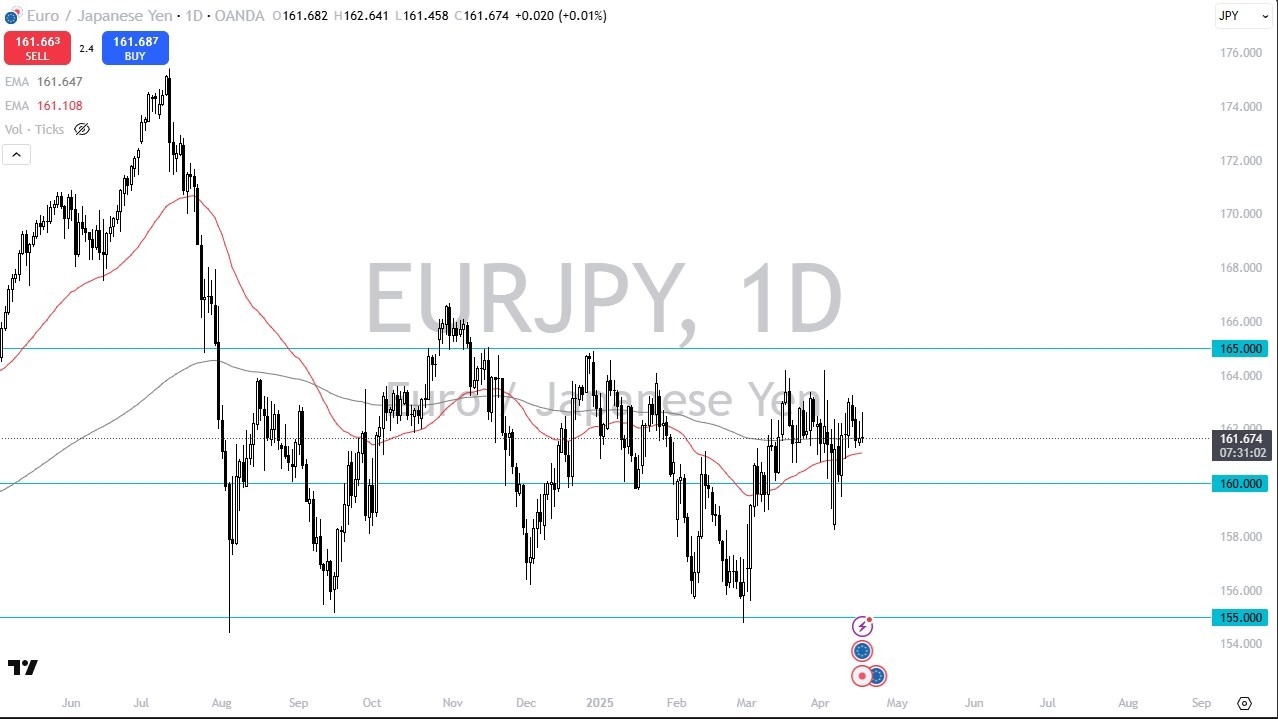
The technical analysis for this market is somewhat stagnant at the moment, as the 50 Day EMA sits just below the current trading range, and this does suggest that perhaps we are sitting on potential technical support. Beyond that, the ¥160 level of course, is an area that a lot of people will be watching, as it is a large, round, psychologically significant figure, and of course an area that has been important more than once.

On the upside, if we were to break above the ¥164 level, then it opens up the possibility of a move to the ¥165 level. In general, I think you’ve got a situation where traders will continue to perhaps kick the EUR/JPY pair between the ¥160 level on the bottom, and the ¥165 level on the top, essentially making this a flat and sideways market. However, if you are a short-term range bound trader, this could be a currency pair that you excel in as it looks like it has nowhere to be.

Expect volatile and choppy trading, but I think you can say that about pretty much any market at this point. I don’t like the idea of taking on a position right now, so position sizing will be crucial going forward. I am looking at this pair through the prism of small position, and short-term trade ideas.

Begin trading our daily forecasts and analysis. Here is a list of Forex brokers in Japan to work with.

Source link

18 04, 2025

Euro struggles to stretch higher after ECB

By |2025-04-18T12:37:35+02:00April 18, 2025|Forex News, News|0 Comments

  • EUR/USD moves sideways in a narrow range above 1.1350 on Friday.
  • The pair is likely to remain quiet on Easter Friday.
  • The ECB lowered key rates by 25 bps after the April policy meeting.

EUR/USD trades in a narrow channel at around 1.1370 after closing in negative territory on Thursday. With major financial markets remaining closed in observance of the Easter Holiday on Friday, the pair is likely to extend its sideways grind heading into the weekend.

Euro PRICE This week

The table below shows the percentage change of Euro (EUR) against listed major currencies this week. Euro was the strongest against the Swiss Franc.

USD EUR GBP JPY CAD AUD NZD CHF
USD -0.04% -1.38% -1.10% -0.14% -1.31% -2.55% -0.06%
EUR 0.04% -0.83% -0.62% 0.36% -0.81% -2.08% 0.42%
GBP 1.38% 0.83% 0.62% 1.18% 0.02% -1.26% 1.26%
JPY 1.10% 0.62% -0.62% 0.95% -0.46% -0.92% 1.17%
CAD 0.14% -0.36% -1.18% -0.95% -1.30% -2.41% 0.00%
AUD 1.31% 0.81% -0.02% 0.46% 1.30% -1.27% 1.24%
NZD 2.55% 2.08% 1.26% 0.92% 2.41% 1.27% 2.58%
CHF 0.06% -0.42% -1.26% -1.17% -0.00% -1.24% -2.58%

The heat map shows percentage changes of major currencies against each other. The base currency is picked from the left column, while the quote currency is picked from the top row. For example, if you pick the Euro from the left column and move along the horizontal line to the US Dollar, the percentage change displayed in the box will represent EUR (base)/USD (quote).

The European Central Bank (ECB) announced on Thursday that it lowered key rates by 25 basis points (bps) following the April policy meeting. This decision came in line with the market expectation and failed to trigger a noticeable market reaction.

While speaking at the post-meeting press conference, ECB President Christine Lagarde adopted a cautious tone, noting that the Eurozone’s economic outlook is clouded by uncertainty.

In the meantime, the data from the US showed that the weekly Initial Jobless Claims declined to 215,000 from 224,000 in the previous week. The US Dollar (USD) held its ground following this data and made it difficult for EUR/USD to gain traction.

Early Friday, ECB policymaker Francois Villeroy de Galhau argued that the inflation risk from trade tensions seems weak and could even be downward, per Reuters.

The economic calendar will not feature any high-tier data releases on Friday.

EUR/USD Technical Analysis

The Relative Strength Index (RSI) indicator on the 4-hour chart moves sideways slightly below 60, suggesting that the bullish bias remains intact but lacks momentum.

On the downside, immediate support is located at 1.1350 (20-period Simple Moving Average) before 1.1280 (static level) and 1.1250 (lower limit of the ascending channel). Looking north, resistances could be spotted at 1.1400 (static level), 1.1470 (midpoint of the ascending channel) and 1.1500 (round level).

ECB FAQs

The European Central Bank (ECB) in Frankfurt, Germany, is the reserve bank for the Eurozone. The ECB sets interest rates and manages monetary policy for the region.
The ECB primary mandate is to maintain price stability, which means keeping inflation at around 2%. Its primary tool for achieving this is by raising or lowering interest rates. Relatively high interest rates will usually result in a stronger Euro and vice versa.
The ECB Governing Council makes monetary policy decisions at meetings held eight times a year. Decisions are made by heads of the Eurozone national banks and six permanent members, including the President of the ECB, Christine Lagarde.

In extreme situations, the European Central Bank can enact a policy tool called Quantitative Easing. QE is the process by which the ECB prints Euros and uses them to buy assets – usually government or corporate bonds – from banks and other financial institutions. QE usually results in a weaker Euro.
QE is a last resort when simply lowering interest rates is unlikely to achieve the objective of price stability. The ECB used it during the Great Financial Crisis in 2009-11, in 2015 when inflation remained stubbornly low, as well as during the covid pandemic.

Quantitative tightening (QT) is the reverse of QE. It is undertaken after QE when an economic recovery is underway and inflation starts rising. Whilst in QE the European Central Bank (ECB) purchases government and corporate bonds from financial institutions to provide them with liquidity, in QT the ECB stops buying more bonds, and stops reinvesting the principal maturing on the bonds it already holds. It is usually positive (or bullish) for the Euro.

(The story was corrected on April 18 at 08:16 GMT to say in the first bullet point that EUR/USD moves sideways above 1.1350 on Friday, not Thursday).

Source link

18 04, 2025

Pound Sterling remains on track to post weekly gains

By |2025-04-18T10:36:58+02:00April 18, 2025|Forex News, News|0 Comments

  • GBP/USD consolidates weekly gains above 1.3250 in the European session.
  • The pair’s action is expected to remain subdued on Easter Friday.
  • The near-term technical outlook suggests that the bullish bias remains intact.

GBP/USD moves sideways in a tight channel above 1.3250 in the European session on Friday after posting small gains on Thursday. The pair remains on track to end the week in positive territory.

British Pound PRICE This week

The table below shows the percentage change of British Pound (GBP) against listed major currencies this week. British Pound was the strongest against the US Dollar.

USD EUR GBP JPY CAD AUD NZD CHF
USD -0.03% -1.35% -1.10% -0.14% -1.31% -2.55% -0.06%
EUR 0.03% -0.83% -0.62% 0.36% -0.81% -2.08% 0.42%
GBP 1.35% 0.83% 0.62% 1.18% 0.02% -1.26% 1.26%
JPY 1.10% 0.62% -0.62% 0.95% -0.44% -0.94% 1.18%
CAD 0.14% -0.36% -1.18% -0.95% -1.29% -2.41% 0.00%
AUD 1.31% 0.81% -0.02% 0.44% 1.29% -1.27% 1.24%
NZD 2.55% 2.08% 1.26% 0.94% 2.41% 1.27% 2.58%
CHF 0.06% -0.42% -1.26% -1.18% -0.00% -1.24% -2.58%

The heat map shows percentage changes of major currencies against each other. The base currency is picked from the left column, while the quote currency is picked from the top row. For example, if you pick the British Pound from the left column and move along the horizontal line to the US Dollar, the percentage change displayed in the box will represent GBP (base)/USD (quote).

The US Dollar (USD) Index, which tracks the USD’s performance against a basket of six major currencies, closed marginally higher on Thursday, supported by the upbeat weekly Initial Jobless Claims data. The number of first-time applications for unemployment benefits declined to 215,000 from 224,000 in the previous week.

Despite the USD’s resilience, GBP/USD managed to stick to its modest daily gains as Pound Sterling captured capital outflows out of the Euro.

The European Central Bank (ECB) lowered key rates by 25 basis points (bps) after the April policy meeting, as anticipated. In the post-meeting press conference, ECB President Lagarde refrained from hinting at a pause in policy-easing and acknowledged escalated uncertainty surrounding the Euro area’s economic outlook. EUR/GBP cross lost about 0.5% after the ECB event, helping Pound Sterling hold its ground.

The economic calendar will not offer any high-impact data releases on Friday. With major financial markets remaining closed in observance of the Easter Holiday, the pair is likely to have a difficult time making a decisive move in either direction heading into the weekend.

GBP/USD Technical Analysis

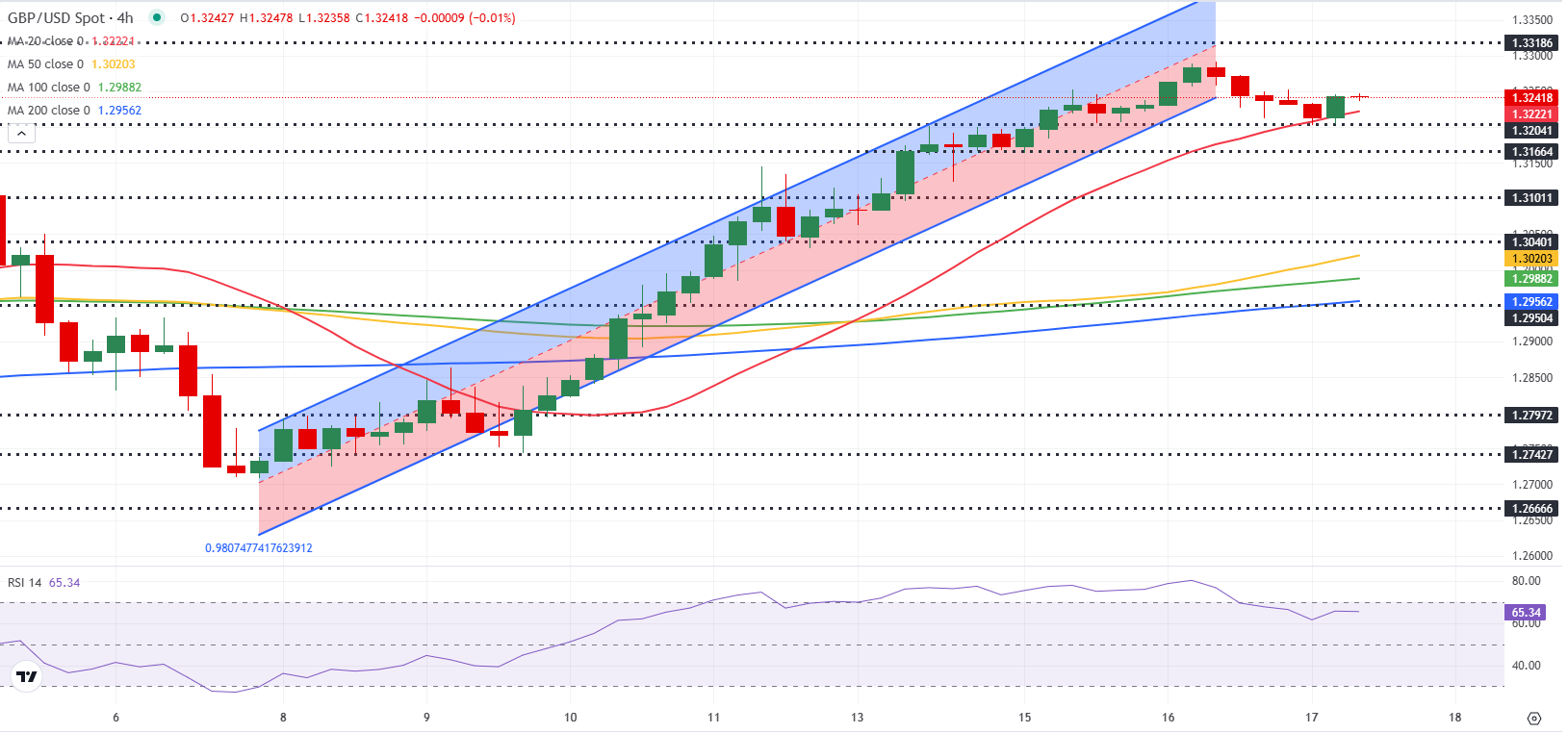
GBP/USD holds above the 20-period Simple Moving Average (SMA) on the 4-hour chart and the Relative Strength Index (RSI) indicator stays above 60, suggesting that the bullish bias remains intact.

On the upside, 1.3280 (static level) aligns as first resistance before 1.3360 (static level) and 1.3400 (static level, round level). Looking south, supports could be seen at 1.3250 (20-period SMA) ahead of 1.3200 (static level) and 1.3160 (static level).

Pound Sterling FAQs

The Pound Sterling (GBP) is the oldest currency in the world (886 AD) and the official currency of the United Kingdom. It is the fourth most traded unit for foreign exchange (FX) in the world, accounting for 12% of all transactions, averaging $630 billion a day, according to 2022 data.
Its key trading pairs are GBP/USD, also known as ‘Cable’, which accounts for 11% of FX, GBP/JPY, or the ‘Dragon’ as it is known by traders (3%), and EUR/GBP (2%). The Pound Sterling is issued by the Bank of England (BoE).

The single most important factor influencing the value of the Pound Sterling is monetary policy decided by the Bank of England. The BoE bases its decisions on whether it has achieved its primary goal of “price stability” – a steady inflation rate of around 2%. Its primary tool for achieving this is the adjustment of interest rates.
When inflation is too high, the BoE will try to rein it in by raising interest rates, making it more expensive for people and businesses to access credit. This is generally positive for GBP, as higher interest rates make the UK a more attractive place for global investors to park their money.
When inflation falls too low it is a sign economic growth is slowing. In this scenario, the BoE will consider lowering interest rates to cheapen credit so businesses will borrow more to invest in growth-generating projects.

Data releases gauge the health of the economy and can impact the value of the Pound Sterling. Indicators such as GDP, Manufacturing and Services PMIs, and employment can all influence the direction of the GBP.
A strong economy is good for Sterling. Not only does it attract more foreign investment but it may encourage the BoE to put up interest rates, which will directly strengthen GBP. Otherwise, if economic data is weak, the Pound Sterling is likely to fall.

Another significant data release for the Pound Sterling is the Trade Balance. This indicator measures the difference between what a country earns from its exports and what it spends on imports over a given period.
If a country produces highly sought-after exports, its currency will benefit purely from the extra demand created from foreign buyers seeking to purchase these goods. Therefore, a positive net Trade Balance strengthens a currency and vice versa for a negative balance.

Source link

Go to Top