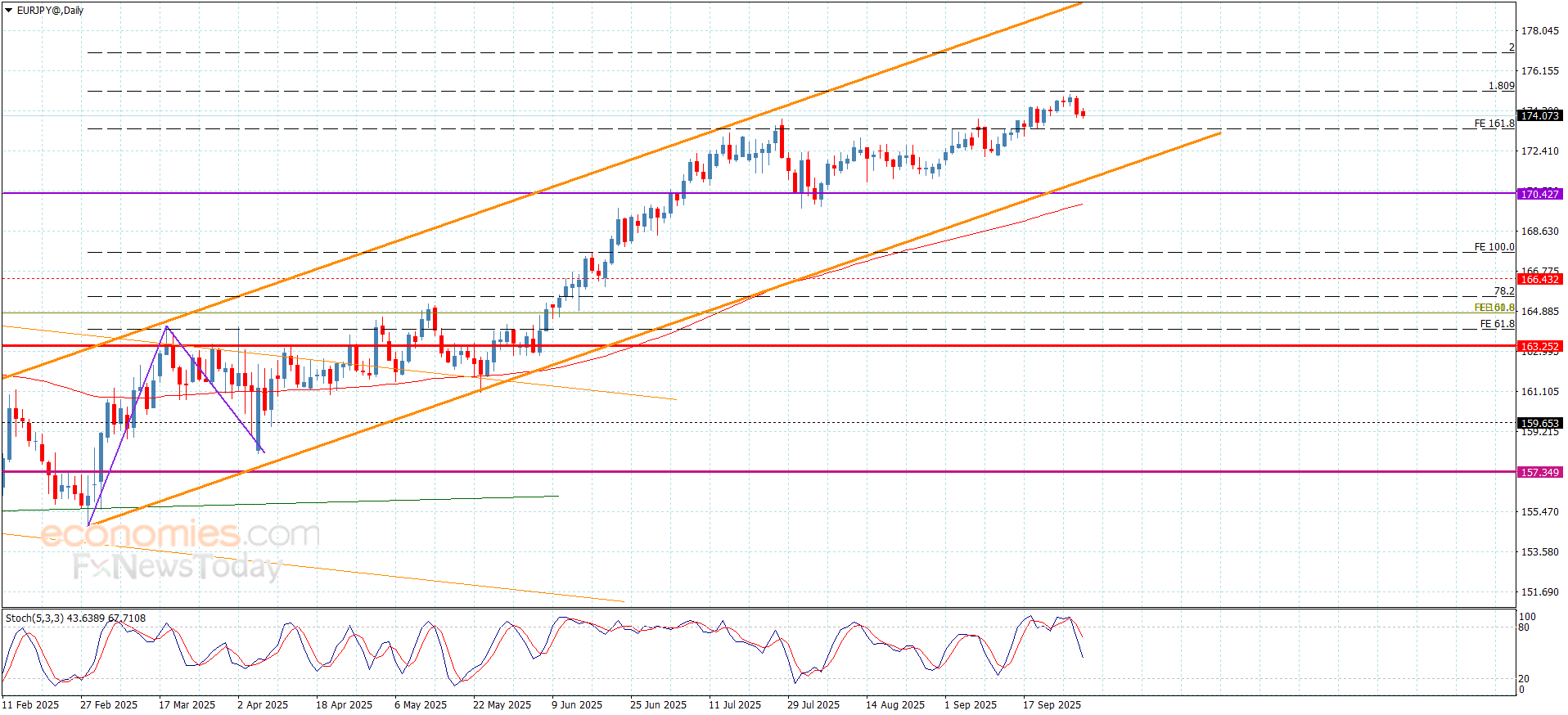
The EURJPY pair activated with stochastic intraday negativity, to keep its stability below the barrier at 175.20, providing correctional trading by reaching 174.00.
Note that the current decline will not affect the bullish scenario due to the stability of the extra support at 173.40, therefore, we will keep waiting for gaining the positive momentum to ease the mission of surpassing the barrier and targeting new positive stations that might extend to 175.60 and 176.00, while breaking the extra support will confirm its surrender to the bearish correctional track, forcing it to suffer extra losses by reaching 172.60.
The expected trading range for today is between 173.65 and 174.85
Trend forecast: Fluctuated within the bullish track
The British Pound remained pinned near two-month lows against the Euro on Thursday, with GBP/EUR trading just under 1.1450 as UK bond-market stress and weak retail sales kept Sterling under pressure.
A fragile gilt auction underscored investor unease ahead of November’s budget, while Danske Bank still targets 1.1240 on a 12-month view.
GBP/EUR Forecasts: Trapped Near 2-Month Low
The Pound to Euro (GBP/EUR) exchange rate has been unable to gain significant support and is trading just below 1.1450, still close to 2-month lows.
A dip below 1.1420 would risk further Pound selling.
Danske Bank maintains a 12-month target of 1.1240.
The Pound and Euro have both been hampered by evidence of weak consumer spending, but the Euro has secured some relative protection due to hopes for stronger German demand next year amid a fiscal boost.
Save on Your GBP/EUR Transfer
Get better rates and lower fees on your next international money transfer.
Compare TorFX with top UK banks in seconds and see how much you could save.
In contrast, there are expectations of UK tax hikes in the November budget while bond-market sentiment remains fragile.
There was weaker demand at the latest 10-year gilt auction with the 10-year yield increasing to 4.73% from 4.68%. Lale Akoner, global market analyst at eToro commented; “The drop in gilt demand highlights investor impatience with uncertainty and could keep markets volatile until the budget.”
The UK CBI retail sales survey improved slightly to -29 for September from -32 previously and compared with consensus forecasts of -31.
This was, however, the 12th successive negative monthly figure and retailers expect a faster rate of decline for October.
CBI Principal Economist Martin Sartorius commented; “September marked the twelfth straight month of falling retail sales, underlining the tough conditions facing the sector.”
He added; “Weak demand continues to weigh on sales, while US tariffs are adding pressure for some retailers.”
As far as the Euro-Zone is concerned, the German GfK consumer confidence index improved slightly to -22.3 from -23.5 the previous month.
Rolf Bürkl, Head of Consumer Climate at NIM commented; “After falling for three months in a row, the Consumer Climate has now ended its downward trend – at least for the moment.”
He added; “Whether this marks the beginning of a sustained turnaround is more than uncertain. The geopolitical situation, concerns about jobs, and renewed fears of inflation are likely hinder a thorough recovery at the moment.”
The Euro was hurt by weaker than expected IFO business confidence data on Wednesday.
MUFG commented; “Overall the survey has put a dampener on optimism over the outlook for Germany’s economy.”
It did, however, note; “Bloomberg consensus forecasts are currently expecting a very gradual pick-up in growth during the 2H of this year before growth picks up more notably next year in response to the government’s plans for looser fiscal policy.”
The bank also notes that markets are still expecting the ECB to hold interest rates at 2.0% through the rest of the year which will limit potential Euro selling.
Like this piece? Please share with your friends and colleagues:
International Money Transfer? Ask our resident FX expert a money transfer question or try John’s new, free, no-obligation personal service! ,where he helps every step of the way,
ensuring you get the best exchange rates on your currency requirements.
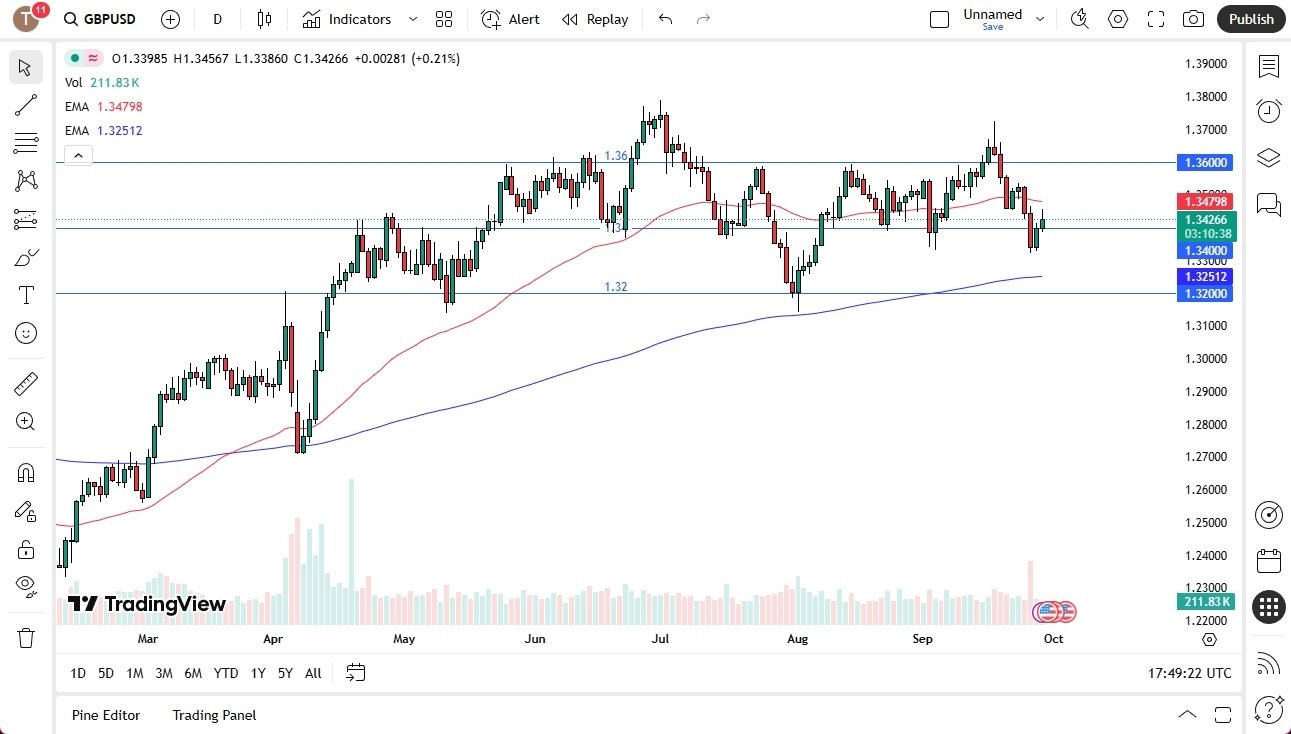
The British Pound initially rallied on Monday and has continued the recovery that started on Friday.
At this point, the market looks as if it is struggling to break above the top of the Thursday candlestick and that is something worth paying attention to.
After all, this is a market that sold off quite viciously on Wednesday and Thursday. And if we cannot break the Thursday candlestick, it shows that we just don’t have enough momentum to continue going higher.
If we can break above there, then we have the 50 day EMA to pay attention to. And again, the Wednesday candlestick is just above the 1.35 level. All things being equal, we are currently between the 50 day EMA, which is above and the 200 day EMA, which is below. And that typically will cause a bit of volatility.
Many Questions About the USD
There are a lot of questions right now as to what’s going to happen with the U S dollar, but it’s worth noting that the US dollar has actually strengthened since the interest rate cut that screams that something isn’t quite right.
Money is flowing into the U S dollar, mainly due to interest rates rising, despite the fact that the federal reserve is talking about cutting them. They aren’t cutting them quickly enough. And that’s part of the problem. Ultimately, if traders out there are a little bit concerned, they go to the US dollar because they need to go to the US treasury market.
The US treasury market demands those dollars, and that might be what’s happening here. Either way, I think we’ve got a situation where the dollar may have finally bottomed out. We’ll have to wait and see. But if we break down below the lows of the Friday candlestick, we then challenge the 200 day EMA and then possibly 1.32 below there. Anything below 1.32, we could see the British pound plunge.
Christopher Lewis has been trading Forex and has over 20 years experience in financial markets. Chris has been a regular contributor to Daily Forex since the early days of the site. He writes about Forex for several online publications, including FX Empire, Investing.com, and his own site, aptly named The Trader Guy. Chris favours technical analysis methods to identify his trades and likes to trade equity indices and commodities as well as Forex. He favours a longer-term trading style, and his trades often last for days or weeks.
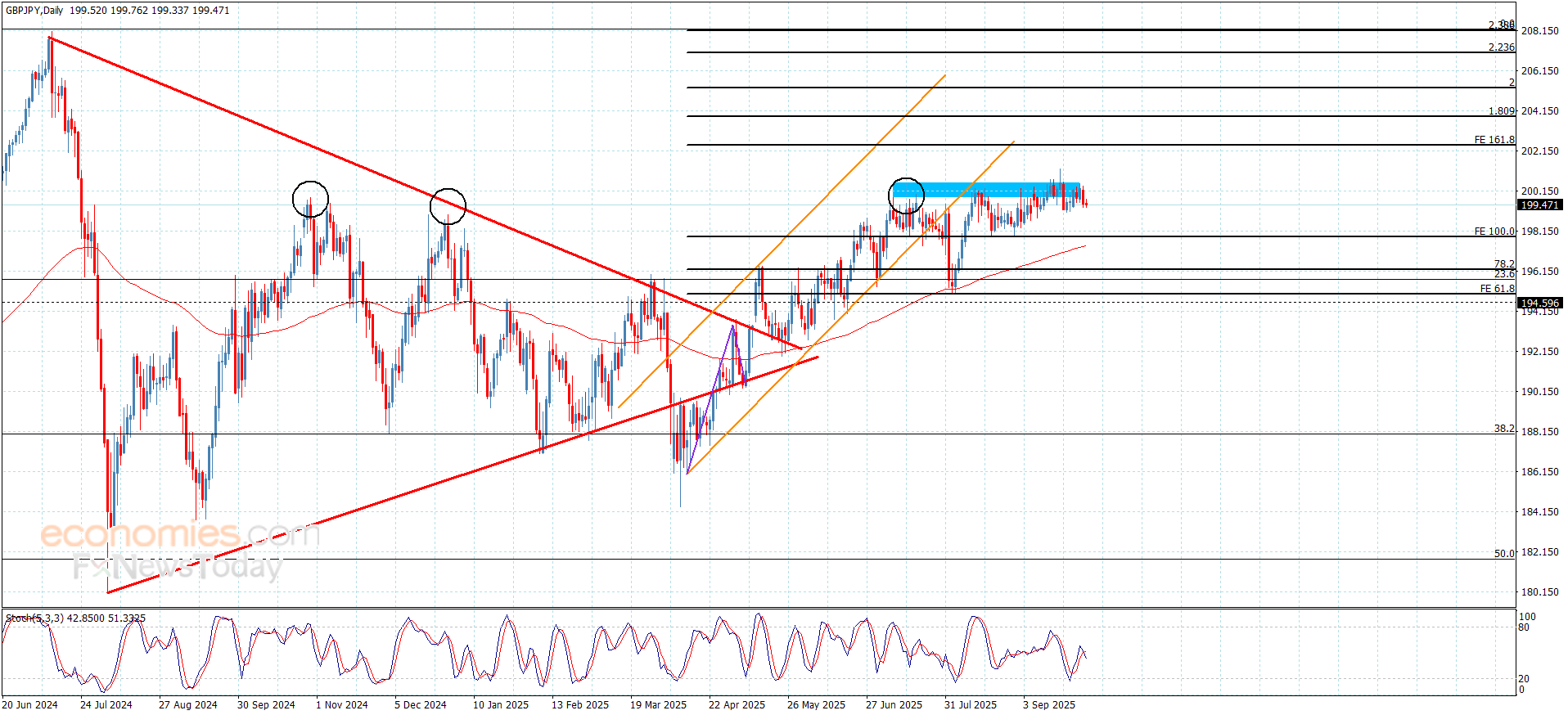
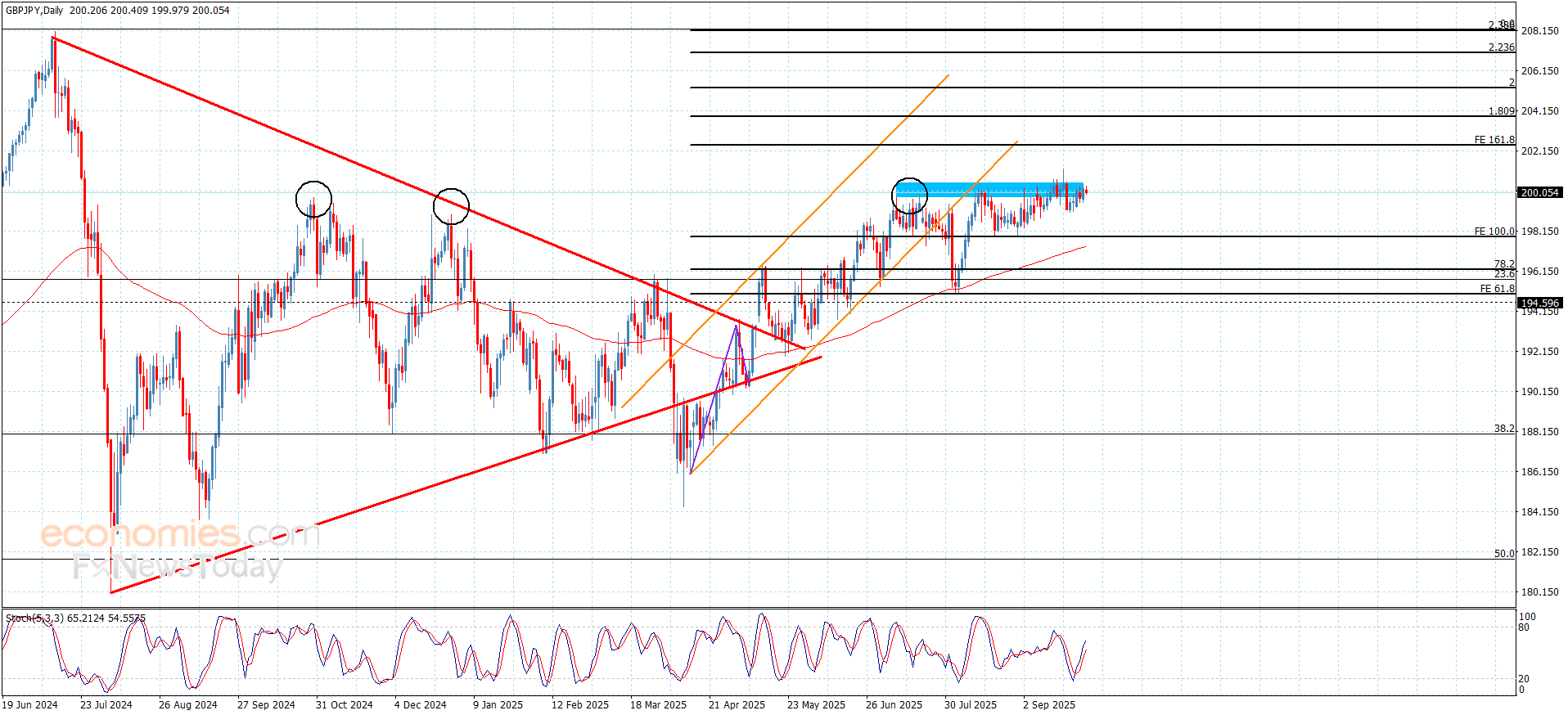
The GBPJPY pair failed to breach the barrier at 200.45, which forces it to provide new mixed trading by reaching 199.50, announcing its surrender to the sideways track that depends on forming extra support at 198.60 level, while the mentioned barrier represents the key of resuming the bullish attack.
Note that the continuation of the attempt of providing positive momentum by the main indicators will increase the chances for some bullish waves, to attempt to press on the barrier, where surpassing it will make the price target new positive stations that begin at 200.95 and 201.55.
The expected trading range for today is between 198.80 and 200.45
The Pound to US Dollar (GBP/USD) exchange rate edged higher on Monday as upbeat risk sentiment pressured the Dollar.
At the time of writing, GBP/USD was trading at $1.3437, up around 0.3% from the session open.
The US Dollar (USD) weakened at the start of the week despite a quiet calendar.
A broadly risk-on mood undercut safe-haven demand, leaving the Greenback on the defensive and posting losses against most peers through Monday’s European session.
The Pound (GBP) saw choppy trading in the absence of major UK data, with moves largely dictated by wider market appetite.
Sterling gained modestly against defensive currencies, while its risk-sensitive profile limited advances versus pro-cyclical rivals.
GBP/USD Forecasts: US Jobs Data in Focus
Save on Your GBP/USD Transfer
Get better rates and lower fees on your next international money transfer.
Compare TorFX with top UK banks in seconds and see how much you could save.
Looking to Tuesday, the spotlight falls on the latest US JOLTs job openings report for August.
Forecasts point to a decline from 7.181 million to 7.1 million, signalling further cooling in the labour market.
If confirmed, concerns over job creation could weigh on the Dollar and give GBP/USD fresh momentum.
For Sterling, a quiet domestic calendar shifts attention to Bank of England speeches.
Any hawkish signals from policymakers could offer support and help the Pound hold firm as the week unfolds.
Like this piece? Please share with your friends and colleagues:
International Money Transfer? Ask our resident FX expert a money transfer question or try John’s new, free, no-obligation personal service! ,where he helps every step of the way,
ensuring you get the best exchange rates on your currency requirements.
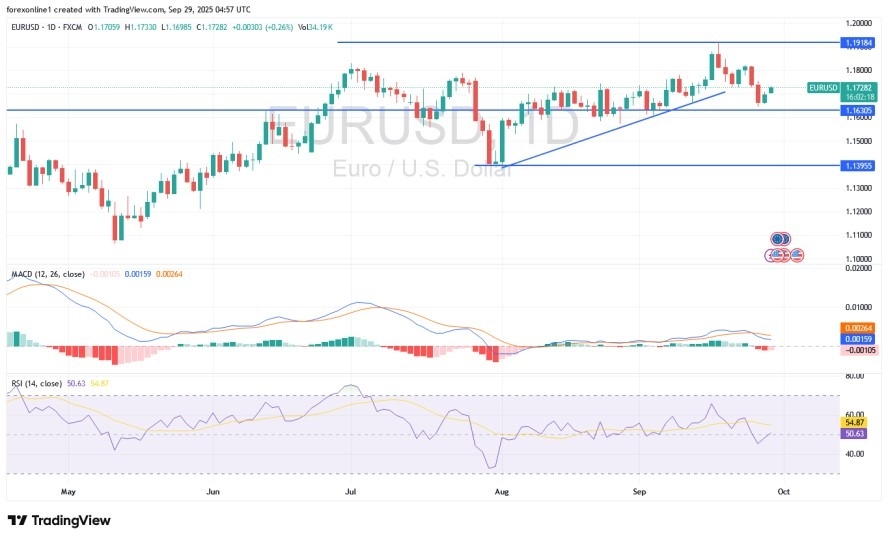
Today’s Support Levels for EUR/USD: 1.1645 – 1.1590 – 1.1500.
Today’s Resistance Levels for EUR/USD: 1.1740 – 1.1800 – 1.1880.
EUR/USD Trading Signals:
Buy EUR/USD from the support level of 1.1580 with a target of 1.1760 and a stop-loss at 1.1500.
Sell EUR/USD from the resistance level of 1.1780 with a target of 1.1600 and a stop-loss at 1.1880.
Technical Analysis of EUR/USD Today:
During trading last week, the Euro against the US Dollar (EUR/USD) fell to its lowest level in three weeks, testing the 1.1645 support level before attempting a bounce higher and stabilizing above the 1.1700 resistance ahead of the weekend close. The most prominent factor pressuring the Euro was the stronger-than-expected US economic data, which boosted the value of the US Dollar. Recently, market expectations for a US interest rate cut by the Federal Reserve have dropped, while analysts warned that a break of the 50-day Moving Average at 1.1660 could lead to further declines.
Nevertheless, Forex trading experts still believe there is a chance for the EUR/USD price to rise above 1.170 in the short term. According to licensed brokerage platforms, the EUR/USD exchange rate failed to rise last Thursday, dropping to its 3-week low below 1.1650 before regaining some ground to 1.1680 on Friday. The US economic data was stronger than anticipated, with no signs of an increase in unemployment, which boosted the value of the US Dollar against other major currencies.
Market expectations have recently shifted, with traders now seeing the probability of two US rate cuts by the Federal Reserve by the end of 2025 dropping to 60%. Technically, while the drop in the exchange rate was sharp, there are no indications of price stabilization yet. As long as the Euro remains below the 1.1715 support, it is possible for the decline to continue. However, it is unlikely to reach the main support level at 1.1610 for now.
In the same vein of forecasts, SocGen Bank believes the US Dollar is at a key support level: “The Euro-Dollar pair is currently testing an ascending support line since August; the 50-day Moving Average at 1.1660 is an important support level. If it fails to hold this level, the decline may continue. In this case, the next support levels for the EUR/USD pair could be the late August lows at 1.1600/1.1570 and 1.1500.”
However, ING Bank doubts the US Dollar’s ability to maintain its recent gains, stating: “We see it as likely that the Dollar will retreat from its current levels, and we expect it to drop below 1.170 in the near days.” The bank pointed to the potential for a further decline in the Euro’s value, explaining: “Alongside any other positive data from the US, another risk is that escalating geopolitical tensions in Europe could negatively impact currency markets. NATO recently stated it is ready to shoot down any Russian plane violating its airspace.”
Economic Data Still Supports the Dollar
MUFG Bank noted that US economic data was stronger than expected, saying: “It’s been a long time since we saw such positive and Dollar-supportive US economic data, but the recently released data was surprisingly positive. With markets recently leaning toward anticipating weak US economic data, we saw a notable Dollar rebound at a time when currency and bond markets are experiencing high volatility.”
The bank believes that the US labor market will be a decisive factor in determining the course of developments in the coming days, as the details of the US jobs report will be announced at the end of the week, which will, in turn, affect the future policies of the US Federal Reserve. According to currency experts’ forecasts, if US labor market data shows better-than-expected results this week, it will reinforce Federal Reserve Chairman Powell’s stance on not cutting rates and will push the US central bank to consider the risks of rising inflation.
Future Price of the Euro in the Coming Days
According to reliable trading platforms, the Euro fell below $1.17 at the end of September, erasing the gains it made at the beginning of the month. It is expected to conclude the month near its current level, as traders balance monetary policy expectations and escalating trade tensions. The market currently still anticipates the US Federal Reserve will cut interest rates by an additional 0.25% twice this year, even though recent data showed the strength of the US economy and labor market.
In Europe, forecasts suggest the European Central Bank’s (ECB) easing cycle is nearing its end, after the bank kept interest rates unchanged in its two consecutive meetings in September. Economic indicators continue to show a mixed picture, with Purchasing Managers’ Indices (PMIs) for the services sector seeing some improvement, while the recession in the manufacturing sector worsens.
On the trade front, US President Donald Trump announced a 100% tariff on registered or patented pharmaceutical products, and a 25% tariff on heavy-duty trucks. Meanwhile, reports indicated that the European Commission is preparing to impose tariffs ranging from 25% to 50% on Chinese steel imports.
Trading Advice:
We advise you to wait for the market reaction to the US employment report to clarify the picture regarding the best trading opportunities for the Euro-Dollar, whether to buy or sell.
The British Pound stayed pinned near two-month lows against the Euro at 1.1440, with the Pound to Euro exchange rate (GBP/EUR) weighed by weak UK data, geopolitical jitters and fragile risk sentiment.
Analysts warn Sterling could suffer more than the euro if Russia tensions escalate, while fresh German IFO weakness underlines Europe’s sluggish growth backdrop.
Danske Bank still sees the pair sliding towards 1.1240 on a 12-month view.
GBP/EUR Forecasts: Near 2-Month Lows
The Pound to Euro (GBP/EUR) exchange rate has remained on the defensive and trading just above 1.1440, close to 2-month lows recorded on Tuesday.
The Pound found it very difficult to make headway in global markets even with tailwinds for global equity markets which suggests underlying vulnerability while the Euro has drifted lower.
The FTSE 100 index posted significant losses on Wednesday following a dip on Wall Street and the Pound tends to be sensitive to risk conditions.
Save on Your GBP/EUR Transfer
Get better rates and lower fees on your next international money transfer.
Compare TorFX with top UK banks in seconds and see how much you could save.
If geo-political tensions with Russia intensify, the Euro and Pound would both be at risk, although Sterling would potentially be hit harder.
A drop below the July low near 1.1420 would risk further losses.
Danske Bank expects gradual GBP/EUR losses to 1.1240 on a 12-month view, but added; “The key risk to seeing EUR/GBP trade substantially higher than our forecast is a sharp sell-off in global risk and/or renewed focus on the UK’s fragile fiscal position.”
In rhetoric on Tuesday, President Trump shifted his position on Ukraine and suggested that it could regain all the territory that has been lost. He also called for a more aggressive NATO stance against Russia which could increase tensions within Europe.
ING commented; “If anything, there are downside risks for the euro and even more for higher-beta European currencies as Trump told EU allies to shoot down Russian planes violating NATO airspace.”
Rabobank noted the stronger tone in the latest NATO statements.
It added; “So while can only speculate about the next steps taken by NATO or Europe, opinions appear to be shifting and there can be little doubt that whatever comes next is going to be even more costly for Europe in many respects.”
The German IFO business confidence index dipped to 87.7 for September from a revised 88.9 previously and below consensus forecasts of 89.3.
The current assessment and expectations components both declined on the week.
According to the IFO; “Companies were less satisfied with current business, while their expectations clouded noticeably. Prospects for an economic recovery have suffered a setback.”
The German PMI services-sector index strengthened according to the latest PMI data, but the IFO commented on the sector; “Expectations have grown markedly more pessimistic, and the indicator fell to its lowest level since February.”
Rabobank noted that PMI business confidence data on Tuesday reported a decline in export orders which will be a headwind for the economy.
It added; “In summary, European growth will probably remain sluggish in the coming quarters.”
Like this piece? Please share with your friends and colleagues:
International Money Transfer? Ask our resident FX expert a money transfer question or try John’s new, free, no-obligation personal service! ,where he helps every step of the way,
ensuring you get the best exchange rates on your currency requirements.
GBP/USD holds comfortably above 1.3400 in the European session on Monday.
The renewed US Dollar weakness helps the pair stretch higher.
Market participant will keep a close eye on political developments in the US.
GBP/USD builds on Friday’s gains and trades in positive territory comfortably above 1.3400 in the European morning on Monday. The pair’s technical outlook is yet to point to a bullish reversal in the short term.
Pound Sterling Price Today
The table below shows the percentage change of British Pound (GBP) against listed major currencies today. British Pound was the strongest against the US Dollar.
USD
EUR
GBP
JPY
CAD
AUD
NZD
CHF
USD
-0.17%
-0.33%
-0.61%
-0.11%
-0.31%
-0.04%
-0.16%
EUR
0.17%
-0.17%
-0.59%
0.05%
-0.15%
0.12%
-0.00%
GBP
0.33%
0.17%
-0.34%
0.22%
-0.04%
0.29%
0.17%
JPY
0.61%
0.59%
0.34%
0.53%
0.34%
0.44%
0.50%
CAD
0.11%
-0.05%
-0.22%
-0.53%
-0.16%
0.07%
-0.05%
AUD
0.31%
0.15%
0.04%
-0.34%
0.16%
0.26%
0.14%
NZD
0.04%
-0.12%
-0.29%
-0.44%
-0.07%
-0.26%
0.03%
CHF
0.16%
0.00%
-0.17%
-0.50%
0.05%
-0.14%
-0.03%
The heat map shows percentage changes of major currencies against each other. The base currency is picked from the left column, while the quote currency is picked from the top row. For example, if you pick the British Pound from the left column and move along the horizontal line to the US Dollar, the percentage change displayed in the box will represent GBP (base)/USD (quote).
The US Dollar (USD) struggles to find demand at the beginning of the week as the deadline for the US government shutdown looms.
United States (US) President Donald Trump will meet with top congressional leaders from both parties later in the day to finalize a funding deal and avoid a shutdown. Senate Minority Leader Chuck Schumer reportedly demands the funding bill to contain an extension of the enhanced Affordable Care Act premium subsidies to get his party’s support to pass the spending package.
In the absence of high-impact macroeconomic data releases, investors will scrutinize political developments in the US. In case markets grow optimistic about lawmakers funding the government beyond September 30, the USD could stage a rebound and cause GBP/USD to lose its traction. Conversely, the USD could stay under bearish pressure if no deal is reached moving towards the deadline.
On Tuesday, the UK’s Office for National Statistics will publish a revision to the second-quarter Gross Domestic Product (GDP) growth data.
GBP/USD Technical Analysis
The Relative Strength Index (RSI) indicator on the 4-hour chart stays slightly above 50, while GBP/USD continues to trade below the 100-period and the 200-period Simple Moving Averages (SMAs). Additionally, GBP/USD stays below the 20-day, 50-day and 100-day SMAs, reflecting a lack of bullish momentum.
On the downside, the first support area could be spotted at 1.3410-1.3400 (Fibonacci 50% retracement of the latest uptrend, round level) ahead of 1.3330 (static level) and 1.3300 (round level). Looking north, resistance levels could be seen at 1.3470-1.3475 (50-day SMA, Fibonacci 38.2% retracement), 1.3490-1.3500 (100-day SMA, 20-day SMA, 200-period SMA) and 1.3550 (Fibonacci 23.6% retracement).
Pound Sterling FAQs
The Pound Sterling (GBP) is the oldest currency in the world (886 AD) and the official currency of the United Kingdom. It is the fourth most traded unit for foreign exchange (FX) in the world, accounting for 12% of all transactions, averaging $630 billion a day, according to 2022 data.
Its key trading pairs are GBP/USD, also known as ‘Cable’, which accounts for 11% of FX, GBP/JPY, or the ‘Dragon’ as it is known by traders (3%), and EUR/GBP (2%). The Pound Sterling is issued by the Bank of England (BoE).
The single most important factor influencing the value of the Pound Sterling is monetary policy decided by the Bank of England. The BoE bases its decisions on whether it has achieved its primary goal of “price stability” – a steady inflation rate of around 2%. Its primary tool for achieving this is the adjustment of interest rates.
When inflation is too high, the BoE will try to rein it in by raising interest rates, making it more expensive for people and businesses to access credit. This is generally positive for GBP, as higher interest rates make the UK a more attractive place for global investors to park their money.
When inflation falls too low it is a sign economic growth is slowing. In this scenario, the BoE will consider lowering interest rates to cheapen credit so businesses will borrow more to invest in growth-generating projects.
Data releases gauge the health of the economy and can impact the value of the Pound Sterling. Indicators such as GDP, Manufacturing and Services PMIs, and employment can all influence the direction of the GBP.
A strong economy is good for Sterling. Not only does it attract more foreign investment but it may encourage the BoE to put up interest rates, which will directly strengthen GBP. Otherwise, if economic data is weak, the Pound Sterling is likely to fall.
Another significant data release for the Pound Sterling is the Trade Balance. This indicator measures the difference between what a country earns from its exports and what it spends on imports over a given period.
If a country produces highly sought-after exports, its currency will benefit purely from the extra demand created from foreign buyers seeking to purchase these goods. Therefore, a positive net Trade Balance strengthens a currency and vice versa for a negative balance.
EUR/USD clings to small gains, trades above 1.1700 early Monday.
The US Dollar struggles to find demand on growing fears over a government shutdown.
The near-term technical outlook points to a loss of bearish momentum.
EUR/USD holds its ground and clings to modest gains above 1.1700 early Monday after closing the previous week in negative territory.
Euro Price Today
The table below shows the percentage change of Euro (EUR) against listed major currencies today. Euro was the strongest against the US Dollar.
USD
EUR
GBP
JPY
CAD
AUD
NZD
CHF
USD
-0.18%
-0.31%
-0.64%
-0.12%
-0.30%
-0.05%
-0.21%
EUR
0.18%
-0.14%
-0.61%
0.06%
-0.12%
0.12%
-0.04%
GBP
0.31%
0.14%
-0.38%
0.19%
-0.05%
0.25%
0.09%
JPY
0.64%
0.61%
0.38%
0.57%
0.38%
0.47%
0.48%
CAD
0.12%
-0.06%
-0.19%
-0.57%
-0.15%
0.06%
-0.10%
AUD
0.30%
0.12%
0.05%
-0.38%
0.15%
0.24%
0.07%
NZD
0.05%
-0.12%
-0.25%
-0.47%
-0.06%
-0.24%
-0.02%
CHF
0.21%
0.04%
-0.09%
-0.48%
0.10%
-0.07%
0.02%
The heat map shows percentage changes of major currencies against each other. The base currency is picked from the left column, while the quote currency is picked from the top row. For example, if you pick the Euro from the left column and move along the horizontal line to the US Dollar, the percentage change displayed in the box will represent EUR (base)/USD (quote).
The renewed selling pressure surrounding the US Dollar (USD) helps EUR/USD gain traction in the European morning as investors grow increasingly concerned over a government shutdown in the US.
United States (US) President Donald Trump will meet with top congressional leaders from both parties later in the day to enact the funding legislation to avoid a shutdown ahead of the Tuesday midnight deadline.
Market participants are also worried that the Bureau of Labor Statistics (BLS) might not be able to release the September employment report, which will include key Nonfarm Payrolls (NFP) and Unemployment Rate figures that the Federal Reserve (Fed) looks at while taking policy steps, this Friday if the government shutdowns midweek.
The US economic calendar will feature Pending Home Sales data for August later in the day, which is unlikely to trigger a significant market reaction. Investors will keep a close eye on the political developments in the US. In case Congress strikes a funding deal, the USD could stage a rebound and make it difficult for EUR/USD to extend its recovery.
EUR/USD Technical Analysis
The Relative Strength Index (RSI) indicator on the 4-hour chart moves sideways near 50 in the European session, reflecting a neutral stance.
EUR/USD faces a pivot level at 1.1690-1.1700 (200-period Simple Moving Average (SMA), Fibonacci 38.2% retracement of the latest uptrend). In case the pair continues to use this level as support, technical buyers could remain interested. In this scenario, 1.1750 (100-period SMA), 1.1770 (Fibonacci 23.6% retracement) and 1.1820 (static level) could be seen as next resistance levels.
If EUR/USD fails to stabilize above 1.1690-1.1700, sellers could take action. On the downside, support levels could be spotted at 1.1640 (Fibonacci 50% retracement) and 1.1580 (Fibonacci 61.8% retracement).
Euro FAQs
The Euro is the currency for the 19 European Union countries that belong to the Eurozone. It is the second most heavily traded currency in the world behind the US Dollar. In 2022, it accounted for 31% of all foreign exchange transactions, with an average daily turnover of over $2.2 trillion a day.
EUR/USD is the most heavily traded currency pair in the world, accounting for an estimated 30% off all transactions, followed by EUR/JPY (4%), EUR/GBP (3%) and EUR/AUD (2%).
The European Central Bank (ECB) in Frankfurt, Germany, is the reserve bank for the Eurozone. The ECB sets interest rates and manages monetary policy.
The ECB’s primary mandate is to maintain price stability, which means either controlling inflation or stimulating growth. Its primary tool is the raising or lowering of interest rates. Relatively high interest rates – or the expectation of higher rates – will usually benefit the Euro and vice versa.
The ECB Governing Council makes monetary policy decisions at meetings held eight times a year. Decisions are made by heads of the Eurozone national banks and six permanent members, including the President of the ECB, Christine Lagarde.
Eurozone inflation data, measured by the Harmonized Index of Consumer Prices (HICP), is an important econometric for the Euro. If inflation rises more than expected, especially if above the ECB’s 2% target, it obliges the ECB to raise interest rates to bring it back under control.
Relatively high interest rates compared to its counterparts will usually benefit the Euro, as it makes the region more attractive as a place for global investors to park their money.
Data releases gauge the health of the economy and can impact on the Euro. Indicators such as GDP, Manufacturing and Services PMIs, employment, and consumer sentiment surveys can all influence the direction of the single currency.
A strong economy is good for the Euro. Not only does it attract more foreign investment but it may encourage the ECB to put up interest rates, which will directly strengthen the Euro. Otherwise, if economic data is weak, the Euro is likely to fall.
Economic data for the four largest economies in the euro area (Germany, France, Italy and Spain) are especially significant, as they account for 75% of the Eurozone’s economy.
Another significant data release for the Euro is the Trade Balance. This indicator measures the difference between what a country earns from its exports and what it spends on imports over a given period.
If a country produces highly sought after exports then its currency will gain in value purely from the extra demand created from foreign buyers seeking to purchase these goods. Therefore, a positive net Trade Balance strengthens a currency and vice versa for a negative balance.
Copper price began today’s trading with positive action, attempting to renew the pressure on the barrier at $4.7500, to find an exit for resuming the main bullish attack, to expect targeting $4.9500 level reaching the main target at $5.3100.
Note that the continuation of forming extra support by the moving average 55 stability near $4.3700, besides stochastic attempt to provide bullish momentum, these factors support the bullish suggestion, to keep waiting for achieving the suggested targets.
The expected trading range for today is $4.5500 and $4.9500