The main tag of Forex News Today Articles.
You can use the search box below to find what you need.
[wd_asp id=1]

16 01, 2025

GBP/USD Analysis Today 16/1: Leaning Towards Selling (Chart)

By |2025-01-16T20:19:14+02:00January 16, 2025|Forex News, News|0 Comments

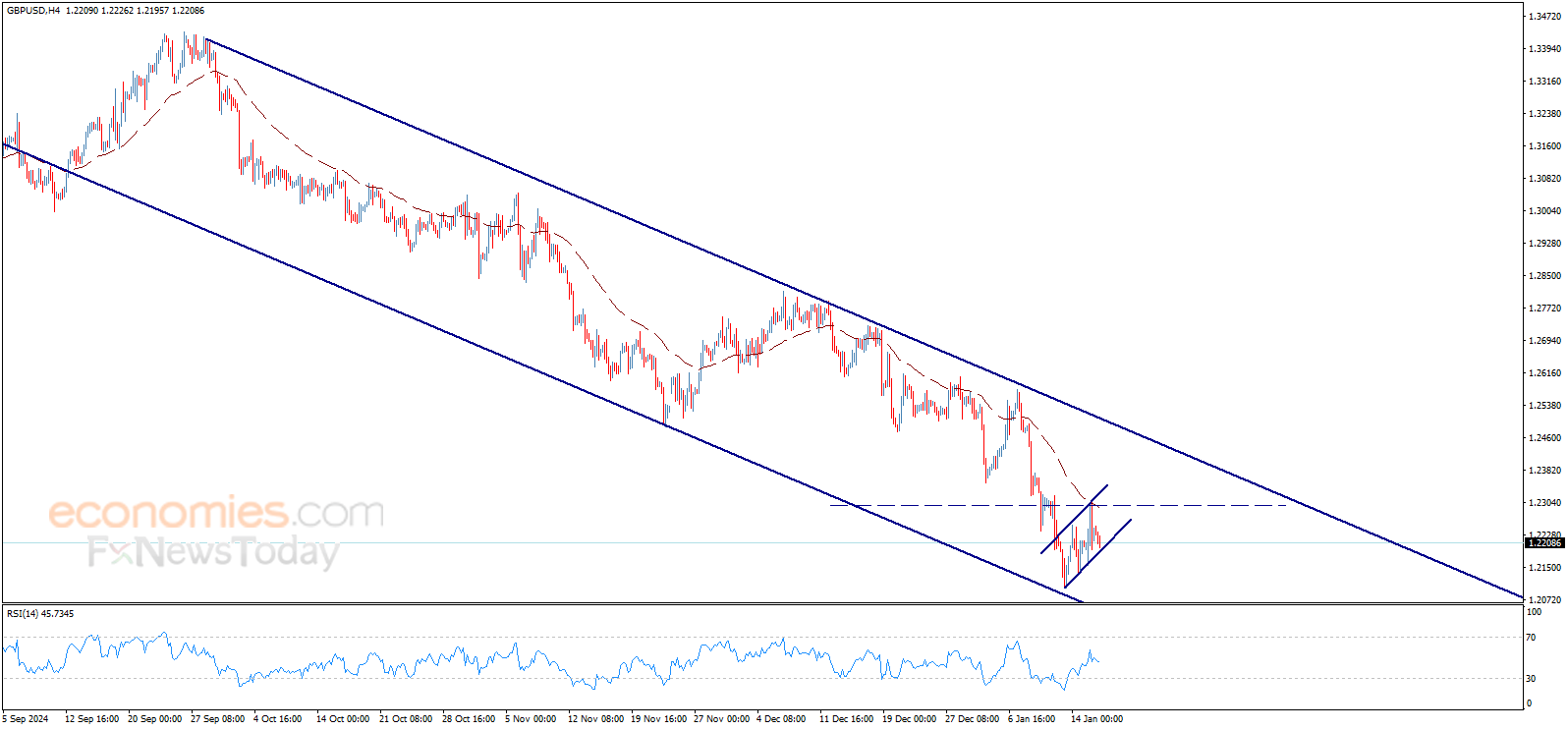
  • Bulls haven’t enjoyed the recent rebound gains for long in the GBP/USD pair, which reached the resistance level of 1.2305.
  • We had recommended selling the GBP/USD pair above that peak through our free direct trading signals on our website.
  • Obviously, this was before it quickly returned in its broader downward path with losses to the support level of 1.2186 before settling around the level of 1.2240 at the beginning of trading on Thursday.
  • Ahead of a package of important economic releases from both Britain and the United States of America, the results of which may shape the closing of trading for the currency pair this week.

US Dollar Price Affected by Inflation Figures

According to Forex trading, dollar bulls needed an inflation reading that exceeded consensus to maintain their momentum, but they received news of an unexpected slowdown in core US inflation. The US dollar had retreated after the US core consumer price index (CPI) fell to 3.2% year-on-year from 3.3% (exp: 3.3%), marking the first decline since July. Overall, US core inflation, which consists of core inflation minus rents, remains elevated but is still trending down. Also, reported was that core consumer price inflation rose to 2.9% year-on-year in December from 2.7%, which was in line with expectations and helped to bolster expectations for a rate cut in June.

Expectations for US Federal Reserve Policies

Influenced by the announcement of US inflation figures, US Treasury yields declined, stocks rose, and money market prices showed that traders had increased their bets on the next US interest rate cut by the Federal Reserve in June, with a possible second cut in the second half of 2025. Overall, the data comes amid signs that the US dollar is at a peak and is trading above its fundamental drivers. This overvalued assessment was driven by a series of US economic data that came in above consensus, which now leaves room for further upside at a particularly high level. Consequently, this makes the US dollar vulnerable to data releases that meet or fall short of expectations.

According to reliable trading platforms, the US Dollar Index – a measure of the US dollar’s strength against a basket of currencies – is now more than 25% above its 25-year average and at a level we have only seen briefly since the 1980s. According to Forex analysts at Societe Generale, the overvalued US dollar assessment seems to reflect the policies of incoming US President Donald Trump that are leading the market. Furthermore, the risk is that what he offers fails to meet expectations.

However, there is also limited scope for significant US interest rate cuts, given the strength of the US economy, suggesting that a defeat for the dollar is unlikely either.

Trading Tips:

Dear TradersUp follower, the British financial crisis will remain a negative pressure factor for investor sentiment towards the British pound in the coming period, threatening any gains against the US dollar and other major currencies.

Technical Analysis for the GPB/USD pair today:

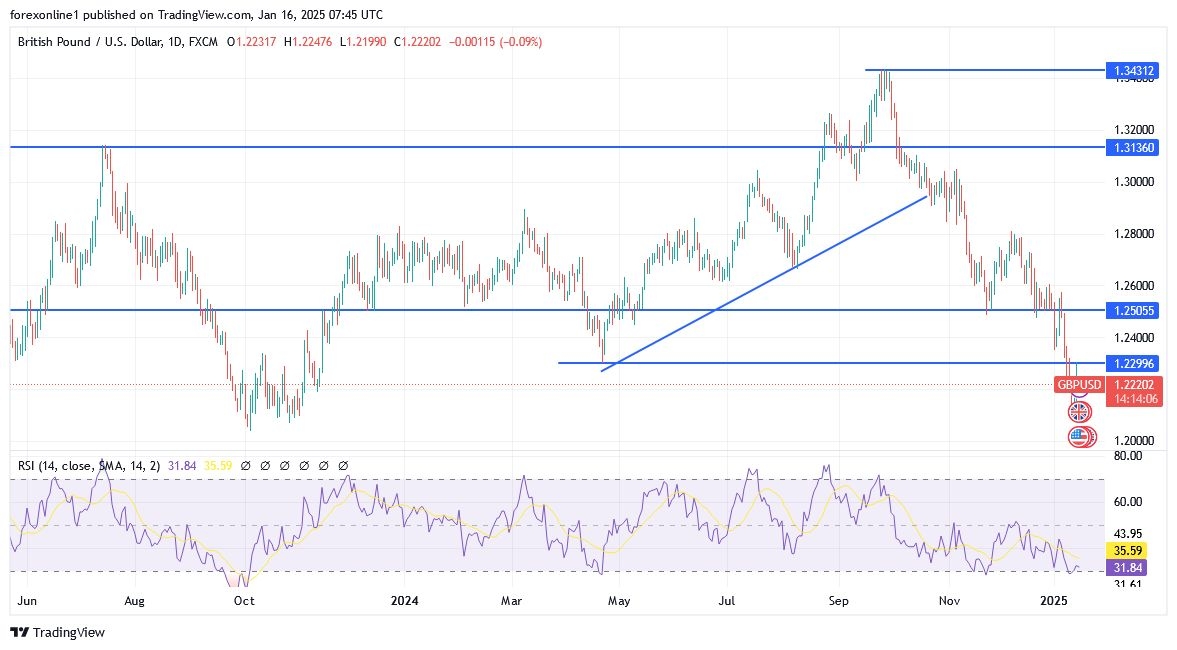
Dear reader, according to trading on the daily chart, the general trend of the GBP/USD pair is still bearish. As mentioned before, we expected that the gains of the GBP/USD pair will remain vulnerable to a rapid collapse. Furthermore, we still prefer to sell the GBP/USD from every upward level. Currently, the closest resistance levels for the currency pair are 1.2330, 1.2420, and 1.2500, respectively. The technical indicators, the Relative Strength Index and the MACD, are still bearish.

Today, the pound will be affected by the announcement of the British economic growth reading and the industrial sector. The US dollar will be affected by the announcement of US retail sales figures, weekly jobless claims and the Philadelphia Fed manufacturing index.

Ready to trade our daily Forex forecast? Here’s a list of some of the top forex brokers UK to check out.

Source link

16 01, 2025

FTSE, EUR/USD Forecast: Two trades to watch

By |2025-01-16T18:17:44+02:00January 16, 2025|Forex News, News|0 Comments

FTSE rises as the pound sinks and growth stalls

  • UK GDP stalls at 0.1% vs 0.2% expected
  • GBP/USD falls below 1.22
  • Miners led the index higher, tracking iron ore prices higher
  • FTSE breaks out of range

The FTSE 100 has risen to an over five-week high after weak GDP data sent the pound lower.

UK GDP figures showed that the UK economy grew 0.1% in November, slower than the 0.2% forecast. However, this is up slightly from the 0.1% decline in output in October and September. The data confirms that growth momentum in the UK has cooled since labour came to power and confirms the country is stuck in a stagflation trap.

Following the data, the pound has fallen back below 1.22, paring yesterday’s gains following cooler UK and US inflation data. The weaker pound, owing to the more beneficial exchange rate, helps to boost the multinationals which make up around 80% of the FTSE.

Mining stocks are leading the gains, boosted by a rebound in iron ore prices and a rally in gold following yesterday’s US inflation data, which increased hopes of a further Fed rate cut this year.

In corporate news, Antofagasta is up 2.9% after posting higher copper and gold production in Q4, while Rio shares have climbed as the company reaffirmed its outlook and announced increased copper output.

Taylor Wimpey is leading the losses, down over 3%, after reporting UK home sales near the top end of guidance, but flagged growing costs.

Looking ahead, attention will turn to US jobless claims and retail sales later today for further clues over the health of the US economy and the outlook for Fed rate cuts.

FTSE forecast – technical analysis

The FTSE 100 has traded within a holding pattern since May last year. More recently the price has extended its recovery from 8000, rising above the 200 SMA at 8225 and has broken above 8325, the level that has capped gains for much of the past 9-months.

Buyers supported by the bullish breakout and the RSI above 50 will look to extend gains towards 8400 and 8480 to fresh record highs.

Support is seen at 8325. A break below here takes the price back into the holding channel and exposes the 200 SMA at 8225. Below here, 8150 comes into focus ahead of 8000.


EUR/USD holds below 1.03 ahead of ECB minutes, US retail sales & jobless claims

  • German CPI was revised higher to 0.5% MoM
  • US retail sales are forecast to rise 0.6%
  • EUR/USD remains in a downward channel

EUR/USD is holding steady below 1.03 after modest losses yesterday amid ongoing concerns surrounding the Eurozone’s economic outlook. Dovish ECB commentary reinforces the expectations of further rate cuts while the USD rises versus major peers.

The euro is finding some support from an upward revision to German inflation, which rose 0.5% MoM in December, while core CPI rose 3.3%, up from 3%.  However, the data raises stagflation concerns for the eurozone’s largest economy and reaffirms expectations of further rate cuts by the ECB.

ECB policymakers have remained dovish. This week, Finland governor Olli Rhen commented that he sees monetary policy leaving restrictive territory, most likely by midsummer. While ECB’s Philip Lane warned over keeping rates too restrictive for too long.

Attention now turns to ECB minutes, which could provide further clues about the outlook for rate cuts this year. eBay is expected to cut rates by 25 basis points at the end of this month, and three more rate cuts are expected this year.

The USD is steadying after losses versus its major peers yesterday after cooling US core inflation and falling bond yields pulled the currency lower.

US core inflation was 0.2% month on month in December down from 0.3% and annualised core inflation eased to 3.2% below the three-point 3% expected. Attention now turns to a slew of U.S. data, including jobless claims and retail sales. Solid numbers could highlight the strength of the US economy and lift the US dollar higher.

Get our exclusive guide to EUR/USD trading in 2025

EUR/USD forecast – technical analysis

EUR/USD has been in a downward trend since September, forming a series of lower highs and lower lows before running into support at 1.0180.

The pair remains vulnerable as the bearish trend persists and the RSI is below 50. Sellers will look to take out 1.0180 support to extend losses towards parity.

Meanwhile, buyers could be encouraged by the hammer candlestick on January 13 which could point to a bullish reversal. Buyers would need to rise above 1.0330, the November low, and 1.0460 to negate the near-term downtrend. A rise above 1.0630 the December high, creates a higher high.


eur/usd forecast chart

Source link

16 01, 2025

USD/JPY Forecast Today 16/01/2025 US Dollar Drops Against

By |2025-01-16T16:16:31+02:00January 16, 2025|Forex News, News|0 Comments

  • During the trading session on Wednesday, we saw the US dollar drop fairly significantly against the Japanese yen, pressuring the pair to drop just below the ¥156 level. This was in direct reaction to the Core Consumer Price Index coming out at 0.23% month over month, under the expected 0.3% for that same period.
  • That being said, it is worth noting that we have bounced a bit, and I do think that although the inflationary figures have dropped a little lower than anticipated, the reality is that we still have a long way to go before the Federal Reserve starts cutting rates. Quite frankly, this is a short-term reaction.

Technical Analysis

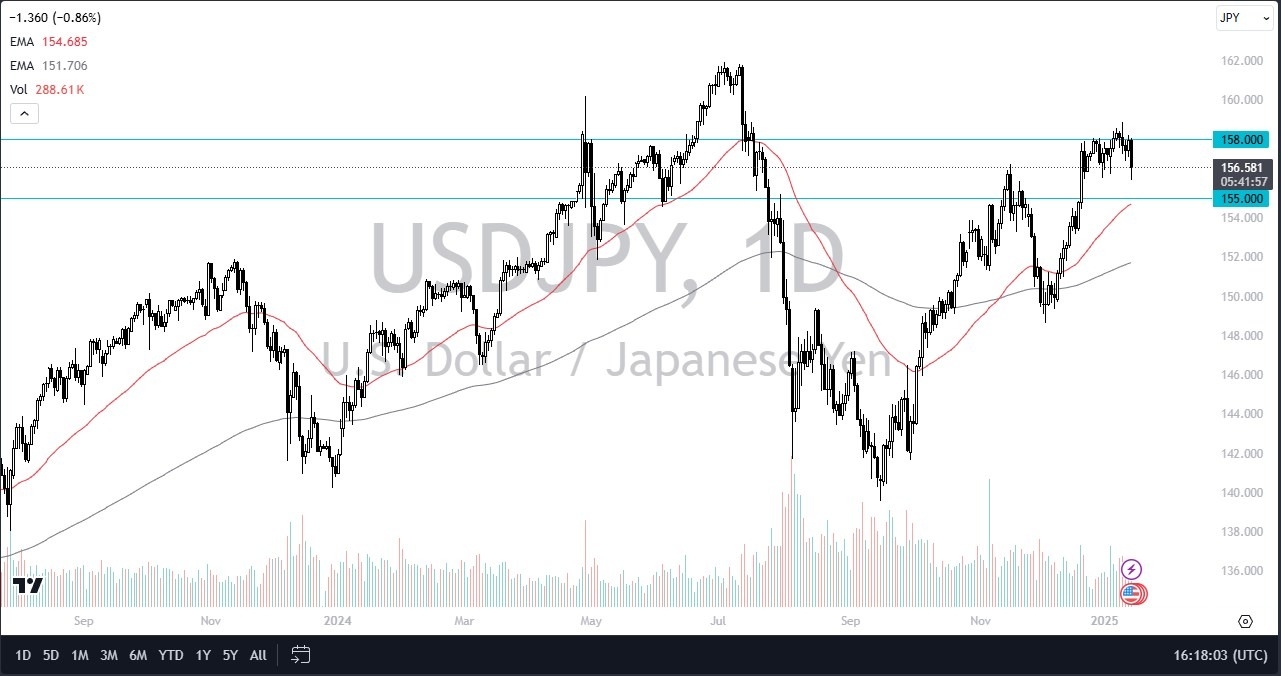
The technical analysis for this pair is still very strong, and it is probably worth noting that we have bounced enough to at least suggest that support should be held in this pair. If that’s going to be the case, then I suspect that we will find this pair reaching the ¥158 level much quicker than anticipated. With that being the case, I am still looking at this pair through the same prism that I was in the previous session, and I look at this as an opportunity to pick up “cheap US dollars”, at least until we were to break down below the ¥155 level.

It’s worth keeping in mind that the ¥155 level is also attracting the 50 Day EMA at the moment, which of course is a major technical indicator. With this, I think you have to look at the longer term trend and recognize that the markets have been bullish for some time. If we can break out above the ¥158 level, then I think it opens up the possibility of a move to the ¥160 level over the longer term. On the other hand, if we were to break down below the ¥155 level, then you might get a little bit more negative on this pair. However, you still get paid a swap at the end of every day, and that is something worth noting.

Want to trade our USD/JPY forex analysis and predictions? Here’s a list of forex brokers in Japan to check out.

Source link

16 01, 2025

The GBPUSD forecast update 16-01-2025

By |2025-01-16T14:15:48+02:00January 16, 2025|Forex News, News|0 Comments

The EURUSD price didn’t show any strong move since this morning, to continue fluctuating around the EMA50, thus, no change to the expected bearish trend scenario for today, which depends on the price stability below 1.0325$, while its targets begin at 1.0220$ and extend to 1.0100$ after breaking the previous level.


The expected trading range for today is between 1.0200$ support and 1.0360$ resistance


Trend forecast: Bearish


Source link

16 01, 2025

The GBPJPY resumes the decline – Forecast today – 16-1-2025

By |2025-01-16T12:14:19+02:00January 16, 2025|Forex News, News|0 Comments

Ethereum price (ETHUSD) traded with clear positivity yesterday to touch our waited target at 3425.50$, noticing that the price finds good resistance there, to show some slight bearish bias, waiting to get positive motive that push the price to surpass this level and confirm opening the way to achieve more gains on the intraday and short-term basis, to head towards visiting 3570.00$ followed by 3680.00$ areas as next positive targets.


Therefore, we are waiting for positive trades in the upcoming sessions, taking into consideration that failing to breach 3425.00$ will stop the bullish wave and push the price to head towards testing 3222.00$ areas before any new positive attempt.


The expected trading range for today is between 3250.00$ support and 3520.00$ resistance.


Trend forecast: Bullish


Source link

16 01, 2025

The EURJPY renews the positive action – Forecast today – 16-1-2025

By |2025-01-16T10:13:10+02:00January 16, 2025|Forex News, News|0 Comments

The GBPJPY pair confirmed its surrender to the domination of the bearish bias by forming many negative waves and break 191.40 level, to notice achieving some waited negative targets by touching 189.90 level.


The price might face difficulty to resume the negative attack due to stochastic consolidation above 20 level, to expect providing some sideways trades until gathering the required additional negative momentum to attack 189.30 level, which breaking it will confirm targeting new negative stations that might start at 188.10 and 186.90 levels.


The expected trading range for today is between 189.30 and 191.60


Trend forecast: Bearish


Source link

16 01, 2025

The GBPUSD price within negative pattern – Forecast today

By |2025-01-16T08:12:10+02:00January 16, 2025|Forex News, News|0 Comments

Energy Markets Experienced a Strong Start at the Beginning of 2025

Energy markets experienced a strong start at the beginning of 2025, with global oil prices jumping to their highest levels in five months, registering a notable increase of an average of 10%.

This significant rise was driven by growing concerns over the potential reduction of Russian crude oil supplies to the global market, especially after the United States imposed a new round of sanctions on Russia’s energy sector.

Additionally, rising expectations of improved global demand, particularly with the strong economic growth led by the United States alongside intensive measures to stimulate the Chinese economy, contributed to this surge.

Recent decisions by the OPEC+ alliance also played a crucial role in determining the price trajectory, as an extension of production restrictions was announced to better balance supply and demand in the market.

On the other hand, geopolitical tensions in some oil-producing regions have heightened concerns among traders about supply stability. This has led to increased insurance costs for shipments, which in turn has impacted prices.

Furthermore, the decline in U.S. inventories has boosted optimism about market recovery, with recent data showing a significant drop in commercial stocks.

In light of these developments, energy experts expect the positive momentum of oil prices to continue during the first quarter of the year, with expectations of further increases if current conditions persist. However, the market remains sensitive to any sudden changes that might affect supply or demand.

This report details the main reasons behind the surge in oil prices, with a comprehensive analysis of future trends that may determine the market’s path in the coming months.

Price Outlook

  • Since the beginning of 2025, the price of U.S. crude oil has risen by more than 10%, reaching its highest level in five months at $79.19 per barrel during trading on January 13.
  • Brent crude oil prices increased by 9.25%, reaching $81.64 per barrel on January 13, the highest level since August 2024.

US Sanctions on Russia

On January 10, 2025, the United States imposed a new package of sanctions on Russia’s energy sector, targeting major companies such as “Gazprom Neft” and “Surgutneftegaz,” in addition to over 180 oil tankers.

These measures aim to reduce Russia’s revenues from oil and gas exports, as part of ongoing efforts to pressure Moscow due to the ongoing war in Ukraine.

Details of the Sanctions

  • Targeted Companies: The sanctions include “Gazprom Neft” and “Surgutneftegaz,” two of Russia’s largest oil producers.
  • Oil Tankers: Approximately 183 ships were listed in the sanctions, hindering their ability to transport Russian oil to global markets.

Reactions

  • The Kremlin: Kremlin spokesperson Dmitry Peskov expressed concern that these sanctions could destabilize global energy markets, emphasizing that such decisions do not contribute to market stability.
  • International Analysts: Energy experts indicated that these sanctions could increase pressures on global oil markets, leading to higher prices and supply fluctuations.

Potential Impact

These sanctions are expected to affect Russia’s ability to export oil and gas, potentially reducing its revenues from the energy sector. They may also cause disruptions in global energy markets, given Russia’s prominent role as a major source of oil and gas.

Top Russian Crude Oil Importers

In 2024, India and China emerged as the largest importers of Russian crude oil, benefiting from competitive prices and discounts offered by Moscow amidst Western sanctions.

India

  • Import Volume: India imported approximately 1.64 million barrels per day of Russian oil during the 2023-2024 fiscal year, representing a 57% increase compared to the previous year.
  • Share of Total Imports: Russian oil accounted for about 35% of India’s total crude imports, compared to 22% in the previous year.
  • Impact on Other Sources: This shift led to a decrease in the Middle East oil share in India’s imports to 46%, the lowest level ever.

China

  • Import Volume: China’s imports of Russian oil increased by 17% since the beginning of 2024, reaching 37.79 million tons, equivalent to approximately 2.28 million barrels per day.
  • Share of Total Imports: Russian oil constituted about 22% of China’s total crude imports, compared to 18% in the previous year, reflecting increased reliance on Russian oil due to competitive prices.
  • Impact on Other Sources: This shift resulted in a reduction in the share of traditional suppliers, such as Saudi Arabia, whose exports to China declined by 8% compared to the previous year.
  • It also affected oil imports from the United States and Africa, as China preferred Russian oil due to its lower cost and the favorable payment terms offered by Moscow.

Turkey

  • Share of Imports: Turkey accounted for about 7% of Russia’s total crude oil exports from December 2022 to December 2024.

European Union

  • Share of Imports: Despite the sanctions, the European Union imported about 6% of Russia’s total crude oil exports during the same period.

This shift in oil flows reflects a reshaping of the global energy map, as Russia seeks to strengthen its relations with Asian countries to overcome the impact of Western sanctions, while countries like India and China benefit from opportunities to obtain oil at discounted prices.

Opinions and Analyses on the Sanctions

Traders and analysts have stated that Russian oil exports will be severely affected by the new sanctions, pushing China and India to obtain more crude from the Middle East, Africa, and the Americas, which will drive up prices and shipping costs.

  • Analyst at BVM “Tamas Farga”: There are real concerns in the market about supply disruptions from Russia. It seems that the worst-case scenario for Russian oil could become a reality.
  • Farga added: However, it is unclear what will happen when “Donald Trump” takes office next week. Farga clarified that the sanctions include a cooling-off period until March 12, so there may not be significant disruptions until now.
  • Goldman Sachs estimates: The ships targeted by the new sanctions transported 1.7 million barrels per day of oil in 2024, or 25% of Russia’s exports.
  • Analysts wrote in a memo: Goldman Sachs: It is increasingly likely that its Brent range forecast between $70 and $85 per barrel will lean upwards.
  • Analysts at RBC Capital Markets: Doubling the number of tankers sanctioned to transport Russian barrels could pose a significant logistical problem affecting crude oil flows.
  • Head of Research at Onix Capital Group “Harry Chelengiorian”: The latest round of sanctions by the U.S. Office of Foreign Assets Control targeting Russian oil companies and a large number of tankers will have particularly severe consequences for India.
  • Analysts at JP Morgan: Russia has some room to maneuver despite the new sanctions, but it will ultimately need to acquire unsanctioned tankers or offer crude at $60 per barrel or less to use Western insurance as stipulated in the Western price cap.
  • Market Strategist at IG “Yap Jon Rong”: The main headlines surrounding Russian oil sanctions have been the dominant driver of oil prices recently, coupled with resilient U.S. economic data, witnessing tighter supply and demand dynamics some momentum.
  • Rong added: With prices rising rapidly and sharply by about 10% since the beginning of the year, it is driving profit-taking activity with some risks emerging around upcoming U.S. inflation data releases.
  • Analysts at ING in a memo: These sanctions have the potential to pull up to 700,000 barrels per day from the market’s supply, which would erase the surplus we expect this year.
  • Analysts added: However, the actual decline in flows is likely to be less, as Russia and buyers find ways to circumvent these sanctions, and it is clear there will be more pressure on unsanctioned ships within the shadow fleet.
  • Philip Jones Lux from Sparta Commodities: The new sanctions on Russian tankers are expected to affect crude supplies to China and India, although the main players in these countries are still assessing the legal situation and possible solutions.

Extension of OPEC+ Production Cuts

In December last year, the OPEC+ alliance announced an extension of oil production cuts by two million barrels per day for an additional year, until the end of 2026 instead of 2025, as part of its ongoing efforts to support the stability of global oil markets and enhance the balance between supply and demand.

Additionally, the eight countries contributing to the voluntary oil production cuts, amounting to 2.2 million barrels per day, decided to extend the timeline for lifting these cuts by an additional three months, so they end at the end of March 2025 instead of the previous deadline at the end of the current December.

OPEC+ members are currently implementing production cuts totaling 5.9 million barrels per day, equivalent to about 5.7% of global demand.

  • Included Cuts: Two million barrels per day from OPEC+ members continue until the end of 2026 after the latest decision.
  • Contributed by 9 Member Countries: (Saudi Arabia, UAE, Iraq, Kuwait, Kazakhstan, Algeria, Oman, Gabon, and Russia) reducing production by 1.7 million barrels per day, ending by the end of 2025.
  • Additional Voluntary Cuts: Eight countries (Saudi Arabia, Russia, UAE, Kuwait, Algeria, Oman, Iraq, and Kazakhstan) agreed to implement additional voluntary production cuts amounting to 2.2 million barrels per day, to end by the end of March 2025.

Harsh Weather and Global Demand

Harsh weather in Europe and the United States has had a notable impact on oil markets recently, as unusual weather conditions have contributed to increased demand for fuel and higher prices. The main impacts are as follows:

  1. Increased Demand for Heating Fuel: A sharp drop in temperatures in Europe and the United States has led to increased consumption of heating fuels, such as diesel and heating oil. This rise in demand for refined products has put pressure on refineries and increased crude oil prices, the primary source of these products.
  2. Production and Transportation Disruptions: In the United States, snowstorms and ice have led to the closure of some oil fields, particularly in major production areas like Texas. Transportation networks and infrastructure have been disrupted, affecting producers’ ability to deliver oil to local and international markets.
  3. Short-Term Price Boost: Cold weather has helped support oil prices, which have seen significant increases. For example, futures contracts for Brent crude and West Texas Intermediate (WTI) crude have risen with ongoing expectations of cold weather conditions.
  4. Impact on Inventories: Increased consumption of heating fuel has led to faster-than-expected draws from strategic inventories, especially in the United States, raising concerns about market balance. Energy Information Administration (EIA) data showed a larger-than-expected decline in inventories, prompting investors to buy more futures contracts in anticipation of potential shortages.
  5. Divergence in Global Demand: While demand for oil rose in Europe and the United States, demand in Asia remained relatively stable due to milder weather conditions. This divergence has helped mitigate the sharp rise in prices on a global level.
  6. Seasonal Factors: Although cold weather boosts oil demand during winter, the market is anticipating a return to milder temperatures in the coming months, which may lead to a gradual decline in prices. Outlook: If harsh weather continues longer than expected, the market may experience further upward pressure on prices. However, the return to climatic stability will rebalance supply and demand, especially if producing countries respond by increasing production to compensate for any shortages.

Global Interest Rate Cuts

Major central banks in the United States, Europe, the United Kingdom, Canada, and New Zealand continue to cut interest rates and ease tight monetary policies, aiming to halt the decline in economic activity and preserve achieved gains. Low interest rates typically reduce borrowing costs, which can boost economic activity and increase demand for oil.

Economic Stimulus in China

Chinese authorities took additional new stimulus measures during the last quarter of 2024 to support the country’s weak economic activities, which will also reflect in improved oil demand levels in the world’s largest crude importer.

Chinese authorities announced that they will adopt a “somewhat accommodative” monetary policy, according to an official statement issued by a meeting of senior Communist Party officials, a term last used in 2010 when they sought to support recovery from the global financial crisis.

According to the ruling party’s political office, the country will adopt a “sufficiently accommodative” monetary policy in 2025, alongside a more proactive fiscal policy to stimulate economic growth.

Key Challenges Affecting Oil Prices in 2025

The crude oil market in 2025 faces numerous challenges that could significantly impact its prices, including the following:

  • Continued Geopolitical Uncertainty:

    • The ongoing war in Ukraine and tensions in the Middle East cast shadows over oil markets, leading to significant price volatility.
    • The war in Ukraine continues with no clear solutions in sight, keeping oil prices in a state of uncertainty.
    • China escalates its claims of sovereignty over Taiwan, raising fears of a war between the two countries.
    • Many countries impose sanctions on some oil-producing nations.

  • Global Economic Slowdown:

    • A slowdown in global economic growth could lead to a decrease in fuel demand.
    • Many major global economies face recession risks this year, casting a gloomy shadow on oil demand forecasts and price declines.

  • Increased Production from Non-OPEC+ Countries:

    • Some non-OPEC+ countries, such as the United States and Canada, are seeking to increase their oil production. This could lead to an oversupply in the market and negatively pressure prices.

  • Shift Towards Renewable Energy:

    • Many countries are aiming to reduce their reliance on fossil fuels and transition to renewable energy sources.
    • The shift to renewable energy in the long term could lead to a decrease in oil demand and exert downward pressure on prices.

  • Climate Change Concerns:

    • Concerns about climate change are increasing pressure on governments and companies to reduce carbon emissions.
    • These pressures could lead to restrictions on oil usage and a decline in demand and prices.

Top Oil Price Forecasts for 2025

  • Bank of America expects oil prices to stabilize around $80 per barrel this year.
  • Goldman Sachs Group forecasts oil prices to rise to $80 per barrel this year.
  • Citibank Group expects oil prices to stabilize around $75 per barrel this year.
  • Morgan Stanley Group forecasted oil prices to reach $75 per barrel by the end of 2025.
  • Deutsche Bank expects oil prices to reach $90 per barrel by the end of 2025, citing supply shortages as a key factor supporting prices.
  • Barclays Bank also raised its oil price forecasts by five dollars above the target price of $90 per barrel by the end of this year.
  • Geoffries Financial Consulting Institute indicated that Brent crude could end the year at $95 per barrel.
  • The World Bank expects the average Brent crude price to be $93 per barrel in 2025, attributing this to ongoing geopolitical tensions and OPEC+ production slowdowns.
  • The International Energy Agency expects the average Brent crude price to be $90 per barrel in 2025.
  • Argus Media expects the average Brent crude price to be $95 per barrel in 2025.

Best Oil Trading Companies January 2025


  • Pepperstone – Best overall crude oil trading broker for beginners. Multiple regulated licenses. Founded 2010. Minimum deposit: $0. 20% discount on deposit.
  • FPMarkets  – Established 2005. Ideal for trading Crude Oil (WTI/Brent) with competitive spreads and fast execution. Minimum deposit: $100.
  • Plus500 – Best licensed broker for investing in crude oil futures. Founded 2008. Multiple regulated licenses. Minimum deposit: $100.
  • XM – Top crude oil WTI trading platform for educational materials and copy trading. Founded 2009. Multiple regulated licenses. Minimum deposit: $5. Periodic competitions and bonuses.


Pepperstone

Licenses:

CySEC, BaFin, FCA, SCB, CMA

74-89% of CFD retail investor accounts lose money.

FPMarkets Logo

FPMarkets

Licenses:

ASIC, CySEC, CMA, STV, FSCA, FSA


Plus500

Licenses:

CySEC, ASIC, IFSC, DFSA, FSA

Plus500 Futures trading is available to US residents only.


XM Logo

XM

Licenses:

CySEC, ASIC, IFSC, DFSA, FCA


Technical Analysis of Crude Oil Prices

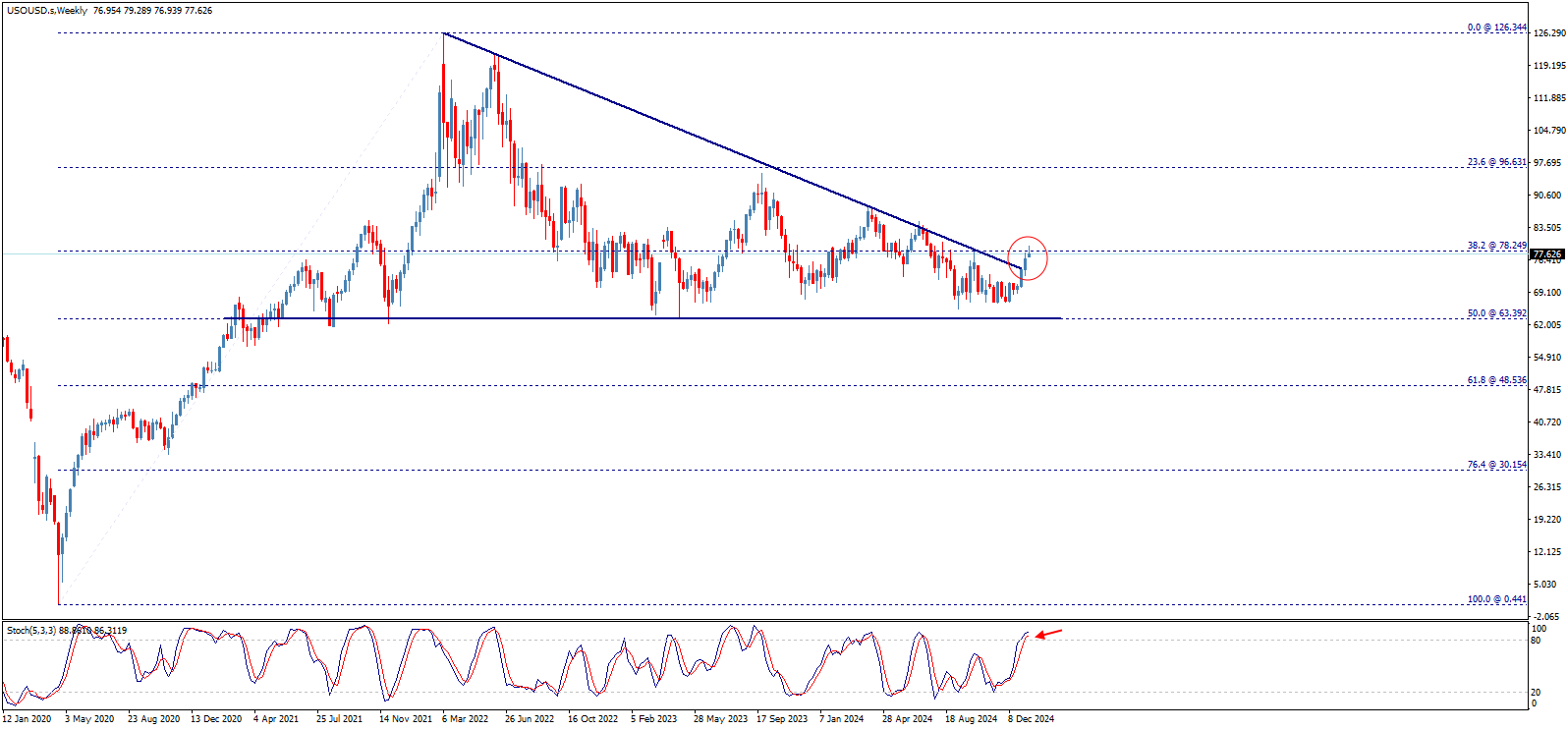
When applying the Fibonacci correction rule to different timeframes of oil prices, we find that there are signals suggesting the price direction towards recovering the upward trend in the medium to long term. After several attempts to reach the 50% Fibonacci level for the entire rise measured from historical lows around $0.44 to the recorded peak at $126.34, the price bounced upward and broke through a significant resistance level, as shown in the following weekly chart:


oil


The price is attempting to break through the resistance level formed at the previously broken 38.2% Fibonacci correction level, forming a significant resistance at $78.25. Breaking this level represents a key confirmation for the continuation of the upward wave and the direction to achieve positive targets starting at $84.40 and extending to areas of $90.00 and then $96.60 in the medium term.

The Stochastic indicator shows negative signals on the weekly timeframe, which may hinder the price’s task of achieving the required breakout at $78.25 and delay the confirmation of the breakout. This indicates that we need a weekly close above this level to confirm the continued rise.

On the other hand, on the daily timeframe, we find that the price began an upward correction from the recorded low in 2023 at $63.76. We observe that the price surpassed the 23.6% Fibonacci level to build more upward waves in the short term, targeting the visit to the 85.70% level as the next corrective target.


oil


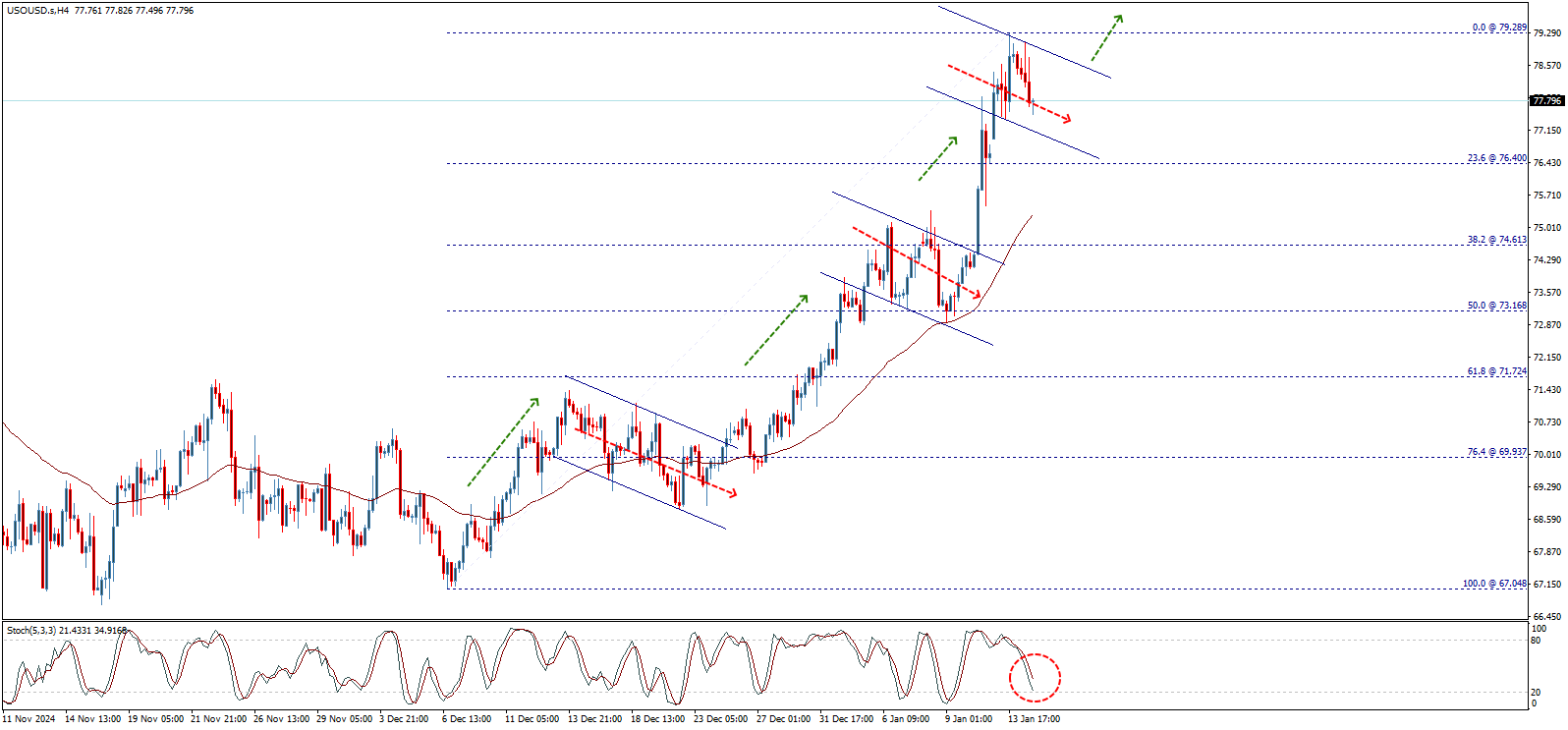
Continuing the application of Fibonacci corrections to different timeframes, the four-hour chart shows that the upward wave initiated by the price from the $67.05 area faced temporary downward retracements, followed by a resumption of the main upward trend. This contributed to pushing the price higher by forming ascending flag patterns, as shown in the chart below. Currently, the price is undergoing a downward correction that may lead it to test the $76.40 areas before resuming the upward wave again.


oil


The recent trades are confined within a descending sub-channel forming a continuation flag pattern, meaning that breaking $78.90 will provide a good positive incentive supporting the continued upward trend in the upcoming period, aiming to achieve the aforementioned positive targets.

In summary, the expected overall trend for the upcoming period is upward, confirmed by breaking $78.25 and then $78.90, to receive positive incentives contributing to the surge towards levels of $84.40, then further to areas of $90.00 and $96.60.

Conversely, it is crucial to note that failing to confirm the breach of $78.90 and a downward rebound breaking the $74.60 level will force the price to turn downward, incurring new losses that could reach areas of $63.40 in the short term.

Fibonacci Levels

  • 50% Fibonacci Level: A Fibonacci correction level reached from $0.44 to $126.34.
  • 38.2% Fibonacci Level: A significant resistance level at $78.25.
  • 23.6% Fibonacci Level: A corrective level on the daily timeframe at $85.70.

Technical Indicators

  • Stochastic Indicator: Shows negative signals on the weekly timeframe, which may hinder the price’s task of achieving the required breakout.

Four-Hour Chart

The four-hour chart shows that the upward wave initiated by the price from the $67.05 area faced temporary downward retracements, followed by a resumption of the main upward trend. This contributed to pushing the price higher by forming ascending flag patterns, as shown in the chart below. Currently, the price is undergoing a downward correction that may lead it to test the $76.40 areas before resuming the upward wave again.

Trading Channels

  • Descending Sub-Channel: Recent trades are confined within a descending sub-channel forming a continuation flag pattern.

Summary

In summary, the expected overall trend for the upcoming period is upward, confirmed by breaking $78.25 and then $78.90, to receive positive incentives contributing to the surge towards levels of $84.40, then further to areas of $90.00 and $96.60.

Conversely, it is crucial to note that failing to confirm the breach of $78.90 and a downward rebound breaking the $74.60 level will force the price to turn downward, incurring new losses that could reach areas of $63.40 in the short term.

Conclusion

In conclusion, the expected overall trend for the upcoming period is upward based on technical analysis, with necessary confirmations at $78.25 and $78.90 levels to support the continuation of the upward trend and achieve positive targets. However, attention must be paid to critical support levels at $74.60 and $63.40 in the event of negative reversals.

Closing

The overall expected trend for the upcoming period is upward based on technical analysis, with the necessity to monitor vital support and resistance levels to ensure the achievement of desired targets and avoid potential risks.


Source link

16 01, 2025

The USDJPY price under the negative pressure – Forecast today

By |2025-01-16T06:11:09+02:00January 16, 2025|Forex News, News|0 Comments

Energy Markets Experienced a Strong Start at the Beginning of 2025

Energy markets experienced a strong start at the beginning of 2025, with global oil prices jumping to their highest levels in five months, registering a notable increase of an average of 10%.

This significant rise was driven by growing concerns over the potential reduction of Russian crude oil supplies to the global market, especially after the United States imposed a new round of sanctions on Russia’s energy sector.

Additionally, rising expectations of improved global demand, particularly with the strong economic growth led by the United States alongside intensive measures to stimulate the Chinese economy, contributed to this surge.

Recent decisions by the OPEC+ alliance also played a crucial role in determining the price trajectory, as an extension of production restrictions was announced to better balance supply and demand in the market.

On the other hand, geopolitical tensions in some oil-producing regions have heightened concerns among traders about supply stability. This has led to increased insurance costs for shipments, which in turn has impacted prices.

Furthermore, the decline in U.S. inventories has boosted optimism about market recovery, with recent data showing a significant drop in commercial stocks.

In light of these developments, energy experts expect the positive momentum of oil prices to continue during the first quarter of the year, with expectations of further increases if current conditions persist. However, the market remains sensitive to any sudden changes that might affect supply or demand.

This report details the main reasons behind the surge in oil prices, with a comprehensive analysis of future trends that may determine the market’s path in the coming months.

Price Outlook

  • Since the beginning of 2025, the price of U.S. crude oil has risen by more than 10%, reaching its highest level in five months at $79.19 per barrel during trading on January 13.
  • Brent crude oil prices increased by 9.25%, reaching $81.64 per barrel on January 13, the highest level since August 2024.

US Sanctions on Russia

On January 10, 2025, the United States imposed a new package of sanctions on Russia’s energy sector, targeting major companies such as “Gazprom Neft” and “Surgutneftegaz,” in addition to over 180 oil tankers.

These measures aim to reduce Russia’s revenues from oil and gas exports, as part of ongoing efforts to pressure Moscow due to the ongoing war in Ukraine.

Details of the Sanctions

  • Targeted Companies: The sanctions include “Gazprom Neft” and “Surgutneftegaz,” two of Russia’s largest oil producers.
  • Oil Tankers: Approximately 183 ships were listed in the sanctions, hindering their ability to transport Russian oil to global markets.

Reactions

  • The Kremlin: Kremlin spokesperson Dmitry Peskov expressed concern that these sanctions could destabilize global energy markets, emphasizing that such decisions do not contribute to market stability.
  • International Analysts: Energy experts indicated that these sanctions could increase pressures on global oil markets, leading to higher prices and supply fluctuations.

Potential Impact

These sanctions are expected to affect Russia’s ability to export oil and gas, potentially reducing its revenues from the energy sector. They may also cause disruptions in global energy markets, given Russia’s prominent role as a major source of oil and gas.

Top Russian Crude Oil Importers

In 2024, India and China emerged as the largest importers of Russian crude oil, benefiting from competitive prices and discounts offered by Moscow amidst Western sanctions.

India

  • Import Volume: India imported approximately 1.64 million barrels per day of Russian oil during the 2023-2024 fiscal year, representing a 57% increase compared to the previous year.
  • Share of Total Imports: Russian oil accounted for about 35% of India’s total crude imports, compared to 22% in the previous year.
  • Impact on Other Sources: This shift led to a decrease in the Middle East oil share in India’s imports to 46%, the lowest level ever.

China

  • Import Volume: China’s imports of Russian oil increased by 17% since the beginning of 2024, reaching 37.79 million tons, equivalent to approximately 2.28 million barrels per day.
  • Share of Total Imports: Russian oil constituted about 22% of China’s total crude imports, compared to 18% in the previous year, reflecting increased reliance on Russian oil due to competitive prices.
  • Impact on Other Sources: This shift resulted in a reduction in the share of traditional suppliers, such as Saudi Arabia, whose exports to China declined by 8% compared to the previous year.
  • It also affected oil imports from the United States and Africa, as China preferred Russian oil due to its lower cost and the favorable payment terms offered by Moscow.

Turkey

  • Share of Imports: Turkey accounted for about 7% of Russia’s total crude oil exports from December 2022 to December 2024.

European Union

  • Share of Imports: Despite the sanctions, the European Union imported about 6% of Russia’s total crude oil exports during the same period.

This shift in oil flows reflects a reshaping of the global energy map, as Russia seeks to strengthen its relations with Asian countries to overcome the impact of Western sanctions, while countries like India and China benefit from opportunities to obtain oil at discounted prices.

Opinions and Analyses on the Sanctions

Traders and analysts have stated that Russian oil exports will be severely affected by the new sanctions, pushing China and India to obtain more crude from the Middle East, Africa, and the Americas, which will drive up prices and shipping costs.

  • Analyst at BVM “Tamas Farga”: There are real concerns in the market about supply disruptions from Russia. It seems that the worst-case scenario for Russian oil could become a reality.
  • Farga added: However, it is unclear what will happen when “Donald Trump” takes office next week. Farga clarified that the sanctions include a cooling-off period until March 12, so there may not be significant disruptions until now.
  • Goldman Sachs estimates: The ships targeted by the new sanctions transported 1.7 million barrels per day of oil in 2024, or 25% of Russia’s exports.
  • Analysts wrote in a memo: Goldman Sachs: It is increasingly likely that its Brent range forecast between $70 and $85 per barrel will lean upwards.
  • Analysts at RBC Capital Markets: Doubling the number of tankers sanctioned to transport Russian barrels could pose a significant logistical problem affecting crude oil flows.
  • Head of Research at Onix Capital Group “Harry Chelengiorian”: The latest round of sanctions by the U.S. Office of Foreign Assets Control targeting Russian oil companies and a large number of tankers will have particularly severe consequences for India.
  • Analysts at JP Morgan: Russia has some room to maneuver despite the new sanctions, but it will ultimately need to acquire unsanctioned tankers or offer crude at $60 per barrel or less to use Western insurance as stipulated in the Western price cap.
  • Market Strategist at IG “Yap Jon Rong”: The main headlines surrounding Russian oil sanctions have been the dominant driver of oil prices recently, coupled with resilient U.S. economic data, witnessing tighter supply and demand dynamics some momentum.
  • Rong added: With prices rising rapidly and sharply by about 10% since the beginning of the year, it is driving profit-taking activity with some risks emerging around upcoming U.S. inflation data releases.
  • Analysts at ING in a memo: These sanctions have the potential to pull up to 700,000 barrels per day from the market’s supply, which would erase the surplus we expect this year.
  • Analysts added: However, the actual decline in flows is likely to be less, as Russia and buyers find ways to circumvent these sanctions, and it is clear there will be more pressure on unsanctioned ships within the shadow fleet.
  • Philip Jones Lux from Sparta Commodities: The new sanctions on Russian tankers are expected to affect crude supplies to China and India, although the main players in these countries are still assessing the legal situation and possible solutions.

Extension of OPEC+ Production Cuts

In December last year, the OPEC+ alliance announced an extension of oil production cuts by two million barrels per day for an additional year, until the end of 2026 instead of 2025, as part of its ongoing efforts to support the stability of global oil markets and enhance the balance between supply and demand.

Additionally, the eight countries contributing to the voluntary oil production cuts, amounting to 2.2 million barrels per day, decided to extend the timeline for lifting these cuts by an additional three months, so they end at the end of March 2025 instead of the previous deadline at the end of the current December.

OPEC+ members are currently implementing production cuts totaling 5.9 million barrels per day, equivalent to about 5.7% of global demand.

  • Included Cuts: Two million barrels per day from OPEC+ members continue until the end of 2026 after the latest decision.
  • Contributed by 9 Member Countries: (Saudi Arabia, UAE, Iraq, Kuwait, Kazakhstan, Algeria, Oman, Gabon, and Russia) reducing production by 1.7 million barrels per day, ending by the end of 2025.
  • Additional Voluntary Cuts: Eight countries (Saudi Arabia, Russia, UAE, Kuwait, Algeria, Oman, Iraq, and Kazakhstan) agreed to implement additional voluntary production cuts amounting to 2.2 million barrels per day, to end by the end of March 2025.

Harsh Weather and Global Demand

Harsh weather in Europe and the United States has had a notable impact on oil markets recently, as unusual weather conditions have contributed to increased demand for fuel and higher prices. The main impacts are as follows:

  1. Increased Demand for Heating Fuel: A sharp drop in temperatures in Europe and the United States has led to increased consumption of heating fuels, such as diesel and heating oil. This rise in demand for refined products has put pressure on refineries and increased crude oil prices, the primary source of these products.
  2. Production and Transportation Disruptions: In the United States, snowstorms and ice have led to the closure of some oil fields, particularly in major production areas like Texas. Transportation networks and infrastructure have been disrupted, affecting producers’ ability to deliver oil to local and international markets.
  3. Short-Term Price Boost: Cold weather has helped support oil prices, which have seen significant increases. For example, futures contracts for Brent crude and West Texas Intermediate (WTI) crude have risen with ongoing expectations of cold weather conditions.
  4. Impact on Inventories: Increased consumption of heating fuel has led to faster-than-expected draws from strategic inventories, especially in the United States, raising concerns about market balance. Energy Information Administration (EIA) data showed a larger-than-expected decline in inventories, prompting investors to buy more futures contracts in anticipation of potential shortages.
  5. Divergence in Global Demand: While demand for oil rose in Europe and the United States, demand in Asia remained relatively stable due to milder weather conditions. This divergence has helped mitigate the sharp rise in prices on a global level.
  6. Seasonal Factors: Although cold weather boosts oil demand during winter, the market is anticipating a return to milder temperatures in the coming months, which may lead to a gradual decline in prices. Outlook: If harsh weather continues longer than expected, the market may experience further upward pressure on prices. However, the return to climatic stability will rebalance supply and demand, especially if producing countries respond by increasing production to compensate for any shortages.

Global Interest Rate Cuts

Major central banks in the United States, Europe, the United Kingdom, Canada, and New Zealand continue to cut interest rates and ease tight monetary policies, aiming to halt the decline in economic activity and preserve achieved gains. Low interest rates typically reduce borrowing costs, which can boost economic activity and increase demand for oil.

Economic Stimulus in China

Chinese authorities took additional new stimulus measures during the last quarter of 2024 to support the country’s weak economic activities, which will also reflect in improved oil demand levels in the world’s largest crude importer.

Chinese authorities announced that they will adopt a “somewhat accommodative” monetary policy, according to an official statement issued by a meeting of senior Communist Party officials, a term last used in 2010 when they sought to support recovery from the global financial crisis.

According to the ruling party’s political office, the country will adopt a “sufficiently accommodative” monetary policy in 2025, alongside a more proactive fiscal policy to stimulate economic growth.

Key Challenges Affecting Oil Prices in 2025

The crude oil market in 2025 faces numerous challenges that could significantly impact its prices, including the following:

  • Continued Geopolitical Uncertainty:

    • The ongoing war in Ukraine and tensions in the Middle East cast shadows over oil markets, leading to significant price volatility.
    • The war in Ukraine continues with no clear solutions in sight, keeping oil prices in a state of uncertainty.
    • China escalates its claims of sovereignty over Taiwan, raising fears of a war between the two countries.
    • Many countries impose sanctions on some oil-producing nations.

  • Global Economic Slowdown:

    • A slowdown in global economic growth could lead to a decrease in fuel demand.
    • Many major global economies face recession risks this year, casting a gloomy shadow on oil demand forecasts and price declines.

  • Increased Production from Non-OPEC+ Countries:

    • Some non-OPEC+ countries, such as the United States and Canada, are seeking to increase their oil production. This could lead to an oversupply in the market and negatively pressure prices.

  • Shift Towards Renewable Energy:

    • Many countries are aiming to reduce their reliance on fossil fuels and transition to renewable energy sources.
    • The shift to renewable energy in the long term could lead to a decrease in oil demand and exert downward pressure on prices.

  • Climate Change Concerns:

    • Concerns about climate change are increasing pressure on governments and companies to reduce carbon emissions.
    • These pressures could lead to restrictions on oil usage and a decline in demand and prices.

Top Oil Price Forecasts for 2025

  • Bank of America expects oil prices to stabilize around $80 per barrel this year.
  • Goldman Sachs Group forecasts oil prices to rise to $80 per barrel this year.
  • Citibank Group expects oil prices to stabilize around $75 per barrel this year.
  • Morgan Stanley Group forecasted oil prices to reach $75 per barrel by the end of 2025.
  • Deutsche Bank expects oil prices to reach $90 per barrel by the end of 2025, citing supply shortages as a key factor supporting prices.
  • Barclays Bank also raised its oil price forecasts by five dollars above the target price of $90 per barrel by the end of this year.
  • Geoffries Financial Consulting Institute indicated that Brent crude could end the year at $95 per barrel.
  • The World Bank expects the average Brent crude price to be $93 per barrel in 2025, attributing this to ongoing geopolitical tensions and OPEC+ production slowdowns.
  • The International Energy Agency expects the average Brent crude price to be $90 per barrel in 2025.
  • Argus Media expects the average Brent crude price to be $95 per barrel in 2025.

Best Oil Trading Companies January 2025


  • Pepperstone – Best overall crude oil trading broker for beginners. Multiple regulated licenses. Founded 2010. Minimum deposit: $0. 20% discount on deposit.
  • FPMarkets  – Established 2005. Ideal for trading Crude Oil (WTI/Brent) with competitive spreads and fast execution. Minimum deposit: $100.
  • Plus500 – Best licensed broker for investing in crude oil futures. Founded 2008. Multiple regulated licenses. Minimum deposit: $100.
  • XM – Top crude oil WTI trading platform for educational materials and copy trading. Founded 2009. Multiple regulated licenses. Minimum deposit: $5. Periodic competitions and bonuses.


Pepperstone

Licenses:

CySEC, BaFin, FCA, SCB, CMA

74-89% of CFD retail investor accounts lose money.

FPMarkets Logo

FPMarkets

Licenses:

ASIC, CySEC, CMA, STV, FSCA, FSA


Plus500

Licenses:

CySEC, ASIC, IFSC, DFSA, FSA

Plus500 Futures trading is available to US residents only.


XM Logo

XM

Licenses:

CySEC, ASIC, IFSC, DFSA, FCA


Technical Analysis of Crude Oil Prices

When applying the Fibonacci correction rule to different timeframes of oil prices, we find that there are signals suggesting the price direction towards recovering the upward trend in the medium to long term. After several attempts to reach the 50% Fibonacci level for the entire rise measured from historical lows around $0.44 to the recorded peak at $126.34, the price bounced upward and broke through a significant resistance level, as shown in the following weekly chart:


oil


The price is attempting to break through the resistance level formed at the previously broken 38.2% Fibonacci correction level, forming a significant resistance at $78.25. Breaking this level represents a key confirmation for the continuation of the upward wave and the direction to achieve positive targets starting at $84.40 and extending to areas of $90.00 and then $96.60 in the medium term.

The Stochastic indicator shows negative signals on the weekly timeframe, which may hinder the price’s task of achieving the required breakout at $78.25 and delay the confirmation of the breakout. This indicates that we need a weekly close above this level to confirm the continued rise.

On the other hand, on the daily timeframe, we find that the price began an upward correction from the recorded low in 2023 at $63.76. We observe that the price surpassed the 23.6% Fibonacci level to build more upward waves in the short term, targeting the visit to the 85.70% level as the next corrective target.


oil


Continuing the application of Fibonacci corrections to different timeframes, the four-hour chart shows that the upward wave initiated by the price from the $67.05 area faced temporary downward retracements, followed by a resumption of the main upward trend. This contributed to pushing the price higher by forming ascending flag patterns, as shown in the chart below. Currently, the price is undergoing a downward correction that may lead it to test the $76.40 areas before resuming the upward wave again.


oil


The recent trades are confined within a descending sub-channel forming a continuation flag pattern, meaning that breaking $78.90 will provide a good positive incentive supporting the continued upward trend in the upcoming period, aiming to achieve the aforementioned positive targets.

In summary, the expected overall trend for the upcoming period is upward, confirmed by breaking $78.25 and then $78.90, to receive positive incentives contributing to the surge towards levels of $84.40, then further to areas of $90.00 and $96.60.

Conversely, it is crucial to note that failing to confirm the breach of $78.90 and a downward rebound breaking the $74.60 level will force the price to turn downward, incurring new losses that could reach areas of $63.40 in the short term.

Fibonacci Levels

  • 50% Fibonacci Level: A Fibonacci correction level reached from $0.44 to $126.34.
  • 38.2% Fibonacci Level: A significant resistance level at $78.25.
  • 23.6% Fibonacci Level: A corrective level on the daily timeframe at $85.70.

Technical Indicators

  • Stochastic Indicator: Shows negative signals on the weekly timeframe, which may hinder the price’s task of achieving the required breakout.

Four-Hour Chart

The four-hour chart shows that the upward wave initiated by the price from the $67.05 area faced temporary downward retracements, followed by a resumption of the main upward trend. This contributed to pushing the price higher by forming ascending flag patterns, as shown in the chart below. Currently, the price is undergoing a downward correction that may lead it to test the $76.40 areas before resuming the upward wave again.

Trading Channels

  • Descending Sub-Channel: Recent trades are confined within a descending sub-channel forming a continuation flag pattern.

Summary

In summary, the expected overall trend for the upcoming period is upward, confirmed by breaking $78.25 and then $78.90, to receive positive incentives contributing to the surge towards levels of $84.40, then further to areas of $90.00 and $96.60.

Conversely, it is crucial to note that failing to confirm the breach of $78.90 and a downward rebound breaking the $74.60 level will force the price to turn downward, incurring new losses that could reach areas of $63.40 in the short term.

Conclusion

In conclusion, the expected overall trend for the upcoming period is upward based on technical analysis, with necessary confirmations at $78.25 and $78.90 levels to support the continuation of the upward trend and achieve positive targets. However, attention must be paid to critical support levels at $74.60 and $63.40 in the event of negative reversals.

Closing

The overall expected trend for the upcoming period is upward based on technical analysis, with the necessity to monitor vital support and resistance levels to ensure the achievement of desired targets and avoid potential risks.


Source link

16 01, 2025

Japanese Yen Technical Analysis: USD/JPY, GBP/JPY, EUR/JPY

By |2025-01-16T02:09:07+02:00January 16, 2025|Forex News, News|0 Comments

Japanese Yen Talking Points:

  • Japanese Yen strength showed against the U.S. Dollar in the aftermath of this morning’s U.S. CPI report.
  • While questions remain around the Fed’s ability to cut rates this year, both Europe and the U.K. could drive bearish fundamental backdrops, making the prospect of carry unwind in GBP/JPY and EUR/JPY as more attractive concepts.
  • I look into these pairs each week in the Tuesday webinar, and you’re welcome to join: Click here for registration information.

USD/JPY Support Break


The U.S. Dollar showed a move of weakness around the U.S. CPI print this morning, and while DXY has bounced back and the EUR/USD sell-off has caught another shot-in-the-arm, USD/JPY is holding relatively close to the morning’s lows.

There’s also the breach of a support zone that had showed as prior resistance, taken from the 76.4 and 78.6% Fibonacci retracements of the July-September sell-off. This zone had previously helped to hold resistance in November, but more recently it had helped to hold support over the past two weeks, until this morning’s breach down to a lower-low.


USD/JPY Daily Price Chart

Chart prepared by James Stanley, USD/JPY on Tradingview

Get our exclusive guide to USD/JPY trading in 2025

USD/JPY Four-Hour


On a shorter-term basis we can see where this morning’s sell-off brought upon a fresh 2025 low in the pair; but the bounce from that has, so far, held resistance at the bottom of the support zone noted above.

For overhead resistance, there’s a prior swing-low at 156.91 and the top of the Fibonacci zone at 157.17. And for next support below the 156.00 handle, it’s the 155.00 psychological level that looms large.


USD/JPY Four-Hour Chart

usdjpy four hour 11525Chart prepared by James Stanley, USD/JPY on Tradingview


GBP/JPY


It’s been a slippery start to the year for the British Pound and I had looked at GBP/JPY in the weekly forecast, highlighting a bearish backdrop as prices had started to push below a long-term zone. Monday saw another spill in GBP/JPY and the pair made a fast push down to the 190.00 handle before catching a sizable bounce. Resistance held overnight at 193.00 and sellers have went back for another run, but chasing this at this point could be a challenge.

From the weekly chart below, we can see a longer-term trend that’s come more and more into question, as shown by lower-highs over the past six months. But if the pair gives up the 190.00 level, the door could soon open to breakdown scenarios.


GBP/JPY Weekly Chart

gbpjpy weekly 11525Chart prepared by James Stanley, GBP/JPY on Tradingview


GBP/JPY Four-Hour


Given how quickly the pair has moved off of that 193.00 level, chasing could be challenging. But, there’s also context for a lower-high around the 192.40 level; and if that doesn’t come into the picture, the 190.81 Fibonacci level could potential be used to work with breakdown scenarios into the 190.00 psychological level.


GBP/JPY Four-Hour Price Chart

gbpjpy four hour 11525Chart prepared by James Stanley, GBP/JPY on Tradingview


EUR/JPY


EUR/JPY is currently within a symmetrical triangle formation and earlier this week, it was around the 160.00 level that had held the lows after bears attempted to continue the sell-off that started after resistance at the 165.00 level around the end of 2024.

Similar to GBP/JPY above, that can be a tough move to chase. But the weekly chart shows the bigger-picture where, if we do see a notable sell-off and a breach of recent congestion, a longer-term move could come into play.


EUR/JPY Weekly Chart

eurjpy weekly 11525Chart prepared by James Stanley, EUR/JPY on Tradingview


EUR/JPY Four-Hour


From the four-hour chart of EUR/JPY, we can see another Fibonacci level coming into play at 160.90 to help hold the lows so far today. This is quite near the earlier week swing low and this could, again, be a challenging place to chase price-lower. But – it does highlight lower-high resistance potential at 161.44 or 162.04, both of which could keep the door open for a 160.00 test.

Or – if no pullback shows, a breach of 160.00 opens the door to bigger picture breakdown potential, with the next notable level-lower the Fibonacci level at 158.66.


EUR/JPY Four-Hour Chart

eurjpy four hour 11525Chart prepared by James Stanley, EUR/JPY on Tradingview


— written by James Stanley, Senior Strategist


Japanese Yen Talking Points:

  • Japanese Yen strength showed against the U.S. Dollar in the aftermath of this morning’s U.S. CPI report.
  • While questions remain around the Fed’s ability to cut rates this year, both Europe and the U.K. could drive bearish fundamental backdrops, making the prospect of carry unwind in GBP/JPY and EUR/JPY as more attractive concepts.
  • I look into these pairs each week in the Tuesday webinar, and you’re welcome to join: Click here for registration information.

USD/JPY Support Break


The U.S. Dollar showed a move of weakness around the U.S. CPI print this morning, and while DXY has bounced back and the EUR/USD sell-off has caught another shot-in-the-arm, USD/JPY is holding relatively close to the morning’s lows.

There’s also the breach of a support zone that had showed as prior resistance, taken from the 76.4 and 78.6% Fibonacci retracements of the July-September sell-off. This zone had previously helped to hold resistance in November, but more recently it had helped to hold support over the past two weeks, until this morning’s breach down to a lower-low.


USD/JPY Daily Price Chart

usdjpy daily 11525Chart prepared by James Stanley, USD/JPY on Tradingview


USDJPY AD


USD/JPY Four-Hour


On a shorter-term basis we can see where this morning’s sell-off brought upon a fresh 2025 low in the pair; but the bounce from that has, so far, held resistance at the bottom of the support zone noted above.

For overhead resistance, there’s a prior swing-low at 156.91 and the top of the Fibonacci zone at 157.17. And for next support below the 156.00 handle, it’s the 155.00 psychological level that looms large.


USD/JPY Four-Hour Chart

usdjpy four hour 11525Chart prepared by James Stanley, USD/JPY on Tradingview


GBP/JPY


It’s been a slippery start to the year for the British Pound and I had looked at GBP/JPY in the weekly forecast, highlighting a bearish backdrop as prices had started to push below a long-term zone. Monday saw another spill in GBP/JPY and the pair made a fast push down to the 190.00 handle before catching a sizable bounce. Resistance held overnight at 193.00 and sellers have went back for another run, but chasing this at this point could be a challenge.

From the weekly chart below, we can see a longer-term trend that’s come more and more into question, as shown by lower-highs over the past six months. But if the pair gives up the 190.00 level, the door could soon open to breakdown scenarios.


GBP/JPY Weekly Chart

gbpjpy weekly 11525Chart prepared by James Stanley, GBP/JPY on Tradingview


GBP/JPY Four-Hour


Given how quickly the pair has moved off of that 193.00 level, chasing could be challenging. But, there’s also context for a lower-high around the 192.40 level; and if that doesn’t come into the picture, the 190.81 Fibonacci level could potential be used to work with breakdown scenarios into the 190.00 psychological level.


GBP/JPY Four-Hour Price Chart

gbpjpy four hour 11525Chart prepared by James Stanley, GBP/JPY on Tradingview


EUR/JPY


EUR/JPY is currently within a symmetrical triangle formation and earlier this week, it was around the 160.00 level that had held the lows after bears attempted to continue the sell-off that started after resistance at the 165.00 level around the end of 2024.

Similar to GBP/JPY above, that can be a tough move to chase. But the weekly chart shows the bigger-picture where, if we do see a notable sell-off and a breach of recent congestion, a longer-term move could come into play.


EUR/JPY Weekly Chart

eurjpy weekly 11525Chart prepared by James Stanley, EUR/JPY on Tradingview


EUR/JPY Four-Hour


From the four-hour chart of EUR/JPY, we can see another Fibonacci level coming into play at 160.90 to help hold the lows so far today. This is quite near the earlier week swing low and this could, again, be a challenging place to chase price-lower. But – it does highlight lower-high resistance potential at 161.44 or 162.04, both of which could keep the door open for a 160.00 test.

Or – if no pullback shows, a breach of 160.00 opens the door to bigger picture breakdown potential, with the next notable level-lower the Fibonacci level at 158.66.


EUR/JPY Four-Hour Chart

eurjpy four hour 11525Chart prepared by James Stanley, EUR/JPY on Tradingview


— written by James Stanley, Senior Strategist

Source link

16 01, 2025

GBP/USD Bulls Emerge at Support

By |2025-01-16T00:08:10+02:00January 16, 2025|Forex News, News|0 Comments

British Pound Technical Forecast: GBP/USD Weekly Trade Levels

  • British Pound poised to mark fourth-monthly decline- bulls responding to key technical support
  • GBP/USD risk for near-term price inflection- Retail sales, U.S. Presidential Inauguration on tap
  • Resistance 1.2367/97, 1.2494 (key), 1.26- Support 1.2084-1.2114 (key), 1.1841/89, 1.1632

The British Pound has plunged more than 3.3% since the start of month / year with GBP/USD responding to key support this week. The four-month decline may be vulnerable while above his key inflection zone and the immediate focus on this recovery in the days ahead. Battle lines drawn on the GBP/USD weekly technical chart.

Review my latest Weekly Strategy Webinar for an in-depth breakdown of this Sterling setup and more. Join live on Monday’s at 8:30am EST.

British Pound Price Chart – GBP/USD Weekly


Chart Prepared by Michael Boutros, Sr. Technical Strategist; GBP/USD on TradingView

Technical Outlook: In last month’s British Pound Weekly Forecast we noted that the GBP/USD was trading into resistance at a major pivot zone with, “the immediate focus is on a breakout of the monthly range with the broader outlook still weighted to the downside while below 1.2850.” Support broke two-weeks later with Sterling plunging more than 5.2% off the December highs.

The decline responded to key support on Monday at the 2023 yearly open / 2023 low-week close (LWC) at 1.2084-1.2114. Looking for a reaction off this mark with the immediate short-bias vulnerable while above.

Initial weekly resistance is eyed at 1.2367/97– a region defined by the April low-close, the 2023 January high-week close (HWC) and the May low-week close (LWC). Note that basic channel resistance converges on this threshold over the next few weeks and further highlight the technical significance of this threshold. Ultimately, a breach / close above the 2024 LWC at 1.2494 would be needed to suggest a more significant low was registered this week / a larger trend reversal is underway (bearish invalidation).

A break / weekly close below this key pivot zone would threaten another bout of accelerated losses with subsequent support objectives seen at the January 2024 swing low / 50% retracement of the 2022 advance at 1.1841/89 and the 2020 LWC at 1.1632– both areas of interest for possible exhaustion / price inflection IF reached.

Get our exclusive guide to GBP/USD trading in 2025

Bottom line: A four-month sell-off takes GBP/USD into pivotal support – risk for possible inflection off this zone. From a trading standpoint, a good region to reduce short-positioning / lower protective stops- rallies should be limited to 1.2397 IF price is heading lower on this stretch with a close below 1.2084 needed to mark downtrend resumption.

Keep in mind we get the release of US & UK retail sales data the close of the week with key UK employment data and the inauguration of President Trump on tap early next week. Stay nimble into the release and watch the weekly closes here for guidance. Review my latest British Pound Short-term Outlook for a closer look at the near-term GBP/USD technical trade levels.

GBP/USD Economic Data Releases

 UK US Economic Calendar-GBPUSD Data Releases- GBP USD Weekly Event Risk-1-15-2025

Economic Calendar – latest economic developments and upcoming event risk.

Active Weekly Technical Charts

— Written by Michael Boutros, Sr Technical Strategist with FOREX.com

Follow Michael on X @MBForex


Source link

Go to Top