The main tag of Forex News Today Articles.
You can use the search box below to find what you need.
[wd_asp id=1]

7 01, 2025

Currency Pair of the Week – January 6, 2025

By |2025-01-07T02:07:15+02:00January 7, 2025|Forex News, News|0 Comments

With the US non-farm payrolls to come in a busy week for US economic data, the USD/JPY is our featured currency pair this week. Earlier, the USD/JPY was trading sharply lower, along with all the other dollar crosses, with analysts pointing to reports suggesting that Trump’s aides may be contemplating a more lenient approach to tariffs as the reason for the greenback’s drop. In an interview, Trump had said that “I predict China’s Xi and I will get along, have been talking through representatives.” The key question now was whether Trump will issue any denials regarding this reportedly softer stance. Lo and behold, Trump shortly denied that he will pare back his tariff policy, and up went the dollar. Given his tough rhetoric so far, it’s hard to envision him adopting a more conciliatory tone when he takes office later this month. The dollar is now going to be more headline- driven and potentially boost the appeal of safe haven yen. For now, it may be too early to have a bearish USD/JPY forecast, especially ahead of this week’s key data highlights. But we could see the USD/JPY drift back lower in the days ahead anyway, as the focus turns to data and monetary policy.


Key US data to watch this week


Here’s a list of key US data to watch this week, which could impact the short-term USD/JPY forecast:


US data


If this week’s data, especially the NFP report, fails to meet or exceed expectations then that could cause a bearish shift in the US dollar.


Longer-term USD/JPY Forecast point to a possible correction


The trend may often be your friend, but when it comes to the slightly longer-term USD/JPY forecast, I’m leaning against the prevailing momentum. While the currency pair has enjoyed a bullish streak, I believe the conditions are ripe for a reversal. However, timing is critical—a clear bearish confirmation and pattern are needed before taking action.

In 2024, analysts widely anticipated a stronger performance from the Japanese yen, driven by expectations of the Bank of Japan (BoJ) normalizing its ultra-loose monetary policy. Instead, the BoJ maintained its dovish stance, and the yen continued to weaken, pushing USD/JPY higher for a fourth consecutive year. By late 2024, the pair approached intervention-prone levels between 157.00 and 160.00. The pair was showing signs of struggle around this area again today.


Looking ahead, several factors suggest that the yen could stage a sharp rally in 2025, making a short USD/JPY an appealing trade idea. One factor behind this idea is the potential for the Bank of Japan to tighten its belt. In December 2024, the BoJ held its benchmark rate at 0.25%, disappointing those hoping for a hawkish pivot. Despite this, persistent above-target inflation could compel the central bank to tighten policy in 2025. Japan’s annual inflation climbed to 2.9% in November, driven by rising food and import costs. With inflation likely to remain elevated due to yen depreciation, the BoJ may act to align its policy more closely with global peers. Even a modest rate hike could strengthen the yen and weigh heavily on USD/JPY.


Unwinding of Trump trades


Today’s earlier reports that Trump will scale down tariff plans (which he later denied) means there is always the possibility we could see the unwinding of Trump trades in the coming weeks. After all, much of the dollar’s strength in 2024 stemmed from resilient US data and anticipation of pro-growth policies under Donald Trump. Should these policies falter in 2025, and Trump decides against imposing tough trade tariffs on imports from Eurozone and China, we could see the likes of the euro and yuan recover sharply. This resulting unwinding of “Trump trades” could further pressure USD/JPY lower.


Key Technical Levels to Watch on USD/JPY


USD/JPY forecast

Source: TradingView.com


From a technical perspective, the trend is still bullish on the USD/JPY, as evidenced by a rising trend line and key moving averages being below price.

While the pair remains in a bullish trend, a decisive break below the bullish trend line that has been in place since September could signal the start of a deeper correction.

In terms of levels to watch, the 156.75 to 160.00 range serves as a significant resistance zone. Ahead of the abovementioned trend line, there are a few levels to watch, including 156.00 and 155.00, now the most important short-term support levels.

In as far as the longer-term view is concerned, we will need to see a break below December’s low of 148.65 to provide a clearer bearish signal.

Meanwhile, if the USD/JPY refuses to buckle, and instead rises through the 160.00 region then I would imagine it might go on to take out the July high of 161.95 before the bears will have another attempt at driving the pair lower.


— Written by Fawad Razaqzada, Market Analyst

Follow Fawad on Twitter @Trader_F_R



Source link

7 01, 2025

Pound to Dollar Rate Week Ahead Forecast: GBP/USD Firm in Turbulent Week

By |2025-01-07T00:06:37+02:00January 7, 2025|Forex News, News|0 Comments

January 6, 2025 – Written by David Woodsmith

Monday AM Brief: The Pound to Dollar exchange rate edged higher on Monday ahead of a number of US data releases expected this week.

On Monday, the Pound (GBP) experienced a slight rise against most of its major counterparts, even as the UK’s final services PMI for December was released.

The services PMI, a key indicator for the UK economy, registered at 51.1, falling just short of the expected 51.4.

Nonetheless, the GBP maintained its stability after the data was made public, showing resilience despite the minor discrepancy.

On Monday, the US Dollar (USD) failed to capture much investor interest and weakened against most of its major counterparts.

US investors appeared cautious about making significant bets on the ‘Greenback’ ahead of a busy economic calendar this week.

Key economic data releases are scheduled for the coming days: the latest labor data and PMIs will be out on Tuesday, the Federal Reserve’s FOMC meeting minutes will be released on Wednesday, and the crucial non-farm payrolls report along with the latest unemployment rate will be published on Friday.

Advertisement


Anticipation of these important economic indicators left USD exchange rates struggling to attract strong buying interest at the beginning of the week.

Looking ahead, the main driver of movement for the Pound US Dollar exchange rate on Tuesday will likely be the release of several high-impact economic data points from the US.

First up, the US will publish its latest ISM services PMI for December.

If the data shows another rise in this crucial sector, it could provide a lift to the ‘Greenback.’

Later in the day, the US will release its JOLT job openings survey for November.

Should the data remain around the positive levels seen in October, it could further support USD exchange rates.

On the Pound side, the UK will release its latest BRC retail sales monitor for December.

The data is expected to show a recovery, with a forecasted improvement from -3.4% to -0.2%.

If the figures meet these expectations and confirm an uptick in the UK’s retail sales, it could give a boost to GBP exchange rates.

Like this piece? Please share with your friends and colleagues:


International Money Transfer? Ask our resident FX expert a money transfer question or try John’s new, free, no-obligation personal service! ,where he helps every step of the way,
ensuring you get the best exchange rates on your currency requirements.

TAGS: Currency Predictions Pound Dollar Forecasts

Source link

6 01, 2025

Currency Pair of the Week – January 6, 2025

By |2025-01-06T22:04:44+02:00January 6, 2025|Forex News, News|0 Comments

With the US non-farm payrolls to come in a busy week for US economic data, the USD/JPY is our featured currency pair this week. Earlier, the USD/JPY was trading sharply lower, along with all the other dollar crosses, with analysts pointing to reports suggesting that Trump’s aides may be contemplating a more lenient approach to tariffs as the reason for the greenback’s drop. In an interview, Trump had said that “I predict China’s Xi and I will get along, have been talking through representatives.” The key question now was whether Trump will issue any denials regarding this reportedly softer stance. Lo and behold, Trump shortly denied that he will pare back his tariff policy, and up went the dollar. Given his tough rhetoric so far, it’s hard to envision him adopting a more conciliatory tone when he takes office later this month. The dollar is now going to be more headline- driven and potentially boost the appeal of safe haven yen. For now, it may be too early to have a bearish USD/JPY forecast, especially ahead of this week’s key data highlights. But we could see the USD/JPY drift back lower in the days ahead anyway, as the focus turns to data and monetary policy.


Key US data to watch this week


Here’s a list of key US data to watch this week, which could impact the short-term USD/JPY forecast:


US data


If this week’s data, especially the NFP report, fails to meet or exceed expectations then that could cause a bearish shift in the US dollar.


Longer-term USD/JPY Forecast point to a possible correction


The trend may often be your friend, but when it comes to the slightly longer-term USD/JPY forecast, I’m leaning against the prevailing momentum. While the currency pair has enjoyed a bullish streak, I believe the conditions are ripe for a reversal. However, timing is critical—a clear bearish confirmation and pattern are needed before taking action.

In 2024, analysts widely anticipated a stronger performance from the Japanese yen, driven by expectations of the Bank of Japan (BoJ) normalizing its ultra-loose monetary policy. Instead, the BoJ maintained its dovish stance, and the yen continued to weaken, pushing USD/JPY higher for a fourth consecutive year. By late 2024, the pair approached intervention-prone levels between 157.00 and 160.00. The pair was showing signs of struggle around this area again today.


Looking ahead, several factors suggest that the yen could stage a sharp rally in 2025, making a short USD/JPY an appealing trade idea. One factor behind this idea is the potential for the Bank of Japan to tighten its belt. In December 2024, the BoJ held its benchmark rate at 0.25%, disappointing those hoping for a hawkish pivot. Despite this, persistent above-target inflation could compel the central bank to tighten policy in 2025. Japan’s annual inflation climbed to 2.9% in November, driven by rising food and import costs. With inflation likely to remain elevated due to yen depreciation, the BoJ may act to align its policy more closely with global peers. Even a modest rate hike could strengthen the yen and weigh heavily on USD/JPY.


Unwinding of Trump trades


Today’s earlier reports that Trump will scale down tariff plans (which he later denied) means there is always the possibility we could see the unwinding of Trump trades in the coming weeks. After all, much of the dollar’s strength in 2024 stemmed from resilient US data and anticipation of pro-growth policies under Donald Trump. Should these policies falter in 2025, and Trump decides against imposing tough trade tariffs on imports from Eurozone and China, we could see the likes of the euro and yuan recover sharply. This resulting unwinding of “Trump trades” could further pressure USD/JPY lower.


Key Technical Levels to Watch on USD/JPY


USD/JPY forecast

Source: TradingView.com


From a technical perspective, the trend is still bullish on the USD/JPY, as evidenced by a rising trend line and key moving averages being below price.

While the pair remains in a bullish trend, a decisive break below the bullish trend line that has been in place since September could signal the start of a deeper correction.

In terms of levels to watch, the 156.75 to 160.00 range serves as a significant resistance zone. Ahead of the abovementioned trend line, there are a few levels to watch, including 156.00 and 155.00, now the most important short-term support levels.

In as far as the longer-term view is concerned, we will need to see a break below December’s low of 148.65 to provide a clearer bearish signal.

Meanwhile, if the USD/JPY refuses to buckle, and instead rises through the 160.00 region then I would imagine it might go on to take out the July high of 161.95 before the bears will have another attempt at driving the pair lower.


— Written by Fawad Razaqzada, Market Analyst

Follow Fawad on Twitter @Trader_F_R


Source link

6 01, 2025

USD/JPY Analysis Today 06/01: Bullish Moves Ahead (Chart)

By |2025-01-06T18:02:37+02:00January 6, 2025|Forex News, News|0 Comments

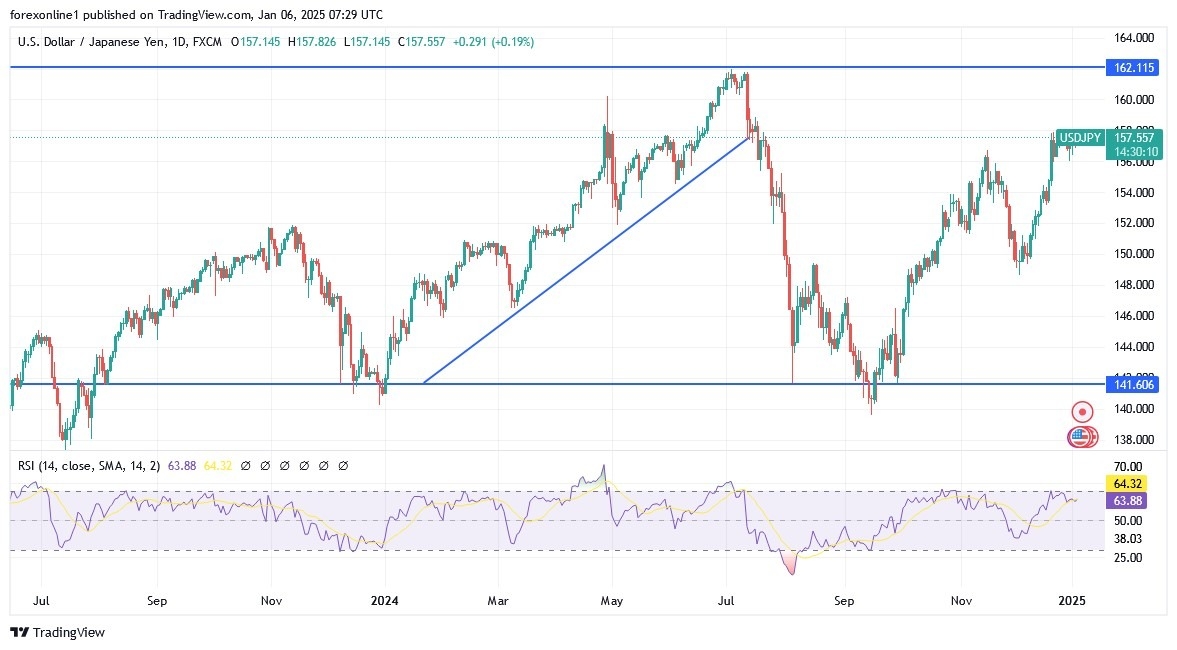
  • For ten consecutive trading sessions, the USD/JPY pair has been moving within narrow ranges with a strong bullish bias, with gains reaching the resistance level of 158.00.
  • This is the highest for the pair in five months, paving the way for bulls to move towards the psychological resistance of 160.00.

From now on, you may notice an increase in Japanese statements about the possibility of intervening in the exchange markets to prevent further collapse of the Japanese yen, which historically contradicts the policies of the upcoming US administration, as Trump refuses to intervene in the exchange markets. Keep in mind that the movement of the dollar against the Japanese yen price for long periods in narrow ranges portends a strong move in one of the two directions.

Trading Tips:

We still recommend buying the dollar against the Japanese yen from every downward level, but without risk and placing stop loss profit orders

US Dollar Performance Awaits the Future of Interest Rate Policies

The US dollar is trading near its two-year high, supported by a shift in US Federal Reserve policies and the continuation of Trump’s trade. The Federal Reserve has cut US interest rates by a full percentage point in three steps since September 2024. Federal Reserve Chairman Jerome Powell described the latest move as “closer to a call,” adding that the federal funds rate is now “much less restrictive.” It currently falls within the range of 4.25% to 4.5%.

Fed officials’ expectations for US interest rates this year indicate a median estimate of only two more cuts this year. Also, four officials preferred not to cut US interest rates at all in December 2024. Moreover, Cleveland Federal Reserve President Beth Hammack opposed the decision in favour of keeping interest rates steady.

USD/JPY Technical Analysis and Expectations Today:

The USD/JPY pair recently retreated to trade at the 100-hour moving average line. However, the pair continues to move towards the overbought levels of the 14-hour Relative Strength Index (RSI). In the near term, bulls will look to extend the current rally towards the 157.75 resistance levels and then the 158.90 resistance levels respectively. On the other hand, bears will look to take advantage of the selling to move towards the 156.80 support levels or lower at the 155.95 support.

In the long term, according to the performance on the daily chart, the USD/JPY pair is trading within an ascending channel formation. Also, the 14-day RSI supports a long-term bullish bias as it is about to enter overbought levels. Therefore, bulls will look to move towards stronger highs beyond the usual Japanese intervention levels reaching the 161.20 and 164.00 resistance levels respectively. In contrast, and over the same period of time, bears will look to move with renewed profit-taking selling operations, reaching the support levels of 155.30 and then the support of 152.00, respectively.

Want to trade our USD/JPY forex analysis and predictions? Here’s a list of forex brokers in Japan to check out. 

Source link

6 01, 2025

Pound Sterling gains traction on improving risk mood

By |2025-01-06T16:00:58+02:00January 6, 2025|Forex News, News|0 Comments

  • GBP/USD trades in positive territory above 1.2450 in the European session on Monday.
  • The technical outlook points to a buildup of recovery momentum.
  • The pair could continue to push higher in case risk flows continue to dominate the market action.

After touching a fresh multi-month low near 1.2350 on Thursday, GBP/USD staged a technical correction and closed in positive territory on Friday. Early Monday, the pair benefits from improving risk mood and continues to stretch higher toward 1.2500.

British Pound PRICE Today

The table below shows the percentage change of British Pound (GBP) against listed major currencies today. British Pound was the strongest against the Japanese Yen.

  USD EUR GBP JPY CAD AUD NZD CHF
USD   -0.37% -0.44% 0.33% -0.58% -0.49% -0.40% -0.37%
EUR 0.37%   -0.08% 0.64% -0.15% -0.08% 0.00% 0.03%
GBP 0.44% 0.08%   0.73% -0.08% 0.00% 0.08% 0.10%
JPY -0.33% -0.64% -0.73%   -0.90% -0.80% -0.69% -0.47%
CAD 0.58% 0.15% 0.08% 0.90%   0.02% 0.14% 0.18%
AUD 0.49% 0.08% 0.00% 0.80% -0.02%   0.09% 0.09%
NZD 0.40% -0.01% -0.08% 0.69% -0.14% -0.09%   0.02%
CHF 0.37% -0.03% -0.10% 0.47% -0.18% -0.09% -0.02%  

The heat map shows percentage changes of major currencies against each other. The base currency is picked from the left column, while the quote currency is picked from the top row. For example, if you pick the British Pound from the left column and move along the horizontal line to the US Dollar, the percentage change displayed in the box will represent GBP (base)/USD (quote).

Following a bearish start to the year, Wall Street’s main indexes gathered bullish momentum and registered strong gains on Friday. Early Monday, US stock index futures trade in the green, making it hard for the US Dollar (USD) to hold its ground.

December Factory Orders will be the only noticeable data featured in the US economic calendar on Monday. Ahead of this week’s key employment-related releases, however, investors are unlikely to react to this data. Hence, the risk perception could continue to influence the USD’s valuation and drive GBP/USD’s action.

On Tuesday, JOLTS Job Openings data for November and the ISM Services PMI report for December from the US will be watched closely by market participants.

GBP/USD Technical Analysis

The Relative Strength Index (RSI) indicator on the 4-hour chart rose above 50 and GBP/USD closed the last 4-hour candle above the 20-period Simple Moving Average (SMA), highlighting a buildup of recovery momentum.

On the upside, 1.2500 (static level, round level, 50-period SMA) aligns as immediate resistance before 1.2525 (Fibonacci 38.2% retracement) of the latest downtrend) and 1.2570-1.2575 (100-period SMA; Fibonacci 50% retracement). Looking south, first support could be spotted at 1.2460-1.2450 (Fibonacci 23.6% retracement, 20-period SMA) ahead of 1.2400 (round level, static level).

Pound Sterling FAQs

The Pound Sterling (GBP) is the oldest currency in the world (886 AD) and the official currency of the United Kingdom. It is the fourth most traded unit for foreign exchange (FX) in the world, accounting for 12% of all transactions, averaging $630 billion a day, according to 2022 data. Its key trading pairs are GBP/USD, also known as ‘Cable’, which accounts for 11% of FX, GBP/JPY, or the ‘Dragon’ as it is known by traders (3%), and EUR/GBP (2%). The Pound Sterling is issued by the Bank of England (BoE).

The single most important factor influencing the value of the Pound Sterling is monetary policy decided by the Bank of England. The BoE bases its decisions on whether it has achieved its primary goal of “price stability” – a steady inflation rate of around 2%. Its primary tool for achieving this is the adjustment of interest rates. When inflation is too high, the BoE will try to rein it in by raising interest rates, making it more expensive for people and businesses to access credit. This is generally positive for GBP, as higher interest rates make the UK a more attractive place for global investors to park their money. When inflation falls too low it is a sign economic growth is slowing. In this scenario, the BoE will consider lowering interest rates to cheapen credit so businesses will borrow more to invest in growth-generating projects.

Data releases gauge the health of the economy and can impact the value of the Pound Sterling. Indicators such as GDP, Manufacturing and Services PMIs, and employment can all influence the direction of the GBP. A strong economy is good for Sterling. Not only does it attract more foreign investment but it may encourage the BoE to put up interest rates, which will directly strengthen GBP. Otherwise, if economic data is weak, the Pound Sterling is likely to fall.

Another significant data release for the Pound Sterling is the Trade Balance. This indicator measures the difference between what a country earns from its exports and what it spends on imports over a given period. If a country produces highly sought-after exports, its currency will benefit purely from the extra demand created from foreign buyers seeking to purchase these goods. Therefore, a positive net Trade Balance strengthens a currency and vice versa for a negative balance.


Source link

6 01, 2025

USD/JPY Forecast Today 06/01: Tests Key Resistance (Video)

By |2025-01-06T14:00:03+02:00January 6, 2025|Forex News, News|0 Comments

  • The Friday session has seen the US dollar pullback just a bit against the Japanese yen again.
  • Just like we have seen all week, the buyers have stepped in to pick it up. That being said, it isn’t exactly as if it’s a huge move.
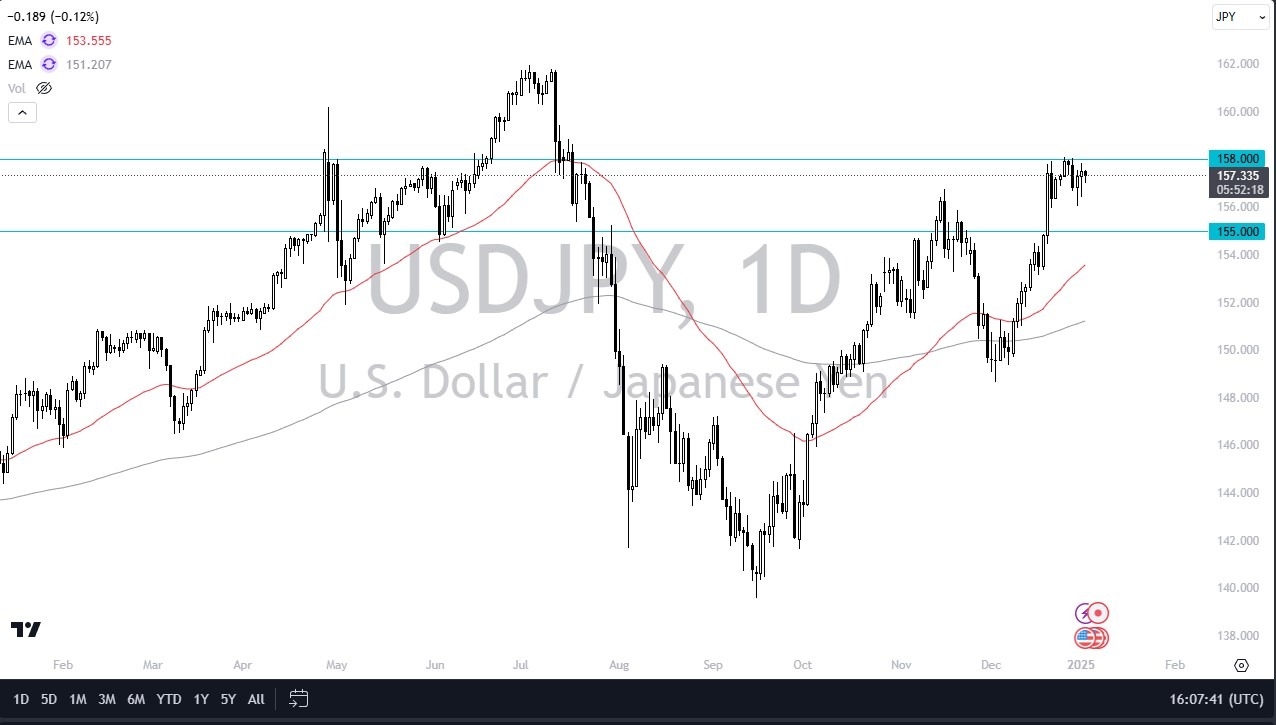
  • It’s just the market trying to sort out whether or not we can finally break above the crucial 158 yen level.

The 158 yen level is an area that’s been like a brick wall over the last couple of weeks, but we also have to keep in mind the past couple of weeks have been all about the holidays. Now there is market memory to be found at the 158 yen level, so it all ties in quite easily. I would be surprised to see this market go somewhat sideways, more of a buy on the dip attitude, but sideways overall between now and the jobs number next Friday.

The Jobs Number and Its Importance

That will be your first piece of major information that will possibly drive the US dollar higher in general. The PMI numbers came out during the trading session a little better than anticipated for the dollar. So that’s part of what the recovery was, but really, I don’t even think that was that big of a deal. I think this all comes down to people wanting to continue to own the greenback.

Even if we were to fall from here, the 155 yen level is probably a short-term floor, especially now that the 50-day EMA is running toward it. If we break above the 158 yen level, then the 160 yen level, and then the 161.50 yen level, both come into focus. I do think that eventually happens, and I like the idea of buying dips, because after all, you get paid via swap at the end of every day to hold this USD/JPY pair.

Want to trade our USD/JPY forex analysis and predictions? Here’s a list of forex brokers in Japan to check out. 

Source link

6 01, 2025

Euro recovery could pick up steam after German inflation data

By |2025-01-06T11:59:08+02:00January 6, 2025|Forex News, News|0 Comments

  • EUR/USD trades in positive territory above 1.0300 on Monday.
  • Regional and nation-wide inflation data from Germany will be watched closely.
  • The technical outlook points to a loss of bearish momentum in the near term.

After closing in positive territory on Friday, EUR/USD continues to edge higher and trades above 1.0300 in the European morning on Monday. Regional and nation-wide inflation data from Germany could drive the Euro’s valuation later in the session.

Euro PRICE Last 7 days

The table below shows the percentage change of Euro (EUR) against listed major currencies last 7 days. Euro was the weakest against the Australian Dollar.

  USD EUR GBP JPY CAD AUD NZD CHF
USD   0.90% 0.96% -0.03% -0.15% -0.22% 0.05% 0.67%
EUR -0.90%   0.05% -0.96% -1.09% -1.19% -0.89% -0.28%
GBP -0.96% -0.05%   -1.00% -1.14% -1.24% -0.95% -0.33%
JPY 0.03% 0.96% 1.00%   -0.13% -0.14% 0.24% 0.78%
CAD 0.15% 1.09% 1.14% 0.13%   -0.08% 0.27% 0.82%
AUD 0.22% 1.19% 1.24% 0.14% 0.08%   0.30% 0.92%
NZD -0.05% 0.89% 0.95% -0.24% -0.27% -0.30%   0.62%
CHF -0.67% 0.28% 0.33% -0.78% -0.82% -0.92% -0.62%  

The heat map shows percentage changes of major currencies against each other. The base currency is picked from the left column, while the quote currency is picked from the top row. For example, if you pick the Euro from the left column and move along the horizontal line to the US Dollar, the percentage change displayed in the box will represent EUR (base)/USD (quote).

The improving risk mood heading into the weekend made it difficult for the US Dollar (USD) to find demand and helped EUR/USD erase a portion of its weekly losses on Friday. 

Early Monday, US stock index futures trade marginally higher on the day, not allowing the USD to stay resilient against its rivals. 

Inflation in Germany, as measured by the change in the Consumer Price Index (CPI), is forecast to rise to 2.4% on a yearly basis in December from 2.2% in November. In case the CPI rises at a stronger pace than expected, the Euro could gather strength. Investors will also pay close attention to regional CPI figures from Germany. If these data arrive generally higher than anticipated, this could be seen as a sign pointing to a positive surprise in the headline print and provide an early boost to the Euro.

On Tuesday, Eurozone inflation data and ISM Services PMI report from the US could influence EUR/USD’s action.

EUR/USD Technical Analysis

The Relative Strength Index (RSI) indicator on the 4-hour chart recovered to 50, reflecting the loss of bearish momentum. Additionally, EUR/USD closed the last 4-hour candle above the 20-period Simple Moving Average (SMA). 

On the upside, 1.0350 (static level), could be seen as first resistance before 1.0400-1.0410 (static level, 100-period SMA) and 1.0440 (static level). Looking south, supports could be spotted at 1.0300 (static level, round level), 1.0240 (static level) and 1.0200 (static level).

Euro FAQs

The Euro is the currency for the 19 European Union countries that belong to the Eurozone. It is the second most heavily traded currency in the world behind the US Dollar. In 2022, it accounted for 31% of all foreign exchange transactions, with an average daily turnover of over $2.2 trillion a day. EUR/USD is the most heavily traded currency pair in the world, accounting for an estimated 30% off all transactions, followed by EUR/JPY (4%), EUR/GBP (3%) and EUR/AUD (2%).

The European Central Bank (ECB) in Frankfurt, Germany, is the reserve bank for the Eurozone. The ECB sets interest rates and manages monetary policy. The ECB’s primary mandate is to maintain price stability, which means either controlling inflation or stimulating growth. Its primary tool is the raising or lowering of interest rates. Relatively high interest rates – or the expectation of higher rates – will usually benefit the Euro and vice versa. The ECB Governing Council makes monetary policy decisions at meetings held eight times a year. Decisions are made by heads of the Eurozone national banks and six permanent members, including the President of the ECB, Christine Lagarde.

Eurozone inflation data, measured by the Harmonized Index of Consumer Prices (HICP), is an important econometric for the Euro. If inflation rises more than expected, especially if above the ECB’s 2% target, it obliges the ECB to raise interest rates to bring it back under control. Relatively high interest rates compared to its counterparts will usually benefit the Euro, as it makes the region more attractive as a place for global investors to park their money.

Data releases gauge the health of the economy and can impact on the Euro. Indicators such as GDP, Manufacturing and Services PMIs, employment, and consumer sentiment surveys can all influence the direction of the single currency. A strong economy is good for the Euro. Not only does it attract more foreign investment but it may encourage the ECB to put up interest rates, which will directly strengthen the Euro. Otherwise, if economic data is weak, the Euro is likely to fall. Economic data for the four largest economies in the euro area (Germany, France, Italy and Spain) are especially significant, as they account for 75% of the Eurozone’s economy.

Another significant data release for the Euro is the Trade Balance. This indicator measures the difference between what a country earns from its exports and what it spends on imports over a given period. If a country produces highly sought after exports then its currency will gain in value purely from the extra demand created from foreign buyers seeking to purchase these goods. Therefore, a positive net Trade Balance strengthens a currency and vice versa for a negative balance.


Source link

6 01, 2025

US Dollar Forecast: Factory Orders in Focus, Gold and GBP/USD Outlook

By |2025-01-06T09:57:32+02:00January 6, 2025|Forex News, News|0 Comments

Gold Price Chart

Gold (XAU/USD) is trading at $2,632.27, facing bearish pressure after failing to break resistance at $2,662.26. Immediate support lies at $2,612.14, with stronger support at $2,583.80. The 50 EMA at $2,632.77 acts as near-term resistance, while the 200 EMA at $2,641.67 caps broader upside. Bulls need to push above $2,642.17 to regain momentum, while the descending trendline maintains downward pressure.

Sterling Weakens Amid Disappointing UK Data

The British Pound (GBP) faced headwinds on Friday as economic data fell short of expectations. M4 Money Supply stagnated at 0.0% (forecast: 0.1%), while Mortgage Approvals dropped to 66K, missing the 69K forecast. Net Lending to Individuals also declined to £3.4B, below the expected £4.4B.

Looking ahead, the Final Services PMI (forecast: 51.4) on Monday will be closely watched to assess the services sector’s resilience and its impact on Sterling.

Source link

5 01, 2025

Weekly Forex Forecast – 05/01: (Charts)

By |2025-01-05T19:47:19+02:00January 5, 2025|Forex News, News|0 Comments

Fundamental Analysis & Market Sentiment

I wrote on 29th December that the best trade opportunities for the week were likely to be:

The weekly loss of 0.79% equals 0.26% per asset.

Last week saw a more active market as the Christmas holiday came to an end; the very few key takeaways were:

  1. US ISM Manufacturing PMI was better than expected, suggesting the US economy is still buoyant.
  2. US Unemployment Claims – a fraction better than expected.
  3. Chinese Manufacturing PMI – a small fraction worse than expected.

Last week saw continued risk-off sentiment, with particular fears of President-Elect Trump’s recent tariff threats and of slowing growth data in many G20 nations. However, towards the end of last week, there was a recovery in risk sentiment. However, two US Fed members made hawkish comments over the weekend about inflation not yet being under control, which may boost the US Dollar and weaken US stocks when markets open Monday.

The British Pound and Euro are notably weak in the Forex market, while the US Dollar and the Japanese Yen are strong.

There was little high-impact data last week, but there will be this coming week, so markets will probably be much more active now that the seasonal holiday is over.

The Week Ahead: 6th – 10th January

The coming week has a much fuller schedule, so we are very likely to see increased market activity and volatility.

The coming week’s important data points are:

  1. US Average Hourly Earnings
  2. US FOMC Meeting Minutes
  3. US Non-Farm Payrolls
  4. US JOLTS Job Openings
  5. US ISM Services PMI
  6. German Preliminary CPI (inflation)
  7. Australian CPI (inflation)
  8. Swiss CPI (inflation)
  9. US Unemployment Claims
  10. US Unemployment Rate
  11. Canadian Unemployment Rate

Monday is a public holiday in Italy.

Monthly Forecast January 2025

For the month of December, I forecasted that the EUR/USD currency pair would fall in value. The final performance of my forecast was:


Weekly Forex Forecast – 05/01: (Charts)

For January, I forecasted that the USD/JPY currency pair would rise in value and that the EUR/USD currency pair would fall in value

Weekly Forecast 5th January 2025

Last week, I made no weekly forecast as there were no unusually strong price movements in currency crosses, which is the basis of my trading strategy.

The Japanese Yen was the strongest major currency, while the Euro was the weakest. Volatility was much higher last week, with 30% of the most important Forex currency pairs and crosses changing in value by more than 1%. It is likely to increase again this week.

You can trade these forecasts in a real or demo Forex brokerage account.

Key Support/Resistance Levels for Popular Pairs

Weekly Forex Forecast – 05/01: (Charts)

Technical Analysis

US Dollar Index

Last week, the US Dollar Index again printed a bullish candlestick that continued toward the long-term bullish trend, bullishly breaking out to make its highest close in more than 2 years. The price is above its price from three and six months ago, suggesting a healthy long-term bullish trend in the greenback that should be exploitable. The breakout was from an inside bar, which suggests that momentum could be good. On the other hand, the weekly candlestick has a significant upper wick, which shows the Dollar has already given back some of its gains.

I have plenty of fundamental reasons to be bullish on the US Dollar after the Federal Reserve’s hawkish tilt three weeks ago, which took markets by surprise and triggered a rise in the greenback and a sharp selloff in stocks, while US treasury yields rose. Comments from two Fed members over the weekend that inflation is still not under control could also produce hawkish sentiment towards the greenback and push the price higher still, stoking bullish momentum here.

Overall, the Dollar is more likely to rise than fall over the coming week. The price has room to rise to at least the next resistance level at 110.00.

Weekly Forex Forecast – 05/01: (Charts)

EUR/USD

The EUR/USD currency pair is in a valid long-term bearish trend. This currency pair typically takes its time to move, with its trends usually including plenty of deep retracements, but for almost three weeks after plunging to a new long-term low price well below $1.0400, the price consolidated without turning definitively bearish.

This has changed over the past three weeks, and the past week finally saw a further significant breakdown. The Euro suddenly weakened, although it is not obvious why. The price traded below $1.0225 for a time, its lowest price in more than two years.

This currency pair often has very reliable trends, so I am interested in being short, especially after last week’s breakdown, which has it now trading in “blue sky”.

Weekly Forex Forecast – 05/01: (Charts)

USD/JPY

The USD/JPY currency pair did not rise last week, although the fact that the entire week was a public holiday in Japan was significant. However, the souring risk sentiment in global markets has boosted the Japanese Yen to begin acting as a safe haven again, and recent weeks have seen Japanese monetary policy as a stronger driver of the price.

I still see this currency pair as a buy, as it tends to trend quite reliably over the long term, but I have less confidence in this trend than I do in the bearish trend in EUR/USD because the price here is still well below a relatively recent peak.

Another factor lowering my confidence in the bullish trend is that the Bank of Japan will eventually start implementing a more hawkish monetary policy. When that finally really starts to happen with the Bank of Japan’s next rate hike, the price will be very likely to start moving down, so the trend is vulnerable to policy.

Weekly Forex Forecast – 05/01: (Charts)

USD/CAD

Last week, the USD/CAD currency pair printed another bullish candlestick, closing near its high, but the price did not quite make a new 2-year high. A look at the weekly chart below shows that the bullish momentum has been strong here since October, and the trend here has been stronger and clearer than any other trend in the Forex market, which does not often happen in this currency pair as the US and Canadian economies do not tend to be divergent.

The story is really about US economic success and a more hawkish Fed boosting the greenback, while Canada is dealing with several problems right now, both financial and political, which are feeding through to make a weaker Loonie.

This currency pair does not trend very reliably, so I don’t take long-term trades in it, but it certainly looks very weak right now. All the commodity currencies except maybe the Australian Dollar are looking very weak right now, so it might be an idea to use the CAD and the NZD together as the short component of any Forex trades you are making this week, or at least part of the short component by creating a basket. For example, if you were short two lots of EUR/USD, you might also be one lot of USD/CAD long.

Of course, early January can cause strange and volatile price movements in the Forex market that can end trends quickly, so keep an eye out for that.

Weekly Forex Forecast – 05/01: (Charts)

NZD/USD

Last week, the NZD/USD currency pair printed a fifth consecutive bearish candlestick, closing not far from its low. It closed at a new 2-year low, a significant bearish breakdown in any asset. However, the candlestick was small, suggesting that momentum may have slowed, although it was a holiday week, so the market was slow.

This currency pair does not trend very reliably, so I don’t take long-term trades in it, but it certainly looks very weak right now. The Aussie has gotten a bit stronger, but for a few weeks, I have been talking about weakness in all the commodity currencies, notably the Canadian Dollar and the Kiwi.

Weekly Forex Forecast – 05/01: (Charts)

Bottom Line

I see the best trading opportunities this week as:

  • Short of the EUR/USD currency pair.
  • Long of the USD/JPY currency pair.

Ready to trade our Forex weekly forecast? Check out our list of the top best Forex brokers.

Source link

4 01, 2025

Dollar Index Pulls Back Slightly Today: Analysis for EUR/USD, GBP/USD, USD/CAD, USD/JPY

By |2025-01-04T09:24:04+02:00January 4, 2025|Forex News, News|0 Comments

Important DisclaimersThe content provided on the website includes general news and publications, our personal analysis and opinions, and contents provided by third parties, which are intended for educational and research purposes only. It does not constitute, and should not be read as, any recommendation or advice to take any action whatsoever, including to make any investment or buy any product. When making any financial decision, you should perform your own due diligence checks, apply your own discretion and consult your competent advisors. The content of the website is not personally directed to you, and we does not take into account your financial situation or needs.The information contained in this website is not necessarily provided in real-time nor is it necessarily accurate. Prices provided herein may be provided by market makers and not by exchanges.Any trading or other financial decision you make shall be at your full responsibility, and you must not rely on any information provided through the website. FX Empire does not provide any warranty regarding any of the information contained in the website, and shall bear no responsibility for any trading losses you might incur as a result of using any information contained in the website.The website may include advertisements and other promotional contents, and FX Empire may receive compensation from third parties in connection with the content. FX Empire does not endorse any third party or recommends using any third party’s services, and does not assume responsibility for your use of any such third party’s website or services.FX Empire and its employees, officers, subsidiaries and associates, are not liable nor shall they be held liable for any loss or damage resulting from your use of the website or reliance on the information provided on this website.Risk DisclaimersThis website includes information about cryptocurrencies, contracts for difference (CFDs) and other financial instruments, and about brokers, exchanges and other entities trading in such instruments. Both cryptocurrencies and CFDs are complex instruments and come with a high risk of losing money. You should carefully consider whether you understand how these instruments work and whether you can afford to take the high risk of losing your money.FX Empire encourages you to perform your own research before making any investment decision, and to avoid investing in any financial instrument which you do not fully understand how it works and what are the risks involved.

Source link

Go to Top