The main tag of Forex News Today Articles.
You can use the search box below to find what you need.
[wd_asp id=1]

24 12, 2024

Euro looks to extend sideways action

By |2024-12-24T10:44:07+02:00December 24, 2024|Forex News, News|0 Comments

  • EUR/USD trades in a narrow channel near 1.0400 early Tuesday.
  • Trading action is likely to remain subdued on Christmas Eve. 
  • Technical picture highlights the pair’s indecisiveness in the near term.

EUR/USD closed marginally lower on Monday but the pair remained confined within a tight channel. The pair fluctuates near 1.0400 in the European morning on Tuesday as trading conditions thin out on Christmas Eve.

Euro PRICE Last 7 days

The table below shows the percentage change of Euro (EUR) against listed major currencies last 7 days. Euro was the weakest against the US Dollar.

  USD EUR GBP JPY CAD AUD NZD CHF
USD   1.09% 1.16% 1.87% 0.88% 1.96% 2.33% 0.60%
EUR -1.09%   0.07% 0.75% -0.21% 0.85% 1.22% -0.48%
GBP -1.16% -0.07%   0.71% -0.27% 0.78% 1.15% -0.54%
JPY -1.87% -0.75% -0.71%   -0.95% 0.14% 0.49% -1.17%
CAD -0.88% 0.21% 0.27% 0.95%   1.07% 1.43% -0.26%
AUD -1.96% -0.85% -0.78% -0.14% -1.07%   0.36% -1.33%
NZD -2.33% -1.22% -1.15% -0.49% -1.43% -0.36%   -1.67%
CHF -0.60% 0.48% 0.54% 1.17% 0.26% 1.33% 1.67%  

The heat map shows percentage changes of major currencies against each other. The base currency is picked from the left column, while the quote currency is picked from the top row. For example, if you pick the Euro from the left column and move along the horizontal line to the US Dollar, the percentage change displayed in the box will represent EUR (base)/USD (quote).

Mixed macroeconomic data releases from the US limited the US Dollar’s (USD) gains on Monday and helped EUR/USD find a foothold.

The US Census Bureau reported that Durable Goods Orders declined by 1.1% on a monthly basis in November, coming in worse than the market expectation for a decrease of 0.4%. Meanwhile, the Conference Board’s Consumer Confidence Index fell to 104.7 in December from 112.8 (revised from 111.7) in November. On a positive note, New Home Sales increased by 5.9% in November following the 14.8% decrease recorded in October.

The economic calendar will not feature any macroeconomic data releases. Bond and stock markets in the US will operate half day on Tuesday and remain closed on Christmas Day on Wednesday.

EUR/USD Technical Analysis

The Relative Strength Index (RSI) indicator on the 4-hour chart stays slightly below 50 but EUR/USD fluctuates at around the 20-period Simple Moving Average (SMA), highlighting a lack of directional momentum.

First resistance could be spotted at 1.0440 (static level) before 1.0490-1.0500, (100-period Simple Moving Average (SMA), static level). On the downside, 1.0350 (static level) and 1.0300 (static level, round level) could be seen as next support levels if EUR/USD confirms 1.0400 (static level, round level) as resistance.

Euro FAQs

The Euro is the currency for the 19 European Union countries that belong to the Eurozone. It is the second most heavily traded currency in the world behind the US Dollar. In 2022, it accounted for 31% of all foreign exchange transactions, with an average daily turnover of over $2.2 trillion a day. EUR/USD is the most heavily traded currency pair in the world, accounting for an estimated 30% off all transactions, followed by EUR/JPY (4%), EUR/GBP (3%) and EUR/AUD (2%).

The European Central Bank (ECB) in Frankfurt, Germany, is the reserve bank for the Eurozone. The ECB sets interest rates and manages monetary policy. The ECB’s primary mandate is to maintain price stability, which means either controlling inflation or stimulating growth. Its primary tool is the raising or lowering of interest rates. Relatively high interest rates – or the expectation of higher rates – will usually benefit the Euro and vice versa. The ECB Governing Council makes monetary policy decisions at meetings held eight times a year. Decisions are made by heads of the Eurozone national banks and six permanent members, including the President of the ECB, Christine Lagarde.

Eurozone inflation data, measured by the Harmonized Index of Consumer Prices (HICP), is an important econometric for the Euro. If inflation rises more than expected, especially if above the ECB’s 2% target, it obliges the ECB to raise interest rates to bring it back under control. Relatively high interest rates compared to its counterparts will usually benefit the Euro, as it makes the region more attractive as a place for global investors to park their money.

Data releases gauge the health of the economy and can impact on the Euro. Indicators such as GDP, Manufacturing and Services PMIs, employment, and consumer sentiment surveys can all influence the direction of the single currency. A strong economy is good for the Euro. Not only does it attract more foreign investment but it may encourage the ECB to put up interest rates, which will directly strengthen the Euro. Otherwise, if economic data is weak, the Euro is likely to fall. Economic data for the four largest economies in the euro area (Germany, France, Italy and Spain) are especially significant, as they account for 75% of the Eurozone’s economy.

Another significant data release for the Euro is the Trade Balance. This indicator measures the difference between what a country earns from its exports and what it spends on imports over a given period. If a country produces highly sought after exports then its currency will gain in value purely from the extra demand created from foreign buyers seeking to purchase these goods. Therefore, a positive net Trade Balance strengthens a currency and vice versa for a negative balance.

 

Source link

23 12, 2024

Pound Sterling stabilizes below 1.2600

By |2024-12-23T22:37:20+02:00December 23, 2024|Forex News, News|0 Comments

  • GBP/USD fluctuates below 1.2600 after closing in positive territory on Friday.
  • The pair remains bearish in the near-term technical outlook.
  • The risk perception could drive GBP/USD’s action in the second half of the day.

After suffering large losses on Wednesday and Thursday, GBP/USD corrected higher on Friday but ended up closing the week in the red. The pair stays in a consolidation phase below 1.2600 early Monday as trading conditions remain thin ahead of the Christmas holiday.

British Pound PRICE Last 7 days

The table below shows the percentage change of British Pound (GBP) against listed major currencies last 7 days. British Pound was the weakest against the US Dollar.

  USD EUR GBP JPY CAD AUD NZD CHF
USD   0.82% 0.39% 1.85% 1.04% 1.66% 1.98% 0.17%
EUR -0.82%   -0.37% 1.16% 0.29% 1.01% 1.23% -0.59%
GBP -0.39% 0.37%   1.40% 0.69% 1.38% 1.58% -0.22%
JPY -1.85% -1.16% -1.40%   -0.81% -0.18% 0.14% -1.57%
CAD -1.04% -0.29% -0.69% 0.81%   0.67% 0.91% -0.87%
AUD -1.66% -1.01% -1.38% 0.18% -0.67%   0.22% -1.58%
NZD -1.98% -1.23% -1.58% -0.14% -0.91% -0.22%   -1.79%
CHF -0.17% 0.59% 0.22% 1.57% 0.87% 1.58% 1.79%  

The heat map shows percentage changes of major currencies against each other. The base currency is picked from the left column, while the quote currency is picked from the top row. For example, if you pick the British Pound from the left column and move along the horizontal line to the US Dollar, the percentage change displayed in the box will represent GBP (base)/USD (quote).

The Federal Reserve’s (Fed) hawkish dot plot and the Bank of England relatively dovish language following the last policy meeting of the year triggered a sharp decline in GBP/USD. The positive shift seen in risk mood heading into weekend on US Congress’ avoidance of a government shutdown caused the US Dollar (USD) to weaken against its rivals and helped the pair erase a portion of its weekly losses.

Meanwhile, the softer-than-expected November inflation data put additional weight on the USD’s shoulders. The US Bureau of Economic Analysis reported that the core Personal Consumption Expenditures (PCE) Price Index, the Federal Reserve’s (Fed) preferred gauge of inflation, rose 0.1% on a monthly basis in November. This reading followed the 0.3% increase recorded in October and came in below the market expectation of 0.2%.

In the absence of high-tier data releases, investors could react to changes in risk perception in the second half of the day. At the time of press, US stock index futures were up between 0.1% and 0.5%. A bullish opening in Wall Street could make it difficult for the USD to stay resilient against its rivals and support GBP/USD.

GBP/USD Technical Analysis

The Relative Strength Index (RSI) indicator on the 4-hour chart stays below 50 and GBP/USD is yet to make a 4-hour close above the 20-period Simple Moving Average (SMA), reflecting buyers’ hesitancy.

On the downside, interim support is located at 1.2550 (static level) before 1.2480 (static level) and 1.2400 (static level, round level). Looking north, resistances could be seen at 1.2600 (static level, round level), 1.2640 (50-period SMA) and 1.2680 (100-period SMA).

Pound Sterling FAQs

The Pound Sterling (GBP) is the oldest currency in the world (886 AD) and the official currency of the United Kingdom. It is the fourth most traded unit for foreign exchange (FX) in the world, accounting for 12% of all transactions, averaging $630 billion a day, according to 2022 data. Its key trading pairs are GBP/USD, also known as ‘Cable’, which accounts for 11% of FX, GBP/JPY, or the ‘Dragon’ as it is known by traders (3%), and EUR/GBP (2%). The Pound Sterling is issued by the Bank of England (BoE).

The single most important factor influencing the value of the Pound Sterling is monetary policy decided by the Bank of England. The BoE bases its decisions on whether it has achieved its primary goal of “price stability” – a steady inflation rate of around 2%. Its primary tool for achieving this is the adjustment of interest rates. When inflation is too high, the BoE will try to rein it in by raising interest rates, making it more expensive for people and businesses to access credit. This is generally positive for GBP, as higher interest rates make the UK a more attractive place for global investors to park their money. When inflation falls too low it is a sign economic growth is slowing. In this scenario, the BoE will consider lowering interest rates to cheapen credit so businesses will borrow more to invest in growth-generating projects.

Data releases gauge the health of the economy and can impact the value of the Pound Sterling. Indicators such as GDP, Manufacturing and Services PMIs, and employment can all influence the direction of the GBP. A strong economy is good for Sterling. Not only does it attract more foreign investment but it may encourage the BoE to put up interest rates, which will directly strengthen GBP. Otherwise, if economic data is weak, the Pound Sterling is likely to fall.

Another significant data release for the Pound Sterling is the Trade Balance. This indicator measures the difference between what a country earns from its exports and what it spends on imports over a given period. If a country produces highly sought-after exports, its currency will benefit purely from the extra demand created from foreign buyers seeking to purchase these goods. Therefore, a positive net Trade Balance strengthens a currency and vice versa for a negative balance.


Source link

23 12, 2024

EUR/USD Analysis Today 23/12: Bearish Outlook

By |2024-12-23T20:36:30+02:00December 23, 2024|Forex News, News|0 Comments

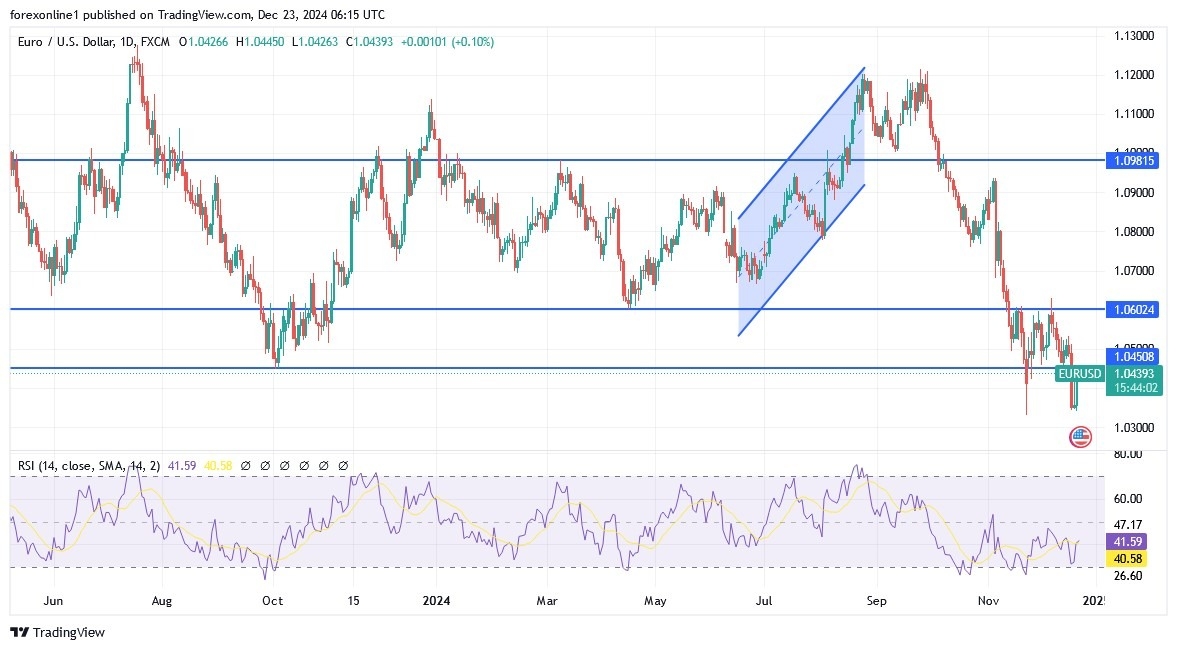
  • The past trading week witnessed a strong dominance of bears on the EUR/USD pair, with the most traded currency pair in the forex market plummeting to the support level of 1.0343, near its two-year low.
  • The trading closed around the 1.0428 level, with a strong dominance of bears on the trend and anticipation of a move towards the expected parity price for the euro-dollar.
  • The markets will be monitoring the future of the US government shutdown this week. However, holidays this week will dampen investor risk appetite.

Stock Market Turmoil with Weakening Sentiment

According to recent stock market trading and stock trading company platforms, European stocks have recently suffered a severe setback. Also, the sharp decline in shares of Novo Nordisk A/S by $93 billion weakened investor sentiment. In addition to Novo, shares of Nestle SA and LVMH Moët Hennessy Louis Vuitton SE were also affected. Furthermore, losses in the shares of these European companies pushed the Stoxx Europe 600 index towards its worst performance compared to the S&P 500 index in nearly a quarter of a century.

European interest rate cut for 2025

In this regard, a member of the European Central Bank’s policy confirmed that it will continue to reduce borrowing costs in 2025. Croatian central bank chief Boris Vujcic added that “the trend is clear, it is a continuation of the trend from 2024, which is to reduce interest rates further.” For its part, the European Central Bank last week cut its deposit rate by a quarter of a percentage point to 3%, the fourth such move since last June. Officials indicated that more steps would follow, although they differed on how many steps would be necessary. the official added, “I don’t even know at what point” the ECB will cut interest rates”. Also, “That will be determined by the data, especially the inflation rate, whether it slows down, according to our expectations, and we will see the impact of the transmission of monetary policy, our expectations.”

However, HSBC expects the ECB to be more aggressive; “We believe there is an increasing risk that the ECB will cut rates below the perceived neutral rate to stimulate the economy, and possibly even to 1.00%. Among the uncertainties weighing on the outlook is the threat of US tariffs after Trump takes office. In this regard, the official said: “If a trade war erupts, it will be bad for growth in Europe and the rest of the world,” adding that trade wars usually lead to higher prices. “We hope we don’t see a trade war, and it won’t be good for anyone.”

Trading Tips:

Keep in mind that the Euro Dollar’s path will remain bearish and stability below the 1.05 support confirms the strength of bear control. The current trading week includes Christmas holidays, which affects liquidity and investors’ desire to trade.

EUR/USD Analysis Today:

According to the performance on the daily chart above, the general trend of the Euro against the US Dollar EUR/USD is still bearish and Forex investors will not care about the technical indicators reaching strong oversold levels as much as they care about monitoring the negative impact factors on the Euro’s performance, led by the economic and political turmoil of the bloc’s largest economies and the future of the European Central Bank’s policies and the future of trade wars on the region’s economy, which is already suffering. The Euro Dollar’s gains will remain vulnerable to a rapid collapse, so caution is required. The relative strength indicators and the MACD indicator are still in oversold areas. The future of the Euro Dollar parity price is close and the closest support levels are currently 1.0380, 1.0300 and 1.0225, respectively.

On the other hand, and in the same time frame, there will be no first break of the Euro-Dollar downtrend without the bulls moving towards the resistance levels of 1.0665 and 1.0800 respectively. I still prefer to sell the Euro-Dollar.

Ready to trade our daily EUR/USD Forex analysis? We’ve made this forex brokers list for you to check out. 

Source link

23 12, 2024

GBP/USD Analysis Today 23/12: Increasing Pressure (Chart)

By |2024-12-23T18:35:03+02:00December 23, 2024|Forex News, News|0 Comments

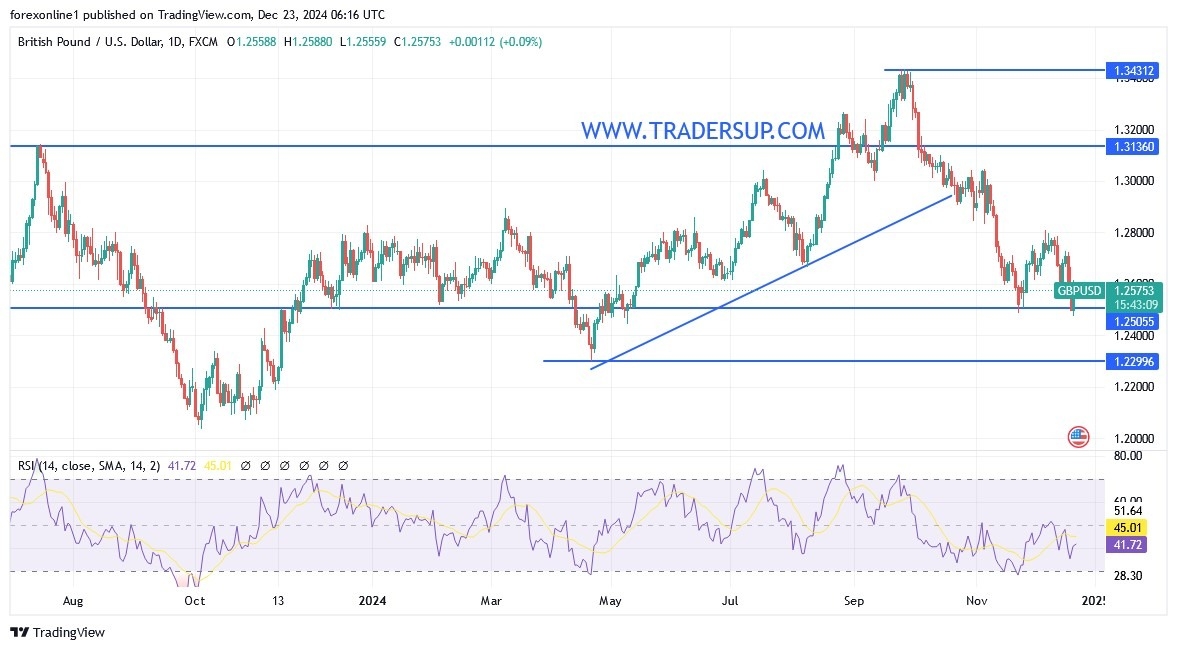
  • Last week’s selling of the pound sterling was the strongest.
  • The GBP/USD pair’s losses were the most prominent, as it plummeted to the support level of 1.2475, the lowest for the currency pair in 7 months before closing the trading stable around 1.2562.
  • According to licensed trading companies’ platforms, the Bank of England’s vote to keep interest rates at 4.75%, which was narrower than expected, led to a wave of selling of the pound sterling.

Pressure factors on the British pound dollar

According to recent forex market trading, several pressure factors have formed on the sterling, as the hawkish statement by the US Federal Reserve helped reduce market expectations of the Bank of England cutting interest rates in February 2025 to less than 50%, but this was reflected after the Bank of England’s statement. For its part, the Monetary Policy Committee of the Bank of England kept interest rates at 4.75%, which is in line with analysts’ expectations.

However, there was a surprise in the vote, with the vote split 6-3 compared to the 8-1 expected. Dhingra, Ramsden and Taylor voted for a further 25bps cut. The majority cited significant uncertainty over the outlook for inflation and supply-side issues, particularly following the National Insurance increases. In this context, they wanted more time to assess developments and continued to support a gradual easing of policy. At the same time, there was no change in official guidance, with comments that “a gradual approach to unwinding monetary policy remains appropriate”.

According to BoE Governor Bailey, “With the increasing uncertainty in the economy, we cannot commit to a date or amount of rate cuts in 2025”.

Overall, the minority considered that policy was too restrictive and that a cut was warranted, especially with domestic and international growth risks tilted to the downside. They also considered that current policy would push inflation well below the 2% target. The BoE also noted that growth had been slightly weaker than expected and that there were risks from potential US tariffs.

The future of Bank of England policy

The division in the voting in the last meeting of the Bank of England strengthened expectations of interest rate cuts in February, especially since one of the six members who voted in favour of fixed interest rates (possibly Bailey) seemed close to supporting the cut this time. Also, Traders moved to price in three interest rate cuts in 2025 from two previously, while bond yields fell. At the same time, the US Federal Reserve cut US interest rates by 25 basis points to 4.50%, which is in line with expectations.

However, there was a shift in interest rate expectations by committee members, with the median expectation being that there would be only two interest rate cuts for 2025 compared to four cuts in the previous update from September. Also, US Federal Reserve Chairman Powell indicated that a slower pace of interest rate cuts is justified given slightly stronger growth and some disappointing inflation data.

Overall, the stronger dollar is likely to continue to hinder the GBP/USD currency pair from making gains.

Trading Tips:

Any attempts to rebound the GBP/USD price break is an important support level. We have often noted that the pressures will intensify after it, which is the 1.25 level. Selling pressures will remain as long as the currency pair is stable below it.

Technical Analysis for the GBP/USD pair today:

As we previously predicted, the movement of the GBP/USD pair below the support level of 1.2500 will increase the dominance of the bears and confirm the strength of the downward trend. The Relative Strength Index has the opportunity to move down before reaching oversold levels. as well as the MACD, which confirms that the bears are ready for further downward movement, and the next important support levels may be 1.2475, 1.2330, and 1.2300, respectively. Conversely, and on the same time frame, the daily chart will not have a primary break of the downward trend without moving above the resistance of 1.2800 again.

Furthermore, it should be taken into account that this week includes Christmas holidays and liquidity often decreases during these holidays and investor interest in trading decreases, so movements may be calm and unstable.

Ready to trade our daily GBP/USD Forex forecast? Here’s some of the best forex broker UK reviews to check out. 

Source link

23 12, 2024

Euro struggles to gather recovery momentum

By |2024-12-23T16:34:23+02:00December 23, 2024|Forex News, News|0 Comments

  • EUR/USD holds slightly above 1.0400 after posting gains on Friday.
  • The upbeat risk mood could help the pair hold its ground.
  • Trading conditions could remain thin heading into the Christmas break.

Following the sharp decline seen after the Federal Reserve’s policy announcements midweek, EUR/USD staged a rebound and closed in positive territory on Friday. The pair struggles to preserve its recovery momentum early Monday but manages to hold slightly above 1.0400.

Euro PRICE Last 7 days

The table below shows the percentage change of Euro (EUR) against listed major currencies last 7 days. Euro was the weakest against the US Dollar.

  USD EUR GBP JPY CAD AUD NZD CHF
USD   0.84% 0.47% 1.99% 1.06% 1.71% 2.00% 0.17%
EUR -0.84%   -0.32% 1.26% 0.28% 1.03% 1.23% -0.61%
GBP -0.47% 0.32%   1.44% 0.60% 1.35% 1.53% -0.29%
JPY -1.99% -1.26% -1.44%   -0.93% -0.27% 0.04% -1.70%
CAD -1.06% -0.28% -0.60% 0.93%   0.70% 0.92% -0.89%
AUD -1.71% -1.03% -1.35% 0.27% -0.70%   0.19% -1.62%
NZD -2.00% -1.23% -1.53% -0.04% -0.92% -0.19%   -1.81%
CHF -0.17% 0.61% 0.29% 1.70% 0.89% 1.62% 1.81%  

The heat map shows percentage changes of major currencies against each other. The base currency is picked from the left column, while the quote currency is picked from the top row. For example, if you pick the Euro from the left column and move along the horizontal line to the US Dollar, the percentage change displayed in the box will represent EUR (base)/USD (quote).

The improving risk sentiment and the softer-than-forecast inflation data from the US made it difficult for the US Dollar (USD) to find demand on Friday. Congress’ approval of a stopgap spending bill late Friday triggered a rally in Wall Street’s main indexes and dragged US Treasury bond yields lower. 

The core Personal Consumption Expenditures (PCE) Price Index, the Federal Reserve’s (Fed) preferred gauge of inflation, rose 0.1% on a monthly basis in November, the US Bureau of Economic Analysis reported on Friday. This reading followed the 0.3% increase recorded in October and came in below the market expectation of 0.2%.

In an interview with the Financial Times (FT) on Monday, European Central Bank (ECB) President Christine Lagarde repeated that they are getting very close to the stage when they can declare that they have sustainably brought inflation to the medium-term target of 2%.

The Conference Board’s Consumer Confidence Index for December will be featured in the US economic calendar on Monday. Meanwhile, US stock index futures were last seen rising between 0.3% and 0.7% on the day. In case risk flows continue to dominate the action in the second half of the day, the USD could have a hard time gathering strength and allow EUR/USD to hold its ground. Nevertheless, thin trading conditions ahead of the Christmas holiday could limit the pair’s volatility.

EUR/USD Technical Analysis

The Relative Strength Index (RSI) indicator on the 4-hour chart stays slightly below 50, highlighting a lack of bullish momentum.

On the upside, immediate resistance is located at 1.0440 (static level) before 1.0490-1.0500, (100-period Simple Moving Average (SMA), static level). Looking south, supports could be spotted at 1.0400 (static level, round level), 1.0350 (static level) and 1.0300 (static level, round level).

Euro FAQs

The Euro is the currency for the 19 European Union countries that belong to the Eurozone. It is the second most heavily traded currency in the world behind the US Dollar. In 2022, it accounted for 31% of all foreign exchange transactions, with an average daily turnover of over $2.2 trillion a day. EUR/USD is the most heavily traded currency pair in the world, accounting for an estimated 30% off all transactions, followed by EUR/JPY (4%), EUR/GBP (3%) and EUR/AUD (2%).

The European Central Bank (ECB) in Frankfurt, Germany, is the reserve bank for the Eurozone. The ECB sets interest rates and manages monetary policy. The ECB’s primary mandate is to maintain price stability, which means either controlling inflation or stimulating growth. Its primary tool is the raising or lowering of interest rates. Relatively high interest rates – or the expectation of higher rates – will usually benefit the Euro and vice versa. The ECB Governing Council makes monetary policy decisions at meetings held eight times a year. Decisions are made by heads of the Eurozone national banks and six permanent members, including the President of the ECB, Christine Lagarde.

Eurozone inflation data, measured by the Harmonized Index of Consumer Prices (HICP), is an important econometric for the Euro. If inflation rises more than expected, especially if above the ECB’s 2% target, it obliges the ECB to raise interest rates to bring it back under control. Relatively high interest rates compared to its counterparts will usually benefit the Euro, as it makes the region more attractive as a place for global investors to park their money.

Data releases gauge the health of the economy and can impact on the Euro. Indicators such as GDP, Manufacturing and Services PMIs, employment, and consumer sentiment surveys can all influence the direction of the single currency. A strong economy is good for the Euro. Not only does it attract more foreign investment but it may encourage the ECB to put up interest rates, which will directly strengthen the Euro. Otherwise, if economic data is weak, the Euro is likely to fall. Economic data for the four largest economies in the euro area (Germany, France, Italy and Spain) are especially significant, as they account for 75% of the Eurozone’s economy.

Another significant data release for the Euro is the Trade Balance. This indicator measures the difference between what a country earns from its exports and what it spends on imports over a given period. If a country produces highly sought after exports then its currency will gain in value purely from the extra demand created from foreign buyers seeking to purchase these goods. Therefore, a positive net Trade Balance strengthens a currency and vice versa for a negative balance.
 

Source link

23 12, 2024

GBP Holds Key Support (Video)

By |2024-12-23T14:33:19+02:00December 23, 2024|Forex News, News|0 Comments

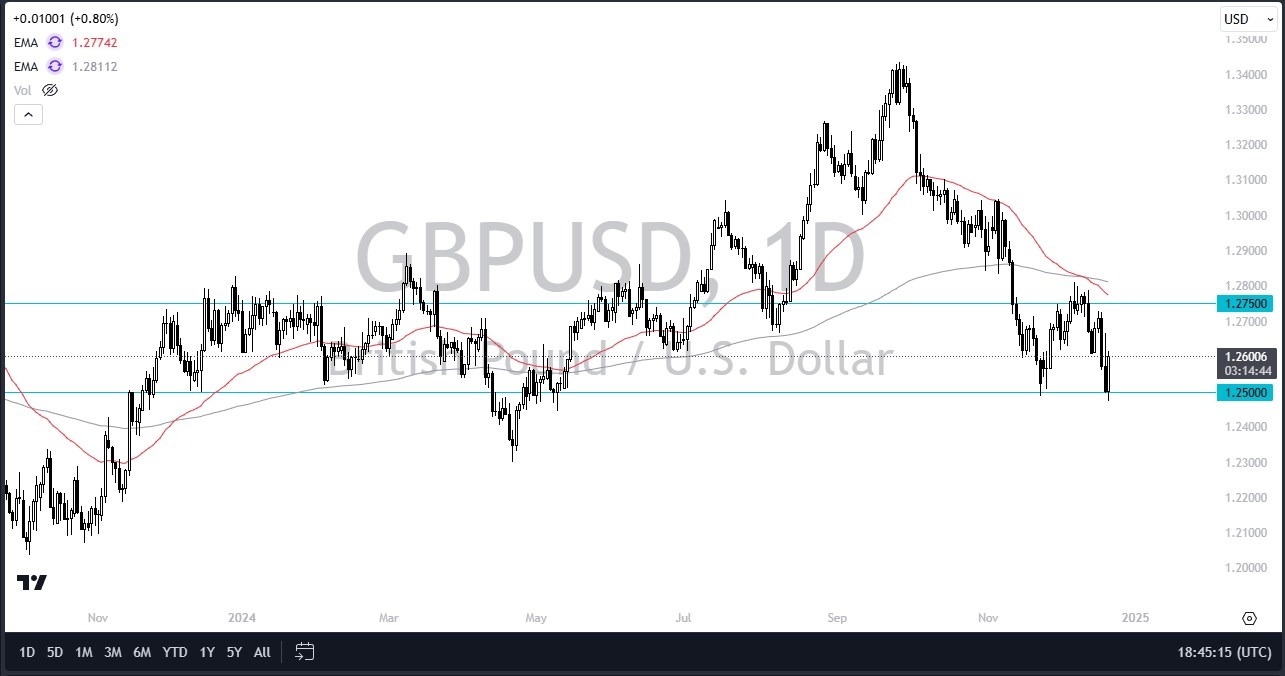
  • The British pound initially did fall a bit during the trading session against the US dollar on Friday, dipping below the 1.25 level.
  • However, we have since seen the market turn around quite drastically, reaching all the way back to the 1.26 level.
  • This is a potential double bottom that a lot of people will be paying attention to. This is also an area that has mattered for a while, so there is that as well.

If we can continue to rally, I think the British pound probably goes looking to the 1.2750 level in general. This is a market that I think you have to be somewhat cautious with your optimism, but you also have to realize that market participants will continue to see a lot of concerns with the bond markets, especially with the US yields spiking the way they had recently. This market continues to pay close attention to the bond markets.

The 50 Day EMA

If we were to take out the 50 day EMA, then the market goes looking to the 1.30 level. However, there is a lot of work to be done between now and then before that actually happens. And I do think that the interest rates in America will remain a little bit elevated as the 2025 year is likely to see less interest rate cuts than people had anticipated out of the Federal Reserve.

If we do drop from here and break down below the lows of the trading session on Friday, then it’s possible that the British pound drops down to the 1.23 level. I do favor shorting this pair on signs of exhaustion after short-term rallies. We’ve had the rally, but we haven’t had the exhaustion. So with that, you have to keep an open mind, at least until the market tells you that we are in fact going in one direction or the other.

Ready to trade our GBP/USD Forex analysis? Check out the best forex trading company in UK worth using

Source link

23 12, 2024

USD/JPY Analysis Today 23/12: Targets 160

By |2024-12-23T12:32:34+02:00December 23, 2024|Forex News, News|0 Comments

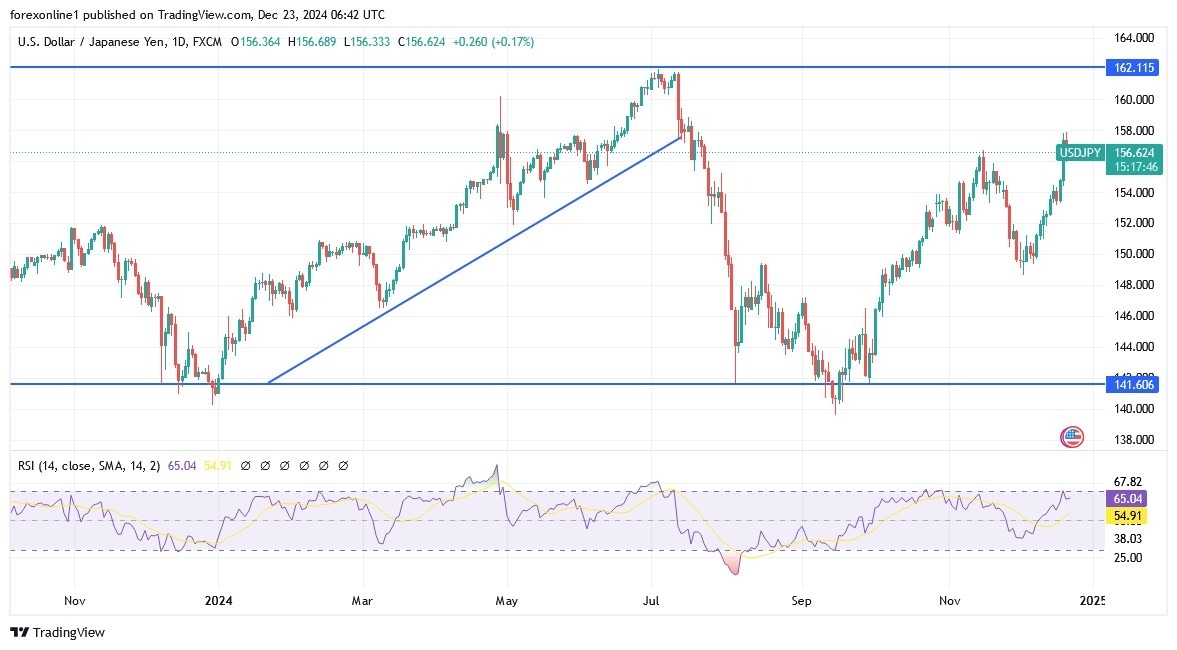
  • The USD/JPY pair experienced another week of upward momentum, with gains extending to the resistance level of 157.92, the highest for the currency pair in five months.
  • The week’s trading closed around 156.42 amidst strong bull control over the trend.
  • The increasing strength of the US dollar may push the trend towards the psychological resistance of 160.00 before the end of 2024.
  • Furthermore, diverging policies of central banks worldwide and the extent of investor risk appetite are the main factors affecting the performance of the currency pair.

US Dollar Near Two-Year High

Despite a decline in the US dollar price after the announcement of the US Federal Reserve’s preferred US inflation reading, it is still near its two-year high amid declining expectations of US interest rate cuts by the Federal Reserve in 2025. According to forex market trading, the US dollar has risen to new highs following news that Republican lawmakers have dropped a previously agreed-upon spending bill, raising the spectre of a government shutdown over the weekend.

The US dollar’s gains also came in the wake of the Federal Reserve’s decision in the middle of last week, when interest rates were cut, but policymakers said they expect only two interest rate cuts in 2025.

Trading Tips:

The dollar price against the US dollar will remain on its upward path until Japan intervenes in the exchange markets to stop the yen’s collapse

US Stocks Continue to Gain

According to stock trading platforms, US stock indices rose on the last day of 2024. According to trading, the S&P 500 index rose by 1%, the Nasdaq index rose by 0.8%. Meanwhile, the Dow Jones index gained 497 points. The gains of the US stock indices came on the heels of the preferred US inflation reading for the US Federal Reserve. Obviously, after that the Personal Consumption Expenditures index in November showed an increase of 2.4% on an annual basis, which is slightly below expectations. This helped ease market concerns raised by the Federal Reserve’s expectations of cutting US interest rates in 2025.

Investor sentiment was also affected by the threat of a US government shutdown and the pressures facing global financial markets due to threats of tariffs. According to last week’s trading, all three major US stock indices fell by 2.3%, with the Dow Jones recording its worst week since 2023.

Stock investors’ sentiment was also affected by the threat of a US government shutdown and the pressure on global financial markets due to tariff threats. According to last week’s trading, all three major US stock indices fell by 2.3%, with the Dow Jones recording its worst week since 2023.

USD/JPY Technical Analysis and Expectations Today:

According to the performance on the daily chart, the general trend of the US dollar against the Japanese yen USD/JPY is still bullish, exceeding the resistance of 158.00, moving the relative strength index towards strong overbought levels. Moreover, the MACD indicator has the opportunity to achieve stronger gains before reaching the overbought peak. Furthermore, the strength factors of the currency pair are present and will remain until a technical downward correction occurs. We do not rule out a move towards the psychological peak of 160.00. In contrast, and in the same period of time, the bearish shift of the USD/JPY pair will begin by returning to the support level of 151.50 again. Ultimately, we still prefer to buy USD/JPY from every downward level without risk and activate profit limit and stop loss orders to ensure the safety of the trading account from any sudden price reversals.

Want to trade our USD/JPY Forex analysis and predictions? Here’s a list of forex brokers in Japan to check out. 

Source link

21 12, 2024

The Price Breaks the Two-Year Support Zone

By |2024-12-21T20:09:25+02:00December 21, 2024|Forex News, News|0 Comments

  • EUR/USD has breached the support level at 1.05500, and selling momentum has strengthened the current downtrend in the chart.


  • The Federal Reserve (Fed) has emphasized slowing down the pace of interest rate cuts, a move that could be crucial in maintaining the strength of the U.S. dollar over the long term.


EUR/USD has recorded a 2% decline over the last five sessions, favoring the dollar and placing the euro in a sustained bearish zone. This selling pressure has intensified following the Fed’s recent decision, accompanied by neutral remarks regarding decisions for the upcoming year. This bearish pressure has pushed the price to break the crucial two-year support level at 1.0550.


Fed’s Remarks

In its final meeting of the year, the Fed reduced interest rates to a range of 4.25%-4.5%, down from the previous 4.5%-4.75% (a 25-basis-point cut). This adjustment aligns with efforts to stimulate the U.S. economy in early 2025.

However, Fed Chair Jerome Powell highlighted that although inflation has decreased significantly, it remains at elevated levels, making it challenging to achieve the central bank’s 2% target. Powell also stressed the need to proceed cautiously in future decisions,given that current projections place inflation at 2.5% for 2025, still far from the central bank’s target for the upcoming year.

In this context, the CME Group’s probability tool currently reflects a 91% chance that the Fed will keep rates unchanged at its next meeting, scheduled for January 29. And, for the 19-march decision, the probability stands in 53% of rates unchanged versus 43% of rate reduction. That said, now the market is seeing a neutral decision bias for next decisions which could help maintain higher interest rates, leading to a stronger dollar perspective. Remember that these probabilities could shift based on economic developments leading up to that date.

Interest Rate Probability Chart January – CME Group

 CMEGroup Prob Rates


Source: CmeGroup

Interest Rate Probability Chart March – CME Group

 FED march prob

Source: CmeGroup


Given the context outlined, the Fed’s interest rate of 4.5% remains significantly higher than the European Central Bank (ECB) rate of 3.15%. This differential could continue to attract investment into U.S. fixed-income assets, increasing demand for the dollar and exerting selling pressure on the EUR/USD. This scenario will likely persist as long as the U.S. central bank maintains rates above 4%.


EUR/USD Technical Forecast

EUR/USD has maintained a steady downtrend since late September, reaching a minimum price in the 1.03 range. Recent U.S. monetary policy events have strengthened the dollar, once again driving the price close to these lows not seen since November.

  EURUSD_2024-12-19_11-23-59

Source: StoneX, Tradingview


  • Downtrend Channel: The current downtrend channel favoring the dollar remains intact, with no significant bullish breakout threatening the formation. However, it’s important to note that the recent low at 1.03 remains a relevant support level that could trigger bullish corrections as the channel evolves. This level also represents the last low within the downtrend channel, and further lower lows are required to avoid a lateral consolidation in the short term.


  • RSI: The RSI indicator remains below 50, signaling that bearish momentum dominates the market in the short term. However, the RSI line is near an oversold zone, around the 20 level, which could indicate potential exhaustion of the bearish momentum and open the door for bullish corrections near the closest support level (1.03).

    Key Levels:

  • 1.03: The current support level corresponds to areas of indecision that served as a barrier in 2023. A drop below this level could lead to new lows in the current downtrend and reinforce the bearish bias.


  • 1.05500: This is the new resistance zone, coinciding with the lower boundary of the lateral range maintained during 2024. It also converges with the upper line of the downtrend channel and the Ichimoku cloud, further reinforcing its importance as a barrier. Movements above this level could weaken the current downtrend and threaten the channel formation.


Source link

20 12, 2024

The Price Breaks the Two-Year Support Zone

By |2024-12-20T23:57:32+02:00December 20, 2024|Forex News, News|0 Comments

  • EUR/USD has breached the support level at 1.05500, and selling momentum has strengthened the current downtrend in the chart.


  • The Federal Reserve (Fed) has emphasized slowing down the pace of interest rate cuts, a move that could be crucial in maintaining the strength of the U.S. dollar over the long term.


EUR/USD has recorded a 2% decline over the last five sessions, favoring the dollar and placing the euro in a sustained bearish zone. This selling pressure has intensified following the Fed’s recent decision, accompanied by neutral remarks regarding decisions for the upcoming year. This bearish pressure has pushed the price to break the crucial two-year support level at 1.0550.


Fed’s Remarks

In its final meeting of the year, the Fed reduced interest rates to a range of 4.25%-4.5%, down from the previous 4.5%-4.75% (a 25-basis-point cut). This adjustment aligns with efforts to stimulate the U.S. economy in early 2025.

However, Fed Chair Jerome Powell highlighted that although inflation has decreased significantly, it remains at elevated levels, making it challenging to achieve the central bank’s 2% target. Powell also stressed the need to proceed cautiously in future decisions,given that current projections place inflation at 2.5% for 2025, still far from the central bank’s target for the upcoming year.

In this context, the CME Group’s probability tool currently reflects a 91% chance that the Fed will keep rates unchanged at its next meeting, scheduled for January 29. And, for the 19-march decision, the probability stands in 53% of rates unchanged versus 43% of rate reduction. That said, now the market is seeing a neutral decision bias for next decisions which could help maintain higher interest rates, leading to a stronger dollar perspective. Remember that these probabilities could shift based on economic developments leading up to that date.

Interest Rate Probability Chart January – CME Group

 CMEGroup Prob Rates


Source: CmeGroup

Interest Rate Probability Chart March – CME Group

 FED march prob

Source: CmeGroup


Given the context outlined, the Fed’s interest rate of 4.5% remains significantly higher than the European Central Bank (ECB) rate of 3.15%. This differential could continue to attract investment into U.S. fixed-income assets, increasing demand for the dollar and exerting selling pressure on the EUR/USD. This scenario will likely persist as long as the U.S. central bank maintains rates above 4%.


EUR/USD Technical Forecast

EUR/USD has maintained a steady downtrend since late September, reaching a minimum price in the 1.03 range. Recent U.S. monetary policy events have strengthened the dollar, once again driving the price close to these lows not seen since November.

  EURUSD_2024-12-19_11-23-59

Source: StoneX, Tradingview


  • Downtrend Channel: The current downtrend channel favoring the dollar remains intact, with no significant bullish breakout threatening the formation. However, it’s important to note that the recent low at 1.03 remains a relevant support level that could trigger bullish corrections as the channel evolves. This level also represents the last low within the downtrend channel, and further lower lows are required to avoid a lateral consolidation in the short term.


  • RSI: The RSI indicator remains below 50, signaling that bearish momentum dominates the market in the short term. However, the RSI line is near an oversold zone, around the 20 level, which could indicate potential exhaustion of the bearish momentum and open the door for bullish corrections near the closest support level (1.03).

    Key Levels:

  • 1.03: The current support level corresponds to areas of indecision that served as a barrier in 2023. A drop below this level could lead to new lows in the current downtrend and reinforce the bearish bias.


  • 1.05500: This is the new resistance zone, coinciding with the lower boundary of the lateral range maintained during 2024. It also converges with the upper line of the downtrend channel and the Ichimoku cloud, further reinforcing its importance as a barrier. Movements above this level could weaken the current downtrend and threaten the channel formation.


Source link

20 12, 2024

GBP/USD Outlook: Pound Slides as Rate Cut Bets Grow

By |2024-12-20T19:55:11+02:00December 20, 2024|Forex News, News|0 Comments

  • Three BoE policymakers were ready to lower borrowing costs.
  • Data revealed that UK retail sales missed forecasts, increasing by 0.2%.
  • The US economy expanded by 3.1% in the fourth quarter, above estimates of 2.8%.

The GBP/USD outlook shows growing enthusiasm among pound bears as Bank of England rate cut expectations increase. At the same time, expectations for fewer rate cuts in the US in 2025 have boosted the dollar, further weighing on sterling.

If you are interested in automated forex trading, check our detailed guide-

The pound collapsed to new lows on Thursday after the Bank of England policy meeting. Although the central bank kept interest rates unchanged, there was a shift in sentiment among some policymakers. Three policymakers were ready to lower borrowing costs, which was unexpected. As a result, markets increase bets for rate cuts in 2025. 

Recent economic data have pointed to a recovering labor market and high inflation. Consequently, market participants were pricing a gradual easing pace in the coming year. However, if three policymakers were ready to cut rates in December, the number might increase at the next meeting. 

Meanwhile, data revealed that UK retail sales missed forecasts, increasing by 0.2%. Economists had expected a 0.5% increase. The miss was a sign that consumer spending dropped, which could put more pressure on the Bank of England to lower borrowing costs. 

On the other hand, the dollar remained strong after the Fed projected fewer rate cuts in 2025. At the same time, data on Thursday revealed that the US economy expanded by 3.1% in the fourth quarter, above estimates of 2.8%. Moreover, unemployment claims fell more than expected, showing a resilient economy.

GBP/USD key events today

GBP/USD technical outlook: Bears prompt 100% retracement

GBP/USD 4-hour chart

On the technical side, the GBP/USD price has made a sharp move from the 30-SMA to the 1.2500 key support level. The decline has put the price well below the 30-SMA and the RSI near the oversold region, supporting a bearish bias. 

If you are interested in guaranteed stop-loss forex brokers, check our detailed guide-

Previously, the price traded in a shallow bullish trend but reversed when it broke below its support trendline. Since then, bears have been in the lead, making lower highs and lows. The most recent move has made a 100% retracement of the previous bullish trend. 

Therefore, a break below the 1.2500 support will be a significant milestone for bears. It will signal a continuation of the bearish trend that was there before bulls prompted a corrective move.

Looking to trade forex now? Invest at eToro!

67% of retail investor accounts lose money when trading CFDs with this provider. You should consider whether you can afford to take the high risk of losing your money.

Source link

Go to Top