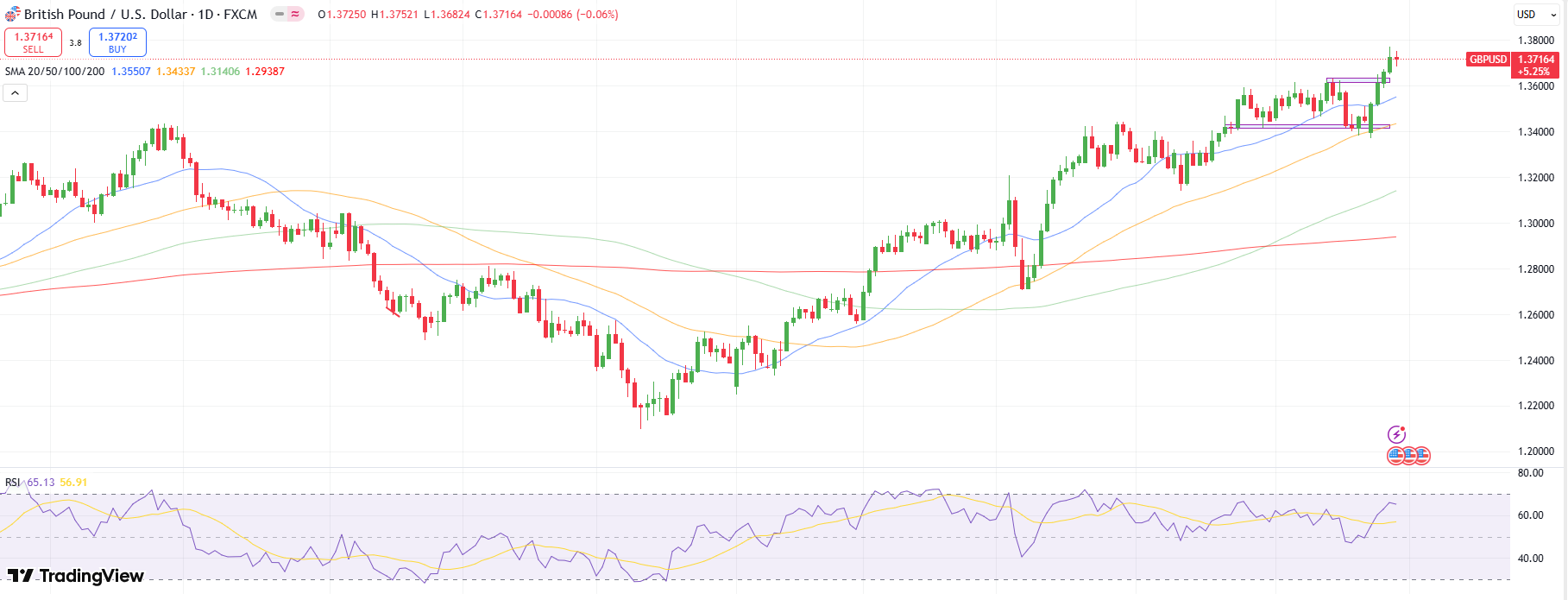
The British pound has fallen rather significantly during the trading session on Thursday as we continue to see a lot of risk aversion, especially after the tariff announcement came out of the United States.
Because of this, we’ve seen a lot of traders run toward the Japanese yen, long considered one of the premier safety currencies in the world.
What will be interesting to see is how the market behaves after we’ve had time to digest all of the news, which of course has been very rapidly released. The Americans have slept massive tariffs on most of the rest of the world, and how certain countries behave will have a major outsized influence on how the markets behave. For example, some of the bigger ones like China and the European Union obviously will be crucial, but there are other countries that will also be moving, both of these groups will more likely than not move this pair, if for no other reason than the fact that the GBP/JPY pair tends to move based on risk appetite more than anything else.
Friday Could Be Wild
During the trading session on Friday, we will get the employment numbers coming out of the United States, which almost always causes quite a bit of volatility as far as risk appetite is concerned. Because of this, it’s very likely that we will continue to see a lot of noisy behavior, and if it’s more of a “risk off day”, then the Japanese yen will continue to strengthen. The ¥190 level is an area that you need to be watching very closely, as it is a large, round, psychologically significant figure, and of course an area that traders will be paying close attention to for any signs of a bounce.
The ¥195 level above is going to be important as well, and if we can break above there then it would be a very bullish sign. That being said, we are nowhere near doing that, so I think more likely than not, we start bouncing around in a bit of a bounce.
USD/JPY edged higher in latest intraday trading while trying to recoup some recent losses, as the price also tried to vent off oversold saturation in the Stochastic with positive signals emerging from it.
It comes as the price settles below the pivotal support of 146.65 that was breached yesterday, while hurt by exiting an ascending correctional price channel previously, with the dominance of the main downward trend.
To get our more detailed analysis and 100% accurate signals provided by Best Trading Signal, subscribe to Economies.com VIP Club through the link below!
USD/JPY Forecast: the USD/JPY currency pair, representing the exchange rate between the U.S. dollar and the Japanese yen, is closely watched by traders and investors alike.
Overview of the USD/JPY Currency Pair
The USD/JPY pair is one of the most actively traded currency pairs in the world, reflecting the economic relationship between the United States and Japan. Both countries have significant global economic influence, making their currencies important in international trade and finance. The movements in this currency pair can be attributed to various factors, including economic data releases, central bank policies, and geopolitical events.
Economic Indicators Impacting USD/JPY
U.S. Economic Data Economic indicators from the United States play a pivotal role in determining the direction of the USD/JPY pair. Key reports such as gross domestic product (GDP) growth, employment figures, and inflation rates provide insights into the health of the U.S. economy. Strong economic performance often leads to a stronger dollar, as investors seek to capitalize on growth prospects. Conversely, weaker economic data can result in a decline in the dollar’s value against the yen.
Japanese Economic Indicators
Similarly, economic data from Japan significantly impacts the yen’s value. Reports on Japan’s GDP, trade balance, and consumer sentiment help gauge the overall strength of the Japanese economy. A robust economic outlook may bolster the yen, while weak data could lead to depreciation. The Bank of Japan’s policies and responses to economic conditions also play a crucial role in shaping market perceptions of the yen.
Central Bank Policies
Federal Reserve Actions The U.S. Federal Reserve’s monetary policy decisions are vital for the USD/JPY exchange rate. Changes in interest rates, quantitative easing measures, and forward guidance influence market expectations. When the Fed signals a tightening of monetary policy, the dollar typically strengthens against the yen. On the other hand, accommodative policies may lead to a weaker dollar as investors seek higher yields elsewhere.
Bank of Japan Policies
The Bank of Japan (BOJ) also plays a significant role in the dynamics of the USD/JPY pair. The BOJ’s stance on interest rates and its approach to economic stimulus impact the yen’s value. If the BOJ maintains a dovish stance, it may lead to yen weakness, while a shift towards tightening could strengthen the currency. The BOJ’s interventions in the foreign exchange market can also cause significant fluctuations in the USD/JPY exchange rate.
Market Sentiment and Geopolitical Factors on USD/JPY
Risk Sentiment Market sentiment is a crucial driver of currency movements. In times of uncertainty, investors tend to favor currencies perceived as more stable. The yen is often viewed as a currency that can provide stability during market volatility. Thus, shifts in risk sentiment can lead to movements in the USD/JPY pair, with heightened uncertainty typically resulting in yen appreciation.
Geopolitical Events Geopolitical tensions and events can create significant volatility in the foreign exchange market. Developments such as trade negotiations, political instability, or natural disasters in either the U.S. or Japan can influence investor behavior and, consequently, impact the USD/JPY exchange rate. Monitoring these events is essential for understanding potential market reactions.
Future Outlook for USD/JPY
Economic Recovery and Growth Prospects Looking ahead, the economic recovery in both the U.S. and Japan will be a key factor influencing the USD/JPY exchange rate. Strong growth in the U.S. economy could lead to a stronger dollar, particularly if the Federal Reserve continues to adopt a hawkish stance. Conversely, Japan’s economic performance and the BOJ’s policy direction will determine the yen’s strength.
Inflation and Interest Rate Expectations Inflation trends in both countries will significantly impact monetary policy decisions. Rising inflation in the U.S. may prompt the Federal Reserve to raise interest rates, supporting the dollar. In Japan, however, the BOJ has historically maintained a low-interest-rate environment, which could keep the yen under pressure. Monitoring inflation data will be essential for anticipating future movements in the USD/JPY pair.
Global Economic Influences Global economic developments, including trade relationships and international market trends, will also shape the USD/JPY outlook. As the global economy becomes more interconnected, external factors can have significant ramifications for currency pairs. Staying informed about global economic conditions will be crucial for understanding the potential direction of the USD/JPY exchange rate.
Conclusion
The USD/JPY currency pair is influenced by a myriad of factors, including economic indicators, central bank policies, market sentiment, and geopolitical events. Understanding these dynamics is essential for anyone looking to navigate the foreign exchange market effectively. As we approach the future, keeping a close watch on economic developments and market trends will provide valuable insights into the potential movements of the USD/JPY pair. With careful analysis and informed decision-making, traders can better position themselves to respond to the ever-changing landscape of the currency market.
When considering shares, indices, forex (foreign exchange) and commodities for trading and price predictions, remember that trading CFDs involves a significant degree of risk and could result in capital loss.
Past performance is not indicative of any future results. This information is provided for informative purposes only and should not be construed to be investment advice.
The Euro (EUR) rallied sharply against the US Dollar on Thursday after President Trump’s imposition of tariffs increased fears over the US and global economy and sparked increased recession talk.
Danske Bank commented; “The new tariffs were generally stronger and broader than we and markets expected, and sent shockwaves through global markets amid worries that the aggressive duties will slow growth, hit corporate earnings, and increase inflation.”
There are fears that the Euro-Zone will be hit hard, but the Euro gained defensive support with the Euro to Dollar (EUR/USD) exchange rate hit 6-month highs just above the key 1.1000 level.
An exodus from US capital markets could support the Euro and undermine the dollar.
ING commented; “While a global trade war in theory is a euro-negative, the soft underbelly of the US economy is the dominant factor for EUR/USD right now. A much sharper sell-off in US equities, dragging US rates even lower, adds another nail in the coffin of US exceptionalism and could send EUR/USD over 1.10.”
It added; “Major medium-term resistance sits in the 1.11/12 area. It’s hard to call a major break of that unless US activity craters.”
According to Danske Bank; “we expect consolidation around current levels in the near term, with risks tilted to the upside.”
Advertisement
As part of its wider tariff plan, the US Administration has imposed a 20% tariff on goods imports from the EU.
At this stage, the EU has not announced any formal retaliation, but the rhetoric is tough.
According to European Commission chief Ursula von der Leyen said the new tax imports will see uncertainty spiral causing dire consequences for millions of people around the globe”.
She vowed that Europe would take a unified approach and warned that it is preparing countermeasures in case negotiations fail.
She added; “If you take on one of us, you take on all of us.”
There are potential interest rate implications with markets now pricing in over a 90% chance that the ECB will cut rates this month.
The chances of a May Fed rate cut have also increased to around 20% with around a 75% chance of a move by mid-year.
Like this piece? Please share with your friends and colleagues:
International Money Transfer? Ask our resident FX expert a money transfer question or try John’s new, free, no-obligation personal service! ,where he helps every step of the way,
ensuring you get the best exchange rates on your currency requirements.
At the time of writing, Pound US Dollar (GBP/USD) exchange rate was trading at $1.3148 – its highest level since October 2024 and up 1.3% from Wednesday.
The US Dollar (USD) suffered a sharp decline on Wednesday evening and into Thursday’s session after US President Donald Trump introduced sweeping new tariffs.
On what he declared ‘liberation day’, Trump announced a blanket 10% tariff on all imported goods, alongside increased reciprocal tariffs on countries that impose taxes on US exports.
The move intensified concerns that the US economy could slide into recession this year. Analysts at Barclays warned of a ‘high risk’ of recession, with rising inflation and higher unemployment adding to the economic uncertainty.
In response, USD tumbled, with the US Dollar index – which tracks the currency’s performance against a basket of rivals – plunging nearly 1.4% to its lowest level since October 2024.
Meanwhile, the Pound (GBP) capitalised on the US Dollar’s weakness, propelling GBP/USD to its highest level in six months.
While the UK will be affected by the new tariffs, the economic impact is expected to be significantly less severe than in the US. British exports to the US will face a 10% tariff, but this is a milder blow compared to the broader trade restrictions imposed on other nations.
Advertisement
Looking ahead, Trump’s aggressive tariff policy is likely to fuel further volatility in currency markets as traders assess the potential fallout and watch for retaliatory measures from other economies.
If global trade tensions escalate and recession fears deepen, the US Dollar could remain under pressure.
In addition, upcoming US economic data may influence GBP/USD. Friday’s non-farm payrolls report is expected to show a slowdown in job growth, which could further weigh on the ‘Greenback’ if it reinforces concerns about the health of the US economy.
Federal Reserve Chair Jerome Powell is also set to speak on Friday. Should he express worries about the economic impact of the trade war, GBP/USD could climb even higher, potentially testing new multi-month highs.
Like this piece? Please share with your friends and colleagues:
International Money Transfer? Ask our resident FX expert a money transfer question or try John’s new, free, no-obligation personal service! ,where he helps every step of the way,
ensuring you get the best exchange rates on your currency requirements.
During Thursday’s trading session, the bears’ control over the USD/JPY pair increased, with losses extending to the 146.80 support level.
This is the lowest for the pair in over three weeks, before stabilizing around 147.25 at the time of writing.
The pair’s losses increased as investors flocked to safe-haven assets after US President Donald Trump announced comprehensive reciprocal tariffs, raising fears of a devastating global trade war.
Trump imposed additional tariffs of 34% on China, bringing the total tariffs to 54%. Other major economies facing hefty tariffs include the European Union (20%), Japan (24%), India (26%), in addition to a base tariff of 10% on imports from all countries. Earlier this week, Bank of Japan Governor Kazuo Ueda warned that the new US tariffs could significantly impact global trade and economic growth. While the Bank of Japan is expected to raise interest rates again later this year, uncertainty about global trade and domestic economic conditions continues to overshadow the outlook.
Trading Tips:
We still recommend buying the US dollar against the Japanese yen, but without risk, spreading your trading amount across multiple levels, and monitoring the factors affecting the currency pair’s performance.
Japanese Stocks Negatively Affected by Trump’s Tariff Announcement
During today’s trading session and across stock trading platforms, the Nikkei 225 index fell 2.77% to close at 34,736 points, while the Topix index fell 3.08% to 2,569 points. Japanese stocks fell to their lowest levels in several months after US President Donald Trump announced comprehensive reciprocal tariffs, raising fears of a global trade war that could destabilize major economies.
Trump imposed 24% tariffs on Japanese goods, along with a 25% tariff on auto imports, dealing a severe blow to the Japanese auto industry. In response, Japanese Trade Minister Yuji Muto stated that his country would continue to request an exemption, announcing the formation of a task force to assess the impact of the US tariffs.
According to trading, all sectors declined, with heavy losses among the index’s leading companies, such as Mitsubishi UFJ (-7.2%), Toyota (-5.2%), Kawasaki Heavy Industries (-7.1%), Nintendo (-3.3%), and Advantest (-4.5%). In corporate news, Nissan shares fell 3.7% after reports confirmed it had suspended part of its production line in Mexico as previously planned.
Bank of Japan Governor Warns of Global Trade Risks
This week, Bank of Japan Governor Kazuo Ueda warned that the new US tariffs could have a significant impact on global trade and economic growth. In his speech to the Japanese parliament, Ueda stressed the uncertainty surrounding the potential effects of reciprocal tariffs on trade flows, business sentiment, and inflation. The new tariffs, which take effect on April 3, include 25% tariffs on car imports. These tariffs are in addition to existing US tariffs on aluminium and steel, and higher tariffs on all Chinese imports.
Ueda intends to raise these concerns at the upcoming G20 meeting, where US trade policies and their implications will be a major point of discussion. Analysts indicate that the economic fallout could influence the Bank of Japan’s interest rate decision, with a rate hike expected in the third quarter of 2025, possibly in July.
USD/JPY Technical analysis and Expectations Today:
According to the daily chart performance, the bears’ control over the USD/JPY pair is strengthening, and recent losses may push some technical indicators towards strong oversold levels, led by the Relative Strength Index (RSI) and the MACD indicator. Therefore, we recommend considering buying from the support levels of 146.70, 145.80, and 145.00, respectively. Conversely, on the same timeframe, the 152.00 resistance will remain the most important for the bulls to take control of the USD/JPY trend. Technically, the pair will continue to lean downwards until the reaction to the US jobs data announcement tomorrow, which will have an impact on market expectations for the future of the US Federal Reserve’s policies.
Since the start of Thursday’s trading session, the EUR/USD pair has been in a strong upward rebound, with gains reaching the 1.0989 resistance level.
This is the closest point to breaking the psychological resistance of 1.1000, which supports the strength of the EUR/USD pair’s bullish shift.
The pair’s gains increased even with US President Donald Trump imposing 20% tariffs on all imports from the European Union.
The currency also benefited from the weakening US dollar, as this tariff move represents a significant escalation in the global trade dispute and raises concerns about economic growth.
Meanwhile, recent economic data showed that the eurozone inflation rate fell to 2.2% in March, its lowest level since November 2024. Core inflation fell more than expected to 2.4%, its lowest level since January 2022. With easing inflationary pressures and escalating global trade tensions, market expectations have strengthened that the European Central Bank could cut interest rates by 65 basis points this year.
European Inflation Figures
According to economic calendar data, Eurostat reported a slight decrease in the Eurozone’s annual inflation rate to 2.2% in March, from 2.3% in February, meeting expectations and approaching the ECB’s target of 2%. Economists say, “Eurozone inflation is easing as expected and is likely to fall below the ECB’s 2% target in the coming months.”
Encouragingly for the central bank, the eurozone’s core inflation gauge fell to 2.4% in March, from 2.6% in February, below the consensus forecast of 2.5%. Services inflation also fell to 3.4% from 3.7%, according to the announcement.
The European Central Bank is scheduled to announce its next interest rate decision on April 17, and market expectations now indicate a 72% chance of a rate cut. By then, the extent of the upcoming US tariffs will become clearer, as will any adjustments the White House may make. By the April meeting, the ECB will also learn the nature and scope of the eurozone’s countervailing tariffs, which will impact European import prices.
Trading Tips:
We still recommend selling the euro against the US dollar from every rising level, but without risk and monitoring the factors affecting prices.
European Stocks Decline After New US Tariffs
According to yesterday’s trading session and across stock trading platforms, European markets closed lower as investors braced for new US trade tariffs. According to trading, the Stoxx 50 index fell 0.4%, and the Stoxx 600 index lost 0.6%, reversing Tuesday’s rebound.
According to performance, most sectors declined, with healthcare stocks being the hardest hit – falling about 2% – amid fading hopes for tariff exemptions. Bayer shares fell about 4%, leading the declines. Overall, concerns increased after Trump reiterated that his “reciprocal tariffs” would apply to “all countries.” Reports indicate that 20% tariffs will be imposed on most imports, but final details remain uncertain.
Meanwhile, the White House confirmed that the measures will take effect immediately upon their announcement. Further escalating trade tensions, the United States is set to impose a 25% tariff on foreign-made cars. Meanwhile, UniCredit has received approval for its bid to acquire Banco BPM, and Credit Agricole has received approval from the European Central Bank to increase its stake in the Italian bank.
EUR/USD Technical Analysis Today:
According to the daily chart performance, the EUR/USD pair has an opportunity for a bullish shift, and as I mentioned before, the psychological resistance of 1.1000 will remain the most prominent for this shift, which may technically push the pair towards stronger peaks. I see these peaks as potential selling opportunities for the EUR/USD, but without risk, regardless of the strength of trading opportunities. Markets are now reacting to Trump’s tariffs, and attention will then turn to US jobs data tomorrow.
Conversely, over the same timeframe, the 1.0800 support level will remain a real threat to any upward shift in the EUR/USD pair.
Amid strong upward momentum, the GBP/USD pair rose to the 1.3128 resistance level, the highest level in about six months, driven by a sharp decline in the US dollar.
Obviously, this was due to traders’ reaction to the latest round of reciprocal tariffs announced by US President Donald Trump.
The US is set to impose a 10% tariff on all imports, with some countries subject to much higher rates. British imports will be subject to these tariffs.
Reactions to Trump’s Tariffs
This announcement triggered a flight to safe havens and a shift towards low-risk assets, as investors grew increasingly concerned about the potential impact on the global economy. For her part, British Foreign Secretary Reynolds stated that the US is Britain’s “closest ally” and that the government’s approach is to “remain calm and committed to securing this deal, which we hope will mitigate the effects of what was announced today.”
UK inflation was a factor in the pound’s decline ahead of the US tariffs. According to forex trading, the pound fell below $1.29, its lowest level in nearly two weeks, as traders reacted to the weaker-than-expected February inflation reading and the Spring Statement. Chancellor Reeves said that UK inflation is expected to average 3.2% in 2025, up from the 2.6% forecast in October. At the same time, growth forecasts for 2025 were lowered to 1% from 2%, and public sector net borrowing is expected to fall from £137.3 billion (4.8% of GDP) this year to £74.0 billion (2.1% of GDP) by 2029-30. However, compared to the October estimate, borrowing for 2025-26 is expected to be £12.1 billion higher (0.4% of GDP).
The UK government has already announced several policy changes to restore the government’s budget, including social welfare reforms, cuts in administrative spending, and a small set of tax changes. The UK’s annual inflation rate fell to 2.8% in February, slightly lower than the expected 2.9% but in line with the Bank of England’s forecast.
Trading Tips:
The pound will remain supported for some time, but beware of profit-taking.
UK avoids Trump’s tariffs, good for the exchange rate.
The British pound is experiencing sharp fluctuations following US President Donald Trump’s announcement of a 10% tariff on British imports. The 10% tariff imposed on Britain is much more lenient than those imposed on other countries, pushing the pound higher.
Here’s a look at some of the most significant tariffs:
20% on the European Union 34% on China 46% on Vietnam 24% on Japan
According to licensed trading company platforms, the British pound is rising against most major currencies, confirming its role as a safe haven in tariff trading. The GBP/USD exchange rate is higher at 1.3120, confirming that the dollar is a complete loser. This is understandable; ultimately, US consumers and businesses bear the costs of high imports. Also, the GBP/EUR exchange rate rose to 1.1989, a rise indicating that the EU’s 20% tariffs were lower than expected. In other markets, China-related currencies, such as the Australian dollar and the New Zealand dollar, are experiencing selloffs.
Trump asked a crowd gathered in the White House Rose Garden: “They’re charging us tariffs, and we’re charging them tariffs. How can anyone be upset?” Among other things, he specifically mentioned China and the European Union. “They’re deceiving us. It’s very sad to see this. It’s pathetic.”
He said, “India is very difficult. Very difficult.”
Regarding exchange rate reactions, we reported that the British pound entered the tariff announcements as a hedge due to its relatively low exposure. This is due to Britain’s declining manufacturing base, which keeps it balanced in goods trade with the United States.
Technical Analysis for the GBP/USD pair today:
Based on the performance on the daily chart, the GBP/USD pair is witnessing a strong upward movement towards levels that confirm this shift. Technically, from the resistance levels of 1.3120 and 1.3230, technical indicators will move towards strong overbought levels. Conversely, the currency pair will not abandon its upward recovery path without moving towards the support level of 1.2880 again. Finally, the GBP/USD may remain on its upward path until the reaction to the US jobs numbers tomorrow.
The USD/JPY outlook remains strongly bearish after Trump’s tariffs.
BoJ and Fed divergence, along with falling US yields, lend more support to the yen.
Tariffs pose a threat to Japan’s export-driven economy as well, igniting further uncertainty.
The USD/JPY outlook is predominantly bearish as the yen capitalizes on safe-haven appeal due to President Trump’s sweeping trade tariffs. The pair plummeted 1.2%, marking fresh 3-week lows near 147.20 during the early Asian session. With mounting fears of a US recession, investors are fleeing to the JPY, reinforcing its strength against the US dollar.
-Are you looking for the best AI Trading Brokers? Check our detailed guide-
Riskier assets saw a broader sell-off after the latest round of Trump’s tariffs. The stocks slipped, and bond yields dipped, creating a demand for conventional safe-haven assets. The US 10Y hit a YTD low at 4.0%, reinforcing the potential for a Fed rate cut.
The ongoing divergence between the Federal Reserve and the Bank of Japan further fueled the JPY rally. While the Fed is widely expected to cut rates, BoJ remains uncertain. Previously, market participants were expecting an aggressive stance from BoJ. However, Japan’s export-driven economy may suffer as a result of recent tariffs. Still, the recent Tokyo consumer inflation figures suggest that the BoJ may retain its hawkish stance.
Despite Trump’s tariffs favoring the US dollar in the long run, the likelihood of a rate cut and the risk of a recession has undermined the Greenback. According to Wells Fargo analysts, monetary easing is expected to be more pronounced in 2025-26, which could keep the dollar defensive.
Key Events for USD/JPY
Looking ahead, traders will primarily focus on the following:
Weekly jobless claims
ISM Services PMI
Still, the broader focus remains on trade development and China’s potential reaction.
USD/JPY technical outlook: Sellers looking at 146.55
USD/JPY 4-hour chart
The USD/JPY 4-hour chart shows a gloomy picture. The price is slipping towards the key support level at 146.55. The pair lies well below the 30-period SMA, posing a risk of a deeper downside. However, the RSI value reaches 30.0, which indicates an oversold zone. Hence, corrective upside can be expected.
-Are you looking for the best MT5 Brokers? Check our detailed guide-
On the upside, the 30-period SMA is one tough nut to crack for the buyers. Meanwhile, a strong resistance level emerges at 151.15. The path of least resistance lies on the downside.
Looking to trade forex now? Invest at eToro!
75% of retail investor accounts lose money when trading CFDs with this provider. You should consider whether you can afford to take the high risk of losing your money.
EUR/USD trades at its highest level since early October above 1.1000.
US Dollar stays under strong bearish pressure following US Pres. Trump’s tariff announcements.
The pair turns technically overbought in the near term.
EUR/USD gathers bullish momentum in the European session on Thursday and trades at its highest level since early October above 1.1000. Although the pair’s near-term technical outlook points to overbought conditions, buyers could retain control amid the broad-based US Dollar (USD) weakness.
Euro PRICE Today
The table below shows the percentage change of Euro (EUR) against listed major currencies today. Euro was the strongest against the US Dollar.
USD
EUR
GBP
JPY
CAD
AUD
NZD
CHF
USD
-1.39%
-0.89%
-1.64%
-0.70%
-0.56%
-0.80%
-1.72%
EUR
1.39%
0.26%
-0.27%
0.73%
0.87%
0.61%
-0.31%
GBP
0.89%
-0.26%
-0.50%
0.47%
0.63%
0.36%
-0.60%
JPY
1.64%
0.27%
0.50%
0.96%
1.14%
0.74%
-0.07%
CAD
0.70%
-0.73%
-0.47%
-0.96%
0.24%
-0.11%
-1.05%
AUD
0.56%
-0.87%
-0.63%
-1.14%
-0.24%
-0.26%
-1.19%
NZD
0.80%
-0.61%
-0.36%
-0.74%
0.11%
0.26%
-0.95%
CHF
1.72%
0.31%
0.60%
0.07%
1.05%
1.19%
0.95%
The heat map shows percentage changes of major currencies against each other. The base currency is picked from the left column, while the quote currency is picked from the top row. For example, if you pick the Euro from the left column and move along the horizontal line to the US Dollar, the percentage change displayed in the box will represent EUR (base)/USD (quote).
US President Donald Trump announced on “Liberation Day” that they will impose a 10% baseline tariff, effective April 5, on all imports to the US. The Trump administration will also impose higher reciprocal tariffs, which will go into effect on April 9, on about 60 countries they describe as “worst offenders.” The European Union will be within that list, facing 20%, tariffs.
In response, European Commission President Ursula von der Leyen said early Thursday that the US’ tariffs will be a major blow to the world economy. “We are preparing a further package of measures to protect our interests,” she added.
Investors grow increasingly concerned over the potential negative impact of the US’ new trade regime on the economic outlook. In turn, the USD suffers large losses against its major rivals. At the time of press, the USD Index was down about 1.4% on the day at 102.25.
In the second half of the day, the US economic calendar will feature weekly Initial Jobless Claims and March ISM Services Purchasing Managers Index (PMI) data. Investors are likely to ignore these releases and remain focused on trade war-related headlines.
EUR/USD Technical Analysis
The Relative Strength Index (RSI) indicator on the 4-hour chart rises toward 80, reflecting overbought conditions for EUR/USD. On the upside, 1.1040 (static level) aligns as next resistance level before 1.1100 (static level, round level).
In case EUR/USD drops below 1.1000 (static level, former resistance) and starts using this level as resistance, it could extend its correction toward 1.0950 (static level) and 1.0900 (static level, round level).
Tariffs FAQs
Tariffs are customs duties levied on certain merchandise imports or a category of products. Tariffs are designed to help local producers and manufacturers be more competitive in the market by providing a price advantage over similar goods that can be imported. Tariffs are widely used as tools of protectionism, along with trade barriers and import quotas.
Although tariffs and taxes both generate government revenue to fund public goods and services, they have several distinctions. Tariffs are prepaid at the port of entry, while taxes are paid at the time of purchase. Taxes are imposed on individual taxpayers and businesses, while tariffs are paid by importers.
There are two schools of thought among economists regarding the usage of tariffs. While some argue that tariffs are necessary to protect domestic industries and address trade imbalances, others see them as a harmful tool that could potentially drive prices higher over the long term and lead to a damaging trade war by encouraging tit-for-tat tariffs.
During the run-up to the presidential election in November 2024, Donald Trump made it clear that he intends to use tariffs to support the US economy and American producers. In 2024, Mexico, China and Canada accounted for 42% of total US imports. In this period, Mexico stood out as the top exporter with $466.6 billion, according to the US Census Bureau. Hence, Trump wants to focus on these three nations when imposing tariffs. He also plans to use the revenue generated through tariffs to lower personal income taxes.