The main tag of Forex News Today Articles.
You can use the search box below to find what you need.
[wd_asp id=1]

11 09, 2024

Pound Sterling finds support but struggles to rebound

By |2024-09-11T13:18:11+03:00September 11, 2024|Forex News, News|0 Comments

  • GBP/USD trades in a tight range slightly below 1.3100 on Wednesday.
  • August inflation data from the US will be scrutinized by investors.
  • Disappointing data releases from the UK don’t allow Pound Sterling to gather strength.

Following Tuesday’s indecisive action, GBP/USD struggles to make a decisive move in either direction and trades in a tight channel slightly below 1.3100. August inflation data from the US could trigger the next big action in the pair.

British Pound PRICE This week

The table below shows the percentage change of British Pound (GBP) against listed major currencies this week. British Pound was the weakest against the Japanese Yen.

  USD EUR GBP JPY CAD AUD NZD CHF
USD   0.41% 0.36% -0.47% 0.16% 0.17% 0.54% 0.18%
EUR -0.41%   -0.10% -0.83% -0.25% -0.29% 0.15% -0.25%
GBP -0.36% 0.10%   -0.85% -0.14% -0.18% 0.23% -0.15%
JPY 0.47% 0.83% 0.85%   0.62% 0.65% 1.00% 0.84%
CAD -0.16% 0.25% 0.14% -0.62%   0.05% 0.37% 0.18%
AUD -0.17% 0.29% 0.18% -0.65% -0.05%   0.41% 0.00%
NZD -0.54% -0.15% -0.23% -1.00% -0.37% -0.41%   -0.37%
CHF -0.18% 0.25% 0.15% -0.84% -0.18% -0.01% 0.37%  

The heat map shows percentage changes of major currencies against each other. The base currency is picked from the left column, while the quote currency is picked from the top row. For example, if you pick the British Pound from the left column and move along the horizontal line to the US Dollar, the percentage change displayed in the box will represent GBP (base)/USD (quote).

Although the US Dollar (USD) stays under bearish pressure in the European session on Wednesday, GBP/USD finds it difficult to gain traction, with the latest data releases from the UK disappointing market participants.

The UK’s Office for National Statistics reported early Wednesday that Industrial Production and Manufacturing Production declined by 0.8% and 1%, respectively, on a monthly basis in July. Both of these prints fell short of analysts’ estimates. Other data from the UK showed that the monthly Gross Domestic Product (GDP) was unchanged in July.

In the second half of the day, the US Bureau of Labor Statistics will publish the Consumer Price Index (CPI) data for August. Investors are likely to react to a surprise in the monthly core CPI reading, which is not distorted by base effects and excludes volatile food and energy prices.

Markets expect an increase of 0.2% in the monthly core CPI in August. A stronger-than-forecast reading could provide a boost to the USD and pave the way for another leg lower in GBP/USD. On the flip side, investors could reassess the probability of a 50 basis points (bps) Federal Reserve rate cut in September, which currently stands at 35% according to the CME FedWatch Tool, on a soft print and cause the USD to come under renewed selling pressure.

GBP/USD Technical Analysis

GBP/USD stays below the 20-period, 50-period and 100-period Simple Moving Averages (SMA) on the 4-hour chart, while the Relative Strength Index (RSI) indicator stays near 40, suggesting that the bearish bias remains intact.

GBP/USD could meet first support at 1.3040 (Fibonacci 38.2% retracement level of the latest uptrend) before 1.3000 (psychological level, static level) and 1.2970 (Fibonacci 50% retracement, 200-period SMA).

On the upside, interim resistance is located at 1.3100 (static level) ahead of 1.3130 (50-period SMA, 100-period SMA) and 1.3200 (psychological level, static level).

Pound Sterling FAQs

The Pound Sterling (GBP) is the oldest currency in the world (886 AD) and the official currency of the United Kingdom. It is the fourth most traded unit for foreign exchange (FX) in the world, accounting for 12% of all transactions, averaging $630 billion a day, according to 2022 data. Its key trading pairs are GBP/USD, aka ‘Cable’, which accounts for 11% of FX, GBP/JPY, or the ‘Dragon’ as it is known by traders (3%), and EUR/GBP (2%). The Pound Sterling is issued by the Bank of England (BoE).

The single most important factor influencing the value of the Pound Sterling is monetary policy decided by the Bank of England. The BoE bases its decisions on whether it has achieved its primary goal of “price stability” – a steady inflation rate of around 2%. Its primary tool for achieving this is the adjustment of interest rates. When inflation is too high, the BoE will try to rein it in by raising interest rates, making it more expensive for people and businesses to access credit. This is generally positive for GBP, as higher interest rates make the UK a more attractive place for global investors to park their money. When inflation falls too low it is a sign economic growth is slowing. In this scenario, the BoE will consider lowering interest rates to cheapen credit so businesses will borrow more to invest in growth-generating projects.

Data releases gauge the health of the economy and can impact the value of the Pound Sterling. Indicators such as GDP, Manufacturing and Services PMIs, and employment can all influence the direction of the GBP. A strong economy is good for Sterling. Not only does it attract more foreign investment but it may encourage the BoE to put up interest rates, which will directly strengthen GBP. Otherwise, if economic data is weak, the Pound Sterling is likely to fall.

Another significant data release for the Pound Sterling is the Trade Balance. This indicator measures the difference between what a country earns from its exports and what it spends on imports over a given period. If a country produces highly sought-after exports, its currency will benefit purely from the extra demand created from foreign buyers seeking to purchase these goods. Therefore, a positive net Trade Balance strengthens a currency and vice versa for a negative balance.


Source link

11 09, 2024

Japanese Yen Forecast: USD/JPY Faces Pressure as US Inflation Data Looms

By |2024-09-11T05:14:19+03:00September 11, 2024|Forex News, News|0 Comments

“US Aug payrolls +142k,

Short-term Forecast: Bearish

USD/JPY trends will hinge on the upcoming inflation figures from the US and comments from the BoJ. A combination of hawkish comments from the BoJ and weaker US inflation could narrow the interest rate differential between the US and Japan, signaling a drop below 141.5.

Investors should remain alert with inflation data and central bank chatter likely to influence the BoJ and the Fed’s rate paths. Monitor real-time data, central bank insights, and expert commentary to adjust your trading strategies accordingly. Stay updated with our latest news and analysis to manage USD/JPY volatility.

USD/JPY Price Action

Daily Chart

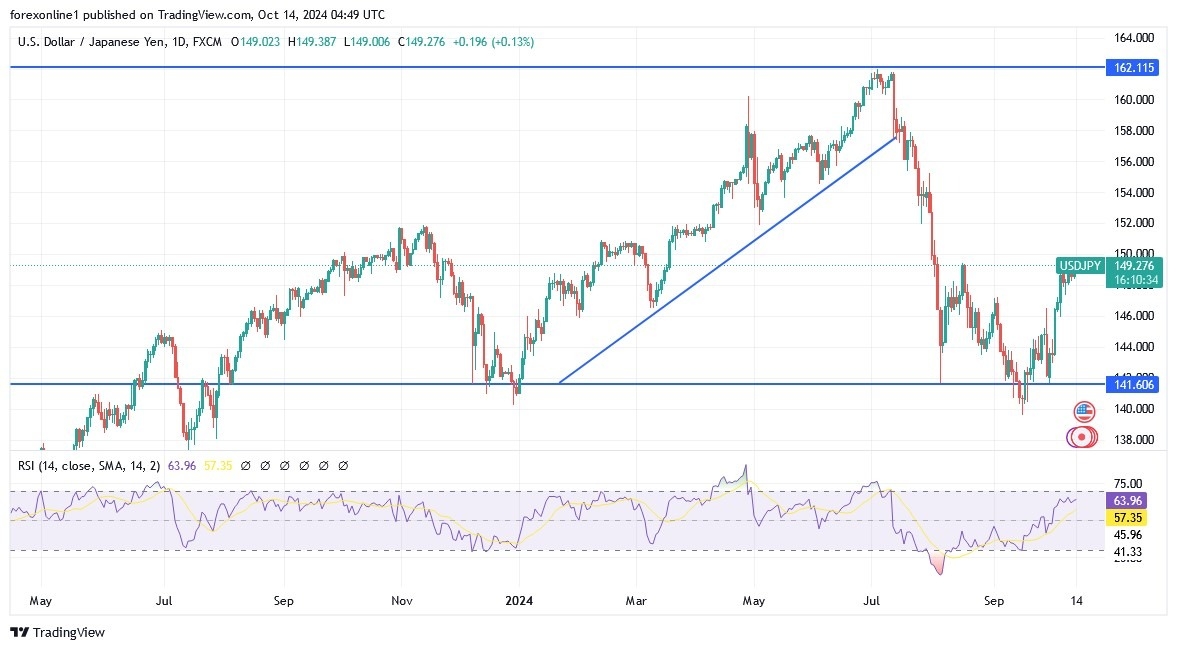
The USD/JPY remained well below the 50-day and 200-day EMAs, confirming bearish price trends.

A USD/JPY breakout from 142.500 could signal a move toward the 143.495 resistance level. Furthermore, a break above the 143.495 resistance level may bring the 145.891 resistance level into play.

Central bank commentary and the US CPI Report require consideration.

Conversely, a break below 142 could indicate a drop toward the 141.032 support level.

The 14-day RSI at 34.54 indicates a USD/JPY drop below 142 before entering oversold territory.

Source link

11 09, 2024

Price action now looks at US CPI data

By |2024-09-11T01:12:33+03:00September 11, 2024|Forex News, News|0 Comments

  • EUR/USD extended its weekly leg lower and approaches the 1.1000 support.
  • The US Dollar traded with minimal gains ahead of US inflation data.
  • Investors look at US CPI and its impact on the size of the September rate cut.

EUR/USD experienced renewed downward momentum on turnaround Tuesday, continuing its losses from the beginning of the week and moving back towards the 1.1015-10101 area, driven by ongoing buying pressure on the US Dollar (USD).

Meanwhile, the US Dollar Index (DXY) stuck to the upper end of the recent range in the proximity of the 101.70 level in a context where US yields deepened their retracements across the curve.

In the meantime, market participants are expected to closely watch the release of US inflation figures gauged by the CPI on Wednesday, as it could give extra signals about the extent of the Fed’s expected rate cut this month, especially after Fed Chair Jerome Powell suggested at the Jackson Hole Symposium that it may be time to adjust monetary policy.

Also advocating for a rate cut later in the month appeared many Fed officials, namely San Francisco Fed President Mary Daly, New York Fed President John Williams, and Chicago Fed President Austan Goolsbee.

In this context, the upcoming US Consumer Price Index (CPI) report is set to be a key factor, especially given the Fed’s shift from a sole focus on managing inflation to avoiding job losses.

According to the CME Group’s FedWatch Tool, there is currently about a 63% probability of a 25 bps rate cut in September.

A shift to the European Central Bank’s (ECB) noted that recent Accounts showed that policymakers did not see a strong reason to cut interest rates last month. However, they noted that this decision could be revisited in September due to the impact of high rates on economic growth.

Recent reports indicate growing divisions among ECB policymakers regarding the growth outlook, which could affect future discussions on rate cuts. Some officials are concerned about a potential recession, while others remain focused on persistent inflationary pressures.

However, lower-than-expected preliminary CPI data for August in Germany and the Eurozone could challenge the cautious stance of some officials, potentially paving the way for the ECB to consider another rate cut at its September 12 meeting.

Overall, if the Fed proceeds with additional or larger rate cuts, the policy gap between the Fed and the ECB could narrow over the medium to long term, potentially supporting EUR/USD. This is particularly likely, as markets anticipate two more rate cuts from the ECB this year.

In the longer term, however, the US economy is expected to outperform the European economy, which could limit any prolonged weakness in the dollar.

Finally, according to the CFTC report for the week ending September 3, speculators (non-commercial traders) have increased their net long positions in the Euro (EUR) to the highest levels since January, while commercial traders (such as hedge funds) have raised their net short positions to multi-month highs amid a notable increase in open interest.

EUR/USD daily chart

EUR/USD short-term technical outlook

If bulls regain the upper hand, EUR/USD should face its initial hurdle at the September high of 1.1155 (September 6), prior to the 2024 top of 1.1201 (August 26), and the 2023 peak of 1.1275 (July 18).

On the other side, the pair’s next downside objective is the September low of 1.1015 (September 10), prior to the preliminary 55-day SMA at 1.10936 and the weekly low of 1.0881 (August 8). The crucial 200-day SMA is at 1.0858, preceding the weekly low of 1.0777 (August 1) ahead of the June low of 1.0666.

Meanwhile, the pair’s upward trend is projected to continue as long as it remains above the key 200-day SMA.

The four-hour chart suggests a minor rebound in negative sentiment. However, the initial resistance level is 1.1155, followed by 1.1190 and 1.1201. Instead, there is immediate support at 1.1015, before the 200-SMA of 1.1002, and then at 1.0949. The relative strength index (RSI) receded below 34.


Source link

10 09, 2024

USD/JPY Forecast – US Dollar Continues to Test Support

By |2024-09-10T23:11:48+03:00September 10, 2024|Forex News, News|0 Comments

US Dollar vs Japanese Yen Technical Analysis

The US Dollar rallied initially in the early hours on Tuesday, only to turn around and fall again. The 142 yen level underneath is a major support level and I think at this point in time, it’s worth noting that we also have the intersection of an uptrend line that a lot of people are paying attention to. I think at this point in time, we are in the midst of perhaps trying to form some type of double bottom. At this point, the double bottom of course is a sign that perhaps things are starting to turn around. We recognize, of course, that the Federal Reserve is likely to cut rates later this month.

But the question is how much do they cut? If they only cut this month and maybe one other time, the interest rate differential between the US dollar and the Japanese yen remains pretty much intact. Yes, it’s smaller, but it’s still enough that it will attract a certain amount of inflows. If we can turn around and break above the 145 yen pair higher, perhaps reaching the 149 yen level.

Furthermore, we have to keep in mind that both CPI and PPI come out later this week, so that will have a bit of an influence. And beyond that, we also have to keep a risk appetite in the back of our mind. If we were to close on a daily close below the 141 yen level, then I think the bottom falls out and we probably drop quite significantly.

For a look at all of today’s economic events, check out our economic calendar.

This article was originally posted on FX Empire

More From FXEMPIRE:

Source link

10 09, 2024

EUR/USD gaining bearish traction near 1.1000

By |2024-09-10T19:08:56+03:00September 10, 2024|Forex News, News|0 Comments

EUR/USD Current price: 1.1028

  • Germany confirmed the August Harmonized Index of Consumer Prices at 2% YoY.
  • Speculative interest awaits the United States Consumer Price Index.
  • EUR/USD pressures the 1.1020 support area, aims to break below it.

The EUR/USD pair is pressured, trading near its daily low at 1.1027. The US Dollar trades with a weaker tone against other major rivals on Tuesday, but the Euro can not attract investors. The looming European Central Bank (ECB) monetary policy announcement undermines demand for the Euro, as the ECB is widely anticipated to trim interest on the three benchmark rates by 25 basis points (bps) each. The latest data coming from the Eurozone fueled concerns about a potential recession in the area, which was led by an economic setback in Germany. An interest rate cut was priced long ago, yet recent concerns add to the Euro’s weakness.

The US Dollar, in the meantime, is in no better shape. Market players are waiting for an inflation update, as the country will release the August Consumer Price Index (CPI) on Wednesday. Price pressures are expected to have eased further in the month, although the index is still foreseen above the Federal Reserve (Fed) goal of around 2%.

Data-wise, Germany confirmed that the Harmonized Index of Consumer Prices (HICP) rose at an annualized pace of 2% in August. The United States (US) has a light macroeconomic calendar, as it published the NFIB Business Optimism Index, which contracted to 91.2 in August from 93.7 in July. Fed officials Michael Barr and Michelle Bowman are scheduled to speak after Wall Street’s opening, although no relevant comments about monetary policy are to be expected ahead of the Federal Open Market Committee (FOMC) meeting next week.

EUR/USD short-term technical outlook

The daily chart for the EUR/USD pair shows the risk remains skewed to the downside as it develops below a now flat 20 Simple Moving Average, which provides dynamic resistance at around 1.1090. The 100 SMA is slowly advancing above the 200 SMA, both well below the current level, losing their bullish relevance. Finally, technical indicators head south with uneven strength but within negative levels, in line with another leg lower.

Technical readings in the 4-hour chart support a downward extension. The EUR/USD pair is developing below the 20 and 100 SMAs, with the shorter one gaining bearish strength. At the same time, technical indicators maintain firm downward slopes near oversold readings, supporting a break below 1.1020, the immediate support level.

Support levels: 1.1020 1.0975 1.0930

Resistance levels: 1.1090 1.1115 1.1150  

Source link

10 09, 2024

UK, US Data Pose Risks (Chart)

By |2024-09-10T17:07:32+03:00September 10, 2024|Forex News, News|0 Comments

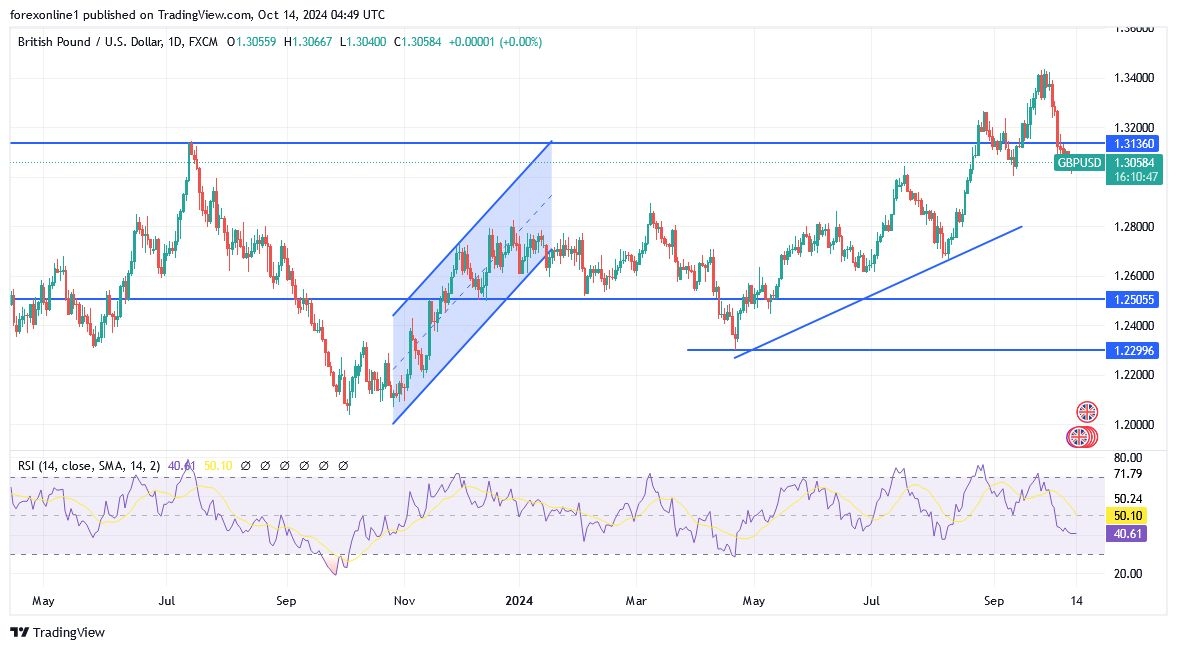
  • We anticipate further losses for the GBP/USD pair this week, but we believe the decline will be limited to the 1.3036 support level.
  • Currently, the GBP/USD is trading around 1.3075 at the time of writing this analysis.
  • Overall, it’s a busy few day for the GBP/USD exchange rate, as an important UK jobs report and US inflation figures are due to be released, both of which will guide the outcome of decisions at the Bank of England and the US Federal Reserve later in September.

Facing the economic calendar risks, the pound is under short-term pressure against the dollar. The GBP/USD pair fell below the important psychological level of 1.31 on Monday, as the strong sell-off we witnessed on Friday extended into the new week. This move is driven by an adjustment in expectations for US interest rate cuts by the Federal Reserve, as the market has lowered the probability of a 50 basis point US interest rate cut on September 18, now favouring a more traditional 25 basis point move.

Overall, the extent of the sell-off will be determined first and foremost by how long the US interest rate outlook continues to be revised. The market entered September with high hopes for a rapid and aggressive easing cycle from the Fed, but the reality has become clear that the US economy is too healthy to warrant such an easing in policy expectations.

Technical forecasts for the GBP/USD pair today:

The net result is a stronger dollar, and the immediate support for the resulting weakness in the GBP/USD pair is now at 1.3087, a horizontal graphical support from which the GBP/USD pair rebounded last week. As we have seen it come into play in late August, there is a chance for some buyers to intervene here.

However, we are looking at a lower level at 1.3036 as a more important support area, as this level represents a 23.6% Fibonacci retracement of the significant rally we saw from April to August. Furthermore, we note that Fibonacci retracement lines in this broader multi-month move have a degree of predictive power, and we will add them to our toolkit as a result. Note that upon reaching the 1.3036 level, the best price for the dollar for individual buyers will start to slip to the 1.29 level.

The pound is likely to dominate the proceedings on Tuesday with the release of UK jobs and wages figures. The market expects employment to rise by 84,000 jobs in the three months to July, with an unemployment rate of 4.1%. However, UK jobs figures will be of greater importance for the pound, as this is what the Bank of England will be watching closely. The bank is not expected to cut rates again, but there is some debate about whether it will move again in October and November.

Overall, weaker-than-expected wage data could strengthen the chances of a rate cut in October, which would negatively impact the pound. Average earnings are expected to rise by 4.1% in the three months to July, down from 4.5%. Wage pressures have eased, but some economists are concerned that they are not falling fast enough. If this is the case, the data could beat expectations and reduce the chances of a rate cut in October, which could strengthen the pound against the euro and other currencies. According to analysts, “Another decline in nominal wages could ease inflation concerns in the UK and allow the Bank of England to cut rates later this year, although we still expect them to cut rates at a slower pace than the European Central Bank and the Federal Reserve.”

Tomorrow, Wednesday, will see the release of the UK’s GDP figures for July, with the market expecting a 0.2% growth, up from the flat 0% growth in the previous month. Theoretically, the GDP figure ranks second after the wage data release, but any significant surprises (more than 0.2%) could shake the market, potentially weakening the British pound in case of any disappointments and strengthening it in the event of any unexpected growth.

The biggest release of the day is the US monthly inflation report, due at 13:30 GMT, and given the importance of global drivers, this could end up being the highlight of the week for sterling exchange rates. If US inflation comes in below expectations, market expectations of a 50bp rate cut by the Fed on September 18 will increase, boosting equity markets and supporting sterling against the euro.

However, if the data comes in stronger, expect more selling pressure, as the odds of a 50-basis point cut will be erased, potentially putting further pressure on stocks and the British pound.

Last week, we heard from an influential member of the Federal Reserve’s rate-setting committee that, while U.S. rate cuts are necessary, the path forward remains data-dependent. Consequently, markets interpreted this as a sign that the Fed isn’t concerned enough to pursue a 50-basis point cut and would prefer sticking to more traditional 25 basis point adjustments. This view could shift if inflation numbers exceed expectations, increasing the likelihood of another strong week for the U.S. dollar.

Analysts also note that September is historically a month when global stocks decline, which could keep the pound under pressure in the coming three weeks, in line with this adjustment. However, we believe that supportive UK rate expectations could limit the downside for the GBP/USD pair, and we still view any weakness as part of a larger cyclical trend toward appreciation, which will eventually return.

Ready to trade our Forex daily analysis and predictions? Here are the best forex trading platforms UK to choose from. 

Source link

10 09, 2024

JPY Weak as USD Gains (Chart)

By |2024-09-10T15:06:28+03:00September 10, 2024|Forex News, News|0 Comments

  • At the beginning of this week, the Japanese yen declined to 143.79 against the US dollar, cutting short a recent upward trend as the US dollar gained some ground amid continued uncertainty about the extent of the expected interest rate cut by the Federal Reserve later this month.
  • The latest monthly US jobs report did not provide much clarity on the path of interest rates, while traders await key US inflation data this week.
  • At the same time, the Japanese yen rose by about 3% last week and reached its highest level since the beginning of the year amid bets that the Bank of Japan will raise interest rates further amid strong growth, rising wages, and continued inflationary pressures.

Analogously, bank of Japan policymakers indicated that they would adjust monetary settings further if their economic and price outlooks materialize. On the economic data front, final figures showed that Japan’s economy grew at an annual rate of 2.9% in the second quarter, below the previous figure of 3.1% and market expectations of 3.2%.

According to stock trading platforms, Japan’s Nikkei Index falls to its lowest level in a month. According to trading, the Nikkei 225 index of Japanese shares fell by 0.48% to close at 36,216 points, while the broader TOPIX index lost 0.68% to close at 2,580 points on Monday, settling at its lowest levels in more than three weeks, as technology stocks led the decline. Consequently, Japanese stocks followed a sharp sell-off in Wall Street markets on Friday as weak US jobs data raised concerns about the health of the world’s largest economy.

Meanwhile, final data showed that Japan’s economy grew at an annual rate of 2.9% in the second quarter, below the previous figure of 3.1% and the consensus forecast of 3.2%. However, strong growth, rising wages and persistent inflationary pressures continue to support bets that the Bank of Japan will raise interest rates further. According to trading platforms, losses in technology stocks were led by Tokyo Electron (-2.3%), Disco Corp (-3.1%) and Renesas Electronics (-3.1%). Other major constituents in the index also posted notable declines, including Mitsubishi Heavy Industries (-2.3%), Mitsubishi UFJ (-2.3%) and Toyota Motor (-3.2%).

USD/JPY Technical Analysis and Expectations Today:

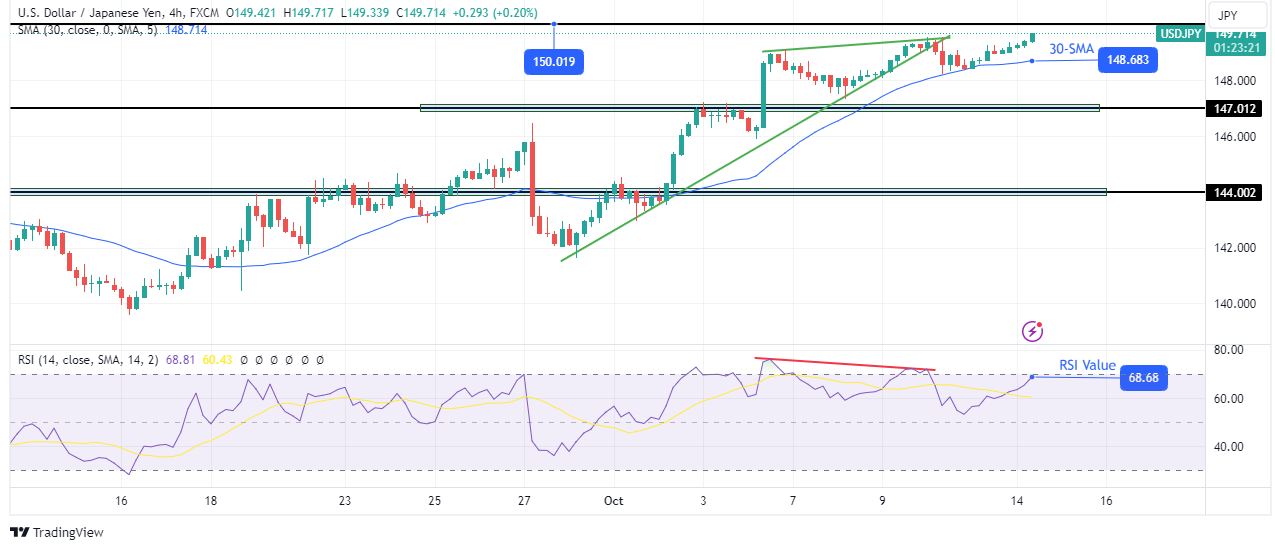
USD/JPY has been trending lower in the past few days, but support around 142.00 appears to be holding. A pullback to Fibonacci levels close to here could follow. Meanwhile, the 38.2% Fibonacci retracement level is at 143.88, followed by the 50% level at 144.51. also, the larger correction could reach the 61.8% level at 145.15 near the downtrend line that has held since August and the 100 SMA resistance.

As for the moving averages, the 100 SMA is below the 200 SMA suggesting that the stronger resistance path is to the downside or that the sell-off is likely to gain more strength than a reversal. However, the gap between the indicators is narrowing to reflect the weakening downward pressure and a potential bullish crossover. If the latter happens, the USD/JPY pair could attempt to break above the trend line and go for a reversal on the downside. Stochastic is after all signalling oversold conditions, and is turning higher to reflect the recovery of bullish momentum. Similarly, the RSI is moving higher, so the price could follow suit as bulls regain control. Both oscillators have plenty of room to run before signalling exhaustion among buyers.

Overall, the USD/JPY pair is likely to take cues from this week’s US inflation reports, especially the CPI release which could feature a decline in annual inflation. A weaker-than-expected result could increase the chances of a 0.5% Fed rate cut in September, which could drag the dollar lower further. On the other hand, strong data could dampen hopes of a Fed rate cut, which could lift the greenback. Nevertheless, it is worth noting that data out of Japan was mostly positive last week while the Bank of Japan’s rhetoric turned hawkish, which led to strong gains for the JPY. Finally, there are no major reports out of Japan this week.

Ready to trade our daily forex forecast? Here are the best forex brokers in Japan to choose from. 

Source link

10 09, 2024

Euro shows no signs of a rebound

By |2024-09-10T13:06:10+03:00September 10, 2024|Forex News, News|0 Comments

  • EUR/USD seems to have entered a consolidation phase near 1.1050.
  • The technical outlook doesn’t yet suggest that the pair is looking to recover.
  • The US economic calendar will not feature any high-tier data releases.

After ending the previous week on a bearish note, EUR/USD remained under bearish pressure and closed in negative territory on Monday. The pair holds steady at around 1.1050 early Tuesday as investors move to the sidelines ahead of this week’s key events.

Euro PRICE This week

The table below shows the percentage change of Euro (EUR) against listed major currencies this week. Euro was the weakest against the US Dollar.

  USD EUR GBP JPY CAD AUD NZD CHF
USD   0.44% 0.30% 0.90% 0.04% 0.16% 0.39% 0.47%
EUR -0.44%   -0.19% 0.52% -0.39% -0.33% -0.03% 0.01%
GBP -0.30% 0.19%   0.58% -0.20% -0.14% 0.14% 0.20%
JPY -0.90% -0.52% -0.58%   -0.85% -0.72% -0.52% -0.23%
CAD -0.04% 0.39% 0.20% 0.85%   0.16% 0.33% 0.59%
AUD -0.16% 0.33% 0.14% 0.72% -0.16%   0.28% 0.31%
NZD -0.39% 0.03% -0.14% 0.52% -0.33% -0.28%   0.07%
CHF -0.47% -0.01% -0.20% 0.23% -0.59% -0.31% -0.07%  

The heat map shows percentage changes of major currencies against each other. The base currency is picked from the left column, while the quote currency is picked from the top row. For example, if you pick the Euro from the left column and move along the horizontal line to the US Dollar, the percentage change displayed in the box will represent EUR (base)/USD (quote).

Rising US Treasury bond yields helped the US Dollar outperform its rivals in the first half of the day on Monday. Although the improving risk mood limited the USD’s gains in the American session, EUR/USD still lost nearly 0.5% on a daily basis.

The US economic calendar will not feature any macroeconomic data releases that could influence the USD’s valuation on Tuesday. Hence, investors could remain focused on risk perception. At the time of press, US stock index futures were trading little changed on the day. In case safe-haven flows return to markets ahead of the Presidential Debate, EUR/USD could have a difficult time holding its ground.

Nevertheless, investors could refrain from taking large positions while waiting for the Consumer Price Index data from the US and the European Central Bank’s (ECB) policy announcements later in the week.

EUR/USD Technical Analysis

The Relative Strength Index (RSI) indicator on the 4-hour chart stays below 40 and EUR/USD trades well below the 20, 50 and the 100-period Simple Moving Averages (SMA). 

The Fibonacci 38.2% retracement of the latest uptrend aligns as immediate support at 1.1040. If this support fails, 1.1000-1.0990 (Fibonacci 50% retracement, psychological level, 200-period SMA) could be seen as next bearish target before 1.0940 (Fibonacci 61.8% retracement).

On the upside, first resistance is located at 1.1070 (20-period SMA, 50-period SMA) before 1.1100 (Fibonacci 23.6% retracement, 100-period SMA) and 1.1160 (static level).

Euro FAQs

The Euro is the currency for the 20 European Union countries that belong to the Eurozone. It is the second most heavily traded currency in the world behind the US Dollar. In 2022, it accounted for 31% of all foreign exchange transactions, with an average daily turnover of over $2.2 trillion a day. EUR/USD is the most heavily traded currency pair in the world, accounting for an estimated 30% off all transactions, followed by EUR/JPY (4%), EUR/GBP (3%) and EUR/AUD (2%).

The European Central Bank (ECB) in Frankfurt, Germany, is the reserve bank for the Eurozone. The ECB sets interest rates and manages monetary policy. The ECB’s primary mandate is to maintain price stability, which means either controlling inflation or stimulating growth. Its primary tool is the raising or lowering of interest rates. Relatively high interest rates – or the expectation of higher rates – will usually benefit the Euro and vice versa. The ECB Governing Council makes monetary policy decisions at meetings held eight times a year. Decisions are made by heads of the Eurozone national banks and six permanent members, including the President of the ECB, Christine Lagarde.

Eurozone inflation data, measured by the Harmonized Index of Consumer Prices (HICP), is an important econometric for the Euro. If inflation rises more than expected, especially if above the ECB’s 2% target, it obliges the ECB to raise interest rates to bring it back under control. Relatively high interest rates compared to its counterparts will usually benefit the Euro, as it makes the region more attractive as a place for global investors to park their money.

Data releases gauge the health of the economy and can impact on the Euro. Indicators such as GDP, Manufacturing and Services PMIs, employment, and consumer sentiment surveys can all influence the direction of the single currency. A strong economy is good for the Euro. Not only does it attract more foreign investment but it may encourage the ECB to put up interest rates, which will directly strengthen the Euro. Otherwise, if economic data is weak, the Euro is likely to fall. Economic data for the four largest economies in the euro area (Germany, France, Italy and Spain) are especially significant, as they account for 75% of the Eurozone’s economy.

Another significant data release for the Euro is the Trade Balance. This indicator measures the difference between what a country earns from its exports and what it spends on imports over a given period. If a country produces highly sought after exports then its currency will gain in value purely from the extra demand created from foreign buyers seeking to purchase these goods. Therefore, a positive net Trade Balance strengthens a currency and vice versa for a negative balance.


Source link

10 09, 2024

GBP/USD Forecast Today 09/09: Selloff After Rally (Video)

By |2024-09-10T09:03:45+03:00September 10, 2024|Forex News, News|0 Comments

(MENAFN– Daily Forex)

  • You can see that the British pound initially rallied during the trading session on Friday, but then collapsed quite significantly to show extreme signs of weakness.

  • At this point in time, the market is likely to continue to see a lot of uncertainty.

  • With the jobs number in the United States coming out weaker than anticipated, that has people worried about the global growth situation. And of course, whether or not the trader is going to continue to chase risk, or will they run into something like the US bond market in order to protect their wealth?

That is a very real possibility, but we’ll have to wait and see how that plays out. Keep in mind, this is a market that has been very, uh, bullish for some time. And we are now consolidating quite drastically. This suggests that the market will more likely than not continue to see the dips as potential buying opportunities, but if we really start to see panic take over the market, the US dollar is almost always a big winner.Top Forex Brokers1 Get Started 74% of retail CFD accounts lose money A breakdown below the 1.3050 level opens up the possibility of a move down to the 1.30 level and then the 50 day EMA. In general, this is a market that I think continues to be very noisy and no matter what happens next, it is going to be a choppy affair. If we were to break above the 1.3250 level, then the 1.35 level could end up being a target, which being a psychologically important large figure, it also could end up being a ceiling. We will wait to see if that ends up being the case, and as a result, I think this is a market that will remain volatile, but over the next few weeks, we should get a bit of clarity if the Federal Reserve can do its job of conveying their plans to the marketplace.Ready to trade our GBP/USD daily analysis and predictions? Here are the best forex trading platforms UK to choose from.

MENAFN09092024000131011023ID1108653819


Daily Forex


Legal Disclaimer:
MENAFN provides the information “as is” without warranty of any kind. We do not accept any responsibility or liability for the accuracy, content, images, videos, licenses, completeness, legality, or reliability of the information contained in this article. If you have any complaints or copyright issues related to this article, kindly contact the provider above.

Source link

10 09, 2024

GBP/USD Analysis Today 09/09: Neutral Upward Bias (Chart)

By |2024-09-10T00:59:27+03:00September 10, 2024|Forex News, News|0 Comments

  • During last Friday’s trading session, the US dollar fell and then recovered after the release of the weaker-than-expected US Labor market report.
  • According to licensed trading platforms, the GBP/USD exchange rate recovered to 1.3230 from 1.3170 after the US non-farm payrolls data came in below expectations at 160,000 jobs after falling to 142,000 jobs in August.
  • The pair then fell again to fall below 1.32, perhaps due to a speech from John Williams of the Federal Reserve, which did not include a clear commitment to cut US interest rates by 50 basis points later this month.

Williams said that the time had come for a US interest rate cut, but market expectations of a large 50 basis point move faded as he showed no inclination for such an aggressive initial cut. In addition, the US non-farm payrolls numbers were not significantly below expectations and remained above 114K in July. Additionally, the unemployment rate fell to 4.2% from 4.3%, which was expected. Also shining on the positive side for the US dollar was the stronger-than-expected earnings data of 0.44% on a monthly basis, which was stronger than the expected reading of 0.3%.

Widely, Hurricane Beryl is believed to have tarnished the picture in July, which is why the smoothing of the data on a three-month basis provides a good glimpse into the direction of the Labor market. The three-month rolling average has now fallen to 116K from 146K, confirming a clear trend of weakness.

According to Forex trading, the US dollar’s ​​reaction after the payrolls is likely to be limited to recent ranges as there is not enough evidence in this report to clearly indicate whether the Fed will raise US interest rates by 50 or 25 basis points, ensuring that an element of uncertainty remains.

Overall, the US inflation report this week will provide more guidance for the markets, but it should be noted that the US Federal Reserve has shifted its focus from inflation to employment, believing that higher prices are eventually expected to decline further in the coming months. The Fed will be concerned about rising unemployment if it does not take action, but the debate now is over how strong the opening strike will be.

Concurrently, the Fed is expected to cut US interest rates by a total of 100 basis points this year, meaning at least one of the remaining meetings will see a 50-basis point rate cut. If that happens, the US dollar could continue to fall as US interest rates converge with those in other parts of the world.

An analysis from Bank of America says: “With the US 10-year Treasury yield trending lower after the first Fed cut, global financial conditions are set to improve further. The US dollar could see further weakness as other central banks, especially those that cut rates before the Fed, are now able to let the Fed do some of its work.”

On the stock exchanges front, the FTSE 100 failed to recover and closed down about 0.7% at 8,181.5 on Friday, its lowest level in nearly a month, extending losses to a sixth straight session. Meanwhile, the performance came as global traders reassessed the latest US jobs report, which pointed to continued slowdown in the Labor market, reinforcing expectations of an imminent interest rate cut by the Federal Reserve. However, uncertainty persisted over the scope of the potential cut. Locally, figures from Halifax showed that UK house prices rose to a two-year high in August as confidence rebounded amid easing interest rates. Among individual stocks, Vestry Group shares hit the bottom of the index, down 6.3% after UBS analysts stuck to a “sell” rating on the housebuilder despite positive results on Thursday. Burberry shares lost more than 5% ahead of their imminent FTSE 100 plunge. Also, industrial mining shares fell on the back of lower copper and iron ore prices.

For the week, the FTSE 100 index of UK shares fell 2.3%.

Technical forecasts for the GBP/USD pair today:

The GBP/USD price is trying hard to avoid collapsing to the psychological support level of 1.3000 so that the current bullish hopes do not evaporate. Technically, this is the most prominent level on the daily chart below and the GBP/USD price may remain in the current performance area until the financial markets and investors react to the announcement of the US inflation figures. Obviously, this latest economic data that will determine the fate of the US Federal Reserve’s decision in the coming days. In contrast, the resistance of 1.3250 remains the most important for the strength of bulls’ control. At the same time technical indicators are moving towards strong overbought levels.

Ready to trade our daily Forex analysis? We’ve made this UK forex brokers list for you to check out. 

Source link

Go to Top