The main tag of Forex News Today Articles.
You can use the search box below to find what you need.
[wd_asp id=1]

24 06, 2024

Eyes on Support Levels (Chart)

By |2024-06-24T18:14:18+03:00June 24, 2024|Forex News, News|0 Comments

  • At the end of last week’s trading, the latest UK data recorded a strong rebound in retail sales for May, but the pound struggled to make significant headway in global markets.
  • According to trading, the pound against the dollar (GBP/USD) exchange rate fell to a 6-week low overnight before recovering slightly to 1.2665 after the data.
  • In the same performance, the pound against the euro (GBP/EUR) exchange rate also approached a one-week low at 1.1820.

According to the results of the economic calendar, UK sales volumes jumped by 2.9% in May after a revised 1.8% decline in April, which was originally reported as a 2.3% decline. Clearly, this was much stronger than the consensus forecast for a 1.6% increase. On the other hand, Sales rose 1.0% in the three months to May compared with the previous three months. Sales in April were hurt by bad weather conditions and there were more favorable conditions in May, which helped to spur a recovery. There was a 1.3% annual increase in sales compared with a previous 2.3% decline, but sales are still slightly below pre-pandemic levels.

Non-food store sales volumes jumped 3.5% during the month, the biggest increase since April 2021.

Elsewhere, the latest UK consumer confidence index also improved to -14 for June from -17 the previous month, which was the strongest reading since December 2021.

The Bank of England has hinted that more officials may be moving closer to supporting interest rate cuts, keeping alive hopes of policy easing by the end of the summer. Last week, the Bank of England kept its main lending rate at a 16-year high of 5.25%. But the minutes of the meeting said the decision not to cut rates was “finely balanced” for some of the nine members of the Monetary Policy Committee.

Investors had been pricing in a greater than 50% chance of a BoE move in August, the first time in more than a month they were certain. Moreover, Governor Andrew Bailey said inflation falling to its 2% target for the first time in nearly three years was “good news,” but officials wanted to make sure the pressure on prices had eased before acting.

What’s next for the pound versus the dollar?

The pound is set to weaken against the dollar to levels last seen in May, according to new analysis. ING forex analysts say the BoE will cut rates by a larger margin in 2024 than markets are currently pricing in, which will weigh on sterling. The main focus of sterling weakness will be against the dollar, as the US Federal Reserve is in no position to match the Bank of England’s rate cuts. Francesco Bisol, FX strategist at ING said, “We expect most of the sterling weakness to be channeled through GBP/USD, which we expect to trade back below 1.25,”.

Technical forecasts for the GBP/USD pair today:

The US dollar has had a quiet week, but “cautious” developments in Europe have helped it maintain its upward momentum. It has gained a third of a percent against the pound over the past week, looking set to post its third straight weekly advance. Also, it is outperforming the euro.

“The US dollar looks set to end the week on a higher note, extending its winning streak into a third week,” said analysts at XM.com. furthermore, the signs of a slowdown in inflationary pressures and the broader economy have boosted expectations that the US Federal Reserve may be able to deliver two rate cuts after all in 2024, with the first expected in September, other central banks appear to be ahead in the race to ease policy.”

Recently, the pound fell after the Bank of England left interest rates unchanged on Thursday but issued a statement saying a number of its Monetary Policy Committee members were close to voting for a cut. Clearly, this has led markets to raise their expectations for a rate cut in August. Moreover, ING adds that it expects three rate cuts in 2024 starting in August. This is more pessimistic than the two cuts that the market has priced in.

Currently, financial markets price in a cut of around 65% in August and are seeing two 25bp cuts this year. According to analysts, central banks in Europe are far ahead of the Federal Reserve in terms of interest rate cuts, which is a positive development for the US dollar, but we doubt that there is enough to push the dollar down significantly at this stage.”

Ready to trade our daily Forex forecast? Here’s a list of some of the top forex brokers UK to check out. 

Source link

24 06, 2024

Boj Minutes Suggest A July Rate Hike Is Not Out Of The Question, Yen Unchanged

By |2024-06-24T16:13:18+03:00June 24, 2024|Forex News, News|0 Comments

Date


(MENAFN– DailyFX) uggest a July Rate Hike is not out of the Question, Yen Unchanged

Skip to Conten

News & Analysis at your fingertips.

MENAFN24062024000076011015ID1108365248


DailyFX


Legal Disclaimer:
MENAFN provides the information “as is” without warranty of any kind. We do not accept any responsibility or liability for the accuracy, content, images, videos, licenses, completeness, legality, or reliability of the information contained in this article. If you have any complaints or copyright issues related to this article, kindly contact the provider above.

Source link

24 06, 2024

Euro holds above key support, struggles to gather momentum

By |2024-06-24T14:12:15+03:00June 24, 2024|Forex News, News|0 Comments

You have reached your limit of 5 free articles for this month.

Get Premium without limits for only $479.76 for the first month

Access all our articles, insights, and analysts.

Your coupon code


UNLOCK OFFER

  • EUR/USD fluctuates above 1.0700 to start the new week.
  • The technical outlook doesn’t yet point to a buildup of recovery momentum.
  • The data from Germany showed that business morale weakened in June.

After closing the previous week marginally lower, EUR/USD edges higher and trades above 1.0700 in the European session on Monday. The technical outlook doesn’t yet point to a buildup of recovery momentum but the improving risk mood could help the pair stretch higher in the second half of the day.

Euro PRICE Last 7 days

The table below shows the percentage change of Euro (EUR) against listed major currencies last 7 days. Euro was the weakest against the Australian Dollar.

  USD EUR GBP JPY CAD AUD NZD CHF
USD   -0.10% 0.19% 1.50% -0.50% -0.60% 0.08% 0.36%
EUR 0.10%   0.32% 1.64% -0.39% -0.59% 0.23% 0.47%
GBP -0.19% -0.32%   1.40% -0.71% -0.92% -0.13% 0.18%
JPY -1.50% -1.64% -1.40%   -1.89% -2.09% -1.28% -1.08%
CAD 0.50% 0.39% 0.71% 1.89%   -0.17% 0.57% 0.89%
AUD 0.60% 0.59% 0.92% 2.09% 0.17%   0.88% 1.10%
NZD -0.08% -0.23% 0.13% 1.28% -0.57% -0.88%   0.30%
CHF -0.36% -0.47% -0.18% 1.08% -0.89% -1.10% -0.30%  

The heat map shows percentage changes of major currencies against each other. The base currency is picked from the left column, while the quote currency is picked from the top row. For example, if you pick the Euro from the left column and move along the horizontal line to the US Dollar, the percentage change displayed in the box will represent EUR (base)/USD (quote).

The PMI data from the US showed on Friday that the business activity continued to expand at a robust pace in June, helping the US Dollar (USD) preserve its strength ahead of the weekend and not allowing EUR/USD to gain traction.

Early Monday, Germany’s Ifo Institute reported that the Business Climate Index declined to 88.6 in June from 89.3 in May. This reading came in weaker than the market expectation of 89.7 but failed to trigger a noticeable market reaction.

The US economic docket will not feature any high-tier data releases that could drive the USD’s valuation in the second half of the day. Hence, investors are likely to react to changes in risk perception.

In the European session, US stock index futures gain above 0.2%. A bullish opening in Wall Street could make it difficult for the USD to find demand and help EUR/USD to extend its rebound.

EUR/USD Technical Analysis

The Relative Strength Index (RSI) indicator on the 4-hour chart recovers to 50, reflecting sellers’ hesitancy. On the upside, 1.0730-1.0740 (Fibonacci 61.8% retracement of the latest uptrend, 50-period Simple Moving Average) aligns as immediate resistance before 1.0760 (Fibonacci 50% retracement) and 1.0785 (100-period SMA).

On the downside, 1.0670 (Fibonacci 78.6% retracement) stays intact as key support level.  If EUR/USD falls below that level and starts using it as resistance, 1.0600 (static level) could be seen as next support.

Euro FAQs

The Euro is the currency for the 20 European Union countries that belong to the Eurozone. It is the second most heavily traded currency in the world behind the US Dollar. In 2022, it accounted for 31% of all foreign exchange transactions, with an average daily turnover of over $2.2 trillion a day. EUR/USD is the most heavily traded currency pair in the world, accounting for an estimated 30% off all transactions, followed by EUR/JPY (4%), EUR/GBP (3%) and EUR/AUD (2%).

The European Central Bank (ECB) in Frankfurt, Germany, is the reserve bank for the Eurozone. The ECB sets interest rates and manages monetary policy. The ECB’s primary mandate is to maintain price stability, which means either controlling inflation or stimulating growth. Its primary tool is the raising or lowering of interest rates. Relatively high interest rates – or the expectation of higher rates – will usually benefit the Euro and vice versa. The ECB Governing Council makes monetary policy decisions at meetings held eight times a year. Decisions are made by heads of the Eurozone national banks and six permanent members, including the President of the ECB, Christine Lagarde.

Eurozone inflation data, measured by the Harmonized Index of Consumer Prices (HICP), is an important econometric for the Euro. If inflation rises more than expected, especially if above the ECB’s 2% target, it obliges the ECB to raise interest rates to bring it back under control. Relatively high interest rates compared to its counterparts will usually benefit the Euro, as it makes the region more attractive as a place for global investors to park their money.

Data releases gauge the health of the economy and can impact on the Euro. Indicators such as GDP, Manufacturing and Services PMIs, employment, and consumer sentiment surveys can all influence the direction of the single currency. A strong economy is good for the Euro. Not only does it attract more foreign investment but it may encourage the ECB to put up interest rates, which will directly strengthen the Euro. Otherwise, if economic data is weak, the Euro is likely to fall. Economic data for the four largest economies in the euro area (Germany, France, Italy and Spain) are especially significant, as they account for 75% of the Eurozone’s economy.

Another significant data release for the Euro is the Trade Balance. This indicator measures the difference between what a country earns from its exports and what it spends on imports over a given period. If a country produces highly sought after exports then its currency will gain in value purely from the extra demand created from foreign buyers seeking to purchase these goods. Therefore, a positive net Trade Balance strengthens a currency and vice versa for a negative balance.


  • EUR/USD fluctuates above 1.0700 to start the new week.
  • The technical outlook doesn’t yet point to a buildup of recovery momentum.
  • The data from Germany showed that business morale weakened in June.

After closing the previous week marginally lower, EUR/USD edges higher and trades above 1.0700 in the European session on Monday. The technical outlook doesn’t yet point to a buildup of recovery momentum but the improving risk mood could help the pair stretch higher in the second half of the day.

Euro PRICE Last 7 days

The table below shows the percentage change of Euro (EUR) against listed major currencies last 7 days. Euro was the weakest against the Australian Dollar.

  USD EUR GBP JPY CAD AUD NZD CHF
USD   -0.10% 0.19% 1.50% -0.50% -0.60% 0.08% 0.36%
EUR 0.10%   0.32% 1.64% -0.39% -0.59% 0.23% 0.47%
GBP -0.19% -0.32%   1.40% -0.71% -0.92% -0.13% 0.18%
JPY -1.50% -1.64% -1.40%   -1.89% -2.09% -1.28% -1.08%
CAD 0.50% 0.39% 0.71% 1.89%   -0.17% 0.57% 0.89%
AUD 0.60% 0.59% 0.92% 2.09% 0.17%   0.88% 1.10%
NZD -0.08% -0.23% 0.13% 1.28% -0.57% -0.88%   0.30%
CHF -0.36% -0.47% -0.18% 1.08% -0.89% -1.10% -0.30%  

The heat map shows percentage changes of major currencies against each other. The base currency is picked from the left column, while the quote currency is picked from the top row. For example, if you pick the Euro from the left column and move along the horizontal line to the US Dollar, the percentage change displayed in the box will represent EUR (base)/USD (quote).

The PMI data from the US showed on Friday that the business activity continued to expand at a robust pace in June, helping the US Dollar (USD) preserve its strength ahead of the weekend and not allowing EUR/USD to gain traction.

Early Monday, Germany’s Ifo Institute reported that the Business Climate Index declined to 88.6 in June from 89.3 in May. This reading came in weaker than the market expectation of 89.7 but failed to trigger a noticeable market reaction.

The US economic docket will not feature any high-tier data releases that could drive the USD’s valuation in the second half of the day. Hence, investors are likely to react to changes in risk perception.

In the European session, US stock index futures gain above 0.2%. A bullish opening in Wall Street could make it difficult for the USD to find demand and help EUR/USD to extend its rebound.

EUR/USD Technical Analysis

The Relative Strength Index (RSI) indicator on the 4-hour chart recovers to 50, reflecting sellers’ hesitancy. On the upside, 1.0730-1.0740 (Fibonacci 61.8% retracement of the latest uptrend, 50-period Simple Moving Average) aligns as immediate resistance before 1.0760 (Fibonacci 50% retracement) and 1.0785 (100-period SMA).

On the downside, 1.0670 (Fibonacci 78.6% retracement) stays intact as key support level.  If EUR/USD falls below that level and starts using it as resistance, 1.0600 (static level) could be seen as next support.

Euro FAQs

The Euro is the currency for the 20 European Union countries that belong to the Eurozone. It is the second most heavily traded currency in the world behind the US Dollar. In 2022, it accounted for 31% of all foreign exchange transactions, with an average daily turnover of over $2.2 trillion a day. EUR/USD is the most heavily traded currency pair in the world, accounting for an estimated 30% off all transactions, followed by EUR/JPY (4%), EUR/GBP (3%) and EUR/AUD (2%).

The European Central Bank (ECB) in Frankfurt, Germany, is the reserve bank for the Eurozone. The ECB sets interest rates and manages monetary policy. The ECB’s primary mandate is to maintain price stability, which means either controlling inflation or stimulating growth. Its primary tool is the raising or lowering of interest rates. Relatively high interest rates – or the expectation of higher rates – will usually benefit the Euro and vice versa. The ECB Governing Council makes monetary policy decisions at meetings held eight times a year. Decisions are made by heads of the Eurozone national banks and six permanent members, including the President of the ECB, Christine Lagarde.

Eurozone inflation data, measured by the Harmonized Index of Consumer Prices (HICP), is an important econometric for the Euro. If inflation rises more than expected, especially if above the ECB’s 2% target, it obliges the ECB to raise interest rates to bring it back under control. Relatively high interest rates compared to its counterparts will usually benefit the Euro, as it makes the region more attractive as a place for global investors to park their money.

Data releases gauge the health of the economy and can impact on the Euro. Indicators such as GDP, Manufacturing and Services PMIs, employment, and consumer sentiment surveys can all influence the direction of the single currency. A strong economy is good for the Euro. Not only does it attract more foreign investment but it may encourage the ECB to put up interest rates, which will directly strengthen the Euro. Otherwise, if economic data is weak, the Euro is likely to fall. Economic data for the four largest economies in the euro area (Germany, France, Italy and Spain) are especially significant, as they account for 75% of the Eurozone’s economy.

Another significant data release for the Euro is the Trade Balance. This indicator measures the difference between what a country earns from its exports and what it spends on imports over a given period. If a country produces highly sought after exports then its currency will gain in value purely from the extra demand created from foreign buyers seeking to purchase these goods. Therefore, a positive net Trade Balance strengthens a currency and vice versa for a negative balance.


Source link

24 06, 2024

EUR/USD, GBP/USD, DXY Forecast: DXY at 105.80; EUR, GBP to Trade Bullish Today?

By |2024-06-24T12:10:25+03:00June 24, 2024|Forex News, News|0 Comments

EUR/USD is trading at $1.07127, up 0.03%. The pivot point is $1.07109, marked by the green line. Immediate resistance levels are at $1.07381, $1.07597, and $1.07817, suggesting potential upward movement.

On the downside, immediate support is found at $1.06865, with further support at $1.06678 and $1.06479. The 50-day Exponential Moving Average (EMA) stands at $1.07342, while the 200-day EMA is at $1.07802.

These technical indicators suggest a bullish outlook above $1.07109. However, a break below this level could trigger a sharp selling trend.

GBP/USD Technical Forecast

Source link

24 06, 2024

Pound to Dollar 12-Month Outlook: GBP/USD Exchange Rate to Weaken to 1.18

By |2024-06-24T06:06:07+03:00June 24, 2024|Forex News, News|0 Comments

June 23, 2024 – Written by Frank Davies

Danske Bank forecasts that the Pound to Dollar (GBP/USD) exchange rate will weaken to 1.18 on a 12-month view.

Bank of America is still forecasting gains to 1.33 at the end of 2024.

GBP/USD lost ground during the week with a slide to 5-week lows close to 1.2620 as European currencies struggled while the Bank of England moved closer to an interest rate cut.

The Bank of England held interest rates at 5.25% at the latest meeting which was in line with consensus forecasts.

There was another 7-2 vote for the decision as Dhingra and Ramsden voted to cut rates by 25 basis points to 5.00%.

There was, however, a significant element of division within the majority that voted for unchanged rates.

It suggested that four members were still concerned over inflation trends, but three members were more confident that deflation trends remained on track and considered that the decision this month was finely balanced.

Advertisement


ING commented; “we read the minutes as slightly bearish for the pound as it raises expectations we could hear from the BoE dovish elements once the 4 July general election has passed.” According to Rabobank; “The central bank appears to be preparing the markets for a first rate cut in August, which continues to be our base case. We have, however, removed a subsequent September cut from our forecasts. This follows yesterday’s services inflation data. Services inflation remains a concern, and whether it is diminishing or persistent is largely a matter of judgment, with notable differences of opinion within the MPC.”

It added; “Governor Bailey didn’t add additional colour to this meeting outcome and the pre-election purdah means we will hear nothing from members until after July 4.”

Danske Bank commented; “Before the next meeting on 1 August, we get a limited amount of data. Namely one jobs report for May/June and the inflation report for June.

It added; “We expect the data releases to show further signs easing inflationary pressures and wage growth to level off, leaving the BoE comfortable enough to opt for a rate cut at the August meeting. Risks are however to a later start to the cutting cycle if we get a topside surprise to especially service inflation.”

According to ING; “the risks of sterling weakness emerging over coming months should largely be witnessed in GBP/USD, which we expect to trade back under 1.25.”

There were also still reservations over medium-term UK fiscal trends.

For the first two months of fiscal 2024/25, the budget deficit increased to £33.5bn from £33.1bn the previous year with the debt/GDP ratio increasing to 99.8%.

According to Danske Bank; “Regardless of the election outcome, fiscal policy is likely to remain constrained and we expect the market reaction to be muted in our base case of a Labour majority. However, closer ties to the EU, policies aimed at boosting growth and the supply side of the economy, less policy uncertainty are on balance GBP positive although we do not want to overstate the impact.

The latest US data was mixed with weaker than expected retail sales data offset by a stronger than expected PMI business confidence data.

There was evidence of a weaker labour market with jobless claims remaining at elevated levels.

Inflation trends will be very important for the Federal Reserve and market expectations surrounding interest rates.

Nordea does not think that the inflation data will co-operate; “We think that the soft May US CPI print was mainly an outlier and continue to expect that it will take time for the incoming data to persuade the Fed to cut rates.”

It added; “We have for some time argued that inflation is heading lower, but that it would be a slow and bumpy process. It will probably take until December before the central bank is convinced that the price problem has been solved.”

Although Danske expects Fed rate cuts, it expects weaker risk appetite will undermine the Pound.

Like this piece? Please share with your friends and colleagues:


International Money Transfer? Ask our resident FX expert a money transfer question or try John’s new, free, no-obligation personal service! ,where he helps every step of the way,
ensuring you get the best exchange rates on your currency requirements.

TAGS: Pound Dollar Forecasts

Source link

24 06, 2024

Weekly Forex Forecast – 23/06 (Charts)

By |2024-06-24T04:05:17+03:00June 24, 2024|Forex News, News|0 Comments

I wrote on 16th June that the best trade opportunities for the week were likely to be:

  1. Long of the NASDAQ 100 Index. This produced a gain of 0.54%.
  2. Long of the S&P 500 Index. This produced a gain of 0.62%.
  3. Long of the CHF/JPY currency cross. This produced a gain of 1.09%.
  4. Long of the NZD/JPY currency cross. This produced a gain of 1.16%.

The overall result was a net gain of 3.41%, resulting in a loss of 0.85% per asset.

Last week’s key takeaways were:

  1. Falling inflation in the UK, with CPI coming in as expected at only 2.0% annualized, finally reaching the Bank of England’s inflation target. However, this rate was widely expected by the market, so it had no dramatic impact upon the value of the British Pound, although the Pound did lose ground last week. This was almost certainly helped by a feeling eh CPI data makes earlier rate cuts possible.
  2. The Swiss National Bank held a policy meeting and announced a cut in its policy rate from 1.50% to 1.25%. This was unexpected, and it sent the Swiss Franc lower.
  3. The Bank of England voted exactly as expected to leave rates on hold, so the market reacted little to this policy meeting. The relative value of the Pound seemed to be affected more by declining inflation.
  4. The Reserve Bank of Australia held a policy meeting at which it left its Cash Rate unchanged. However, the Bank left the possibility of a further rate hike open within the near to medium term, which seems to have firmed up the Aussie somewhat.

Another key event is the continuing strong showing by far-right parties in polls concerning the general election in France following the far right’s victory there in the European Parliament elections. Although the major far right party is no longer in favour of exiting the European Union, the Euro is looking weak partly due to concerns over the political outcome here.

Other important data releases last week were:

  1. US Retail Sales – this came in lower than expected, showing a month-on-month increase of only 0.1%, suggesting a trend that US consumer demand is weakening.
  2. US, German, UK, French Flash Services & Manufacturing PMI – the US data was a little higher than expected, while the European data was worse than expected, suggesting output is stronger in the USA.
  3. US Empire State Manufacturing Index – slightly better than expected, reinforcing my point in 1. above.
  4. New Zealand GDP – a fraction better than expected, showing a quarterly growth of 0.2%.
  5. UK Retail Sales – the data was surprising, showing much stronger growth than was expected.
  6. US Unemployment Claims – this came in almost exactly as expected.

The most important item over this coming week will be the release of US Core PCE Price Index data, which is the Fed’s favourite inflation indicator and is therefore closely watched. It is expected to show a month-on-month increase of 0.1%. If the actual data release lower, that could see a lower Dollar and higher stock markets, and vice versa if higher. Also in the USA, there will be a release of Final GDP data which is expected to show annualized growth of 1.4%. A different number at the actual release could move the Dollar and stocks to some extent.

There will also be significant releases of Canadian and Australian CPI data, both of which are expected to show declines.

Other major data releases due this week are:

  1. US CB Consumer Confidence
  2. US Revised UoM Consumer Sentiment
  3. Canadian GDP
  4. US Unemployment Claims
  5. US Pending Home Sales

Thursday will be a public holiday in New Zealand.

In Forex, I follow the US Dollar’s long-term trend to make monthly forecasts. However, just as last month showed no clear trend in the US Dollar, so did this month, and I again made no monthly forecast this month.

Last week, I made no weekly forecast, as there were no unusually large swings in any Forex currency crosses, which is the basis of my weekly trading strategy. I again make no weekly forecast, as this situation is unchanged.

Directional volatility in the Forex market fell fractionally last week, with 30% of the most important currency pairs fluctuating by more than 1%.

Last week, the Australian Dollar showed relative strength, while the Japanese Yen showed relative weakness.

You can trade these forecasts in a real or demo Forex brokerage account.

Weekly Forex Forecast – 23/06 (Charts)

The US Dollar Index printed a bullish near pin bar candlestick last week which closed just above the previous week’s high. The price managed to get established above the former resistance level at 105.28. There is a bullish long-term trend as the price is above its levels from 3 months ago and its price of 6 months ago. This trend is now looking more solid. However, bulls really need to generate a sustained breakout beyond 106.00 before we will see truly strong technical bullishness here.

It may make sense to trade the US Dollar long now, but I will feel much more comfortable doing that once we start getting daily closes of this Index above 105.80, a bit below 106.00. I see the Dollar as a bit of a sideshow right now, with the Forex market currently driven by weakness in the Japanese Yen and the Swiss Franc.

US Dollar Index Weekly Price Chart 23/06

The GBP/USD currency pair declined again last week, dragged lower by a general decline in European currencies such as the Swiss Franc after its surprise rate cut, and the Euro which is suffering from opinion polls suggesting that the far-right parties may take power in the forthcoming French Parliamentary election.

Technically, the price chart below shows topping price action, with the price clearly rejecting the big quarter-level at $1.2750 over the previous weeks. The large bearish engulfing pin bar two weeks ago dominates the price chart below. Last week saw a continuing decline, but there is an area of strong support based on the round number at $1.2600 which could halt the move lower.

We may well see a further decline if the price can get well established below $1.2600.

GBP/USD Weekly Price Chart 23/06

The USD/JPY currency pair printed a strongly bullish candlestick last week which made a record high weekly close, closing right on the high of its range. The closing price was only about 30 pips below the multi-decade high price we saw in April.

The Japanese Yen has been showing a real long-term weakness as the Bank of Japan continues to stall on really changing its ultra-loose monetary policy.

The US Dollar has become a better currency to use on the long side to exploit the Yen’s weakness, as the US Dollar has broken beyond a key resistance level over the past week. However, there are other Yen crosses which it may be better to be long of.

Long trades may work out well here over the coming week. However, bulls need to beware potential sudden intervention by the Bank of Japan, or profit taking when the key psychological levels such as ¥160.00 or the high at ¥160.21 are reached.

As a trend trader, I am very happy to be long of this currency pair. 

USD/JPY Weekly Price Chart 23/06

I expected that the AUD/JPY currency cross would have potential support at ¥103.73.

The H1 price chart below shows how this support level was rejected right at the end of last Monday’s Tokyo session by an engulfing bar, marked by the up arrow in the price chart below, signaling the timing of this bullish rejection.

This can be an excellent time of day to enter a trade in a currency cross involving the Japanese Yen such as this one. The AUD/JPY currency pair is one of the most volatile Forex pairs, so trading can offer a lot of pips in profit.

This trade has been nicely profitable, giving a maximum reward to risk ratio of approximately 4 to 1.

There is strong bullish momentum here, as the two currencies were respectively the largest gainer and loser last week. It may be wise to be long here as the price is trading at a long-term high, and the price rose by almost 2% over the past week showing momentum.

AUD/JPY Weekly Price Chart 23/06

The CHF/JPY currency cross rose firmly during the week, continuing its strong long-term bullish trend as it reaches new long-term high prices. However, it is worth noting that due to fresh weakness in the Swiss Franc following the SNB’s surprise rate cut, the price ended the week somewhat off its high.

There is weakness in the Japanese Yen which is the major defining feature of the Forex market right now. This is a good reason to be short of the Japanese Yen. However, it might be better to do that with other currencies than the Swiss Franc right now.

CHF/JPY Weekly Price Chart 23/06

The NZD/JPY currency cross rose firmly last week to reach a new multi-year high price. The price ended the week only slightly below its high, which is a bullish sign.

There is weakness in the Japanese Yen which is the major defining feature of the Forex market right now. This is a good reason to be short of the Japanese Yen.

This currency cross could be a good vehicle to use to take advantage of any Yen weakness over the coming week, although the Australian cross looks even better. However, we see a symmetrical bullish price channel here, which is another bullish sign of reliability of the trend. We also see the start of a bullish breakout above this channel, which is another bullish sign.

When trading this cross, it helps to check support and resistance levels in the USD/JPY and NZD/USD currency pairs to be sure the price can rise or fall relatively easier.

A long trade above last week’s high price could work well over the coming week.

NZD/JPY Weekly Price Chart 23/06

The USD/ZAR currency pair broke down last week to reach a new 10-month low. The weekly candlestick in the price chart below is quite large and the price ended the week near the low of its range – these together are bearish signs. Technically, the price is showing bearish momentum and looks likely to continue lower to at least 17.60.

The reason for the strong performance by the South African Rand is mostly the new South African government which for the first time since democracy in 1994 includes parties other than the ANC, all of which have economic policies preferred by the markets. The market is now hoping for a somewhat different economic approach and less corruption in government, leading to a stronger Rand.

I see a potential short trade opportunity here targeting 17.60 if we get a bearish reversal at 18.18 to 18.25, which is likely to be an area of firm resistance.

USD/ZAR Chart 23/06

The NASDAQ 100 Index reached a new all-time high last week above the huge round number of 20,000. However, the price fell towards the end of the week as the US Dollar advanced.

The weekly candlestick looks quite bearish, as it is a bearish pin bar rejecting the 20,000 area. This suggests there was strong profit-taking at this level, before the price fell by about 300 points or so. However, this is not a large drop, and the price remains relatively close to the high made earlier in the week.

It makes sense to be bullish on this major stock market index when it has recently made a new record high. Historic precedent shows this tends to produce further gains quickly. However, it will be prudent to wait for a daily close above 20,000 to prove that bulls truly seem to be in control.

I therefore see the NASDAQ 100 Index as a buy following a daily close above 20,000.

NASDAQ 100 Index Weekly Price Chart 23/06

The S&P 500 Index reached a new all-time high last week. However, the price fell towards the end of the week as the US Dollar advanced.

The weekly candlestick looks bearish, as it is a semi pin bar rejecting the high price. However, this was not a large drop, and the price remains relatively close to the high made earlier in the week.

It makes sense to be bullish on this major stock market index when it has recently made a new record high. Historic precedent shows this tends to produce further gains quickly. However, it will be prudent to wait for a new record high daily close above the round number at 5,500 to prove that bulls truly seem to be in control.

I therefore see the S&P 500 Index as a buy following a daily close above 5,500.

S&P 500 Index Weekly Price Chart 23/06

I see the best trading opportunities this week as follows:

  1. Long of the USD/JPY currency pair.
  2. Long of the AUD/JPY currency cross.
  3. Long of the NZD/JPY currency cross following a daily close above ¥97.79.
  4. Short of the USD/ZAR currency pair following a rejection of the resistance area at 18.18 to 18.25, targeting 17.60.
  5. Long of the NASDAQ 100 Index following a daily close above 20,000.
  6. Long of the S&P 500 Index following a daily close above 5,500.

Ready to trade our Forex weekly forecast? We’ve shortlisted the best Forex brokers in the industry for you to check out.

Source link

23 06, 2024

GBP/USD Weekly Forecast – 23/06: Bearish Momentum (Chart)

By |2024-06-23T22:02:47+03:00June 23, 2024|Forex News, News|0 Comments

Date


(MENAFN– Daily Forex) The GBP/USD suffered from additional selling momentum this past week as financial institutions demonstrate their negative near-term behavioral sentiment.

  • The GBP/USD pair went into the weekend near the 1.26404 ratio, the currency pair began last Monday near the 1.26860 ratio.

  • The GBP/USD did ebb higher starting last week and managed a high around the 1.27405 mark on Wednesday, perhaps helped when the Consumer Price Index met expectations in the United Kingdom with a gain of 2.0% via the broad annual outcome.

  • However, this momentum upwards was effectively shut down and the currency pair started to incrementally selloff going into Thursday.

The Bank of England did not change their Official Bank Rate; no interest rate cut was expected. And even though the BoE suggested strongly a cut to the Official Bank Rate is likely to be seen late this coming summer and perhaps even again by the end of the year, the GBP/USD suffered more selling. As Thursday ended the GBP/USD was selling below its starting ratio from Monday of the past week/USD Short-Term Frustrations and Mid-Term UnknownsIt should be remembered the GBP/USD was trading near the 1.28600 level on the 12th of June, this as financial institutions were betting on more dovish rhetoric from the U.S Federal Reserve, but that didn’t exactly happen. The GBP/USD has suffered the past couple of weeks on a lack of clarity regarding the next time the U.S Fed will cut its interest rate, the potential for a landslide victory for the Labour Party in the coming U.K election on the 4th of July is also certainly causing headwinds.Yes, the GBP/USD had reached a speculative high level in the second week of June and it has been punished with selling likely based on the consideration financial institutions had wagered with too much bullish optimism. However, the move lower now has to be called into question. While the short-term is likely going to remain volatile over the next two weeks, some traders with mid-term outlooks may believe the GBP/USD has been oversold. However, this notion of being oversold before the results of the U.K election are known is clearly a speculative approach too, particularly for short-term traders.Top Forex Brokers

  • 1 Get Started 74% of retail CFD accounts lose money

GBP/USD Trading Intrigue and a Cautious ApproachIt is highly recommended that short-term traders of the GBP/USD take a conservative approach to the currency pair this week. Behavioral sentiment because of political intrigue in the U.K, France and the U.S are all affecting short term emotions and may continue to spark rather fast nervous reversals.
Support and resistance levels this coming week may continue to prove difficult to factor.

  • The GBP/USD is essentially testing values it has last seen since the middle of May.

  • The selling demonstrated on Thursday and Friday this past week proved support levels were vulnerable, this as financial institutions are showing a rather large amount of nervousness and these emotions will not disappear over the coming week.

  • Traders are advised to remain cautious and look for quick hitting trades that take advantage of prevailing short-term technical trends.

GBP/USD Weekly Outlook:Speculative price range for GBP/USD is 1.25760 to 1.27100The price velocity downwards seen in the GBP/USD since touching a near-term high last Wednesday is a signal that selling pressure is strong. The opening for tomorrow and into Tuesday of this coming week should be monitored closely. Forex pairs including the GBP/USD have seen choppiness which has been a factor since the start of this year, this as global financial institutions react to a whirlwind of murky economic data, reactive central banks which appear trigger shy about cutting interest rates quickly, and the growing noise from diverse political winds.The GBP/USD support levels should be watched and if selling pressure suddenly challenges the 1.26300 to 1.26200 levels, this may spark additional worries about short-term selling pressures being strong. Choppy trading has been evident in the GBP/USD over the mid-term, and the short-term is likely to continue to display nervousness. While some speculators may feel the GBP/USD has been oversold, a look at three and six month charts shows the currency pair has traversed lower. This coming week looks rather speculative and day traders should be alert.Ready to trade our GBP/USD weekly forecast ? Here are the best forex trading platforms UK to choose from.MENAFN23062024000131011023ID1108362799


Daily Forex


Legal Disclaimer:
MENAFN provides the information “as is” without warranty of any kind. We do not accept any responsibility or liability for the accuracy, content, images, videos, licenses, completeness, legality, or reliability of the information contained in this article. If you have any complaints or copyright issues related to this article, kindly contact the provider above.

Source link

23 06, 2024

USD/JPY Forecast – US Dollar Continues to Rally

By |2024-06-23T20:00:58+03:00June 23, 2024|Forex News, News|0 Comments

USD/JPY Forecast Video for 09.08.23

US Dollar vs Japanese Yen Technical Analysis

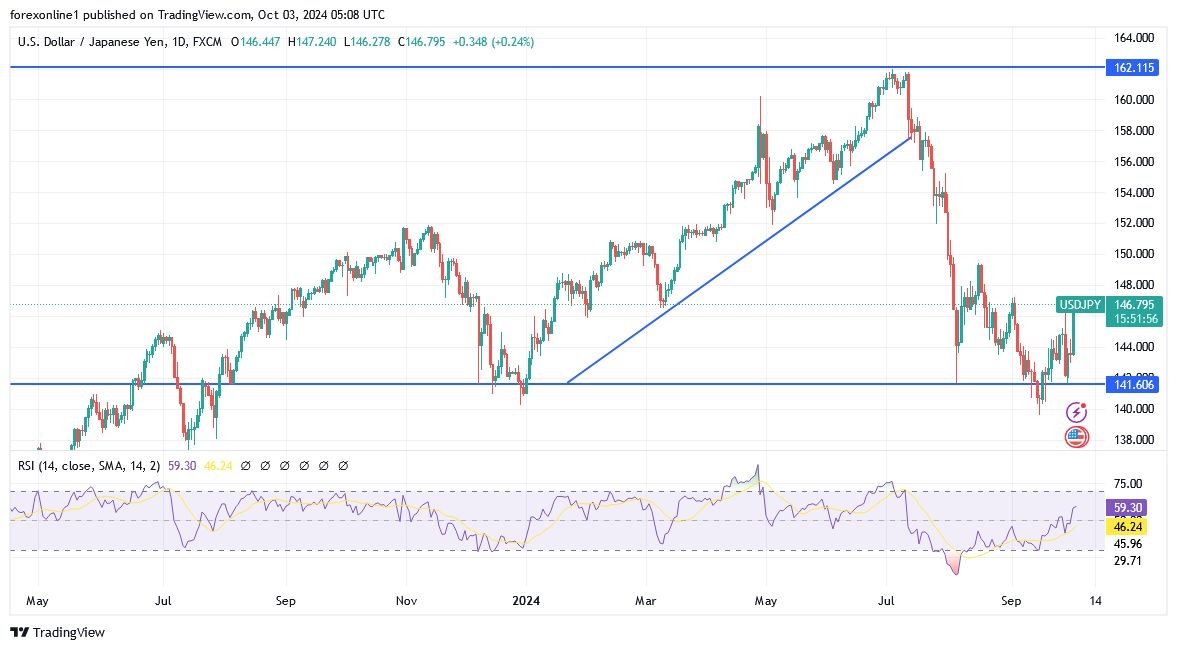
The US dollar rallied a bit during the trading session on Tuesday, as we broke above the ¥142.50 level, reaching toward the ¥143.50 level. That being said, we are at the top of a short-term consolidation area, so we could pull back a bit at this point. I still look at that as a potential buying opportunity though, due to the fact that the market is paying you to sit on this currency pair, as a positive swap certainly is something that matters over the longer term.

Short-term pullbacks at this point continue to see a lot of support near the ¥141.75 level, and then of course the 50-Day EMA that sits below and is rising. That is an area that a lot of people will be paying close attention to, and then below there we have the ¥138 level, which is an area that previously has been a major resistance level, so it should now be a major support level. All things being equal, this is a market that is not one that I could sell until we break down below that level, something that I just don’t see that happening anytime soon. With this being the case, you should also pay close attention to the fact that the 200-Day EMA is right around that area.

All of that being said, it’s very unlikely that this market pulls back, at least for anything that is significant. And it’s even more unlikely that this market sells off. The ¥145 level is an area where we could pay close attention to, as the market has seen quite a bit of resistance there, so if we were to break above that level, then it almost certainly would open up the possibility of fairly big move to the outside. In that environment, I would anticipate that the market is looking to the ¥150 level, which is my longer-term target.

The Bank of Japan continues to offer quite a bit of quantitative easing, and that of course works against the value of the Japanese yen, which is essentially what you are seeing on this chart. The US dollar has been strong during the trading session, so it all plays out perfectly on this chart.

For a look at all of today’s economic events, check out our economic calendar.

This article was originally posted on FX Empire

More From FXEMPIRE:

Source link

23 06, 2024

Euro to Dollar Week Ahead Forecast: 1.04-1.09 Ranges Over Next Three Months

By |2024-06-23T18:00:13+03:00June 23, 2024|Forex News, News|0 Comments

June 23, 2024 – Written by David Woodsmith

Nordea forecasts that the Euro to Dollar (EUR/USD) exchange rate will weaken to 1.04 on a 3-month view as the Federal Reserve rules out near-term interest rates.

After little immediate change amid political risks, ING expects limited net gains to 1.09 on a 3-month view.

EUR/USD attempted to rally at times during the week, but dipped back below 1.07 after weaker-than-expected Euro-Zone business confidence data.

The Euro-Zone PMI data was weaker than expected with the composite PMI index retreating to a 3-month low of 50.8 from 52.2 the previous month amid deterioration in manufacturing and services.

Dr. Cyrus de la Rubia, Chief Economist at Hamburg Commercial Bank, commented; “Is the recovery in the manufacturing sector ending before it began?”

HSBC pointed to the latest German ZEW investor sentiment survey with the headline reading at 47.5 for June from 47.1 previously while there was a small decline in the current conditions component.

It added; “Eurozone economic activity data showed some signs of above-consensus momentum in March and April, but that has stalled in May and June. Given much of that earlier improvement in activity was built on expectations of ECB rate cuts, the sticky nature of some aspects of inflation could chip away at that confidence.”

Advertisement


The latest US retail sales data was weaker than expected with a 0.1% increase for May after a revised 0.2% decline for April. Wells Fargo commented; “We look for a gradual moderation in spending to take hold as the year progresses.”

The New York and Philadelphia Fed manufacturing surveys remained weak, but the PMI data was stronger than expected with the first employment increase for three months.

ING commented on evidence of more subdued inflation pressures; “It has been a struggle, but it is starting to look like investors are swinging behind Federal Reserve rate cuts this year.

It added; “US May CPI and PPI price data are showing encouraging signals and point to another low print for the Fed’s preferred price gauge – core PCE – when it is released on 28 June. We think there is plenty of room for US short-dated yields to fall – a clear dollar negative.”

Nordea, however, does not see scope for a near-term rate cut; “We expect the Fed will only cut its interest rate once this year, compared to the market expectation of almost two interest rate cuts.

It added; “Meanwhile, we expect the ECB to cut its rate twice this year, compared to the market expectation that still does not fully price in two interest rate cuts.”

In this context, it noted; “EUR/USD we expect that EUR/USD will fall toward a yearly low level of 1.04 as it becomes increasingly evident that the ECB is embarking on a different interest rate cutting cycle than the Fed. We believe the US dollar will strengthen on a growing interest rate differential.”

Markets are also extremely wary of political developments on both sides of the Atlantic.

The US November election will come into greater focus with opinion polls still suggesting a close race between Trump and Biden.

According to HSBC; “The jury is also out on geopolitics, with the US election looming large towards the end of the year. Against this backdrop of unknowns, the USD appears better-positioned to benefit as it is a carry trade and a hedge against most currencies in uncertain times.”

ING pointed to on-going French political risks; “Were it not for events in Europe, FX markets would now be focusing on the welcome disinflation in the US and the prospects of a softer dollar. As it is, President Macron’s gamble has added some unexpected volatility into European currencies – likely to keep risk appetite in check.”

MUFG also looked at the French election; “in a scenario of RN winning an outright majority in the snap elections, EUR is likely to fall more sharply.”

Danske Bank still sees medium-term downside Euro risks; “We still believe that fundamental factors point to a lower EUR/USD in the medium term, including the structural case for stronger US growth dynamics. In the near term, we slightly favour the downside due to the EUR leg potentially remaining fragile owing to the political risk premium.”

Like this piece? Please share with your friends and colleagues:


International Money Transfer? Ask our resident FX expert a money transfer question or try John’s new, free, no-obligation personal service! ,where he helps every step of the way,
ensuring you get the best exchange rates on your currency requirements.

TAGS: Pound Dollar Forecasts

Source link

22 06, 2024

GBP/JPY Weekly Forecast – British Pound Plunges Against the Yen for the Week

By |2024-06-22T21:48:03+03:00June 22, 2024|Forex News, News|0 Comments

GBP/JPY Forecast Video for 27.03.23

British Pound vs Japanese Yen Weekly Technical Analysis

The British pound has initially tried to rally against the Japanese yen during the week but found quite a bit of resistance near the ¥162.50 level. That’s an area that previously has been resistance, so it does make a certain amount of sense that we would see sellers there again. The market has broken down below the ¥160 level, multiple times during the week. That being said, there also has been plenty of upward pressure underneath there, so at this point I suspect that the market is still trying to find its footing as to which direction it wants to go.

At this point, the ¥157.50 level should offer a certain amount of support based upon previous action, and then after that the ¥155 level would also offer a significant amount of support. Ultimately, this is a situation that has been very noisy as of late, and I think longer term traders are going to continue to have a hard time trading this market. You can also squint and make a bit of an uptrend line underneath, and therefore it’s likely that we will find buyers based on that as well.

Keep in mind that the Bank of Japan continues its yield curve control situation, meaning that they will continue to have to print Japanese yen every time the yield start to rise against the 10 year JGB. There is a current limit of 50 basis points, and therefore they will have to print those to buy unlimited bonds if the market moves in that direction. However, the market were to see yields drop, as we have multiple times recently, that helps the Japanese yen.

For a look at all of today’s economic events, check out our economic calendar.

This article was originally posted on FX Empire

More From FXEMPIRE:

Source link

Go to Top