GBP/USD stays under bearish pressure after posting losses on Monday.
The pair could extend its downtrend if 1.2700 support fails.
The US economic calendar will not feature any high-impact data releases on Tuesday.
GBP/USD failed to benefit from the broad-based selling pressure surrounding the US Dollar (USD) on Monday and closed the day in negative territory. The pair stays on the back foot early Tuesday and declines toward 1.2700.
British Pound PRICE This week
The table below shows the percentage change of British Pound (GBP) against listed major currencies this week. British Pound was the weakest against the Japanese Yen.
USD
EUR
GBP
JPY
CAD
AUD
NZD
CHF
USD
-0.03%
0.72%
-1.32%
-0.19%
0.36%
0.52%
-0.38%
EUR
0.03%
0.67%
-1.44%
-0.29%
0.38%
0.44%
-0.46%
GBP
-0.72%
-0.67%
-2.04%
-0.93%
-0.27%
-0.21%
-1.12%
JPY
1.32%
1.44%
2.04%
1.16%
1.63%
1.86%
0.97%
CAD
0.19%
0.29%
0.93%
-1.16%
0.58%
0.71%
-0.37%
AUD
-0.36%
-0.38%
0.27%
-1.63%
-0.58%
0.04%
-0.85%
NZD
-0.52%
-0.44%
0.21%
-1.86%
-0.71%
-0.04%
-0.89%
CHF
0.38%
0.46%
1.12%
-0.97%
0.37%
0.85%
0.89%
The heat map shows percentage changes of major currencies against each other. The base currency is picked from the left column, while the quote currency is picked from the top row. For example, if you pick the British Pound from the left column and move along the horizontal line to the US Dollar, the percentage change displayed in the box will represent GBP (base)/USD (quote).
Escalating geopolitical tensions triggered an intense flight to safety at the beginning of the week. The broad market selloff weighed heavily on the USD but the risk-sensitive Pound Sterling failed to find demand in the risk-averse market environment.
Although there are no fresh developments that point to a de-escalation of the conflict in the Middle East, investors seem to be breathing a sigh of relief for now. At the time of press, US stock index futures were up between 0.4% and 0.8%, while the UK’s FTSE 100 Index was trading flat. It’s worth noting that US stock index futures were up more than 1% earlier in the session, suggesting that risk flows are losing steam already.
The economic calendar will not offer any high-tier data releases that could impact the USD’s valuation in a meaningful way. Hence, market participants will pay close attention to changes in risk perception.
GBP/USD Technical Analysis
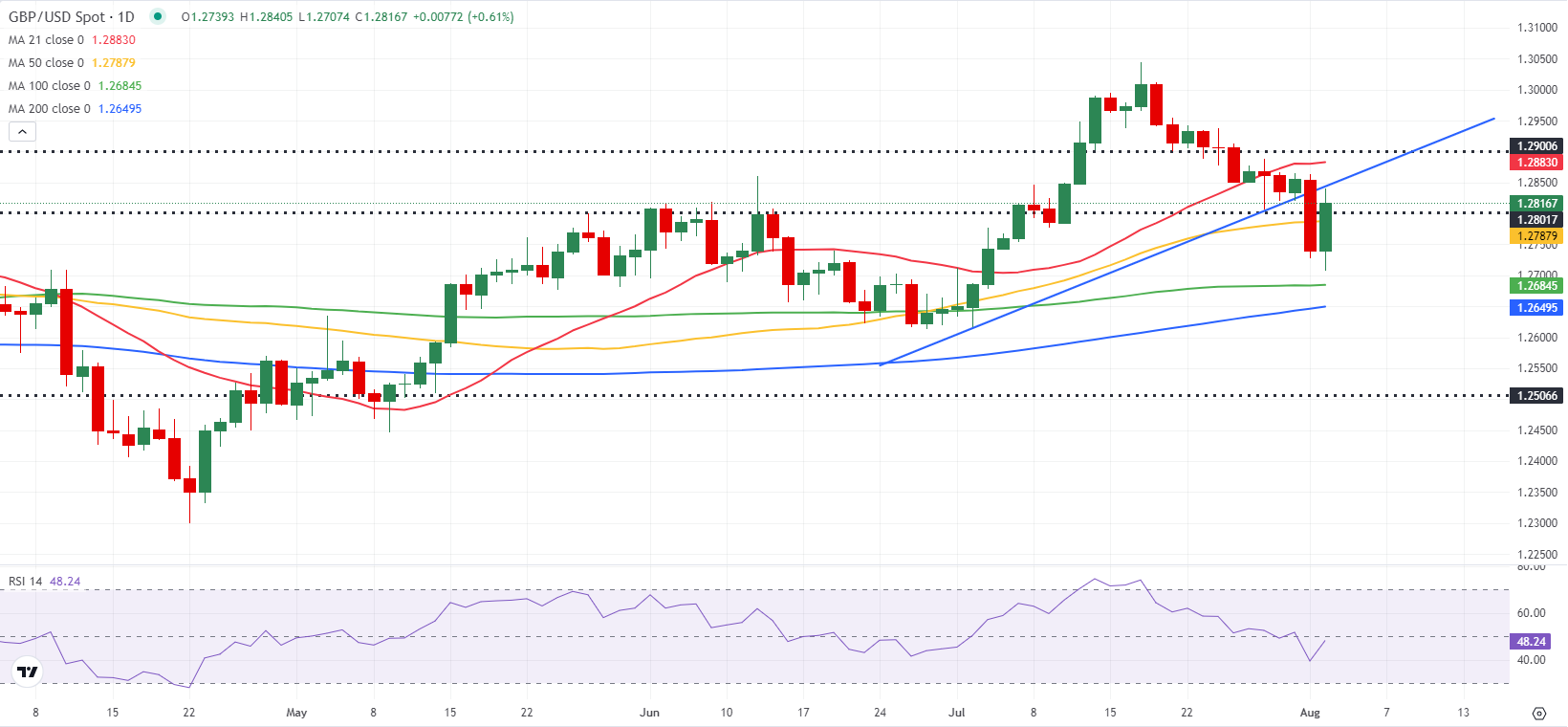
GBP/USD was last seen trading near the 1.2710-1.2700 support area, where the Fibonacci 78.6% retracement of the latest uptrend and a psychological level align. In case that region turns into resistance, additional losses toward 1.2620 (static level, beginning point of the uptrend) and 1.2600 (psychological level, static level) could be seen.
On the upside, resistances could be seen at 1.2780 (Fibonacci 61.8% retracement, descending trend line), 1.2810 (200-period Simple Moving Average) and 1.2830 (Fibonacci 50% retracement).
Pound Sterling FAQs
The Pound Sterling (GBP) is the oldest currency in the world (886 AD) and the official currency of the United Kingdom. It is the fourth most traded unit for foreign exchange (FX) in the world, accounting for 12% of all transactions, averaging $630 billion a day, according to 2022 data. Its key trading pairs are GBP/USD, aka ‘Cable’, which accounts for 11% of FX, GBP/JPY, or the ‘Dragon’ as it is known by traders (3%), and EUR/GBP (2%). The Pound Sterling is issued by the Bank of England (BoE).
The single most important factor influencing the value of the Pound Sterling is monetary policy decided by the Bank of England. The BoE bases its decisions on whether it has achieved its primary goal of “price stability” – a steady inflation rate of around 2%. Its primary tool for achieving this is the adjustment of interest rates. When inflation is too high, the BoE will try to rein it in by raising interest rates, making it more expensive for people and businesses to access credit. This is generally positive for GBP, as higher interest rates make the UK a more attractive place for global investors to park their money. When inflation falls too low it is a sign economic growth is slowing. In this scenario, the BoE will consider lowering interest rates to cheapen credit so businesses will borrow more to invest in growth-generating projects.
Data releases gauge the health of the economy and can impact the value of the Pound Sterling. Indicators such as GDP, Manufacturing and Services PMIs, and employment can all influence the direction of the GBP. A strong economy is good for Sterling. Not only does it attract more foreign investment but it may encourage the BoE to put up interest rates, which will directly strengthen GBP. Otherwise, if economic data is weak, the Pound Sterling is likely to fall.
Another significant data release for the Pound Sterling is the Trade Balance. This indicator measures the difference between what a country earns from its exports and what it spends on imports over a given period. If a country produces highly sought-after exports, its currency will benefit purely from the extra demand created from foreign buyers seeking to purchase these goods. Therefore, a positive net Trade Balance strengthens a currency and vice versa for a negative balance.
The US dollar has plunged against the Japanese yen in trading on Monday as we have now breached the 143 yen level, but it is worth noting that we are at least attempting to recover a bit.
At this point in time though, I do not trust any bounce as this market has been so crucially beaten.
That being said, the market is likely to continue to see a lot of a fade the rally type of attitude, and that of course is the major factor in this market.
Support Areas
There is an area right around the 142 yen level and the 141 yen level that offers significant support. We have just broken through a major trend line and therefore it’s likely that we will continue to see a lot of noise in general. Keep in mind that this is about the carry trade unwinding where people had borrowed in Japanese Yen to buy AI stocks and at this point it looks like that trade is all but over.
The interest rate differential still favors the US dollar but quite frankly at this point everybody is so worried about whether or not the Federal Reserve will cut that it is working against the greenback in general if we can turn around and break above the 147.50 yen level then the market could make a move towards the 150 yen level if we break down below the 140 yen level that would be extraordinarily negative and that could send this market much lower at that point the bottom will have fallen out
Quite frankly, we are on the precipice of something big and you’re better served simply standing on the sidelines instead of trying to become a hero or worse yet, getting wiped out. Being patient will protect your account and perhaps keep you in the game period I have seen moves like this wipe out traders and completely remove them from trading forever. Caution is advised.
Carry trades, popular in the FX space. involve borrowing in a low-interest-rate environment to invest in a higher-interest-rate environment. For the USD/JPY, carry trades involve being long on the US dollar or short on the Yen. USD/JPY movements are exaggerated as investors use leverage to boost returns.
The USD/JPY fell from a July 31 high of 153.889 to an August 5 low of 141.684 due to carry trade unwinding.
Equity and crypto market moves following the BoJ policy decision also reflected the effects of unwinding carry trades.
Is the Yen carry trade unwind close to an end?
Multiple 2024 Fed rate cuts and a US economic recession could narrow interest rate differentials further, weakening the USD/JPY and delivering more pain to the markets.
Brookings Institution Senior Fellow Robin Brooks commented on the Yen carry trade, stating,
“Price action since Friday offers a good lens on where the Yen carry trade is concentrated. EM currencies that have been most hit are the Mexican Peso and Colombian Peso, both of which have been known to harbor lots of carry trades. South Africa and Turkey are also getting hit…”
US Economic Calendar
Later in the Tuesday session, the RCM/TIPP Economic Optimism Index needs consideration.
Economists expect the Index to rise from 44.2 in July to 45.0 in August, potentially influencing the USD/JPY pairing amid US recession fears.
The Index reflects consumer views on the US economy, personal finances, inflation, and the labor market. A higher-than-expected Index would suggest increasing consumer spending, easing concerns about the economic outlook as it contributes over 60% to GDP.
Moreover, higher spending trends could fuel demand-driven inflation, reducing the need for multiple 2024 Fed rate cuts. A less dovish Fed rate path may support a USD/JPY move toward 150.
“Govt bonds as a group up 8 straight days, longest streak in 4 years. Growth outlook souring, rate cuts starting to come out of the kitchen. Swaps signal 3 Fed cuts now fully priced this year. Eerily enough, last time we had an 8-day streak was when pandemic lockdowns pummeled the global economy.”
Short-term Forecast: Bearish
USD/JPY trends will hinge on household spending and wage growth numbers from Japan. Upbeat numbers could raise investor bets on a Q4 2024 BoJ rate hike and a USD/JPY fall below 140.
Investors should remain alert. Monitor real-time data, central bank monetary policy decisions, and expert commentary to adjust your trading strategies accordingly. Stay updated with our latest news and analysis to manage USD/JPY volatility.
USD/JPY Price Action
Daily Chart
The USD/JPY sat well below the 50-day and 200-day EMAs, confirming the bearish price trends.
A USD/JPY return to 145 would support a move toward 150. Furthermore, a breakout from 150 could bring the 151.685 resistance level into view.
Japan’s household spending and the RCM/TIPP Economic Optimism Index require consideration on Tuesday.
Conversely, a drop below the 143.495 support level could signal a fall to the 141.032 support level. A break below the 141.032 support could bring sub-140 into play.
The 14-day RSI at 13.96 shows the USD/JPY in oversold territory. Buying pressure may increase at the 143.495 support level.
EUR/USD briefly pierced the key 1.1000 barrier on Monday.
The Dollar melted as markets priced in an inter-meeting Fed rate cut.
Concerns over a hard landing in the US spooked investors.
EUR/USD added to Friday’s robust comeback and briefly trespassed the psychological 1.1000 hurdle in quite a positive start to the new trading week.
The strong move higher in spot followed an equally deep retracement in the US Dollar (USD), which sent the US Dollar (USD) to levels last seen in January near the 102.00 neighbourhood.
Meanwhile, investors continued to gauge last week’s discouraging prints from the US docket vs. the likelihood that the US economy might tip into recession this year, all requiring a probable inter-meeting rate cut by the Fed as well as more interest rate reductions.
Meanwhile, stocks around the world plummeted on (exaggerated?) fears that the world’s top economy could lose traction to the point of entering recession.
Looking at the money markets, US yields rebounded on the short end of the curve while trimming some losses in the belly and the long term. In Germany, 10-year bund yields bounced off fresh lows near 2.10%.
Back to the Fed, Austan Goolsbee, President of the Chicago Fed Bank, argued on Monday that Fed rate setters must closely watch changes in the US economy to avoid being overly restrictive with interest rates. He observed that, despite weaker-than-expected employment growth, there are currently no indicators of a recession. Goolsbee also warned against overinterpreting the global stock market sell-off.
The policy divergence between the Fed and the ECB could shrink in the event of more and deeper rate cuts by the Fed. However, fresh weakness in US fundamentals has flagged risks to the view of a soft landing, mirroring a loss of momentum in the Eurozone’s recovery. This opens the door to a potentially weaker Dollar in the near term and extra gains in EUR/USD.
EUR/USD daily chart
EUR/USD short-term technical outlook
Further north, EUR/USD’s first obstacle is the August high of 1.1008 (August 5), followed by the December 2023 top of 1.1139 (December 28).
On the downside, the next target for the pair is the 200-day SMA at 1.0827 prior to the weekly low of 1.0777 (August 1) and the June low of 1.0666 (June 26), all preceding the May low of 1.0649 (May 1).
Looking at the larger picture, the pair’s constructive bias should hold if it climbs above the critical 200-day SMA in a convincing fashion.
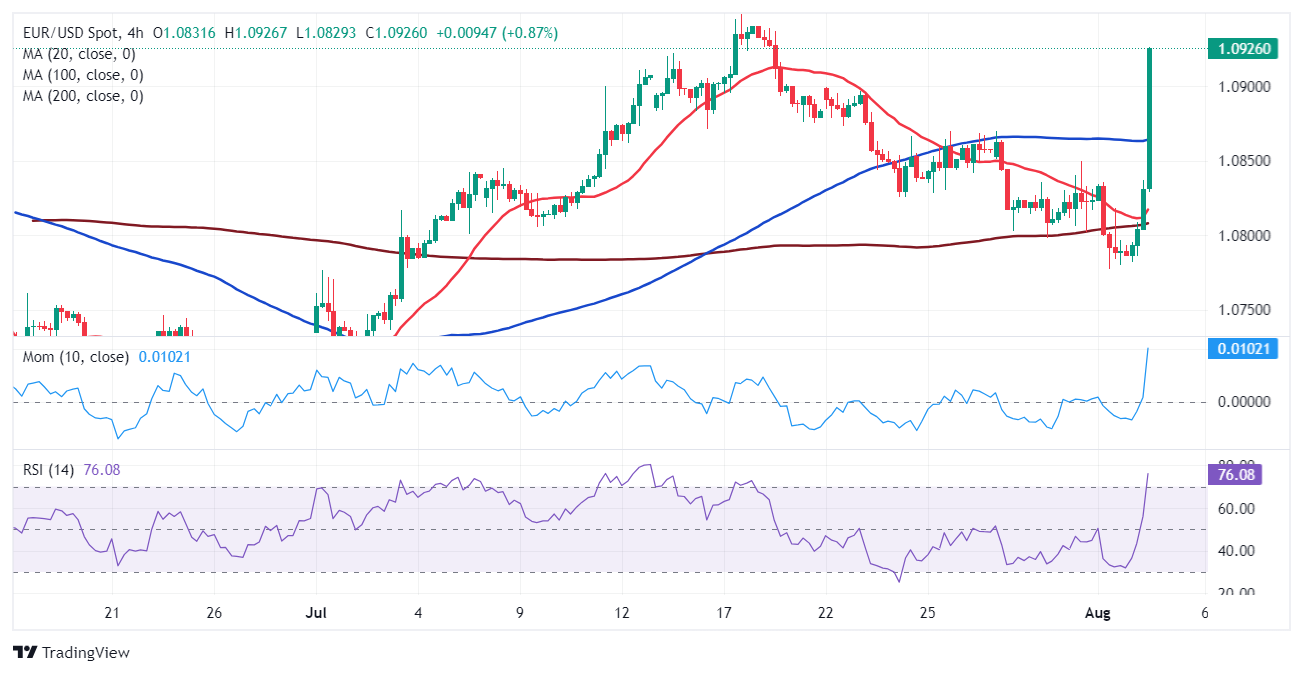
So far, the four-hour chart suggests renewed bullish momentum. Against it, the initial resistance is at 1.1008, ahead of 1.1139. On the flip side, initial support aligns at 1.0777, seconded by 1.0709. The relative strength index (RSI) eased to about 68.
GBP/USD Forecast: Bulls struggle to take control despite broad USD weakness
GBP/USD closed in positive territory on Friday but failed to build preserve its recovery momentum at the beginning of the week. At the time of press, the pair was trading in the red slightly above 1.2750.
The selling pressure surrounding the US Dollar (USD) helped GBP/USD erase a portion of its weekly losses in the American session on Friday. The US Bureau of Labor Statistics (BLS) reported that Nonfarm Payrolls rose 114,000 in July. This reading missed the market expectation for an increase of 175,000 by a wide margin. Read more…
GBP/USD Weekly Forecast: Pound Sterling sellers look to retain control
Recording a third consecutive weekly decline, the Pound Sterling (GBP) reached its lowest level in a month against the US Dollar (USD), leaving GBP/USD to battle the 1.2700 threshold.
GBP/USD remained at the losing end, despite the persistent divergent monetary policy outlooks between the US Federal Reserve (Fed) and the Bank of England (BoE), as the pair witnessed more of a risk trade rather than a rate trade. Read more…
United States Treasury yields collapsed amid speculation of an out-of-schedule rate cut.
Mounting tensions in the Middle East fueled risk-aversion and further hurt the US Dollar.
EUR/USD tests the 1.1000 mark, more gains likely despite extremely overbought conditions.
The EUR/USD pair trades at fresh multi-month highs near the 1.1000 mark in a chaotic start to the week. Concerns about the state of the United States (US) economy hit hard the US Dollar as market players increased bets on an out-of-schedule rate cut from the Federal Reserve (Fed) as soon as next week. It seems a bit overstretched, but as expected last week, financial markets are all about sentiment and will likely remain so in the upcoming days.
Adding fuel to the fire, weekend news showed increased tensions in the Middle East. Israel responded to the latest Hamas attack and air-striked Gaza, killing at least 30 people, while Hamas’s political leader, Ismail Haniyeh, was killed in Tehran. Fears of an escalating war in the region as Iran vowed retaliation further fueled the dismal mood.
The US Dollar trades mixed, under strong selling pressure against European rivals and safe-haven currencies, but firmer against Gold amid plummeting Treasury yields, with the 10-year note offering as low as 3.67% ahead of Wall Street’s opening, a fresh 52-week low. Yields on the 2-year note also plummeted and practically match the 10-year ones.
Data-wise, the Hamburg Commercial Bank (HBOC) published the final estimates of the July PMIs for the Eurozone, with the EU Composite PMI upwardly revised to 50.2, slightly better than the previous 50.1. Additionally, the Producer Price Index (PPI) fell 3.2% YoY in June, while it rose 0.5% MoM. The readings were higher than expected but far from concerning.
The American session will bring the final July US S&P Global Services PMI and the official ISM report on non-manufacturing output.
EUR/USD short-term technical outlook
The EUR/USD pair is sharply up for a second consecutive day and poised to extend its advance. In the daily chart, the pair has run beyond all its moving averages, while the 20 Simple Moving Average (SMA) gains upward momentum above the longer ones, yet over 100 pips below the current level. Technical indicators, in the meantime, head north within positive levels, far from reaching overbought readings and without signs of upward exhaustion.
In the near term, and according to the 4-hour chart, the bullish momentum remains strong despite technical indicators standing at extreme overbought levels. At the same time, the 20 SMA heads firmly north above the 200 SMA, although still below a pretty much flat 100 SMA. Overall, EUR/USD seems poised to storm through the 1.1000 figure in the upcoming sessions.
GBP/USD stays below 1.2800 in the European session on Monday.
Escalating geopolitical tensions force investors to seek refuge at the beginning of the week.
US economic docket will feature ISM Services PMI data for July.
GBP/USD closed in positive territory on Friday but failed to build preserve its recovery momentum at the beginning of the week. At the time of press, the pair was trading in the red slightly above 1.2750.
British Pound PRICE Last 7 days
The table below shows the percentage change of British Pound (GBP) against listed major currencies last 7 days. British Pound was the weakest against the Japanese Yen.
USD
EUR
GBP
JPY
CAD
AUD
NZD
CHF
USD
-0.87%
0.77%
-7.48%
0.33%
1.48%
-0.66%
-3.75%
EUR
0.87%
1.64%
-6.65%
1.25%
2.43%
0.21%
-2.89%
GBP
-0.77%
-1.64%
-8.19%
-0.41%
0.76%
-1.40%
-4.49%
JPY
7.48%
6.65%
8.19%
8.40%
9.70%
7.37%
4.02%
CAD
-0.33%
-1.25%
0.41%
-8.40%
1.18%
-1.00%
-4.08%
AUD
-1.48%
-2.43%
-0.76%
-9.70%
-1.18%
-2.12%
-5.20%
NZD
0.66%
-0.21%
1.40%
-7.37%
1.00%
2.12%
-3.14%
CHF
3.75%
2.89%
4.49%
-4.02%
4.08%
5.20%
3.14%
The heat map shows percentage changes of major currencies against each other. The base currency is picked from the left column, while the quote currency is picked from the top row. For example, if you pick the British Pound from the left column and move along the horizontal line to the US Dollar, the percentage change displayed in the box will represent GBP (base)/USD (quote).
The selling pressure surrounding the US Dollar (USD) helped GBP/USD erase a portion of its weekly losses in the American session on Friday.
The US Bureau of Labor Statistics (BLS) reported that Nonfarm Payrolls rose 114,000 in July. This reading missed the market expectation for an increase of 175,000 by a wide margin. Other details of the jobs report showed that the Unemployment Rate climbed to 4.3% from 4.1% in June and the annual wage inflation softened to 3.6% from 3.8% in the same period. Following these labor market figures, markets started to price in a 50 basis points Federal Reserve (Fed) rate cut in September and caused the USD to weaken.
Over the weekend, several news outlets reported that Iran was preparing to attack Israel. Investors grow increasingly worried about a deepening conflict in the Middle East and it’s potential negative impact on markets. Early Monday, the UK’s FTSE 100 Index is down more than 2% on the day and US stock index futures lose between 1.6% and 4%, reflecting the intense flight to safety.
In the second half of the day, the ISM Services PMI data for July will be featured in the US economic docket. Investors see the headline PMI rising into the expansion territory above 51 from 48.8 in June. A disappointing PMI print could make it difficult for the USD to find demand and help GBP/USD find support. Nevertheless, the pair could struggle to gain traction unless risk mood improves in a noticeable way.
GBP/USD Technical Analysis
The Relative Strength Index (RSI) indicator turned south and declined below 40 after rising to 50 on Friday, suggesting that sellers look to retain control of GBP/USD’s action. A break below 1.2710-1.2700 support area, where the Fibonacci 78.6% retracement of the latest uptrend, could open the door for an extended decline toward 1.2620 (static level, beginning point of the uptrend).
On the upside, 1.2780 (Fibonacci 61.8% retracement) and 1.2800 (200-period Simple Moving Average, descending trend line) align as immediate resistance levels before 1.2830 (Fibonacci 50% retracement).
Risk sentiment FAQs
In the world of financial jargon the two widely used terms “risk-on” and “risk off” refer to the level of risk that investors are willing to stomach during the period referenced. In a “risk-on” market, investors are optimistic about the future and more willing to buy risky assets. In a “risk-off” market investors start to ‘play it safe’ because they are worried about the future, and therefore buy less risky assets that are more certain of bringing a return, even if it is relatively modest.
Typically, during periods of “risk-on”, stock markets will rise, most commodities – except Gold – will also gain in value, since they benefit from a positive growth outlook. The currencies of nations that are heavy commodity exporters strengthen because of increased demand, and Cryptocurrencies rise. In a “risk-off” market, Bonds go up – especially major government Bonds – Gold shines, and safe-haven currencies such as the Japanese Yen, Swiss Franc and US Dollar all benefit.
The Australian Dollar (AUD), the Canadian Dollar (CAD), the New Zealand Dollar (NZD) and minor FX like the Ruble (RUB) and the South African Rand (ZAR), all tend to rise in markets that are “risk-on”. This is because the economies of these currencies are heavily reliant on commodity exports for growth, and commodities tend to rise in price during risk-on periods. This is because investors foresee greater demand for raw materials in the future due to heightened economic activity.
The major currencies that tend to rise during periods of “risk-off” are the US Dollar (USD), the Japanese Yen (JPY) and the Swiss Franc (CHF). The US Dollar, because it is the world’s reserve currency, and because in times of crisis investors buy US government debt, which is seen as safe because the largest economy in the world is unlikely to default. The Yen, from increased demand for Japanese government bonds, because a high proportion are held by domestic investors who are unlikely to dump them – even in a crisis. The Swiss Franc, because strict Swiss banking laws offer investors enhanced capital protection.
The Japanese yen extended its rally to above 146.50 yen against the US dollar, its strongest level since last March, after the latest economic data widened the divergence between the monetary policy expectations of the US Federal Reserve and the Bank of Japan.
Recently, the weak US jobs report had prompted financial markets to prepare for further interest rate cuts by the Fed this year in response to growing signs of a slowing economy.
Meanwhile, the Bank of Japan raised its interest rate to a 16-year high of 0.25% and indicated the will to raise interest rates further if the economy merits it.
Financial markets are betting on two more rate hikes this fiscal year ending in March 2025, with another hike in December.
According to the economic calendar, recent data also showed that Japanese authorities spent 5.53 trillion yen to support the currency through intervention in July. Meanwhile, the Japanese government said a weaker yen could erode household purchasing power by pushing inflation higher than wage growth, highlighting the urgent need for officials to support the currency.
According to forex trading, the Japanese yen continued to strengthen against the US dollar, (USD/JPY) but it may have come at the expense of Japanese financial markets. The yen had fallen to a four-decade low before authorities intervened to support the currency. However, officials may have triggered a bear market for the country’s stock market. To end the trading week, Japan’s benchmark Nikkei 225 index fell about 6% to close Friday’s session at 35,909.70. Japan’s consumer price index recorded its worst single-day performance in March 2020, falling below 36,000 for the first time since January.
Also, Japanese government bond yields fell, with the benchmark 10-year yield falling below 1%, its lowest level in two months.
Meanwhile, financial markets in Tokyo weakened, the yen staged a dramatic reversal. Moreover, this was driven by the Bank of Japan surprising most economists by raising interest rates and planning to buy fewer bonds over the coming years. Furthermore, the decision was made after BoJ Governor Kazuo Ueda suggested that a weaker yen could raise inflationary threats and force struggling Japanese households to bear the brunt of higher prices.
Generally, investors are expecting another rate hike before the end of the year. “Today’s move supports USD/JPY’s return below 150.00. There could be further declines ahead as the BoJ supports a stronger yen to combat inflation, and as the yield spread between the US and Japan narrows further,” analysts at XTB said.
Whether this translates into further yen support remains to be seen. The US dollar has weakened amid the Federal Reserve’s signal of a September rate cut. According to electronic trading platforms, US financial markets have been falling over the past two sessions, with the technology-based Nasdaq Composite sliding into correction territory.
Meanwhile, the Japanese yen has fallen 4% against the US dollar since the start of the year. Global demand concerns for crude oil have recently outweighed supply risks from rising geopolitical tensions in the Middle East.
According to the economic calendar, data released on Friday showed that job growth in the United States slowed sharply, the unemployment rate rose to 4.3% and wage growth slowed. This comes on top of weak manufacturing data. The ISM manufacturing purchasing managers’ index revealed a larger-than-expected contraction in factory activity in the United States, while factory activity in China unexpectedly contracted, the first decline since last October.
Meanwhile, markets are closely watching Iran’s response to the assassination of Hamas leader Ismail Haniyeh, which followed the killing of Hezbollah’s top commander in an airstrike in Beirut.
USD/JPY Technical Analysis and Expectations Today
According to the performance on the daily chart below, the USD/JPY is in a downward channel path and the support of 146.00 confirms the bears’ control, while at the same time moving the technical indicators towards strong oversold levels. You can buy without risk from the support levels of 145.45 and 144.00 respectively. On the other hand, over the same period of time, stability above the resistance of 152.85 will give bulls a new opportunity to control. The USD/JPY price will continue to be affected by the future policies of global central banks, in addition to the extent of investors’ appetite for risk or not.
Tepid United States data fueled concerns about the country’s economic health.
Market players are increasing bets on a Fed 50 bps rate cut in September.
EUR/USD turned sharply higher and could test the 1.1000 in the upcoming sessions.
The EUR/USD pair fell to a fresh three-week low of 1.0776 on Thursday but managed to finish the week in the green above the 1.0900 threshold. Market players had loads to digest throughout the week, but in the end, mounting speculation that the Federal Reserve (Fed) will trim interest rates aggressively and tepid United States (US) data fueling recession fears weighed more.
Trouble in the Eurozone
The Euro had the chance to rally mid-week, but local data undermined its strength. Macroeconomic figures highlighted softer growth extended into the third quarter of the year, as the final Hamburg Commercial Bank (HCOB) Manufacturing PMI was confirmed at 45.8 in July, matching June’s reading. “The eurozone’s manufacturing sector suffered yet another setback at the start of the third quarter as a steeper reduction in new orders led contractions in output and employment to accelerate,” the official report reads.
Furthermore, Germany reported that the economy contracted in the second quarter of the year, as the Gross Domestic Product (GDP) fell 0.1% in the three months to June, according to preliminary estimates. The EU economy, however, expanded a modest 0.3% in the same period, slightly better than the 0.2% anticipated by market participants.
Finally, both economies reported the preliminary estimates of the July Harmonized Index of Consumer Prices (HICP). The German annual index was up by 2.6%, higher than the previous 2.5% and above the 2.4% anticipated. In Europe, the core annual HICP rose by 2.9%, also above the market’s expectations.
Federal Reserve paves the way for a September cut
As widely anticipated, the Fed left the federal funds rate unchanged at 5.25%- 5.5% in its July policy meeting.
The Fed introduced some changes to its statement, which grabbed investors’ attention. On the one hand, policymakers acknowledged that job gains have moderated, while inflation is now seen as “somewhat elevated.” Additionally, the Fed noted that it is attentive to risks on both sides of its dual mandate, a change from the June statement, in which it said it was “highly attentive” to inflation risks. Finally, the Committee judged that the risks to achieving its employment and inflation goals continued to move into better balance.
The US Dollar came under selling pressure as Chairman Jerome Powell delivered a speech and said that a September rate cut is on the table, particularly if macroeconomic data keeps moving in the current direction. However, he clearly remarked that policymakers have made no future decision on monetary policy, and that they will remain data-dependant. As a result, financial markets moved into pricing in at least two rate cuts before year-end, while there are mounting expectations the Fed will deliver three cuts in 2024.
Central banks in the eye of the storm
However, USD’s weakness was short-lived. The Greenback quickly trimmed losses and extended gains against major rivals as markets turned risk-averse. The reason behind the latter was a mixture of central banks’ announcements and tepid US data, fueling concerns about the health of the world’s largest economy.
On the one hand, the Bank of Japan (BoJ) and the Bank of England (BoE) announced their decisions on monetary policy. The first hiked interest rates by 15 basis points (bps), while the second trimmed its benchmark rate by 25 bps. Both decisions were widely anticipated, although only the BoJ is seen continuing its recent policy, putting local stocks in sell-off mode and spurring demand for the safe-haven USD. Meanwhile, tepid earnings reports also weighed on stock markets, fueling USD demand.
Concerns about US economic health
Stock markets tumbled after the US released the ISM Manufacturing PMI on Thursday. The index fell in July to 46.8 from 48.5 in the previous month, missing expectations of 48.8. The ISM report also showed a concerning uptick in Prices Paid, as the sub-index jumped to 52.9, higher than the 51.8 anticipated.
US employment-related data supported the case for rate cuts. The ADP report showed that the private sector added 122K new jobs in July, missing the 150K expected. Also, Initial Jobless Claims for the week ended July 26 unexpectedly rose to 249K, worse than anticipated. Additionally, US-based employers announced 25,885 job cuts in July, a 47% decrease from the 48,786 cuts announced one month prior, according to the Challenger Job Cuts report, while hiring fell to its lowest point in over a decade. Finally, Nonfarm Productivity rose 2.3% in the second quarter of the year, while Unit Labor Cost in the same period printed at 0.9%, much lower than the previous 3.8%.
Finally, the US released the July Nonfarm Payrolls (NFP) report on Friday. The report showed the country added 114,000 new jobs in July, missing the 175,000 expected. Furthermore, the Unemployment Rate rose to 4.3% from 4.1% in the previous month, while the Labor Force Participation Rate ticked up to 62.7% from 62.6%. Finally, Average Hourly Earnings declined to 3.6% from 3.8% in the same period, indicating easing inflationary pressures from that side. Also, Factory Orders fell 3.3% MoM in June, worse than anticipated.
By the end of the week, speculative interest believed the Fed could cut up to 50 bps at the September meeting, while the odds for three rate cuts before year-end continued to increase. Before the NFP release, the chances of a 50 bps cut in September stood at 30%, soaring to roughly 90% afterwards.
Next in the macroeconomic front
The upcoming week will bring some interesting economic indicators, but for the most, financial markets are expected to trade on sentiment, with the Fed’s future actions in the eye of the storm.
On Monday, the US will publish the July ISM Services PMI, foreseen at 51.0, improving from 48.8 in June. Other than that, HCOB and S&P Global will release the final estimates of the Services and Composite PMIs for most major economies.
Germany will report June Factory Orders and Industrial Production for the same month. By the end of the week, the country will publish the final calculation of July inflation figures. The Eurozone will offer June Retail Sales and August Sentix Investor Confidence.
The scheduled data has a limited potential to impact their respective currencies but would be a good barometer of economic health on both shores of the Atlantic.
EUR/USD technical outlook
From a technical point of view, the weekly chart for EUR/USD offers a neutral-to-bullish stance. The pair met buyers around a flat 20 Simple Moving Average (SMA), while the 100 SMA grinds higher below the shorter one. Technical indicators, in the meantime, tick higher within positive levels but lack clear directional strength. Finally, a mildly bearish 200 SMA stands at around 1.1080, a critical level to overcome to anticipate a sustained advance in the long term.
Technical readings in the daily chart support a bullish extension, particularly if the pair closes the week above the 1.0900 threshold. EUR/USD has accelerated above all its moving averages after meeting buyers around a mildly bearish 100 SMA and currently stands roughly 50 pips above a mildly bullish 20 SMA. At the same time, technical indicators head north almost vertically, with the Relative Strength Index (RSI) indicator currently standing at 59 but the Momentum indicator battling to overcome its 100 line.
July monthly high provides immediate resistance at 1.0947, with gains beyond this level aiming to test the 1.1000 psychological level. A break above the latter exposes the 1.1080 area. Near-term support can be found at 1.0880, with a more relevant one at 1.0800. A downward acceleration through the latter opens the door for a test of 1.0720.
Fed FAQs
Monetary policy in the US is shaped by the Federal Reserve (Fed). The Fed has two mandates: to achieve price stability and foster full employment. Its primary tool to achieve these goals is by adjusting interest rates. When prices are rising too quickly and inflation is above the Fed’s 2% target, it raises interest rates, increasing borrowing costs throughout the economy. This results in a stronger US Dollar (USD) as it makes the US a more attractive place for international investors to park their money. When inflation falls below 2% or the Unemployment Rate is too high, the Fed may lower interest rates to encourage borrowing, which weighs on the Greenback.
The Federal Reserve (Fed) holds eight policy meetings a year, where the Federal Open Market Committee (FOMC) assesses economic conditions and makes monetary policy decisions. The FOMC is attended by twelve Fed officials – the seven members of the Board of Governors, the president of the Federal Reserve Bank of New York, and four of the remaining eleven regional Reserve Bank presidents, who serve one-year terms on a rotating basis.
In extreme situations, the Federal Reserve may resort to a policy named Quantitative Easing (QE). QE is the process by which the Fed substantially increases the flow of credit in a stuck financial system. It is a non-standard policy measure used during crises or when inflation is extremely low. It was the Fed’s weapon of choice during the Great Financial Crisis in 2008. It involves the Fed printing more Dollars and using them to buy high grade bonds from financial institutions. QE usually weakens the US Dollar.
Quantitative tightening (QT) is the reverse process of QE, whereby the Federal Reserve stops buying bonds from financial institutions and does not reinvest the principal from the bonds it holds maturing, to purchase new bonds. It is usually positive for the value of the US Dollar.
GDP FAQs
A country’s Gross Domestic Product (GDP) measures the rate of growth of its economy over a given period of time, usually a quarter. The most reliable figures are those that compare GDP to the previous quarter e.g Q2 of 2023 vs Q1 of 2023, or to the same period in the previous year, e.g Q2 of 2023 vs Q2 of 2022. Annualized quarterly GDP figures extrapolate the growth rate of the quarter as if it were constant for the rest of the year. These can be misleading, however, if temporary shocks impact growth in one quarter but are unlikely to last all year – such as happened in the first quarter of 2020 at the outbreak of the covid pandemic, when growth plummeted.
A higher GDP result is generally positive for a nation’s currency as it reflects a growing economy, which is more likely to produce goods and services that can be exported, as well as attracting higher foreign investment. By the same token, when GDP falls it is usually negative for the currency. When an economy grows people tend to spend more, which leads to inflation. The country’s central bank then has to put up interest rates to combat the inflation with the side effect of attracting more capital inflows from global investors, thus helping the local currency appreciate.
When an economy grows and GDP is rising, people tend to spend more which leads to inflation. The country’s central bank then has to put up interest rates to combat the inflation. Higher interest rates are negative for Gold because they increase the opportunity-cost of holding Gold versus placing the money in a cash deposit account. Therefore, a higher GDP growth rate is usually a bearish factor for Gold price.
In my daily analysis of the British pound against the Japanese yen, I find the price action somewhat interesting.
The Bank of England cut rates during the session and while the British pound did fall, as you would expect, the reality is that perhaps we’ve seen the worst of it.
We started to turn things around later in the day as the interest rate differential still heavily favors Great Britain.
After all, the Japanese barely offer any interest in, even with the interest rate cut coming out of the Bank of England, the market will still see the overnight rate at 5%. So, you’re earning well over 4.5% to simply hang on to this pair, and traders will be paying close attention to that. And of course, the pair is oversold.
Its Been Due for a Few Days
So, I think it’s probably due to bounce anyway. If we can recapture the 200 day EMA, I think a lot of traders will jump in based on FOMO and we’ll have to see how things work out from there. The other side of the equation of course is that we break down below the crucial 190 yen level. And I think at that point in time, you probably have a scenario where you end up just completely retracing the entire move, basically from Christmas of last year. The 190 yen level is also the 61.8% Fibonacci retracement level, so that comes into play as well, as a lot of traders will look at that as some type of guidepost.
Another factor that you need to pay close attention to is risk appetite. After all, the interest rate differential does favor more of a “risk on move”, as traders try to look for stable currency markets to pay swap at the end of each day. After all, even if you do get a little bit of a swap and at the same time the currency moves 300 pips against you, that doesn’t do much good. Stabilization will begin more buying before it is all said and done.