The main tag of Forex News Today Articles.
You can use the search box below to find what you need.
[wd_asp id=1]

14 05, 2024

Next on the upside comes 1.0885

By |2024-05-14T21:34:46+03:00May 14, 2024|Forex News, News|0 Comments

You have reached your limit of 5 free articles for this month.

Take advantage of the Special Price just for today!

50% OFF and access to ALL our articles and insights.

Your coupon code


Subscribe to Premium

  • EUR/USD added to gains beyond the 1.0800 barrier.
  • The US Dollar retreated to multi-day lows on Tuesday.
  • US Producer Prices surprised to the upside in April.

The persistence of the negative sentiment surrounding the US Dollar (USD) spurred another positive reaction in EUR/USD, propelling it towards five-week highs above the 1.0800 hurdle on turnaround Tuesday.

The retreat in the Dollar coincided with a broadly negative session in US yields across various durations, persisting within an unchanged macroeconomic environment and following the upside surprise in US Producer Prices in April. This environment continues to anticipate the Federal Reserve (Fed) embarking on its easing cycle in September, in contrast to a potential earlier onset of interest rate cuts by the European Central Bank (ECB), likely in June.

Regarding the latter point, the CME Group’s FedWatch Tool indicates a nearly 66% probability of lower interest rates in the US by September.

The above appeared reinforced after Federal Reserve Chief Jerome Powell expressed his anticipation of US inflation continuing its decline through 2024, mirroring the trend observed last year. He also remarked that it seemed improbable for the Fed to implement further interest rate hikes.

Speaking of inflation, the forthcoming release of the Consumer Price Index (CPI) on Wednesday may offer additional insights into the potential timing of the Fed’s initiation of its rate-cutting programme.

Looking at the broader picture, any temporary weakness in the Dollar is expected to be transitory due to revised expectations of a potential Fed interest rate cut later in the year.

Meanwhile, the unchanged monetary policy landscape underscores the divergence between the Federal Reserve and other G10 central banks, particularly the European Central Bank (ECB).

Regarding the ECB, recent statements from policymakers have hinted at an increasing likelihood of the bank initiating its easing process in June, although uncertainties persist regarding the ECB’s future decisions beyond the summer. In this regard, de Guindos mentioned earlier on Thursday that the ECB exercises caution in predicting any trends beyond June.

Looking forward, the relatively subdued economic fundamentals in the Eurozone, coupled with the resilience of the US economy, underpin expectations for a stronger Dollar in the medium term, especially given the growing probability of the ECB reducing rates well before the Fed.

Considering this perspective, the potential for further weakness in EUR/USD should be taken into account in the medium term.

EUR/USD daily chart

EUR/USD short-term technical outlook

On the upside, EUR/USD is projected to encounter first resistance at the May high of 1.0825 (May 14), an area coincident with the intermediate 100-day SMA. Up from here aligns the April top of 1.0885 (April 9) prior to the March peak of 1.0981 (March 8), and the weekly high of 1.0998 (January 11), all before the psychological 1.1000 threshold.

In the opposite direction, a break below the May low of 1.0649 (May 1) might bring the 2024 bottom of 1.0601 (April 16) back into focus ahead of the November 2023 low of 1.0516 (November 1). Once this zone is cleared, the pair may challenge the weekly low of 1.0495 (October 13, 2023), seconded by the 2023 bottom of 1.0448 (October 3) and the 1.0400 round milestone.

So far, the 4-hour chart has shown a consistent upward trend. Against this, there is an instant uphill hurdle at 1.0825, followed by 1.0885. Meanwhile, initial contention is seen around the 200-SMA of 1.0737, followed by 1.0723. The relative strength index (RSI) climbed to about 68.

  • EUR/USD added to gains beyond the 1.0800 barrier.
  • The US Dollar retreated to multi-day lows on Tuesday.
  • US Producer Prices surprised to the upside in April.

The persistence of the negative sentiment surrounding the US Dollar (USD) spurred another positive reaction in EUR/USD, propelling it towards five-week highs above the 1.0800 hurdle on turnaround Tuesday.

The retreat in the Dollar coincided with a broadly negative session in US yields across various durations, persisting within an unchanged macroeconomic environment and following the upside surprise in US Producer Prices in April. This environment continues to anticipate the Federal Reserve (Fed) embarking on its easing cycle in September, in contrast to a potential earlier onset of interest rate cuts by the European Central Bank (ECB), likely in June.

Regarding the latter point, the CME Group’s FedWatch Tool indicates a nearly 66% probability of lower interest rates in the US by September.

The above appeared reinforced after Federal Reserve Chief Jerome Powell expressed his anticipation of US inflation continuing its decline through 2024, mirroring the trend observed last year. He also remarked that it seemed improbable for the Fed to implement further interest rate hikes.

Speaking of inflation, the forthcoming release of the Consumer Price Index (CPI) on Wednesday may offer additional insights into the potential timing of the Fed’s initiation of its rate-cutting programme.

Looking at the broader picture, any temporary weakness in the Dollar is expected to be transitory due to revised expectations of a potential Fed interest rate cut later in the year.

Meanwhile, the unchanged monetary policy landscape underscores the divergence between the Federal Reserve and other G10 central banks, particularly the European Central Bank (ECB).

Regarding the ECB, recent statements from policymakers have hinted at an increasing likelihood of the bank initiating its easing process in June, although uncertainties persist regarding the ECB’s future decisions beyond the summer. In this regard, de Guindos mentioned earlier on Thursday that the ECB exercises caution in predicting any trends beyond June.

Looking forward, the relatively subdued economic fundamentals in the Eurozone, coupled with the resilience of the US economy, underpin expectations for a stronger Dollar in the medium term, especially given the growing probability of the ECB reducing rates well before the Fed.

Considering this perspective, the potential for further weakness in EUR/USD should be taken into account in the medium term.

EUR/USD daily chart

EUR/USD short-term technical outlook

On the upside, EUR/USD is projected to encounter first resistance at the May high of 1.0825 (May 14), an area coincident with the intermediate 100-day SMA. Up from here aligns the April top of 1.0885 (April 9) prior to the March peak of 1.0981 (March 8), and the weekly high of 1.0998 (January 11), all before the psychological 1.1000 threshold.

In the opposite direction, a break below the May low of 1.0649 (May 1) might bring the 2024 bottom of 1.0601 (April 16) back into focus ahead of the November 2023 low of 1.0516 (November 1). Once this zone is cleared, the pair may challenge the weekly low of 1.0495 (October 13, 2023), seconded by the 2023 bottom of 1.0448 (October 3) and the 1.0400 round milestone.

So far, the 4-hour chart has shown a consistent upward trend. Against this, there is an instant uphill hurdle at 1.0825, followed by 1.0885. Meanwhile, initial contention is seen around the 200-SMA of 1.0737, followed by 1.0723. The relative strength index (RSI) climbed to about 68.

Source link

14 05, 2024

Bulls fighting to conquer the 1.0800 threshold

By |2024-05-14T19:32:26+03:00May 14, 2024|Forex News, News|0 Comments

EUR/USD Current price: 1.0803

  • German upbeat data fell short of boosting the Euro.
  • Hotter than anticipated, US inflation figures hit the Greenback.
  • EUR/USD gains upward traction and could finally exhibit directional strength.

The EUR/USD pair keeps trading lifeless, although it has managed to marginally uplift the range. The pair hovered around 1.0800 throughout the first half of the day, with sellers rejecting advances around 1.0810 with limited conviction. Inflation takes centre stage this week, as Germany confirmed the Harmonized Index of Consumer Prices (HICP) at 2.4% YoY in April, as previously estimated.

The country also released the May ZEW Survey, which showed Economic Sentiment improved more than anticipated, to 47.1 from 42.9. Sentiment in the Eurozone also resulted upbeat, with the index hitting 47. Finally, the assessment of the Current Situation improved to -72.3, beating the 75 anticipated. None of such news, however, were enough to boost the Euro.

On the contrary, the US Dollar eases ahead of the American session following the United States (US) Producer Price Index (PPI) data. The figures indicated inflationary pressures persist, as the monthly PPI rose 0.5%, up from -0.1% in March and above the 0.3% expected. The yearly figure matched the anticipated 2.2%, while the core annual reading printed at 2.4%, unchanged from March  EUR/USD dipped to 1.0766 but quickly trimmed losses and is once again battling with the 1.0800 threshold.

Right after Wall Street’s opening, Federal Reserve (Fed) Chairman Jerome Powell will speak at the Netherlands Foreign Bankers’ Association in Amsterdam. Powell will hardly deliver a surprise message that can affect the USD direction.  

EUR/USD short-term technical outlook

The daily chart for the EUR/USD pair shows it’s slowly gaining upward momentum, up for a second consecutive day. Technical indicators grind higher within positive levels, supporting another leg north. At the same time, EUR/USD extends gains above a directionless 200 Simple Moving Average (SMA), while the 20 SMA gains bullish strength below the current level. Finally, the next hurdle is 1.0840, where a bearish 100 SMA provides resistance.

The optimistic tone is also clear in the 4-hour chart. The Momentum indicator bounced from its 100 level, offering a firmly bullish slope, while the Relative Strength Index (RSI) indicator also picked up and approaches overbought territory. At the same time, EUR/USD runs above all its moving averages, with the 20 SMA gaining upward traction above the longer ones, in line with increased buying interest.

 Support levels: 1.0750 1.0695 1.0660  

Resistance levels: 1.0810 1.0840 1.0885  

Source link

14 05, 2024

GBP/USD Analysis today – 14/05: Important Dat (chart)

By |2024-05-14T17:31:18+03:00May 14, 2024|Forex News, News|0 Comments

  • GBP/USD bulls have pushed the pair above 1.2500, but bears are still in control of the trend.
  • The key resistance level to watching is 1.2568. so far, if US inflation data comes in below expectations on Wednesday, GBP/USD could break out of its recent range and head higher.

GBP/USD has been in a short-term recovery since late April, but it is too early to say that the trend has turned. The dollar is still the dominant force in the market, and many analysts believe that it will remain strong in the coming weeks and months. However, this assumption will be put to the test if US inflation data this week disappoints.

Therefore, the fate of the pound sterling depends largely on what happens to the US dollar, which means that the key to its continued rise depends on what happens in the US economy. For the US dollar to advance to new highs in 2024, we need signs that the economy is still hot and for inflation above consensus to undermine expectations for 2024 rate cuts.

According to the Economic Calendar data, this could happen if the US CPI and retail sales data on Wednesday comes in above expectations: inflation is expected to be 3.4% year-on-year (0.3% month-on-month) and retail sales are expected to be 0.4% month-on-month.

If this data comes in weak, GBP/USD could break above the 200-day moving average at 1.2541 and is likely to end the week higher. Obviously, a break above the 200 DMA would be an increasingly bullish technical development that would increase the chances of further gains in the rest of the month, potentially opening the door to levels above 1.26.

Back in the UK, sterling felt last week as investors prepared for the Bank of England to signal that it is close to cutting interest rates, which was ultimately confirmed in the Monetary Policy Decision and Directions on Thursday. The bank says it will carefully consider the next two points of wages and inflation before deciding whether a June rate cut is appropriate. Furthermore, if the key wage figures from the ONS today come in weaker than expected, look for a resumption of sterling weakness in the coming days. The more the market expects a June rate cut, the more downside we can expect in sterling, all other things being equal. Finally, market implied odds for a June rate cut are now up to 45%, which means there is plenty of room for repricing that could affect the exchange rate.

However, if wage growth is higher than the 5.3% y/y that the market is expecting, look for a nice rebound in GBP towards 1.26, especially if US data comes in close to target or below target.

Technical forecasts for the GBP/USD pair today:

The GBP/USD price may be declining, as the pair is forming a head and shoulders pattern on the hourly time frame. Technically, the price has yet to test the neckline around 1.2500 to confirm that selling is underway. Also, the 100 SMA has already crossed below the 200 SMA to indicate that the overall trend remains bearish or that support is more likely to break than to hold. In this case, GBPUSD could fall as high as the formation or around 100 pips. At the same time, the stochastic appears to be moving lower to reflect bearish pressure, although the oscillator is also moving sideways to indicate consolidation. Ultimately, the RSI is moving sideways but has some room to head down, so price could follow suit while downward pressure remains. 

Ready to trade our daily Forex forecast? Here’s a list of some of the top forex brokers UK to check out.

Source link

14 05, 2024

USD/JPY Forecast Today – 14/05: USD Strong (Video & Chart)

By |2024-05-14T15:30:43+03:00May 14, 2024|Forex News, News|0 Comments

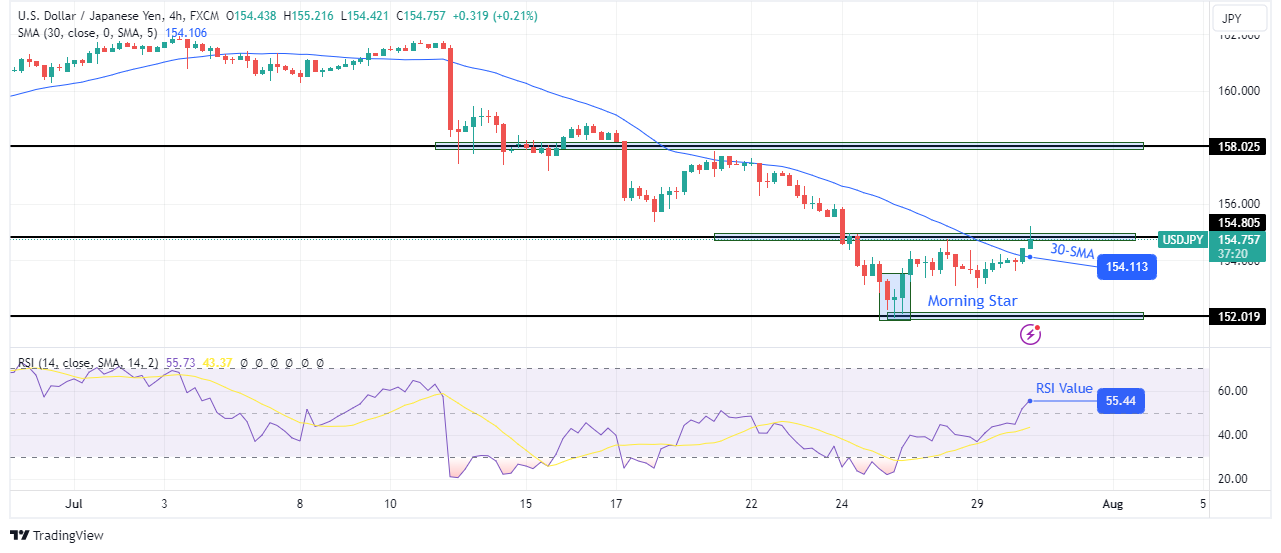
  • The U.S. dollar has rallied slightly against the Japanese yen during the early hours on Monday, but I think at this point in time, we are trying to stabilize a little bit above the crucial 155 yen level.
  • This is a market that I would have no interest in shorting, and I do think given enough time, we will see buyers step in every time it pulls back.

Keep in mind that recently the Bank of Japan intervened, but quite frankly, there’s not a lot they can do with the setup being what it is. You have major issues with debt in Japan, and of course, with that being the situation, they can’t afford massive interest rates, so therefore, it’s likely that interest rates will continue to stay low because the higher the interest rate payment, the more burdensome this becomes, short-term pullbacks should be a buying opportunity with the 50-day EMA underneath offering support near the 153 yen level, and then perhaps even the 152 yen level comes into the picture as it was previous resistance.

Either way, keep in mind that the market pays you to hang on to the USD/JPY pair and therefore, it makes quite a bit of sense that buyers will continue to see buying opportunities based on the investment attitude of the market. At this point, the 160 yen level above is a massive barrier that’s going to be difficult to get beyond, but if and when we do, that could open up the door to a huge move.

Is the Yen in Serious Long-Term Trouble?

We could be looking at 200 yen being targeted over the next several years, because quite frankly, there’s not a lot the Japanese can do. Having said that the Federal Reserve will eventually cut rates so, it’ll be interesting to see how that plays out. But right now, despite the intervention, there’s only one way to trade the USD/JPY market and that is to get long of the dollar against the yen.

Ready to trade our daily Forex forecast? Here’s a list of some of the best regulated forex brokers to check out.

Source link

14 05, 2024

New Attempts to Ascent (chart)

By |2024-05-14T13:29:53+03:00May 14, 2024|Forex News, News|0 Comments

  • The euro has now completed four consecutive weekly advances, suggesting ongoing resilience that could continue if mid-week US inflation and retail sales data disappoint.
  • As trading starts this week, EUR/USD is approaching the key psychological level of 1.08 but will require an unequivocally weak set of US numbers to reach it.

Turning to the economic calendar data this week, the market consensus expects an inflation reading of 3.4% year-on-year (0.3% month-on-month) and retail sales (0.4% month-on-month). The US Consumer Price Index (CPI) report, due out on Wednesday, will be the key data release this week. This comes after several strong inflation readings. Also, the signs of an economic slowdown shown by other indicators, so it will be important for investors to assess the likelihood of rate hikes and cuts from the Fed this year.”

Furthermore, the recent strength of the EUR/USD comes on the back of weaker-than-expected US data that suggests US economic exceptionalism may be fading. If inflation and retail sales come in below expectations, the recent US dollar decline could extend as market confidence grows that the Federal Reserve will cut US interest rates more than twice this year.

As recently reported, Initial unemployment claims – unemployment benefits – rose by 231,000 last week, which is usually an early sign of layoffs. The highest reading in nearly nine months supported the case for lowering interest rates.

The dollar had started 2024 with as much as 150 basis points of cuts priced in by markets, but that had been trimmed to just 25 basis points by mid-April, which had lifted the dollar to its highest levels this year. Recently, another 25-basis point cut has been priced back into expectations, which explains some of the dollar’s recent weakness. It could weaken further if confidence in additional cuts starts to grow. Also watch for comments from Fed Chair Jerome Powell, who is due to speak on Tuesday and could inject some near-term market volatility ahead of the mid-week data dump.

On the other hand, according to stock trading platforms, European stock market indexes closed slightly lower on Monday, with the STOXX 50 and STOXX 60 indexes falling below the flat line as investors await key US inflation data, Q1 GDP and eurozone employment figures due out this week. In trading, construction and materials stocks fell 0.9%, while auto stocks rose 1.4%. also, Orsted shares fell by almost 4% after reports that Republican US presidential candidate Donald Trump would hinder offshore wind power development if re-elected. On the other hand, Maersk shares rose by more than 7% despite concerns raised by its CEO about continued trade disruptions next year. Likewise, Siemens Energy shares were flat after the German conglomerate updated its 2024 prospect.

EUR/USD Technical analysis and forecast:

According to the performance on the daily chart below, the EUR/USD exchange rate still lacks strong momentum to confirm an upward shift. Currently, the 200-day moving average is near 1.08, as depicted in the chart below, indicating the technical difficulty of this level. Traders widely reference the 200-day moving average (DMA) in search of market support and resistance signs, and unless there are some weak US prints next Wednesday, the EUR/USD exchange rate may remain confined below the glass ceiling of the 200 DMA.

Presently, the EUR/USD pair is in a triangular formation, with the 50-day and 200-day simple moving averages slightly below $1.08, while supported from below by the 21-day simple moving average at the $1.07 level. Further weakness in the dollar is crucial, and the pair will rise above $1.08, given the strong upcoming technical resistance barriers. However, the psychological resistance at 1.1000 will remain crucial to confirm the overall trend reversal.

Ready to trade our Forex daily forecast? We’ve shortlisted the best European brokers in the industry for you.

Source link

14 05, 2024

Pound Sterling needs to confirm 1.2550 as support to attract bulls

By |2024-05-14T11:28:19+03:00May 14, 2024|Forex News, News|0 Comments

You have reached your limit of 5 free articles for this month.

Take advantage of the Special Price just for today!

50% OFF and access to ALL our articles and insights.

Your coupon code


Subscribe to Premium

  • Pound Sterling struggles to build on Monday’s gains.
  • The Unemployment Rate in the UK edged higher to 4.3% in the three months to March.
  • Focus shifts to US PPI data and Fed Chairman Powell’s speech.

GBP/USD is having a difficult time gaining traction after rising nearly 0.3% on a daily basis on Monday. Ahead of the US producer inflation data and Federal Reserve (Fed) Chairman Jerome Powell’s speech, the pair trades in a narrow band at around 1.2550.

The data published by the UK’s Office for National Statistics showed early Tuesday that the ILO Unemployment Rate edged higher to 4.3% in the three months to March from 4.2%. This reading came in line with analysts’ estimate. Annual wage inflation, as measured by the change in the Average Earnings Including Bonus, held steady at 5.7% and beat the market expectation of 5.3%. Nevertheless, the mixed data failed to provide a boost to Pound Sterling.

Pound Sterling FAQs

The Pound Sterling (GBP) is the oldest currency in the world (886 AD) and the official currency of the United Kingdom. It is the fourth most traded unit for foreign exchange (FX) in the world, accounting for 12% of all transactions, averaging $630 billion a day, according to 2022 data. Its key trading pairs are GBP/USD, aka ‘Cable’, which accounts for 11% of FX, GBP/JPY, or the ‘Dragon’ as it is known by traders (3%), and EUR/GBP (2%). The Pound Sterling is issued by the Bank of England (BoE).

The single most important factor influencing the value of the Pound Sterling is monetary policy decided by the Bank of England. The BoE bases its decisions on whether it has achieved its primary goal of “price stability” – a steady inflation rate of around 2%. Its primary tool for achieving this is the adjustment of interest rates. When inflation is too high, the BoE will try to rein it in by raising interest rates, making it more expensive for people and businesses to access credit. This is generally positive for GBP, as higher interest rates make the UK a more attractive place for global investors to park their money. When inflation falls too low it is a sign economic growth is slowing. In this scenario, the BoE will consider lowering interest rates to cheapen credit so businesses will borrow more to invest in growth-generating projects.

Data releases gauge the health of the economy and can impact the value of the Pound Sterling. Indicators such as GDP, Manufacturing and Services PMIs, and employment can all influence the direction of the GBP. A strong economy is good for Sterling. Not only does it attract more foreign investment but it may encourage the BoE to put up interest rates, which will directly strengthen GBP. Otherwise, if economic data is weak, the Pound Sterling is likely to fall.

Another significant data release for the Pound Sterling is the Trade Balance. This indicator measures the difference between what a country earns from its exports and what it spends on imports over a given period. If a country produces highly sought-after exports, its currency will benefit purely from the extra demand created from foreign buyers seeking to purchase these goods. Therefore, a positive net Trade Balance strengthens a currency and vice versa for a negative balance.

The US Bureau of Labor Statistics will release the Producer Price Index (PPI) data for April in the early American session on Tuesday. Investors expect the PPI ex Food & Energy to rise 0.2% on a monthly basis. A monthly increase of more than 0.3% in the core PPI could help the USD stay resilient against its rivals. On the other hand, a reading below the market consensus could weigh on the currency and help GBP/USD push higher. Ahead of Wednesday’s Consumer Price Index (CPI) data, however, the market reaction could remain short-lived.

In the second half of the day, Fed Chairman Powell will appear at a moderated discussion with De Nederlandsche Bank (DNB) President Klaas Knot at the Foreign Bankers’ Association’s Annual General Meeting in Amsterdam. If Powell notes that they will stick to restrictive policy stance for longer than anticipated, investors could refrain from pricing in a rate cut in September and allow the USD to outperform its rivals. The CME FedWatch Tool shows that markets see a less than 40% chance that the Fed will keep the interest rate unchanged in September.

GBP/USD Technical Analysis

The 20-day and the 200-day Simple Moving Averages (SMA) form a pivot level at 1.2550. GBP/USD could attract bulls once it stabilizes above this level and starts using it as support. In this scenario, 1.2590-1.2600 (Fibonacci 50% retracement of the latest downtrend, psychological level) and 1.2635 (May 3 high) could be set as next targets.

On the downside, supports are located at 1.2500 (psychological level, 100-period SMA on the 4-hour chart), 1.2450 (Fibonacci 23.6% retracement) and 1.2400 (static level, psychological level).

Economic Indicator

Fed’s Chair Powell speech

Jerome H. Powell took office as a member of the Board of Governors of the Federal Reserve System on May 25, 2012, to fill an unexpired term. On November 2, 2017, President Donald Trump nominated Powell to serve as the next Chairman of the Federal Reserve. Powell assumed office as Chair on February 5, 2018.

Read more.

Next release: Tue May 14, 2024 14:00

Frequency: Irregular

Consensus:

Previous:

Source: Federal Reserve


  • Pound Sterling struggles to build on Monday’s gains.
  • The Unemployment Rate in the UK edged higher to 4.3% in the three months to March.
  • Focus shifts to US PPI data and Fed Chairman Powell’s speech.

GBP/USD is having a difficult time gaining traction after rising nearly 0.3% on a daily basis on Monday. Ahead of the US producer inflation data and Federal Reserve (Fed) Chairman Jerome Powell’s speech, the pair trades in a narrow band at around 1.2550.

The data published by the UK’s Office for National Statistics showed early Tuesday that the ILO Unemployment Rate edged higher to 4.3% in the three months to March from 4.2%. This reading came in line with analysts’ estimate. Annual wage inflation, as measured by the change in the Average Earnings Including Bonus, held steady at 5.7% and beat the market expectation of 5.3%. Nevertheless, the mixed data failed to provide a boost to Pound Sterling.

Pound Sterling FAQs

The Pound Sterling (GBP) is the oldest currency in the world (886 AD) and the official currency of the United Kingdom. It is the fourth most traded unit for foreign exchange (FX) in the world, accounting for 12% of all transactions, averaging $630 billion a day, according to 2022 data. Its key trading pairs are GBP/USD, aka ‘Cable’, which accounts for 11% of FX, GBP/JPY, or the ‘Dragon’ as it is known by traders (3%), and EUR/GBP (2%). The Pound Sterling is issued by the Bank of England (BoE).

The single most important factor influencing the value of the Pound Sterling is monetary policy decided by the Bank of England. The BoE bases its decisions on whether it has achieved its primary goal of “price stability” – a steady inflation rate of around 2%. Its primary tool for achieving this is the adjustment of interest rates. When inflation is too high, the BoE will try to rein it in by raising interest rates, making it more expensive for people and businesses to access credit. This is generally positive for GBP, as higher interest rates make the UK a more attractive place for global investors to park their money. When inflation falls too low it is a sign economic growth is slowing. In this scenario, the BoE will consider lowering interest rates to cheapen credit so businesses will borrow more to invest in growth-generating projects.

Data releases gauge the health of the economy and can impact the value of the Pound Sterling. Indicators such as GDP, Manufacturing and Services PMIs, and employment can all influence the direction of the GBP. A strong economy is good for Sterling. Not only does it attract more foreign investment but it may encourage the BoE to put up interest rates, which will directly strengthen GBP. Otherwise, if economic data is weak, the Pound Sterling is likely to fall.

Another significant data release for the Pound Sterling is the Trade Balance. This indicator measures the difference between what a country earns from its exports and what it spends on imports over a given period. If a country produces highly sought-after exports, its currency will benefit purely from the extra demand created from foreign buyers seeking to purchase these goods. Therefore, a positive net Trade Balance strengthens a currency and vice versa for a negative balance.

The US Bureau of Labor Statistics will release the Producer Price Index (PPI) data for April in the early American session on Tuesday. Investors expect the PPI ex Food & Energy to rise 0.2% on a monthly basis. A monthly increase of more than 0.3% in the core PPI could help the USD stay resilient against its rivals. On the other hand, a reading below the market consensus could weigh on the currency and help GBP/USD push higher. Ahead of Wednesday’s Consumer Price Index (CPI) data, however, the market reaction could remain short-lived.

In the second half of the day, Fed Chairman Powell will appear at a moderated discussion with De Nederlandsche Bank (DNB) President Klaas Knot at the Foreign Bankers’ Association’s Annual General Meeting in Amsterdam. If Powell notes that they will stick to restrictive policy stance for longer than anticipated, investors could refrain from pricing in a rate cut in September and allow the USD to outperform its rivals. The CME FedWatch Tool shows that markets see a less than 40% chance that the Fed will keep the interest rate unchanged in September.

GBP/USD Technical Analysis

The 20-day and the 200-day Simple Moving Averages (SMA) form a pivot level at 1.2550. GBP/USD could attract bulls once it stabilizes above this level and starts using it as support. In this scenario, 1.2590-1.2600 (Fibonacci 50% retracement of the latest downtrend, psychological level) and 1.2635 (May 3 high) could be set as next targets.

On the downside, supports are located at 1.2500 (psychological level, 100-period SMA on the 4-hour chart), 1.2450 (Fibonacci 23.6% retracement) and 1.2400 (static level, psychological level).

Economic Indicator

Fed’s Chair Powell speech

Jerome H. Powell took office as a member of the Board of Governors of the Federal Reserve System on May 25, 2012, to fill an unexpired term. On November 2, 2017, President Donald Trump nominated Powell to serve as the next Chairman of the Federal Reserve. Powell assumed office as Chair on February 5, 2018.

Read more.

Next release: Tue May 14, 2024 14:00

Frequency: Irregular

Consensus:

Previous:

Source: Federal Reserve


Source link

14 05, 2024

USD/JPY Forecast – US Dollar Finds Support Against the Japanese Yen

By |2024-05-14T09:27:24+03:00May 14, 2024|Forex News, News|0 Comments

USD/JPY Forecast Video for 27.04.23

US Dollar vs Japanese Yen Technical Analysis

The US dollar initially fell during the trading session on Wednesday, dipping below the 50-Day EMA before finding plenty of support. That being said, the market looks as if it is trying to form some hammer, which is a bullish sign, and, therefore, it’s likely that we will continue to see buyers on dips and upward momentum in the US dollar. That being said, it is moving rather slowly, but that makes a certain amount of sense considering just how many questions there are around the world regarding where we are going next.

If we break down below the bottom of the candlestick for the Wednesday session, then it’s possible that we could go down to the ¥132.50 level, which is an area where we have seen a lot of support previously. After that, we could look to the ¥130 level, which, of course, is a large, round, psychologically significant figure and an area that would probably attract a lot of attention. On the other hand, if we break out to the upside; the market could go looking to the ¥135 level, an area that, of course, is also a large, round, psychologically significant figure, and therefore I think it’s probably going to be an area where we would see a lot of noise.

Ultimately, I do think that it remains that the market will continue to be very choppy, which makes sense considering that a lot of this is based on the bond market, which has been very noisy. The Bank of Japan continues its yield curve control policy, keeping the 10-year JGB to 50 basis points or less. As long as that’s the case, the Japanese yen could get printed in mass amounts, which could flood the market with a lot of Japanese yen, therefore dropping the currency and value. The US dollar also has to look at this through the prism of strengthening due to interest rates, which remain high in the United States. As long as that’s the case, it should continue to push this market higher, and if we can break above the ¥135 level, I suspect there will be even more momentum to the upside in this market.

For a look at all of today’s economic events, check out our economic calendar.

This article was originally posted on FX Empire

More From FXEMPIRE:

Source link

14 05, 2024

EUR/GBP Forecast Today – 14/05: Volatile on Monday (Chart)

By |2024-05-14T07:26:21+03:00May 14, 2024|Forex News, News|0 Comments

  • The euro rallied a bit after initially gapping lower during the volatile open on Monday.
  • We pierced the 200-Day EMA, pierced the 0.86 level, and then attempted to pierce the top of the Friday candlestick. All things being equal, this is a relatively strong sign, for both buyers and sellers.

What I mean by this is that we have seen quite a bit of momentum jump into the market and try to take advantage of “cheap euros”, but at the same time, we have seen a significant pushback by the resistance area that had been so important over the last several months. Nonetheless, this is a market that looks as if it is forming some type of accumulation phase, and therefore it’s worth noting each move. I think if we can break above the 0.8650 level, is likely that this market will continue to go higher. However, this is a situation that is probably going to continue to be very noisy, and that is rather typical for the EUR/GBP pair under the best of circumstances anyways.

At this point in time, I believe that the 50-Day EMA underneath near the 0.8570 level offers plenty of support. We have been gradually grinding higher, so it’ll be interesting to see whether or not that pattern continues. That’s probably the best way to describe this pair, it’s one that grinds a lot, not necessarily trends, unless there is something specific that happens in the market. Currently, this is a market that just looks like it is essentially killing some time, trying to build up the necessary momentum to go higher.

Position sizing matters in this pair, because to begin with, each PIP is worth quite a bit more than most other larger currency pairs. Furthermore, it does tend to be very choppy which makes sense, considering just how intertwined both of these economies are. Yes, I understand Brexit happened, but at this point in time, the 2 economies is still highly interdependent, no matter what the bureaucrats or news tries to tell you. A simple analysis of money flow shows how that’s true. Furthermore, the European Union looks to be exiting a recession, so it does make a certain amount of sense of money flows euro as a result. With this, I am cautiously optimistic, but not aggressively bullish.

Ready to trade our Forex daily forecast? We’ve shortlisted the top forex brokers in the industry for you. 

Source link

14 05, 2024

Gold, EUR/USD, USD/JPY Price Action Analysis And Technical Outlook

By |2024-05-14T05:25:20+03:00May 14, 2024|Forex News, News|0 Comments

(MENAFN– DailyFX) , USD/JPY – Price Action Analysis and Technical Outlook Skip to Content News & Analysis at your fingertips. We use a range of cookies to give you the best possible browsing experience. By continuing to use this website, you agree to our use of cookies.
You can learn more about our cookie policy here , or by following the link at the bottom of any page on our site. See our updated Privacy Policy here .

MENAFN13052024000076011015ID1108208661


Legal Disclaimer:
MENAFN provides the information “as is” without warranty of any kind. We do not accept any responsibility or liability for the accuracy, content, images, videos, licenses, completeness, legality, or reliability of the information contained in this article. If you have any complaints or copyright issues related to this article, kindly contact the provider above.

Source link

14 05, 2024

Extra gains need to clear the 200-day SMA

By |2024-05-14T03:24:19+03:00May 14, 2024|Forex News, News|0 Comments

You have reached your limit of 5 free articles for this month.

Take advantage of the Special Price just for today!

50% OFF and access to ALL our articles and insights.

Your coupon code


Subscribe to Premium

  • EUR/USD managed to surpass the 1.0800 barrier on Monday.
  • The Greenback started the week on the defensive amidst lower yields.
  • Investors’ focus is on the upcoming US inflation data.

A resurgence of bearish sentiment in the US Dollar (USD) prompted a strong response in EUR/USD, pushing it towards multi-day tops north of 1.0800 the figure at the beginning of the week.

The Dollar’s pullback coincided with a widespread negative session in US yields across various maturities, always against the unchanged macro environment, which continues to see the Federal Reserve (Fed) beginning its easing cycle in September vs. an earlier start of interest rate cuts by the European Central Bank (ECB), probably in June.

In reference to the latter point, CME Group’s FedWatch Tool sees the probability of lower interest rates in the US in September at nearly 65%.

Still around the Fed, FOMC Governor Phillip Jefferson advocated earlier in the day for the continuation of the current monetary policy stance until there were clear signs that price pressures were moderating towards the Fed’s 2% goal. Speaking about inflation, the release of the Producer Prices Index (PPI) and the Consumer Price Index (CPI) later in the week could shed further light on the potential timing of the Fed’s start of its rate-cut programme.

Looking ahead, any temporary weakness in the Dollar is anticipated to be brief due to postponed expectations of a potential Fed interest rate cut later in the year.

Meanwhile, the unchanged monetary policy environment highlights the contrast between the Federal Reserve and other G10 central banks, notably the European Central Bank (ECB).

Regarding the ECB, recent statements from policymakers have suggested an increasing likelihood of the bank starting its easing programme in June, although uncertainties persist regarding the ECB’s future decisions beyond the summer. On this note, de Guindos remarked earlier on Thursday that the ECB is cautious about predicting any trend beyond June.

Looking forward, the relatively subdued economic fundamentals in the Eurozone, coupled with the resilience of the US economy, support expectations for a stronger Dollar in the medium term, especially considering the growing likelihood of the ECB cutting rates well before the Fed.

With this perspective in mind, the potential for further weakness in EUR/USD should be considered in the medium term.

EUR/USD daily chart

EUR/USD short-term technical outlook

On the upside, EUR/USD is likely to face first resistance at the May high of 1.0812 (May 3), which comes before the intermediate 100-day SMA of 1.0827 and the April top of 1.0885 (April 9). North of here is the March peak of 1.0981 (March 8), which precedes the weekly high of 1.0998 (January 11), all before the psychological 1.1000 yardstick.

Looking south, a break below the May low of 1.0649 (May 1) could put the 2024 bottom of 1.0601 (April 16) back on the radar prior to the November 2023 low of 1.0516 (November 1). Once this zone is breached, spot may test the weekly low of 1.0495 (October 13, 2023), ahead of the 2023 bottom of 1.0448 (October 3) and the round milestone of 1.0400.

The 4-hour chart shows a persistent move higher so far. Against that, there is an immediate upward obstacle at 1.0812, seconded by 1.0885. Meanwhile, initial contention comes at the 200-SMA at 1.0737 followed by 1.0723. The relative strength index (RSI) dropped to around 60.

  • EUR/USD managed to surpass the 1.0800 barrier on Monday.
  • The Greenback started the week on the defensive amidst lower yields.
  • Investors’ focus is on the upcoming US inflation data.

A resurgence of bearish sentiment in the US Dollar (USD) prompted a strong response in EUR/USD, pushing it towards multi-day tops north of 1.0800 the figure at the beginning of the week.

The Dollar’s pullback coincided with a widespread negative session in US yields across various maturities, always against the unchanged macro environment, which continues to see the Federal Reserve (Fed) beginning its easing cycle in September vs. an earlier start of interest rate cuts by the European Central Bank (ECB), probably in June.

In reference to the latter point, CME Group’s FedWatch Tool sees the probability of lower interest rates in the US in September at nearly 65%.

Still around the Fed, FOMC Governor Phillip Jefferson advocated earlier in the day for the continuation of the current monetary policy stance until there were clear signs that price pressures were moderating towards the Fed’s 2% goal. Speaking about inflation, the release of the Producer Prices Index (PPI) and the Consumer Price Index (CPI) later in the week could shed further light on the potential timing of the Fed’s start of its rate-cut programme.

Looking ahead, any temporary weakness in the Dollar is anticipated to be brief due to postponed expectations of a potential Fed interest rate cut later in the year.

Meanwhile, the unchanged monetary policy environment highlights the contrast between the Federal Reserve and other G10 central banks, notably the European Central Bank (ECB).

Regarding the ECB, recent statements from policymakers have suggested an increasing likelihood of the bank starting its easing programme in June, although uncertainties persist regarding the ECB’s future decisions beyond the summer. On this note, de Guindos remarked earlier on Thursday that the ECB is cautious about predicting any trend beyond June.

Looking forward, the relatively subdued economic fundamentals in the Eurozone, coupled with the resilience of the US economy, support expectations for a stronger Dollar in the medium term, especially considering the growing likelihood of the ECB cutting rates well before the Fed.

With this perspective in mind, the potential for further weakness in EUR/USD should be considered in the medium term.

EUR/USD daily chart

EUR/USD short-term technical outlook

On the upside, EUR/USD is likely to face first resistance at the May high of 1.0812 (May 3), which comes before the intermediate 100-day SMA of 1.0827 and the April top of 1.0885 (April 9). North of here is the March peak of 1.0981 (March 8), which precedes the weekly high of 1.0998 (January 11), all before the psychological 1.1000 yardstick.

Looking south, a break below the May low of 1.0649 (May 1) could put the 2024 bottom of 1.0601 (April 16) back on the radar prior to the November 2023 low of 1.0516 (November 1). Once this zone is breached, spot may test the weekly low of 1.0495 (October 13, 2023), ahead of the 2023 bottom of 1.0448 (October 3) and the round milestone of 1.0400.

The 4-hour chart shows a persistent move higher so far. Against that, there is an immediate upward obstacle at 1.0812, seconded by 1.0885. Meanwhile, initial contention comes at the 200-SMA at 1.0737 followed by 1.0723. The relative strength index (RSI) dropped to around 60.

Source link

Go to Top