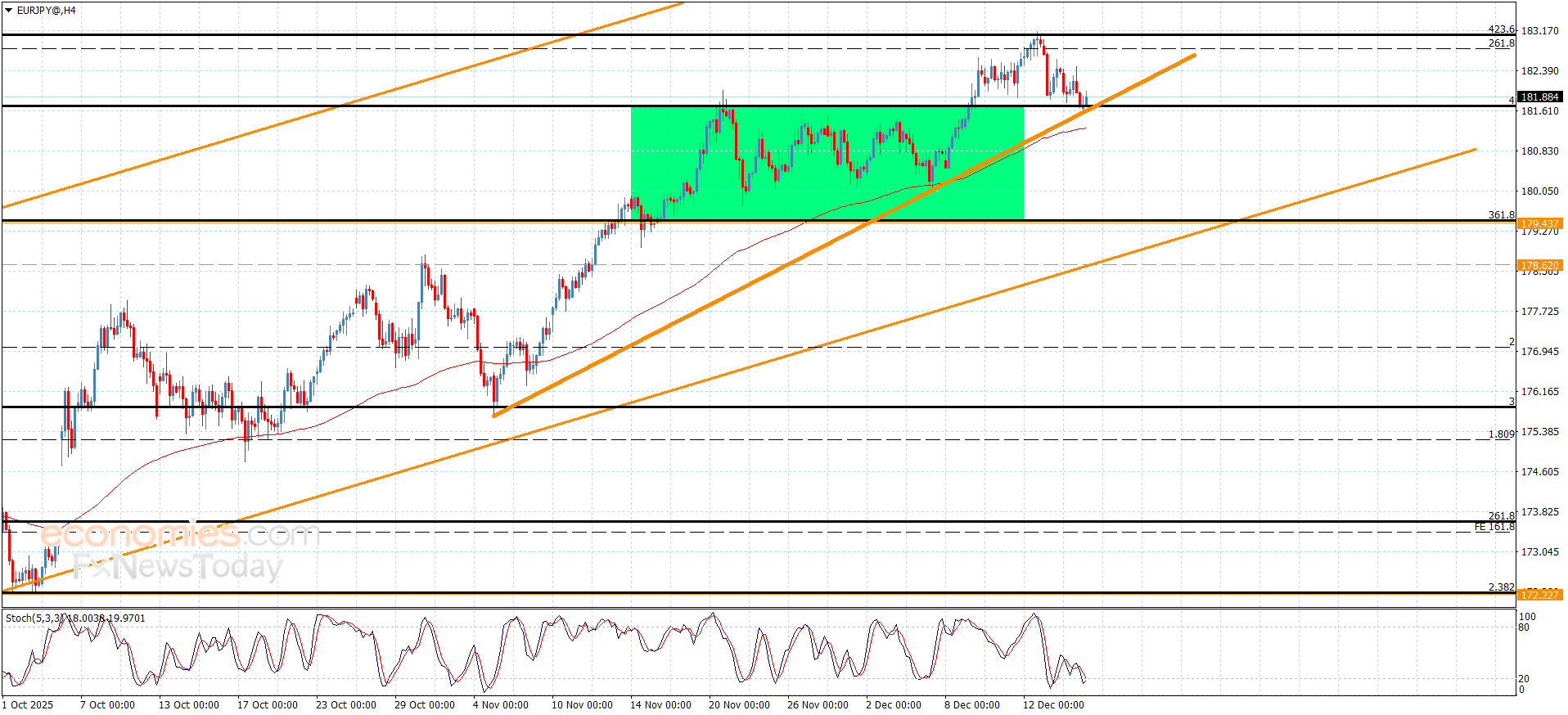
The EURJPY pair confirmed its surrender to the bearish corrective bias dominance by providing several negative closes below 181.75 barrier, forming some corrective trading by targeting 179.75 level.
Despite the main stability within the bullish channel’s levels, the stability below the previously mentioned barrier and stochastic attempt to provide negative momentum support the dominance of the corrective bias, to target the initial support at 179.30 and breaking it might extend the trading towards 178.60, forming the main target of the current trading.
The expected trading range for today is between 179.30 and 181.10
“Japan’s Yen in real effective terms is almost as weak as Turkish Lira, which is the world’s weakest currency after Erdogan eviscerated his central bank. Japan is in denial on debt. Sanae Takaichi’s fiscal stimulus makes this worse…”
James E. Thorne, Chief Market Strategist at Wellington Altus, previously commented:
“Sanae Takaichi, the “Iron Lady of Japan,” has revived Abenomics-style stimulus that will expand global liquidity through fiscal easing and ultra-loose credit. Her policies strengthen the yen carry trade and the U.S. dollar, gold’s pullback should not be a surprise. Contrary to popular belief, the “death of the dollar” is greatly exaggerated. King Dollar is alive and well.”
On Monday, November 24, debates over the fiscal stimulus package and BoJ commentary will influence USD/JPY trends. Traders should also monitor yen intervention warnings from the Japanese government if USD/JPY climbs toward 160.
Meanwhile, US economic data will also play a crucial role in driving USD/JPY trends through its impact on Fed rate expectations.
US Economy and Fed Speakers in Focus
Economists forecast the Chicago Fed National Activity Index (CFNAI) to drop from -0.12 in August to -0.2 in October. Furthermore, economists expect the Dallas Fed Manufacturing Index to rise from -5.0 in October to -1.0 in November.
CFNAI will likely face greater scrutiny given that the index captures the entire US economy, including manufacturing and services. Economists view the CFNAI as a broader economic barometer since it considers production, employment, personal income, and sales. By contrast, the manufacturing sector contributes around 10% to the US GDP.
A sharper-than-expected fall in the CFNAI could signal a loss of economic momentum midway through Q4, supporting a more dovish Fed policy stance. USD/JPY may drop toward 155 on a lower CFNAI reading.
Beyond the data, traders should closely monitor FOMC members’ speeches after last week’s shift in sentiment toward Fed rate cuts. According to the CME FedWatch Tool, the chances of a December Fed rate cut jumped from 44.4% on November 14 to 71.0% on November 21.
Growing support for a December cut could weaken demand for the US dollar and push USD/JPY toward 150.
USD/JPY Scenarios: Diverging Monetary Policies
Bearish USD/JPY Scenario: Hawkish BoJ chatter, intervention threats, softer US data, and dovish Fed comments could drag USD/JPY toward 150.
Bullish USD/JPY Scenario: Dovish BoJ rhetoric, stronger US data, and hawkish Fed comments could send USD/JPY toward 160.
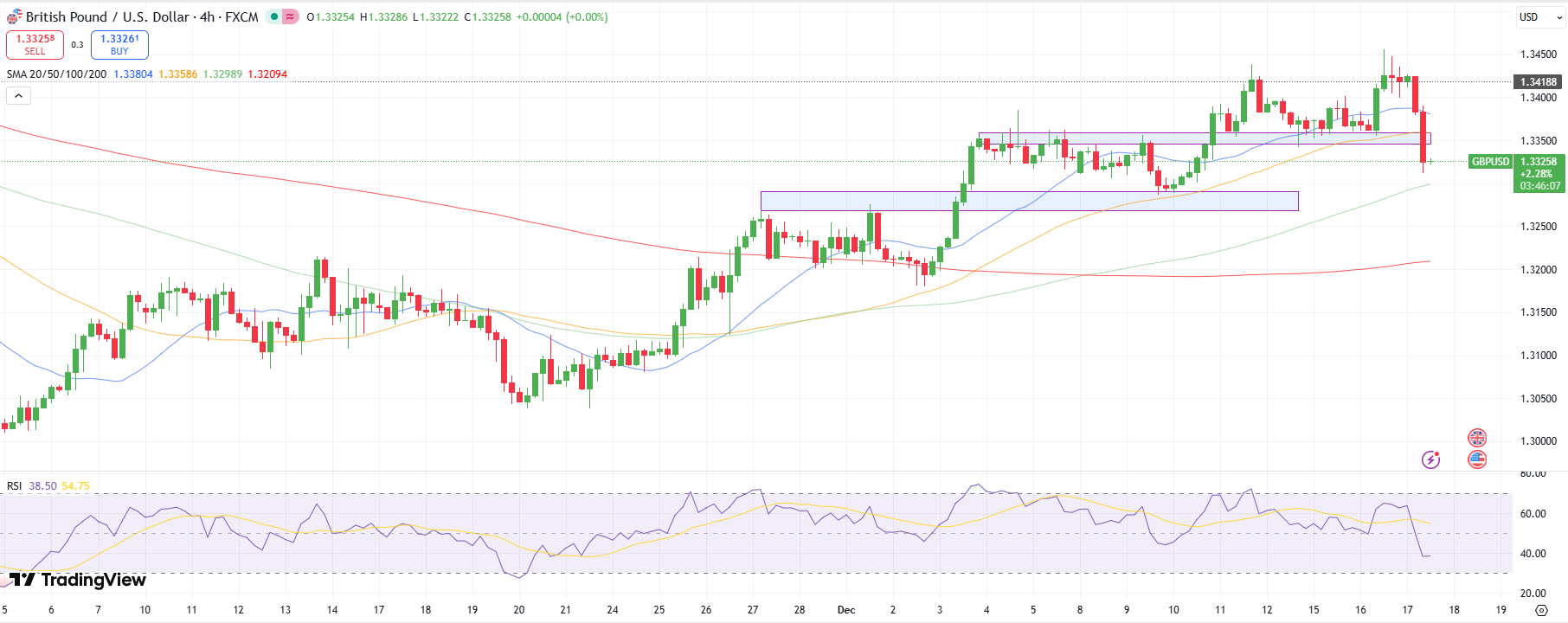
The Pound to Dollar exchange rate (GBP/USD) held near 1.3075 despite a sharp global risk-off move led by equities and crypto.
Softer UK data and renewed fiscal worries are limiting Sterling’s ability to extend higher, keeping consensus expectations anchored around a 1.30-1.31 trading band.
Markets now look to incoming fiscal updates and December BoE signals to judge whether support at 1.30 can hold.
GBP/USD Forecasts: Hold Above 1.30
Volatility across asset classes jumped on Thursday with a particular focus on equities. The US S&P 500 index initially traded sharply higher before a sharp reversal in Nvidia triggered notable losses.
The FTSE 100 index also dipped sharply to 1-month lows on Friday while bitcoin slumped to 7-month lows.
In these circumstances, the Pound was broadly resilient with the Pound to Dollar (GBP/USD) exchange rate trading around 1.3075, but there will be notable unease surrounding the UK fundamentals and risk conditions.
Save on Your GBP/USD Transfer
Get better rates and lower fees on your next international money transfer.
Compare TorFX with top UK banks in seconds and see how much you could save.
According to UoB; “The outlook for today is mixed after the choppy price movements. Today, GBP could trade between 1.3045 and 1.3120.”
Key support remains around 1.30.
The UK government borrowing requirement narrowed to £17.4bn for October from £19.2bn the previous year, but above consensus forecasts of £15.2bn.
For the first seven months of fiscal 2025/26, the deficit widened to £116.8bn from £107.8bn the previous year and around £10bn above ONS projections.
Richard Carter, head of fixed interest research at Quilter Cheviot commented; “Ultimately, today’s borrowing figures suggest Reeves is running out of room, and potentially time, to kick start the economy and get it growing once again. While rate cuts will help, inflation remains sticky and as such the Bank of England may not act as aggressively as the government would like. The ball is in Reeves’ court, but her next move will prove crucial next week.”
Kenneth Broux, head of corporate research FX and rates at Societe Generale commented; “It’s very difficult and I think there’s quite a bit of bad news already priced in, but it doesn’t mean that it can’t get worse.”
He added; “If the gilt market has absolutely no trust in the new borrowing figures and whether the fiscal headroom can be delivered, then we will see a fair steepening of the gilt curve and that is going to result in a weaker sterling.”
Retail sales data was also weaker than expected with a 1.1% decline in volumes for October compared with expectations of a 0.1% decline with the year-on-year increase held to 0.2%.
The UK PMI services-sector index also dipped to a 7-month low of 50.5 for October from 52.3 and below consensus forecasts of 52.0 although the manufacturing PMI index edged back above the 50.0 level to a 14-month high.
Notably, the rate of increase in output charges slowed to a 5-year low despite strong upward pressure on costs.
Chris Williamson, Chief Business Economist at S&P Global Market Intelligence commented; “November’s flash PMI surveys brought disappointing news on the UK economy. Economic growth has stalled, job losses have accelerated, and business confidence has deteriorated.”
He added; “The PMI data therefore suggest the policy debate will shift further away from inflation worries toward the need to support the struggling economy, hence adding to the chances of interest rates being cut in December.”
Like this piece? Please share with your friends and colleagues:
International Money Transfer? Ask our resident FX expert a money transfer question or try John’s new, free, no-obligation personal service! ,where he helps every step of the way,
ensuring you get the best exchange rates on your currency requirements.
The GBP/USD weekly forecast remains under pressure amid dismal UK economic data.
The US dollar remains firm amid receding Fed rate cut expectations.
All eyes on the UK Autumn budget and US inflation data that could shape the market expectations.
The GBP/USD weekly forecast reveals sustained pressure as the soft UK data, like a 1.1% MoM drop in UK retail sales in October, while annual growth came at 0.2%, both well below expectations.
-Are you looking for the best AI Trading Brokers? Check our detailed guide-
Meanwhile, sterling came under pressure amid growing odds of the Bank of England’s tilt towards a looser policy in the near term due to weaker domestic demand and persistent fiscal concerns ahead of the Autumn budget. The UK PMI data remained mixed, failing to generate any buying traction. On the other hand, the US Federal Reserve signaled caution as inflation remains a risk, shrinking December rate cut expectations. The net effect is GBP/USD staying within a narrow range near 1.3100 after finding a bottom around 1.3050.
Across the Atlantic, the US dollar remains firm after hawkish FOMC meeting minutes that dampened expectations for rate cuts, as revealed by the CME FedWatch tool, to around 35%. The US NFP data exceeded expectations, reflecting 119k jobs added against the expected 55k. The October data is not likely to be released, although some of it will be reflected in the November data, which will be key to watch. Meanwhile, US PMI readings showed a mild improvement, with no significant impact on the US dollar.
GBP/USD Key Events Next Week
Moving ahead to the next week, the outlook remains tilted to the downside unless sterling receives a positive boost. On the UK side, the market participants will be watching for signs of stabilization in consumer spending after poor retail sales. However, the primary focus remains on the UK budget. In the US, the focus lies on the labor and inflation data, along with further remarks from Fed officials. The significant events scheduled for next week include Core PCE, PPI, Retail Sales, and the GDP Price Index.
GBP/USD Weekly Technical Forecast: Bears paused by 1.3050
GBP/USD daily chart
The GBP/USD daily chart reveals a weak structure near the broken demand zone. A strong bearish candle, followed by a bearish pinbar, shows the odds of more downside. However, 1.3050 acts as an intermediate support ahead of 1.3000. As UOB states, the pound is unlikely to find a sustained breakout below 1.3000. But a breakout could attract more sellers and test the 1.2900 level.
-Are you looking for the best MT5 Brokers? Check our detailed guide-
On the other hand, any acceptance above the 1.3100 area could gather buying momentum and aim to test the 1.3200 level. While the RSI has begun rising from the oversold region, it remains below 50.0, indicating neutral momentum.
Looking to trade forex now? Invest at eToro!
75% of retail investor accounts lose money when trading CFDs with this provider. You should consider whether you can afford to take the high risk of losing your money.
The euro initially tried to rally against the British pound but turned around to show signs of weakness again. Ultimately, this is a market that I think is going to continue to be very choppy, and therefore, you have to look at it through the prism of a range-bound type of situation, with short-term pullbacks perhaps offering buying opportunities. The 0.8750 level is an area that previously had been significant resistance, so I think you have to look at it as market memory just waiting to happen in the form of support.
The 50-day EMA sits there as well, so that, of course, helps. I look at this as a market that gives us an opportunity on these dips to pick up cheap euros. I don’t look for an explosive move, but I do think the measured move of the previous consolidation, suggesting 0.89 as a target, is pretty reasonable, but this pair tends to move at a snail’s pace.
For a look at all of today’s economic events, check out our economic calendar.
The Pound Sterling (GBP) broke its previous week’s consolidation to the downside against the US Dollar (USD), as GBP/USD revisited levels below the 1.3100 threshold.
Pound Sterling sellers returned with a bang
The broad-based USD resurgence and increased concerns over the United Kingdom’s (UK) fiscal health emerged as the two main underlying themes during the week, driving the GBP/USD price action.
The Greenback garnered strength from receding interest rate cut bets for the US Federal Reserve (Fed) and worries about AI technology stock overvaluations. However, the former was the main catalyst.
Markets preferred to hold the US currency in the lead-up to the quarterly earnings report from chipmaker giant Nvidia and the first US employment data release, following nearly two months without public data.
As a result, the upside in the pair remained restricted, with a fresh leg lower seen on the release of the UK Consumer Price Index (CPI) for October.
Data published by the Office for National Statistics (ONS) showed on Wednesday that the headline annual CPI increased by 3.6% in October, in line with market expectations and compared to a rise of 3.8% in September.
The UK inflation cooled down for the first time in five months, reviving bets for a rate cut by the Bank of England (BoE) next month. Following the UK CPI report, traders increased BoE easing bets with December cut probabilities rising to 85% versus 80% pre-data release.
The market now sees 63 basis points (bps) of monetary easing by the end of 2026 compared to 59 bps before the inflation report. GBP/USD hit fresh 11-day lows at 1.3038 in the aftermath.
Thereafter, Pound Sterling buyers briefly came up for air in the first half of Thursday’s trading, courtesy of the relief rally on global stocks. Nvidia reported a 65% jump in net income, beating analysts’ estimates and temporarily calming nerves surrounding overvaluation concerns.
However, strong US Nonfarm Payrolls data for September paused the risk rally, as markets believed that higher-than-expected job gains could dissuade the Fed from further monetary policy easing.
The NFP rose by 119,000 in September, following a 4,000 decrease (revised from +22,000) recorded in August. The reading outpaced the market forecast of 50,000. Meanwhile, the Unemployment Rate rose to 4.4% from 4.3% in this same period.
Markets continued to price in about a 40% chance that the Fed will lower rates next month as officials remained cautious about their policy stance due to inflation risks.
The renewed risk-aversion wave, combined with easing Fed rate cut bets, helped the USD hold its ground near ten-month highs against its major currency rivals, halting the pair’s recovery.
Buyers once again tried their luck on Friday but faced headwinds from a bigger-than-expected drop in British retail volume data. Retail Sales fell by 1.1% in October, against expectations of no growth.
Further, the UK S&P Global Preliminary data showed that UK private sector growth eased in November, adding to the downside pressure on the Pound Sterling. The S&P Global Composite Purchasing Managers’ Index (PMI) dropped to 50.5 in November from 52.2 in October. The data came in way below the estimates of 51.8.
The USD held resilient against its peers on Friday and limited GBP/USD’s upside as the S&P Global reported in its preliminary estimate that the Composite Purchasing Managers’ Index (PMI) rose to 54.8 from 54.6 in October. This print highlighted an ongoing expansion in the private sector’s economic activity at a robust pace.
UK Autumn Budget and US economic data set to rock GBP markets
The main event risk of the upcoming week is the British 2025 Autumn Forecast, followed by the Budget speech from Chancellor of the Exchequer Rachel Reeves.
The Budget is highly anticipated after the Financial Times (FT) reported earlier this month that UK Prime Minister Keir Starmer and Reeves scrapped plans to raise income tax rates in a massive U-turn.
According to the Guardian, speculation remains that “the chancellor could extend a freeze on income tax and NI thresholds beyond the planned 2028-29 deadline.”
Next in relevance will be the resumption of the mid- and top-tier economic data releases from the United States (US), the September Producer Price Index (PPI), Retail Sales and Durable Goods Orders data.
Meanwhile, the October Core Personal Consumption Expenditures (PCE) – Price Index figures are also slated for release, alongside the third-quarter Gross Domestic Product (GDP). But there is no official confirmation of these metrics as yet.
Additionally, speeches from the Fed and BoE officials will be closely scrutinized to gauge the path forward on interest rates from these major central banks.
GBP/USD Technical Outlook
On the daily chart, the 21-day Simple Moving Average (SMA) extends its decline beneath the 50- and 100-day SMAs, and the pair holds under all of them, keeping the short-term outlook bearish. The 50- and 100-day SMAs continue to slide, while the 200-day SMA edges higher, highlighting short-term weakness against a steadier long-term trend. The Relative Strength Index (RSI) stands at 36.55, below the midline and consistent with persistent selling pressure.
Adding credence to the bearish potential, the 50-day SMA is looking to cross the 200-day SMA from above, and if that happens on a daily candlestick closing basis it would confirm a Death Cross.
Immediate resistance aligns with the 21-day SMA at 1.3154. Recovery attempts could face the rising 200-day SMA at 1.3298, with additional caps at the 50-day SMA at 1.3320 and the 100-day SMA at 1.3392. RSI needs to firm toward 50 to suggest fading bearish momentum and allow a more durable bounce. While price trades beneath the descending short- and medium-term averages, the path of least resistance would remain to the downside.
(The technical analysis of this story was written with the help of an AI tool)
Economic Indicator
Budget Report
The United Kingdom’s Budget, or Financial Statement, is a statement made to the House of Commons by the Chancellor of the Exchequer on the nation’s finances and the Government’s proposals for changes to taxation. The Budget also includes forecasts for the economy by the Office for Budget Responsibility (OBR).
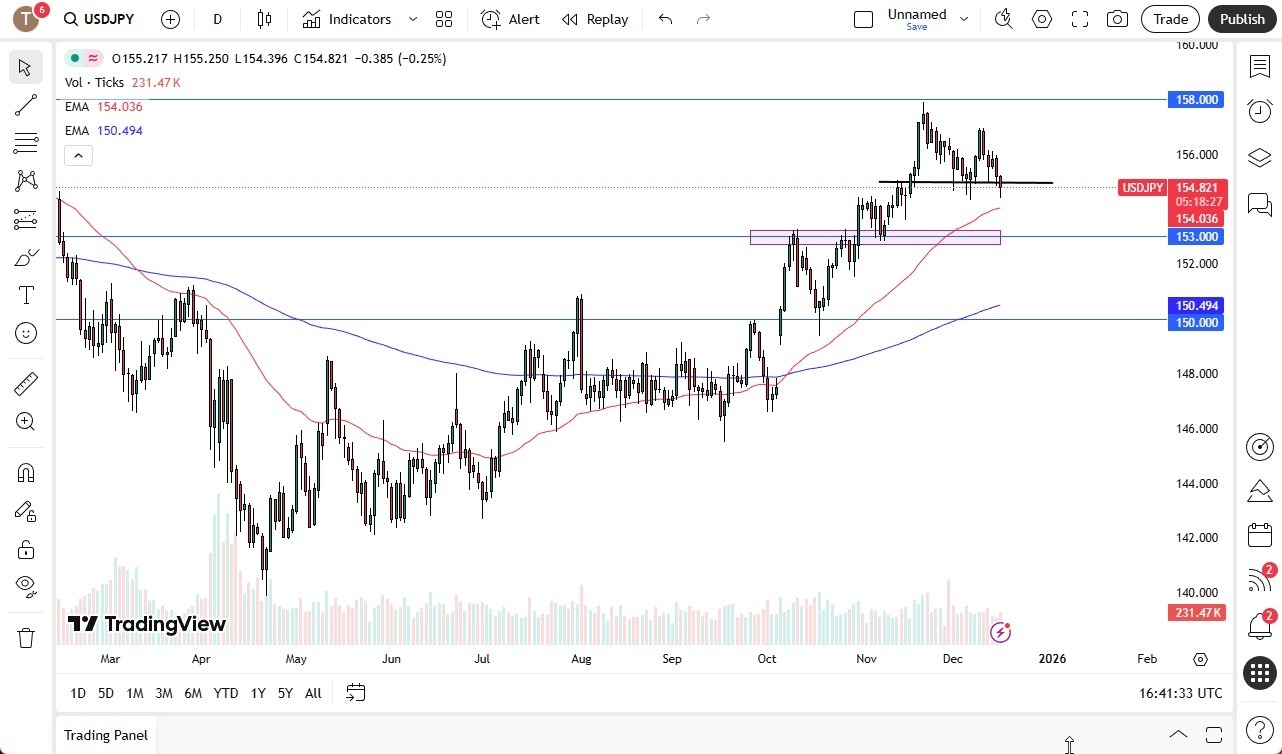
I am a buyer again if we drop close to the 155.50 level, with a stop loss at the 154.50 level. I am aiming for the 159 level eventually.
The US dollar has rallied a little bit during the early hours here on Thursday but gave back some of the gains on the 158 yen level. The 158 yen level, of course, is an area that I think continues to be important as it had previously been resistance. Ultimately, though, this is a market that continues to see a little bit of an overextension. I do think at this point in time, if we pull back from here, it is likely that buyers will try to find some type of value.
Entry Point on a Pullback
I would be particularly interested in the 155.50 yen level, as it is an area that we launched from, and there should be a lot of demand. Below there, we have the 154 yen level followed by the 153 yen level. Ultimately, the interest rate differential continues to favor the US dollar, and I think that continues to be the case for quite some time. Ultimately, I just do not see a scenario where things change rapidly, and the fact that you get paid to hang on to this position at the end of every day certainly helps as well.
If we could clear the 159 yen level, this market could really start to take off, but I think we are a little overdone at this point. I am looking for some value. I went ahead and closed my long position for the day. Not because I think this is a bearish market, just because I think we pull back, we try to find a little bit of support, and then we continue the overall uptrend. Longer term, I do not really know where we go, but you could make an argument for 162 yen before it is all said and done.
Christopher Lewis has been trading Forex and has over 20 years experience in financial markets. Chris has been a regular contributor to Daily Forex since the early days of the site. He writes about Forex for several online publications, including FX Empire, Investing.com, and his own site, aptly named The Trader Guy. Chris favours technical analysis methods to identify his trades and likes to trade equity indices and commodities as well as Forex. He favours a longer-term trading style, and his trades often last for days or weeks.
The euro has drifted a little bit lower during the trading session against the US dollar on Thursday as we continue to see selling pressure.
It is worth noting that the euro did bounce a little bit later in the day, so it suggests at least that we have some type of support underneath.
This area, right around the 1.15 level I think, continues to be very important, and with that being the case, it is likely that the market may bounce around here.
But if we were to break down below the 1.15 level, then it opens up the possibility of a drop down to the 1.14 level, where we see the 200-day EMA.
Short-Term Rallies
Short-term rallies are possible here with the 50-day EMA above offering a bit of a short-term barrier. I think that could end up being a short-term ceiling for that matter, as there is also a downtrend line there. If we were to break above there, then the 1.17 level becomes the next target, followed by the 1.18 level.
The interest rate differential favors the US dollar and probably will for some time. So with that being the case, I prefer fading short-term rallies that show signs of exhaustion, as we have seen multiple times since the September FOMC meeting.
Longer term, if we can break down below the 1.14 level, it is possible that we could drop all the way down to the 1.11 level, which is my longer-term target. I expect to see a lot of choppy back-and-forth volatility as we are between the 50-day EMA above and the 200-day EMA below. Over the longer term, I think that we are in the midst of some type of bigger topping pattern, and it is worth noting that there are a lot of concerns that the Federal Reserve will not be able to cut rates as quickly as everybody wanted because of a delay in jobs numbers.
Christopher Lewis has been trading Forex and has over 20 years experience in financial markets. Chris has been a regular contributor to Daily Forex since the early days of the site. He writes about Forex for several online publications, including FX Empire, Investing.com, and his own site, aptly named The Trader Guy. Chris favours technical analysis methods to identify his trades and likes to trade equity indices and commodities as well as Forex. He favours a longer-term trading style, and his trades often last for days or weeks.
Natural gas price rose in its last trading on the intraday basis, due to its leaning on the support of EMA50, gaining bullish momentum that helped it to achieve these last gains, preparing to attack the key resistance at $4.75, amid the dominance of the main bullish trend on the short-term basis and its trading alongside supportive trend line for this trend, besides the emergence of the positive signals on the relative strength indicators, after reaching oversold levels.
Therefore, we suggest a rise in its upcoming intraday trading, especially when breaching $4.75, to target its main resistance at $5.00.
The expected trading range for today is between $4.55 and $5.00
The EURGBP rose cautiously in its last trading, to hit the resistance of its EMA50, in attempt to offload some of its clear oversold conditions on the relative strength indicators, with the emergence of positive overlapping signals, affected by breaking bullish trend line on the short-term basis, intensifying the negative pressure on the pair, reinforcing the chances of the price decline on the near-term basis.
Therefore, our expectation suggests a decline in EURGBP’s last intraday trading, if the resistance settles at 0.8825, to target the key support at 0.8795.
The expected trading range for today is between 0.8795 and 0.8830