OPEC+ remains steadfast in its significant production cut into the second quarter of 2024. Led by Saudi Arabia and Russia, this collective decision includes Saudi Arabia upholding its 1 million bpd cut and Russia contributing an additional reduction of 471,000 bpd. These measures cumulatively represent about 5.7% of global daily demand, demonstrating OPEC+’s dedicated approach to stabilizing the oil market in the face of variable demand.
U.S. Energy Information Administration (EIA) Report
The latest EIA report revealed a smaller-than-expected increase in U.S. crude inventories, alongside significant decreases in gasoline and distillate stockpiles. This trend indicates an upturn in fuel demand and refining activity, potentially supportive of WTI crude oil prices.
China’s Market Influence
China’s early 2024 crude oil import growth contrasts sharply with its overall decrease in imports, showing reluctance to pay high oil prices. This cautious approach by one of the world’s largest oil consumers presents a complex variable in the equation of global oil demand.
Federal Reserve’s Policy Anticipation
Jerome Powell, the Federal Reserve Chair, has hinted at possible interest rate reductions later in 2024, depending on inflation trends. This potential shift in monetary policy is a critical factor influencing investor confidence and, consequently, commodity markets, including crude oil.
Short-Term Forecast
The WTI crude market currently reflects a balance between bullish influences, such as OPEC+ supply cuts and geopolitical concerns, and bearish aspects like China’s reduced import enthusiasm and anticipated supply increments from non-OPEC+ nations. Despite the IEA projecting a record global oil supply from these countries, the market remains tempered due to these conflicting forces.
In the near term, WTI futures might see limited growth, spurred by OPEC+ supply strategies and geopolitical unrest. Nevertheless, traders should remain alert to fluctuations in China’s demand patterns and broader economic indicators, particularly in light of the Fed’s evolving monetary stance. The market’s direction in the forthcoming weeks could pivot significantly based on these crucial developments, demanding a flexible and informed trading approach.
Solana has seen industry-leading levels of growth and activity in recent months.
A series of airdrops have helped usher in its resurgence.
Speculators have flowed into the network, despite outages and fallout from FTX.
Solana enthusiasts have long dubbed the layer 1 blockchain an “Ethereum killer.” But a better moniker might be “bear market survivor.”
Whipsawed by the crash in DeFi valuations in 2022 and its exposure to FTX, a former business partner, Solana’s SOL token lost 94% of its value in that annus horribilis, which was way worse than the 67% decline in Ether.
DeFi users feared the blockchain network wouldn’t be able to recover and was doomed to become just another forgotten project.
Yet lately many in the Solana community are basking in its rekindled radiance.
Stay ahead of the game with our weekly newsletters
Its assets have steadily grown to about $1.6 billion, according to DefiLlama. And SOL’s 450% surgeduringthe past 12 monthstrouncesEther’s 82% gain.
Moreover, last year the number of daily active Solana wallets tripled compared to a 3% uptick in active Ethereum wallets, according to Messari, the crypto research firm.
Major issues
Still, there are major issues.
Solana has long been plagued by outages to its blockchain network, which makes it hard to establish the blockchain as a reliable processor of transactions.
Join the community to get our latest stories and updates
And for all its heat, Solana’s total value still comprises only 2.7% of the DeFi market compared to Ethereum’s 59.5% slice.
But everyone loves a comeback story, and Solana has a good one.
FTX and the great rebuild
Solana sprang from a whitepaper published in 2017 by Anatoly Yakovenko, a Ukrainian-born software engineer educated at the University of Illinois.
Solana launched the SOL token in March 2020, and two months later created its first set of transactions. Solana caught fire during DeFi Summer in 2021, a heady time when coin values skyrocketed and new decentralised finance projects hit the scene every week.
Venture capital investment in crypto soared. According to DefiLlama, crypto projects raised $40 billion in 2021, more than six times the level the prior year.
Few firms threw money into new crypto projects like FTX, the crypto exchange co-founded and led by Sam Bankman-Fried. The crypto wunderkind also ran a hedge fund called Alameda Research and was a big fan of Solana.
He tweeted he was a buyer of Solana’s SOL token. In his book about Bankman-Fried, Going Infinite, author Michael Lewis said the FTX chief owned anywhere between 10% and 15% of the entire SOL supply through his companies. Solana ecosystem tokens became known as “Sam coins” in the crypto space.
I’ll buy as much SOL has you have, right now, at $3.
Then, FTX collapsed in November 2022., wiping out about $275 billion dollars from the crypto market. It tanked investor confidence in the entire sector.
The FTX collapse decimated crypto’s total market capitalisation in November 2022. (Tradingview)
A year later, while on trial, Bankman-Fried attributed the crash in FTX’s FTT token and Solana’s token to the collapse of his exchange, confirming the hunches of crypto commentators the year before.
In November, a US jury found him guilty on seven counts of fraud and conspiracy in connection with the legerdemain he used at FTX and Alameda.
It’s taken about a year for Solana to dig out from under the rubble of FTX. Airdrops have helped. These are distributions of free tokens designed to whet the appetite among users of new protocols.
They can be quite lucrative but timing is everything.
In November, the Pyth and Jito protocols launched airdrops worth a combined $290 million into the Solana ecosystem, which drove hype, but they dropped rapidly and deeply in the following weeks.
Another driver of Solana’s popularity: memecoins. These tokens have become a popular feature on Solana’s blockchain network. Crypto speculators have piled into Bonk and similar offerings on to capture outsized gains.
Solana’s low transaction fees have provided another edge against Ethereum, which in times of heightened activity or network congestion can see fees cost many dollars per transaction.
Solana can process 65,000 transactions per second compared to 15 for Ethereum, which means Solana is probably more scalable than its older rival.
But cheaper fees and faster processing won’t mean much if Solana can’t stay online. And with 15 outages in the last three years, this has become a serious problem.
In early February, Solana went down again for four hours in what developers called a “performance degradation.” A post-mortem released by Solana on February 9 identified a bug in Solana’s caching code as the source of the outage.
DefiLlama data shows SOL fell 4% fall during the outage. Once back online, Solana token’s price recovered and continued to rise throughout the week.
Solana Labs, the company behind the Solana blockchain, did not immediately respond to DL News’ request for comment.
The outage followed some good news. Yakovenko stated in September 2023 that developers were working on making validation more accessible to Solana users staking small amounts.
Around that time, payments giant Visa announced it would include Solana in its stablecoin settlements infrastructure.
Meanwhile, Solana is making inroads in the NFT market. It is now outpacing Ethereum in terms of sales of nonfungible tokens.
For all the drama, the bottom line is that Solana has become a must-have asset when investors are building crypto portfolios.
Its market value is more than twice as much as Cardano and Polkadot combined. And for all of Solana’s limitations the network continues to challenge Ethereum in the race to win over more users.
More than anything, Solana has proven its resilience, at least in terms of its popularity. But until it solves its outage issue, investors may wonder how long that lasts.
The Meme Coin Revival: SHIB and FLOKI March Higher
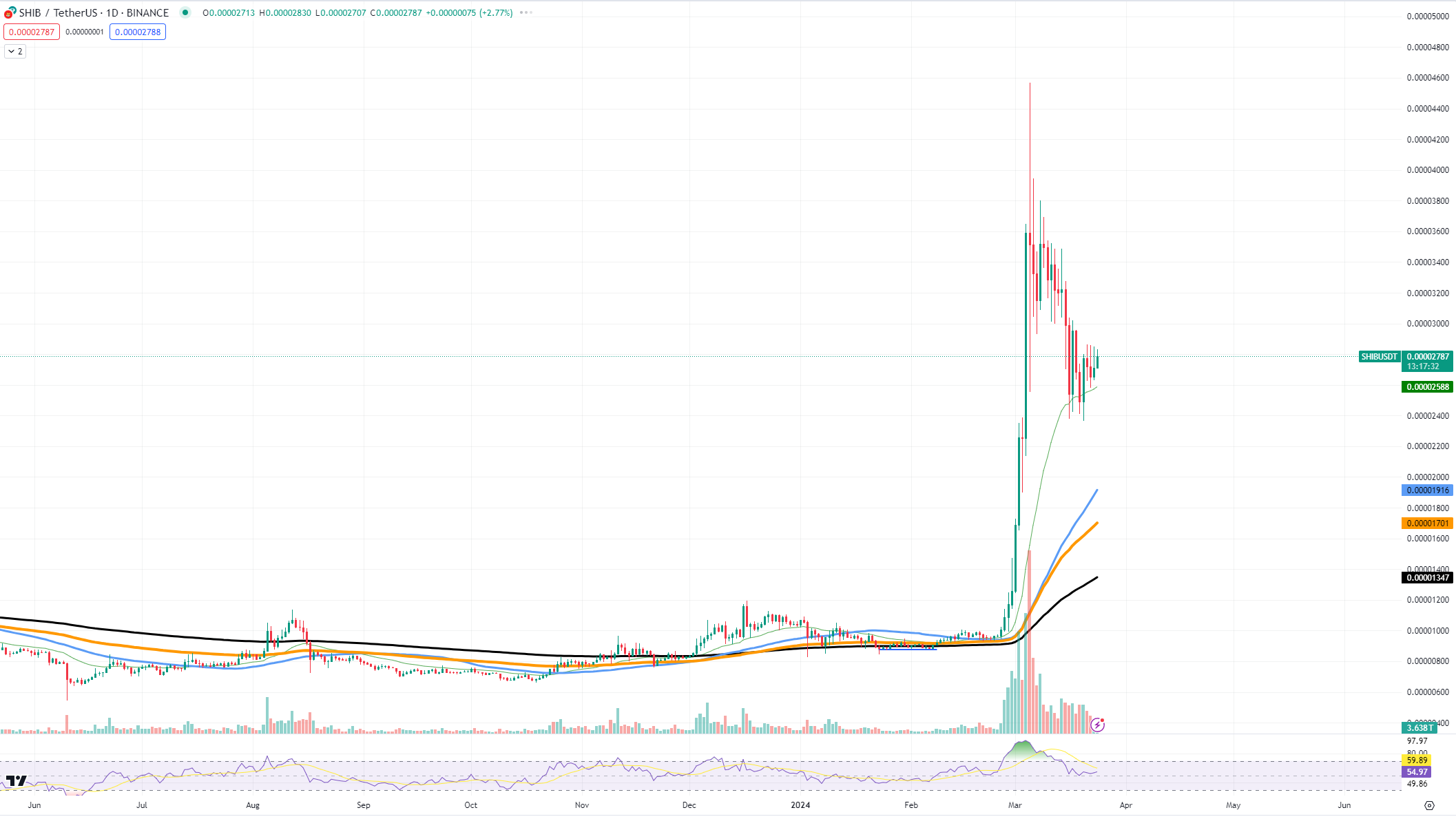
Meme coins continued to draw investor interest in the week ending March 10. Shiba inu coin (SHIB) and floki inu (FLOKI) enjoyed impressive gains Monday through Saturday. FLOKI was up 69% to $0.000248, with SHIB up 60% to $0.00003610.
The fear of missing out drove buyer demand after FLOKI and SHIB saw gains of 299% and 133%, respectively, in the week ending March 3.
Dogecoin (DOGE) trailed the pair, rising by a more modest 10.32% to $0.17 from Monday to Saturday. In the week ending March 3, DOGE gained 79%.
Upward trends in active addresses contributed to DOGE and SHIB gains. Exchange listings drove buyer demand for FLOKI.
SEC v Ripple: SEC Appeal Threat Leaves XRP Trailing the Market
XRP bucked the broader market trend Monday through Saturday, declining by 0.43% to $0.6250.
Uncertainty about the outcome of the ongoing SEC v Ripple case continued to limit the upside. The SEC and Ripple are preparing remedy-related briefs to argue for and against a punitive penalty for XRP sales to institutional investors. Judge Analisa Torres could decide on a penalty this summer.
After the penalty stage, investors expect the SEC to appeal against the Programmatic Sales of XRP ruling. SEC plans to appeal may delay an XRP-spot ETF application until after any appeal. An appeal against the Programmatic Sales ruling could extend the SEC v Ripple case into 2025. In July 2023, Judge Torres ruled programmatic sales of XRP do not satisfy the third prong of the Howey Test.
Blackwing has secured a substantial $4.5 million in a recent funding round spearheaded by industry titans Hashed and Gumi Cryptos. This influx of capital is designated for the creation of a modular layer-2 blockchain. What sets this platform apart is its innovative design for leveraged trading sans liquidation, applicable to a wide range of assets through its “Limitless Pools” feature.
Using Initia’s foundational technology, Blackwing stands at the forefront of the modular chains concept. The seamless integration across any application-specific chain not only upholds the sanctity of decentralization but promises traders cost-efficiency and enhanced security. With Blackwing, moving assets across disparate chains becomes obsolete, as traders can operate fluidly within a single, interconnected ecosystem.
Source: Blackwing.fi
Baek Kim, a partner at Hashed, expressed enthusiasm for the initiative, emphasizing the trader-centric advancement in DeFi that Blackwing embodies. Meanwhile, Miko Matsumura from Gumi Cryptos Capital extolled the team’s ingenuity in developing a mechanism that fundamentally elevates the trading experience.
With its Limitless Pools, Blackwing changes leverage trading. The platform transforms liquidity positions into a form of collateral, allowing traders to maintain positions despite market fluctuations. This infrastructure not only augments fee revenue for liquidity providers but also safeguards traders against volatile market conditions.
Amid the fervent debates around decentralization, Blackwing introduces a new breed of modular chain architecture, one that favors a diverse network of specialized app chains. This concept, as envisaged by co-founder Shahmeer, promises a paradigm shift in Web3.
Blackwing is setting the stage for a transformed DeFi landscape where trading complexities are streamlined, empowering traders to focus on their strategic goals without the traditional constraints.
The crypto wallet service OKX Wallet has announced its integration with the Kava network, which will be useful for crypto users who look for a more versatile and functioning blockchain to have control over their virtual money. It not only ensures consistency but also offers benefits like making the food more economical, nutritional, and eco-friendly.
Kava’s operations on the Cosmos ecosystem facilitate Ethereum’s users to exploit the advantages of both Cosmos and Ethereum. Developers build smart contracts for the Ethereum network now in the process with the Cosmos environment that comes with higher processing speed and better compatibility among different blockchains. Through that, there will be now easy asset and interaction management as well as app creation built on the Kava network.
Demonstrating the commitment to always be leading the front, the fundamental feature of OKX wallet is its commitment to supporting new blockchains like Kava. This correlation is a part of the attempt to provide easy and constant opportunities for users in the fast-developing blockchain world.
The Kava blockchain network is the third-generation cross-chain DeFi that marries the goodness of both the Cosmos and Ethereum platforms. It provides a combination of those attributes from both Cosmos and the thriving developer ecosystem of Ethereum. The feature helps the wallet by providing users who are interested in new additions to the crypto ecosystem with various experiences.
Hence, OKX Wallet continues to stand on its own as a unique wallet in the industry. In OKX you get the full range of products, from (hot) and (non-custodial) exchanges, and agglomerating the DeFi platform and NFT market. In regards to their innovation, we see that they are not only focused on now but are already looking forward to the future with their new brand campaign called “The System Needs a Rewrite” which argues that the future to come will be more technology-based with Web3 technologies.
Despite Judge Torres addressing the Terraform Labs case, uncertainty shrouds XRP. As the crypto-spot ETF market evolves, the hanging threat of an SEC appeal also limits the chances of an XRP-spot ETF.
Investors will likely have more clarity on SEC plans in the summer. Judge Torres will begin deliberating on a penalty for Ripple breaching Section 5 of the Securities Act in May. At this stage, the chances of a settlement will likely have vanished. The SEC may begin preparing an appeal that could leave XRP sidelined through H2 2024.
However, SEC plans to appeal against the Programmatic Sales ruling hinge on the outcome of,
Coinbase (COIN) Motion to Dismiss (MTD) all charges in the ongoing SEC v Coinbase case.
Office of Inspector General investigation into reported crypto conflicts of interest within the SEC.
There is also the US Presidential Election to consider. A Republican Party victory could result in a new SEC Chair and a material shift in attitude toward regulating the US digital asset space.
Nonetheless, recent price action suggests investors are unwilling to bet on the outcomes of the Coinbase MTD, the OIG Investigation, or the US Presidential Election.
Consumer price inflation data from China for February 2024 shows an exit from deflation
CPI +0.7% y/y
expected +0.3%, prior -0.8% (that -0.8% in January was the sharpest the steepest fall in more than 14 years)
for the m/m, comes in at +1.0% (prior +0.3%)
first rise in the CPI since August of 2023
core CPI +1.2% y/y (prior +0.4%)
PPI -2.7% y/y
expected -2.5%, prior -2.5%
for the m/m, comes in at -0.2%
Thats a very large jump in CPI from -0.8% y/y in January to +0.7% in February. Its not as if the yuan collapsed, which would ramp up the price of imports.
Well, that ends the ‘deflation narrative’ in China. This is welcome news, deflation weighs on the economy in multiple ways:
When prices are falling, consumers may delay purchases in anticipation of even lower prices in the future. This reduction in spending can lead to decreased demand for goods and services, slowing down economic growth.
Deflation increases the real value of debt, making it more expensive for borrowers to repay loans. This can lead to higher default rates and can stress financial institutions. Individuals and businesses may cut back on spending and investment as a result.
As prices fall, revenues for companies decrease, but many of their costs (like loans, leases, and salaries) do not adjust downward as quickly. This can lead to lower profits, cutbacks in production, and layoffs, further contributing to the economic downturn.
Wages tend to be sticky downwards, meaning they do not easily decrease even when there is deflation. This can lead to higher labor costs relative to revenues for businesses, forcing them to reduce their workforce or halt hiring.
With falling prices, the return on investments can be lower than expected, or even negative. This can lead to a reduction in investments by businesses in areas like research and development, new projects, or expansion.
The most dangerous aspect of deflation is the risk of a deflationary spiral. This occurs when falling prices lead to lower production, leading to higher unemployment, leading to lower demand, and thus further declines in prices. This vicious cycle can be very difficult to break and can lead to long-term economic stagnation.
Dogecoin (DOGE) and shiba inu (SHIB) outperformed BTC and the broader market.
DOGE and SHIB ended the Friday session with gains of 4.58% and 11.73%, respectively. SHIB ended a three-day losing streak. Despite a three-day losing streak, SHIB is on target for another stellar week. After surging by 133.09% in the week ending March 3, SHIB was up 56.52% Monday through Friday. DOGE was up a more modest 6.55% after rallying 79.39% in the week ending March 3.
Upward trends in active addresses fueled breakouts as investors returned from the sidelines. BTC remained the market barometer, a Friday record high driving buyer demand for meme coins.
However, FLOKI (FLOKI) stole the show on Friday, surging 66.39% to $0.0002323. FLOKI was up 60% Monday through Friday after ballooning 299% in the week ending March 3. FLOKI has benefited from listings on crypto exchanges and endorsements as a long-term investment opportunity.
Coinhako, a Monetary Authority of Singapore-regulated crypto exchange, listed FLOKI on Friday, March 8. CoinMENA also announced the listing of FLOKI on Friday.
Technical Analysis
Bitcoin Analysis
BTC sat well above the 50-day and 200-day EMAs, affirming bullish price signals.
A BTC break above the Friday all-time high of $70,066 would support a move toward the $75,000 handle.
BTC-spot ETF market flows need consideration.
However, a fall below the $67,500 handle could give the bears a run at the $59,176 support level.
The 14-Daily RSI reading, 74.89, shows BTC sitting in overbought territory. Selling pressure may intensify at the Friday all-time high of $70,066.
Disclaimer: The opinions expressed by our writers are their own and do not represent the views of U.Today. The financial and market information provided on U.Today is intended for informational purposes only. U.Today is not liable for any financial losses incurred while trading cryptocurrencies. Conduct your own research by contacting financial experts before making any investment decisions. We believe that all content is accurate as of the date of publication, but certain offers mentioned may no longer be available.
Bitcoin has recently faced significant resistance at the $70,000 mark, a psychological threshold that has proven to be a formidable barrier for the digital asset. Despite the enthusiasm surrounding its previous rallies, Bitcoin is currently exhibiting signs of a correction, which could impede its ability to achieve a rapid breakthrough above this level.
A detailed analysis of the TradingView chart reveals that Bitcoin has encountered a consolidation phase after a steep ascent. The current local support is found near the $57,932 level, aligning with the 50-day moving average, a crucial technical level that often acts as a stronghold for the asset’s price. This area may serve as a foundation for BTC if bearish pressure increases.
Conversely, resistance is firmly established at the $70,000 level. This is not just a numerical ceiling but a psychological one, where sell orders tend to cluster as investors aim to capitalize on round-number milestones.
If the correction deepens, Bitcoin may seek support at lower levels, with the next substantial support zone around the $50,117 mark, which is also near the 100-day moving average.
Market sentiment is mixed, reflecting the uncertainty of Bitcoin’s immediate path. While long-term confidence in Bitcoin remains high due to its established track record and increasing mainstream adoption, the short-term outlook is clouded by current market conditions and the $70,000 resistance level.
Solana rises
As the crypto market continues its dynamic course, Solana (SOL) emerges as a robust contender, gearing up to potentially set a new yearly high. With investors and traders eyeing SOL’s chart for signs of its next big move, the digital asset does not disappoint, showcasing strong bullish signals in its recent price action.
The SOL/USDT pair, as observed on the TradingView chart, is currently experiencing a commendable uptrend. The local support is firmly established around the $120.13 mark, a level that SOL has tested and bounced off recently, reaffirming its role as a reliable foothold for the asset. The next critical support lies near the $110 region, aligning with the 50-day moving average, serving as a secondary defense should any bearish shift occur.
On the resistance spectrum, SOL faces its immediate challenge near the $155 zone. A convincing break above this level could very well propel Solana to carve out new highs for the year, fueling bullish sentiment across the market. The current price structure, characterized by successive higher highs and higher lows, underscores the possibility of such a breakout
XRP faces hurdle
XRP is currently facing a significant technical challenge on the charts, as a concerning pattern emerges that could signal potential headwinds for the cryptocurrency.
The recent price action of XRP/USDT indicates a struggle to maintain its upward momentum. After reaching a peak, the asset has begun to set successively lower highs — a technical pattern that can dampen bullish sentiment and may lead to a trend reversal. This development is pivotal because lower highs are frequently associated with diminishing buying pressure and the beginning of a downturn.
Current technical analysis places XRP’s local support at the $0.55 mark, which is in proximity to the 50-day moving average, a critical juncture for the asset to hold to avert a bearish outlook. Should XRP fall below this support level, the door could open for further declines, with the next level of substantial support near $0.50, a psychological and technical support level.
Conversely, resistance levels have formed near the recent high around $0.63, where XRP has faced rejection, reinforcing the bearish pattern of lower highs. For XRP to invalidate this troubling trend, it would need to break through this resistance with conviction and sustained volume, a move that would require significant market buy-in.
The formation of lower highs is a troubling signal for XRP, often indicating that sellers are becoming more aggressive and buyers are unable to push the price to new highs.
I’m always leery of a pre-NFP front run and today is an example of why. The US dollar was soft and bonds bid for 24 hours before the report. When the data rolled out it was dovish. Yes, the headline beat but unemployment rose, revisions were much lower and wage growth was surprisingly soft. The initial reaction was for more USD selling but that was the extreme of the day. In the hours that followed the dollar weakness slowly reversed, with the help of a weak stock market.
The euro climbed up to 1.0980 on the NFP headlines but slowly slid back to 1.0930, which is slightly before the data was released. It didn’t get any help from the leak saying that only a few ECB members want to cut in April.
The pound was more resilient as it finished up 50 pips on the day but still gave back 50 pips from the highs in what could have been its strongest day since December. Still, it’s the best close of the year for the pond and breaks months of consolidation. That will be something to watch in the week ahead.
USD/JPY continues to be sold on BOJ hike speculation. That will be a key topic next week ahead of the March 19 decision as the leaks continue to roll in.
USD/CAD was a tough trade today. The Canadian jobs report was strong but so much is being driven by population growth that the market isn’t impressed. Later as the risk trade and oil stumbled, so did the loonie, erasing all the jobs moves and more.
Gold hit another all-time high but as it neared $2200, some aggressive selling hit. The turn in gold coincided with heavy profit taking in some high-flying stocks, particularly chipmakers with NVDA falling to $875 at the close from a record high of $974.