The main tag of Forex News Today Articles.
You can use the search box below to find what you need.
[wd_asp id=1]

9 02, 2026

Euro buyers show interest to start week

By |2026-02-09T16:51:47+02:00February 9, 2026|Forex News, News|0 Comments

After closing the previous week in negative territory, EUR/USD gains traction on Monday and trades above 1.1850. In the second half of the day, investors will pay close attention to comments from central bankers.

Euro Price Today

The table below shows the percentage change of Euro (EUR) against listed major currencies today. Euro was the strongest against the British Pound.

USD EUR GBP JPY CAD AUD NZD CHF
USD -0.33% 0.14% -0.25% -0.09% -0.26% 0.12% -0.32%
EUR 0.33% 0.47% 0.06% 0.25% 0.07% 0.45% 0.00%
GBP -0.14% -0.47% -0.40% -0.24% -0.40% -0.02% -0.46%
JPY 0.25% -0.06% 0.40% 0.16% -0.01% 0.37% -0.08%
CAD 0.09% -0.25% 0.24% -0.16% -0.17% 0.21% -0.24%
AUD 0.26% -0.07% 0.40% 0.00% 0.17% 0.38% -0.06%
NZD -0.12% -0.45% 0.02% -0.37% -0.21% -0.38% -0.45%
CHF 0.32% -0.00% 0.46% 0.08% 0.24% 0.06% 0.45%

The heat map shows percentage changes of major currencies against each other. The base currency is picked from the left column, while the quote currency is picked from the top row. For example, if you pick the Euro from the left column and move along the horizontal line to the US Dollar, the percentage change displayed in the box will represent EUR (base)/USD (quote).

The selling pressure surrounding the US Dollar (USD) seems to be helping EUR/USD edge higher at the beginning of the week. The positive shift seen in risk mood and the sharp decline in the USD/JPY pair following the verbal intervention by Japanese officials to offset the JPY weakness on the election outcome cause the USD to lose interest. At the time of press, the USD Index was down 0.3% on the day at 97.35.

Later in the day, European Central Bank (ECB) President Christine Lagarde will speak on the state of the EU economy and ECB activities in an event in France. In the American session, several policymakers from the Federal Reserve (Fed) will be delivering speeches.

The CME FedWatch Tool currently shows that markets are pricing in about a 16% probability of a 25 basis points (bps) rate cut next month. In case officials reiterate that they are willing to remain patient and watch the data before deciding on the next policy move, the USD could find a foothold and limit EUR/USD’s upside.

Nevertheless, investors could refrain from betting on a steady recoveryin the USD ahead of the critical Nonfarm Payrolls data for January, which is scheduled to be released on Friday.

EUR/USD Technical Analysis:

In the 4-hour chart, EUR/USD trades at 1.1858. The 20-period Simple Moving Average (SMA) has turned higher but remains below the 50-period SMA, which slopes gently lower. The 100- and 200-period SMAs trend upward, hinting at a firmer medium-term bias. The 14-period RSI at 61.8 rises above the midline, underscoring building bullish momentum.

Measured from the 1.1590 low to the 1.2025 high, the 38.2% retracement at 1.1860 aligns as a pivot point. If this level stays intact and EUR/USD failes to stabilize above it, the 50% retracement and the 100-period SMA in the 1.1810-1.1800 could act as the next support. On the upside, 1.1900 (static level) could be seen as an interim resistance level ahead of 1.1925 (Fibonacci 23.6% retracement).

(The technical analysis of this story was written with the help of an AI tool.)

Euro FAQs

The Euro is the currency for the 20 European Union countries that belong to the Eurozone. It is the second most heavily traded currency in the world behind the US Dollar. In 2022, it accounted for 31% of all foreign exchange transactions, with an average daily turnover of over $2.2 trillion a day.
EUR/USD is the most heavily traded currency pair in the world, accounting for an estimated 30% off all transactions, followed by EUR/JPY (4%), EUR/GBP (3%) and EUR/AUD (2%).

The European Central Bank (ECB) in Frankfurt, Germany, is the reserve bank for the Eurozone. The ECB sets interest rates and manages monetary policy.
The ECB’s primary mandate is to maintain price stability, which means either controlling inflation or stimulating growth. Its primary tool is the raising or lowering of interest rates. Relatively high interest rates – or the expectation of higher rates – will usually benefit the Euro and vice versa.
The ECB Governing Council makes monetary policy decisions at meetings held eight times a year. Decisions are made by heads of the Eurozone national banks and six permanent members, including the President of the ECB, Christine Lagarde.

Eurozone inflation data, measured by the Harmonized Index of Consumer Prices (HICP), is an important econometric for the Euro. If inflation rises more than expected, especially if above the ECB’s 2% target, it obliges the ECB to raise interest rates to bring it back under control.
Relatively high interest rates compared to its counterparts will usually benefit the Euro, as it makes the region more attractive as a place for global investors to park their money.

Data releases gauge the health of the economy and can impact on the Euro. Indicators such as GDP, Manufacturing and Services PMIs, employment, and consumer sentiment surveys can all influence the direction of the single currency.
A strong economy is good for the Euro. Not only does it attract more foreign investment but it may encourage the ECB to put up interest rates, which will directly strengthen the Euro. Otherwise, if economic data is weak, the Euro is likely to fall.
Economic data for the four largest economies in the euro area (Germany, France, Italy and Spain) are especially significant, as they account for 75% of the Eurozone’s economy.

Another significant data release for the Euro is the Trade Balance. This indicator measures the difference between what a country earns from its exports and what it spends on imports over a given period.
If a country produces highly sought after exports then its currency will gain in value purely from the extra demand created from foreign buyers seeking to purchase these goods. Therefore, a positive net Trade Balance strengthens a currency and vice versa for a negative balance.

Source link

9 02, 2026

The EURJPY remains positive– Forecast today – 9-2-2026

By |2026-02-09T12:50:39+02:00February 9, 2026|Forex News, News|0 Comments

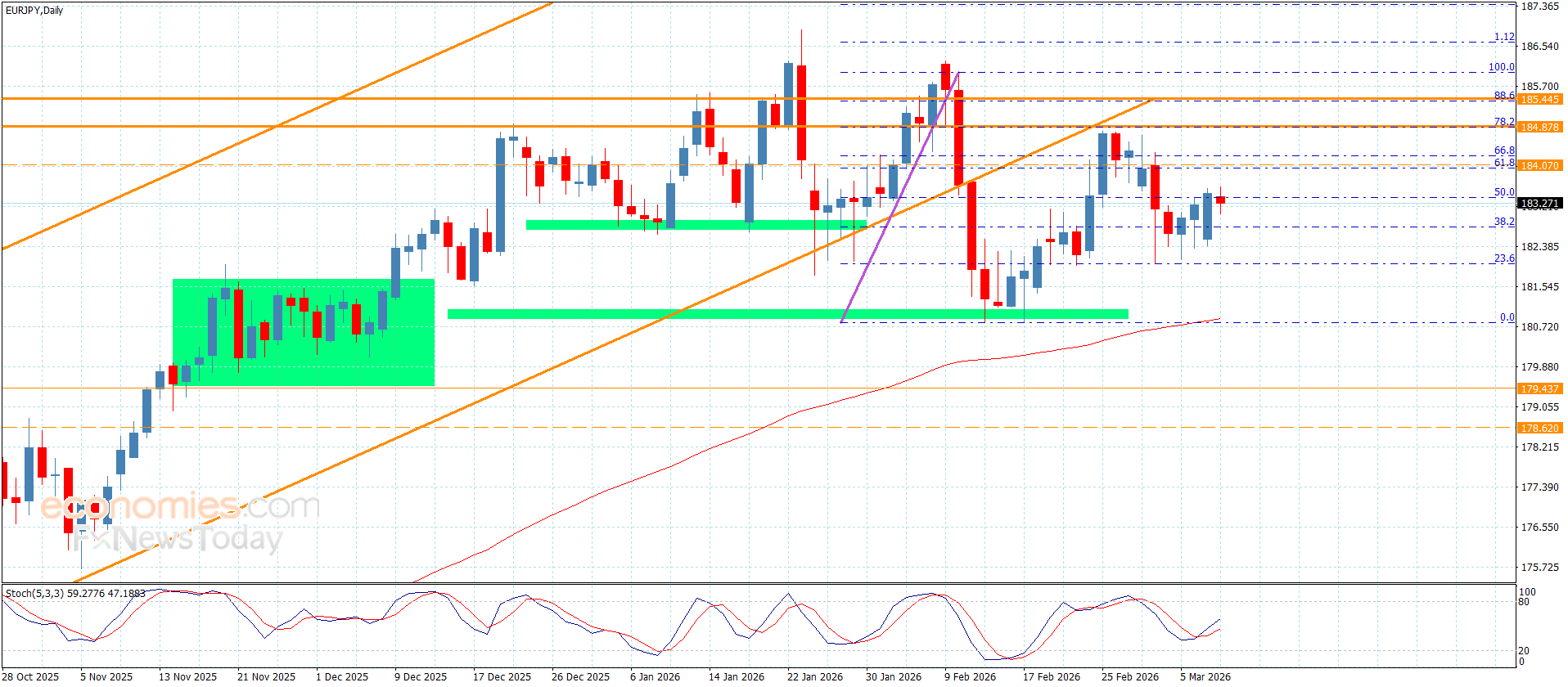
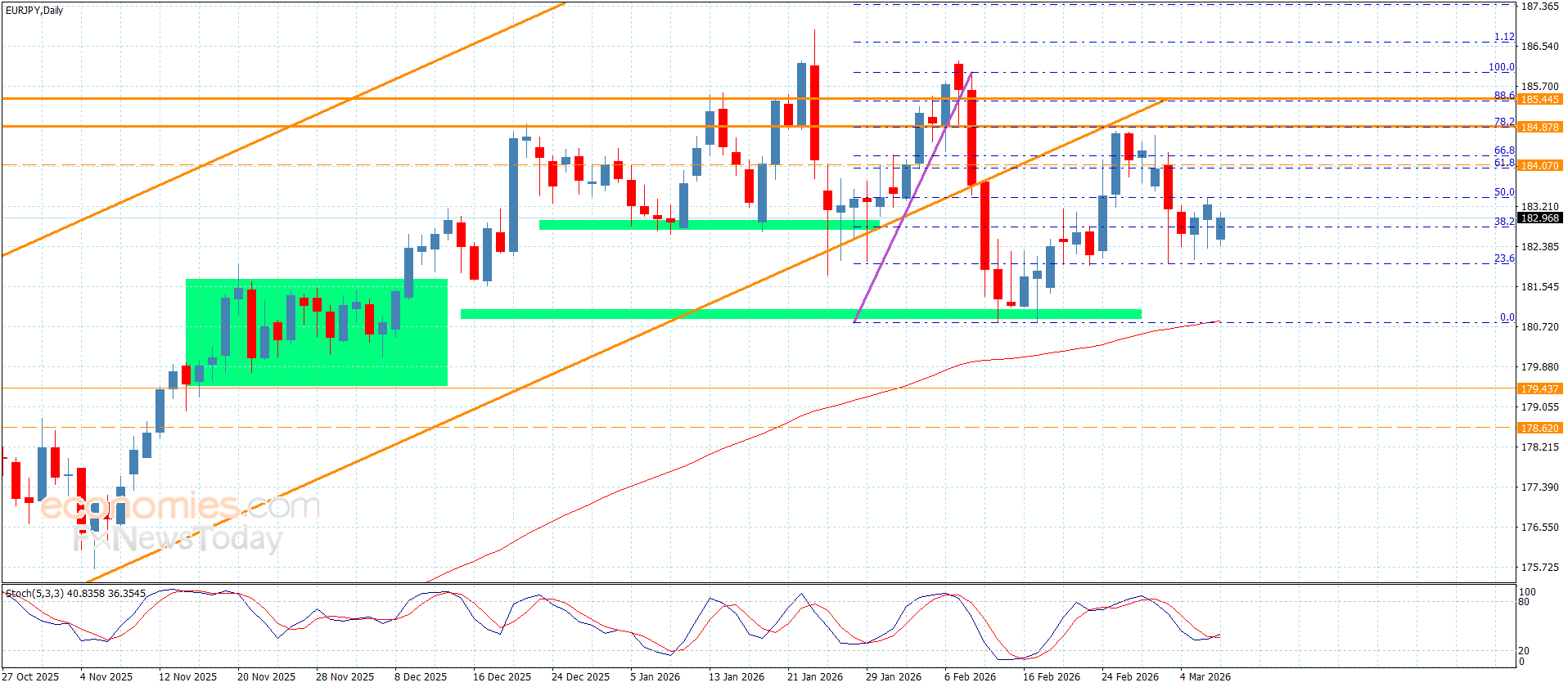
The EURJPY pair began new positivity this morning by its rally towards 186.22, but its neediness to negative momentum that pushed it to retest 184.85 level, to begin forming sideways waves as appears in the above image.


In general, we will keep preferring the bullish bias by the stability of the trading within the bullish channel’s levels and its main support settles near 183.40, therefore, we recommend waiting for gathering bullish momentum in the near period, reinforcing the chances of reaching 186.85, and surpassing it will form next main target at 187.75 in the upcoming trading.


The expected trading range for today is between 184.90 and 186.85


Trend forecast: Bullish


Source link

8 02, 2026

Japanese Yen Weekly Forecast: USD/JPY Tests 158 as Election Looms

By |2026-02-08T20:47:51+02:00February 8, 2026|Forex News, News|0 Comments

USDJPY – Daily Chart – 080226 – The Takaichi Effect

The prospect of an LDP-JIP supermajority in the Lower House supports the bullish short-term outlook for USD/JPY. However, yen intervention threats are likely to continue capping the upside below 160 as seen in January.

Meanwhile, a supermajority would remove the need for Prime Minister Takaichi to make concessions with smaller coalition parties. Over the longer term, this is likely to give the LDP greater control over legislation and ensure prudent fiscal spending, supporting a bearish medium-term outlook for USD/JPY.

Key Japanese Economic Indicators to Look Out For

While the election result will be key to near-term price trends, Japanese economic data will influence the BoJ’s policy stance. On Monday, February 9, wage growth will fuel speculation about a BoJ rate hike. Economists expect average cash earnings to rise 3% year-on-year in December, following a 0.5% increase in November.

A sharp upswing in wage growth would align with the BoJ’s outlook on wages and growing support for rate hikes.

For context, higher wages could boost households’ purchasing power, offsetting the effects of rising import prices. Increased purchasing power, coupled with improving consumer sentiment, would indicate a pickup in spending. Higher spending would fuel demand-driven inflation and bolster the economy, given that private consumption accounts for around 55% of GDP.

Crucially, these scenarios would align with the BoJ’s hawkish quarterly projections, which sent USD/JPY down 1.64% on January 23.

However, leading inflation indicators will also be key given Tokyo’s softer consumer prices in January. Economists expect producer prices to rise 2.3% year-on-year in January, down from 2.4% in December. Holding above the BoJ’s 2% target may revive bets on an H1 2026 rate hike, boosting demand for the yen. A stronger yen would send USD/JPY lower, supporting the bearish medium-term price outlook.

Follow real-time updates to stay ahead of USD/JPY market developments.

US Economic Calendar: Retail Sales, the Jobs Report, and the Fed in Focus

While Japan’s election and Japanese economic data will affect the yen, US economic indicators and Fed rhetoric will influence buying interest in the US dollar.

On Tuesday, February 10, retail sales data will reflect consumer sentiment and economic momentum. Economists forecast retail sales will rise 0.5% month-on-month in December, down from 0.6% in November.

While resilient consumer spending may ease immediate fears of a US recession, the jobs report will be key on Wednesday, February 11.

Economists expect unemployment to remain at 4.4% in January, and wage growth to slow from 3.8% YoY in December to 3.6% YoY in January. Softer wage growth would indicate a drop in consumer spending, dampening demand-driven inflation. A cooler inflation outlook would suggest a more dovish Fed rate path, reaffirming the bearish medium-term price outlook for USD/JPY.

Beyond the data, traders should closely monitor Fed chatter for clues on the timing of a rate cut.

According to the CME FedWatch Tool, the chances of a March 2026 Fed rate cut increased from 13.4% on January 30 to 23.2% on February 6. Additionally, the probability of a June cut rose from 67.3% to 75%. Shifts in the chances of March and June cuts will be key for US dollar trends.

Market View: Medium-Term Yen Strength

In my opinion, USD/JPY would likely fall toward 150 on market bets on multiple Fed rate cuts and a hawkish BoJ policy stance. Narrowing US-Japan rate differentials would affirm the bearish medium-term (4-8 weeks) outlook. A drop below 150 would reaffirm the longer-term (8-16 weeks) 145-140 range.

Counter-Trend Risks: What Could Send USD/JPY Toward 160?

Upside risks include:

  • LDP-JIP wins a landslide election and announces aggressive fiscal spending plans.
  • Upbeat US economic data and Fed rhetoric cool bets on an H1 2026 rate cut.
  • Weaker Japanese economic data temper BoJ rate hike expectations.

Despite the upside risks, yen intervention threats are likely to cap upside around 160. Given the upside risks, a breakout above 158 would pave the way toward January’s high of 159.453. A move toward 159.453 would invalidate the medium-term bearish structure.

Financial Analysis

Technical Outlook: Bearish Momentum Building

On the daily chart, USD/JPY traded above its 50-day and 200-day Exponential Moving Averages (EMAs). The EMA positions signaled a bullish bias. However, favorable yen fundamentals continue to counter technicals, supporting the negative outlook for USD/JPY.

A drop below the 50-day EMA would expose 155. If breached, the 200-day EMA would be the next key technical support level. Crucially, a sustained fall through the EMAs would indicate a bearish trend reversal, bringing the 150 support level into play. A break below 150 would enable the bears to target the 145-140 range, aligning with the longer-term price projection.

Source link

8 02, 2026

Weekly Forex Forecast – 08th to 13th February 2026 (Charts)

By |2026-02-08T16:47:11+02:00February 8, 2026|Forex News, News|0 Comments

I wrote on the 1st February that the best trades for the week would be:

  1. Long of the EUR/USD currency pair following a daily close above $1.2039. This did not set up.

A summary of last week’s most important data in the market:

  1. Preliminary UoM Inflation Expectations – fell from 4.0% to 3.5%.
  2. European Central Bank Main Refinancing Rate & Monetary Policy Statement – rates left on hold as expected.
  3. Bank of England Official Bank Rate, Votes, Monetary Policy Summary & Report – rates left on hold as expected, but there were a couple more abstentions on the vote than were expected, which was a minor dovish tilt, boosting chances of a rate cut in the near term.
  4. RBA Cash Rate, Rate Statement, and Monetary Policy Statement – the RBA hiked its interest rate by 0.25% as was expected, albeit with 73% probability, so the Australian Dollar rose following this news.
  5. US JOLTS Job Openings – this was a little worse than expected, which was slightly negative news on the US economy.
  6. Preliminary UoM Consumer Sentiment – stronger than expected, which was positive news on the US economy.
  7. US ISM Services PMI – approximately as expected.
  8. US ISM Manufacturing PMI– considerably stronger than expected, which was positive news on the US economy.
  9. New Zealand Unemployment Rate – unexpectedly ticked higher to 5.4%.
  10. Canada Unemployment Rate – unexpectedly fell from 6.8% to 6.5%.
  11. US Unemployment Claims – slightly higher than expected.

The only two elements here which really affected the markets last week was the continued bullish performance of the US economy, which keeps rate cut expectations low, and the RBA’s rate hike which kept the Australian Dollar performing as the strongest major currency.

The other two relevant issues are

  1. The continuing US military build up against Iran, although the USA and Iran began talks last Friday, with President Trump publicly saying they are going well. Prediction markets currently see a US attack on Iran before July as unlikely.
  2. An election to the more powerful Lower House of the Japanese Parliament is being held today (Sunday), and opinion polls suggest the new LDP administration will probably win a landslide. This may weaken the Japanese Yen further as the administration truly requires a weaker Yen, or it could be a case of “sell the fact”, which would present a Yen rebound recovery when results start to emerge.

The coming week’s most important data points, in order of likely importance, are:

  1. US CPI (inflation)
  2. US Average Hourly Earnings
  3. US Retail Sales
  4. US Non-Farm Employment Change
  5. Swiss CPI (inflation)
  6. UK GDP
  7. US Unemployment Rate
  8. US Unemployment Claims

Wednesday will be a public holiday in Japan.

Currency Price Changes and Interest Rates

For the month of February, I forecasted that the EUR/USD currency pair would rise in value.

Weekly Forex Forecast – 08th to 13th February 2026 (Charts)

February 2026 Monthly Forecast Performance to Date

Last week saw one cross with excessive volatility, so I made the following weekly forecast:

The Australian Dollar was the strongest major currency last week, while the Japanese Yen was the weakest. Directional volatility rose significantly last week, with one third of all major pairs and crosses changing in value by more than 1%.

Next week’s volatility is likely to be similar.

You can trade these forecasts in a real or demo Forex brokerage account.

Weekly Forex Forecast – 08th to 13th February 2026 (Charts)

Key Support and Resistance Levels

Last week, the US Dollar Index printed a bullish candlestick which closed higher but with a significant upper wick, signifying some indecision. This is weakly bullish by itself, but we also have a long-term bearish trend with the price below its levels of both 13 and 26 weeks ago. This gives us a conflicted technical picture about the US Dollar.

So, I see the outlook now as uncertain and the best market opportunities will probably not be US Dollar-dependent.

Weekly Forex Forecast – 08th to 13th February 2026 (Charts)

US Dollar Index Weekly Price Chart

The AUD/JPY currency cross made a very strong upwards move, with the weekly close almost right at the high of the range, with unusually high volatility. The price made a bullish breakout to a new 30+ year high.

These are very bullish signs, as are the facts that the Australian Dollar was the strongest major currency last week, backed by an RBA rate hike, while the Japanese Yen continues to depreciate against most currencies as part of its long-term bearish trend, driven by the massive level of Japanese debt.

While this may look like the perfect bullish storm, an excessive weekly move like this is often followed by a retracement for at least a few days, so a drop in price over the next week would not surprise me.

This pair is likely to see the most action in the Forex market next week, at least until the US CPI data is released, so it might be interesting for swing traders on the long side or day traders on the short side.

Weekly Forex Forecast – 08th to 13th February 2026 (Charts)

AUD/JPY Weekly Price Chart

The major US equity indices like the S&P 500 Index and the tech-focused NASDAQ 100 Index are looking very choppy as they struggle to make new highs, showing swings with high volatility. This suggests an unstable market which, although bullish, may be about to reverse.

Yet, the old fashioned, old economy Dow Jones Industrial Average had a very strong week, closing right on its high at a new record, and breaking the big round number at 50,000 too. These are bullish signs, suggesting that it is the big tech firms which dominate the major indices which are causing poor price action. Away from the big tech giants, we see the basic sectors of the old economy doing well enough to make new record highs.

I am not strongly confident of this trade, but I think a long trade here with a trailing stop loss, due to the US economy’s historically strong track record, is worth taking. You might want to use a smaller than usual position size, like 50% for example.

Weekly Forex Forecast – 08th to 13th February 2026 (Charts)

Dow Jones Industrial Average Weekly Price Chart

BTC/USD has continued to make significant bearish breakdowns below a few long-term support levels from just above $81,000 and has recently reached a new 16-month low. This is technically very significant in a bearish way.

While stocks and precious metals were rising strongly over recent months, Bitcoin fell from a record high a few months ago and continued to decline. It is clear the crypto sector is in decline, and that Bitcoin is in serious trouble. Bitcoin was meant to change the world, but outside of Africa, is just has not – you still can’t use it and it is unclear what value it really holds.

I do not like shorting assets, and Bitcoin now seems to be staging a recovery, with a significantly long lower wick now showing on the current weekly candlestick.

I think the price to watch is the support level at about $68,500. If the price action settles above this support, the fall will likely at least pause for a while. If the price action settles below this level, we will likely see a further drop towards the $50,000 area soon.

Weekly Forex Forecast – 08th to 13th February 2026 (Charts)

Bitcoin Weekly Price Chart

Gold, like Silver, saw a massive drop in just a day or two at the end of January. The drop is Silver was stronger, but Gold fell quickly from a record high at about $5,600 to a low at $4,400 by the end of the week, which is shown within the daily price chart below.

Applying a Fibonacci retracement study, we can see that the halfway level of this movement is very confluent with a major round number at $5,000 and this has held firmly as resistance.

The price action suggests we are going to get a consolidation now on gradually declining volatility, like a struck tuning fork playing itself out.

I think short trades from rejections of the $5,000 level as this plays out, provided they are handled skillfully as short-term trades on lower timeframes, is probably going to be the best strategy for trading Gold over the coming week.

If the price gets established above $5,000 that will be a contradictory bullish sign.

Weekly Forex Forecast – 08th to 13th February 2026 (Charts)

Gold Daily Price Chart

I see the best trades this week as:

  1. Long of the Dow Jones Industrial Average.

Ready to trade our Forex weekly forecast? Check out our list of the best Forex brokers.

Source link

8 02, 2026

UBS Reveals Crucial Range-Bound Outlook as Budget Fears Subside

By |2026-02-08T12:45:36+02:00February 8, 2026|Forex News, News|0 Comments

BitcoinWorld

EUR/GBP Forecast: UBS Reveals Crucial Range-Bound Outlook as Budget Fears Subside

LONDON, March 2025 – The EUR/GBP currency pair enters a critical consolidation phase as UBS analysts project sustained range-bound trading following the dissipation of UK budget risk premiums. This development signals a pivotal shift in cross-channel currency dynamics that will influence international trade, investment flows, and monetary policy coordination between the Eurozone and United Kingdom.

EUR/GBP Forecast: Understanding the Range-Bound Thesis

UBS Global Wealth Management recently published comprehensive analysis indicating the EUR/GBP pair will likely trade within a narrow band of 0.8550 to 0.8750 throughout 2025. This projection emerges from converging economic fundamentals between the Eurozone and United Kingdom. The Swiss financial institution bases its assessment on multiple quantitative models incorporating inflation differentials, interest rate expectations, and trade balance developments.

Market participants initially priced significant risk premiums into Sterling during the UK’s autumn budget uncertainty. However, subsequent fiscal clarity and improved debt sustainability metrics have gradually eroded these premiums. Consequently, the currency pair has stabilized around technical support and resistance levels established over the past eighteen months. This stabilization reflects broader market recognition that both economies face similar structural challenges despite different monetary policy approaches.

Budget Risk Premium Dynamics and Their Fading Impact

The concept of budget risk premium refers to the additional yield or currency depreciation investors demand when sovereign fiscal policy appears unsustainable. During the UK’s budget formulation process last autumn, markets expressed concern through Sterling weakness against major counterparts. UBS tracking data reveals this premium reached approximately 1.5% at its peak in November 2024.

Several factors contributed to the premium’s subsequent decline:

  • Fiscal credibility restoration: The UK government implemented measured spending adjustments
  • Debt trajectory improvement: Revised Office for Budget Responsibility projections showed manageable ratios
  • Market confidence rebuilding: Institutional investors gradually returned to UK gilts
  • Comparative analysis: Recognition that Eurozone members face similar demographic pressures

As the premium evaporated, EUR/GBP volatility declined significantly. The 30-day realized volatility metric dropped from 8.2% in December 2024 to 5.1% by February 2025. This compression created ideal conditions for range-bound behavior as directional catalysts diminished.

Technical and Fundamental Convergence

Currency analysts observe remarkable alignment between technical patterns and fundamental drivers. The pair has established clear support near the 0.8550 level, corresponding with the 200-day moving average and the psychological 0.8500-0.8550 zone where substantial option barriers reside. Resistance consistently emerges around 0.8750, aligning with the 61.8% Fibonacci retracement of the 2023-2024 downward move.

Fundamentally, both economies exhibit parallel characteristics:

Metric Eurozone United Kingdom
Core Inflation 2.8% 3.1%
GDP Growth Forecast 1.2% 1.4%
Central Bank Policy Rate 2.75% 3.25%
Current Account Balance +2.1% of GDP -1.8% of GDP

These converging metrics reduce the likelihood of significant divergence that would typically drive sustained directional moves. Market participants increasingly recognize that relative performance matters more than absolute outcomes for currency pair dynamics.

Monetary Policy Implications for EUR/GBP Trading Ranges

The European Central Bank and Bank of England maintain cautiously divergent policy stances, yet their ultimate trajectories appear more synchronized than markets previously anticipated. Both institutions have signaled a gradual normalization process rather than aggressive easing cycles. This policy parallelism reinforces the range-bound thesis.

ECB President Christine Lagarde emphasized data-dependent approach during her latest press conference, specifically noting that “monetary policy transmission remains strong but uneven across member states.” Simultaneously, Bank of England Governor emphasized the need to “see sustained evidence of inflation returning to target” before considering rate adjustments. These communications create a policy environment where interest rate differentials should remain relatively stable.

Forward rate agreements currently price approximately 50 basis points of easing from both central banks over the next twelve months. This synchronized expectation further supports the range-bound forecast, as currency markets typically respond to differentials rather than absolute rate levels.

Trade Flow and Investment Pattern Analysis

Bilateral trade between the Eurozone and United Kingdom has stabilized following post-Brexit adjustments. Goods trade now flows through established customs procedures, while services trade has developed new regulatory frameworks. The resulting predictability reduces currency volatility associated with trade surprises.

Investment patterns reveal similar stabilization. UK-based investors continue allocating to Eurozone equities and bonds, while European investors maintain substantial UK asset holdings. These cross-border investments create natural hedging flows that dampen currency movements. Portfolio rebalancing typically occurs within established ranges unless fundamental dislocations emerge.

Historical Context and Comparative Analysis

The current range-bound projection contrasts sharply with historical EUR/GBP behavior. The pair experienced significant volatility during several previous periods:

  • 2016 Brexit referendum: 15% single-day move
  • 2020 pandemic crisis: 8% weekly volatility spikes
  • 2022 energy crisis: Sustained directional trends

Present conditions differ fundamentally because both economies face similar external shocks and internal adjustments. Energy security improvements, supply chain diversification, and inflation management approaches show remarkable convergence. This synchronization reduces the probability of asymmetric shocks that would typically drive sustained currency moves.

Comparative analysis with other major currency pairs reinforces the uniqueness of current EUR/GBP dynamics. While USD pairs experience Federal Reserve-driven volatility and JPY pairs respond to Bank of Japan policy shifts, EUR/GBP benefits from regional economic integration despite political separation. This creates a distinctive market microstructure where range-trading strategies often outperform directional approaches.

Market Participant Implications and Trading Strategies

The range-bound forecast carries significant implications for different market participants:

Corporate treasurers can implement more predictable hedging programs with reduced volatility premiums. Institutional investors may adjust currency overlay strategies to emphasize yield capture rather than directional positioning. Retail traders might find range-trading approaches more effective than breakout strategies that dominated previous periods.

Several specific strategies gain prominence in this environment:

  • Option range structures: Selling strangles or iron condors around technical boundaries
  • Carry trade optimization: Exploiting stable interest rate differentials
  • Mean reversion systems: Automated trading near range extremes
  • Volatility harvesting: Selling volatility during compression phases

Risk management considerations shift accordingly. Tail risk protection becomes less expensive as implied volatility declines, while position sizing may increase due to reduced uncertainty. However, traders must remain vigilant for potential range breaks if unexpected divergence emerges between the two economies.

Geopolitical and Regulatory Considerations

Ongoing EU-UK regulatory alignment discussions create additional stability. Financial services equivalence negotiations, though progressing slowly, establish frameworks for cross-border activity. Meanwhile, the Windsor Framework implementation has reduced Northern Ireland-related uncertainties that previously affected Sterling sentiment.

Geopolitical developments affect both currencies similarly. Energy security initiatives, climate transition investments, and defense spending increases show parallel trajectories. This common exposure means external shocks typically impact both currencies in comparable magnitude, preserving their relative valuation.

Conclusion

The EUR/GBP currency pair appears destined for extended range-bound trading as budget risk premiums fade and economic fundamentals converge. UBS analysis correctly identifies the diminishing catalysts for sustained directional moves, pointing toward a consolidation phase where technical boundaries gain increased significance. Market participants should prepare for an environment where relative value analysis and range-trading strategies outperform directional approaches. This EUR/GBP forecast reflects broader financial market normalization following years of exceptional volatility, representing a maturation in cross-channel economic relations that benefits traders, corporations, and policymakers alike.

FAQs

Q1: What does “range-bound” mean for EUR/GBP?
A range-bound market refers to a currency pair trading within established upper and lower boundaries without breaking out to new highs or lows. For EUR/GBP, UBS identifies 0.8550 as key support and 0.8750 as primary resistance.

Q2: How long might this range-bound period last?
While precise timing remains uncertain, UBS analysis suggests the range could persist throughout 2025 unless unexpected economic divergence emerges between the Eurozone and United Kingdom.

Q3: What would break the EUR/GBP out of its range?
Sustained breakout would require significant divergence in monetary policy, unexpected inflation developments, geopolitical events affecting one region disproportionately, or substantial changes in trade or capital flows.

Q4: How does budget risk premium affect currency values?
Budget risk premium represents the additional compensation investors demand when fiscal policy appears unsustainable. As this premium increases, the affected currency typically weakens. Conversely, premium reduction supports currency stabilization or strengthening.

Q5: What trading strategies work best in range-bound markets?
Range-trading approaches like buying near support and selling near resistance often prove effective. Option strategies that benefit from time decay and volatility compression also perform well, while breakout strategies typically underperform during consolidation phases.

This post EUR/GBP Forecast: UBS Reveals Crucial Range-Bound Outlook as Budget Fears Subside first appeared on BitcoinWorld.

Source link

7 02, 2026

Pound to Dollar Forecast: GBP Under Pressure as BoE Signals Cuts Ahead

By |2026-02-07T12:39:37+02:00February 7, 2026|Forex News, News|0 Comments


– Written by

The Pound to Dollar exchange rate (GBP/USD) has come under renewed pressure as a knife-edge Bank of England decision collides with rising UK political uncertainty, reviving downside risks for Sterling just as markets begin to price earlier interest-rate cuts.

A sharply divided Monetary Policy Committee and leadership speculation surrounding Prime Minister Starmer have unsettled investors, leaving GBP/USD vulnerable near key support levels amid broader FX volatility.

GBP/USD Forecasts: 10-Day Low

The Pound to Dollar (GBP/USD) exchange rate was subjected to heavy losses after the Thursday open amid UK political fears.

After a tentative recovery, there was a fresh U-turn following a dovish Bank of England policy decision with GBP/USD sliding to 10-day lows below 1.3550 before a recovery to 1.3590 as wider FX volatility spiked.

ING commented; “Today’s dovish communication from the BoE has added to a softer pound – already under pressure from local politics.”

A sustained break below the 1.3550-70 support area would risk further losses.

Save on Your GBP/USD Transfer

Get better rates and lower fees on your next international money transfer.
Compare TorFX with top UK banks in seconds and see how much you could save.


Compare the Best GBP/USD Rates »

The dollar secured wider gains amid weaker equities, but then retreated after a higher than expected figure for US jobless claims.

ING pointed to underlying market stresses; “A burgeoning sell-off in US tech stocks and ongoing volatility in the metals markets are providing many cross-currents for FX.”

The Bank of England (BoE) Monetary Policy Committee (MPC) held interest rates at 3.75% following the latest policy decision, in line with strong consensus forecasts.

There was, however, a very narrow 5-4 vote for the decision as Dhingra, Taylor, Ramsden and Breedon voted for a further 25 basis-point cut to 3.50%.

The majority commented that further evidence was needed on wages and inflation before having confidence in another cut.

Bailey and Mann, however, had greater confidence in the inflation outlook which suggested that they were very close to backing a cut at this meeting.

According to the dissenters, inflation risks had declined further and that policy was too restrictive which justified a further cut.

There was some relief in the bond market with the 10-year yield retreating to around 4.53% from 4.58% earlier in the session.

Following the decision, markets are pricing in 50 basis points in cuts this year compared with 35 basis points ahead of the latest decision.

According to MUFG; “It certainly looks like we could get a cut as early as the next policy meeting.”

Danske Bank Analyst Kirstine Kundby-Nielsen commented; “I think it will be pretty tight whether it will be a March or April cut, but I think the point is that, prior to this it was priced that we would see only one more cut, but now two could definitely be in play.”

According to Schroders senior economist George Brown; “Today’s rate decision was seen as a foregone conclusion, but the Bank’s close vote to hold rates suggests cuts are not a matter of if, but when.”

He sees scope for Governor Bailey to back one or two cuts over the next few months.

Nevertheless, he added; “However, the Bank will have to act soon if it intends to cut, before that window closes and the opportunity for further easing slams shut in the second half of the year.”

Political difficulties for Prime Minister Starmer have also undermined the Pound amid concerns over a challenge on Starmer which could jeopardise the position of Chancellor Reeves.

BBH commented; “GBP and gilts plunged, driven by UK political uncertainty. Prime Minister Keir Starmer is facing intense leadership speculation over his decision to appoint Peter Mandelson as US ambassador, despite knowing about his connection to Jeffrey Epstein.”

Like this piece? Please share with your friends and colleagues:


International Money Transfer? Ask our resident FX expert a money transfer question or try John’s new, free, no-obligation personal service! ,where he helps every step of the way,
ensuring you get the best exchange rates on your currency requirements.

TAGS: Pound Dollar Forecasts

Source link

7 02, 2026

Forecast update for EURUSD -06-02-2026.

By |2026-02-07T08:38:42+02:00February 7, 2026|Forex News, News|0 Comments

The EURJPY pair provided several weak sideways trading, delaying the bullish trend due to its stability below 185.45 barrier, to form some mixed trading by reaching 184.35 level.


Note that stochastic exit from the overbought level might increase the negative pressures on the trading, forcing it to provide negative corrective trading, to target 183.85 level reaching the bullish channel’s support at 183.20, while breaching the barrier and holding above it will reinforce the chances of recording extra gains that might begin at 186.20.


The expected trading range for today is between 183.85 and 185.40


Trend forecast: Fluctuating within the bullish trend


Source link

7 02, 2026

Pound Sterling tests key support ahead of a big week

By |2026-02-07T04:37:52+02:00February 7, 2026|Forex News, News|0 Comments

The Pound Sterling (GBP) changed course against the US Dollar (USD), with GBP/USD giving up nearly 200 pips in a dramatic correction.

Pound Sterling gave in to the USD resurgence

GBP/USD faced a double whammy during the week, with resurgent haven demand for the US Dollar (USD) on one hand. While the dovish Bank of England (BoE) interest rate on hold decision smashed the pair on the other hand.

In doing so, the pair reversed a majority of gains seen from the beginning of this year, extending the correction from over four-year highs of 1.3869 reached on January 27.

The Greenback attracted haven demand as markets embarked on a solid rotation spree, with capital flowing out of overvalued and growth assets, such as tech stocks, Gold, Silver etc., into value assets and undermined ones like the USD.

Markets resorted to ‘sell-everything’ mode as the AI rout deepened, boosting the USD recovery against its six major currency rivals. The end of the partial government shutdown on Tuesday also helped the buck maintain its ground, despite a slew of weak US labor data and concerns over the US Federal Reserve’s (Fed) monetary policy outlook under the leadership of Kevin Warsh.

The Automatic Data Processing (ADP) Research Institute said on Wednesday, private sector employment in the US rose 22,000 in January, against a forecast of 48,000. Meanwhile, Initial claims for ‌state unemployment benefits jumped 22,000 to a seasonally adjusted 231,000 for the week ended January 31, the ‌Labor Department said on Thursday.

“The US December JOLTS report shows a steep drop-off in job openings to 6.54 million from a downwardly revised 6.93 million level in November,” according to ING Bank.

In the second half of the week, the dovish BoE storm pounded the Pound Sterling further. The UK central bank kept interest rates on hold at 3.75% in February.

The BoE nine-member Monetary Policy Committee (MPC) voted by a slim 5:4 majority to keep rates steady. Four members voted to lower rates. 

Expectations of a sharp drop in inflation in the coming months also added to the dovish BoE outlook, fueling bets for a rate cut as early as next month.

 Key US and UK economic data to watch out for

In light of the dovish tilt, the focus is now on a series of speeches from BoE policymakers, with Governor Andrew Bailey’s appearance late Sunday eagerly awaited.

A slew of Fed and BoE officials are also set to speak on Tuesday, with Monday being a data-light day.

Tuesday will also feature the US Retail Sales report and the quarterly Employment Cost Index.

On Wednesday, the delayed US January jobs data will be published, with key focus on the headline Nonfarm Payrolls print.

The quarterly and monthly Gross Domestic Product (GDP) data will be released from the United Kingdom (UK) on Thursday, followed by the US Jobless Claims data.

On Friday, BoE Chief Economist Huw Pill will participate in a fireside chat at an event hosted by Santander Bank in London ahead of the critical US Consumer Price Index (CPI) inflation report.

Besides these economic events, geopolitics will continue to grab attention amid US President Donald Trump’s erratic international policies.

GBP/USD Technical Analysis

The 21-, 50-, 100- and 200-day Simple Moving Averages (SMA) all rise, with the shorter ones positioned above the longer, reinforcing buyers’ control. Price holds above these markers, with the 21-day SMA at 1.3564 offering nearby dynamic support. The Relative Strength Index (RSI) stands at 51 (neutral) and has edged higher, hinting stabilizing momentum. Measured from the 1.3346 low to the 1.3868 high, the 61.8% retracement at 1.3545 offers a floor, while the 50.0% retracement at 1.3607 is the level bulls would seek to reclaim to extend the advance.

Shorter SMAs continue to advance over the medium-term ones, and the broader set trends higher, underpinning an upward bias. The pair trades above the 50-day SMA at 1.3475 and the 200-day SMA at 1.3430, keeping dip-buying interest intact. RSI near 51 remains neutral; a firm move above 60 would strengthen the upside impulse. On setbacks, the 100-day SMA at 1.3379 would serve as the next layer of support.

(The technical analysis of this story was written with the help of an AI tool.)

GDP FAQs

A country’s Gross Domestic Product (GDP) measures the rate of growth of its economy over a given period of time, usually a quarter. The most reliable figures are those that compare GDP to the previous quarter e.g Q2 of 2023 vs Q1 of 2023, or to the same period in the previous year, e.g Q2 of 2023 vs Q2 of 2022.
Annualized quarterly GDP figures extrapolate the growth rate of the quarter as if it were constant for the rest of the year. These can be misleading, however, if temporary shocks impact growth in one quarter but are unlikely to last all year – such as happened in the first quarter of 2020 at the outbreak of the covid pandemic, when growth plummeted.

A higher GDP result is generally positive for a nation’s currency as it reflects a growing economy, which is more likely to produce goods and services that can be exported, as well as attracting higher foreign investment. By the same token, when GDP falls it is usually negative for the currency.
When an economy grows people tend to spend more, which leads to inflation. The country’s central bank then has to put up interest rates to combat the inflation with the side effect of attracting more capital inflows from global investors, thus helping the local currency appreciate.

When an economy grows and GDP is rising, people tend to spend more which leads to inflation. The country’s central bank then has to put up interest rates to combat the inflation. Higher interest rates are negative for Gold because they increase the opportunity-cost of holding Gold versus placing the money in a cash deposit account. Therefore, a higher GDP growth rate is usually a bearish factor for Gold price.

Source link

7 02, 2026

USD/JPY Forecast Today 06/02: Overbought Condition (Chart)

By |2026-02-07T00:36:36+02:00February 7, 2026|Forex News, News|0 Comments

  • The US dollar tried to rally against the Japanese yen early on Thursday, however, we have since seen a bit of exhaustion.

The US dollar tried to rally against the Japanese yen early on Thursday but has turned around to show signs of exhaustion. That’s not a huge surprise though because quite frankly we have been straight up in the air for a while and it does make a certain amount of sense that sooner or later sellers come in and push the market back down and of course buyers run out of momentum and new buyers to join them.

That being said this is a market that still favors the upside as far as an interest rate differential argument is concerned and with that being said short term pullbacks, I think are going to end up being buying opportunities. The 50-day EMA is going to offer support underneath and then after that we could talk about the 155-yen level.

Market Memory and Technical Support

The 158 yen level above is a significant target over the longer term and it’s an area that I think probably will have a lot of market memory attached to it because we had some type of intervention there but all things being equal any pullback from here probably offers a little bit of buying opportunity with the 200-day EMA perhaps being the absolute floor.

I don’t have any issue whatsoever in buying this pair on a pullback that bounces because not only do I get paid at the end of every day, but the overall uptrend still is strong. If we can break out above the recent swing high, then the 160-yen level becomes a very important level.

Keep in mind this is an area that’s significant on the monthly chart going back decades that we had just pulled back from so a couple of attempts before we can finally break out would not be a huge surprise to me at all. Regardless I don’t have any interest in buying the yen so I’m looking for buying opportunities here.

Want to trade our USD/JPY forex analysis and predictions? Here’s a list of forex brokers in Japan to check out.

Christopher Lewis has been trading Forex and has over 20 years experience in financial markets. Chris has been a regular contributor to Daily Forex since the early days of the site. He writes about Forex for several online publications, including FX Empire, Investing.com, and his own site, aptly named The Trader Guy. Chris favours technical analysis methods to identify his trades and likes to trade equity indices and commodities as well as Forex. He favours a longer-term trading style, and his trades often last for days or weeks.

Source link

6 02, 2026

EUR/USD Forecast Today 06/02: Up or Down? (Video&Chart)

By |2026-02-06T20:35:51+02:00February 6, 2026|Forex News, News|0 Comments

  • The Euro has been slightly negative during fairly quiet trading on Thursday, as the ECB rate decision has come and gone.
  • At this point, the market looks like it is ready to make a decision.

The Euro has been slightly negative during fairly quiet trading on Thursday despite the fact that we had an ECB decision. Ultimately, not much changed. That is not a huge surprise because quite frankly, that is what we had anticipated. So, we are just hanging around the 1.18 level, and we will have to look through this market through the prism of what the US dollar is doing.

During the trading session, it has been a touch stronger against Europe and a touch weaker against Asia—at least some Asia. So, with that being said, I think we have a potential for a move to the upside on any type of momentum breaking above the 1.1850 level.

Binary Choice for Momentum

If we break above there, then the 1.20 level would be the target. If we break down from here, then we will test the 50-day EMA. If we were to break down below the 50-day EMA, then it opens up the Euro to go to the 1.16 level, which is just sitting right around the 200-day EMA.

We are essentially in the middle of a binary choice like this, so that being said, if we see some type of momentum, I think we have a couple of targets ahead of us based on those. We will have to wait and see how Friday plays out, but as things stand right now, we still have a situation where we broke out of consolidation, we pulled back to retest that previous resistance. Now the question is, will we find buyers to push this thing to the upside?

Ready to trade our daily Forex analysis? We’ve made this forex brokers list for you to check out.

Christopher Lewis has been trading Forex and has over 20 years experience in financial markets. Chris has been a regular contributor to Daily Forex since the early days of the site. He writes about Forex for several online publications, including FX Empire, Investing.com, and his own site, aptly named The Trader Guy. Chris favours technical analysis methods to identify his trades and likes to trade equity indices and commodities as well as Forex. He favours a longer-term trading style, and his trades often last for days or weeks.

Source link

Go to Top