The main tag of Gold Price Articles.
You can use the search box below to find what you need.
[wd_asp id=1]
The main tag of Gold Price Articles.
You can use the search box below to find what you need.
[wd_asp id=1]
At 18:22 GMT, XAGUSD is trading $76.27, down $39.30 or -34%.
Given the tremendous downside momentum, all we can do is treat this trend line as a target. We have to wait patiently while it’s being tested because momentum selling can and will take it out. However, there is always the chance of recovery. What we could see if you watch closely is how professionals trade versus non-professionals.
The non-professional will place orders to buy on the trend line, but the professional will let the market test or go through the trendline then start taking out offers if and when it turns higher. This is the point where the non-professional complains that they were going after his stop. However, this is not the case. The difference is the non-professional placed an order thinking it would stop the decline, but the professional is thinking, let it go until it stops then catch the intraday reversal when the selling is over. In my world, if I want to be long, I take offers, I don’t bid because I’m not big enough to stop the market.
With the selling obvious and the market down more than half of its January rally, we may finally get to see what the market perceives as real value. We know that 50% of the rally from $45.55 to $121.67 is $83.61 so that’s a great place to start. We see that the low of the day at 18:09 GMT is $83.06. Since you may have missed the bottom at $45.55 and you may not have wanted it at $121.67, the 50% price at $83.61 may look attractive if you are looking for the bull market to continue over the long-run.
The Fibonacci 61.8% retracement level is $74.63. This may even be a better price to resume the rally since it forms a cluster with the 50-day moving average at $74.55.
So going into the close and the weekend, we’ll have to decide if the 50% level at $83.61 is our value or if we should wait for another clean break into $74.63 to $74.55.
Gold’s (XAU/USD) rally came to an abrupt halt on Thursday. The precious metal dropped nearly 10% in less than 24 hours and is trading around $5,080 at the time of writing, with the $5,000 psychological level at a short distance.
US President Trump seems set to name former Fed Governor Kevin Warsh as the next central bank Chairman, which has provided some relief to investors, wary about the Fed’s independence. It is debatable, however, whether that alone can justify the sharp reversal in precious metals, especially given that Trump has launched a new tariff threat against countries supplying oil to Cuba and that tensions in the Middle East remain high.
Gold was rejected a few pips shy of the $5,600 area on Thursday and is forming an impulsive bearish candle in the daily chart on Friday, which, if confirmed, will complete an “Evening Star” candle pattern, a signal that often announces a trend shift.
The 4-hour chart shows prices moving at a short distance from the $5,000 level, with technical indicators trending lower. The Moving Average Convergence Divergence (MACD) line shows a sharp cross below the Signal line and a widening negative histogram, and the Relative Strength Index (RSI) prints at 43.76 (neutral below the midline), reinforcing the bearish momentum.
A confirmation below $5,000 and the January 26 low, at $4,980, would bring the 100-period SMA, now at $4,822, and the January 21 low, near $4,755, to the focus. On the upside, the intra-day high, at $5,450, is likely to close the path towards the all-time highs, at $5,595, hit on Thursday.
(The technical analysis of this story was written with the help of an AI tool.)
Gold has played a key role in human’s history as it has been widely used as a store of value and medium of exchange. Currently, apart from its shine and usage for jewelry, the precious metal is widely seen as a safe-haven asset, meaning that it is considered a good investment during turbulent times. Gold is also widely seen as a hedge against inflation and against depreciating currencies as it doesn’t rely on any specific issuer or government.
Central banks are the biggest Gold holders. In their aim to support their currencies in turbulent times, central banks tend to diversify their reserves and buy Gold to improve the perceived strength of the economy and the currency. High Gold reserves can be a source of trust for a country’s solvency. Central banks added 1,136 tonnes of Gold worth around $70 billion to their reserves in 2022, according to data from the World Gold Council. This is the highest yearly purchase since records began. Central banks from emerging economies such as China, India and Turkey are quickly increasing their Gold reserves.
Gold has an inverse correlation with the US Dollar and US Treasuries, which are both major reserve and safe-haven assets. When the Dollar depreciates, Gold tends to rise, enabling investors and central banks to diversify their assets in turbulent times. Gold is also inversely correlated with risk assets. A rally in the stock market tends to weaken Gold price, while sell-offs in riskier markets tend to favor the precious metal.
The price can move due to a wide range of factors. Geopolitical instability or fears of a deep recession can quickly make Gold price escalate due to its safe-haven status. As a yield-less asset, Gold tends to rise with lower interest rates, while higher cost of money usually weighs down on the yellow metal. Still, most moves depend on how the US Dollar (USD) behaves as the asset is priced in dollars (XAU/USD). A strong Dollar tends to keep the price of Gold controlled, whereas a weaker Dollar is likely to push Gold prices up.
The Natural Gas Price Index has experienced notable fluctuations in recent months due to supply-demand shifts, geopolitical factors, and seasonal energy consumption. Understanding the price of Natural Gas is vital for traders, industrial users, and investors seeking insights into market trends. This report provides a detailed overview of Natural Gas Prices, including historical data, price trends, forecasts for 2026, and regional variations. Whether you are analyzing the Natural Gas price chart or tracking Natural Gas future price, this report offers reliable insights.
Natural Gas Recent Price Movements:
In early 2026, Natural Gas prices have shown moderate increases across major markets:
• USA: USD 4.14/MMBtu
• China: USD 2.52/MMBtu
• Saudi Arabia: USD 2.65/MMBtu
• Germany: USD 11.24/MMBtu
• India: USD 4.51/MMBtu
Key factors driving these movements:
• Rising winter energy demand
• Supply constraints from LNG exporters
• Geopolitical tensions affecting trade flows
• Fluctuations in production and storage levels
These movements help stakeholders forecast short-term trends and adjust procurement strategies effectively.
Get the Real-Time Prices Analysis: https://www.imarcgroup.com/natural-gas-pricing-report/requestsample
Note: The analysis can be tailored to align with the customer’s specific needs.
Natural Gas Price Snapshot (2026):
As of January 2026, Natural Gas prices reflect moderate growth
• Price in the USA is approximately USD 1,100/MMBtu
• Europe is trading around USD 2,950/MMBtu
• Asia is observing USD 2,150/MMBtu
This snapshot highlights global regional disparities influenced by local supply-demand balances, LNG imports, and storage levels.
Natural Gas Price Trend Analysis:
The Natural Gas price index demonstrates steady upward momentum since late 2025, influenced by seasonal demand and production constraints. Historical trends indicate that prices spike during high consumption months and stabilize during lower-demand periods. Tracking the Natural Gas price chart allows investors and businesses to anticipate fluctuations.
Natural Gas Price Forecast 2026:
Analysts project a stable-to-moderate increase in Natural Gas future price during 2026. Forecasts suggest prices could range between USD 1,100-1,250/MMBtu in the USA and USD 2,950-3,200/MMBtu in Europe, depending on production, LNG supply, and geopolitical developments.
Natural Gas Price Chart & Index – What It Suggests:
The Natural Gas price chart shows consistent seasonal trends and market volatility. Peaks often correlate with winter demand surges or supply disruptions. The Natural Gas price index provides a benchmark for monitoring trends, guiding procurement, trading, and investment decisions.
Natural Gas Price Historical Analysis Data:
Historical Natural Gas price history shows fluctuations driven by
• Seasonal demand variations
• Geopolitical events affecting LNG supply
• Shifts in storage and production capacity
Past trends reveal patterns that help market participants predict short-term and long-term price movements.
Factors Driving Recent Natural Gas Price Trend Increases:
• Increased demand in residential and industrial sectors
• LNG supply constraints from major exporters
• Rising production and transportation costs
• Geopolitical tensions impacting trade flows
These factors collectively contribute to the current trend in Natural Gas price today and inform forecast projections.
Natural Gas Price Forecast Next 12 Months:
The Natural Gas Price Trend Analysis indicates moderate growth over the next year. Prices are expected to increase gradually, influenced by ongoing global demand, supply adjustments, and market dynamics. Continuous monitoring of the Natural Gas price index is essential for strategic planning.
Regional Price Differences for Natural Gas:
• USA: USD 1,085-1,150/MMBtu
• Europe: USD 2,900-3,050/MMBtu
• Asia: USD 2,130-2,250/MMBtu
Regional variations reflect supply constraints, local consumption patterns, and logistics costs.
Current & Near-Term Prices (Late 2025 – Early 2026):
• Prices in late 2025 were relatively stable.
• Early 2026 shows a slight upward trend of 2-3% globally.
• Tracking the Natural Gas price chart and price index helps forecast near-term trends for traders and industrial buyers.
Summary – Key Points:
• Natural Gas Price Trend Analysis shows moderate upward momentum globally.
• Supply-demand shifts and geopolitical factors drive price changes.
• Forecasts for 2026 indicate steady growth in Natural Gas future price.
• Regional variations impact global trading strategies.
• Historical trends and price charts provide actionable market insights.
Speak to An Analyst: https://www.imarcgroup.com/request?type=report&id=22409&flag=C
Key Coverage:
• Market Analysis
• Market Breakup by Region
• Demand Supply Analysis by Type
• Demand Supply Analysis by Application
• Demand Supply Analysis of Raw Materials
• Price Analysis
o Spot Prices by Major Ports
o Price Breakup
o Price Trends by Region
o Factors influencing the Price Trends
• Market Drivers, Restraints, and Opportunities
• Competitive Landscape
• Recent Developments
• Global Event Analysis
How IMARC Pricing Database Can Help
The latest IMARC Group study, Natural Gas Prices, Trend, Chart, Demand, Market Analysis, News, Historical and Forecast Data 2025 Edition, presents a detailed analysis of Natural Gas price trend, offering key insights into global Natural Gas market dynamics. This report includes comprehensive price charts, which trace historical data and highlights major shifts in the market.
The analysis delves into the factors driving these trends, including raw material costs, production fluctuations, and geopolitical influences. Moreover, the report examines Natural Gas demand, illustrating how consumer behaviour and industrial needs affect overall market dynamics. By exploring the intricate relationship between supply and demand, the prices report uncovers critical factors influencing current and future prices.
About Us:
IMARC Group is a global management consulting firm that provides a comprehensive suite of services to support market entry and expansion efforts. The company offers detailed market assessments, feasibility studies, regulatory approvals and licensing support, and pricing analysis, including spot pricing and regional price trends. Its expertise spans demand-supply analysis alongside regional insights covering Asia-Pacific, Europe, North America, Latin America, and the Middle East and Africa. IMARC also specializes in competitive landscape evaluations, profiling key market players, and conducting research into market drivers, restraints, and opportunities. IMARC’s data-driven approach helps businesses navigate complex markets with precision and confidence.
Contact Us:
IMARC Group
134 N 4th St. Brooklyn, NY 11249, USA
Email: sales[@]imarcgroup.com
Tel No:(D) +91 120 433 0800
United States: +1-201971-6302
This release was published on openPR.
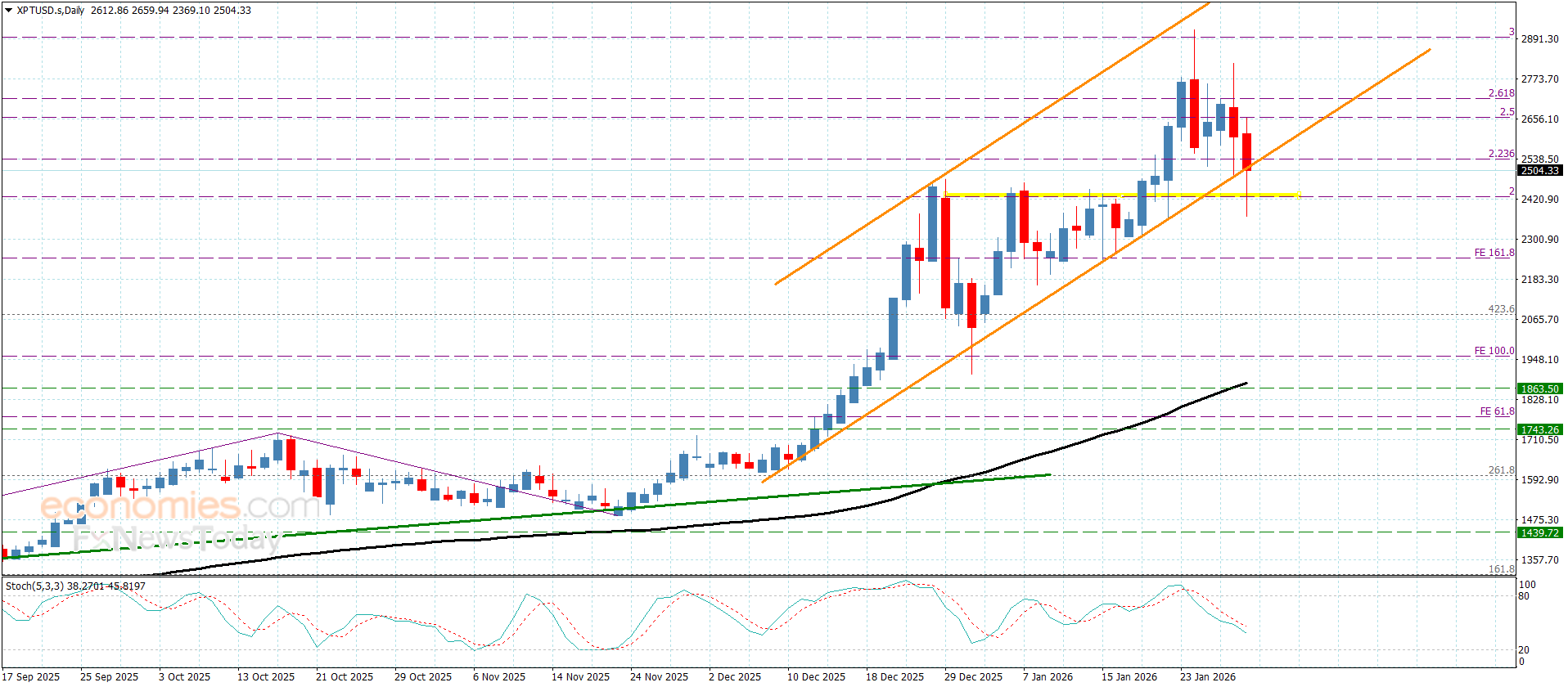
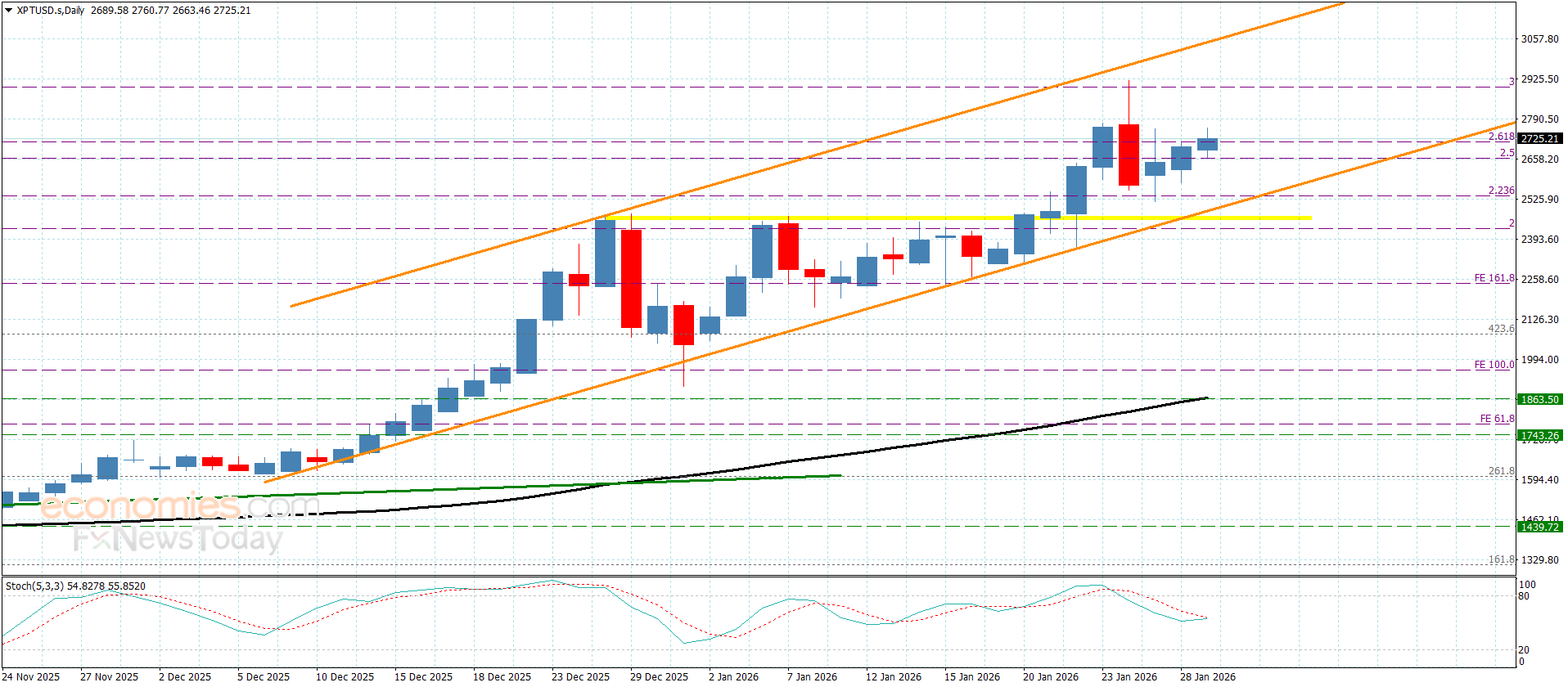
Platinum price faced strong negative pressures, which forces it to provide negative corrective trading by reaching $2370.00, to rebound to settle above the minor bullish channel’s support at $2520.00.
The continuation of providing negative momentum by stochastic will increase the negative pressure, to expect forming corrective waves to press on $2430.00 support, where breaking it will open the way for resuming the corrective decline, and $2325.00 will form extra initial target for the bearish track, while renewing the bullish trend requires a new positive close above $2710.00.
The expected trading range for today is between $2430.00 and $2560.00
Trend forecast: Bearish
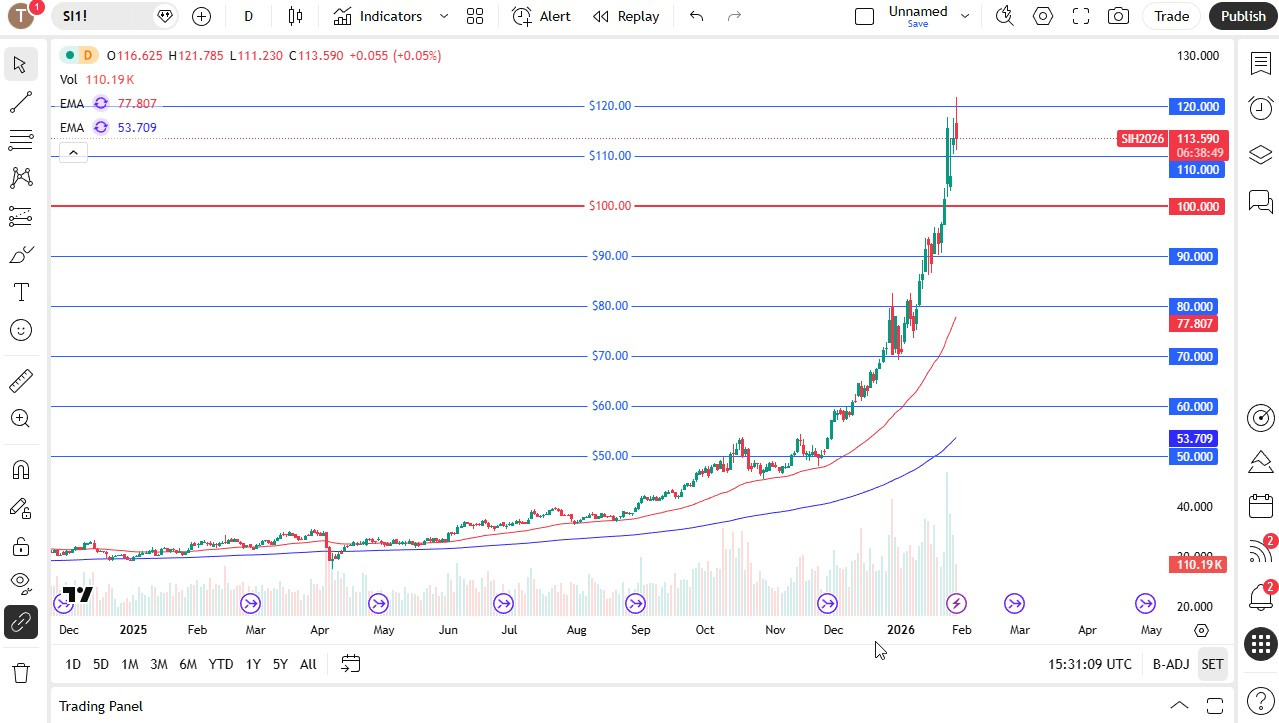
Silver markets continue to see a lot of volatility as we broke above the $120 level, only to turn around and show signs of weakness. All things being equal, this is a market that I think continues to see a lot of questions asked about whether or not it can continue to go higher.
But with all that being said, I also recognize that we continue to see a lot of questions about whether or not the silver market can sustain this type of pressure and quite frankly, I don’t think it can. So, with that being the case, I also recognize that the market is going to remain very dangerous and doing anything with huge position size is probably going to be a major problem.

We have seen the market break all the way towards the $122 level and then turn around to drop to the $111 level in a very short amount of time during the day. In fact, it’s probably worth noting that volume spiked quite wildly at about 10:00 New York time and with this being the case, it looks like we have seen a retest of the $110 level as we are starting to see the narrative play out that perhaps there’s all sellers and no buyers at some of these higher levels.
If that’s going to be the case, I fully anticipate that this market will probably drop. I do think the $100 level will be a bit of support, but I also recognize that the volatility will continue to be a situation where traders are looking at this through the possibility of a deep correction that they can take advantage of value.
The silver market will eventually go looking to its floor and find out where that is, but this time it’s obviously going to be higher than the last major melts up. All things being equal, I think buying dips continues to work, but as we saw on Thursday, you have to be very careful about position sizing as a lot of long positions just got wiped out.
Ready to trade our daily forex analysis and predictions? Here are the best Silver trading brokers to choose from.
Christopher Lewis has been trading Forex and has over 20 years experience in financial markets. Chris has been a regular contributor to Daily Forex since the early days of the site. He writes about Forex for several online publications, including FX Empire, Investing.com, and his own site, aptly named The Trader Guy. Chris favours technical analysis methods to identify his trades and likes to trade equity indices and commodities as well as Forex. He favours a longer-term trading style, and his trades often last for days or weeks.
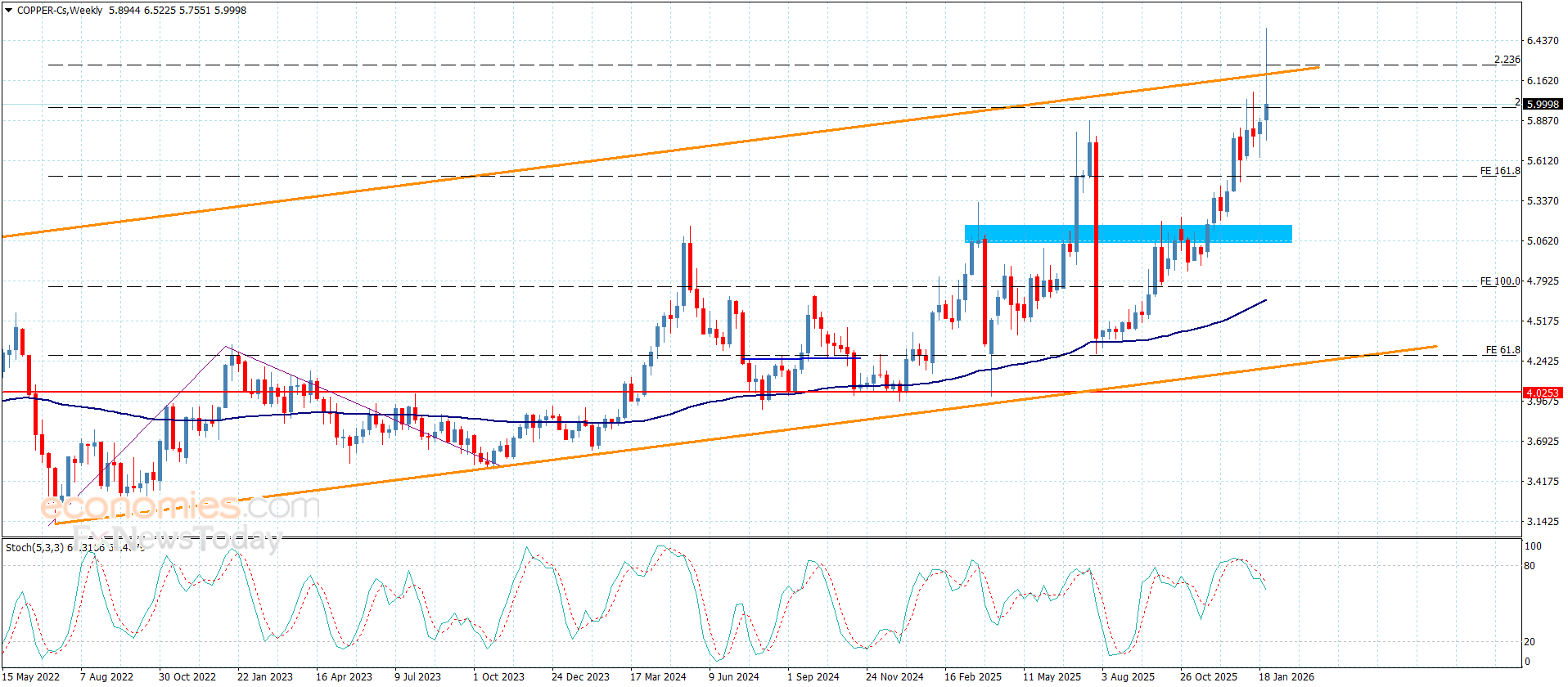
Copper price’s trading extended towards $6.5225 level, achieving new historical gains but its neediness to the negative momentum pushed it to decline again to settle below $6.2100 resistance, to begin gathering some gains by reaching $6.000.
The contradiction between the main indicators by the stability below the resistance might increase the efficiency of the bearish corrective track, which might target $5.7500 level reaching the initial support at $5.5100.
The expected trading range for today is between $5.8000 and $6.2000
Trend forecast: Bearish
Gold is seeing a deep correction early Friday, challenging bids near the $5,100 kevel, following intense volatility witnessed on Thursday.
Gold is down nearly 3% so far this Friday, yet on track for the largest monthly advance since January 1980.
The latest corrective pullback could be attributed mainly to a strong comeback staged by the US Dollar (USD) across the board. A cocktail of factors emerges as a tailwind to the Greenback, offering a much-needed reprieve.
The Wall Street Journal (WSJ) reported that US President Donald Trump and Senate Democrats struck a deal to avert a government shutdown, lending support to the buck.
Additionally, the Fed’s cautious hold decision and profit-taking following the recent meltdown to four-year lows collaborate to the USD’s resurgence heading into Trump’s announcement of the US Federal Reserve (Fed) Chair pick due later in the American morning on Friday.
The Trump administration is preparing to nominate former Fed Governor Kevin Warsh to be the next Chair, Bloomberg reported on Friday.
Despite the sharp correction in the bright metal, bargain hunting cannot be ruled out as geopolitical risks remain elevated between the US and Iran, while markets digest the latest tariff threats by Trump on Cuba and Canada.
The White House said that Trump signed an executive order that would impose tariffs on countries that provide oil to Cuba, per Reuters.
Looking, Trump’s announcement of his Fed Chair pick and US Producer Price Index (PPI) data are eagerly awaited for the next critical move in Gold.
In the daily chart, XAU/USD trades at $5,195.05. The 21-day Simple Moving Average (SMA) rises above the 50- and 100-day, while the 200-day SMA also trends higher. Price holds above these averages, reinforcing a bullish bias. The Relative Strength Index (RSI) is at 72.07 (overbought), with momentum still firm. Immediate support is at the 21-day SMA at $4,764.72.
Shorter SMAs remaining stacked above longer ones underscore the prevailing uptrend, with the 50-day SMA at $4,481.84 underpinning the structure. The 100- and 200-day SMAs continue to advance, confirming the broader positive slope. RSI stays elevated, which could cap near-term upside and favor consolidation rather than reversal. Pullbacks would be expected to find support near the 50-day SMA, while sustained trade above the short-term averages keeps the path of least resistance to the upside.
(The technical analysis of this story was written with the help of an AI tool.)
(This story was corrected on January 30 at 4:12 GMT to say in the first bullet point that “Gold corrected steeply early Friday, not correctly steeply.)
Gold has played a key role in human’s history as it has been widely used as a store of value and medium of exchange. Currently, apart from its shine and usage for jewelry, the precious metal is widely seen as a safe-haven asset, meaning that it is considered a good investment during turbulent times. Gold is also widely seen as a hedge against inflation and against depreciating currencies as it doesn’t rely on any specific issuer or government.
Central banks are the biggest Gold holders. In their aim to support their currencies in turbulent times, central banks tend to diversify their reserves and buy Gold to improve the perceived strength of the economy and the currency. High Gold reserves can be a source of trust for a country’s solvency. Central banks added 1,136 tonnes of Gold worth around $70 billion to their reserves in 2022, according to data from the World Gold Council. This is the highest yearly purchase since records began. Central banks from emerging economies such as China, India and Turkey are quickly increasing their Gold reserves.
Gold has an inverse correlation with the US Dollar and US Treasuries, which are both major reserve and safe-haven assets. When the Dollar depreciates, Gold tends to rise, enabling investors and central banks to diversify their assets in turbulent times. Gold is also inversely correlated with risk assets. A rally in the stock market tends to weaken Gold price, while sell-offs in riskier markets tend to favor the precious metal.
The price can move due to a wide range of factors. Geopolitical instability or fears of a deep recession can quickly make Gold price escalate due to its safe-haven status. As a yield-less asset, Gold tends to rise with lower interest rates, while higher cost of money usually weighs down on the yellow metal. Still, most moves depend on how the US Dollar (USD) behaves as the asset is priced in dollars (XAU/USD). A strong Dollar tends to keep the price of Gold controlled, whereas a weaker Dollar is likely to push Gold prices up.

Why are oil and copper prices rising to record highs and will they increase further or fall down is driven by a mix of geopolitical risk, currency movement, and investor activity. Oil prices moved higher due to concerns over possible supply disruption linked to Iran and Middle East tensions. Copper prices climbed to record levels as speculative funds increased positions, supported by expectations of higher spending on power, data centres, and energy transition projects. A weak US dollar made commodities cheaper for global buyers. Future price direction depends on geopolitical developments, actual demand trends, supply responses, and whether speculative interest continues or fades.
Why are oil prices rising to record highs is mainly linked to fears of supply disruption from Iran, one of the largest OPEC producers. Reports of potential US military action and new European Union sanctions raised concerns over oil flows through the Strait of Hormuz. At the same time, the US dollar stayed weak, supporting oil demand. Oil prices also gained support from expectations that interest rates may stay steady, which can support economic activity and fuel consumption in major economies.
The oil prices are rising to record highs due to oil market fears. Oil prices climbed about 4% after reports said the United States may take action against Iran. Iran is a major OPEC producer.
Brent crude rose to $70.90 per barrel. WTI rose to $65.56 per barrel. Both reached levels last seen months ago. Markets fear Iran may respond by targeting regional oil flows. The Strait of Hormuz carries about 20 million barrels per day.
The European Union also imposed sanctions on Iran. It targeted officials and entities linked to protest crackdowns. The EU also designated Iran’s Revolutionary Guards as a terrorist group. This raised supply risk concerns.
Why are oil and copper prices rising to record highs and will they increase further or fall down also depends on supply changes. Russia may increase exports if peace talks with Ukraine progress. Russia is one of the top oil producers.
Kazakhstan said Chevron will restore full production at the Tengiz field soon. Venezuela lawmakers are discussing oil reforms. These steps may raise future supply and ease prices.
Analysts say current prices include a geopolitical risk premium. Any easing in tensions may reduce oil prices.
Why are oil and copper prices rising to record highs and will they increase further or fall down is also linked to the dollar. The dollar is near multi-year lows. A weak dollar makes oil cheaper for global buyers.
The Federal Reserve signaled rates may stay steady. Lower borrowing costs can support demand. Brent’s premium over WTI rose above $5. This may increase US crude exports.
Why are oil and copper prices rising to record highs and will they increase further or fall down includes copper market forces. Copper rose above $14,000 per ton. Speculative funds led buying, mainly in China.Copper is used in power, construction, and energy systems. Investors expect higher spending on data centers and power grids. A weak dollar also supported prices.
However, physical demand in China remains weak. Exchange inventories remain high. Analysts warn prices may not match supply and demand conditions.
Why are oil and copper prices rising to record highs and will they increase further or fall down depends on geopolitics and demand. Oil may fall if Iran tensions ease or supply rises. Copper may correct if speculation slows and demand stays weak.
What should investors do is a key question as oil and copper prices trade near record levels. Investors should track geopolitical developments linked to Iran and the Middle East, as headlines can shift prices quickly. They should also watch supply signals from OPEC, Russia, Kazakhstan, and Venezuela. For copper, investors should monitor physical demand data from China and inventory levels on exchanges. Price moves are being driven by speculation and currency trends, so risk management is important. Investors may consider avoiding overexposure and staying prepared for sharp corrections if conditions change.
Why are oil and copper prices rising to record highs and will they increase further or fall down now?
Oil prices rose due to Iran risks and dollar weakness. Copper prices rose due to speculation and growth expectations. Future moves depend on geopolitics, demand data, and currency trends.
Will oil and copper prices fall after hitting record levels?
Prices may fall if Middle East tensions ease, supply increases, or speculative trading slows. Weak physical demand and high inventories may also pressure copper and oil prices.
Copper price succeeded in activating the bullish attack by surpassing $5.9700 barrier, to begin recording clear gains by reaching $6.2300, recording extra suggested target in the previous report.
Note that the stability above $5.9700 level might form an important support, besides providing bullish momentum by the main indicators, these factors support resuming the bullish attack, to expect targeting new stations that might begin at $6.4100.
The expected trading range for today is between $6.0700 and $6.4100
Trend forecast: Bullish
Silver price (XAG/USD) continues its winning streak that began on January 22, trading around $117.70 per troy ounce during the Asian hours on Thursday. Silver price surged to a fresh record high of $119.42 earlier, supported by persistent safe-haven demand amid economic and geopolitical uncertainty. The grey metal has climbed more than 65% so far this month.
Investor appetite for precious metals, including Silver remained strong despite a rebound in the US Dollar (USD), highlighting robust hedging demand against currency risks. US Treasury Secretary Scott Bessent reiterated the US commitment to a strong dollar policy, while the Federal Reserve left interest rates unchanged at its January meeting, citing still-elevated inflation and resilient economic growth.
Fed Chair Jerome Powell said job gains have cooled and the unemployment rate is stabilising, adding that the Fed is “well positioned” to assess data meeting by meeting and is not on a preset path for future rate decisions.
Safe-haven demand for precious metals, including Silver, strengthened against the backdrop of global trade frictions. Renewed protectionist rhetoric ahead of the US election has heightened concerns over tariffs, supply-chain disruptions, and inflationary pressures. Market sentiment was further dampened by fears of a potential US government shutdown, which could delay key economic data releases.
Geopolitical risks remained elevated amid escalating Middle East tensions. US President Donald Trump urged Iran on Wednesday to return to negotiations over its nuclear programme, warning that any future US attack would be far more severe. Tehran responded by threatening retaliation against the US, Israel, and their allies, per Reuters.
At the same time, solid industrial demand from renewable energy and electronics sectors continued to tighten supply, reinforcing Silver’s upward momentum. Prices have also been supported by investors seeking cheaper alternatives to Gold, alongside supply constraints and momentum-driven buying.
Silver is a precious metal highly traded among investors. It has been historically used as a store of value and a medium of exchange. Although less popular than Gold, traders may turn to Silver to diversify their investment portfolio, for its intrinsic value or as a potential hedge during high-inflation periods. Investors can buy physical Silver, in coins or in bars, or trade it through vehicles such as Exchange Traded Funds, which track its price on international markets.
Silver prices can move due to a wide range of factors. Geopolitical instability or fears of a deep recession can make Silver price escalate due to its safe-haven status, although to a lesser extent than Gold’s. As a yieldless asset, Silver tends to rise with lower interest rates. Its moves also depend on how the US Dollar (USD) behaves as the asset is priced in dollars (XAG/USD). A strong Dollar tends to keep the price of Silver at bay, whereas a weaker Dollar is likely to propel prices up. Other factors such as investment demand, mining supply – Silver is much more abundant than Gold – and recycling rates can also affect prices.
Silver is widely used in industry, particularly in sectors such as electronics or solar energy, as it has one of the highest electric conductivity of all metals – more than Copper and Gold. A surge in demand can increase prices, while a decline tends to lower them. Dynamics in the US, Chinese and Indian economies can also contribute to price swings: for the US and particularly China, their big industrial sectors use Silver in various processes; in India, consumers’ demand for the precious metal for jewellery also plays a key role in setting prices.
Silver prices tend to follow Gold’s moves. When Gold prices rise, Silver typically follows suit, as their status as safe-haven assets is similar. The Gold/Silver ratio, which shows the number of ounces of Silver needed to equal the value of one ounce of Gold, may help to determine the relative valuation between both metals. Some investors may consider a high ratio as an indicator that Silver is undervalued, or Gold is overvalued. On the contrary, a low ratio might suggest that Gold is undervalued relative to Silver.