The main tag of Gold Price Articles.
You can use the search box below to find what you need.
[wd_asp id=1]
The main tag of Gold Price Articles.
You can use the search box below to find what you need.
[wd_asp id=1]
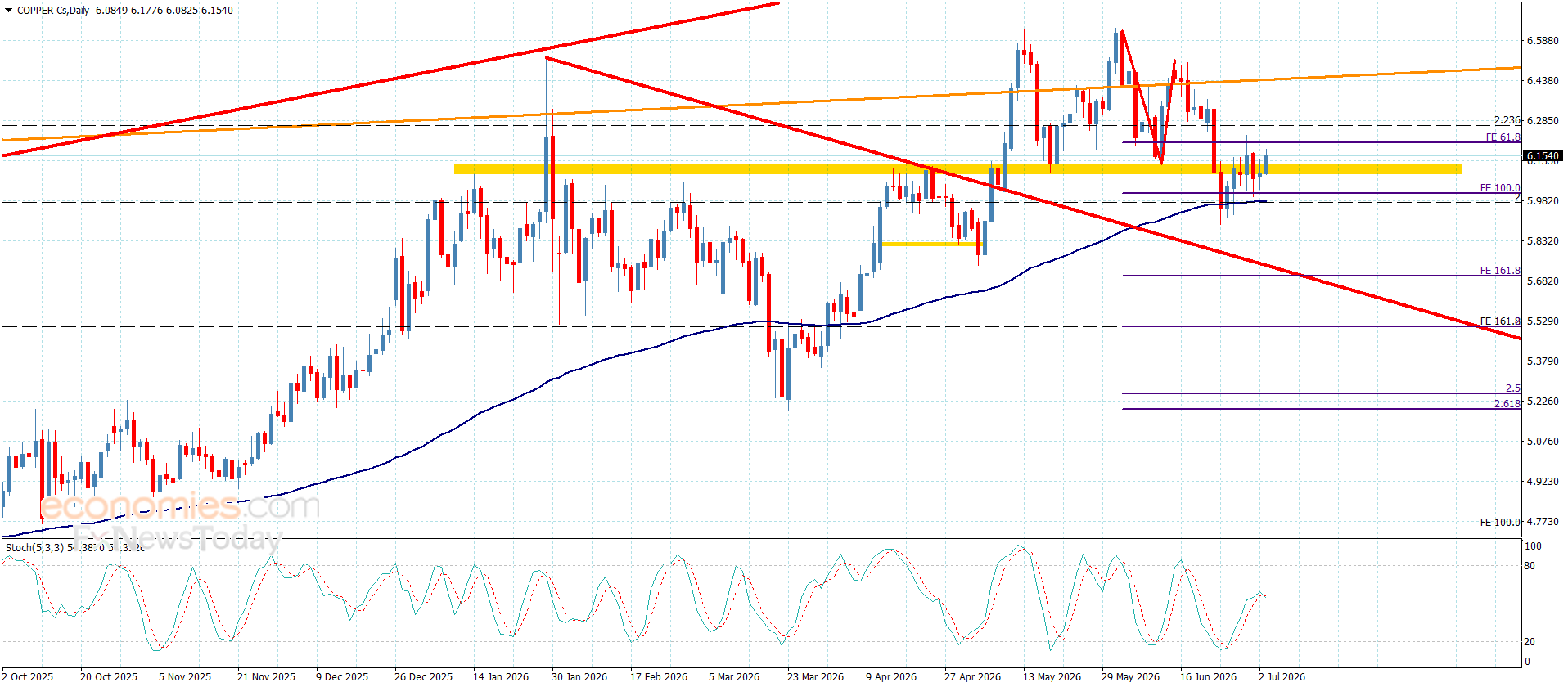
Copper price settles above the moving average 55 near $5.9500, to announce delaying the bearish corrective attempts, noticing its rally to settle near $6.1500 level, surrendering to the sideways track, which is represented by the current support and $6.3000 level that represents an extra barrier against the current trading.
The price might form sideways trading until surpassing one of the mentioned levels, note that reaching below the extra support and holding below it will open the way for activating the bearish corrective track, to expect targeting $5.8200 and $5.7100 level.
The expected trading range for today is between $5.9500 and $6.3000
Trend forecast: Sideways
Domestic coffee prices today
Coffee prices today in the domestic market turned down slightly after a strong increase in the previous session. The average price was recorded at 92,900 VND/kg, down 100 VND/kg.
In Dak Lak, coffee prices decreased by 200 VND/kg, down to 92,800 VND/kg. Gia Lai also recorded a similar decrease, bringing the purchase price back to 92,800 VND/kg.
In Lam Dong, coffee prices today decreased by 300 VND/kg, down to 92,300 VND/kg and continue to be the lowest level among the surveyed areas.
The old Dak Nong area had the highest purchase price, reaching 93,000 VND/kg and no changes were recorded compared to the previous update.
Thus, domestic coffee prices currently range from 92,300-93,000 VND/kg. The gap between the region with the highest and lowest prices is 700 VND/kg.
Despite the downward adjustment, the domestic coffee price level still maintained above 92,000 VND/kg, significantly higher than the price range below 90,000 VND/kg at the end of June.
The USD/VND exchange rate according to Vietcombank is recorded at 26,073 VND/USD.
World coffee prices
Robusta coffee prices on the London exchange simultaneously decreased in the last trading session of the week, while the New York Arabica exchange was closed for US Independence Day.
On the London exchange, the September 2026 Robusta futures contract fell 67 USD/ton, equivalent to 1.77%, to 3,716 USD/ton.
During the session, the contract price at one point reached 3,783 USD/ton but then decreased to the lowest level of 3,675 USD/ton. Trading volume reached 5,306 lots.
Robusta futures in November 2026 decreased by 66 USD/ton, equivalent to 1.76%, to 3,679 USD/ton.
The January and March 2027 terms both decreased by 66 USD/ton, down to 3,646 USD/ton and 3,614 USD/ton respectively.
The July 2026 contract was recorded at 3,903 USD/ton, down 67 USD/ton. However, the trading volume only reached 2 lots because the contract had approached its expiration date, so the September term reflected the market trend more clearly.
For Arabica, the US Intercontinental Exchange did not open on July 3 due to the National Day holiday. Therefore, the price list on July 5 still reflects the results of the pre-holiday trading session.
Accordingly, Arabica futures in September 2026 stood at 301.20 US cents/lb, down 8.70 cents/lb, equivalent to 2.81%.
December 2026 futures are at 286.30 US cents/lb, down 8.55 cents/lb. The March and May 2027 terms are at 281.10 US cents/lb and 280.90 US cents/lb, respectively.
Coffee price assessment
According to financial data from Barchart, coffee prices at one point reached their highest level in about 4 months and 3 weeks before the differentiation.
Arabica prices fell sharply in the most recent session due to profit-taking and liquidation of buy positions before the long holiday in the US. Previously, this commodity had increased rapidly for about 3 weeks due to concerns about unfavorable weather in Brazil.
Heavy rain in Brazil disrupted harvesting activities and increased the risk of affecting coffee quality. Brazil’s Somar Meteorologia forecasting company said that Minas Gerais state recorded 31.3 mm of rainfall in the week ending June 28, nearly 20 times higher than the historical average of the same period.
Minas Gerais is Brazil’s largest coffee producing region. Rains during harvesting can slow down coffee harvesting, transportation and drying, and cause fruit or seeds to decline in quality.
Standard Arabica inventories on the US Intercontinental Exchange decreased to 375,079 bags, the lowest level in about 2 years and 3 months. Available supply on the exchange decreased, continuing to create support for prices after the adjustment.
Meanwhile, Robusta inventories on the European Intercontinental Exchange have increased to 4,053 lots, the highest level in nearly 3 months. The replenishment of standard goods is one of the factors putting pressure on Robusta prices.
The market is also continuing to monitor El Niño developments. The US National Oceanic and Atmospheric Administration assesses that there is a 63% chance that El Niño will reach very strong intensity in the period from November 2026 to January 2027.
El Niño may affect rainfall in Brazil during the coffee flowering period in September and October, as well as Robusta production conditions in some Asian countries. However, the specific impact depends on the intensity and timing of appearance in each region.
In terms of pressure, the Foreign Agricultural Services Agency of the US Department of Agriculture forecasts that Brazil’s coffee production in the 2026-2027 crop year may reach 66.7 million bags.
Rabobank of the Netherlands also forecasts that the global Arabica market will continue to have a surplus. Meanwhile, the prospect of increased Vietnamese coffee production and exports may add more Robusta supply to the market.
The 20-day moving average was confirmed as dynamic resistance twice previously, validating the potential significance of Friday’s close above the indicator. Moreover, the larger trend resistance zone is defined by the 50-day moving average, confirmed multiple times as resistance during rallies on the way down.
A bounce to test dynamic resistance would be a typical progression of a downtrend, as it may result in a lower swing high. Initially, that would be the expectation unless it was followed by additional signs of strength. In other words, the current rebound still fits within a broader corrective structure unless resistance levels are decisively reclaimed.
On a weekly basis, gold has set up a bullish hammer candlestick pattern with a lower high and lower low for the week. Therefore, a decisive breakout above the week’s high of $4,195 would trigger a one-week bullish reversal and set the stage for further strengthening. The next weekly target would then be the two-week high of $4,221. If exceeded, the 50-day moving average becomes more likely to be tested as resistance during the current developing rally.
Overall, while the broader trend remains under pressure, the recent recovery above both the 20-day moving average and rising trendline suggests early signs of stabilization, with follow-through above short-term highs likely to determine whether a deeper corrective phase or a more sustained recovery unfolds.
If you’d like to know more about how to trade gold and silver, please visit our educational area.
Copper is experiencing a remarkable transformation from a traditional industrial commodity to a strategic asset class, with prices surging to record highs above $13,000 per metric tonne in early 2026. The convergence of artificial intelligence infrastructure expansion, electric vehicle adoption, and renewable energy deployment has created unprecedented demand dynamics that analysts project will drive copper prices toward $15,000 per tonne by 2035. Supply constraints from aging mines, declining ore grades, and limited new project development suggest the current bull market has significant room to run, making copper one of the most compelling investment themes for the remainder of the decade.
The structural nature of copper’s demand growth distinguishes this cycle from previous commodity rallies. Unlike cyclical industrial demand fluctuations, the electrification of transportation, the buildout of AI data centers, and global renewable energy targets represent multi-decade trends that will sustain copper consumption regardless of near-term economic conditions. For investors seeking exposure to the energy transition and AI revolution, understanding copper market dynamics has become essential for portfolio positioning.
The copper market in 2026 exemplifies what happens when structural supply limitations collide with transformational demand growth. Global copper demand is projected to increase from 28 million tons in 2025 to 42 million tons by 2040, representing a 50% expansion over fifteen years. However, supply growth has failed to keep pace, with mine supply expansion estimates for 2026 falling to approximately 1.4%, roughly 500,000 metric tons lower than initial projections due to operational disruptions including the Grasberg mudslide and ongoing challenges at major producing facilities.
The supply side challenges extend beyond temporary disruptions. Average copper ore grades globally have declined from approximately 1.6% copper content in 1980 to less than 0.8% in 2025, effectively doubling the amount of rock that must be processed to maintain equivalent output levels. This grade deterioration increases energy intensity, water consumption, and waste generation while requiring more sophisticated processing equipment and higher capital expenditures for marginal deposits. New mine development timelines spanning 10-15 years from discovery to production mean that supply cannot respond quickly to price signals, creating a structural deficit that analysts anticipate will reach 10 million tons annually by 2040 without significant supply expansions.
Treatment and refining charges (TC/RCs), the fees smelters charge miners to process concentrate, have collapsed to historic lows, reflecting the tight concentrate market and limited available supply. Benchmark TC/RC negotiations for 2026 have been particularly contentious, with regional fragmentation potentially leading to the establishment of regional benchmarks rather than a single global reference price. This dynamic underscores the fundamental tightness in the copper concentrate market and suggests that refined copper production growth will remain constrained regardless of smelter capacity expansions.
While electric vehicles and renewable energy have captured headlines as copper demand drivers, artificial intelligence infrastructure represents an emerging consumption category that market participants are only beginning to appreciate. AI data centers require substantially more copper than traditional data centers due to higher power densities, advanced cooling systems, and extensive networking infrastructure. A single large AI data center can consume between 3,000 to 5,000 tons of copper during construction and initial deployment, with ongoing replacement and expansion needs sustaining demand over the facility’s operational life.
The global buildout of AI infrastructure is accelerating rapidly, with hyperscale cloud providers announcing multi-billion dollar capital expenditure programs focused on AI-enabled data centers. Goldman Sachs Research estimates that AI-related data center investment will reach $1.4 trillion globally by the end of the decade, with copper representing a significant portion of the materials required for power distribution, thermal management, and interconnect systems. This demand category did not exist in meaningful quantities five years ago but is projected to consume over one million tons of copper annually by 2030.
The geographic distribution of AI data center construction creates additional copper demand complexity. While traditional data center hubs in North America and Europe continue to expand, emerging markets including Southeast Asia, the Middle East, and parts of Africa are attracting significant AI infrastructure investment as countries seek to establish digital sovereignty and capture value from the AI revolution. Each new facility requires copper-intensive electrical infrastructure, from high-voltage transmission connections to facility-level power distribution systems, creating localized demand surges that strain regional supply chains.
The transportation electrification megatrend continues to drive substantial copper consumption growth, with electric vehicles requiring approximately four times more copper than internal combustion engine vehicles. A typical battery electric vehicle contains between 80-100 kilograms of copper across the battery pack, electric motor, wiring harness, and charging infrastructure, compared to approximately 20-25 kilograms for conventional vehicles. As global EV adoption accelerates toward mass market penetration, automotive copper demand is projected to grow from approximately 2 million tons in 2024 to over 5 million tons by 2030.
Grid modernization and renewable energy deployment represent equally significant demand categories. Wind and solar installations require substantially more copper per unit of generating capacity than fossil fuel power plants, with offshore wind turbines containing up to 10 tons of copper per megawatt of capacity. The International Energy Agency estimates that achieving global net-zero emissions targets will require annual copper consumption for clean energy applications to double by 2030, creating sustained demand growth regardless of near-term economic conditions.
Energy storage systems, essential for grid stability as renewable penetration increases, represent another emerging copper demand driver. Battery energy storage systems require copper for internal wiring, power conversion systems, and thermal management, with utility-scale installations consuming hundreds of tons per facility. As battery costs decline and deployment accelerates, this demand category will compound copper consumption growth from generation assets and transmission infrastructure.
Analyst consensus for copper prices in 2026 reflects the fundamental tightness in the market, with forecasts ranging from conservative estimates around $9,800 per tonne to bullish scenarios exceeding $15,000 per tonne. Goldman Sachs Research has established one of the more optimistic price targets, forecasting LME copper prices reaching $15,000 per tonne by 2035 as structural deficits materialize. Citigroup analysts suggest prices could exceed $13,000 and approach $15,000 per tonne in 2026 if supply constraints persist and inventories remain at historically low levels.
Morgan Stanley’s base case scenario positions copper around $10,650 per tonne, with an upside case near $12,780 per tonne if tighter supply conditions persist through the year. The World Bank maintains a more conservative longer-term view, suggesting copper might average closer to $9,800 per tonne in 2026 before rising modestly in 2027 as supply tightens further. These varying projections reflect different assumptions about Chinese demand trajectory, the pace of mine supply growth, and the potential for demand destruction at higher price levels.
The institutional investment community has taken notice of copper’s structural bull case, with capital rotating from precious metals into base metals exposure. Major mining companies including Freeport-McMoRan have seen increased investor interest as the copper price rally translates into earnings leverage and improved shareholder returns. For individual investors, multiple exposure vehicles exist including physical copper ETFs, diversified mining majors like BHP Group and Rio Tinto, and pure-play copper producers such as Southern Copper Corporation.
While the structural bull case for copper appears compelling, investors must navigate significant volatility and potential downside risks. Copper prices have historically exhibited high volatility, with annual price ranges of 25-35% common during periods of market uncertainty. The copper market in 2026 will likely be characterized by heightened volatility where fundamental supply constraints intersect with policy-driven demand disruptions, requiring sophisticated risk management and tactical positioning flexibility.
Chinese demand represents the largest single risk factor, accounting for more than half of global copper consumption. The Chinese property sector slowdown, inventory destocking cycles, and export restrictions create headwinds that could temporarily offset bullish supply dynamics. However, supportive factors including high-tech manufacturing growth and potential currency movements provide offsetting demand support that could sustain Chinese consumption even as traditional construction-related demand moderates.
Geopolitical tensions and trade policy add additional complexity to copper market forecasting. US tariff implementation on refined copper imports has encouraged stockpiling and tighter physical markets, potentially creating price distortions between regional markets. Resource nationalism in major producing countries including Chile, Peru, and the Democratic Republic of Congo presents ongoing risks to supply security, while trade restrictions could fragment global copper markets and create arbitrage opportunities for well-positioned traders.

Investors seeking copper exposure must evaluate multiple vehicle options with distinct risk-return profiles suited to different portfolio allocation strategies. Physical copper ETFs provide direct commodity exposure without operational risk from individual mining companies, eliminating mine production risk, labor disputes, and jurisdiction-specific regulatory changes while providing pure copper price sensitivity. The Sprott Physical Copper Trust represents the primary option for investors seeking unlevered copper exposure with professional custody and storage management.
Major diversified miners including BHP Group and Rio Tinto offer copper exposure within broader commodity portfolios that provide natural diversification across multiple metals markets. These companies typically maintain strong balance sheets, established operations across multiple jurisdictions, and dividend policies that provide income during periods of price volatility. For investors seeking lower volatility exposure to copper price appreciation, diversified majors offer an attractive risk-adjusted entry point.
Pure-play copper companies such as Freeport-McMoRan and Southern Copper Corporation provide concentrated copper exposure with higher beta characteristics relative to copper price movements. These investments carry greater operational leverage to copper prices but increased sensitivity to mine-specific risks including geological challenges, labor relations, and environmental compliance issues. For investors with higher risk tolerance and conviction in the copper bull case, pure-play producers offer the greatest potential upside capture.
The copper price forecast for 2026 reflects a market undergoing fundamental transformation from a cyclical industrial commodity to a strategic asset essential for the energy transition and AI revolution. Supply constraints from declining ore grades, limited new project development, and operational disruptions have created a structural deficit that will persist regardless of near-term economic conditions. Demand growth from AI data centers, electric vehicles, renewable energy, and grid modernization represents multi-decade trends that will sustain copper consumption at elevated levels.
For investors, the current copper bull market offers compelling opportunities across multiple exposure vehicles, from physical ETFs to diversified mining majors and pure-play producers. While volatility will remain a defining characteristic of copper markets, the structural nature of supply-demand imbalances suggests that price pullbacks represent buying opportunities rather than trend reversals. As the world electrifies and digitizes, copper’s role as the essential infrastructure metal positions it for sustained outperformance relative to traditional asset classes.
To identify the best copper mining stocks and track market-leading opportunities, consider using Intellectia.AI’s AI-powered stock screener to analyze valuation metrics, earnings growth, and technical patterns across the mining sector. Our platform provides real-time insights into commodity-driven investment themes, helping you capture alpha in the evolving copper market.

Domestic coffee prices today
Coffee prices today in key production areas simultaneously increased sharply. The average price was recorded at 93,000 VND/kg, an increase of 1,000 VND/kg compared to the previous update.
In Dak Lak, coffee prices increased by 1,000 VND/kg, to 93,000 VND/kg. Gia Lai also recorded a price of 93,000 VND/kg, an increase of 1,000 VND/kg.
In Lam Dong, coffee prices today reached 92,600 VND/kg, an increase of 1,000 VND/kg but still the lowest level among the surveyed areas.
The old Dak Nong area recorded a purchase price of 93,000 VND/kg, an increase of 1,000 VND/kg.
Thus, domestic coffee prices currently fluctuate from 92,600-93,000 VND/kg. The gap between the region with the highest and lowest prices is 400 VND/kg.
The buying level has returned above the threshold of 92,000 VND/kg after strong fluctuations at the end of June.
The USD/VND exchange rate according to Vietcombank was recorded at 26,073 VND/USD, down 2 VND.
World coffee prices
World coffee prices fluctuated in opposite directions in the most recent trading session. Robusta on the London exchange increased slightly, while Arabica on the New York exchange decreased sharply due to profit-taking activities.
On the London exchange, the September 2026 Robusta futures contract increased by 12 USD/ton, equivalent to 0.32%, to 3,783 USD/ton.
During the session, this contract once increased to 3,920 USD/ton but then significantly narrowed the increase. Trading volume reached 16,235 lots.
Robusta for November 2026 delivery increased by 19 USD/ton, equivalent to 0.51%, to 3,745 USD/ton. For January 2027 delivery, it increased by 20 USD/ton, reaching 3-712 USD/ton.
The March 2027 term increased by 19 USD/ton, equivalent to 0.52%, to 3,680 USD/ton.
The July 2026 Robusta contract was recorded at 3,970 USD/ton, but only 2 lots were traded because it was close to maturity. Therefore, the September contract reflects the market diễn biến more clearly.
On the New York exchange, Arabica September 2026 futures fell 8.70 US cents/lb, equivalent to 2.81%, to 301.20 US cents/lb.
This contract once increased to 316.80 US cents/lb but then reversed, at one point falling to 300.05 US cents/lb.
Arabica December 2026 futures fell 8.55 US cents/lb, or 2.90%, to 286.30 US cents/lb.
The March and May 2027 terms decreased by 8.45 US cents/lb and 8.95 US cents/lb respectively, to 281.10 US cents/lb and 280.90 US cents/lb.
Coffee price assessment
According to data from Barchart, coffee prices at one point reached their highest level in about 4 months and 3 weeks, but then diverged.
Arabica reversed and fell sharply due to investors taking profits and liquidating buy positions before the long holiday in the US. The Coffee C market on the US Intercontinental Exchange closed on July 3 on the occasion of the National Day holiday.
Before the adjustment, Arabica prices had increased sharply for about 3 weeks. The increase was supported by heavy rain in Brazil, disrupting harvesting and increasing concerns about coffee quality.
Brazil’s Somar Meteorologia company said rainfall in Minas Gerais state, the country’s largest coffee growing region, reached 31.3 mm in the week ending June 28. This level is nearly 20 times higher than the historical average of the same period.
Rainfall during harvest season can cause difficulties for coffee harvesting, transportation, and drying. Prolonged humidity can also cause fruit to fall off or affect seed quality.
Standard Arabica inventories on the US Intercontinental Exchange continued to decrease, also creating momentum for the market. Inventory fell to 37,579 bags, the lowest in about 2 years and 3 months.
Conversely, Robusta inventories on the European Intercontinental Exchange have increased to 4,553 lots, the highest level in nearly 3 months. The replenishment of standard goods may limit Robusta’s upward momentum.
The market is also monitoring the impact of El Niño on the next crop year. The US National Oceanic and Atmospheric Administration said that El Niño has appeared and is forecast to continue to strengthen in the 2026-2027 Northern Hemisphere winter.
El Niño may change rainfall in Brazil during the coffee tree flowering period in September and October, and also affect Robusta production areas in Asia. However, the actual impact depends on the intensity and timing of each region.
In terms of pressure, the Foreign Agricultural Services Agency of the US Department of Agriculture forecasts that Brazil could produce 66.7 million bags of coffee in the 2026-2027 crop year.
Rabobank of the Netherlands also raised its global Arabica surplus forecast for the 2026-2027 crop year from 7 million bags to 9.5 million bags.
For Robusta, increased Vietnamese coffee exports and recovery of inventory on the exchange are factors that can curb prices. However, domestic prices on July 4th still increased sharply according to the previous positive developments of the international market.
“Fundamentals are showing strength again,” Citigroup analysts were quoted as saying by Bloomberg.
The brokerage, however, noted that even with the shipping flows returning to normal, Chinese buyers are still missing from the market, leading to weakness in the physical crude market. Further, inventories are currently lower than expected.
Analysts at Citi said the initial return to normal market conditions could be uneven as shipping routes, insurance costs and logistics gradually stabilise.
Rising traffic and organised shipping patterns show that market participants now see the risk as manageable rather than disruptive.
“We continue to recommend selling any summer rallies and forecast Brent reaching $60 to $65 a barrel by the turn of the year,” Citi analysts said.
Other global banks have taken a similar view, Bloomberg stated.
Goldman Sachs expects the global oil market to slip back into surplus as the impact of the Iran conflict fades and shipping through the Strait of Hormuz normalises. Morgan Stanley has also lowered its oil price forecasts twice in recent weeks, warning of an emerging supply glut, the news agency added.
Oil prices edged higher on Friday as investors remained cautiously optimistic about ongoing peace efforts between the United States and Iran. Brent crude rose to $72.26 a barrel, while US crude climbed to $69.01 a barrel, Reuters reported.
Crude supply picks up pace
The reopening of the Strait of Hormuz has eased concerns over global oil supplies, with Gulf producers steadily ramping up output and exports as shipping returns to normal.
Kuwait sharply increased oil production in June, while Saudi Arabia boosted exports by sending more supertankers through the key shipping route and switching to spot pricing to speed up sales in Asia, Reuters reported.
“It’s a case of guarded optimism, with the market wanting to believe the peace efforts will hold, but it is still hedging its bets until it sees real evidence on the water,” Tim Waterer, Chief Market Analyst at KCM Trade, was quoted as saying by the news agency.
Higher crude exports from Gulf producers have increased oil supply at a time when concerns over supply disruptions are easing. According to Reuters, with more oil entering the market, expectations of excess supply have grown. As a result, the market has moved into a situation where oil prices for future delivery are higher than current spot prices.
(Disclaimer: Recommendations, suggestions, views, and opinions given by experts are their own. These do not represent the views of The Economic Times)
The article covers the following subjects:
Consider long positions from corrections above 67.00 with a target of 91.80–105.17.
Breakout and consolidation below 67.00 will allow the asset to continue declining to the levels of 62.00–58.50.
A descending correction appears to have formed as the second wave of larger degree (2) on the weekly chart, with wave C of (2) completed as its part. On the daily time frame, an ascending third wave (3) is likely developing. Within it, the first wave of smaller degree 1 of (3) has formed, and a downward correction has been completed as the second wave 2 of (3). On the H4 time frame, wave 3 of (3) is presumably starting to develop. If this assumption is correct, WTI will continue to rise to 91.80–105.17. The level of 67.00 is critical in this scenario as a breakout below it will enable the asset to continue declining to the levels of 62.00–58.50.
This forecast is based on the Elliott Wave Theory. When developing trading strategies, it is essential to consider fundamental factors, as the market situation can change at any time.
The content of this article reflects the author’s opinion and does not necessarily reflect the official position of LiteFinance broker. The material published on this page is provided for informational purposes only and should not be considered as the provision of investment advice for the purposes of Directive 2014/65/EU.
According to copyright law, this article is considered intellectual property, which includes a prohibition on copying and distributing it without consent.
Copper price settles above the moving average 55 near $5.9500, to announce delaying the bearish corrective attempts, noticing its rally to settle near $6.1500 level, surrendering to the sideways track, which is represented by the current support and $6.3000 level that represents an extra barrier against the current trading.
The price might form sideways trading until surpassing one of the mentioned levels, note that reaching below the extra support and holding below it will open the way for activating the bearish corrective track, to expect targeting $5.8200 and $5.7100 level.
The expected trading range for today is between $5.9500 and $6.3000
Trend forecast: Sideways
Silver price (XAG/USD) jumps to the weekly high near $62.15 during the early European trading hours on Friday. The precious metal extends the rally as a weaker-than-expected US Nonfarm Payrolls (NFP) report has reduced expectations of Federal Reserve (Fed) interest rate hikes this year.
According to the CME FedWatch tool, traders are now pricing in nearly a 52% chance of a US rate hike by September, down from 66% before the jobs data.
Traders will closely monitor the developments surrounding peace in the Middle East between the US and Iran. Renewed tensions between Wahington and Tehran could raise inflation worries, weighing the white metal.
Iran’s joint military command warned on Thursday that any US interference in the Strait of Hormuz will be met with a “decisive and swift response” as tensions continue to roil negotiations. Meanwhile, US President Donald Trump said that “I think they have accepted nearly everything we require.”
In the daily chart, XAG/USD holds in a bearish near-term stance as price sits below the Bollinger middle band and well under the 100-day moving average (MA). The metal hovers in the lower half of its Bollinger envelope, while the Relative Strength Index (RSI) at about 42 points to subdued bullish momentum and reinforces the view that recent bounces remain corrective within a broader downside phase.
On the topside, initial resistance emerges at the Bollinger middle band near $63.50, with further barriers at the $70.00 psychologocal level. The next hurdle to watch is the upper Bollinger band around $71.80 and the 100-day MA clustered higher toward $75.00.
On the other hand, the first downside target is seen at the $60.00 round mark. The next notable cushion aligns with the lower Bollinger band near $55.25, where failure would open the door to a deeper extension of the current decline.
(The technical analysis of this story was written with the help of an AI tool.)
Silver is a precious metal highly traded among investors. It has been historically used as a store of value and a medium of exchange. Although less popular than Gold, traders may turn to Silver to diversify their investment portfolio, for its intrinsic value or as a potential hedge during high-inflation periods. Investors can buy physical Silver, in coins or in bars, or trade it through vehicles such as Exchange Traded Funds, which track its price on international markets.
Silver prices can move due to a wide range of factors. Geopolitical instability or fears of a deep recession can make Silver price escalate due to its safe-haven status, although to a lesser extent than Gold’s. As a yieldless asset, Silver tends to rise with lower interest rates. Its moves also depend on how the US Dollar (USD) behaves as the asset is priced in dollars (XAG/USD). A strong Dollar tends to keep the price of Silver at bay, whereas a weaker Dollar is likely to propel prices up. Other factors such as investment demand, mining supply – Silver is much more abundant than Gold – and recycling rates can also affect prices.
Silver is widely used in industry, particularly in sectors such as electronics or solar energy, as it has one of the highest electric conductivity of all metals – more than Copper and Gold. A surge in demand can increase prices, while a decline tends to lower them. Dynamics in the US, Chinese and Indian economies can also contribute to price swings: for the US and particularly China, their big industrial sectors use Silver in various processes; in India, consumers’ demand for the precious metal for jewellery also plays a key role in setting prices.
Silver prices tend to follow Gold’s moves. When Gold prices rise, Silver typically follows suit, as their status as safe-haven assets is similar. The Gold/Silver ratio, which shows the number of ounces of Silver needed to equal the value of one ounce of Gold, may help to determine the relative valuation between both metals. Some investors may consider a high ratio as an indicator that Silver is undervalued, or Gold is overvalued. On the contrary, a low ratio might suggest that Gold is undervalued relative to Silver.
The EURJPY pair surrendered to the negative factors in yesterday’s trading, which are represented by the continuation of forming a strong barrier at 185.80 level besides providing negative momentum by stochastic, which forces it to form new bearish waves, to settle below the support level at 184.20.
Note that the attempt of forming extra barrier at 184.85 level will increase the chances of forming new bearish waves, to expect reaching 183.50 followed by the next support at 183.00, while surpassing the current barrier will provide a chances for recovering the previously achieved losses by its rally towards 185.40 and 185.80.
The expected trading range for today is between 183.50 and 184.60
Trend forecast: Bearish