The main tag of Gold Today Price Articles.
You can use the search box below to find what you need.
[wd_asp id=1]
The main tag of Gold Today Price Articles.
You can use the search box below to find what you need.
[wd_asp id=1]
The GBPJPY pair succeeded in taking advantage of the main indicator’s positiveness, forming a strong bullish rally, achieving the previously suggested targets by reaching 196.18, forming a temporary negative rebound, in order to catch its breath before forming a new bullish attack.
The bullish track will remain valid, depending on the stability of the support near 194.20, besides the continuation of providing positive momentum by the main indicators, to expect surpassing 196.30 and reaching the next target at 197.35, to face 61.8%Fibonacci correction level.
The expected trading range for today is between 195.25 and 197.35
Trend forecast: Bullish
Gold price is battling the $3,300 threshold early Monday amid a bearish start to a critical week. Traders eagerly await the US-China trade talks on Monday and Wednesday’s US consumer inflation data for a fresh trading impetus in Gold price.
Gold price is trading on thin ice even as the US Dollar (USD) loses ground following a steep advance led by the above forecasts US Nonfarm Payrolls (NFP) data on Friday.
The headline NFP data showed that the US economy added 139,000 jobs in May after reporting a revised 147,000 job gain in April, beating estimates of a 130,000 print.
Strong US employment data eased expectations of more than two interest rate cuts by the US Federal Reserve (Fed) this year, justifying the central bank’s prudent approach while lifting the USD at the expense of the Gold price.
In Monday’s trading so far, the Greenback is feeling the angst of the worsening riots in Los Angeles (LA) over immigration issues.
According to CNN News, “immigration authorities and demonstrators have clashed for three days in the LA area, with unrest beginning Friday after dozens of people were detained by federal immigration agents across different locations.”
Intensifying the fragile situation, US President Donald Trump ordered the deployment of 2,000 National Guard troops to quell the protests, overriding California Governor Gavin Newsom’s objections in a rare move.
Additionally, USD markets stay unnerved ahead of the much-awaited US-China trade talks due later in the day.
US Treasury Secretary Scott Bessent, Commerce Secretary Howard Lutnick and Trade Representative Jamieson Greer will meet with China’s Vice Premier He Lifeng in the United Kingdom (UK) on Monday for economic and trade consultations.
Traders also resort to adjusting their USD positions ahead of the key US Consumer Price Index (CPI) data slated for release on Wednesday. The ongoing spat between Trump and Space X founder Elon Musk also remains a headwind for the buck.
Looking ahead, further optimism on the US-China trade front could fuel a fresh leg down in Gold price. However, the downside could remain limited amid US political and civil concerns while the Russia-Ukraine geopolitical escalation could also remain supportive of the traditional safe-haven Gold price.
China’s disinflation and widening trade surplus data have little to no impact on the bright metal, as yet. China is the world’s top Gold consumer.
According to the short-term technical outlook, Gold price’s bullish bias remains in place.
Buyers continue to defend the confluence of the 21-day Simple Moving Average (SMA) and the 38.2% Fibonacci Retracement (Fibo) level of the April record rally at $3,297.
Meanwhile, the 14-day Relative Strength Index (RSI) is holding above the midline, adding credence to the bullish potential.
Gold sellers need a daily candlestick closing below the abovementioned strong support at $3,297 to challenge the 50-day SMA cap at $3,262.
The last line of defense for buyers is aligned at $3,232, the 50% Fibo level of the same ascent.
On the flip side, Gold buyers will likely find strong offers at the $3,350 psychological level if the rebound gathers strength.
The next resistance is spotted at the 23.6% Fibo resistance at $3,377, above which the May high of $3,439 could be threatened.
Generally speaking, a trade war is an economic conflict between two or more countries due to extreme protectionism on one end. It implies the creation of trade barriers, such as tariffs, which result in counter-barriers, escalating import costs, and hence the cost of living.
An economic conflict between the United States (US) and China began early in 2018, when President Donald Trump set trade barriers on China, claiming unfair commercial practices and intellectual property theft from the Asian giant. China took retaliatory action, imposing tariffs on multiple US goods, such as automobiles and soybeans. Tensions escalated until the two countries signed the US-China Phase One trade deal in January 2020. The agreement required structural reforms and other changes to China’s economic and trade regime and pretended to restore stability and trust between the two nations. However, the Coronavirus pandemic took the focus out of the conflict. Yet, it is worth mentioning that President Joe Biden, who took office after Trump, kept tariffs in place and even added some additional levies.
The return of Donald Trump to the White House as the 47th US President has sparked a fresh wave of tensions between the two countries. During the 2024 election campaign, Trump pledged to impose 60% tariffs on China once he returned to office, which he did on January 20, 2025. With Trump back, the US-China trade war is meant to resume where it was left, with tit-for-tat policies affecting the global economic landscape amid disruptions in global supply chains, resulting in a reduction in spending, particularly investment, and directly feeding into the Consumer Price Index inflation.
The Gold price (XAU/USD ) trades on a flat note near $3,310 during the early Asian session on Monday. The rebound in the US Dollar (USD) could weigh on the precious metal. However, uncertainty from US President Donald Trump’s tariff policies might help limit the Gold’s losses.
Stronger-than-expected US jobs growth in May lifts the Greenback and undermine the USD-denominated commodity price. Nonfarm Payrolls (NFP) in the United States (US) climbed by 139,000 in May compared to the 147,000 increase (revised from 177,000) in April, the US Bureau of Labor Statistics (BLS) revealed on Friday. This reading came in above the market consensus of 130,000.
The US Unemployment Rate held steady at 4.2% in May, while the Average Hourly Earnings remained unchanged at 3.9% in the same reported period. Both readings came in stronger than the market expectation.
Following the upbeat US job report, Federal Fund Futures pointed to a larger chance that the US Federal Reserve (Fed) may keep its benchmark interest rate steady at its next two monetary policy meetings.
Investors will closely monitor trade talks between the US and China later on Monday, as Trump said that the world’s two largest economies will hold trade talks in London. Any signs of an escalating trade war between the US and China might boost the safe-haven flows, benefiting the yellow metal.
Gold has played a key role in human’s history as it has been widely used as a store of value and medium of exchange. Currently, apart from its shine and usage for jewelry, the precious metal is widely seen as a safe-haven asset, meaning that it is considered a good investment during turbulent times. Gold is also widely seen as a hedge against inflation and against depreciating currencies as it doesn’t rely on any specific issuer or government.
Central banks are the biggest Gold holders. In their aim to support their currencies in turbulent times, central banks tend to diversify their reserves and buy Gold to improve the perceived strength of the economy and the currency. High Gold reserves can be a source of trust for a country’s solvency. Central banks added 1,136 tonnes of Gold worth around $70 billion to their reserves in 2022, according to data from the World Gold Council. This is the highest yearly purchase since records began. Central banks from emerging economies such as China, India and Turkey are quickly increasing their Gold reserves.
Gold has an inverse correlation with the US Dollar and US Treasuries, which are both major reserve and safe-haven assets. When the Dollar depreciates, Gold tends to rise, enabling investors and central banks to diversify their assets in turbulent times. Gold is also inversely correlated with risk assets. A rally in the stock market tends to weaken Gold price, while sell-offs in riskier markets tend to favor the precious metal.
The price can move due to a wide range of factors. Geopolitical instability or fears of a deep recession can quickly make Gold price escalate due to its safe-haven status. As a yield-less asset, Gold tends to rise with lower interest rates, while higher cost of money usually weighs down on the yellow metal. Still, most moves depend on how the US Dollar (USD) behaves as the asset is priced in dollars (XAU/USD). A strong Dollar tends to keep the price of Gold controlled, whereas a weaker Dollar is likely to push Gold prices up.
Today’s short-term bearish price action reflects weakness following a potentially significant bull breakout that was triggered on Monday. A double breakout occurred on Monday as gold rose above a downtrend line and prior swing high (B). Today’s price action shows a potential failure of the breakout, as there has been no upside follow-through, other than a failed attempt to continue higher on Thursday.
Gold fell below two trendlines today that represented potential support, a declining purple line and rising blue line. A decline below the lower blue line could lead to further weakness as it represented dynamic support for the near-term uptrend that began from the May swing low (A). This will change the angle of ascent for the trend and therefore a recovery may not occur quickly.
Potential support around the 20-Day MA at $3,29, is enhanced by this week’s low, which showed support at $3,296. However, it also indicates a greater potential risk of a deeper pullback. Gold is set to end the week with a bearish shooting star weekly candlestick pattern. And it follows a failed upside breakout. Failed patterns can lead to sharp moves the other direction.
A drop below this week’s low will make last week’s low of $3,245, a potential downside target. Note that it aligns with the higher swing low (C) on the daily chart. However, the 50-Day MA marks a potential higher support level, now at $3,260. The 20-Day MA has not been confirmed as key dynamic trend support yet as the line has gone through a consolidation range since the May 1 interim swing low. Therefore, the 50-Day MA becomes a potential target.
For a look at all of today’s economic events, check out our economic calendar.
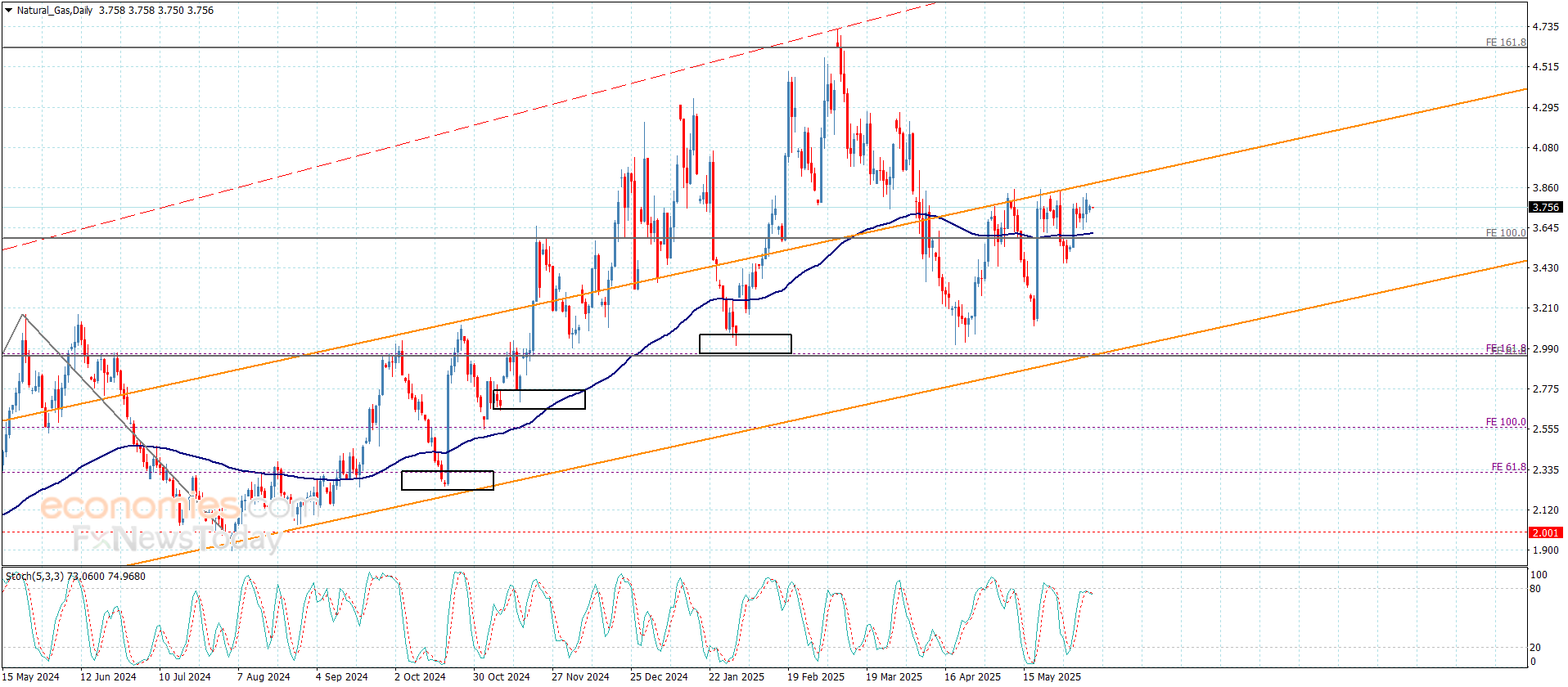
Today’s bullish price action represents a likely completion to the short three-day consolidation that followed Monday’s strong advance. It puts natural gas in a position to again challenge a resistance zone that was tested during four of the past five weeks. It is identified by weekly highs from $3.82 to $3.84 (B). The high price was the most recent swing high that led to a pullback. This behavior shows strong resistance. But if it is broken to the upside, a trend continuation signal is triggered and the continuation of the rising ABCD pattern, measured from the April low (A).
Nonetheless, since there have been signs of strong resistance and there is a large consolidation range above (head and shoulders top), until there is a decisive upside breakout there remains a risk that a bearish reversal could occur. Currently, that possibility would become more likely on a decline below today’s low. An initial potential support zone is at $3.52 currently, which is the convergence of the 20-Day and 50-Day MAs, therefore adding significance to the price zone.
Nonetheless, if an upside breakout triggers above $3.84, the next decision point looks to be an upside target zone from $4.08 to $4.12, consisting of the initial target from a rising ABCD pattern and the 61.8% Fibonacci retracement, respectively. Since the two levels are relatively close together, they could act like a magnet for price following a confirmed upside breakout. Confirmation would occur on a daily close above the price level.
Notice that a swing low of $2.86 was established at the end of the bearish correction that followed the trend high of $4.90 in March. The subsequent advance from that low established a higher angle of ascent for the long-term trend, relative to the lower purple trendline that connects to the August 2024 swing low. This shows improving momentum and is supportive of a potential bull breakout and move for the price of natural gas.
For a look at all of today’s economic events, check out our economic calendar.
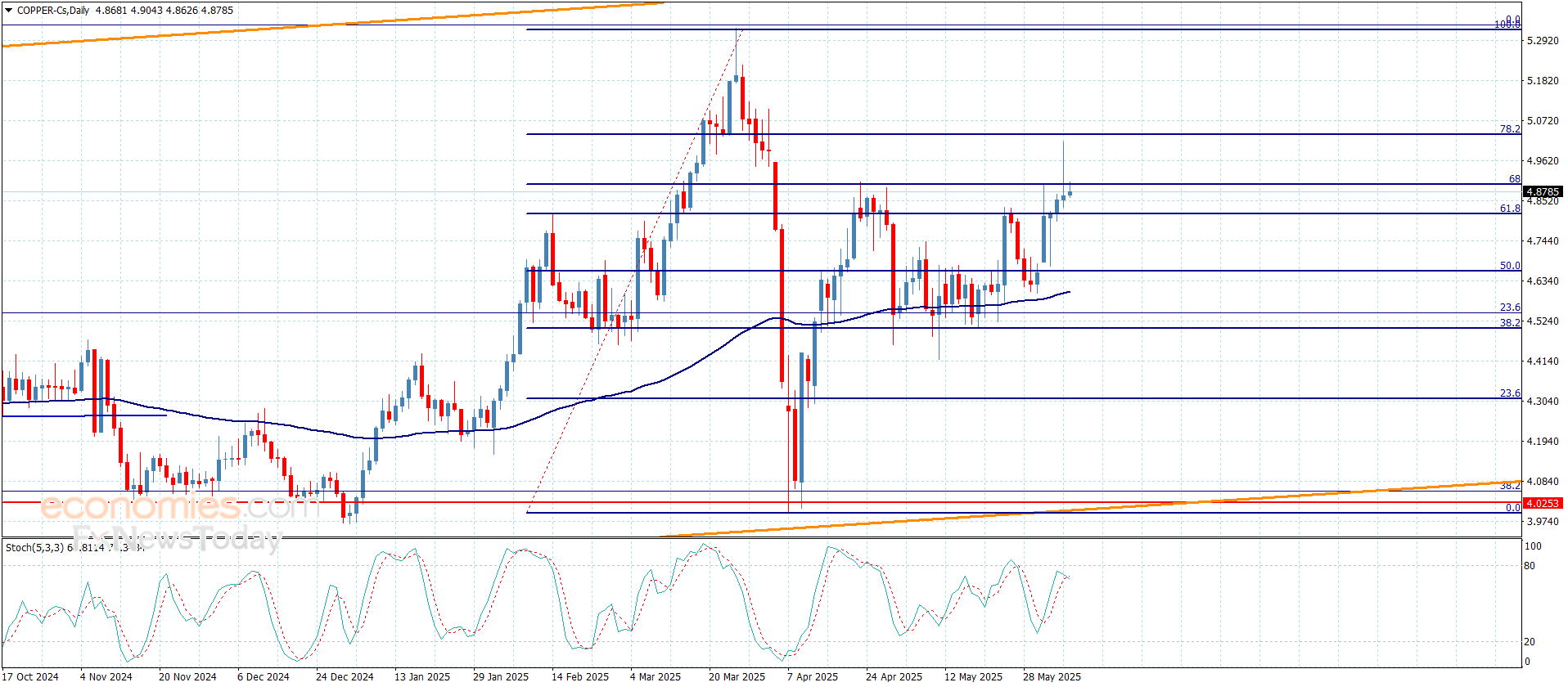
Copper price formed temporary negative rebound after reaching $5.01000 level and recording the waited targets, to fluctuate near 38.1%Fiboancci correctional level at $4.8900.
The current negative rebound won’t represent any threat to the chances of resuming the bullish attack, as there are several bullish factors such as forming a new support at $4.8000 level, to provide the positive momentum for the main indicators, therefore, we will keep waiting for renewing the bullish attempts to target $5.0300 level reaching $5.1000 level.
The expected trading range for today is between $4.8500 and $5.030
Trend forecast: Bullish
Gold prices are extending losses against the US Dollar (USD) on Friday, falling below prior psychological support, now resistance, at $3,350, after the US Nonfarm Payrolls (NFP) report showed a resilient labour market.
After a week of data suggesting a softening US labor market, the Nonfarm Payrolls (NFP) report for May surprised to the upside. The US economy added 139,000 new jobs, beating analysts’ expectations of a 130,000 increase.
Meanwhile, the Unemployment Rate remained unchanged at 4.2%, offering a mixed but slightly more optimistic view of labor market conditions. The stronger-than-expected headline figure has provided temporary relief for the US Dollar, easing concerns that the Federal Reserve (Fed) may need to act quickly with rate cuts. However, underlying softness in other employment metrics earlier in the week continues to warrant caution in the broader policy outlook.
According to the CME FedWatch Tool, the probability of a July rate cut has dropped sharply to 16.5%, down from 33.9% prior to the release. The data has temporarily eased pressure on the Fed to act swiftly, suggesting that policymakers may adopt a more patient stance in the near term.
Although Thursday’s phone call between Chinese and US presidents helped ease immediate fears of an escalating trade war, tariff uncertainties and broader trade tensions remain a key concern for global investors.
The US decision to double tariffs on steel and aluminum imports to 50%, which was enforced on Wednesday, has drawn sharp criticism from key trade partners, including India, Canada, the European Union and Mexico, all of whom have threatened retaliatory measures.
With trade negotiations expected to continue into next week, the risk of prolonged disputes looms. Should talks break down or tensions escalate further, the global economy could face renewed headwinds, potentially weakening equity markets and driving demand for safe-haven assets such as Gold.
Gold has broken below the $3,350 psychological level of support on Friday, with prices testing $3,330 at the time of writing. With prices still confined to a narrow range that has been building over the past four days, the whipsaw price action and broader geopolitical developments leave Gold prices vulnerable to any fundamental shifts that could impact the direction of prices next week.
With the $3,350 level now providing near-term resistance, short-term support is seen at the $3,300 psychological level, resting just above the 20-day Simple Moving Average (SMA) at $3,291.
The pullback in prices has also pushed the Relative Strength Index (RSI) lower, with a reading of 52 suggesting that bulls may be losing steam.
For the upside to prevail, a move above $3,350 and above the $3,370, which provided resistance for Friday’s move, could see prices recover, bringing the $3,400 psychological level back into play.
Gold daily chart
For an upside move, the Gold price has a few technical hurdles to clear. The $3,392 resistance level has limited the bullish potential throughout the week, followed by the $3,400 psychological level. If bulls clear this zone and bullish momentum gains traction, a move toward the April all-time high at $3,500 may be possible.
Gold has played a key role in human’s history as it has been widely used as a store of value and medium of exchange. Currently, apart from its shine and usage for jewelry, the precious metal is widely seen as a safe-haven asset, meaning that it is considered a good investment during turbulent times. Gold is also widely seen as a hedge against inflation and against depreciating currencies as it doesn’t rely on any specific issuer or government.
Central banks are the biggest Gold holders. In their aim to support their currencies in turbulent times, central banks tend to diversify their reserves and buy Gold to improve the perceived strength of the economy and the currency. High Gold reserves can be a source of trust for a country’s solvency. Central banks added 1,136 tonnes of Gold worth around $70 billion to their reserves in 2022, according to data from the World Gold Council. This is the highest yearly purchase since records began. Central banks from emerging economies such as China, India and Turkey are quickly increasing their Gold reserves.
Gold has an inverse correlation with the US Dollar and US Treasuries, which are both major reserve and safe-haven assets. When the Dollar depreciates, Gold tends to rise, enabling investors and central banks to diversify their assets in turbulent times. Gold is also inversely correlated with risk assets. A rally in the stock market tends to weaken Gold price, while sell-offs in riskier markets tend to favor the precious metal.
The price can move due to a wide range of factors. Geopolitical instability or fears of a deep recession can quickly make Gold price escalate due to its safe-haven status. As a yield-less asset, Gold tends to rise with lower interest rates, while higher cost of money usually weighs down on the yellow metal. Still, most moves depend on how the US Dollar (USD) behaves as the asset is priced in dollars (XAU/USD). A strong Dollar tends to keep the price of Gold controlled, whereas a weaker Dollar is likely to push Gold prices up.
The GBPJPY pair renewed the bullish attempts by its rally above 194.55 level, attempting to confirm the suggested bullish scenario, achieving some gains by hitting 195.30 level.
Note that the beginning of providing positive momentum will reinforce the chances for forming strong bullish waves, to expect attacking 195.70 level, and surpassing it will make it target new bullish stations, by reaching 61.8%Fibonacci correction level at 197.35, while the decline below 194.00 will force it to delay the rise and provide mixed trading again.
The expected trading range for today is between 194.45 and 195.70
Trend forecast: Bullish
Copper price formed temporary negative rebound after reaching $5.01000 level and recording the waited targets, to fluctuate near 38.1%Fiboancci correctional level at $4.8900.
The current negative rebound won’t represent any threat to the chances of resuming the bullish attack, as there are several bullish factors such as forming a new support at $4.8000 level, to provide the positive momentum for the main indicators, therefore, we will keep waiting for renewing the bullish attempts to target $5.0300 level reaching $5.1000 level.
The expected trading range for today is between $4.8500 and $5.030
Trend forecast: Bullish
Silver prices (XAG/USD) maintain their bullish structure intact, with bulls aiming for the $34.60-$34.80 resistance area, with downside attempts contained above the $34.00 support level.
A US Dollar on its back foot is contributing to keeping the precious metal buoyed. US ISM Services PMI data showed an unexpected contraction in the sector’s activity in May, and the ADP Employment report posted a poor increase in payrolls, which revived fears of an economic recession.
Beyond that, the global trade scenario remains highly uncertain. The negotiations between the US and its trade partners are failing to yield any significant breakthrough, and Trump has complained about the difficulties of cutting a deal with China’s President, Xi, revealing that the world’s two major economies are far from reaching a trade agreement.
The technical picture shows a bullish structure in place, from mid-May lows at $31.75, with price action testing the top of an ascending triangle pattern, which points to an eventual bullish outcome.
Prices are about to test the top of the triangle, at the lower limit of the $34.60-34-80 resistance area, which has been holding the pair over the last few days. Above here, a 261.8% Fibonacci extension awaits at the $36.10 area.
On the downside, a breach of $34.00 would invalidate this view, and add pressure towards the previous top, at $33.65 ahead of the $32.70 level.
Silver is a precious metal highly traded among investors. It has been historically used as a store of value and a medium of exchange. Although less popular than Gold, traders may turn to Silver to diversify their investment portfolio, for its intrinsic value or as a potential hedge during high-inflation periods. Investors can buy physical Silver, in coins or in bars, or trade it through vehicles such as Exchange Traded Funds, which track its price on international markets.
Silver prices can move due to a wide range of factors. Geopolitical instability or fears of a deep recession can make Silver price escalate due to its safe-haven status, although to a lesser extent than Gold’s. As a yieldless asset, Silver tends to rise with lower interest rates. Its moves also depend on how the US Dollar (USD) behaves as the asset is priced in dollars (XAG/USD). A strong Dollar tends to keep the price of Silver at bay, whereas a weaker Dollar is likely to propel prices up. Other factors such as investment demand, mining supply – Silver is much more abundant than Gold – and recycling rates can also affect prices.
Silver is widely used in industry, particularly in sectors such as electronics or solar energy, as it has one of the highest electric conductivity of all metals – more than Copper and Gold. A surge in demand can increase prices, while a decline tends to lower them. Dynamics in the US, Chinese and Indian economies can also contribute to price swings: for the US and particularly China, their big industrial sectors use Silver in various processes; in India, consumers’ demand for the precious metal for jewellery also plays a key role in setting prices.
Silver prices tend to follow Gold’s moves. When Gold prices rise, Silver typically follows suit, as their status as safe-haven assets is similar. The Gold/Silver ratio, which shows the number of ounces of Silver needed to equal the value of one ounce of Gold, may help to determine the relative valuation between both metals. Some investors may consider a high ratio as an indicator that Silver is undervalued, or Gold is overvalued. On the contrary, a low ratio might suggest that Gold is undervalued relative to Silver.