The main tag of Gold Today Price Articles.
You can use the search box below to find what you need.
[wd_asp id=1]
The main tag of Gold Today Price Articles.
You can use the search box below to find what you need.
[wd_asp id=1]
Notice that there has been only one day since the April bottom that natural gas closed above the neckline, indicating a potential bullish breakout. The current and second test of the neckline may have greater success. Nonetheless, the recent swing high at $3.84 (B) is a key pivot that needs to be reclaimed before higher targets are valid.
At the time of this writing, the high of the day was $3.73 and the low $3.66. Notice that support for today and yesterday was found around two lines. There is a dashed line that marks the halfway point of a rising trend channel (green) and an AVWAP support line (light blue) begun from the trend high in March.
A successful test of support around those lines the past two days is a sign of strength as the lines previously represented dynamic resistance. It is also interesting to note that the weekly 20-period moving average has been converging recently with the AVWAP. Currently, they each mark a similar support level.
A rise above today’s high will trigger a breakout of an inside day, while an advance above yesterday’s high of $3.76 provides a stronger bullish signal. If momentum is retained that should lead to a breakout above the $3.84 swing high and trigger a continuation of a rising ABCD pattern. An initial target from that pattern is at $4.08. But it is joined by the 61.8% Fibonacci retracement at $4.12. They should be looked at as a potential resistance area.
For a look at all of today’s economic events, check out our economic calendar.
Silver price consolidated during Wednesday’s session, trading almost flat near $34.50, as traders seem reluctant to push the metal’s prices outside of the $34.00-$34.50 range.
Technically, Silver remains bullish-biased, though buyers are taking a breather after Monday’s over 5% gain, which pushed XAG/USD from around $33.00 to $34.50, the most significant gain since October 18, 2024, when Silver gained 6.40%.
As Silver makes higher highs and higher lows and has broken the previous two peaks seen near $34.51, the grey metal seems poised to challenge the $35.00 figure. A decisive break could send XAG/USD to challenge 13-year highs at $37.49, the February 29, 2012, daily high.
Conversely, a daily close of XAG/USD below the March 28 peak of $34.58 would likely result in a decline towards $34.00. In the event of further weakness, the next support level would be the May 22 peak, which has since turned into support at $33.69.
Silver is a precious metal highly traded among investors. It has been historically used as a store of value and a medium of exchange. Although less popular than Gold, traders may turn to Silver to diversify their investment portfolio, for its intrinsic value or as a potential hedge during high-inflation periods. Investors can buy physical Silver, in coins or in bars, or trade it through vehicles such as Exchange Traded Funds, which track its price on international markets.
Silver prices can move due to a wide range of factors. Geopolitical instability or fears of a deep recession can make Silver price escalate due to its safe-haven status, although to a lesser extent than Gold’s. As a yieldless asset, Silver tends to rise with lower interest rates. Its moves also depend on how the US Dollar (USD) behaves as the asset is priced in dollars (XAG/USD). A strong Dollar tends to keep the price of Silver at bay, whereas a weaker Dollar is likely to propel prices up. Other factors such as investment demand, mining supply – Silver is much more abundant than Gold – and recycling rates can also affect prices.
Silver is widely used in industry, particularly in sectors such as electronics or solar energy, as it has one of the highest electric conductivity of all metals – more than Copper and Gold. A surge in demand can increase prices, while a decline tends to lower them. Dynamics in the US, Chinese and Indian economies can also contribute to price swings: for the US and particularly China, their big industrial sectors use Silver in various processes; in India, consumers’ demand for the precious metal for jewellery also plays a key role in setting prices.
Silver prices tend to follow Gold’s moves. When Gold prices rise, Silver typically follows suit, as their status as safe-haven assets is similar. The Gold/Silver ratio, which shows the number of ounces of Silver needed to equal the value of one ounce of Gold, may help to determine the relative valuation between both metals. Some investors may consider a high ratio as an indicator that Silver is undervalued, or Gold is overvalued. On the contrary, a low ratio might suggest that Gold is undervalued relative to Silver.
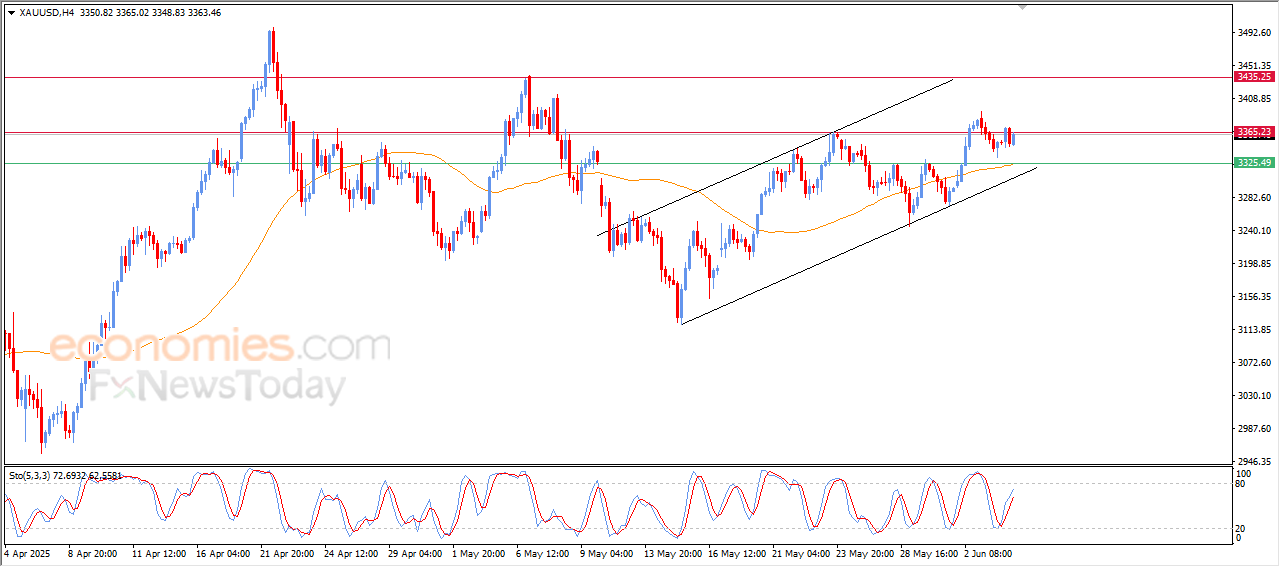
Spot Gold resumed its advance on Wednesday, although XAU/USD trades below the weekly high set at $3,392.22. The bright metal hovers around $3,370, helped by a fresh round of US Dollar (USD) selling after the release of discouraging United States (US) data.
On the one hand, the country reported that the private sector added measly 37K new job positions in May, according to the ADP Employment Change report. Additionally, the ISM Services Purchasing Managers’ Index (PMI) contracted to 49.9 in the same month, down from the 51.6 posted in April and below the 52 anticipated.
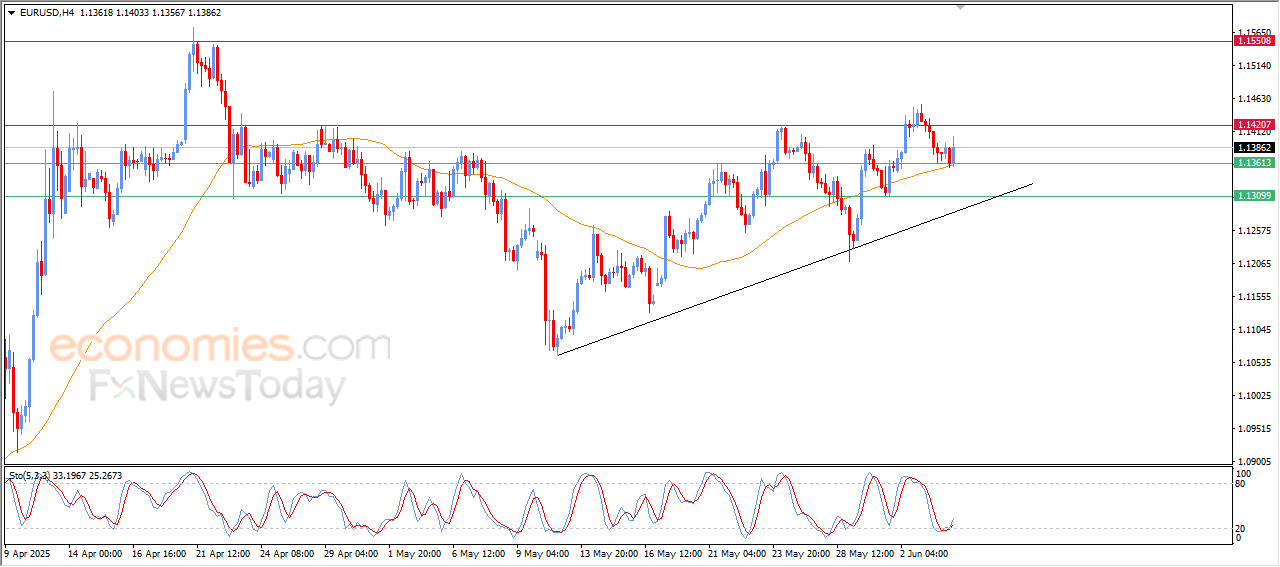
The USD came under modest selling pressure with the news, as speculative interest awaits first-tier releases scheduled for the upcoming days. The European Central Bank (ECB) will announce its decision on monetary policy on Thursday, while the US will publish the May Nonfarm Payrolls (NFP) report on Friday.
In the meantime, US President Donald Trump and his Chinese counterpart, Xi Jinping, engaged in another round of mutual accusations. Trump claimed that his Xi Jinping was “extremely hard” to make a deal with, while Beijing’s Foreign Minister Wang Yi called on the US to “meet China halfway.” A hinted call within the next few days between the two leaders partially cooled concerns, which, anyway, keep the mood contained. At the time being, US indexes are marginally up, suggesting market participants are holding on to modest hopes.
The daily chart for the XAU/USD pair shows it keeps consolidating recent gains, and that the risk skews to the upside. It keeps developing above a flat 20 Simple Moving Average (SMA) currently at around $3,293.30. The Momentum indicator eases from its intraday peak but holds well above its midline, while the Relative Strength Index (RSI) indicator consolidates at around 57. Finally, XAU/USD remains far above bullish 100 and 200 SMAs, which reflect the dominant bullish trend regardless of the ongoing consolidation.
The 4-hour chart favors a bullish extension, although the momentum is missing. Technical indicators hold within positive levels, but with uneven strength. At the same time, a bullish 20 SMA keeps providing intraday support while advancing beyond flat 100 and 200 SMAs.
In the near term, and according to the 4-hour chart, XAU/USD maintains its positive bias. The pair bounced from a mildly bullish 20 SMA, which advances beyond directionless 100 and 200 SMAs. Finally, technical indicators eased from their recent peaks, but consolidate within positive levels, far from suggesting a steeper decline.
Support levels: 3,361.20 3,346.55 3,333.10
Resistance levels: 3,382.60 3,394.05 3,408.45
Natural gas prices haven’t moved anything since yesterday’s trading, to repeat forming sideways trading near $3.710, reinforcing the chances for renewing the negative attempts that depend on the stability of the resistance at $3.87.
We recommend waiting for breaking the initial support at $3.600, reinforcing the chances for forming strong bearish waves, to target $3.450 and $3.320 level, while breaching the resistance and holding above it will confirm its move to the bullish track by its rally to $3.960 initially.
The expected trading range for today is between $3.550 and $3.800
Trend forecast: Bearish
Platinum price remains affected by the contradiction between the main indicators, which forces it to delay the negative attack by its repeated fluctuation above the extra support at $950.00, achieving some gains by reaching $973.00.
Reminding you that the stability of the price below $983.00 level, will increase the chances for renewing the negative trading in the current trading, to keep waiting for attacking the support at $950.00, while surpassing the barrier will cancel the negative suggestion, to open the way towards activating the bullish rally, which might target $1000.00 level initially.
The expected trading range for today is between $950.00 and $983.00
Trend forecast: Fluctuated within the bearish track
The EURJPY pair ended yesterday’s trading positively, due to its repeated stability above 163.35 level, attacking the initial barrier near 163.85, which represents one of the keys to regain the bullish bias in the near and medium period trading.
The price needs a new positive momentum, assisting to reinforce the chances for forming more of the bullish waves, to begin targeting bullish stations by its rally towards 164.85 and 165.35, while the price return to fluctuate below 163.35 will force it to activate the bearish correctional track before reaching any on the suggested positive stations.
The expected trading range for today is between 163.50 and 164.85
Trend forecast: Bullish
“The market’s focus has shifted from inflation fear to growth fragility,” noted Thomas Bucher, strategist at DWS. “That’s supportive for metals with defensive characteristics like gold.”
The latest JOLTS data showed 7.39 million job openings in April, beating the 7.34 million estimate. While this suggests labor market resilience, falling bond yields and a softer dollar indicate traders remain focused on Fed easing.
Fed officials remain divided. Atlanta Fed’s Raphael Bostic argued for caution, while Chicago’s Austan Goolsbee cited delayed inflation effects from tariffs. Governor Lisa Cook raised concerns over stagflation, warning that persistent trade disruptions could hinder growth while driving up prices.
These diverging viewpoints have injected uncertainty into markets, limiting directional conviction in gold or silver.
Upcoming economic indicators, including Wednesday’s ADP private payrolls and the ISM Services PMI, are likely to impact short-term demand for the dollar and shape the momentum of precious metals.
However, Friday’s Nonfarm Payrolls (NFP) report remains the decisive catalyst. A strong reading may delay easing expectations, while a miss could fast-track rate cuts, supporting further gains in gold and silver.
The EURJPY pair ended yesterday’s trading positively, due to its repeated stability above 163.35 level, attacking the initial barrier near 163.85, which represents one of the keys to regain the bullish bias in the near and medium period trading.
The price needs a new positive momentum, assisting to reinforce the chances for forming more of the bullish waves, to begin targeting bullish stations by its rally towards 164.85 and 165.35, while the price return to fluctuate below 163.35 will force it to activate the bearish correctional track before reaching any on the suggested positive stations.
The expected trading range for today is between 163.50 and 164.85
Trend forecast: Bullish
Silver (XAG/USD) struggles to capitalize on the overnight bounce from sub-$34.00 levels and oscillates in a narrow trading band during the Asian session on Wednesday. The white metal currently hovers around the $34.50 area, nearly unchanged for the day, though it remains close to the year-to-date peak (YTD) touched on Monday.
From a technical perspective, this week’s breakout through the $33.80 barrier, or the top boundary of a multi-week-old range, was seen as a key trigger for bullish traders. Moreover, oscillators on the daily chart are holding comfortably in positive territory and are still away from being in the overbought zone. This, in turn, suggests that the path of least resistance for the XAG/USD is to the upside and backs the case for a further near-term appreciating move.
Some follow-through buying beyond the $34.8-$34.90 region, or the YTD top and a twelve-year high touched in October 2024, will reaffirm the constructive outlook and pave the way for additional gains. The XAG/USD might then accelerate the momentum towards the next relevant hurdle near the $35.66 area, or March 2012 swing high, before aiming to reclaim the $36.00 mark for the first time since February 2012.
On the flip side, corrective slides below the $34.00 mark could be seen as a buying opportunity and remain limited near the aforementioned trading range resistance breakpoint, around the $33.65 region. A sustained break below the latter, however, could drag the XAG/USD to the $33.00 round figure. This is followed by the $32.75-$32.70 strong horizontal support, which if broken decisively might shift the near-term bias in favor of bearish traders.
Silver is a precious metal highly traded among investors. It has been historically used as a store of value and a medium of exchange. Although less popular than Gold, traders may turn to Silver to diversify their investment portfolio, for its intrinsic value or as a potential hedge during high-inflation periods. Investors can buy physical Silver, in coins or in bars, or trade it through vehicles such as Exchange Traded Funds, which track its price on international markets.
Silver prices can move due to a wide range of factors. Geopolitical instability or fears of a deep recession can make Silver price escalate due to its safe-haven status, although to a lesser extent than Gold’s. As a yieldless asset, Silver tends to rise with lower interest rates. Its moves also depend on how the US Dollar (USD) behaves as the asset is priced in dollars (XAG/USD). A strong Dollar tends to keep the price of Silver at bay, whereas a weaker Dollar is likely to propel prices up. Other factors such as investment demand, mining supply – Silver is much more abundant than Gold – and recycling rates can also affect prices.
Silver is widely used in industry, particularly in sectors such as electronics or solar energy, as it has one of the highest electric conductivity of all metals – more than Copper and Gold. A surge in demand can increase prices, while a decline tends to lower them. Dynamics in the US, Chinese and Indian economies can also contribute to price swings: for the US and particularly China, their big industrial sectors use Silver in various processes; in India, consumers’ demand for the precious metal for jewellery also plays a key role in setting prices.
Silver prices tend to follow Gold’s moves. When Gold prices rise, Silver typically follows suit, as their status as safe-haven assets is similar. The Gold/Silver ratio, which shows the number of ounces of Silver needed to equal the value of one ounce of Gold, may help to determine the relative valuation between both metals. Some investors may consider a high ratio as an indicator that Silver is undervalued, or Gold is overvalued. On the contrary, a low ratio might suggest that Gold is undervalued relative to Silver.
Gold price is staging a tepid turnaround above $3,350 in Asian trading on Wednesday. Gold buyers keenly await the high-impact US data releases and speeches from Federal Reserve (Fed) policymakers for a sustained move higher.
Having retreated from the monthly high of $3,392 on Tuesday, Gold price is recovering some ground amid a renewed selling wave around the US Dollar (USD) as trade concerns return to the fore.
The Trump administration’s deadline for its trading partners to submit their best offers on trade looms this Wednesday while a doubling of levies to 50% on imported steel and aluminium will take effect at 4 GMT.
Additionally, markets remain wary of the likely talks between US President Donald Trump and his Chinese counterpart Xi Jinping on Friday, especially after US Federal Bureau of Investigation (FBI) Director Kash Patel confirmed via a post on X the arrest of two Chinese nationals charged for smuggling potential bioterror fungus into the US.
Last week, both sides accused each other of violating the terms of an agreement in May to lower some tariffs.
The USD-denominated bright metal could receive a brief boost as the Greenback sees a fresh leg down on US steel and aluminium tariffs coming into effect.
Attention will then turn toward the top-tier US ADP Employment Change and ISM Services PMI data due later in the American session for fresh signs on the health of the US economy. This could provide hints on the Fed’s next policy move and direction on the USD.
On Tuesday, the US Dollar found some respite from stronger-than-expected JOLTS Job Openings, which are closely watched by the Fed.
The number of job openings on the last business day of April stood at 7.39 million, following 7.2 million openings recorded in March. The market expectation was for 7.1 million.
The short-term technical outlook remains constructive so long as the confluence of the 21-day Simple Moving Average (SMA) and the 38.2% Fibonacci Retracement (Fibo) level of the April record rally at $3,297 is held.
The 14-day Relative Strength Index (RSI) is pointing north while comfortably above the midline, justifying the renewed upside.
Gold buyers must scale the 23.6% Fibo resistance at $3,377 on a daily candlestick closing basis to resume the recent upswing toward the lifetime highs of $3,500.
Ahead of that, the May high of $3,439 must be taken out.
Gold price stormed through the falling trendline resistance, then at $3,346, to finish Monday at $3,382.
Alternatively, sellers could attempt control on a break below the falling trendline resistance-turned-support, now at $3,325.
The next support is seen at the abovementioned powerful confluence of $3,297.
The last line of defense for buyers is aligned near $3,240, where the 50% Fibo level and the 50-day SMA hang around.
The ADP Employment Change is a gauge of employment in the private sector released by the largest payroll processor in the US, Automatic Data Processing Inc. It measures the change in the number of people privately employed in the US. Generally speaking, a rise in the indicator has positive implications for consumer spending and is stimulative of economic growth. So a high reading is traditionally seen as bullish for the US Dollar (USD), while a low reading is seen as bearish.
Next release:
Wed Jun 04, 2025 12:15
Frequency:
Monthly
Consensus:
115K
Previous:
62K
Source:
ADP Research Institute