The main tag of Gold Today Price Articles.
You can use the search box below to find what you need.
[wd_asp id=1]
The main tag of Gold Today Price Articles.
You can use the search box below to find what you need.
[wd_asp id=1]
The next key upside pivot level is the prior lower swing high at $3.84 (B). A decisive rally above that higher level will trigger the continuation of a rising ABCD pattern with an initial upside target around $4.08. That price level can be considered as the beginning of a price range up the 61.8% Fibonacci retracement at $4.12.
Given recent signs of strength, it looks like there is a good chance the breakout may trigger. Notice that the prior three days found support around the 20-Day MA (purple). A breakout above the 50-Day MA was confirmed yesterday with a daily close above the line. Once reclaimed both the 20-Day and 50-Day lines are potential support and will likely be used by traders as an area to enter or add in anticipation of rising prices.
In addition, support last week was also confirmed by a 50% retracement level and an AVWAP (light blue) support level anchored from the April swing low. Notice that previously, the AVWAP line represented an area of resistance from May 15 to May 27. Again, once a prior resistance line is successfully tested as support the stage is set for the trend to move higher.
The 20-Day and 50-Day lines have been converging, with the faster 20-Day line targeting a rise above the 50-Day soon. That would provide another bullish sign in support of a strengthening trend. If the parameters of the rising trend channel are retained, there is the potential for resistance to be seen near the top line of the channel. The timing could coincide with the approach to the $4.08 target zone. There are three hits of the top channel line thereby confirming the line. If a third hit leads to a bearish reversal the bottom of the channel becomes a potential target.
For a look at all of today’s economic events, check out our economic calendar.
Silver (XAG/USD) price trimmed some of its Monday’s 5% gains, edging down 0.52% on Tuesday, with the grey metal trading near the $34.50 area, stuck to the highs of the current week. Upbeat economic data in the United States (US) pushed XAG/USD under $34.00, but buyers emerged and lifted the non-yielding metal.
Silver price maintains its bullish bias despite retreating somewhat during the session and remains above the October 29 swing high of $34.54, which is seen as the first support level. The Relative Strength Index (RSI) indicates that buyers are in control; however, they need to overcome the next key resistance level, which is seen at $35.00. Once cleared, Silver would be poised to test the February 29, 2012, high of $37.49.
Conversely, a daily close of XAG/USD below the March 28 peak of $34.59 would likely result in a decline towards $34.00. In the event of further weakness, the next support level would be the May 22 peak, which has since turned into support at $33.69.
Silver is a precious metal highly traded among investors. It has been historically used as a store of value and a medium of exchange. Although less popular than Gold, traders may turn to Silver to diversify their investment portfolio, for its intrinsic value or as a potential hedge during high-inflation periods. Investors can buy physical Silver, in coins or in bars, or trade it through vehicles such as Exchange Traded Funds, which track its price on international markets.
Silver prices can move due to a wide range of factors. Geopolitical instability or fears of a deep recession can make Silver price escalate due to its safe-haven status, although to a lesser extent than Gold’s. As a yieldless asset, Silver tends to rise with lower interest rates. Its moves also depend on how the US Dollar (USD) behaves as the asset is priced in dollars (XAG/USD). A strong Dollar tends to keep the price of Silver at bay, whereas a weaker Dollar is likely to propel prices up. Other factors such as investment demand, mining supply – Silver is much more abundant than Gold – and recycling rates can also affect prices.
Silver is widely used in industry, particularly in sectors such as electronics or solar energy, as it has one of the highest electric conductivity of all metals – more than Copper and Gold. A surge in demand can increase prices, while a decline tends to lower them. Dynamics in the US, Chinese and Indian economies can also contribute to price swings: for the US and particularly China, their big industrial sectors use Silver in various processes; in India, consumers’ demand for the precious metal for jewellery also plays a key role in setting prices.
Silver prices tend to follow Gold’s moves. When Gold prices rise, Silver typically follows suit, as their status as safe-haven assets is similar. The Gold/Silver ratio, which shows the number of ounces of Silver needed to equal the value of one ounce of Gold, may help to determine the relative valuation between both metals. Some investors may consider a high ratio as an indicator that Silver is undervalued, or Gold is overvalued. On the contrary, a low ratio might suggest that Gold is undervalued relative to Silver.
Gold price hovers around $3,350 a troy ounce, down on Tuesday as the US Dollar (USD) managed to recover some of the ground shed on Monday. Speculative interest flipped into riskier assets, with US indexes up by the time of writing, reverting from a pre-opening dip.
United States (US) data was mixed, as Factory Orders fell by 3.7% MoM in April, much worse than the 3.4% advance posted in March or the -3% anticipated by market analysts. At the same time, the number of job openings on the last business day of April stood at 7.39 million, according to the Job Openings and Labor Turnover Survey (JOLTS) report. The figure surpassed the 7.2 million openings recorded in March and exceeded the market expectation of 7.1 million.
Also, the Eurozone (EU) reported that Harmonized Index of Consumer Prices (HICP) rose by 1.9% year-on-year (YoY) in May, below the European Central Bank’s (ECB) 2% target. The core annual figure printed at 2.3%, easing from the 2.7% posted in April and below the 2.5% anticipated by market players. The figures lifted the mood ahead of the European Central Bank (ECB) monetary policy decision on Thursday.
Meanwhile, global trade tensions remain the same. The latest from US President Donald Trump was doubling tariffs on aluminium and steel imports into the country to 50%, starting Wednesday. An update on the matter can come later today.
From a technical point of view, XAU/USD seems to be consolidating gains and with the risk still poised to the upside. In the daily chart, the bright metal holds above all its moving averages, with a flat 20 Simple Moving Average (SMA) offering support around $3,292.80, while the 100 and 200 SMAs keep grinding north far below the shorter one. Technical indicators, in the meantime, remain within positive levels, although with uneven directional strength.
In the near term, and according to the 4-hour chart, XAU/USD maintains its positive bias. The pair bounced from a mildly bullish 20 SMA, which advances beyond directionless 100 and 200 SMAs. Finally, technical indicators eased from their recent peaks, but consolidate within positive levels, far from suggesting a steeper decline.
Support levels: 3,333.10 3,316.65 3,292.80
Resistance levels: 3,367.75 3,374.90 3,394.05
The GBPJPY pair formed more of the slow bearish waves, confirming their surrender to the suggested bearish scenario, by moving away from the barrier at 194.55 level, to repeat the pressure on the intraday obstacle at 192.90.
The continuation of providing negative momentum by stochastic will assist in forming an extra decline to target 192.35 level, reaching the main support at 191.70, while breaching the mentioned barrier will cancel the negative suggestion, to provide the price a chance to renew the bullish attempts by its rally towards 195.20 initially.
The expected trading range for today is between 192.35 and 194.20
Trend forecast: Bearish
Silver prices (XAG/USD) are trading lower on Tuesday’s European session, weighed by a somewhat firmer US Dollar, as the risk-off mood witnessed on Monday seems to have eased.
The precious metal hit fresh six-month highs on Monday, with the US Dollar hammered by renewed tariff concerns and downbeat US data. The US Manufacturing PMI confirmed the negative impact of tariffs on factory activity and pushed the US Dollar to fresh multi-month lows.
From a wider perspective, price action remains positive. The reversal from $34.75 has been contained at the 34.00 round level, above the previous resistance, now a potential support area, at $33.70.
On the upside, the area between $34.75 and $35.00 contains several resistance levels (October 23 and June 4 highs), and the 161.8% Fibonacci extension of the Mid may rally, and might be a tough nut to crack.
Above here, a late 2012 peak lies at $35.40. The 261.8% Fiboinnacci retracement is at $37.00.
On the downside, immediate support is at the mentioned $33.70 and then at the $32.65-$32.75 zone.
.
(This story was corrected on June 3 at 08:43 GMT to say that the 261.8% Fiboinnacci retracement is at $37.00, not the 2611.8% retracement.)
Silver is a precious metal highly traded among investors. It has been historically used as a store of value and a medium of exchange. Although less popular than Gold, traders may turn to Silver to diversify their investment portfolio, for its intrinsic value or as a potential hedge during high-inflation periods. Investors can buy physical Silver, in coins or in bars, or trade it through vehicles such as Exchange Traded Funds, which track its price on international markets.
Silver prices can move due to a wide range of factors. Geopolitical instability or fears of a deep recession can make Silver price escalate due to its safe-haven status, although to a lesser extent than Gold’s. As a yieldless asset, Silver tends to rise with lower interest rates. Its moves also depend on how the US Dollar (USD) behaves as the asset is priced in dollars (XAG/USD). A strong Dollar tends to keep the price of Silver at bay, whereas a weaker Dollar is likely to propel prices up. Other factors such as investment demand, mining supply – Silver is much more abundant than Gold – and recycling rates can also affect prices.
Silver is widely used in industry, particularly in sectors such as electronics or solar energy, as it has one of the highest electric conductivity of all metals – more than Copper and Gold. A surge in demand can increase prices, while a decline tends to lower them. Dynamics in the US, Chinese and Indian economies can also contribute to price swings: for the US and particularly China, their big industrial sectors use Silver in various processes; in India, consumers’ demand for the precious metal for jewellery also plays a key role in setting prices.
Silver prices tend to follow Gold’s moves. When Gold prices rise, Silver typically follows suit, as their status as safe-haven assets is similar. The Gold/Silver ratio, which shows the number of ounces of Silver needed to equal the value of one ounce of Gold, may help to determine the relative valuation between both metals. Some investors may consider a high ratio as an indicator that Silver is undervalued, or Gold is overvalued. On the contrary, a low ratio might suggest that Gold is undervalued relative to Silver.
Despite the pullback, gold’s downside was limited. “Persistent concerns about trade disruptions and expectations of Federal Reserve rate cuts have helped stabilize gold prices,” said a commodities strategist at a Hong Kong-based brokerage.
Silver (XAG/USD) traded at $34.79 per ounce, reflecting modest losses as the precious metal followed gold’s trajectory. The dip comes amid an uptick in risk sentiment, as investors rotated into equities. However, expectations of Fed easing and sustained global uncertainties have kept silver’s downside in check.
Market expectations lean toward the Federal Reserve delivering at least two rate cuts in 2025, a view bolstered by recent comments from Fed officials. Traders now await key US economic releases, including the JOLTS Job Openings report and Friday’s Nonfarm Payrolls (NFP) data, which could influence both the dollar and precious metals.
“While stronger-than-expected US jobs data may lift the dollar in the near term, the overarching narrative of a dovish Fed remains supportive for gold and silver,” noted an analyst at a Singapore-based investment firm.
With geopolitical tensions and trade uncertainties persisting, the broader market sentiment remains favorably inclined towards safe-haven assets, positioning gold and silver as key beneficiaries in a volatile global environment.
Gold consolidates near $3,360, eyeing a breakout above $3,365. Silver holds support at $34.41; a push above $34.79 could target $35.50. Key levels hint at swift moves.
Natural gas price took advantage of stochastic attempt to provide positive momentum, to notice surpassing $3.600 level, recording some of the gains by reaching $3.750, but the repeated stability below the barrier at $3.870 represents a main barrier against regaining the bullish bias, to expect forming mixed trading, and there is chance for the decline again below $3.600 level and targeting the negative stations near $3.450 and $3.320.
While facing new bullish pressure and breaching the mentioned barrier will confirm its readiness to form strong bullish waves, to expect achieving several gains by its rally towards $3.950 and $4.150.
The expected trading range for today is between $3.550 and 3.800
Trend forecast: Bearish
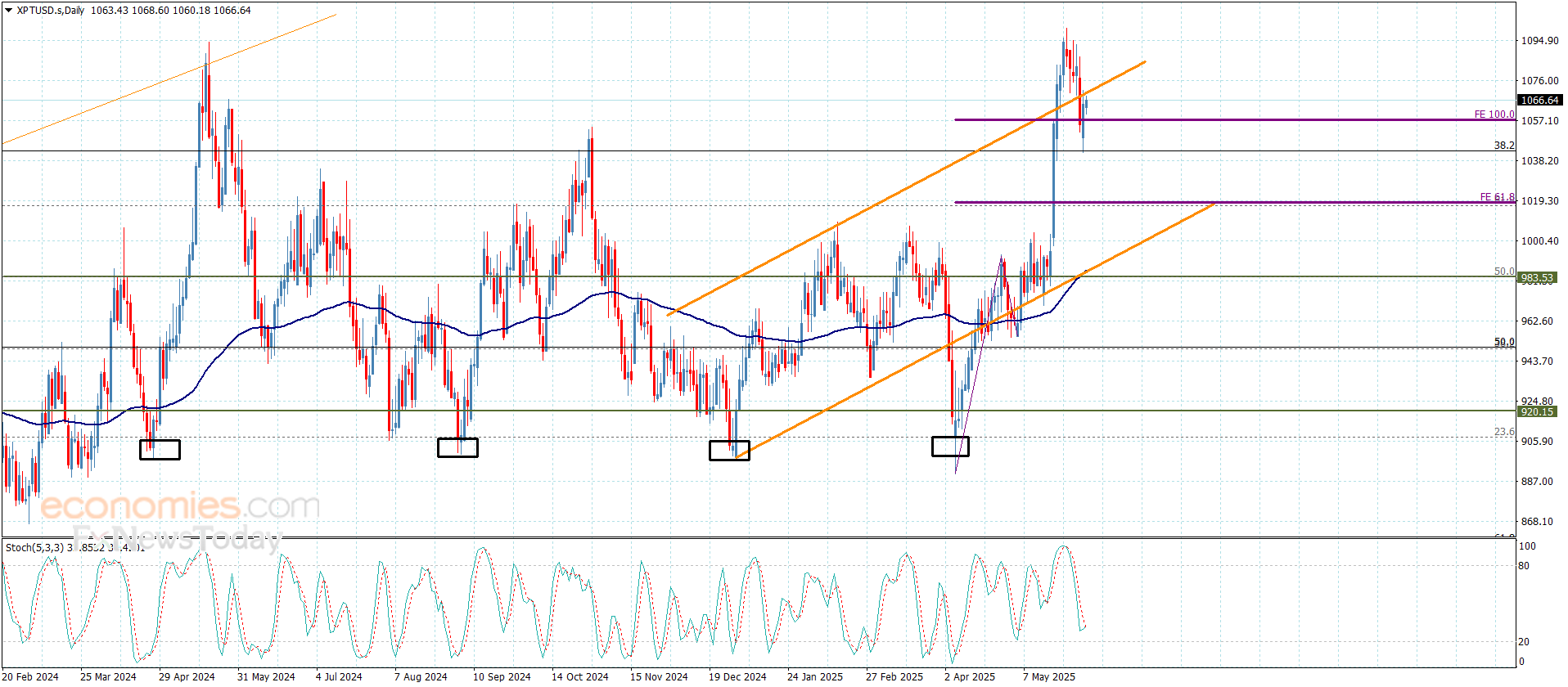
Platinum price took advantage of the repeated stability above the extra support at $1042.00, to notice forming some bullish trading and recording the initial target by hitting $1071.00.
Reminding you that confirming breaching $1070.00 level that represents the extension of the bullish channel’s resistance is important, to confirm its move to a new bullish station that allows it to press on the barrier at $1100.00, while the failure of the breach will force the price to provide mixed trading, and there is chance for renewing the pressure on the support at $1042.00.
The expected trading range for today is between $1052.00 and $1080.00
Trend forecast: Bullish
Gold price is on a modest pullback from the monthly high of $3,392 reached in Tuesday’s early Asian trades. The focus is back on the US JOLTS Job Openings data while trade headlines will continue to remain the primary market driver.
Despite the latest retreat, Gold price will likely remain underpinned by renewed tensions over US President Donald Trump’s latest tariff announcement and rekindling US-China trade rift.
Ever since Trump announced on Friday that he would double import tariffs on steel and aluminium to 50% in a bid to “even further secure the steel industry in the United States (US)”, the US Dollar (USD) has been on the receiving end amid renewed fears over the economy and policies uncertainty.
Further, trade concerns intensified after Trump accused China of violating its agreement with the US to mutually roll back tariffs and holding back products essential to the industrial supply chain., in a post published on Truth Social on Friday.
Moreover, Reuters reported on Monday that The Trump administration is reportedly working on delivering a final trade deal deadline set for this Wednesday.
However, early Tuesday, USD sellers seem to be taking a breather, limiting the Gold price upside. Traders could be covering their USD short positions, gearing for a slew of critical US employment data this week, with the JOLTS Job Openings Survey due later in the day.
Strong US jobs data could back the Federal Reserve’s (Fed) prudent policy approach and aid the Greenback’s recovery, impeding the renewed Gold price uptrend toward record highs.
That said, the daily technical setup for Gold price continues to indicate strong gains in the near term.
Having firmly defended the 21-day Simple Moving Average (SMA), Gold price stormed through the falling trendline resistance, then at $3,346, to finish Monday at $3,382.
At the moment, Gold price is struggling yet again with $3,377, the 23.6% Fibonacci Retracement (Fibo) level of the April record rally.
Buyers yearn for acceptance above the $3,400 threshold to resume the recent upswing toward the lifetime highs of $3,500.
Ahead of that, the May high of $3,439 must be scaled on a sustained basis.
The 14-day Relative Strength Index (RSI) points lower but holds comfortably above the midline, supporting bullish bias.
Conversely, the correction could gather steam on a decisive break below the falling trendline resistance-turned-support, now at $3,341.
The next support is seen at the confluence of the 21-day SMA and the 38.2% Fibo level near $3,300.
Gold sellers could then accelerate declines toward the 50% Fibo level near $3,232 where the 50-day SMA hangs around.
Gold has played a key role in human’s history as it has been widely used as a store of value and medium of exchange. Currently, apart from its shine and usage for jewelry, the precious metal is widely seen as a safe-haven asset, meaning that it is considered a good investment during turbulent times. Gold is also widely seen as a hedge against inflation and against depreciating currencies as it doesn’t rely on any specific issuer or government.
Central banks are the biggest Gold holders. In their aim to support their currencies in turbulent times, central banks tend to diversify their reserves and buy Gold to improve the perceived strength of the economy and the currency. High Gold reserves can be a source of trust for a country’s solvency. Central banks added 1,136 tonnes of Gold worth around $70 billion to their reserves in 2022, according to data from the World Gold Council. This is the highest yearly purchase since records began. Central banks from emerging economies such as China, India and Turkey are quickly increasing their Gold reserves.
Gold has an inverse correlation with the US Dollar and US Treasuries, which are both major reserve and safe-haven assets. When the Dollar depreciates, Gold tends to rise, enabling investors and central banks to diversify their assets in turbulent times. Gold is also inversely correlated with risk assets. A rally in the stock market tends to weaken Gold price, while sell-offs in riskier markets tend to favor the precious metal.
The price can move due to a wide range of factors. Geopolitical instability or fears of a deep recession can quickly make Gold price escalate due to its safe-haven status. As a yield-less asset, Gold tends to rise with lower interest rates, while higher cost of money usually weighs down on the yellow metal. Still, most moves depend on how the US Dollar (USD) behaves as the asset is priced in dollars (XAU/USD). A strong Dollar tends to keep the price of Gold controlled, whereas a weaker Dollar is likely to push Gold prices up.
Given today’s bullish reversal signal, last Thursday’s low of $3.44 established a higher swing low within a near-term uptrend structure that is contained within the developing CD leg of a potential rising ABCD pattern. The ABCD pattern is within a potential bullish trend channel that is highlighted in light green. Support for the bearish pullback was seen last around the confluence of a 50% retracement level, the 20-Day MA, and an AVWAP level from the May swing low (A).
Given the subsequent bullish reaction from that support zone, natural gas looks poised to challenge and possibly exceed the $3.84 lower swing high (B). A decisive breakout above $3.84 would trigger the ABCD pattern as a higher swing high would be established and a daily close above that level would confirm the breakout.
The first higher target zone is $4.08 to $4.12, consisting of the initial target for the rising ABCD pattern and the 61.8% Fibonacci retracement, respectively. Potential resistance around the top line of the trend channel may also provide clues about supply and demand, particularly if it lines up with another indicator once approached by price.
If the price of natural gas continues to rise it will eventually encounter potential resistance around an interim swing high of $4.25. That swing high established the right should for a recent head and shoulders bearish reversal pattern. It marks a lower high in the bearish correction that started after the $4.90 peak in March. A violation of that bearish price structure would be bullish and provide another bullish reversal signal.
For a look at all of today’s economic events, check out our economic calendar.