The main tag of Gold Today Price Articles.
You can use the search box below to find what you need.
[wd_asp id=1]
The main tag of Gold Today Price Articles.
You can use the search box below to find what you need.
[wd_asp id=1]
Copper price reached the initial positive target by reaching $4.7400 level, which forces it to form sideways fluctuated moves, waiting for the extra positive momentum from the main indicators, to confirm renewing the bullish attempts.
Reminding you that the stability of the moving average 55 near the initial support at $4.5400 level supports the attempts of renewing the bullish attempts, which might target $4.8200 level, then attempts to press on the barrier at $4.9000.
The expected trading range for today is between $4.6000 and $4.8100
Trend forecast: Bullish
Do you need help in trading decisions? Do you want to learn how to start trading?
Join Economies.com VIP Club and benefit from over 15 years of market analysis expertise and get:
Special Offer: Subscribe to the Economies.com VIP channel and get also a free subscription to a trusted trading signals channel provided by Best Trading Signal.
Spot Gold trades above the $3,400 mark on Tuesday, helped by broad US Dollar’s (USD) weakness and a sour market mood. Risk-off hit during European trading hours amid political noise in Germany. Friedrich Merz, the conservative leader who won the election over two months ago, was unable to secure a majority in parliament to become chancellor in a first round of voting, finally succeeding in a second attempt.
Wall Street started the day with a soft tone, but managed to trim part of its intraday losses mid-American afternoon, following comments from United States (US) President Donald Trump regarding progress in trade deals. In a joint press conference with Canadian Prime Minister Mark Carney, Trump said he wants to be friends with Canada, and anticipates a big announcement coming in the next few days, following a “very friendly conversation.”
Trump also referred to potential trade deals with other nations and upcoming talks with China. However, his words lacked substance, and US indexes keep trading in the red at the time of writing.
Adding to the dismal sentiment, market players are in a wait-and-see mode ahead of the Federal Reserve (Fed) monetary policy announcement on Wednesday. The Fed is widely anticipated to keep the benchmark interest rate on hold amid uncertainty about the impact of Trump’s levies on the economy. Policymakers are also concerned tariffs could put upward pressure on inflation, and hence, refuse to trim interest rates, something that “frustrated” President Trump recently, and ended up putting at doubt Fed’s independence.
The daily chart for the XAU/USD pair shows it is sharply up for a second consecutive day, and on its way to re-test the record high at $3,500.14. The pair develops well above a bullish 20 Simple Moving Average (SMA) currently at $3,275.80, while the 100 and 200 SMAs gain upward traction far below the shorter one. At the same time, technical indicators head firmly higher after bouncing from around their midlines, anticipating higher highs ahead.
In the near term, and according to the 4-hour chart, Gold is on its way to extend its advance. The pair trades well above all its moving averages, with the 20 SMA gaining upward traction and about to cross above the 100 SMA. Even further, the XAU/USD pair pressures intraday highs in the $3,410 region, while technical indicators maintain their bullish slopes within overbought levels.
Support levels: 3,392.25 3,277.60 3,263.10
Resistance levels: 3,430.20 3,444.25 3,468.30
Copper price began activating with the positivity of the main indicators, forming some of the bullish waves, to settle above $4.660 level, attempting to regain the bullish attempts, and the stability of the moving average 55 near the support at $4.5400 reinforces the chances for targeting positive stations, to wait to reach $4.7300, then repeating the pressure on %61.8 Fibonacci correction level near $4.8200.
Noting that reaching below the mentioned support and providing negative closes below it, will assist to confirm the negative scenario again, to expect suffering several losses by reaching $4.4500 and $4.3100.
The expected trading range for today is between $4.5900 and $4.7300
Trend forecast: Bullish
Do you need help in trading decisions? Do you want to learn how to start trading?
Join Economies.com VIP Club and benefit from over 15 years of market analysis expertise and get:
Special Offer: Subscribe to the Economies.com VIP channel and get also a free subscription to a trusted trading signals channel provided by Best Trading Signal.
Silver price (XAG/USD) surges to near $33.00 during European trading hours on Tuesday. The white metal strengthens as demand for safe-haven assets increasez after United States (US) President Donald Trump threatened to impose tariffs on pharmaceuticals.
On Monday, US President Trump signaled that he intends to reduce reliance on pharmaceutical imports and will announce tariffs on them in two weeks. Trump signed orders to reduce the time lag for approval of new pharma plants and instructed the Environmental Protection Agency (EPA) to accelerate the construction of new manufacturing facilities.
Meanwhile, persistent uncertainty over US-China trade talks continues to support the demand for safe-haven assets, such as Silver. Both nations are trading at a very high level of tariffs, dampening the operating margins of businesses. The US has imposed 145% tariffs on imports from China, while the latter is taking 125% import duty. Washington has signaled that these levels of tariffs are not sustainable, but it wants Beijing to initiate trade talks before lowering import duties. However, Beijing has clarified that it will come to the table for trade negotiations only after the US trims additional levies.
Additionally, the US Dollar’s underperformance ahead of the Federal Reserve’s (Fed) monetary policy decision on Wednesday has also supported the Silver price. The US Dollar Index (DXY), which tracks the Greenback’s value against six major currencies, trades lower around 99.60. Technically, a lower US Dollar makes the Silver price an attractive bet for investors.
According to the CME FedWatch tool, traders have fully priced in that the Fed will leave interest rates steady in the range of 4.25%-4.50% for the third straight meeting in a row.
The scenario of the Fed maintaining interest rates bodes poorly for non-yielding assets, such as Silver.
Silver is a precious metal highly traded among investors. It has been historically used as a store of value and a medium of exchange. Although less popular than Gold, traders may turn to Silver to diversify their investment portfolio, for its intrinsic value or as a potential hedge during high-inflation periods. Investors can buy physical Silver, in coins or in bars, or trade it through vehicles such as Exchange Traded Funds, which track its price on international markets.
Silver prices can move due to a wide range of factors. Geopolitical instability or fears of a deep recession can make Silver price escalate due to its safe-haven status, although to a lesser extent than Gold’s. As a yieldless asset, Silver tends to rise with lower interest rates. Its moves also depend on how the US Dollar (USD) behaves as the asset is priced in dollars (XAG/USD). A strong Dollar tends to keep the price of Silver at bay, whereas a weaker Dollar is likely to propel prices up. Other factors such as investment demand, mining supply – Silver is much more abundant than Gold – and recycling rates can also affect prices.
Silver is widely used in industry, particularly in sectors such as electronics or solar energy, as it has one of the highest electric conductivity of all metals – more than Copper and Gold. A surge in demand can increase prices, while a decline tends to lower them. Dynamics in the US, Chinese and Indian economies can also contribute to price swings: for the US and particularly China, their big industrial sectors use Silver in various processes; in India, consumers’ demand for the precious metal for jewellery also plays a key role in setting prices.
Silver prices tend to follow Gold’s moves. When Gold prices rise, Silver typically follows suit, as their status as safe-haven assets is similar. The Gold/Silver ratio, which shows the number of ounces of Silver needed to equal the value of one ounce of Gold, may help to determine the relative valuation between both metals. Some investors may consider a high ratio as an indicator that Silver is undervalued, or Gold is overvalued. On the contrary, a low ratio might suggest that Gold is undervalued relative to Silver.
“Gold is holding firm as a hedge against uncertainty—both economic and geopolitical,” said a commodities strategist at ING.
The broader macro backdrop remains mixed. Although U.S. economic data has reduced immediate recession fears, traders are still pricing in volatility around the Fed’s tone on interest rates.
Silver (XAG/USD) is also benefitting from the risk-off tone, trading at $33.10 after reaching a session high of $33.12. The metal continues to mirror gold’s price trajectory, supported by technical strength and safe-haven flows.
Both metals are responding to a confluence of forces: easing fears of an imminent U.S. recession, persistent geopolitical tensions, and uncertainty around central bank policy.
Economic data from the U.S. has shown improvement. The Institute for Supply Management (ISM) reported its services PMI rose to 51.6 in April, up from 50.8 in March, indicating steady expansion. Meanwhile, last week’s employment report revealed stronger-than-expected job growth, adding to optimism around the U.S. economy.
Still, the market remains cautious. “While the data points are supportive of growth, uncertainty around inflation and the Fed’s next steps keeps investors defensive,” said a senior economist at Capital Economics.
Despite the stability of the GBPJPY pair above the sideways triangle’s support at 190.85, but the continuation of the main indicators’ negative momentum, as the moving average 55 forms an extra barrier at 191.70, besides stochastic reach to 50 level, these factors support the chances for activating the negative attack, to expect reaching near 189.90, breaking this obstacle will extend the losses directly to 189.20 and 188.60.
While regaining the bullish bias requires forming strong bullish waves, to breach the resistance at 193.35, to confirm its readiness to achieve new gains that might begin at 194.60.
The expected trading range for today is between 189.90 and 191.75
Trend forecast: Bearish
Do you need help in trading decisions? Do you want to learn how to start trading?
Join Economies.com VIP Club and benefit from over 15 years of market analysis expertise and get:
Special Offer: Subscribe to the Economies.com VIP channel and get also a free subscription to a trusted trading signals channel provided by Best Trading Signal.
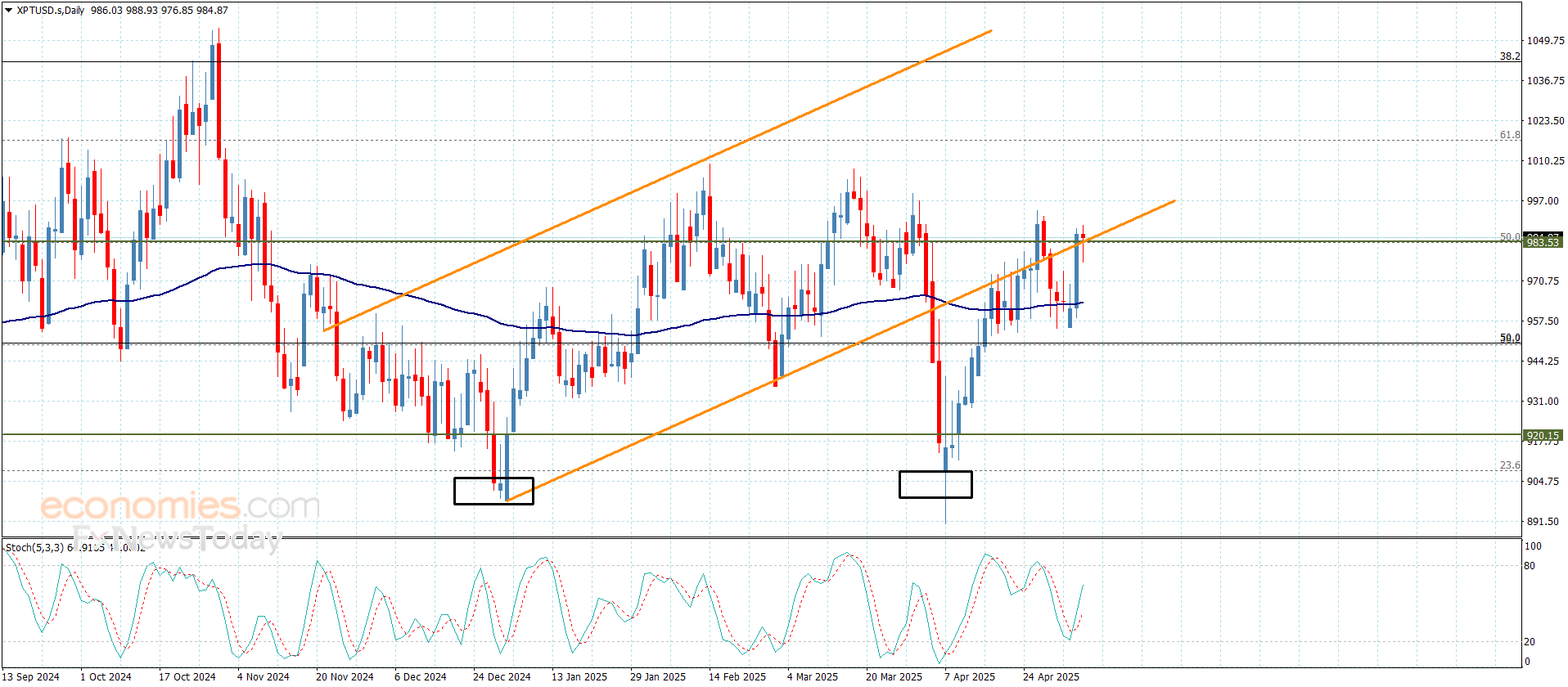
Platinum price remains affected by the contradiction between the main indicators, which forces it to delay the negative attack by its repeated fluctuation above the extra support at $950.00, achieving some gains by reaching $973.00.
Reminding you that the stability of the price below $983.00 level, will increase the chances for renewing the negative trading in the current trading, to keep waiting for attacking the support at $950.00, while surpassing the barrier will cancel the negative suggestion, to open the way towards activating the bullish rally, which might target $1000.00 level initially.
The expected trading range for today is between $950.00 and $983.00
Trend forecast: Fluctuated within the bearish track
Do you need help in trading decisions? Do you want to learn how to start trading?
Join Economies.com VIP Club and benefit from over 15 years of market analysis expertise and get:
Special Offer: Subscribe to the Economies.com VIP channel and get also a free subscription to a trusted trading signals channel provided by Best Trading Signal.
Gold price extends its recovery rally into the second straight day on Tuesday as buyers appear unstoppable amid a bearish sentiment around the US Dollar (USD) and escalating geopolitical tensions in the Middle East.
Despite renewed optimism of the US reaching trade deals with some of its trading partners as early as this week, US President Donald Trump’s erratic trade policies continue to unnerve markets, allowing Gold price to recover lost ground.
Trump said late Monday that he would announce pharmaceutical tariffs in the next two weeks after signing an executive order to incentivize drug manufacturing in the United States (US).
Additionally, the Asian forex exchange chaos also keeps the haven demand for the precious metal alive and kicking. Markets are speculating that some of the Asian central banks are planning to revalue their currencies to shield against the impact of the US tariffs.
In this regard, the Taiwan Dollar (TWD) leapt 8% against the USD on Monday, contributing to the Greenback’s renewed downside. Earlier on, the Hong Kong central bank sold the local currency to restrain it from strengthening against the USD.
Furthermore, escalating geopolitical tensions between Israel and Yemeni Houthi rebels and Russia-Ukraine continue to act as a tailwind for the traditional store of value Gold price. In the latest developments, Russian officials said that Ukraine launched drones at Moscow for the second night in a row, forcing the closure of the capital’s three major airports. Adding to it, they reported that Ukrainian forces were trying to advance in Russia’s western region Kursk.
Meanwhile, “Israel, reportedly in coordination with the US, launched airstrikes on Yemen’s Hodeidah port in response to Houthi rebel’s ballistic missile attack that hit Ben Gurion International Airport on Sunday,” FXStreet’s Analyst Haresh Menghani said.
Therefore, Gold price seems to remain in a constructive space heading into the two-day US Federal Reserve (Fed) policy meeting starting later on Tuesday. Commenting on the upcoming Fed event, Nick Timiraos, the Wall Street Journal’s Fed whisperer, noted that the Fed “prepares for difficult judgments and emerging divisions regarding when to cut interest rates.”
Gold optimists shrugged off easing bets of a June interest rate cut amid an improving economic outlook, as trade headlines and geopolitics dominate, in anticipation of the Fed rate call and Chair Jerome Powell’s comments.
Data showed on Monday that the Institute for Supply Management’s (ISM) Services PMI Index rose to 51.6 from 50.8 in March. Steve Miller, chair of the ISM services survey, said, “April change in indexes was a reversal of March’s direction,” noting rises in new orders, employment, and supplier deliveries indices.
Gold price holds the bounce from the critical 21-day Simple Moving Average (SMA) support, now at $3,260.
The 14-day Relative Strength Index (RSI) holds firm above the midline near 62, suggesting that there is more room to the upside.
The latest leg higher needs acceptance above the $3,400 barrier for Gold buyers to flex their muscles toward the channel support (now resistance) at $3,467.
Further up, the record high of $3,500 will come into play.
On the flip side, the immediate support is seen at $3,300 on a pullback, below which the 21-day SMA at $3,260 will be challenged again.
A failure to defend the latter will fuel a fresh downside move toward the $3,150 psychological level.
Gold has played a key role in human’s history as it has been widely used as a store of value and medium of exchange. Currently, apart from its shine and usage for jewelry, the precious metal is widely seen as a safe-haven asset, meaning that it is considered a good investment during turbulent times. Gold is also widely seen as a hedge against inflation and against depreciating currencies as it doesn’t rely on any specific issuer or government.
Central banks are the biggest Gold holders. In their aim to support their currencies in turbulent times, central banks tend to diversify their reserves and buy Gold to improve the perceived strength of the economy and the currency. High Gold reserves can be a source of trust for a country’s solvency. Central banks added 1,136 tonnes of Gold worth around $70 billion to their reserves in 2022, according to data from the World Gold Council. This is the highest yearly purchase since records began. Central banks from emerging economies such as China, India and Turkey are quickly increasing their Gold reserves.
Gold has an inverse correlation with the US Dollar and US Treasuries, which are both major reserve and safe-haven assets. When the Dollar depreciates, Gold tends to rise, enabling investors and central banks to diversify their assets in turbulent times. Gold is also inversely correlated with risk assets. A rally in the stock market tends to weaken Gold price, while sell-offs in riskier markets tend to favor the precious metal.
The price can move due to a wide range of factors. Geopolitical instability or fears of a deep recession can quickly make Gold price escalate due to its safe-haven status. As a yield-less asset, Gold tends to rise with lower interest rates, while higher cost of money usually weighs down on the yellow metal. Still, most moves depend on how the US Dollar (USD) behaves as the asset is priced in dollars (XAU/USD). A strong Dollar tends to keep the price of Gold controlled, whereas a weaker Dollar is likely to push Gold prices up.
Morgan Stanley joined other major investment banks in slashing oil price forecasts amid expectations of a larger market surplus later this year as OPEC+ plans to raise output much more than previously expected.
Morgan Stanley cut its oil price forecasts for the remainder of the year, anticipating a bigger glut. The bank revised down its projection of Brent Crude prices to $62.50 per barrel in the third and fourth quarters of this year, down by $5 per barrel from the previous forecast.
The market glut could reach 1.1 million barrels per day (bpd) in the second half of the year, Morgan Stanley reckons. That’s an upward revision of 400,000 bpd from the previous surplus forecast.
“We interpret OPEC+’s communication as an indication that it may unwind its production quota faster altogether,” Morgan Stanley analysts, including Martijn Rats, said in a note carried by Bloomberg.
The bank sees much looser market balances now that OPEC+ plans to add more supply than it had guided just two months ago.
In an online meeting on Saturday, key OPEC+ producers led by Saudi Arabia and Russia agreed to raise collective output by 411,000 barrels per day (bpd), nearly triple the volume originally scheduled.
The move follows a similar surge announced for May and signals a sharp reversal from OPEC+ efforts to defend oil prices.
Following the announcement of another aggressive production hike, Goldman Sachs cut – again – its average oil price forecasts this year and next.
Goldman’s analysts now see Brent Crude prices averaging $60 per barrel this year, down from a previous forecast of $63 a barrel. The average price of the U.S. benchmark, WTI Crude, was now downgraded at Goldman Sachs to $56 for 2025, down from $59 a barrel previously expected.
Next year, Brent is set to average $56 a barrel, down from $58, and WTI is expected at $52, down from $55 per barrel in the previous forecast from mid-April, according to Goldman Sachs.
By Charles Kennedy for Oilprice.com
More Top Reads From Oilprice.com
Gold turned higher on Monday, recovering the $3,300 mark and posting an intraday high of $3,328.94 early in the American session amid broad US Dollar (USD) weakness. Despite encouraging comments from United States (US) President Donald Trump regarding progress in trade talks with China, financial markets remained cautiously optimistic throughout the first half of the day.
Demand for the USD remained subdued, yet better-than-anticipated data gave the Greenback a near-term impulse after Wall Street’s opening. The April ISM Services Purchasing Managers’ Index (PMI) beat expectations of 50.4, printing at 51.6 and improving from the 50.8 posted in March.
Meanwhile, comments from US Treasury Secretary Scott Bessent also backed the USD. Bessent said we could see “substantial progress” on trade with China in the upcoming weeks while announcing good trade proposals from other trading partners. He also anticipated that some trade deals could be announced as soon as this week.
Finally, it’s worth adding that the US Federal Reserve (Fed) will announce its decision on monetary policy on Wednesday. The central bank is widely anticipated to keep interest rates on hold, with the focus on Chairman Jerome Powell’s words on the near-term future of monetary policy.
The daily chart for the XAU/USD pair shows that bulls hold the grip. After last week’s slide, the pair managed to bounce from around a bullish 20 Simple Moving Average (SMA), providing support at around $3,253.45. The 100 and 200 SMAs maintain their bullish slopes far below the shorter one, aligning with the upward trend. Finally, technical indicators bounced from around their midlines, currently gaining upward traction within positive levels, in line with higher highs for the week.
The near-term picture shows the risk skews to the upside, although the positive momentum receded. In the 4-hour chart, technical indicators have turned flat near their intraday peaks well above their midlines. At the same time, XAU/USD develops above all its moving averages, with the 20 SMA losing its bearish momentum after crossing below a still bullish 100 SMA.
Support levels: 3,290.10 3,273.15 3,258.60/
Resistance levels: 3,329.90 3,352.80 3,370.55