The main tag of Gold Today Price Articles.
You can use the search box below to find what you need.
[wd_asp id=1]
The main tag of Gold Today Price Articles.
You can use the search box below to find what you need.
[wd_asp id=1]
The EURUSD settled bearishly in its recent intraday trading, affected by the technical formation negativity, which was formed previously on the short- term basis, represented by the rising wedge pattern, which causes correctional pressures on the price.
The continuation of the trading below EMA50, besides the emergence of weakness signals from the (RSI), after offloading some of the exaggerated oversold conditions, increase the continuation of the negative scenario.
Do you need help in trading decisions? Do you want to learn how to start trading?
Join Economies.com VIP Club and benefit from over 15 years of market analysis expertise and get:
Special Offer: Subscribe to the Economies.com VIP channel and get also a free subscription to a trusted trading signals channel provided by Best Trading Signal.
Platinum price continued forming weak sideways trading by its repeated stability near the resistance at $975.00, confirming its affection for the continuation of the main indicators until this moment, therefore, we will keep waiting for achieving the required breach to increase the chances of forming new bullish waves, to begin recording gains by its rally to $994.00 and $1005.00.
While the breach failure might assist to activate the bearish correctional track in the current trading, which forces the price to renew the pressure on the moving average 55 at $960.00, to attempt to target extra support near $950.00.
The expected trading range for today is between $962.00 and $974.00
Trend forecast: Bullish
Do you need help in trading decisions? Do you want to learn how to start trading?
Join Economies.com VIP Club and benefit from over 15 years of market analysis expertise and get:
Special Offer: Subscribe to the Economies.com VIP channel and get also a free subscription to a trusted trading signals channel provided by Best Trading Signal.
Silver (XAG/USD) attracts some sellers after hitting a nearly three-week top near the $33.70 region during the Asian session on Thursday and erodes a part of the previous day’s strong move up. The white metal currently trades around the $33.35-$33.30 area, down 0.75% for the day, though the technical setup supports prospects for the emergence of dip-buyers at lower levels.
The overnight breakout through a short-term trading range held over the past week or so, along with the fact that oscillators on the daily chart have just started gaining positive traction, validates the near-term positive outlook for the XAG/USD. Hence, any further decline is more likely to get bought into the $33.00 round figure mark, which should now act as a key pivotal point.
A convincing break below the said handle might prompt some technical selling and drag the XAG/USD further toward the $32.40 support en route to the $32.10-$32.00 area. Some follow-through selling will suggest that the recent recovery from the $28.00 mark, or the year-to-date low touched earlier this month, has run out of steam and pave the way for deeper losses.
On the flip side, momentum beyond the Asian session high, around the $33.70 region, should allow the XAG/USD to reclaim the $34.00 mark. The subsequent move higher could lift the commodity towards the $34.30 intermediate hurdle en route to the $34.55-$34.60 area or the highest level since October 2024 touched last month and the $35.00 psychological mark.
Silver is a precious metal highly traded among investors. It has been historically used as a store of value and a medium of exchange. Although less popular than Gold, traders may turn to Silver to diversify their investment portfolio, for its intrinsic value or as a potential hedge during high-inflation periods. Investors can buy physical Silver, in coins or in bars, or trade it through vehicles such as Exchange Traded Funds, which track its price on international markets.
Silver prices can move due to a wide range of factors. Geopolitical instability or fears of a deep recession can make Silver price escalate due to its safe-haven status, although to a lesser extent than Gold’s. As a yieldless asset, Silver tends to rise with lower interest rates. Its moves also depend on how the US Dollar (USD) behaves as the asset is priced in dollars (XAG/USD). A strong Dollar tends to keep the price of Silver at bay, whereas a weaker Dollar is likely to propel prices up. Other factors such as investment demand, mining supply – Silver is much more abundant than Gold – and recycling rates can also affect prices.
Silver is widely used in industry, particularly in sectors such as electronics or solar energy, as it has one of the highest electric conductivity of all metals – more than Copper and Gold. A surge in demand can increase prices, while a decline tends to lower them. Dynamics in the US, Chinese and Indian economies can also contribute to price swings: for the US and particularly China, their big industrial sectors use Silver in various processes; in India, consumers’ demand for the precious metal for jewellery also plays a key role in setting prices.
Silver prices tend to follow Gold’s moves. When Gold prices rise, Silver typically follows suit, as their status as safe-haven assets is similar. The Gold/Silver ratio, which shows the number of ounces of Silver needed to equal the value of one ounce of Gold, may help to determine the relative valuation between both metals. Some investors may consider a high ratio as an indicator that Silver is undervalued, or Gold is overvalued. On the contrary, a low ratio might suggest that Gold is undervalued relative to Silver.
PayPal Holdings’ stock price (PYPL) rose in latest intraday trading as the price tries to recoup some recent losses, amid the dominance of the main downward trend in the short term, while trading alongside a highly steep trend line, with ongoing negative pressure due to trading below the 50-day SMA, couple with negative signals from the Stochastic after reaching overbought levels.
Therefore we expect the price to return lower and target the support of $55.85, provided the resistance of $63.90 holds on.
Today’s price forecast: Bearish
Do you need help in trading decisions? Do you want to learn how to start trading?
Join Economies.com VIP Club and benefit from over 15 years of market analysis expertise and get:
Special Offer: Subscribe to the Economies.com VIP channel and get also a free subscription to a trusted trading signals channel provided by Best Trading Signal.
A decline below today’s low will indicate weakness and will put Tuesday’s low of $2.96 at risk of failing to hold as support. If that happens, the next lower support zone becomes a target. That would be from $2.79 to $2.77, consisting of the 78.6% Fibonacci retracement and the 127.2% projection for a declining ABCD pattern, respectively. There are also two trendlines around the price zone that may provide additional indications of supply and demand.
Despite the potential for a bearish continuation, natural gas has been stalled at a potential support zone around the late January higher swing low of $2.99. Although there was a brief dip below that low yesterday to a new trend low of $2.96, the breakdown has not yet been confirmed with a daily close below that low. Therefore, there remains the possibility that sentiment could change towards a short-term bullish posture.
A decisive rally above today’s high could provide an early sign of a potential bounce within the dominant downtrend. It would signal an inside day upside breakout as well as reclaim the 200-Day MA. If there is subsequently bullish confirmation with a daily close above the 200-Day line, further upside may be possible. Today is the eighth day since an inside day breakdown triggered a bearish continuation on April 11 and sellers have remained in control for most of those days. Therefore, a counter-trend bounce is due. Furthermore, keep an eye on the relative strength index (RSI) as it crosses into oversold territory.
There is another technical indication that current lows may hold as support. This week’s lows have also been testing support around the 50-Week MA, currently at $3.00. That is a long-term trend indicator. Since the 50-Week line was reclaimed in September there has only been one pullback to test it as support and that occurred relatively soon after the bull breakout. Not only does the 50-Week line indicate potentially strong support, but a sustained drop below it further adds to the potential significance of such a breakdown.
For a look at all of today’s economic events, check out our economic calendar.
Silver price (XAG/USD) trades firmly around $33.00 during North American trading hours on Wednesday. The white metal strengthens as fears of an intense trade war between the United States (US) and China have diminished after President Donald Trump signaled the possibility of a deal with Beijing.
“Discussions with Beijing are going well,” Trump said on Tuesday while addressing reporters at the Oval Office, and showed optimism that both nations will “reach a deal”. Trump added that tariffs on China “would not be as high as 145%, but they wouldn’t be zero”.
Theoretically, easing global economic tensions reduces the appeal of safe-haven assets, like Silver. However, the metal is rising due to its industrial demand. Silver has applications in various industries, such as Electric Vehicles (EV), electronics, power and cables, mining etc.
Financial market participants expect that easing tensions between the world’s two largest powerhouses will favor both economies.
Meanwhile, the intraday corrective move in the US Dollar (USD) has also supported the Silver price. The US Dollar Index (DXY), which tracks the Greenback’s value against six major currencies, surrenders initial gains and falls back to near 99.00.
The USD Index gives up intraday gains even though Donald Trump has pushed back fears of sacking Federal Reserve (Fed) Chair Jerome Powell. Still, he is frustrated with Powell for holding interest rates too restrictive.
Silver price trades back-and-forth in a range between $32.08 and $33.12 since Wednesday. The white metal turns sideways after a strong upside move since April 7. The 20-day Exponential Moving Average (EMA) near $32.40 continues to provide support to the Silver price.
The 14-day Relative Strength Index (RSI) oscillates in the 40.00-60.00 range, indicating a volatility contraction.
Looking up, the March 28 high of $34.60 will act as key resistance for the metal. On the downside, the April 11 low of $30.90 will be the key support zone.
Silver is a precious metal highly traded among investors. It has been historically used as a store of value and a medium of exchange. Although less popular than Gold, traders may turn to Silver to diversify their investment portfolio, for its intrinsic value or as a potential hedge during high-inflation periods. Investors can buy physical Silver, in coins or in bars, or trade it through vehicles such as Exchange Traded Funds, which track its price on international markets.
Silver prices can move due to a wide range of factors. Geopolitical instability or fears of a deep recession can make Silver price escalate due to its safe-haven status, although to a lesser extent than Gold’s. As a yieldless asset, Silver tends to rise with lower interest rates. Its moves also depend on how the US Dollar (USD) behaves as the asset is priced in dollars (XAG/USD). A strong Dollar tends to keep the price of Silver at bay, whereas a weaker Dollar is likely to propel prices up. Other factors such as investment demand, mining supply – Silver is much more abundant than Gold – and recycling rates can also affect prices.
Silver is widely used in industry, particularly in sectors such as electronics or solar energy, as it has one of the highest electric conductivity of all metals – more than Copper and Gold. A surge in demand can increase prices, while a decline tends to lower them. Dynamics in the US, Chinese and Indian economies can also contribute to price swings: for the US and particularly China, their big industrial sectors use Silver in various processes; in India, consumers’ demand for the precious metal for jewellery also plays a key role in setting prices.
Silver prices tend to follow Gold’s moves. When Gold prices rise, Silver typically follows suit, as their status as safe-haven assets is similar. The Gold/Silver ratio, which shows the number of ounces of Silver needed to equal the value of one ounce of Gold, may help to determine the relative valuation between both metals. Some investors may consider a high ratio as an indicator that Silver is undervalued, or Gold is overvalued. On the contrary, a low ratio might suggest that Gold is undervalued relative to Silver.
Halliburton reported a first-quarter profit drop to $204 million (24 cents/share) from $606 million last year, with shares falling 6% to $20.62 after warning of a second-quarter earnings hit.
CEO Jeff Miller cited President Trump’s tariffs, which raise costs for steel-based equipment like drilling rigs, and weak U.S. crude prices below $64/barrel, deterring profitable drilling.
North American revenue declined 12% to $2.2 billion, as producers scaled back production due to prices below the $65 threshold. International revenue dipped 2%, led by reduced activity in debt-laden Mexico.
Halliburton forecasts a 2-3 cent/share impact from trade tensions, with second-quarter earnings at 63 cents/share. Despite a $356 million charge, including $107 million in severance costs, revenue of $5.42 billion beat estimates.
The company expects flat to slightly lower international revenue and a 1-3% rise in completion division revenue, but drilling margins may drop significantly.
Miller noted potential equipment “white space” as clients cut 2025 activity, possibly retiring or exporting fleets. The oilfield services sector braces for tariff-driven supply chain disruptions, with Halliburton’s stock down 24% year-to-date, outpacing rival SLB’s 11% decline.
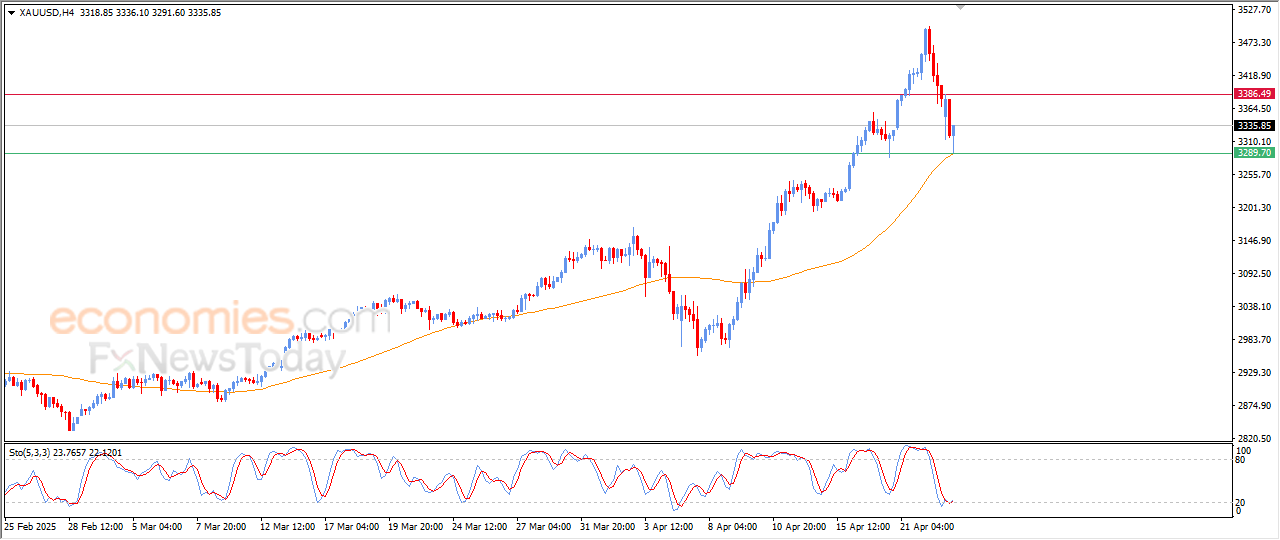
Spot Gold retreats on Wednesday, extending its slump to the $3,260 area during American trading hours. The bright metal fell as the market sentiment improved following United States (US) headlines. US President Donald Trump clarified on Tuesday that he is not willing to fire Federal Reserve (Fed) Chairman Jerome Powell, but that he is frustrated with the decision to maintain interest rates at high levels. Even further, Trump mentioned progress in trade negotiations with China, adding to speculative interests’ relief.
Stock markets reflect the better mood, as Asian and European indexes closed in the green, while Wall Street is firmly up for a second consecutive day, having trimmed all of its Monday losses.
Further optimism came from market talks suggesting the US would lower tariffs on China. Treasury Secretary Scott Bessent on Wednesday said that “there is an opportunity for a big deal” between the two countries, but declined to comment on the tariffs’ levels. He finally added that tariffs will likely have to come down for trade negotiations.
On the data front, S&P Global released the preliminary estimates of the April Purchasing Managers’ Indexes (PMIs), which showed that the manufacturing index improved to 50.7 in April after posting 50.2in March. The Services PMI eased from its previous reading of 54.4 to 51.4, while both indicating expansion in business activity.
The XAU/USD pair bounced from the mentioned low and trades around the $3,290 level. Technical readings in the daily chart suggest Gold may fall further, given that indicators head south almost vertically. Still, as indicators hold within positive levels, the slide could be considered corrective. Even further, the pair develops above all its moving averages, with a firmly bullish 20 Simple Moving Average (SMA) currently at $3,168.
The near-term picture shows sellers have paused. In the 4-hour chart, technical indicators are losing their bearish momentum near oversold readings, but are still far from suggesting an upcoming recovery. In the meantime, the 20 SMA turned flat, providing resistance in the $3,380 region. Finally, the 100 and 200 SMAs maintain their bullish slopes far below the current level, limiting the case for a steeper decline.
Support levels: 3,283.40 3,260.00 3,247.10
Resistance levels: 3,313.65 3,329.20 3,342.35
The CADCHF lost its positive momentum by stochastic exit from the overbought, to end the bullish rally by hitting 1.8520 level, to form a temporary correctional rebound, to settle near 1.8410.
By the above image, we notice the price stability within the main bullish channel’s levels, and 23.6%Fibonacci correction level forms a strong support at 1.8220, which makes us wait for gathering the positive momentum, to activate the bullish rally again by reaching 1.8460, repeating the pressure on the obstacle at 1.8520, in order to find an exit to achieve extra gains in the upcoming period.
The expected trading range for today is between 1.8355 and 1.8460
Trend forecast: Bullish
Do you need help in trading decisions? Do you want to learn how to start trading?
Join Economies.com VIP Club and benefit from over 15 years of market analysis expertise and get:
Special Offer: Subscribe to the Economies.com VIP channel and get also a free subscription to a trusted trading signals channel provided by Best Trading Signal.
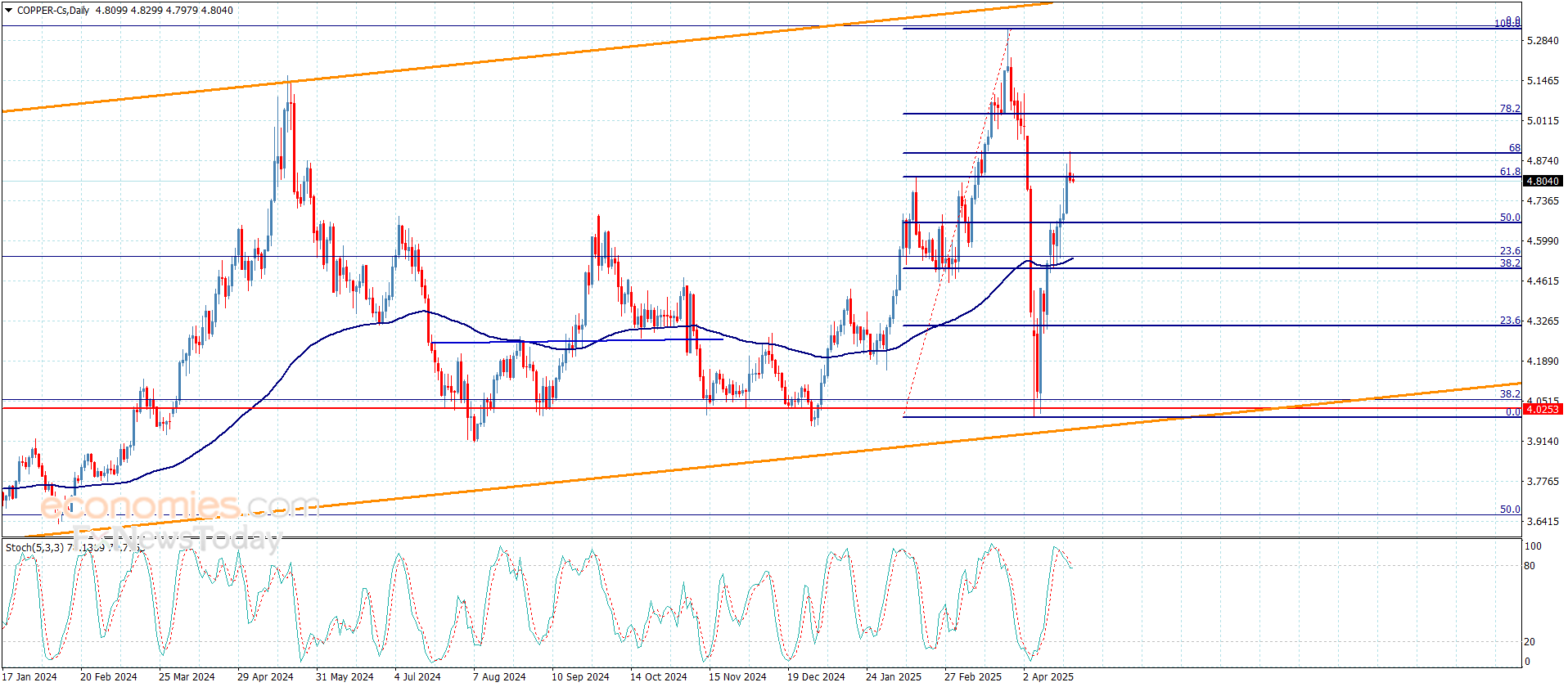
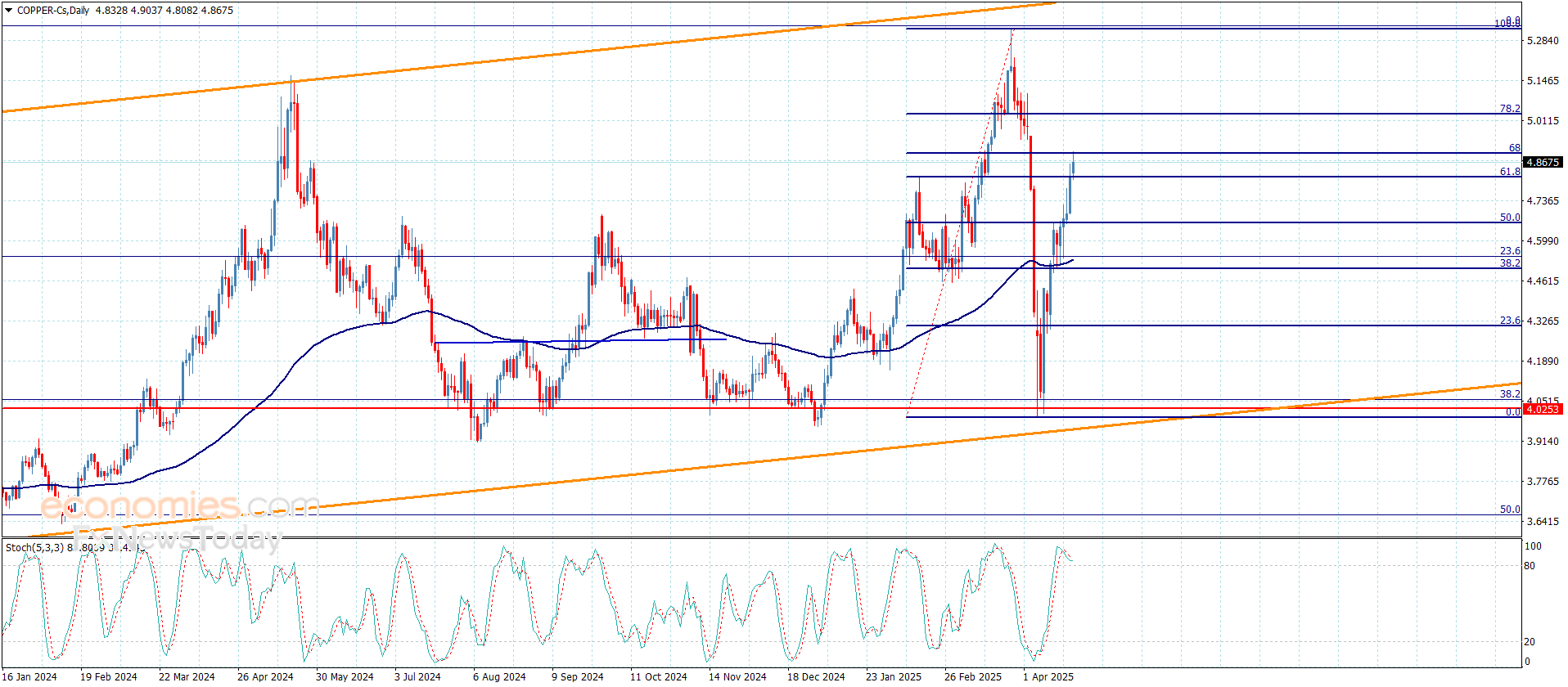
Copper price’s trading extended towards 68% Fibonacci correction level, recording the second target at $4.9000, to form an extra barrier against the bullish rally.
We expect price affection by some of the negative pressures, especially, stochastic attempts to exit the overbought level, which might increase the chances for activating the bearish correctional track and suffering some losses by reaching $4.7700 and $4.6800, while the price success to breach the obstacle will reinforce the chances for recording new gains that might extend towards $4.9600 reaching the next barrier near $5.0300.
The expected trading range for today is between $4.7700 and $4.900
Trend forecast: Fluctuated within the bullish track
Do you need help in trading decisions? Do you want to learn how to start trading?
Join Economies.com VIP Club and benefit from over 15 years of market analysis expertise and get:
Special Offer: Subscribe to the Economies.com VIP channel and get also a free subscription to a trusted trading signals channel provided by Best Trading Signal.