The main tag of Gold Today Price Articles.
You can use the search box below to find what you need.
[wd_asp id=1]
The main tag of Gold Today Price Articles.
You can use the search box below to find what you need.
[wd_asp id=1]
Private payrolls came in at 98,000 for June against expectations of 110,000 to 118,000. May printed 122,000. That is a clean miss and gold moved on it immediately. September hike odds are already running around 64%, and a soft official number later today pulls those odds down. Gold has room to extend off the seven-month low in that scenario.
Every dip this week got bought fast. Traders are not comfortable staying short heading into a payrolls print that the ADP already softened up. That kind of buying pressure into weakness tells you where positioning stands before the number drops.
The U.S. and Iran wrapped up another round of indirect talks on the Strait of Hormuz. Nothing concrete came out of it, but crude dropped on the fact that they were still at the table. Gold traders already know what falling oil does to the rate outlook. Less inflation pressure takes urgency off the Fed, and that is the only story gold is trading right now.
Oil pulling back alongside a weak jobs preview is the combination that points away from a September hike. That is all gold needs to hold above the seven-month low.
Fed Chair Kevin Warsh said inflation expectations and risks have come down in recent weeks but repeated the Fed is still committed to 2% and prices are still too high. That is Warsh staying in the middle. No signal on the next move, no hint at timing.
Markets are pricing over 70% odds that rates hold at the July meeting. September is the live meeting with hike odds at 60% to 64%, and that is the number today’s report can move the most. Warsh not tipping his hand means the payrolls data at 12:30 GMT is making the decision for him.
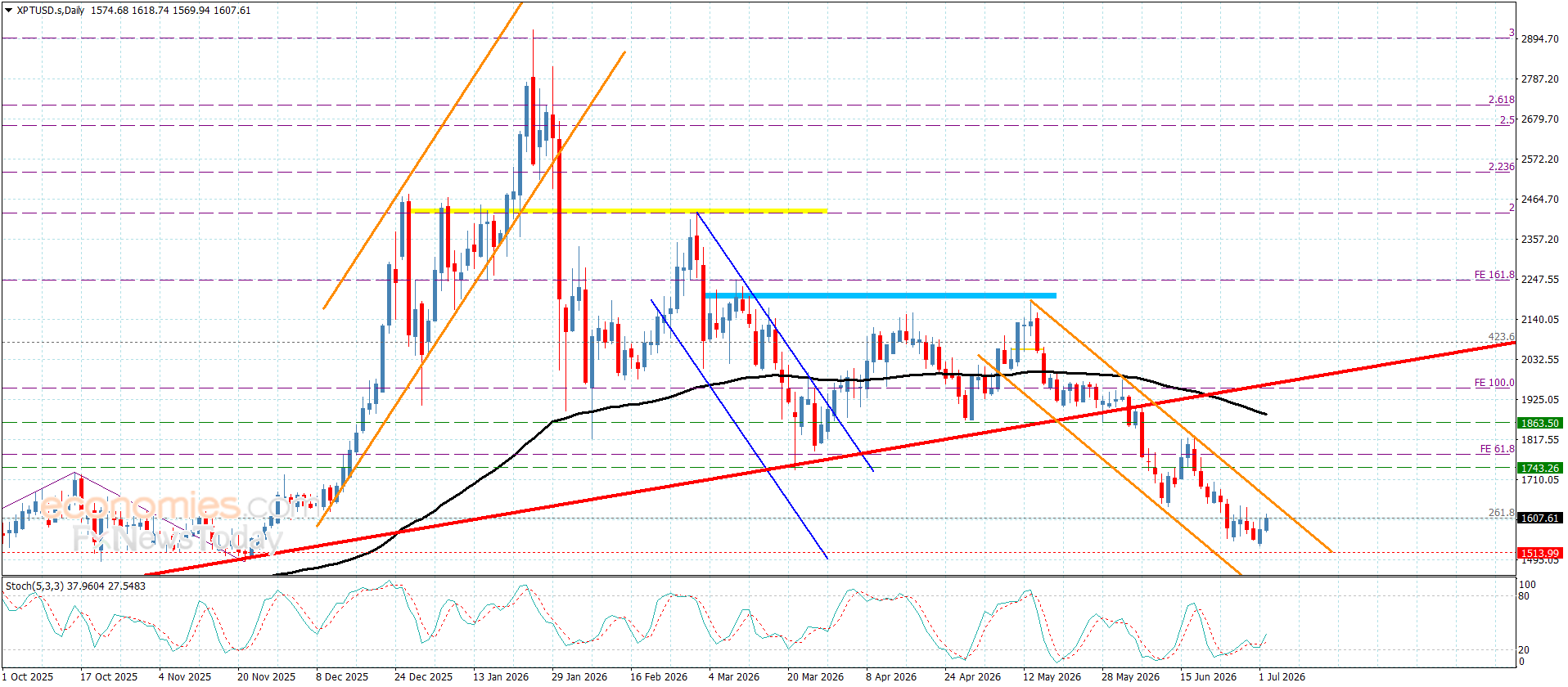
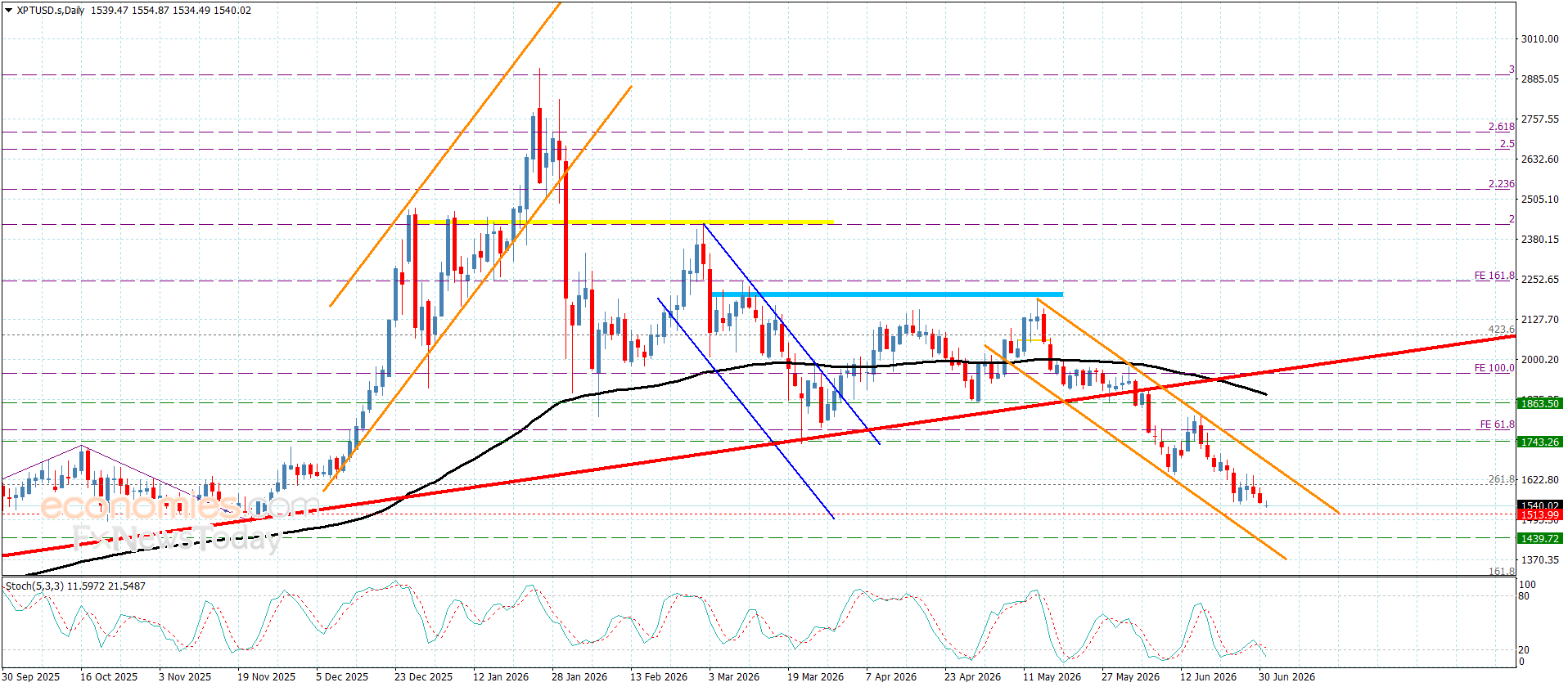
There is no change for Platinum price’s track by its stability within the minor bearish channel’s levels, depending on the stability of its resistance that is located at $1665.00, besides the main stability below $178000 barrier confirms the continuation of the previously suggested negativity, therefore, we will keep waiting for gathering extra negative momentum, allowing it to reach the initial target near $1510.00, and surpassing it will extend the trading directly towards $1480.00 and $1435.00.
While the price rally above $1780.00 and providing a positive close will force it to delay the negative moves, to provide a chances for achieving some gains by its rally towards $1810.00 and $1865.00.
The expected trading range for today is between $1510.00 and $1650.00
Trend forecast: Bearish
The global oil market is rapidly losing momentum. Morgan Stanley has cut its price forecasts for the second time in two weeks, pointing to a growing surplus of crude oil. The reopening of the Strait of Hormuz is progressing faster than analysts had expected. At the same time, U.S. oil production continues to reach record levels, while demand across Asia is weakening. The result is a market with more barrels than buyers.
Photo: Pravda.Ru by Marina Lebedeva is licensed under Free for commercial use
Oil prices
The bank has revised its forecast for Brent crude. Physical Brent is now expected to average $75 per barrel during both the third and fourth quarters of 2026, representing reductions of $15 and $5 respectively from previous estimates. Looking further ahead, Morgan Stanley expects prices to decline to $70 per barrel by the end of 2027.
“We are seeing a classic case of overproduction. When supply floods storage facilities, prices inevitably capitulate. At the moment, the market has no meaningful drivers for growth-only downside risks,” macroeconomist Artyom Loginov said in comments to Pravda.Ru.
Brent futures have already fallen about 30% during the current quarter. The decline has been supported by the temporary easing of tensions between Washington and Tehran, allowing tanker traffic through the Strait of Hormuz to recover. Major financial institutions, including Goldman Sachs, have also been revising their market outlooks as geopolitical conditions change. At the same time, Russia and Iran continue restoring logistics networks affected by sanctions.
Shipping through the world’s most important oil transit route is recovering rapidly. Last Thursday, 35 tankers passed through the Strait of Hormuz, returning traffic to levels seen before the escalation in February. Analysts estimate that restoring shipping to around 65% of its previous capacity-roughly 12 million barrels per day-would be sufficient to stabilize the market by 2027.
| Period | Brent Price Forecast |
|---|---|
| Q3 2026 | $75 per barrel (down $15) |
| Q4 2026 | $75 per barrel (down $5) |
| End of 2027 | $70 per barrel |
Oil prices have retreated sharply from the April peak of $126 per barrel. September Brent futures are currently trading near $73. As negotiations between Iran and the United States continue, the geopolitical risk premium has continued to fade. Even isolated attacks on commercial shipping have done little to discourage tanker operators, with both conventional carriers and shadow fleets continuing to move cargo.
“The reopening of the Strait of Hormuz is a powerful deflationary signal for the oil market. If supply continues to normalize, revenue for Western oil producers that benefited from exceptionally high prices will come under sustained pressure,” oil market analyst Alexey Chernov told Pravda.Ru.
Morgan Stanley also highlights growing signs of weakness in market fundamentals. Analysts note the emergence of bearish contango, a situation in which near-term contracts trade below longer-dated futures, making storage more profitable than immediate sales. Price spreads between different crude grades likewise suggest mounting pressure in the physical market.
“Set aside all the headlines for a moment and simply watch the prices. They describe a market that is weakening across the board,” Morgan Stanley analysts led by Martijn Rats wrote.
“Oversupply is toxic for investment in new oil fields. We are entering a cycle in which only producers with the lowest production costs will remain competitive, and that certainly does not favor U. S. shale producers,” geologist Mikhail Yegorov said in comments to Pravda.Ru.
Why did Morgan Stanley cut its oil forecast again?
The bank cited faster-than-expected recovery in tanker traffic through the Strait of Hormuz, weakening demand in China, and record oil production in the United States.
How do U.S.-Iran negotiations affect gasoline prices?
Reduced geopolitical tensions remove the so-called “war premium” from crude oil prices, contributing to lower global fuel costs.
What is contango?
Contango occurs when future delivery contracts trade above current prices, typically indicating that supply exceeds immediate demand and encouraging storage.
How low could Brent prices fall?
Morgan Stanley expects Brent crude to decline to around $70 per barrel by the end of 2027 if current supply and demand trends continue.

Oil prices moved lower during Wednesday’s trading session as markets reacted to continued diplomatic discussions between Iran and the United States. Investors believe progress in the talks could reduce the risk of further disruptions to global oil supplies.
Brent crude futures dropped by 62 cents, or around 0.9%, to $72.33 per barrel at 1156 GMT. US West Texas Intermediate crude futures fell by 38 cents, or about 0.6%, to $69.12 per barrel, marking their lowest level since February 27.
The decline reflects changing market expectations. During the recent conflict in the Middle East, concerns about possible supply shortages pushed oil prices sharply higher. However, hopes that diplomatic efforts may prevent further escalation have reduced those fears. As supply risks appear to be easing, traders have become more willing to sell oil futures, putting downward pressure on prices.
One of the biggest reasons behind the latest movement in crude prices is the ongoing dialogue between Iran and the United States. According to sources familiar with the discussions, both countries held technical talks in Doha. The negotiations are aimed at reaching an agreement on shipping through the Strait of Hormuz while also working toward a lasting ceasefire.
The Strait of Hormuz remains one of the world’s most important oil transport routes. A large share of globally traded crude oil passes through this narrow waterway every day. Any threat to shipping in the strait can quickly push oil prices higher because it raises concerns over global supply. On the other hand, signs that shipping can continue without disruption often reduce those concerns and support lower prices. The ongoing negotiations have therefore become one of the most closely watched events in the energy market.
Another important factor influencing crude prices is the recovery in tanker movement through the Strait of Hormuz. Shipping activity has started returning to normal levels after disruptions caused by the recent conflict. US Vice President JD Vance stated that oil flows through the strategic waterway have returned to levels seen before the conflict began.This recovery has improved market confidence that global crude supplies will continue moving without major interruptions. The reopening of the shipping route has also encouraged analysts to lower concerns about long-term supply shortages. As supply fears ease, traders generally expect less pressure on oil prices unless fresh geopolitical events emerge.
Apart from geopolitical developments, investors are also waiting for fresh information on US crude oil inventories. The US Energy Information Administration (EIA) is scheduled to release its official weekly oil stock report. Before the government report, market sources cited data from the American Petroleum Institute (API), showing that US crude inventories declined again during the previous week.
Oil inventory data often affects crude prices because it provides insight into supply and demand conditions. A larger-than-expected decline in inventories may suggest stronger demand or tighter supplies, which can support higher prices. If inventory levels rise instead, it may indicate weaker demand or stronger production, which could put additional pressure on oil prices. Because of this, traders are carefully watching the official EIA figures before making major trading decisions.
Analysts believe that current market sentiment remains cautious despite ongoing negotiations. PVM Associates analyst Tamas Varga said that discussions between the United States and Iran continue to create uncertainty about future supply conditions. He noted that investors believe the issues delaying negotiations will eventually be resolved.
According to Varga, the market currently maintains a downward bias. However, stronger evidence of falling inventories or any renewed closure of the Strait of Hormuz could quickly change investor sentiment. This means that while oil prices are currently under pressure, fresh developments could reverse the trend if supply risks return.
Oil prices have experienced major changes over recent months. Brent crude recorded a decline of around $45 per barrel during the second quarter of the year. This represented its biggest quarterly fall since the global financial crisis in 2008.
US WTI crude also recorded a large quarterly decline of around $31 per barrel, marking its largest quarterly loss since 2020, when the COVID-19 pandemic reduced global fuel demand. These losses followed progress toward easing tensions in the Middle East after earlier gains triggered by the outbreak of conflict. The sharp movement highlights how quickly geopolitical developments can influence energy markets.
Market expectations have also changed for the longer term. After five consecutive months of increasing forecasts, analysts have reduced their 2026 oil price estimates for the first time since the Iran conflict began. A Reuters poll found that the reopening of the Strait of Hormuz has reduced concerns over long-lasting supply disruptions.
With shipping activity improving, many analysts now expect a more balanced oil market than they anticipated during the height of the conflict. Petrobras Chief Executive Magda Chambriard also told Reuters that oil prices appear to have entered a trading range of $72 to $75 per barrel. However, she noted that the market has not fully returned to normal because uncertainty surrounding the Middle East conflict remains.
Investors should continue monitoring several important factors before making decisions in the oil market. The outcome of Iran-US negotiations remains one of the biggest influences on future prices. Any agreement that improves regional stability could reduce supply concerns and keep prices under pressure.
At the same time, unexpected developments affecting the Strait of Hormuz could quickly reverse market sentiment and support higher crude prices. Investors should also closely watch US crude inventory reports, global demand trends, and production decisions by major oil-producing countries. While Brent futures and US WTI crude have recently fallen, future price movements will depend on whether supply remains stable and whether geopolitical tensions continue to ease.
Q1. Why are oil prices down today?
Oil prices declined because investors expect Iran-US talks to reduce supply risks, shipping through the Strait of Hormuz has improved, and markets are waiting for US crude inventory data.
Q2. Will Brent futures and US WTI crude prices rise again?
Brent and WTI prices may rise if supply disruptions return, inventories fall sharply, or geopolitical tensions increase. Stable shipping, easing conflicts, and stronger supplies could keep prices under pressure.
Copper price ended the last positive rebound by reaching $6.2000 level, to begin forming bearish corrective trading, affected by the stability below $6.300 barrier, to reach $6.0500 currently.
Gathering extra negative momentum is important for reinforcing the chances of surpassing the barrier at $5.9500, to open the way for targeting more corrective stations, which might begin at $5.8200 and $5.7100.
The expected trading range for today is between $5.820 and $6.1500
Trend forecast: Bearish
Domestic coffee prices today
Coffee prices today in key production areas simultaneously increased after a decrease of 700 VND/kg. The average price was recorded at 90,400 VND/kg, an increase of 1,200 VND/kg compared to the previous update.
In Dak Lak, coffee prices increased by 1,200 VND/kg, reaching 90,400 VND/kg. Gia Lai also recorded a similar increase, bringing the purchase price above the threshold of 90,000 VND/kg.
In Lam Dong, coffee prices today increased by 1,200 VND/kg, listed at the threshold of 90,000 VND/kg and continue to be the lowest level among the surveyed areas.
The old Dak Nong area had the highest purchase price, reaching 90,500 VND/kg.
Thus, domestic coffee prices currently range from 90,000-90,500 VND/kg. The gap between the region with the highest and lowest prices is 500 VND/kg.
World coffee prices
World coffee prices fluctuated in the same direction in the most recent trading session.
On the London exchange, the September 2026 Robusta futures contract increased by 94 USD/ton, equivalent to 2.64%, to the threshold of 3,658 USD/ton.
Robusta futures in November 2026 increased by 102 USD/ton, equivalent to 2.91%, reaching 3,612 USD/ton. The January 2027 term increased by 111 USD/ton, listed at 3,664 USD/ton.
Robusta futures for March 2027 increased to a maximum of 120 USD/ton, equivalent to 3.5%, reaching 3,549 USD/ton.
The July 2026 contract was recorded at 3,845 USD/ton, an increase of 84 USD/ton. However, the trading volume of this term is only 2 lots because the contract has approached maturity, so it does not fully reflect the general diễn biến of the market.
On the New York exchange, Arabica futures in September 2026 increased by 18.65 US cents/lb, equivalent to 6.71%, to 296.45 US cents/lb.
Arabica futures in December 2026 increased by 18.70 US cents/lb, reaching 282.1 US cents/lb. March 2027 futures increased by 18.9 US cents/lb, to 277.6 US cents/lb.
May 2027 futures increased by 19.4 US cents/lb, equivalent to 7.49%, reaching 278.30 US cents/lb.
Coffee preview
Coffee prices rose sharply to their highest level in 4.5 months, as heavy rains in Brazil slowed down harvest progress and raised concerns about crop quality.
In the past two weeks, coffee prices have continuously increased due to heavy rain hindering harvesting activities in the fields, and at the same time posing a risk of affecting the quality of coffee beans.
In addition, coffee inventory on the ICE exchange continuously decreased in the last 3 months, also supporting prices.
The market is also supported by concerns that El Nino may negatively affect the Brazilian coffee crop for the 2026-2027 crop year.
According to Commercial trading firm, El Nino may cause late rain in Brazil in September – October, when coffee trees enter the flowering stage. This may reduce crop yields in 2026 – 2027.
The US National Oceanic and Atmospheric Administration (NOAA) estimates there is a 67% chance of a “Super El Nino” outbreak, possibly the strongest ever recorded.
On June 10, the Japan Meteorological Agency also confirmed that El Nino has formed in the equatorial Pacific region. This increases the risk of floods, droughts and temperature fluctuations in the coming months, affecting coffee production in Asia and South America.
Although prices are increasing sharply, the market is still under pressure from the prospect of large supply.
On June 9, Arabica prices fell to a 19-month low, while Robusta fell to a 2-month low, as the market expected Brazil to have a bumper crop.
The robusta supply from Vietnam – the world’s largest robusta producer – continues to put downward pressure on prices.
According to the General Statistics Office, Vietnam’s coffee exports in the first 5 months of 2026 reached 922,000 tons, an increase of 7.9% compared to the same period last year. In the whole year of 2025, Vietnam’s coffee exports increased by 17.5%, to 1.58 million tons.
Vietnam’s coffee production in the 2025-2026 crop year is also forecast to increase by 6%, reaching 1.76 million tons (equivalent to 29.4 million bags), the highest level in 4 years.

Oil prices traded higher on Tuesday as investors reacted to developments surrounding possible diplomatic discussions between the United States and Iran. The market also continued to monitor the situation in the Strait of Hormuz, one of the world’s most important oil shipping routes. Brent crude futures for August delivery, which expire on Tuesday, rose by 16 cents or 0.22% to reach $73.31 per barrel during trading. The more actively traded September Brent contract gained 45 cents or 0.61% to trade at $74.36 per barrel.
US West Texas Intermediate (WTI) crude futures for August delivery increased by 37 cents or 0.52% to $71.12 per barrel. Although prices moved higher during the day, both benchmark contracts remained on track for major monthly and quarterly declines. Brent crude was set for its third straight monthly loss, falling about 20% during June. US WTI crude was heading for its second consecutive monthly decline, losing around 19% during the month.
Looking at the broader picture, Brent crude had declined around 38% during the second quarter, while WTI crude had fallen approximately 29%. Despite recent volatility, both benchmarks have returned close to levels seen before the recent conflict disrupted energy markets.
One of the biggest factors influencing oil prices is the possibility of future discussions between the United States and Iran. Earlier expectations suggested that senior officials from both countries could meet in Doha. However, Qatar later confirmed that no high-level meeting would take place during the current visit.
Instead, technical-level discussions are expected to cover regional security issues. If progress is made, those discussions could eventually move to meetings involving senior officials. The announcement reduced expectations for immediate diplomatic progress while keeping uncertainty in the market.
The situation also highlights the fragile ceasefire reached on June 17 after months of conflict. The fighting had disrupted oil transportation through the Strait of Hormuz, creating concerns about global energy supplies. Because around one-fifth of global oil shipments pass through the Strait of Hormuz, any disruption in the region can quickly affect international oil prices.
Analysts believe recent shipping movements have helped reduce some of the pressure on global oil supplies. UBS analyst Giovanni Staunovo said he would not say that the market has completely removed the geopolitical risk premium from oil prices. However, he noted that ships previously unable to leave the Gulf have now become available as more vessels move through the region.
This increase in shipping activity has temporarily added more oil supply to the market. As more crude cargoes leave the Gulf without major disruptions, traders have become less concerned about immediate supply shortages. This has limited further gains in oil prices despite continuing geopolitical uncertainty.
Several analysts believe that future oil prices will depend not only on geopolitical developments but also on global supply balances. Morgan Stanley now expects the global oil market to record an implied surplus of about 4.8 million barrels per day by 2027. A larger supply surplus could place downward pressure on oil prices if demand does not increase at the same pace. A separate Reuters survey also showed that analysts have lowered their oil price forecasts for 2026 for the first time since the Iran conflict began.
The survey followed five consecutive months of increasing price expectations. Analysts believe that the reopening of the Strait of Hormuz has reduced fears of prolonged supply disruptions, making lower price forecasts more likely. The latest estimates suggest that traders now see fewer risks to global oil transportation than they did during the height of the conflict.
Another factor affecting the oil market comes from Iraq. According to trade sources and documents reviewed by Reuters, Iraq’s State Organization for Marketing of Oil (SOMO) has offered larger discounts on its official selling prices for Basrah crude loading in July.
The discounts are intended to encourage long-term customers to continue purchasing Iraqi crude from terminals located in the Middle East Gulf. Lower official selling prices can increase competition in the global crude market by making Iraqi oil more attractive to buyers. If additional discounted supplies enter the market, they may contribute to higher overall availability of crude oil. That could also place pressure on oil prices in the coming months.
Investors are likely to remain focused on several key developments before making long-term decisions. The progress of technical discussions involving the United States and Iran will remain important because any diplomatic breakthrough could influence future sanctions and oil exports.
Market participants will also continue watching shipping activity through the Strait of Hormuz for signs of renewed disruption or smooth transportation. Global supply forecasts from investment banks, demand trends, production decisions by oil-producing countries and pricing strategies from exporters such as Iraq will also shape market expectations.
While oil prices posted gains during Tuesday’s trading session, the broader trend still reflects significant quarterly losses. Future price direction will depend on whether geopolitical tensions increase again or whether improving supply conditions continue to outweigh risks.
Q1. Why are oil prices up today despite falling this quarter?
Oil prices rose because traders reacted to US-Iran developments and shipping activity around the Strait of Hormuz. However, Brent and WTI remain lower for the quarter as supply concerns eased.
Q2. Will Brent and US WTI crude futures continue to rise or fall again?
Future price movements will depend on US-Iran negotiations, Strait of Hormuz shipping, global supply forecasts, demand trends, Iraq’s crude exports and changing geopolitical risks affecting energy markets.
Domestic coffee prices today
Coffee prices today in key production areas simultaneously decreased. The average price was recorded at 89,200 VND/kg, down 600 VND/kg compared to the previous update.
In Dak Lak, coffee prices decreased by 600 VND/kg, down to 89,200 VND/kg. Gia Lai also recorded a similar decrease, bringing the purchase price back to 89,200 VND/kg.
In Lam Dong, coffee prices today decreased by 600 VND/kg, down to 88,800 VND/kg and continue to be the lowest level among the surveyed areas.
The old Dak Nong area had the highest purchase price, reaching 89,300 VND/kg, but decreased more sharply than the remaining areas, with a decrease of 700 VND/kg.
Thus, domestic coffee prices currently range from 88,800-89,300 VND/kg. The gap between the region with the highest and lowest prices is 500 VND/kg.
The USD/VND exchange rate according to Vietcombank was recorded at 26,076 VND/USD, down 15 VND.
World coffee prices
World coffee prices fluctuated in opposite directions in the most recent trading session. Arabica on the New York exchange increased, while Robusta on the London exchange simultaneously decreased for all terms.
On the London exchange, the September 2026 Robusta futures contract fell 63 USD/ton, equivalent to 1.74%, to 3,564 USD/ton.
Robusta futures in November 2026 decreased by 60 USD/ton, equivalent to 1.68%, to 3,510 USD/ton. The January 2027 term decreased by 54 USD/ton, to 3,467 USD/ton.
Robusta futures for March 2027 decreased by 51 USD/ton, equivalent to 1.47%, to 3,429 USD/ton.
The July 2026 contract was recorded at 3,761/ton, down 56 USD/ton. However, the trading volume of this term is only 2 lots because the contract has approached maturity, so it does not fully reflect the general diễn biến of the market.
On the New York floor, Arabica futures in September 2026 increased by 4.60 US cents/lb, equivalent to 1.68%, to 277.80 US cents/lb.
Arabica futures in December 2026 increased by 2.50 US cents/lb, reaching 263.40 US cents/lb. March 2027 futures increased by 2.10 US cents/lb, to 258.70 US cents/lb.
May 2027 futures increased by 1.90 US cents/lb, equivalent to 0.74%, reaching 258.90 US cents/lb.
Coffee price assessment
According to financial data firm Barchart, Arabica prices rose sharply as heavy rains in Brazil continued to slow harvest progress.
Meteorological company Somar Meteorologia said that Minas Gerais state, Brazil’s largest coffee producing region, recorded 31.3 mm of rainfall in the week ending June 28. This level is equivalent to 1.956% of the historical average of the same period.
Heavy rain in the middle of harvest season can hinder coffee harvesting, transportation and drying. Coffee beans exposed to prolonged humidity also face the risk of declining quality, thereby creating support for Arabica prices.
In addition to weather factors, standard Arabica inventories on the US Intercontinental Exchange continued to decrease. Arabica inventories fell to 380,534 bags, the lowest in about 2 years and 3 months.
The decrease in available Arabica supply on the exchange made the market more sensitive to unfavorable information about the Brazilian harvest. This is one of the reasons why Arabica maintained its upward momentum even though Robusta turned down.
In the opposite direction, Robusta is under pressure as inventory on the European Intercontinental Exchange increased to 4,053 lots, the highest level in about 2 months and 3 weeks.
Previously, Robusta inventory had decreased to 3,631 lots on May 15, the lowest level in 2 years. The addition of standard goods somewhat reduced concerns about short-term supply shortages.
Robusta supply from Vietnam is also trending upwards. The Foreign Agricultural Services Agency of the US Department of Agriculture forecasts that Vietnam’s coffee production in the 2026-2027 crop year will reach 32.5 million bags, an increase thanks to production expansion after a period of high coffee prices.
Year-end weather risks are still a factor being monitored by businesses. The US National Oceanic and Atmospheric Administration assesses that there is a 63% chance that El Niño will reach very strong intensity in the period from November 2026 to January 2027.
El Niño may change the rainfall pattern in Brazil during the coffee tree flowering period in September and October, and also affect production conditions in Robusta growing areas in Asia. However, the level of impact depends on the actual developments in each region.
In terms of pressure, the Foreign Agricultural Services Agency of the US Department of Agriculture forecasts that Brazil may produce 66.7 million bags of coffee in the 2026-2027 crop year. The Dutch bank Rabobank also forecasts that the global Arabica market will continue to have a surplus.
In general, Arabica prices are being supported by heavy rain in Brazil and standard inventories are falling sharply. Meanwhile, Robusta is under pressure from recovery inventories and the prospect of increased Vietnamese supply.