2026.03.20 2026.03.20 WTI Crude Oil: Elliott Wave Analysis and Forecast for 20.03.26–27.03.26
Alex Geutahttps://www.litefinance.org/blog/authors/alex-geuta/
The article covers the following subjects:
Major Takeaways
Main scenario: Consider long positions from corrections above 75.60 with a target of 126.00–150.00. A buy signal: the price holds above 75.60. Stop Loss: below 75.60, Take Profit: 126.00–150.00.
Alternative scenario: Breakout and consolidation below 75.60 will allow the asset to continue declining to the levels of 65.00–55.00. A sell signal: the 75.60 level is broken to the downside. Stop Loss: above 75.60, Take Profit: 65.00–55.00.
Main Scenario
Consider long positions from corrections above 75.60 with a target of 126.00–150.00.
Alternative Scenario
Breakout and consolidation below 75.60 will allow the asset to continue declining to the levels of 65.00–55.00.
Analysis
A descending correction appears to have formed as the second wave of larger degree (2) on the weekly chart, with wave C of (2) completed as its part. On the daily time frame, the ascending third wave (3) has started unfolding, with the first wave of smaller degree 1 of (3) developing as part of its structure. On the H4 chart, a bearish correction has likely finished developing as wave iv of 1 and wave v of 1 is currently forming. Within it, wave (i) of v has been completed. If the presumption is correct, WTI will continue to rise to the levels of 126.00–150.00 once a local correction (ii) of v ends. The level of 75.60 is critical in this scenario as a breakout below it will enable the asset to continue declining to the levels of 65.00–55.00.
This forecast is based on the Elliott Wave Theory. When developing trading strategies, it is essential to consider fundamental factors, as the market situation can change at any time.
Price chart of USCRUDE in real time mode
The content of this article reflects the author’s opinion and does not necessarily reflect the official position of LiteFinance broker. The material published on this page is provided for informational purposes only and should not be considered as the provision of investment advice for the purposes of Directive 2014/65/EU.
According to copyright law, this article is considered intellectual property, which includes a prohibition on copying and distributing it without consent.
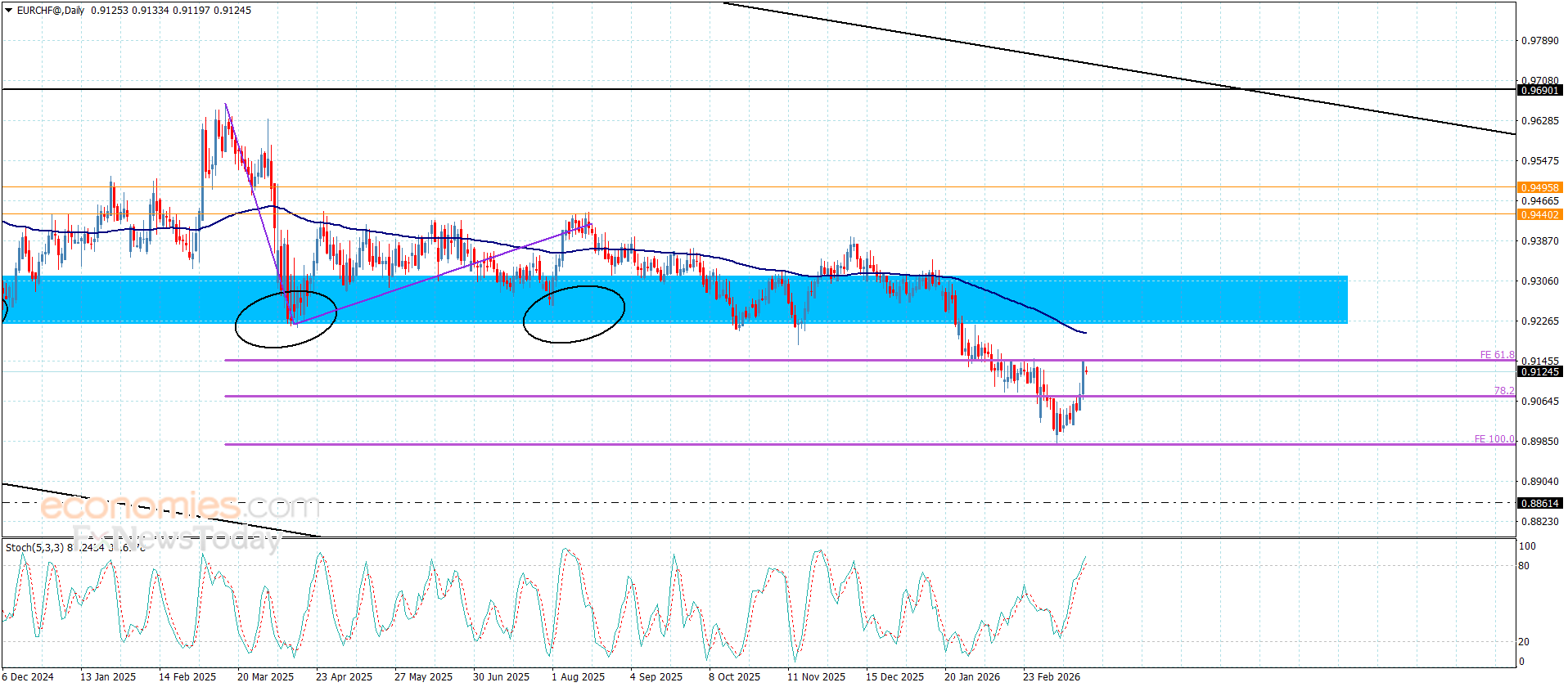
EURCHF resumed the previously suggested bullish corrective rally, recording the target at 0.9115, which represents an important barrier due to the stability of %61.8 Fibonacci extension level near it, forcing it to provide sideways fluctuation as appears in the above image.
Note that the continuation of the price stability below the current barrier will increase the chances of activating the negative attempts, to reach 0.9075 reaching 0.9010, while breaching the barrier will force it to delay the decline and target extra corrective stations that might extend towards 0.9185 and 0.9220.
The expected trading range for today is between 0.9075 and 0.9120
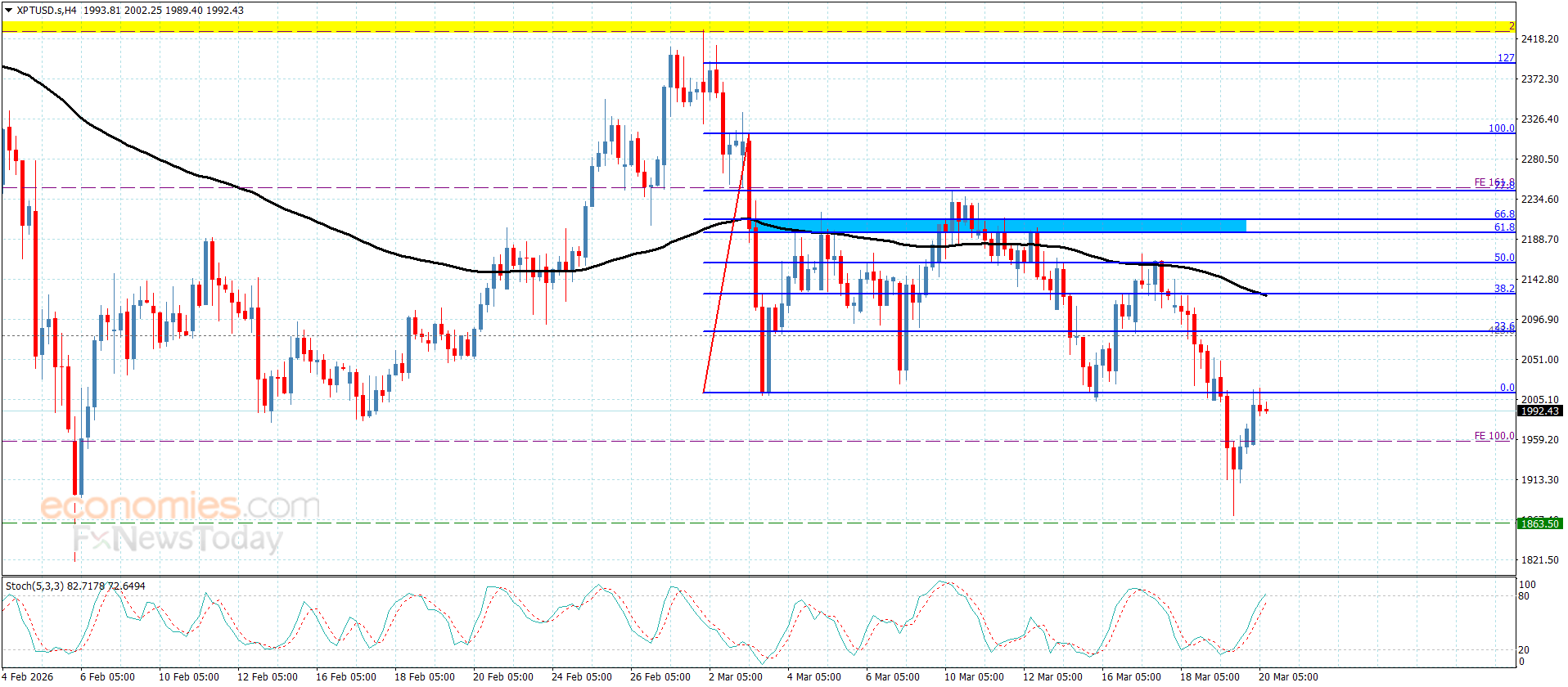
Platinum price resumed the previously suggested negative attack yesterday to surpass the suggested negative stations, to suffer big losses by reaching $1872.00 level, to form a quick positive rebound, attempting to recover some losses by targeting $2015.00 level.
Forming an extra barrier at $2045.00 level makes us expect renewing the negative attempts, to expect reaching near $1955.00, then attempt to press on the next support near $1865.00, while its rally above $2045.00 and holding above it will allow it to recover more losses to target $2085.00 level.
The expected trading range for today is between $1865.00 and $ 2040.00
Silver price (XAG/USD) plummets almost 6.5% to near $70 during the European trading session on Thursday. The white metal faces intense selling pressure as traders raise bets favoring an extended pause by the Federal Reserve (Fed).
According to the CME FedWatch tool, the collective odds of the Fed leaving the Federal Fund Rate unchanged in the current range of 3.50%-3.75% and hiking it from these levels in the December meeting are 57.5%.
The Fed holding interest rates steady for an extended period bodes poorly for non-yielding assets, such as Silver.
Speculation that the Fed will hold interest rates steady for longer intensified after the Fed’s monetary policy outcome on Wednesday, in which officials indicated that monetary policy adjustments are inappropriate unless inflation starts progressing towards the central bank’s 2% target.
“If inflation progress stalls, rate cuts will not follow,” Fed Chair Jerome Powell said in the press conference after the central bank decided to leave interest rates unchanged for the second time in a row, as expected.
Meanwhile, conflicts in the Middle East are not providing any support to the Silver price. Theoretically, demand for safe-haven assets, such as Silver, increases in a heightened geopolitical environment.
Earlier in the day, United States (US) President Donald Trump warned that he will blow up the South Pars gasfield if Iran attacks Qatar again, and said Israel will not be attacking the Iranian energy site again, Al Jazeera reported.
Silver technical analysis
XAG/USD extends its losing streak for the third trading day on Thursday and plunges to near $70.40 during European trading hours. The near-term bias turns extremely bearish as price extends its decline well below the 20-day Exponential Moving Average (EMA), which now tracks near $81.90 and caps the upside.
The 14-day Relative Strength Index (RSI) slides below 40, for the first time in 11 months, to 34.00, which points to a strong negative momentum going forward.
The next major support zone appears near the February low at around $64.00, followed by the round level of $60.00. On the upside, initial resistance emerges at the $75.00 area, with a break above exposing the 20-day EMA near $81.90 as a stronger barrier to recovery.
(The technical analysis of this story was written with the help of an AI tool.)
Silver FAQs
Silver is a precious metal highly traded among investors. It has been historically used as a store of value and a medium of exchange. Although less popular than Gold, traders may turn to Silver to diversify their investment portfolio, for its intrinsic value or as a potential hedge during high-inflation periods. Investors can buy physical Silver, in coins or in bars, or trade it through vehicles such as Exchange Traded Funds, which track its price on international markets.
Silver prices can move due to a wide range of factors. Geopolitical instability or fears of a deep recession can make Silver price escalate due to its safe-haven status, although to a lesser extent than Gold’s. As a yieldless asset, Silver tends to rise with lower interest rates. Its moves also depend on how the US Dollar (USD) behaves as the asset is priced in dollars (XAG/USD). A strong Dollar tends to keep the price of Silver at bay, whereas a weaker Dollar is likely to propel prices up. Other factors such as investment demand, mining supply – Silver is much more abundant than Gold – and recycling rates can also affect prices.
Silver is widely used in industry, particularly in sectors such as electronics or solar energy, as it has one of the highest electric conductivity of all metals – more than Copper and Gold. A surge in demand can increase prices, while a decline tends to lower them. Dynamics in the US, Chinese and Indian economies can also contribute to price swings: for the US and particularly China, their big industrial sectors use Silver in various processes; in India, consumers’ demand for the precious metal for jewellery also plays a key role in setting prices.
Silver prices tend to follow Gold’s moves. When Gold prices rise, Silver typically follows suit, as their status as safe-haven assets is similar. The Gold/Silver ratio, which shows the number of ounces of Silver needed to equal the value of one ounce of Gold, may help to determine the relative valuation between both metals. Some investors may consider a high ratio as an indicator that Silver is undervalued, or Gold is overvalued. On the contrary, a low ratio might suggest that Gold is undervalued relative to Silver.
The primary driver behind the price spike was a series of kinetic strikes on Iranian oil facilities and the subsequent expansion of the conflict. Reports confirmed Israeli airstrikes targeting Iran’s South Pars gas field, but the US and Qatar were not involved, Trump said late Wednesday.
In a retaliatory move that sent shockwaves through trading floors, Iran’s Islamic Revolutionary Guard Corps (IRGC) issued a formal warning that it would target oil installations in Saudi Arabia, the United Arab Emirates (UAE), and Qatar.
Because these three nations represent approximately 20–25% of global crude exports, the threat transformed a regional conflict into a systemic risk for the global economy.
Recent missile and drone attacks have caused major damage to energy facilities across several countries, some of the attacks are listed below:
Qatar: Missiles hit the world’s largest LNG (natural gas) plants and a major Shell facility, stopping production and causing European gas prices to spike.
Saudi Arabia: The military stopped several missiles and drones, but an aerial attack on a refinery in Yanbu briefly disrupted oil shipments.
Kuwait: A drone strike started a fire at a refinery, though it was contained.
For context, Iranian attacks have knocked out 17% of Qatar’s liquefied natural gas (LNG) export capacity, causing an estimated $20 billion in lost annual revenue and threatening supplies to Europe and Asia, QatarEnergy’s CEO told Reuters on Thursday.
QatarEnergy had declared force majeure on its entire output of LNG, after earlier attacks on its Ras Laffan production hub, which came under fire again on Wednesday.
In response to the rising tension, the Trump administration is reportedly considering sending thousands more US troops to the region to support ongoing operations.
Gold (XAU) prices dropped sharply below $4,800 after the Federal Reserve held interest rates steady. On the other hand, escalating tensions in the Middle East triggered sudden shift in market sentiment. This move may seem surprising as rising geopolitical risk and energy driven inflation support gold. In my view, this divergence signals deeper shift in macro environment that could shape gold’s next major move. This article presents the key drivers, technical structure and critical levels that investors need to watch.
Currently, you are using a shared account. To use individual functions (e.g., mark statistics as favourites, set
statistic alerts) please log in with your personal account.
If you are an admin, please authenticate by logging in again.
Other statistics that may interest you Energy prices worldwide
Overview
4
Crude oil
6
Natural gas
7
Coal
6
Electricity
3
Uranium
2
Outlook
5
* For commercial use only
Based on your interests
Free Statistics
Premium Statistics
Free + Premium Statistics
Reports
Market Insights
Learn more about how Statista can support your business.
EIA. (March 10, 2026). Spot prices for Brent crude oil from 2022 to 2024, with a forecast until 2027 (in U.S. dollars per barrel) [Graph]. In Statista. Retrieved March 19, 2026, from https://www.statista.com/statistics/409404/forecast-for-uk-brent-crude-oil-prices/?__sso_cookie_checker=failed
EIA. “Spot prices for Brent crude oil from 2022 to 2024, with a forecast until 2027 (in U.S. dollars per barrel).” Chart. March 10, 2026. Statista. Accessed March 19, 2026. https://www.statista.com/statistics/409404/forecast-for-uk-brent-crude-oil-prices/?__sso_cookie_checker=failed
EIA. (2026). Spot prices for Brent crude oil from 2022 to 2024, with a forecast until 2027 (in U.S. dollars per barrel). Statista. Statista Inc.. Accessed: March 19, 2026. https://www.statista.com/statistics/409404/forecast-for-uk-brent-crude-oil-prices/?__sso_cookie_checker=failed
EIA. “Spot Prices for Brent Crude Oil from 2022 to 2024, with a Forecast until 2027 (in U.S. Dollars per Barrel).” Statista, Statista Inc., 10 Mar 2026, https://www.statista.com/statistics/409404/forecast-for-uk-brent-crude-oil-prices/?__sso_cookie_checker=failed
EIA, Spot prices for Brent crude oil from 2022 to 2024, with a forecast until 2027 (in U.S. dollars per barrel) Statista, https://www.statista.com/statistics/409404/forecast-for-uk-brent-crude-oil-prices/?__sso_cookie_checker=failed (last visited March 19, 2026)
Spot prices for Brent crude oil from 2022 to 2024, with a forecast until 2027 (in U.S. dollars per barrel) [Graph], EIA, March 10, 2026. [Online]. Available: https://www.statista.com/statistics/409404/forecast-for-uk-brent-crude-oil-prices/?__sso_cookie_checker=failed
Gold price is
in freefall. After spending the better part of 2026 consolidating near all-time
highs above $5,000, the yellow metal has lost approximately 6% in two
consecutive sessions, crashing through the psychologically critical $5,000
barrier on Wednesday and extending the decline to $4,700 per ounce on
Thursday, March 19, 2026, the lowest price since early February.
In this
article, I will break down the technical analysis of the XAU/USD, examine the
mechanics behind this week’s crash, and present the key gold price predictions
for 2026 , including where the real floor is if the selling continues. Based on
my 15 years of experience as an analyst and retail investor, here is what I am
watching.
Follow
me on X for real-time gold market analysis: @ChmielDk
Why Gold Is Crashing? The
Fed Pulled the Rug
Wednesday’s
FOMC decision was a hold, as expected – Polymarket had it at over 90%
probability and the market was fully prepared for no rate movement. What the
market was not prepared for was the hawkish tone of the dot
plot. The Fed trimmed its 2026 rate cut projections from two cuts to one,
citing hotter-than-expected producer inflation – February’s PPI came in
at +0.7%, well above consensus – and signalled that the Strait of
Hormuz-driven oil spike is creating inflation persistence that prevents easing.
The 10-year
Treasury yield jumped to 4.2%, the Dollar Index climbed toward 99.9, and gold –
a non-yielding asset whose entire bull thesis rested on falling real yields and
a weakening dollar – repriced accordingly.
As Dilin
Wu, Research Strategist at Pepperstone, frames it: “This sharp decline in
gold reflects a confluence of factors – large-scale risk asset liquidations, a
hawkish shift in Fed expectations, and a stronger dollar.” Crucially, he
views this as “a pricing logic adjustment rather than a reversal of the
long-term trend.”
The
technical break below the 50-day MA near $4,978 and below the $5,000
round level triggered momentum selling and profit-taking from a
crowded long, amplifying what was already a fundamental repricing.
The irony
noted by my earlier
gold analysis remains
fully applicable: gold is being sold during an active Middle East conflict
precisely because the oil shock from that conflict is now hurting
gold’s prospects by reigniting inflation and forcing the Fed to stay
hawkish. Higher oil means higher inflation means higher-for-longer rates means
gold suffers despite the geopolitical backdrop that should theoretically
support it.
Bloomberg
Intelligence’s Mike McGlone identified this paradox earlier this
week: “Gold’s best year in 2025 since 1979 – unequalled in a relatively
low-inflation environment – looks prescient ahead of 2026’s closure of the
Strait of Hormuz, with peak-price inklings.
Technical Outlook – What Follows Gold’s Warning? Store of Value’s Speculative Shift – Gold’s best year in 2025 since 1979 — unequaled in a relatively low-inflation environment — looks prescient ahead of 2026’s closure of the Strait of Hormuz, with peak-price inklings. The surge… pic.twitter.com/LhXk2U8EEy
The surge
to multiyear extremes vs. most moving averages and broad commodities may
suggest the store of value has shifted to a speculative risk asset.” That
framing – gold as speculative risk asset rather than pure safe haven – is the
most bearish structural argument currently circulating, and the two-day crash
gives it uncomfortable credibility.
Gold Technical Analysis:
The Levels That Matter Now
As my
technical analysis shows, gold’s two-day, 6% decline has materially changed the
chart structure. The consolidation near the all-time highs that
I described in Tuesday’s analysis has been broken to the downside, and the move
has opened up a sequence of support targets that were previously theoretical
but are now directly in play.
The first
support I am watching is $4,550 – the late 2025 historical
highs that marked the peak before the January blow-off to $5,600. This was an
area of significant buying last year and should attract some demand on the
first test. Below that, $4,360 is the next meaningful level,
representing a prior consolidation zone and Fibonacci retracement target.
The level
that matters most on my entire gold chart is the 200-day EMA at
approximately $4,200. That is the boundary separating a bull trend from a
bear trend, and gold has not traded below it since late 2023. A sustained break
below $4,200 would be a genuinely significant technical event. It would open
the path toward $3,500 per ounce – the lows from which the
current near-uninterrupted rally to $5,600 began. From Thursday’s $4,700, that
scenario implies a further decline of over 25% and would
represent the most severe gold correction since the 2022 Fed tightening cycle.
Why gold price is going down today? Source: Tradingview.com
Analyst @Kb__Officiall had
been maintaining a bearish gold bias since last week, targeting $4,650
as the primary downside target while watching for a potential
retracement to $5,080 before the next leg lower – a level that has now been
blown past entirely.
His
framework, which generated 12,100 views, is playing out faster than even he
anticipated.
Level
Type
Notes
$5,600
All-time high (Jan 2026)
Gold -16% from here
$5,000
Broken psychological support
Lost Wednesday, now resistance
$4,700
Current price (Mar 19)
-6% in
two sessions, 6-week low
$4,550
First bear target
Late 2025 historical highs
$4,360
Second bear target
Prior consolidation zone
$4,200
200-day
EMA (bull/bear line)
Last below here: late 2023
$3,500
Extreme bear target
2025 rally starting point, -25%+
Silver Is Falling Harder
Than Gold
As my earlier
silver analysis warned, silver amplifies gold’s moves in both directions – and Thursday’s
session is proving that rule. Silver has fallen more sharply than gold in
percentage terms, and according to the Saxo Bank commodities report from Ole
Hansen, “silver may face a deeper retracement” due to its
“higher sensitivity to economic growth and industrial demand, combined
with rising concerns that energy-driven inflation will dent global
activity.”
The crowded
speculative positions that built up during the January $121 spike are still
being unwound, and the broader risk-off tone is accelerating exits.
My silver
chart from Tuesday remains valid: the $80 support and 50 EMA are
the immediate battleground. A break below $70 – the lower
consolidation boundary – activates the path toward the 200-day MA at $60 and
ultimately the October 2025 historical highs at $54.
Dilin Wu of
Pepperstone adds that copper is also trading lower and “adding to growth
worries” – when industrial metals fall in unison, it signals that the
market is pricing in genuine demand destruction, not just a monetary policy
adjustment.
Gold Price Predictions
2026: The Full Range
The 6%
two-day decline has not materially shifted the major institutional forecasts,
which were built on year-end rather than near-term targets. However, the
technical damage done to the chart warrants a full reassessment of the downside
scenarios.
Source
Gold Target 2026
Notes
My chart (extreme bear)
$3,500
If 200 EMA at $4,200 breaks, -25%+
My chart (bear targets)
$4,360 then $4,200
Sequential support levels
@Kb__Officiall
$4,650
Weekly downside target
World Gold Council
+5-15% from current
$4,935-$5,405 scenario
JP Morgan
$5,000 (Q4 2026)
Central bank buying thesis
Goldman Sachs
$6,000
Dollar weakness, rate cuts
Robert Kiyosaki
$35,000
One year
post “bubble bust”
FAQ
Why is gold crashing
today, March 19, 2026?
Gold is
falling for the second consecutive session after Wednesday’s Federal Reserve
decision delivered a hawkish hold: rates were kept at 3.5%-3.75% while the dot
plot was revised to show only one rate cut in all of 2026, down from two.
Hotter-than-expected February PPI at +0.7% pushed Treasury yields to 4.2% and
the dollar toward 99.9, both direct headwinds for non-yielding gold.
How low can gold go in
2026?
As shown on
my chart, the sequential downside targets are $4,550 (late
2025 historical highs), then $4,360 (prior consolidation), and
then the 200-day EMA at $4,200 – the critical bull/bear
dividing line. A sustained break below $4,200 opens the path toward $3,500,
the starting point of the entire 2025-2026 rally, representing a decline of
over 25% from Thursday’s $4,700. @Kb__Officiall targets $4,650 as the
near-term downside with potential for further weakness, while Mike McGlone
warns that gold may have shifted from safe-haven to speculative risk asset.
Is the gold bull market
over?
Not
according to the institutional consensus. JP Morgan maintains its $5,000 Q4
2026 target, Goldman Sachs holds its $6,000 forecast, and Dilin Wu of
Pepperstone describes the current decline as “a pricing logic adjustment
rather than a reversal of the long-term trend.” The structural supports –
central bank buying, US fiscal deficits, and geopolitical risk – remain intact.
What is the gold price
prediction for 2026?
The
institutional range runs from the World Gold Council’s conservative 5-15%
upside scenario from current levels to Goldman Sachs’ $6,000 target and Robert
Kiyosaki’s extraordinary $35,000
post-bubble-bust forecast. JP Morgan’s base case of $5,000 by Q4 2026 is the most credible
near-term institutional target. On the bear side, my chart’s $3,500 extreme
scenario and @Kb__Officiall’s $4,650 near-term target represent the downside
framework.
Gold price is
in freefall. After spending the better part of 2026 consolidating near all-time
highs above $5,000, the yellow metal has lost approximately 6% in two
consecutive sessions, crashing through the psychologically critical $5,000
barrier on Wednesday and extending the decline to $4,700 per ounce on
Thursday, March 19, 2026, the lowest price since early February.
In this
article, I will break down the technical analysis of the XAU/USD, examine the
mechanics behind this week’s crash, and present the key gold price predictions
for 2026 , including where the real floor is if the selling continues. Based on
my 15 years of experience as an analyst and retail investor, here is what I am
watching.
Follow
me on X for real-time gold market analysis: @ChmielDk
Why Gold Is Crashing? The
Fed Pulled the Rug
Wednesday’s
FOMC decision was a hold, as expected – Polymarket had it at over 90%
probability and the market was fully prepared for no rate movement. What the
market was not prepared for was the hawkish tone of the dot
plot. The Fed trimmed its 2026 rate cut projections from two cuts to one,
citing hotter-than-expected producer inflation – February’s PPI came in
at +0.7%, well above consensus – and signalled that the Strait of
Hormuz-driven oil spike is creating inflation persistence that prevents easing.
The 10-year
Treasury yield jumped to 4.2%, the Dollar Index climbed toward 99.9, and gold –
a non-yielding asset whose entire bull thesis rested on falling real yields and
a weakening dollar – repriced accordingly.
As Dilin
Wu, Research Strategist at Pepperstone, frames it: “This sharp decline in
gold reflects a confluence of factors – large-scale risk asset liquidations, a
hawkish shift in Fed expectations, and a stronger dollar.” Crucially, he
views this as “a pricing logic adjustment rather than a reversal of the
long-term trend.”
The
technical break below the 50-day MA near $4,978 and below the $5,000
round level triggered momentum selling and profit-taking from a
crowded long, amplifying what was already a fundamental repricing.
The irony
noted by my earlier
gold analysis remains
fully applicable: gold is being sold during an active Middle East conflict
precisely because the oil shock from that conflict is now hurting
gold’s prospects by reigniting inflation and forcing the Fed to stay
hawkish. Higher oil means higher inflation means higher-for-longer rates means
gold suffers despite the geopolitical backdrop that should theoretically
support it.
Bloomberg
Intelligence’s Mike McGlone identified this paradox earlier this
week: “Gold’s best year in 2025 since 1979 – unequalled in a relatively
low-inflation environment – looks prescient ahead of 2026’s closure of the
Strait of Hormuz, with peak-price inklings.
Technical Outlook – What Follows Gold’s Warning? Store of Value’s Speculative Shift – Gold’s best year in 2025 since 1979 — unequaled in a relatively low-inflation environment — looks prescient ahead of 2026’s closure of the Strait of Hormuz, with peak-price inklings. The surge… pic.twitter.com/LhXk2U8EEy
The surge
to multiyear extremes vs. most moving averages and broad commodities may
suggest the store of value has shifted to a speculative risk asset.” That
framing – gold as speculative risk asset rather than pure safe haven – is the
most bearish structural argument currently circulating, and the two-day crash
gives it uncomfortable credibility.
Gold Technical Analysis:
The Levels That Matter Now
As my
technical analysis shows, gold’s two-day, 6% decline has materially changed the
chart structure. The consolidation near the all-time highs that
I described in Tuesday’s analysis has been broken to the downside, and the move
has opened up a sequence of support targets that were previously theoretical
but are now directly in play.
The first
support I am watching is $4,550 – the late 2025 historical
highs that marked the peak before the January blow-off to $5,600. This was an
area of significant buying last year and should attract some demand on the
first test. Below that, $4,360 is the next meaningful level,
representing a prior consolidation zone and Fibonacci retracement target.
The level
that matters most on my entire gold chart is the 200-day EMA at
approximately $4,200. That is the boundary separating a bull trend from a
bear trend, and gold has not traded below it since late 2023. A sustained break
below $4,200 would be a genuinely significant technical event. It would open
the path toward $3,500 per ounce – the lows from which the
current near-uninterrupted rally to $5,600 began. From Thursday’s $4,700, that
scenario implies a further decline of over 25% and would
represent the most severe gold correction since the 2022 Fed tightening cycle.
Why gold price is going down today? Source: Tradingview.com
Analyst @Kb__Officiall had
been maintaining a bearish gold bias since last week, targeting $4,650
as the primary downside target while watching for a potential
retracement to $5,080 before the next leg lower – a level that has now been
blown past entirely.
His
framework, which generated 12,100 views, is playing out faster than even he
anticipated.
Level
Type
Notes
$5,600
All-time high (Jan 2026)
Gold -16% from here
$5,000
Broken psychological support
Lost Wednesday, now resistance
$4,700
Current price (Mar 19)
-6% in
two sessions, 6-week low
$4,550
First bear target
Late 2025 historical highs
$4,360
Second bear target
Prior consolidation zone
$4,200
200-day
EMA (bull/bear line)
Last below here: late 2023
$3,500
Extreme bear target
2025 rally starting point, -25%+
Silver Is Falling Harder
Than Gold
As my earlier
silver analysis warned, silver amplifies gold’s moves in both directions – and Thursday’s
session is proving that rule. Silver has fallen more sharply than gold in
percentage terms, and according to the Saxo Bank commodities report from Ole
Hansen, “silver may face a deeper retracement” due to its
“higher sensitivity to economic growth and industrial demand, combined
with rising concerns that energy-driven inflation will dent global
activity.”
The crowded
speculative positions that built up during the January $121 spike are still
being unwound, and the broader risk-off tone is accelerating exits.
My silver
chart from Tuesday remains valid: the $80 support and 50 EMA are
the immediate battleground. A break below $70 – the lower
consolidation boundary – activates the path toward the 200-day MA at $60 and
ultimately the October 2025 historical highs at $54.
Dilin Wu of
Pepperstone adds that copper is also trading lower and “adding to growth
worries” – when industrial metals fall in unison, it signals that the
market is pricing in genuine demand destruction, not just a monetary policy
adjustment.
Gold Price Predictions
2026: The Full Range
The 6%
two-day decline has not materially shifted the major institutional forecasts,
which were built on year-end rather than near-term targets. However, the
technical damage done to the chart warrants a full reassessment of the downside
scenarios.
Source
Gold Target 2026
Notes
My chart (extreme bear)
$3,500
If 200 EMA at $4,200 breaks, -25%+
My chart (bear targets)
$4,360 then $4,200
Sequential support levels
@Kb__Officiall
$4,650
Weekly downside target
World Gold Council
+5-15% from current
$4,935-$5,405 scenario
JP Morgan
$5,000 (Q4 2026)
Central bank buying thesis
Goldman Sachs
$6,000
Dollar weakness, rate cuts
Robert Kiyosaki
$35,000
One year
post “bubble bust”
FAQ
Why is gold crashing
today, March 19, 2026?
Gold is
falling for the second consecutive session after Wednesday’s Federal Reserve
decision delivered a hawkish hold: rates were kept at 3.5%-3.75% while the dot
plot was revised to show only one rate cut in all of 2026, down from two.
Hotter-than-expected February PPI at +0.7% pushed Treasury yields to 4.2% and
the dollar toward 99.9, both direct headwinds for non-yielding gold.
How low can gold go in
2026?
As shown on
my chart, the sequential downside targets are $4,550 (late
2025 historical highs), then $4,360 (prior consolidation), and
then the 200-day EMA at $4,200 – the critical bull/bear
dividing line. A sustained break below $4,200 opens the path toward $3,500,
the starting point of the entire 2025-2026 rally, representing a decline of
over 25% from Thursday’s $4,700. @Kb__Officiall targets $4,650 as the
near-term downside with potential for further weakness, while Mike McGlone
warns that gold may have shifted from safe-haven to speculative risk asset.
Is the gold bull market
over?
Not
according to the institutional consensus. JP Morgan maintains its $5,000 Q4
2026 target, Goldman Sachs holds its $6,000 forecast, and Dilin Wu of
Pepperstone describes the current decline as “a pricing logic adjustment
rather than a reversal of the long-term trend.” The structural supports –
central bank buying, US fiscal deficits, and geopolitical risk – remain intact.
What is the gold price
prediction for 2026?
The
institutional range runs from the World Gold Council’s conservative 5-15%
upside scenario from current levels to Goldman Sachs’ $6,000 target and Robert
Kiyosaki’s extraordinary $35,000
post-bubble-bust forecast. JP Morgan’s base case of $5,000 by Q4 2026 is the most credible
near-term institutional target. On the bear side, my chart’s $3,500 extreme
scenario and @Kb__Officiall’s $4,650 near-term target represent the downside
framework.
Natural Gas Slides to Its Lowest Level Since March 4
U.S. natural gas futures are down on Wednesday after testing their lowest level since March 4 earlier in the session. Prices are falling amid a mixed fundamental backdrop. Currently, traders are weighing mild weather, steady production, and LNG demand against weakening seasonal consumption.