The main tag of Gold News Today Articles.
You can use the search box below to find what you need.
[wd_asp id=1]

13 04, 2026

Platinum price tests the support level– Forecast today – 13-4-2026

By |2026-04-13T13:32:01+02:00April 13, 2026|Forex News, News|0 Comments


Platinum price affected by temporary negative pressure since Friday, which pushes it to form bearish corrective waves, to test the additional support at $1950.00, to bounce currently towards $2045.00, to settle above the moving average 55.


The stability of the support level and stochastic attempt to provide positive momentum by the main indicators will increase the chances of the rally towards $2075.00 and providing a positive close above it will open the way for resuming the bullish trend, expecting to reach $2130.00 followed by the next barrier at $2205.00.


The expected trading range for today is between $1970.00 and $2130.00


Trend forecast: Bullish


Source link

13 04, 2026

Coffee prices on April 13: Domestic prices increase, world prices remain flat

By |2026-04-13T09:30:58+02:00April 13, 2026|Forex News, News|0 Comments


Domestic coffee prices

The domestic coffee market this morning, April 13th, continued to increase after a week of deep price slippage.

According to surveys in key growing areas of the Central Highlands, coffee prices simultaneously increased slightly from 200 to 300 VND/kg, bringing the average price level of the whole region to the threshold of 86,000 VND/kg.

In Dak Nong province (old), the purchase price recorded an increase of 200 VND, pushing the price to the highest level in the region at 86,000 VND/kg.

Dak Lak and Gia Lai two localities increased the highest by 300 VND, bringing the price to the highest level of 86,000 VND/kg.

With the same increase of 300 VND, Lam Dong province listed it at 85,500 VND/kg.

World coffee prices

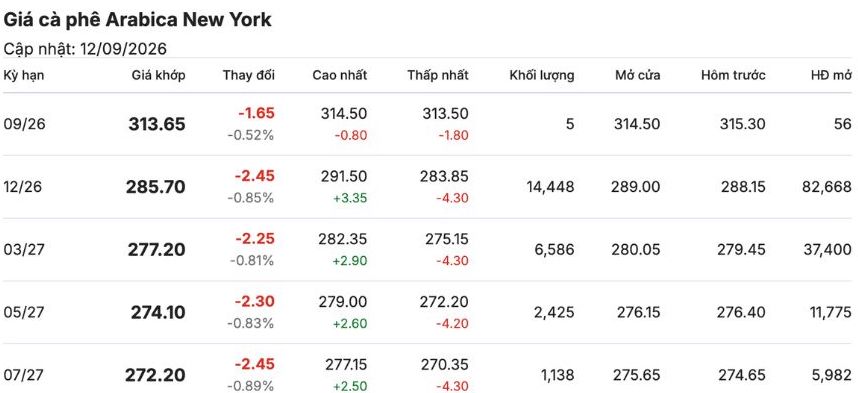
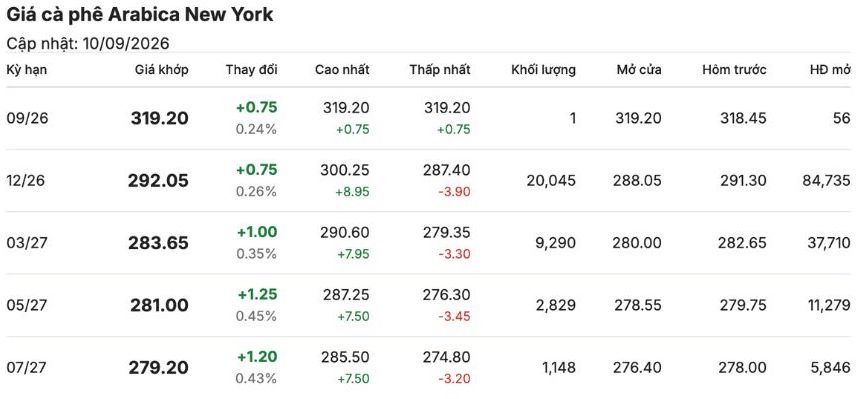
On the international market, futures exchanges remained unchanged after a slight price increase in the last session of the week. On the New York exchange, Arabica futures for May 2026 opened at 300.10 cents/lb. Further forwards offered prices at the threshold of 267 cents/lb – 295.9 cents/lb.

For the same term, the London exchange also witnessed the Robusta flow moving sideways, standing at 3,324 USD/ton. Further terms fluctuated around 3,100 USD/ton – 3,239 USD/ton.

Scarce supply of Robusta coffee is supporting prices. Robusta inventories on the ICE exchange fell to their lowest level in more than 1 year. However, increased Arabica inventories are putting pressure on prices as inventory tracked by ICE increased to its highest level in 6.25 months.

Market outlook

According to the Climate Prediction Center (CPC) of the US National Weather Service, neutral ENSO conditions are present and are likely to last until mid-year. Neutral ENSO states occur when there is no El Nino or La Nina, often bringing more stable and predictable weather. This shows the decline of extreme climate phenomena and can help make global crop forecasts more consistent.

For coffee growing areas, especially in Brazil, Colombia and Vietnam, neutral ENSO conditions can contribute to stabilizing rainfall and temperature, supporting more uniform crop development and reducing the risk of weather disruptions. Weather factors will continue to be closely monitored as the Southern Hemisphere enters the traditional cold winter period in the near future.

In terms of long-term vision, in the context of Vietnamese coffee production expected to recover in the 2025-2026 crop year after years affected by weather, along with the upcoming Robusta Conilon harvest of Brazil and expected positive output from Indonesia and Uganda in the middle of the year, the market is showing signs of rebalancing supply and demand for Robusta coffee.


Source link

13 04, 2026

Gold Forecast: XAU/USD downside is back in play amid risks to US-Iran ceasefire

By |2026-04-13T05:29:20+02:00April 13, 2026|Forex News, News|0 Comments


Gold is re-attempting $4,700 early Monday, looking to fill up a $60 bearish opening gap, as markets brace for a re-escalation in the Middle East conflict.

Gold bounces, but not out of the woods yet

Despite the latest uptick, Gold eyes more pain as the US Dollar (USD) surges through the roof in Asia on Monday. A flight to safety remains a key theme, boosting the latter’s appeal as a safe-haven asset and the world’s reserve currency.

Markets remain increasingly concerned about the durability of the already frail ceasefire agreement between the United States (US) and Iran after the failed peace talks over the weekend in Pakistan.

The breakdown resulted in US President Donald Trump threatening blockades in the Strait of Hormuz, while reiterating his threats to attack the Iranian civilian energy infrastructure.

Additionally, Trump and his advisers are reportedly weighing limited military strikes in Iran in the face of the fallout, per the Wall Street Journal (WSJ).

The US Central Command (CENTCOM) announced that the “Forces will start blockade of all maritime traffic entering and exiting Iranian ports on Monday, 10 AM ET” (14:00 GMT).

In response, Iran’s Islamic Revolutionary Guard (IRGC) warned that any miscalculated move will trap the enemy in the deadly whirlpools” in the key waterway”. 

“Approaching military vessels to the Strait of Hormuz is considered a violation of the ceasefire and will be dealt with harshly and decisively,” the IRGC warned further.

Meanwhile, the USD also draws support from hawkish expectations around the US Federal Reserve’s (Fed) interest rate outlook, which

The potential for US naval action around the Strait raises the risk of further disruption to global Oil supply, which could bolster higher inflation expectations and revive bets for a Fed rate hike this year.

This narrative underpins the USD, while non-yielding assets such as Gold tend to suffer in a high-interest-rate environment.

In the day ahead, the Mideast headlines will continue to drive the broader market sentiment, impacting the Greenback and thus, Gold price.

A lack of top-tier US economic data also puts the market attention back on the US-Iran ceasefire and the likely resumption of the US military action in Iran.

Gold price technical analysis: Daily chart

XAU/USD is holding a bearish bias as the 21-day simple moving average (SMA) near $4,674 has pierced through the 100-day SMA around $4,687 from above, with a Bear Cross confirmation awaited on a daily closing basis. The 14-day Relative Strength Index (RSI) around 47 stays below the midline, hinting at renewed downside.

On the topside, initial resistance is aligned with the 50-day SMA at roughly $4,899, where a daily close higher would open the door for a more decisive recovery phase. On the downside, immediate support is seen first at the 21-day SMA around $4,674, followed closely by the 100-day SMA near $4,687 reinforcing the same demand area, while a deeper pullback towards the 200-day SMA at about $4,186 would be expected to attract more strategic dip-buying interest if tested.

(The technical analysis of this story was written with the help of an AI tool.)

Gold FAQs

Gold has played a key role in human’s history as it has been widely used as a store of value and medium of exchange. Currently, apart from its shine and usage for jewelry, the precious metal is widely seen as a safe-haven asset, meaning that it is considered a good investment during turbulent times. Gold is also widely seen as a hedge against inflation and against depreciating currencies as it doesn’t rely on any specific issuer or government.

Central banks are the biggest Gold holders. In their aim to support their currencies in turbulent times, central banks tend to diversify their reserves and buy Gold to improve the perceived strength of the economy and the currency. High Gold reserves can be a source of trust for a country’s solvency. Central banks added 1,136 tonnes of Gold worth around $70 billion to their reserves in 2022, according to data from the World Gold Council. This is the highest yearly purchase since records began. Central banks from emerging economies such as China, India and Turkey are quickly increasing their Gold reserves.

Gold has an inverse correlation with the US Dollar and US Treasuries, which are both major reserve and safe-haven assets. When the Dollar depreciates, Gold tends to rise, enabling investors and central banks to diversify their assets in turbulent times. Gold is also inversely correlated with risk assets. A rally in the stock market tends to weaken Gold price, while sell-offs in riskier markets tend to favor the precious metal.

The price can move due to a wide range of factors. Geopolitical instability or fears of a deep recession can quickly make Gold price escalate due to its safe-haven status. As a yield-less asset, Gold tends to rise with lower interest rates, while higher cost of money usually weighs down on the yellow metal. Still, most moves depend on how the US Dollar (USD) behaves as the asset is priced in dollars (XAU/USD). A strong Dollar tends to keep the price of Gold controlled, whereas a weaker Dollar is likely to push Gold prices up.


Source link

12 04, 2026

Coffee price on February 12th: Causes of deep price slippage week

By |2026-04-12T09:23:06+02:00April 12, 2026|Forex News, News|0 Comments


Domestic coffee prices

The domestic coffee market entered Sunday (April 12) with a low closing price compared to the beginning of the week of 3,500 VND/kg. In the first trading session of the week, the price remained quite high and stable at 89,200 VND/kg. On April 8, it fell sharply to 85,200 VND/kg, which is also the lowest level of the week. After that, the price recovered slightly but fluctuated narrowly around 85,500-85,900 VND/kg. At the end of the week, it went sideways, showing that the market temporarily stabilized after the shocking decline at the beginning of the week.

Detailed purchase prices in key localities:

Dak Nong (old): Recorded price of 85,800 VND/kg.

Dak Lak and Gia Lai: Both maintain a trading level of 85,700 VND/kg.

Lam Dong: Anchored at the lowest level in the region at 85. 200 VND/kg.

Compared to the peak of 96,600 VND/kg set on March 7, the current coffee price has evaporated by about 10,900 VND/kg.

Coffee price trend in the week from April to December. 4. Chart: Ha Linh

World coffee prices

On the London exchange, the price of online Robusta coffee for May 2026 futures contracts closed last week at 3.324 USD/ton, down 3.6% (124 USD/ton) compared to the previous week. July 2026 futures contracts fell 3.2% (107 USD/ton, down to 3.239 USD/ton.

Conversely, on the New York Stock Exchange, Arabica coffee futures for May 2026 delivery increased by 1.6% (US cents/pound) last week, reaching 300.1 US cents/pound. July 2026 contracts increased by 2.2% (6.5 US cents/pound), reaching 295.9 US cents/pound.

Market outlook

Arabica coffee prices are supported by the Brazilian Real rising to its highest level in two years against the USD, thereby reducing export selling pressure from coffee producers in this country.

Meanwhile, Robusta coffee prices are under downward pressure due to strong increases in Vietnam’s exports, and supply is supplemented from new harvests in Brazil and Indonesia.

According to Reuters, traders said that coffee prices in Vietnam continued to fall this week due to sluggish trading and weak demand, while Indonesian farmers expect lower yields from the upcoming harvest.

Both buyers and sellers are waiting for clearer signals. At the same time, the intense hot weather in coffee growing areas, along with rising fuel prices due to the war in the Middle East, has pushed up diesel prices used to operate irrigation pumps.

Real prices in localities may vary depending on quality and purchasing area.


Source link

12 04, 2026

Silver Price Forecast: XAG/USD Holds Steady Above $72 Amid Critical Trump Iran Deadline Tensions

By |2026-04-12T01:20:08+02:00April 12, 2026|Forex News, News|0 Comments


BitcoinWorld

Silver Price Forecast: XAG/USD Holds Steady Above $72 Amid Critical Trump Iran Deadline Tensions

Global precious metals markets maintained cautious stability on Thursday, with silver prices trading essentially flat above the $72 per ounce threshold as investors worldwide focused their attention on an impending geopolitical deadline involving former President Donald Trump’s Iran policy. The XAG/USD pair demonstrated remarkable resilience despite multiple market pressures, reflecting the complex interplay between monetary policy expectations and geopolitical risk premiums that continue to define the 2025 commodities landscape.

Silver Price Forecast: Technical and Fundamental Analysis

Silver’s current trading pattern reveals significant market indecision. Consequently, analysts observe consolidation within a narrow range. The precious metal found support at $71.85 earlier this week before climbing to current levels. Meanwhile, resistance remains firm near $72.40. This technical behavior suggests traders await clearer directional signals. Fundamentally, several competing factors influence silver’s valuation. First, moderating inflation expectations reduce immediate safe-haven demand. Second, industrial consumption data shows mixed signals across global manufacturing sectors. Third, central bank reserve diversification continues providing underlying support. Fourth, currency fluctuations, particularly dollar strength, create headwinds for dollar-denominated commodities.

Market participants currently monitor several key indicators. The Federal Reserve’s upcoming policy meeting minutes will provide crucial insights. Additionally, Chinese industrial production figures will influence demand expectations. Furthermore, European Central Bank commentary may affect currency cross-rates. These domestic economic factors interact with broader geopolitical developments. Specifically, the Middle East situation introduces volatility potential. Therefore, silver’s price action reflects this multidimensional analysis.

Geopolitical Context: Understanding the Iran Deadline

The geopolitical landscape gained renewed attention this week. Former President Donald Trump’s administration established specific Iran-related deadlines during its tenure. Currently, certain provisions approach their expiration or review periods. These deadlines involve nuclear agreement considerations and sanctions enforcement mechanisms. International observers monitor potential policy shifts carefully. Regional stability concerns naturally affect commodity markets. Historically, Middle East tensions correlate with precious metals volatility. Silver often demonstrates sensitivity to such developments.

Several specific factors contribute to market watchfulness. First, diplomatic channels report ongoing negotiations. Second, regional military posturing shows subtle changes. Third, energy market reactions influence broader commodity sentiment. Fourth, global shipping and trade routes face potential disruption risks. Market analysts reference historical precedents for context. For instance, the 2020 assassination of Qasem Soleimani triggered significant silver price movements. Similarly, the 2015 Joint Comprehensive Plan of Action announcement affected precious metals. Current conditions suggest moderate rather than extreme market impact.

Expert Analysis: Precious Metals Market Dynamics

Financial institutions provide measured assessments of the situation. Goldman Sachs commodities research notes silver’s dual nature as both monetary and industrial asset. Their analysis suggests geopolitical premiums typically add 3-7% to silver prices during tension periods. Meanwhile, JP Morgan’s quarterly commodities report highlights inventory levels. Global silver stockpiles remain within historical averages. This inventory cushion may limit extreme price spikes. Bloomberg Intelligence analysts emphasize technical factors. The 50-day moving average currently provides support at $71.20. Additionally, trading volume patterns show institutional accumulation.

Comparative analysis reveals interesting patterns. Gold-silver ratio calculations currently stand at approximately 78:1. This ratio remains above the 10-year average of 68:1. Consequently, some analysts suggest silver possesses relative value. Historical data supports this perspective. During previous geopolitical crises, silver often outperformed gold percentage-wise. However, silver also demonstrates higher volatility characteristics. Risk management considerations therefore remain paramount for traders.

Market Infrastructure and Trading Considerations

Modern silver trading involves complex market structures. The London Bullion Market Association provides daily price benchmarks. Meanwhile, COMEX futures contracts offer standardized trading vehicles. Exchange-traded funds like iShares Silver Trust provide retail access. These interconnected systems create efficient price discovery. Current open interest data shows moderate positioning. Specifically, managed money accounts maintain net-long positions. However, these positions decreased slightly last week. This reduction suggests professional traders exercise caution.

Several practical factors affect silver market functioning. First, physical delivery mechanisms operate smoothly. Second, storage costs remain stable across major vaults. Third, refining capacity meets current demand levels. Fourth, recycling flows contribute approximately 20% of annual supply. These operational elements support market stability. Despite geopolitical headlines, physical market conditions show normalcy. Premiums for immediate delivery remain within typical ranges. This indicates adequate available supply.

Economic Indicators and Silver Demand Drivers

Broader economic conditions influence silver’s fundamental outlook. Global manufacturing PMI readings show regional variation. Asian industrial activity demonstrates relative strength. European figures indicate contraction concerns. American manufacturing displays mixed signals. These regional differences create complex demand patterns. Solar panel installation represents a growing demand segment. Photovoltaic technology consumes substantial silver quantities. Government renewable energy targets support this demand. Automotive electrification provides additional industrial usage. Electric vehicles utilize silver in multiple components.

Monetary policy developments remain crucial for precious metals. Central bank balance sheet adjustments affect liquidity conditions. Interest rate expectations influence opportunity costs. Currency valuation changes impact dollar-denominated pricing. The current environment features policy divergence among major economies. The Federal Reserve maintains a data-dependent approach. The European Central Bank faces growth challenges. The Bank of Japan continues yield curve control. These policy differences create currency market volatility. Silver often benefits from dollar weakness scenarios.

Risk Assessment and Future Scenarios

Market participants evaluate multiple potential outcomes. A diplomatic resolution to Iran tensions could reduce risk premiums. Conversely, escalating rhetoric might increase safe-haven demand. Economic slowdown concerns present additional considerations. Recession scenarios typically depress industrial demand. However, monetary policy responses might offset this effect. Technological innovation introduces long-term uncertainty. Silver substitution research continues across industries. Alternative materials development could affect future demand.

Several specific scenarios warrant monitoring. First, deadline extensions without substantive changes. Second, renewed negotiations with modified parameters. Third, enforcement actions affecting specific sectors. Fourth, regional proxy conflicts with indirect impacts. Historical analysis provides probability estimates. Similar deadlines in past administrations resulted in varied outcomes. Market reactions correspondingly differed in magnitude and duration. Current volatility expectations remain moderate based on options pricing.

Conclusion

The silver price forecast reflects balanced market assessment as XAG/USD trades near $72. Geopolitical developments involving Trump’s Iran deadline command attention but haven’t triggered dramatic movements. Market infrastructure demonstrates resilience amid uncertainty. Technical indicators suggest consolidation within defined parameters. Fundamental factors present mixed signals across industrial demand and monetary policy dimensions. Ultimately, silver’s price trajectory will depend on resolution clarity regarding Iran policy alongside broader economic indicators. The precious metal maintains its traditional role as both industrial commodity and potential hedge, with current trading patterns indicating measured market evaluation of competing risk factors.

FAQs

Q1: What is the current XAG/USD trading range?
The XAG/USD pair currently trades between $71.85 support and $72.40 resistance, showing consolidation patterns as markets await clearer directional signals from both economic data and geopolitical developments.

Q2: How do geopolitical tensions typically affect silver prices?
Historically, geopolitical tensions in oil-producing regions add risk premiums of 3-7% to silver prices, though the effect varies based on conflict scale, duration, and potential disruption to trade routes and energy supplies.

Q3: What industrial factors support silver demand in 2025?
Solar panel manufacturing represents the fastest-growing demand segment, followed by automotive electrification components and 5G infrastructure deployment, though traditional electronics and jewelry applications remain significant.

Q4: How does the gold-silver ratio affect trading decisions?
The current ratio near 78:1 suggests silver may be relatively undervalued compared to historical averages near 68:1, potentially indicating better value for long-term investors, though silver’s higher volatility requires appropriate risk management.

Q5: What economic indicators most influence silver prices?
Manufacturing PMI data, inflation expectations, currency exchange rates (particularly USD strength), central bank policy signals, and industrial production figures collectively drive silver’s fundamental valuation alongside geopolitical developments.

This post Silver Price Forecast: XAG/USD Holds Steady Above $72 Amid Critical Trump Iran Deadline Tensions first appeared on BitcoinWorld.


Source link

11 04, 2026

Natural gas price approaches the support– Forecast today – 10-4-2026

By |2026-04-11T17:18:26+02:00April 11, 2026|Forex News, News|0 Comments


The GBPJPY pair is under strong positive pressures, pushing it to surpass the resistance at 213.30, to settle above it to confirm regaining the bullish bias by its stability within the minor bullish channel’s levels, recording 213.85 level.


The continuation of providing positive closes above 213.30 level will allow it to take advantage from the main indicators, to begin targeting new positive stations that might begin at 214.10 and 215.00, while the return to settle below 213.30 will force it to activate the bearish corrective scenario again, forming the initial negative targets at 211.90 level.


The expected trading range for today is between 213.30 and 215.00


Trend forecast: Bullish


Source link

11 04, 2026

Coffee prices on April 11: Regaining momentum for recovery

By |2026-04-11T09:15:55+02:00April 11, 2026|Forex News, News|0 Comments


Domestic coffee prices

The domestic coffee market this morning, April 11, recovered after a day of downward adjustment.

According to surveys in key growing areas of the Central Highlands, coffee prices simultaneously increased slightly from 200 to 300 VND/kg, bringing the average price level of the whole region to the threshold of 85,700 VND/kg.

In Dak Nong province (old), the purchase price recorded an increase of 200 VND, pushing the price to the highest in the region at 85,800 VND/kg.

Dak Lak and Gia Lai localities respectively increased by 200 – 300 VND, currently trading stably at the 85. 700 VND/kg mark.

With the same increase of 200 VND, Lam Dong province listed it at 85. 200 VND/kg.

World coffee prices

On the international market, futures exchanges also recorded a slight increase. The New York exchange led the upward trend when Arabica futures for May 2026 surged by 6.4 cents (equivalent to 2.18%), closing at 300.10 cents/lb.

In the same period, the London exchange also witnessed the Robusta line recovering slightly by another 14 USD (equivalent to 0.42%), closing the session at 3,324 USD/ton.

Coffee prices closed the session up again, in which Arabica coffee reached the highest level in 1 week, while Robusta recovered from the lowest level of the most recent contract in 8.5 months. The strengthening of the Brazilian real supported coffee prices as the real exchange rate against the USD rose to the highest level in 2 years yesterday. The strong real caused Brazilian coffee producers to limit export sales.

Market outlook

The scarcity of Robusta coffee supply has continued to support prices. Robusta inventories on the ICE exchange fell to their lowest level in more than 1 year, to 3,977 lots. However, increased Arabica inventories are putting pressure on prices.

The closure of the Strait of Hormuz disrupted global transportation and tightened coffee supply. This move increased transportation costs, insurance and fuel costs, thereby pushing up coffee import and roasting costs.

However, coffee exports increased sharply from Vietnam – the world’s largest Robusta producer, which is also putting pressure on Robusta prices to fall. According to the General Statistics Office, Vietnam’s coffee exports in the first 3 months of 2026 increased by 14% compared to the same period, reaching 585,000 tons. In 2025, exports increased by 17.5% to 1.58 million tons. Production in the 2025/26 crop year is also forecast to increase by 6% to 1.76 million tons (equivalent to 29.4 million bags), the highest level in 4 years.

The International Coffee Organization (ICO) said that global coffee exports in the current crop year (October – September) decreased by 0.3% compared to the same period, to 138.658 million bags.

The actual price at the purchasing yards may differ depending on the quality of the seeds and the actual transaction agreement.


Source link

11 04, 2026

Silver Price Forecast: XAG/USD rises to near $76.00 on easing rate hike bets

By |2026-04-11T05:13:46+02:00April 11, 2026|Forex News, News|0 Comments


Silver price (XAG/USD) extends its winning streak, trading around $76.00 per troy ounce during the Asian hours on Friday. The non-interest-bearing Silver found support as the United States (US)–Iran ceasefire triggered a sharp drop in oil prices, easing concerns over renewed inflation and further rate hikes by the central banks.

The dollar-denominated metal also benefited from a subdued US Dollar (USD) earlier this week, making it cheaper for foreign buyers. However, gains may be limited as the Greenback steadied amid renewed risk aversion driven by ongoing uncertainty surrounding the US–Iran ceasefire longevity.

Market sentiment stays cautious as Israel continues strikes on Hezbollah, despite Benjamin Netanyahu stating that Israel will soon begin direct negotiations with Lebanon. Meanwhile, US President Donald Trump said US forces will remain deployed around Iran until full compliance with the agreement is achieved.

Traders turned their attention to expected diplomatic talks in Islamabad this weekend, where US Vice President JD Vance may lead the American delegation in meetings with Iranian officials. However, uncertainty persists, with no official confirmation of delegates’ arrival on Friday.

The Federal Reserve March Meeting Minutes indicate policymakers are maintaining a wait-and-see approach, while acknowledging that inflation risks linked to higher oil prices are becoming more balanced. Traders are awaiting the US Consumer Price Index (CPI) report due later in the North American session, a key catalyst for near-term Federal Reserve (Fed) policy direction.

Silver FAQs

Silver is a precious metal highly traded among investors. It has been historically used as a store of value and a medium of exchange. Although less popular than Gold, traders may turn to Silver to diversify their investment portfolio, for its intrinsic value or as a potential hedge during high-inflation periods. Investors can buy physical Silver, in coins or in bars, or trade it through vehicles such as Exchange Traded Funds, which track its price on international markets.

Silver prices can move due to a wide range of factors. Geopolitical instability or fears of a deep recession can make Silver price escalate due to its safe-haven status, although to a lesser extent than Gold’s. As a yieldless asset, Silver tends to rise with lower interest rates. Its moves also depend on how the US Dollar (USD) behaves as the asset is priced in dollars (XAG/USD). A strong Dollar tends to keep the price of Silver at bay, whereas a weaker Dollar is likely to propel prices up. Other factors such as investment demand, mining supply – Silver is much more abundant than Gold – and recycling rates can also affect prices.

Silver is widely used in industry, particularly in sectors such as electronics or solar energy, as it has one of the highest electric conductivity of all metals – more than Copper and Gold. A surge in demand can increase prices, while a decline tends to lower them. Dynamics in the US, Chinese and Indian economies can also contribute to price swings: for the US and particularly China, their big industrial sectors use Silver in various processes; in India, consumers’ demand for the precious metal for jewellery also plays a key role in setting prices.

Silver prices tend to follow Gold’s moves. When Gold prices rise, Silver typically follows suit, as their status as safe-haven assets is similar. The Gold/Silver ratio, which shows the number of ounces of Silver needed to equal the value of one ounce of Gold, may help to determine the relative valuation between both metals. Some investors may consider a high ratio as an indicator that Silver is undervalued, or Gold is overvalued. On the contrary, a low ratio might suggest that Gold is undervalued relative to Silver.


Source link

11 04, 2026

Down Arrow Button Icon

By |2026-04-11T01:13:09+02:00April 11, 2026|Forex News, News|0 Comments


At 9 a.m. Eastern Time today, oil was priced at $97.78 per barrel with Brent serving as the benchmark (we’ll explain different benchmarks later in this article). That’s a gain of $4.02 compared with yesterday morning and around $31 higher than the price one year ago.

Oil price per barrel % Change
Price of oil yesterday $93.76 +4.28%
Price of oil 1 month ago $108.90 10.21%
Price of oil 1 year ago $63.68 +53.54%
Price of oil yesterday
Oil price per barrel $93.76
% Change +4.28%
Price of oil 1 month ago
Oil price per barrel $108.90
% Change 10.21%
Price of oil 1 year ago
Oil price per barrel $63.68
% Change +53.54%

Will oil prices go up?

It’s impossible to forecast oil prices with detailed precision. Many different elements affect the market, but ultimately it boils down to supply and demand. When worries about economic recession, war, and other large-scale disruptions increase, oil’s path can shift fast.

How oil prices translate to gas pump prices

Gas prices at the pump don’t only track crude oil. They also include what it takes to refine and move that fuel, the taxes layered on top, and the extra markup your local station adds to stay in business.

Since crude oil generally makes up a majority of the per-gallon cost, changes in its price have an outsized impact. When oil surges, gas prices typically rise in tandem. But when oil retreats, gas prices often lag on the way down, a trend sometimes described as “rockets and feathers.”

The role of the U.S. Strategic Petroleum Reserve

In case of emergency, the U.S. has a store of crude oil known as the Strategic Petroleum Reserve. Its primary purpose is energy security in case of disaster (think sanctions, severe storm damage, even war). But it can also go a long way toward softening crippling price hikes during supply shocks.

It’s not a long-term answer and is more meant to provide temporary relief, assisting consumers and keeping critical parts of the economy running, like key industries, emergency services, public transportation, etc.

How oil and natural gas prices are linked

Both oil and natural gas are key sources of the energy we use every day. Because of this, a big change in oil prices can affect natural gas. For example, if oil prices increase, some industries may swap natural gas for some segments of their operations where possible, which increases demand for natural gas.

Historical performance of oil

To gauge oil’s performance, we often turn to two benchmarks:

  • Brent crude oil, the main global oil benchmark.
  • West Texas Intermediate (WTI), the main benchmark of North America

Between these two, Brent better represents global oil performance because it prices much of the world’s traded crude. And, it’s often the best way to track historical oil performance. In fact, even the U.S. Energy Information Administration now uses Brent as its primary reference in its Annual Energy Outlook.

Looking at the Brent benchmark across several decades, oil has been anything but steady. It’s seen spikes due to factors such as wars and supply cuts, and it’s also seen crashes from global recessions and an oversupply (called a “glut”). For example:

  • The early 1970s brought the first big oil shock when the Middle East cut exports and imposed an embargo on the U.S. and others during the Yom Kippur War.
  • Prices dropped in the mid-1980s for reasons such as lower demand and more non-OPEC oil producers entering the industry.
  • Prices spiked again in 2008 with increased global demand, but it soon plummeted alongside the global financial crisis.
  • During the 2020 COVID lockdown, oil demand collapsed like never before—bringing prices below $20 per barrel.

All to say, oil’s historical performance has been anything but smooth. Again, it’s hugely affected by wars, recessions, OPEC whims, evolving energy initiatives and policies, and much more.

Energy coverage from Fortune

Looking to stay up-to-date regarding the latest energy developments? Check out our recent coverage:

Frequently asked questions

How is the current price of oil per barrel actually determined?

The current price of oil per barrel depends largely on supply and demand, including news about potential future supply and demand (geopolitics, decisions made by OPEC+, etc.). In the U.S., prices also move based on how friendly an administration is to drilling, as it can affect future supply. For example, 2025 saw the Trump administration move to reopen more than 1.5 million acres in the Coastal Plain of the Arctic National Wildlife Refuge for oil and gas leasing, reversing the Biden administration’s policy of limiting oil drilling in the Arctic.

How often does the price of oil change during the day?

The price of oil updates constantly when the “futures” markets are open. A futures market is effectively an auction where people agree to buy or sell oil in the future. As long as people and companies are trading contracts, the oil price is changing.

How does U.S. shale oil production affect the current price of oil?

In short, shale is rock that contains oil and natural gas. Think of shale as energy yet to be tapped. The more shale the U.S. accesses, the more energy we’ll have—and the more easily oil prices can keep from spiking as much thanks to a greater supply.

How does the current price of oil impact inflation and the broader economy?

When oil is expensive, it tends to make everyday items cost more. This can be related to energy (your heating, gas utilities, etc.), but it’s also due to the logistics involved with making those items accessible to you. Shipping, for example, can affect the price of things at the grocery store, as it’s more expensive to get those products from warehouses and farms onto the shelf.


Source link

10 04, 2026

Copper Price Forecast: Market Analysis & Trends 2026

By |2026-04-10T21:12:04+02:00April 10, 2026|Forex News, News|0 Comments


What Economic Fundamentals Are Currently Driving Copper Market Dynamics?

The global copper market operates within a complex ecosystem where supply constraints, demand fluctuations, and monetary conditions intersect to create price discovery mechanisms that extend far beyond simple commodity trading. Understanding these economic fundamentals requires analyzing how industrial production cycles, energy transition requirements, and central bank policies converge to influence copper price forecast expectations through 2026.

Supply-Side Economics: Mining Output and Production Constraints

Global copper mine production faces mounting pressures that extend beyond traditional cyclical patterns. According to the U.S. Geological Survey 2025 Mineral Commodity Summaries, global refined copper production reached approximately 21 million tonnes annually as of 2024, with concentration heavily weighted toward Chile, Peru, China, and Indonesia.

Chile maintains its position as the dominant producer, accounting for roughly 27% of global copper mine output through operations at Escondida, Codelco, and other significant mines. However, the country confronts structural headwinds from declining ore grades and acute water scarcity that constrains expansion capabilities.

Peru, contributing approximately 10-11% of global supply, represents the second-largest producer but faces recurring disruptions from labor disputes and political instability that create supply uncertainty. Recent market analysis indicates copper prices advancing from a four-month low of $5.2463 per pound in March 2026, suggesting underlying supply tightness or demand recovery dynamics.

Furthermore, understanding the US copper production overview provides additional context for North American supply dynamics and their impact on global pricing mechanisms.

Key Supply Chain Constraints:

  • Energy cost pressures affecting 70-80% of copper production expenses
  • Declining ore grades requiring greater processing volumes per unit of refined copper
  • Infrastructure bottlenecks at major ports in Chile and Peru
  • Refining capacity gaps relative to concentrate production growth

Energy-intensive refining operations face particular vulnerability to power price fluctuations and fuel availability. Approximately 70-80% of copper production costs derive from energy expenses, creating substantial operational challenges during periods of energy price volatility.

Demand-Side Analysis: Industrial Consumption Patterns

China’s consumption patterns dominate global copper demand dynamics, representing 50-55% of annual refined copper consumption according to International Copper Study Group data. This concentration creates significant sensitivity to Chinese economic performance and policy decisions.

Recent macroeconomic indicators suggest potential demand recovery momentum. China’s Producer Price Index moved back into positive territory for the first time in three years, supported by higher energy costs and improving demand conditions. This development signals potential industrial demand strengthening that could support copper price forecast projections.

Demand Segmentation by Sector:

  • Building and construction: 35-40% of global copper demand
  • Electrical and electronic equipment: 25-30% of consumption
  • Transportation (including electric vehicles): Growing segment with 3-4x higher copper intensity than traditional vehicles
  • Industrial machinery and equipment: Baseline demand tied to manufacturing output

Manufacturing sector copper intensity has increased approximately 1.5-2.0% annually over the past decade, driven by higher electrical content in products and renewable energy infrastructure requirements. This structural trend supports medium-term demand growth independent of cyclical factors.

The relationship between industrial production indices and copper demand maintains historical correlation coefficients of 0.65-0.75, reinforcing copper’s position as a reliable economic activity indicator. Construction demand shows elasticity to interest rate changes of approximately -1.2 to -1.5 in developed markets, meaning construction copper demand falls 1.2-1.5% for each 1% increase in borrowing costs.

Monetary Policy Impacts on Commodity Pricing

Central bank policy decisions create significant transmission effects on copper valuations through multiple channels. Real interest rates, representing nominal rates minus inflation expectations, serve as primary drivers of copper valuations by influencing opportunity costs of holding non-yielding physical assets.

Current monetary conditions reflect stabilisation following recent volatility. Government bond yields have remained largely steady as investors reassess expectations for central bank rate cuts timing and magnitude. The US dollar traded in narrow ranges while the yen remained weak amid policy divergence, creating a relatively stable currency environment for commodity pricing.

Additionally, the tariff impacts on copper supply demonstrate how trade policy decisions intersect with monetary conditions to influence global pricing mechanisms.

Monetary Transmission Mechanisms:

  • Real interest rate sensitivity: 100 basis point changes typically correlate with 5-8% copper price movements
  • Currency dynamics: 5% USD appreciation historically reduces copper demand by 2-4%
  • Inflation expectations: Commodity prices react to breakeven inflation rate changes with 0.3-0.5 elasticity
  • Liquidity conditions affecting financial investor participation in commodity markets

Markets continue pricing further Bank of England rate cuts as growth indicators remain subdued and inflation trends show moderation signs. This easing bias across major central banks could provide supportive conditions for commodity pricing through reduced opportunity costs and increased liquidity availability.

Which Macroeconomic Scenarios Could Define 2026 Copper Valuations?

Economic scenario analysis provides frameworks for understanding potential copper price trajectories under different macroeconomic conditions. These scenarios incorporate GDP growth assumptions, monetary policy paths, and structural demand factors that could influence copper price forecast outcomes through 2026.

Base Case Economic Scenario ($11,500-$12,500/tonne range)

The base case scenario assumes moderate global economic growth with GDP expansion of 2.0-2.5% across major economies, representing trend-level performance without significant disruptions. This scenario incorporates steady-state conditions with modest monetary policy easing from 2025 peaks and China economic growth maintaining 4.5-5.5% annually.

Current market pricing suggests alignment with base case assumptions. Copper prices around $5.75-5.80 per pound (approximately $12,680-$12,900/tonne) in April 2026 place valuations within the projected range, indicating market participants are pricing moderately constructive economic conditions.

Base Case Assumptions:

  • Global GDP growth: 2.0-2.5% annual rates
  • No major geopolitical supply disruptions
  • Gradual monetary policy normalisation
  • Industrial production stability across major manufacturing centres
  • Trade relationship normalisation post-2024-2025 tensions

Industrial production stability factors include manufacturing PMI readings above 50 across major economies, indicating expansion rather than contraction in manufacturing activity. China’s Producer Price Index returning to positive territory supports base case assumptions of industrial demand stabilisation.

Bullish Economic Scenario ($13,000-$14,000/tonne potential)

Bullish scenario conditions require significant acceleration beyond trend growth, driven primarily by infrastructure investment surges and energy transition acceleration. This scenario assumes coordinated fiscal stimulus supporting green energy deployment and electrification infrastructure beyond current policy targets.

Current copper pricing near $12,680-$12,900/tonne already approaches the lower end of the bullish scenario range, suggesting market participants are incorporating some upside potential from infrastructure spending and energy transition investments. Consequently, examining copper investment strategies becomes crucial for positioning ahead of potential bullish developments.

Bullish Scenario Drivers:

  • Accelerated renewable energy installation exceeding current policy targets
  • Major stimulus announcements supporting electrification infrastructure
  • Supply disruption premiums adding 5-15% to equilibrium prices
  • Financial investor inflows treating commodities as inflation hedges
  • Electric vehicle production acceleration beyond current forecasts

Energy transition investment requirements could drive substantial copper demand growth. Electrification trends may generate 60% growth in copper demand from grid and electric vehicle applications by 2035, fundamentally altering supply-demand equilibrium and supporting structurally higher price levels.

Bearish Economic Scenario ($10,000-$11,000/tonne risk)

Bearish conditions require global economic contraction or significant slowdown with GDP growth below 1%, creating demand destruction across construction and manufacturing sectors. This scenario incorporates inventory overhang from prior production cycles and financial investor liquidation of commodity positions.

Technical analysis suggests copper’s March 2026 low of $5.2463 per pound (approximately $11,560/tonne) represents a key support level. Trading below this threshold could trigger bearish momentum targeting the $5.0000 per pound region ($11,023/tonne), aligning with bearish scenario price projections.

Bearish Risk Factors:

  • Global recession with GDP contraction across major economies
  • Widespread demand destruction in construction and manufacturing
  • Inventory accumulation exceeding storage capacity
  • Financial deleveraging forcing commodity position liquidation
  • Trade war escalation disrupting global supply chains

Historical precedent from the 2008-2009 financial crisis and 2015-2016 China slowdown demonstrates how economic contractions can drive copper below $10,000/tonne levels. Demand destruction typically occurs when construction activity falls significantly and manufacturing capacity utilisation drops below 70%.

How Are Financial Markets Pricing Future Copper Supply-Demand Imbalances?

Financial markets employ multiple mechanisms to price future supply-demand imbalances, incorporating futures market structure, institutional positioning, and options market intelligence. These pricing mechanisms reveal market participants’ collective expectations about copper market evolution and provide insights for copper price forecast analysis.

Futures Market Structure Analysis

Futures market structure reveals critical information about market participants’ near-term versus long-term supply-demand expectations. Contango markets, where forward prices exceed near-term prices, suggest adequate current supply and weak immediate demand. Conversely, backwardated markets indicate immediate supply concerns or strong near-term demand.

Current copper pricing around $5.75-5.80 per pound with resistance at $5.8060 and longer-term targets at $5.8585 suggests market structure supporting gradual price appreciation. The recovery from March 2026 lows indicates underlying demand strength or supply constraints supporting higher valuations.

However, recent NY copper price highs demonstrate how regional market dynamics can create temporary price dislocations that ultimately resolve through arbitrage mechanisms.

Term Structure Indicators:

  • Contango spreads reflecting storage costs and interest rate environment
  • Backwardation premiums indicating supply tightness
  • Volatility term structure showing market uncertainty about future price levels
  • Volume patterns across contract months revealing hedging versus speculative activity
Futures Analysis Framework Bullish Signal Bearish Signal
Term Structure Backwardation Deep Contango
Volume Distribution Near-month concentration Back-month dominance
Open Interest Rising with prices Declining with rallies
Volatility Surface Low implied volatility High implied volatility

Institutional Positioning and Flow Analysis

Institutional copper exposure encompasses hedge fund long/short positioning monitored through Commitments of Traders reports, pension fund commodity allocation as inflation hedges, and sovereign wealth fund strategic commodity reserves.

Hedge fund positioning typically leads price movements by 2-4 weeks, as large fund flows create momentum that retail and commercial participants follow. Pension fund allocation shifts toward commodities during inflationary periods can provide sustained buying pressure lasting quarters rather than weeks.

Institutional Flow Categories:

  • Hedge funds: Momentum-driven positioning with high turnover rates
  • Pension funds: Strategic allocation shifts supporting long-term price trends
  • Sovereign wealth funds: Counter-cyclical accumulation during price weakness
  • ETF flows: Retail investor sentiment barometer
  • Central bank reserves: Strategic metal accumulation programs

Current market conditions with stabilising bond yields and steady dollar trading suggest institutional positioning may be neutral to slightly constructive. The absence of significant currency volatility reduces hedging costs for international copper exposure.

What Role Does China’s Economic Trajectory Play in Copper Price Formation?

China’s economic performance represents the single most significant driver of global copper demand, consuming approximately 50-55% of annual refined copper production. Chinese economic trajectory influences copper price forecast projections through multiple transmission mechanisms including manufacturing sector health, policy effectiveness, and regional demand substitution dynamics.

Chinese Manufacturing Sector Health Indicators

Recent data indicates potential stabilisation in Chinese manufacturing conditions. The Producer Price Index moved back into positive territory for the first time in three years, supported by higher energy costs and improving demand conditions. This development suggests industrial demand recovery that could support copper consumption growth.

Key Chinese Economic Indicators:

  • Industrial capacity utilisation rates above 75% indicate healthy copper demand
  • Producer Price Index trends reflecting manufacturing input cost pressures
  • Property sector copper demand evolution through construction activity
  • Manufacturing PMI readings indicating expansion versus contraction
  • Fixed asset investment growth rates driving infrastructure copper consumption

Chinese property sector dynamics significantly influence copper demand through building and construction applications. Property sector copper intensity remains elevated due to electrical infrastructure requirements and HVAC system installations. Recovery in housing starts and construction permits provides leading indicators for copper demand acceleration.

Policy Transmission Mechanisms

Chinese policy effectiveness directly impacts copper demand through stimulus multiplier effects on infrastructure spending and manufacturing investment. Green energy transition investment flows create additional copper demand from renewable energy installation and grid modernisation projects.

Infrastructure spending multiplier effects typically generate 2.5-3.5x copper demand relative to direct government investment due to private sector participation and supply chain requirements. Policy transmission typically occurs with 6-12 month lags between announcement and demand impact.

Policy Impact Channels:

  • Direct infrastructure investment requiring copper for electrical systems
  • Stimulus effectiveness on construction and manufacturing sectors
  • Green energy subsidy programmes driving renewable energy installation
  • Electric vehicle incentives increasing automotive copper consumption
  • Grid modernisation programmes requiring substantial copper infrastructure

Regional Demand Substitution Dynamics

Regional demand patterns outside China provide diversification for global copper consumption. Southeast Asian industrial growth, India’s manufacturing expansion, and Latin American domestic consumption create alternative demand sources reducing dependence on Chinese economic performance.

India’s manufacturing expansion potential includes electronics production, automotive assembly, and infrastructure development that could generate 8-12% annual copper demand growth over the next decade. Southeast Asia industrial development follows similar patterns with electronics manufacturing and urban development driving copper consumption.

Moreover, developments in the Argentina copper system illustrate how emerging producers can alter regional supply-demand dynamics and provide alternatives to traditional copper sources.

Regional Growth Factors:

  • Southeast Asia electronics manufacturing expansion
  • India automotive and electronics production growth
  • Latin America domestic infrastructure development
  • Africa urbanisation and electrification programmes
  • Middle East renewable energy project implementation

How Will Energy Transition Economics Reshape Long-Term Copper Fundamentals?

Energy transition economics create structural demand drivers that could fundamentally alter copper supply-demand dynamics over the next decade. Electrification investment cycles, grid infrastructure requirements, and technology substitution thresholds represent key factors influencing long-term copper price forecast projections.

Electrification Investment Cycles

Global electrification trends drive copper demand through multiple channels including electric vehicle adoption, renewable energy installation, and grid infrastructure modernisation. These investment cycles operate on different timelines but create compounding demand effects supporting structurally higher copper prices.

Electric vehicle adoption requires 3-4 times more copper per unit than traditional internal combustion engine vehicles. Battery electric vehicles typically contain 80-85 kilograms of copper compared to 20-25 kilograms in conventional vehicles. Projected electric vehicle production growth to 30-50 million units annually by 2030 could generate 2-3 million tonnes of additional annual copper demand.

Electrification trends could drive 60% growth in copper demand from grid and electric vehicle applications by 2035, fundamentally altering the supply-demand equilibrium and supporting structurally higher price levels.

Electrification Copper Intensity:

  • Wind turbines: 3-5 tonnes of copper per MW installed capacity
  • Solar installations: 4-6 tonnes of copper per MW capacity
  • Electric vehicle charging infrastructure: 8-12 kg copper per charging station
  • Grid modernisation: 15-20% increase in copper intensity for smart grid systems
  • Battery storage systems: 1.5-2.5 tonnes copper per MWh storage capacity

Grid infrastructure modernisation represents a multi-decade investment cycle requiring substantial copper input for transmission lines, distribution systems, and smart grid technologies. Renewable energy integration necessitates grid flexibility and storage capacity that amplifies copper requirements beyond traditional power generation.

Technology Substitution Economic Thresholds

Technology substitution risks exist when copper prices reach levels making alternative materials economically viable. Aluminium substitution typically becomes attractive when copper prices exceed aluminium prices by 2.5-3.0x ratios, though technical performance differences limit substitution applications.

Substitution Price Thresholds:

  • Aluminium in power transmission: Economic above $15,000/tonne copper
  • Alternative conductors in automotive: Limited substitution potential due to weight requirements
  • Recycling technology advancement: Reduces primary copper demand when scrap availability increases
  • Superconducting materials: Future technology with potential long-term substitution impact

Recycling technology advancement impacts net primary supply requirements by increasing secondary copper availability. Advanced recycling techniques can recover 95-98% of copper content from scrap materials, potentially reducing primary mining requirements as scrap accumulation increases over time.

What Are the Key Economic Risk Factors for Copper Price Volatility?

Economic risk factors create copper price volatility through geopolitical premiums, financial market contagion, and potential black swan events. Understanding these risk factors helps inform copper price forecast uncertainty and portfolio management strategies for copper exposure.

Geopolitical Risk Premium Assessment

Geopolitical tensions affect copper markets through supply route vulnerabilities, trade policy uncertainty, and resource nationalism risks. Middle East conflicts can disrupt shipping routes used for copper transport, while trade policy changes create demand uncertainty in major consuming regions.

Geopolitical Risk Categories:

  • Supply route vulnerability through key shipping lanes
  • Trade policy uncertainty affecting import/export patterns
  • Resource nationalism in major producing countries
  • Currency instability in producing regions
  • Political stability in Chile, Peru, and other key producers

Resource nationalism represents long-term risk where producing countries implement higher taxation, export restrictions, or nationalisation policies. Historical precedent includes Chile’s copper royalty increases and Peru’s mining tax proposals that create investment uncertainty and potential supply constraints.

Trade policy uncertainty quantification typically adds 3-8% risk premiums to copper prices during periods of elevated trade tensions. Current stable trade relationships suggest minimal risk premium incorporation, but sudden policy changes could quickly alter this assessment.

Financial Market Contagion Risks

Financial market stress can transmit to copper markets through forced liquidation, credit market tightening, and correlation breakdown during crisis periods. Dollar strength correlation patterns show copper typically weakens during USD appreciation phases, while bond market volatility creates commodity price instability.

Contagion Transmission Mechanisms:

  • Margin call-induced selling forcing commodity position liquidation
  • Credit market stress reducing financing availability for copper inventories
  • Currency volatility affecting international copper trade
  • Interest rate shock impacts on commodity demand
  • Equity market correlation breakdown during stress periods

Credit market stress indicators include copper financing availability and warehouse financing costs. When credit spreads widen significantly, copper inventory financing becomes expensive, forcing inventory liquidation and creating downward price pressure independent of supply-demand fundamentals.

Black Swan Event Preparedness

Black swan events represent low-probability, high-impact scenarios that could create extreme copper price movements. Pandemic-style demand shocks, climate-related supply disruptions, and financial system stress require scenario planning despite low probability outcomes.

Black Swan Scenario Types:

  • Pandemic-style global demand collapse
  • Climate disasters affecting major mining operations
  • Financial system crisis forcing widespread commodity liquidation
  • Cyber attacks on critical mining or trading infrastructure
  • Major mine accidents causing extended supply disruptions

Climate-related supply disruption modelling includes drought conditions affecting Chilean mining operations, extreme weather impacting Peruvian mine transportation, and flooding risks at major facilities. These scenarios could remove 5-15% of global supply for extended periods, creating substantial price spikes.

How Should Investors Position for Copper Price Uncertainty?

Investment positioning for copper price uncertainty requires comprehensive portfolio allocation strategies, risk management frameworks, and understanding of various copper exposure vehicles. Investors must balance direct commodity exposure against equity-based copper investments while managing volatility and correlation risks.

Portfolio Allocation Strategies

Direct commodity exposure through ETFs, futures, or physical copper provides pure price exposure but carries storage costs, contango risks, and roll yield considerations. Equity-based copper exposure through mining companies offers leverage to copper prices but introduces company-specific risks, operational issues, and equity market correlation.

Copper Exposure Vehicles:

  • Commodity ETFs: Direct price exposure with management fees and tracking error
  • Futures contracts: Leverage capability with margin requirements and roll costs
  • Mining company equities: Operational leverage to copper prices with company-specific risks
  • Royalty and streaming companies: Cash flow exposure with reduced operational risk
  • Copper-focused mutual funds: Professional management with diversification benefits

Geographic diversification considerations include exposure to different producing regions, various stages of mining operations, and multiple end-user markets. Diversification across Chilean, Peruvian, North American, and Australian operations reduces single-country political and operational risks.

Risk Management Framework

Volatility-adjusted return optimisation requires understanding copper price volatility patterns, correlation relationships, and hedging strategy effectiveness. Copper price volatility typically ranges 25-35% annually, with higher volatility during economic uncertainty periods.

Risk Management Tools:

  • Position sizing based on volatility targeting
  • Correlation monitoring across commodity and equity exposures
  • Options strategies for downside protection
  • Geographic and operational diversification
  • Regular rebalancing protocols

Correlation breakdown scenario planning prepares portfolios for periods when normal relationships fail. During crisis periods, correlations often approach 1.0 as all risk assets move together, reducing diversification benefits when most needed.

Liquidity provision during stress periods becomes critical when copper markets experience significant volatility. ETF liquidity can deteriorate during market stress, while futures markets typically maintain liquidity but may experience wider bid-ask spreads and increased margin requirements.

What Does the Forward Curve Reveal About Market Expectations?

Forward curve analysis provides insights into market participant expectations about future supply-demand conditions, storage costs, and risk premiums embedded in copper pricing. The term structure reveals whether markets expect tightness or surplus conditions and helps inform copper price forecast methodologies.

Term Structure Economic Signals

Current copper pricing shows gradual recovery from March 2026 lows with resistance levels at $5.8060 and targets at $5.8585, suggesting market expectations of modest price appreciation. The absence of steep contango or backwardation indicates relatively balanced near-term supply-demand expectations.

Term Structure Interpretation:

  • Flat curve: Balanced supply-demand expectations
  • Steep contango: Surplus expectations with high storage costs
  • Backwardation: Supply tightness or strong near-term demand
  • Volatility surface: Risk premium and uncertainty measurement
  • Seasonal patterns: Regular supply-demand cycles

Short-term supply tightness indicators include backwardation between prompt and 3-month contracts, elevated warehouse premiums, and low exchange inventory levels. Current market structure suggests moderate supply conditions without extreme tightness or surplus.

Long-term structural demand assumptions embedded in forward pricing reflect energy transition expectations, Chinese demand growth projections, and supply expansion capabilities. Forward curves beyond 12 months typically incorporate structural demand growth from electrification trends.

Options Market Intelligence

Options markets provide additional intelligence about tail risk expectations, volatility premiums, and event risk pricing. Implied volatility surfaces reveal market participants’ expectations about future price uncertainty and help identify potential market stress periods.

Furthermore, examining Goldman Sachs’ insights on copper prices alongside copper market trading data provides comprehensive market intelligence for investment decision-making.

Options Market Signals:

  • Implied volatility levels relative to historical volatility
  • Put-call skew indicating directional bias
  • Options volume and open interest patterns
  • Event risk premium identification around key announcements
  • Volatility term structure showing uncertainty timing

Skew patterns reveal whether markets expect more upside or downside risk. Positive skew (higher call option implied volatility) suggests expectations of potential price spikes, while negative skew indicates concerns about significant price declines.

Event risk premium identification helps investors prepare for periods around key economic announcements, Chinese policy decisions, or supply disruption possibilities. Options markets typically price higher volatility around these events, creating potential trading opportunities for volatility-focused strategies.

Disclaimer: This analysis contains forward-looking projections and scenarios that involve inherent uncertainty. Copper price forecasts depend on numerous variables including but not limited to economic growth rates, monetary policy decisions, geopolitical developments, and technological changes. Past performance does not guarantee future results. Investors should conduct thorough due diligence and consider consulting financial professionals before making investment decisions. The scenarios presented are for educational purposes and should not be construed as investment recommendations.

Ready to Capitalise on the Next Major Copper Discovery?

Discovery Alert’s proprietary Discovery IQ model delivers real-time alerts on significant ASX mineral discoveries, instantly empowering subscribers to identify actionable copper and commodity opportunities ahead of the broader market. Understand why major mineral discoveries can lead to substantial returns by exploring historical examples of exceptional outcomes, then begin your 14-day free trial today to position yourself ahead of market-moving announcements.


Source link

Go to Top