The (ETHUSD) price settled with gains in its last intraday trading, amid the dominance of the bullish correctional trend on the short-term basis and its trading alongside supportive trend line for this track, with the continuation of the positive pressure due to its trading above EMA50, representing dynamic support that helps the price rise, with the positive divergence on the relative strength indicators, after reaching oversold levels, exaggeratedly compared to the price move, with the emergence of the positive signals from them.
VIP Trading Signals Performance by BestTradingSignal.com (September 22–26, 2025)
Get high-accuracy trading signals delivered directly to your Telegram. Subscribe to specialized packages tailored for the world’s top markets:
Full VIP signals performance report for September 22–26, 2025:
The (ETHUSD) price settled with gains in its last intraday trading, amid the dominance of the bullish correctional trend on the short-term basis and its trading alongside supportive trend line for this track, with the continuation of the positive pressure due to its trading above EMA50, representing dynamic support that helps the price rise, with the positive divergence on the relative strength indicators, after reaching oversold levels, exaggeratedly compared to the price move, with the emergence of the positive signals from them.
VIP Trading Signals Performance by BestTradingSignal.com (September 22–26, 2025)
Get high-accuracy trading signals delivered directly to your Telegram. Subscribe to specialized packages tailored for the world’s top markets:
Full VIP signals performance report for September 22–26, 2025:
Gold hangs close to fresh record highs above $3,870 early Wednesday.
US Dollar consolidates the downside on US government shutdown concerns.
Technically, Gold eyes more gains with the four-hourly RSI still within the bullish zone.
Gold keeps its record-setting rally intact early Wednesday, consolidating near lifetime highs above $3,870 as the United States (US) heads for an imminent government shutdown.
Gold capitalizes on US shutdown, delay in payrolls report
Kicking off the final quarter of 2025 on a bullish note, Gold buyers refuse to give up and flex their muscles as the US government funding expires at 04:00 GMT on Wednesday, with the Republicans and Democrats unlikely to strike a last-minute interim deal.
The last government shutdown stretched from December 22, 2018, to January 25, 2019, lasting 35 days – during US President Donald Trump’s first term.
The immediate effect of a government shutdown will likely be the delay in the monthly labor market report, scheduled for this Friday, which is critical for the markets to gauge whether the US Federal Reserve will remain on track for two additional interest rate cuts this year.
Markets are fully pricing in a 25 basis points (bps) Fed rate cut later this month, the CME Group’s FedWatch Tool shows.
A likelihood of prolonged uncertainty on the US fiscal and monetary policy front is expected to rattle investors’ confidence in the US assets, including the US Dollar (USD), fuelling an increased rush to safety in the traditional safe haven Gold.
Meanwhile, the Greenback is also reeling from the pain of a mixed reading for the Bureau of Labor Statistics’ (BLS) Job Openings and Labor Turnover Survey (JOLTS). The report showed US openings increased marginally by 19,000 in August, while hiring declined, consistent with a softening labor market.
All eyes now remain on the US government shutdown scenario and its likely impact on the broader market sentiment. If a shutdown happens, the US private sector payrolls by the Automatic Data Processing (ADP) will hog the limelight on Wednesday, in the absence of the US Nonfarm Payrolls (NFP) release this Friday.
The US ISM Manufacturing PMI and speeches from Fed policymakers could also drive the sentiment around Gold price.
Gold price technical analysis: Four-hourly chart
As observed on the four-hour chart, the 14-day Relative Strength Index (RSI) remains within the bullish territory, currently near 68.
Therefore, the leading indicator suggests that Gold still has more room to the upside, and that any dip could be quickly bought in.
However, if buyers refuse to give up, buyers yearn for acceptance above the $3,870 level on a daily closing basis to resume the bullish momentum.
The next topside hurdle is located at the $3,900 barrier as the hunt for the $4,000 mark remains on the radar.
Conversely, any retracement pullback could test the initial support at $3,806, the 21-Simple Moving Average (SMA), below which the 50-SMA at $3,763 would be tested.
Deeper correction could target the September 24 low at $3,718, followed by the 100-SMA at $3,708.
Fed FAQs
Monetary policy in the US is shaped by the Federal Reserve (Fed). The Fed has two mandates: to achieve price stability and foster full employment. Its primary tool to achieve these goals is by adjusting interest rates.
When prices are rising too quickly and inflation is above the Fed’s 2% target, it raises interest rates, increasing borrowing costs throughout the economy. This results in a stronger US Dollar (USD) as it makes the US a more attractive place for international investors to park their money.
When inflation falls below 2% or the Unemployment Rate is too high, the Fed may lower interest rates to encourage borrowing, which weighs on the Greenback.
The Federal Reserve (Fed) holds eight policy meetings a year, where the Federal Open Market Committee (FOMC) assesses economic conditions and makes monetary policy decisions.
The FOMC is attended by twelve Fed officials – the seven members of the Board of Governors, the president of the Federal Reserve Bank of New York, and four of the remaining eleven regional Reserve Bank presidents, who serve one-year terms on a rotating basis.
In extreme situations, the Federal Reserve may resort to a policy named Quantitative Easing (QE). QE is the process by which the Fed substantially increases the flow of credit in a stuck financial system.
It is a non-standard policy measure used during crises or when inflation is extremely low. It was the Fed’s weapon of choice during the Great Financial Crisis in 2008. It involves the Fed printing more Dollars and using them to buy high grade bonds from financial institutions. QE usually weakens the US Dollar.
Quantitative tightening (QT) is the reverse process of QE, whereby the Federal Reserve stops buying bonds from financial institutions and does not reinvest the principal from the bonds it holds maturing, to purchase new bonds. It is usually positive for the value of the US Dollar.
While strength has been confirmed, natural gas now confronts a decision zone. The ABCD measured move symmetry between the rising AB and CD legs aligns with the 100% projected target at $3.34. This creates the possibility of a pivot and pullback, especially since a lower gap remains unfilled and the market has yet to revisit the 20-Day and 50-Day moving averages for support. These moving averages, converging near $3.00, represent important levels to watch if selling pressure emerges.
Path Toward 200-Day Average
A strong daily close above today’s high could open the door to higher levels. The next upside zone lies near the 200-Day moving average at $3.49, reinforced by the 127.2% ABCD projection at $3.50. The overlap of multiple indicators at this level strengthens its potential importance as resistance. Before that target is reached, however, natural gas must break decisively above a descending trendline, a move that would further confirm strengthening demand.
Outlook
The interaction with the long-term uptrend line has turned into a bullish signal. A sustained close above the 200-Day average would mark a significant shift in trend dynamics and encourage further bullish momentum. Until then, the $3.25 level serves as immediate support, while the $3.34–$3.35 area defines the near-term decision point for traders.
For a look at all of today’s economic events, check out our economic calendar.
WTI (CL=F) and Brent (BZ=F) Under Pressure After Saudi Signals Supply Hike
Crude benchmarks are retreating sharply, with West Texas Intermediate sliding 2.82% to $61.69 per barrel and Brent down 2.48% to $65.33. The drop was ignited by reports that Saudi Arabia is pressing OPEC+ ministers to accelerate the reinstatement of 1.66 million barrels per day of supply that had been cut under voluntary quotas. This proposal, now expected to dominate the upcoming OPEC+ virtual meeting, represents a strategic pivot from defending prices toward reclaiming market share, underscoring Riyadh’s willingness to test downside resilience in the oil market.
Inventory Builds in the U.S. Complicate OPEC+ Narrative
Fresh EIA data showed a 2.4 million barrel build in U.S. commercial crude stockpiles last week, defying expectations of a draw and amplifying pressure on prices. Refineries moving into seasonal maintenance reduced throughput, aggravating the supply overhang. Gasoline prices also reflected weakness, down nearly 2.85% to $1.95 per gallon. Together, these figures undermine the short-term bullish case and support the market’s view that a glut may form even if OPEC+ decides not to accelerate its supply hike.
Asia Buys the Dip While India Shifts Crude Mix
Lower prices are stimulating bargain hunting in Asia. Imports across the continent are rising, with India playing a pivotal role. The country’s top refiner, IOC, bypassed U.S. crude at its latest tender, instead securing West African and Middle Eastern barrels. This pivot reflects the narrow arbitrage between WTI and seaborne alternatives but also signals how pricing in Asia can quickly reshape flows. India continues to buy Russian oil aggressively, taking advantage of deepening discounts as Russia struggles with refining outages caused by Ukrainian drone strikes.
Geopolitical and Structural Risks Add Volatility to CL=F and BZ=F
Oil’s weakness is not purely supply-driven. Ongoing geopolitical risk, from Venezuelan military confrontations in the Caribbean to Houthi missile activity near Saudi lanes, is simmering in the background. Yet the overriding narrative is excess supply, not disrupted flows. Analysts warn that if Brent breaks below $65 and WTI under $60, psychological thresholds could fuel momentum selling. ING projects OPEC+ will keep production unchanged, but Saxo Bank highlights a “floor” around current prices, arguing that disruptions in Iraq and Kazakhstan—both exceeding quotas—could cap downside. Still, Saudi Arabia’s push suggests the kingdom sees current demand elasticity as too fragile to support a rally, particularly with Chinese demand showing signs of slowing.
Medium-Term Outlook and Investment Implications
With OPEC+ having already unwound 2.2 million barrels per day of cuts this year, the market is now staring at the potential of another rapid flood of supply. The result is a widening consensus that oil could revisit levels not seen since 2021. Traders are now debating whether CL=F will retest $60, a level that could trigger U.S. shale producers to reconsider drilling programs, or whether Brent (BZ=F) stabilizes near $65 with support from Asian imports. For investors, the equation is clear: while supply-driven weakness creates a bearish short-term setup, any reversal in OPEC+ policy or geopolitical flare-up could flip sentiment instantly.
Fed cuts, central bank buying, and ETF inflows drive momentum as safe-haven demand grows.
Technical roadmap eyes $3,880–$3,900, with $3,825–$3,835 FVG and $3,800 as critical support.
Gold rally materializes: From forecast to reality
In last week’s forecast, we outlined the potential for gold to break above $3,800 once buyers defended the $3,791–$3,758 Fair Value Gap. That roadmap has now unfolded: XAU/USD surged decisively to fresh all-time highs, confirming the bullish structure that had been building.
The breakout was also highlighted in our recent YouTube market update, where we anticipated the conditions for gold’s upside momentum. That projection has since been validated in price action, with gold bulls taking full control.
Fed policy tailwind: Lower yields, higher Gold
The Federal Reserve’s latest 25 bps rate cut has once again reduced real yields, directly fueling gold’s rise. Investors are no longer just pricing in the cut itself—they’re positioning for a series of further adjustments into year-end. This repricing of U.S. interest rate expectations has made non-yielding assets like gold more attractive.
What makes this policy tailwind more powerful is the Fed’s balance of language: while acknowledging inflation risks, officials have been forced to weigh a slowing labor market and softer business activity. Markets are leaning toward at least two more cuts before December, leaving gold well-supported on dips.
Why Gold is breaking all-time highs
Gold’s surge into record territory is not a short-lived anomaly—it’s the culmination of several converging forces:
Erosion of Real Yields – Each Fed rate cut chips away at real returns on U.S. assets, lifting gold as an alternative store of value.
Structural Buying From Central Banks – Heavy purchases from China, India, and emerging markets highlight a global diversification away from the U.S. dollar.
ETF & Institutional Flows – Record inflows into gold-backed ETFs indicate growing conviction from funds and asset managers.
Geopolitical Tensions – Middle East conflicts, U.S.–China tariff disputes, and cyber risk events sustain gold’s safe-haven role.
Dollar Weakness Rotation – As investors reprice the U.S. rate path, capital shifts away from the dollar into tangible hedges like bullion.
Combined, these forces have built the perfect backdrop for gold’s historic breakout—fueling momentum not just from speculators, but also from long-term strategic buyers.
Why Gold favors a bullish bias over shorts
Gold’s underlying structure and demand profile tilt decisively toward the upside, making bullish setups far more favorable than shorting attempts:
Structural Demand – Central banks remain net buyers, cushioning dips.
Safe-Haven Flows – Risk events continue to attract capital into bullion.
Price Action – Every new high has historically been followed by further extensions, not sustained reversals.
Short plays may exist tactically in overheated conditions, but the macro and structural landscape continues to favor the bulls.
Technical outlook: Gold (XAU/USD)
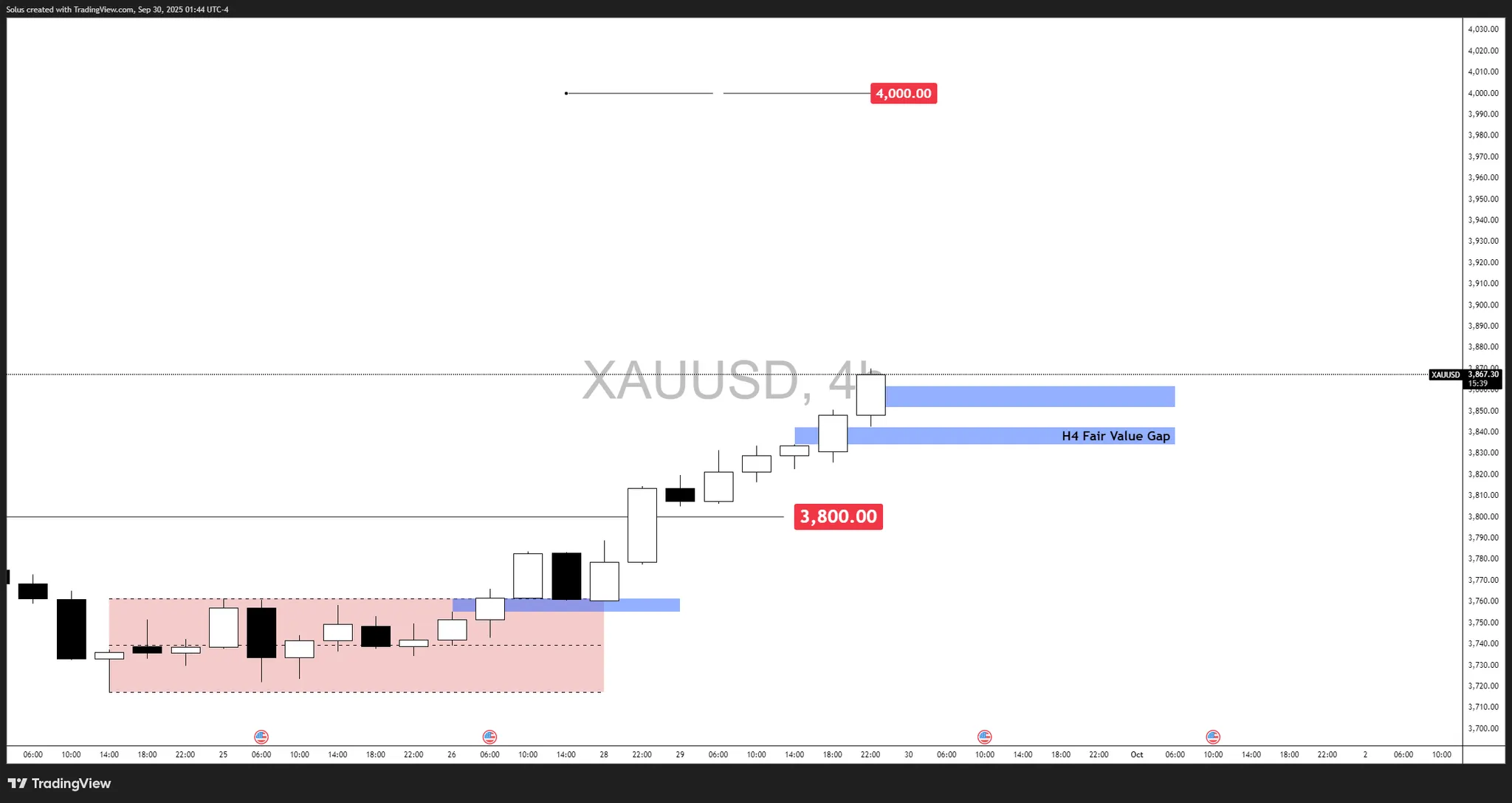
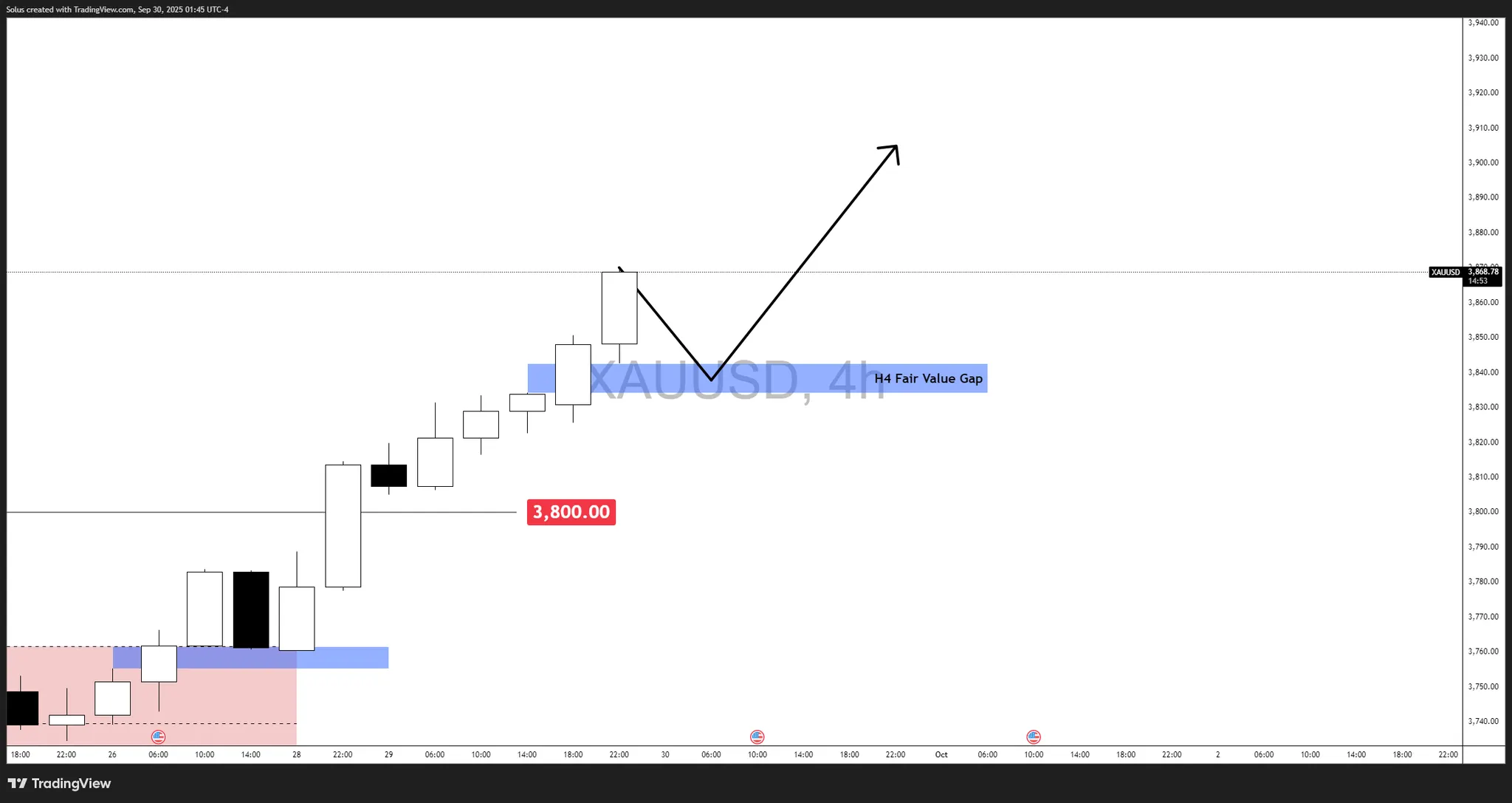
Gold has confirmed its breakout above $3,800, with momentum carrying price to fresh highs near $3,860. On the H4 chart, price action shows a clean displacement to the upside, leaving behind a Fair Value Gap (FVG) around $3,825–$3,835 that now acts as immediate demand. This gap, alongside the $3,800 breakout level, forms the first line of defense for bulls.
Bullish scenario: Retest and continuation
Gold’s breakout above $3,800 has left behind an H4 Fair Value Gap at $3,825–$3,835, which now acts as a potential springboard for further upside. If price pulls back into this zone and finds support, buyers are likely to step back in with conviction.
Holding above this FVG confirms bullish order flow, keeping buyers in control.
Upside targets: $3,880 first, followed by the $3,900 psychological milestone if momentum extends.
The bullish narrative remains intact as long as $3,800 holds as support.
Bearish scenario: FVG rejection and breakdown
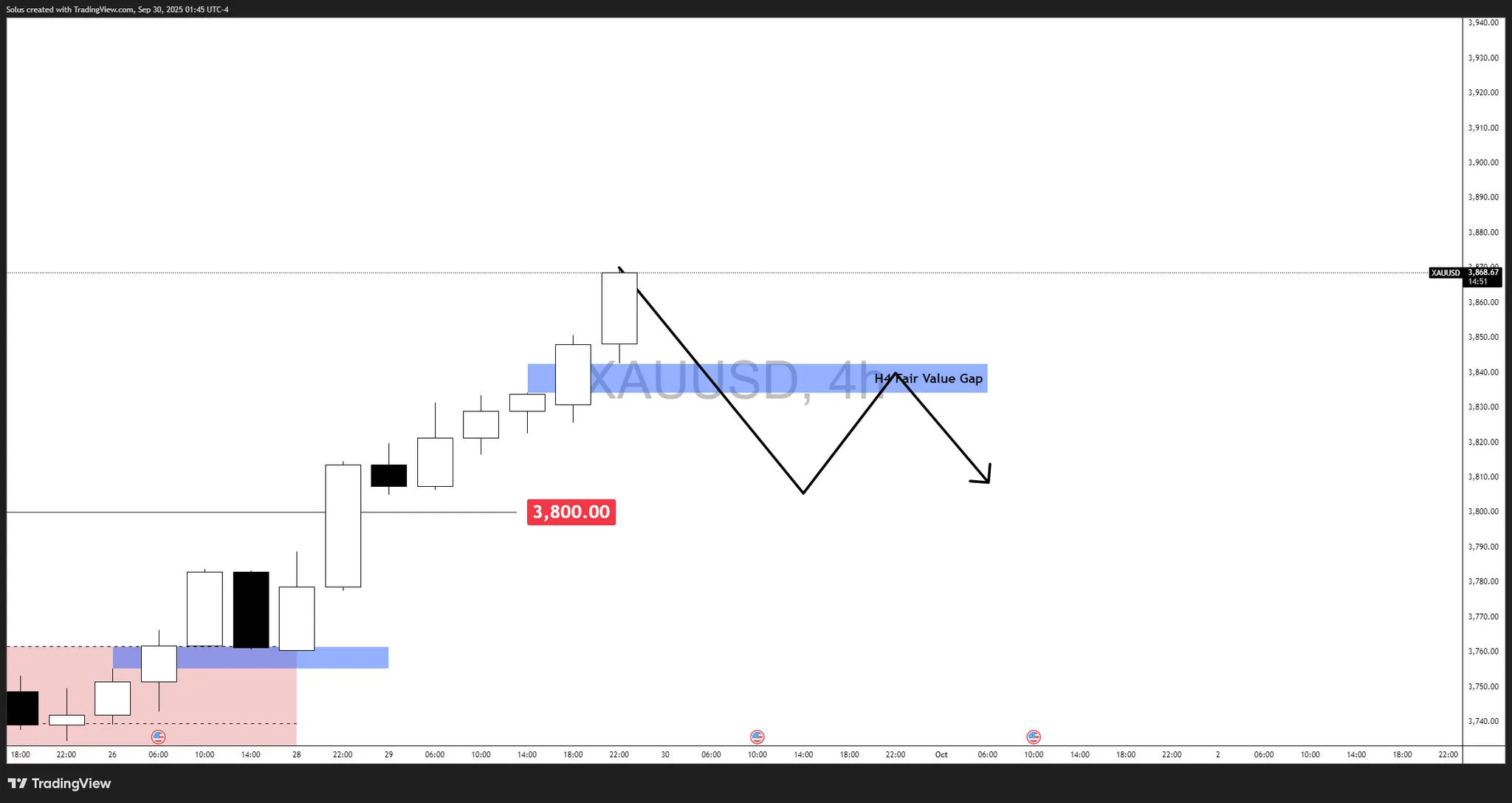
If the H4 Fair Value Gap at $3,825–$3,835 fails to attract strong buyers, gold risks turning lower in a corrective phase. A clean rejection from this zone would indicate sellers are defending premium pricing after the breakout.
Failure to hold the FVG drags price back to retest $3,800.
A decisive breakdown below $3,800 flips the breakout level into resistance.
Downside targets open at $3,770 → $3,740, where deeper liquidity sits.
Conclusion
Gold has delivered exactly as forecasted—breaking through $3,800 and setting new records. With Fed policy acting as a steady tailwind, structural central bank demand, and persistent safe-haven flows, the metal’s bullish case far outweighs any shorting attempts. Unless a hawkish Fed shock emerges or inflation data flips the script, the path of least resistance remains upward.
The EURJPY pair activated with stochastic intraday negativity, to keep its stability below the barrier at 175.20, providing correctional trading by reaching 174.00.
Note that the current decline will not affect the bullish scenario due to the stability of the extra support at 173.40, therefore, we will keep waiting for gaining the positive momentum to ease the mission of surpassing the barrier and targeting new positive stations that might extend to 175.60 and 176.00, while breaking the extra support will confirm its surrender to the bearish correctional track, forcing it to suffer extra losses by reaching 172.60.
The expected trading range for today is between 173.65 and 174.85
Trend forecast: Fluctuated within the bullish track
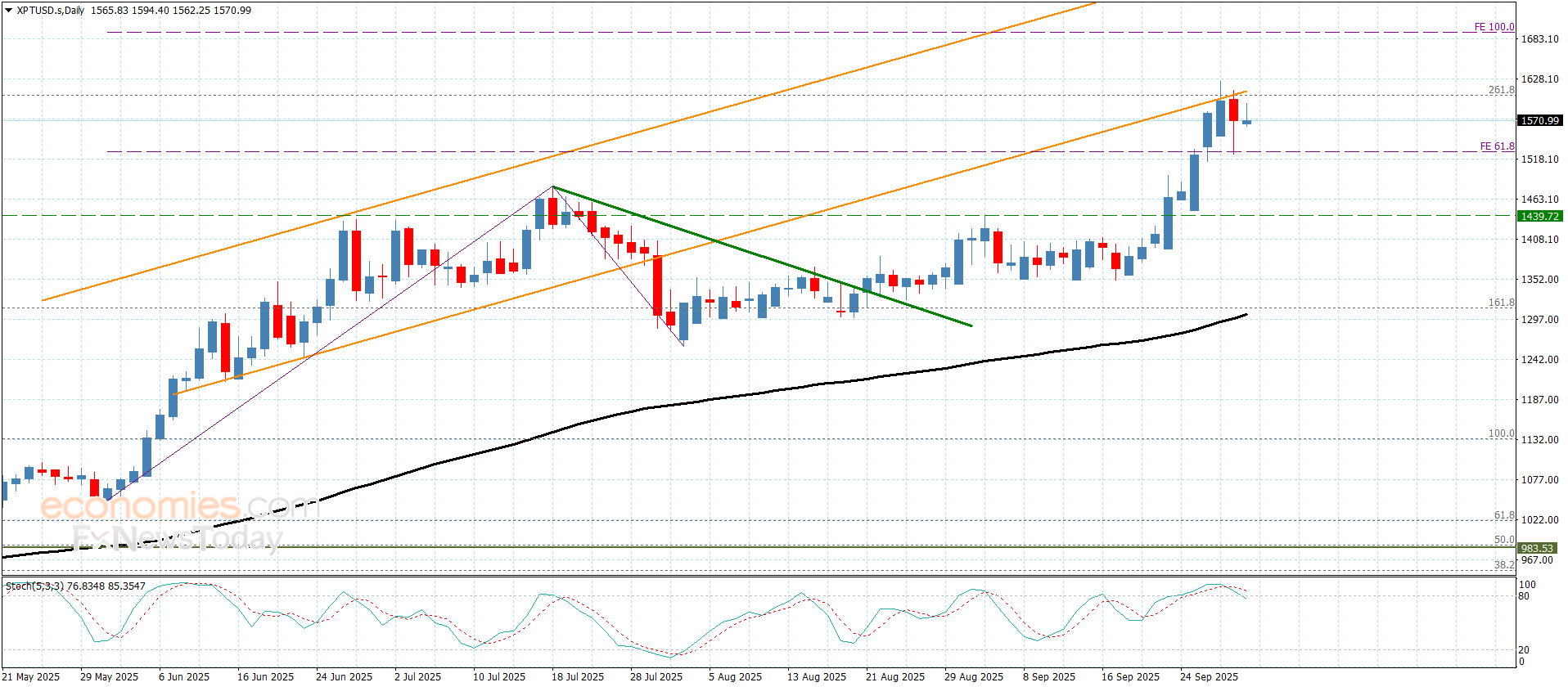
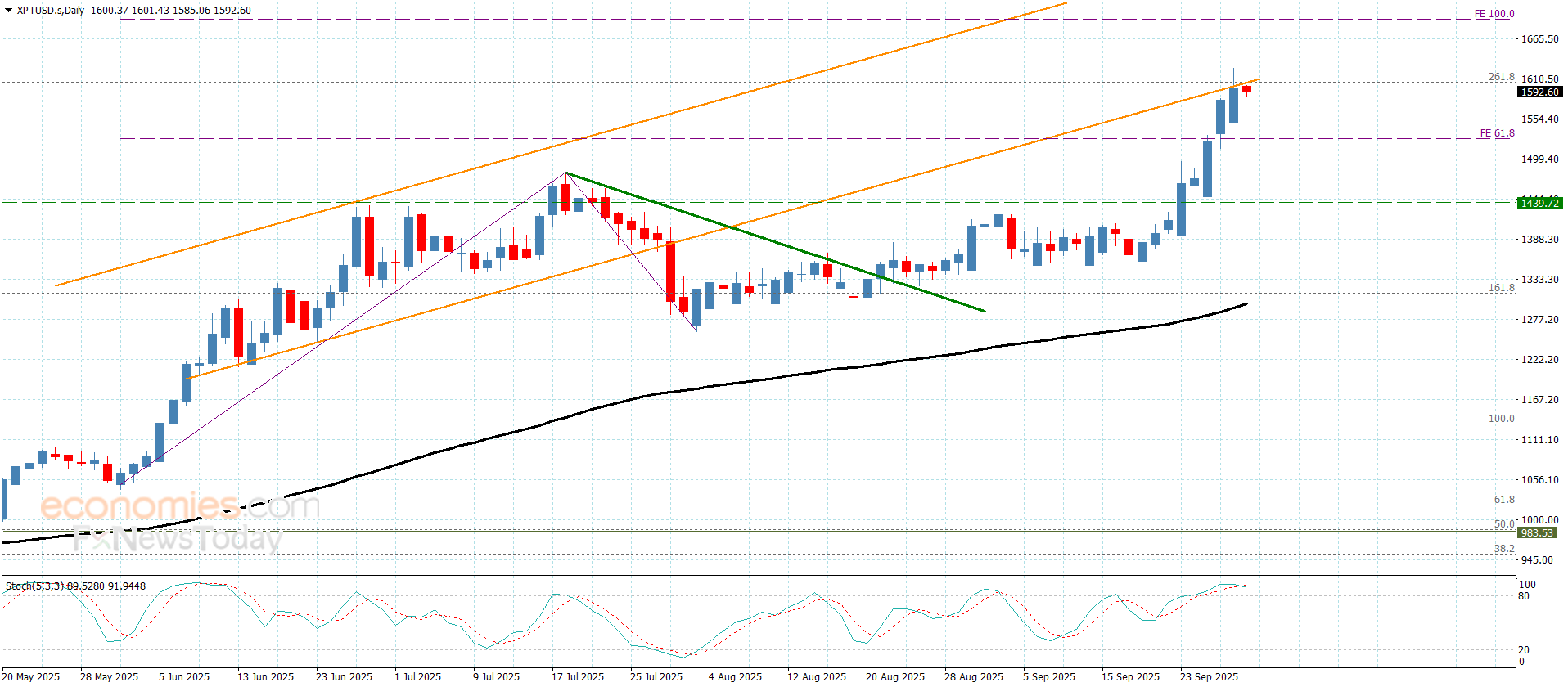
Platinum price reached $1625.00 level in its last rally, then bounces quickly to settle below 261.8%Fibonacci extension level at $1605.00, forming a strong barrier against the attempt of holding within the bullish channel’s levels that appear in the above image.
The price might be force to provide mixed trading, its stability above the extra support near $1525.00 besides the continuation of providing positive momentum by the main indicators will increase the chances for confirm breaching the current barrier, to ease the mission of achieving extra gains that might extend to $1642.00 initially, reaching $1690.000.
The expected trading range for today is between $1565.00 and $1642.00
WTI Crude (CL=F) and Brent (BZ=F) Rebound as Asia’s Imports Surge
WTI crude (CL=F) climbed 2.55% to $65.64, while Brent crude (BZ=F) rose 1.51% to $69.18, with gains reinforced by a rebound in Asia’s buying activity. Data showed that Asia’s August crude imports averaged 27.18 million barrels per day, up from July’s year-low of 24.91 million bpd and higher than a year earlier. China and India, which together drive more than a third of global oil demand, boosted imports after prices in May and June dropped into the low $60s per barrel. Opportunistic buying during that dip is now showing up in stronger August arrivals. However, forward flows could tighten again, as cargoes contracted after June’s spike above $80 per barrel during the Israel–Iran war will likely soften September imports.
Urals Oil and Russian Discounts Narrow Amid Tariffs and Caps
Urals crude is trading at $62 per barrel, narrowing its discount against Brent, which sits at $69.12. Since the G7’s $60 price cap was introduced in 2022, Urals has defied enforcement, trading above that level on 75% of days thanks to shipments through “dark fleets.” China remains the largest buyer, while Russia has kept its top-supplier position for India despite U.S. sanctions pressure. That dynamic shifted in late August when the U.S. imposed a 50% tariff on Indian imports of Russian oil, effective August 27, after New Delhi refused to scale back purchases. The EU and G7 allies will lower the threshold of the price cap to $46.50 per barrel, but enforcement remains patchy. This geopolitical tug-of-war is adding volatility across the curve, forcing traders to watch not just demand but also policy intervention.
Saudi Arabia’s Fiscal Stress as Brent Lingers Below $70
Saudi Arabia faces fiscal strain as Brent crude trades near $69, well below the estimated $90 per barrel price needed to balance its 2025 budget. Oil export revenues in April fell to $16.5 billion, down 21% year-over-year and the weakest in four years, as prices crashed 15% during the U.S. tariff blitz and OPEC+ production hikes. To finance its widening deficit, Riyadh is again tapping debt markets, issuing new tranches of Sukuk bonds. Investors placed $15 billion in orders by midday, showing global demand for Saudi debt remains strong despite oil’s downturn. Brent has lost 8% year-to-date, raising questions about how long Saudi can sustain spending on diversification projects while simultaneously defending market share.
OPEC+ Strategy and the Market Balancing Act
Speculation ahead of the OPEC+ meeting points to a likely rollover of current quotas, with no major cuts expected. The bloc faces a difficult balancing act: U.S. production set a record in 2024 and continues to beat weekly estimates in mid-2025, while Russia is keeping exports strong to Asia. Brent futures at $68.43 for November delivery and WTI October contracts at $64.91 show that markets are anchored in the mid-$60s to high-$60s range, struggling to break higher. The 200-day EMA sits at $62 for WTI and $70.52 for Brent, marking key technical pivot levels. For WTI, a sustained break above $66.50–$67.00 could target $70, while support lies at $62.00. Brent must clear $70.50–$73.00 to escape the consolidation band.
India and China: Winners of Cheaper Crude
India saved $12.6 billion on its oil import bill this year by leveraging discounted Russian crude, while China has expanded purchases from both Russia and Saudi Arabia. Together, their opportunistic buying strategies amplified August’s rebound in Asian imports. Yet this reliance comes at a geopolitical cost. Trump’s tariffs directly target India’s Russian inflows, and future U.S. policy may pressure Chinese refiners as well. India’s imports from sanctioned suppliers such as Nayara Energy are under scrutiny, with Saudi Arabia and Iraq suspending shipments in response to Western sanctions compliance issues. These disruptions highlight the fragility of Asia’s supply chain, where opportunistic savings clash with policy risks.
Geopolitical Shocks Add to Supply Volatility
Drone strikes forced Sudan to shut down production in the Heglig basin, cutting about 30,000 bpd. Separately, Houthis claimed a missile attack on an Israel-linked oil tanker in the Red Sea, and Russia’s Baltic fuel ports remain impaired after drone damage, extending repairs for months. Syria exported crude for the first time in 14 years, signaling the return of sanctioned barrels. These disruptions underscore how geopolitics are keeping risk premiums alive even as overall supply is abundant. Meanwhile, Russia and China advanced the Power of Siberia-2 pipeline, aiming to add 50 bcm of gas annually to Chinese buyers, reshaping long-term flows in Eurasia.
Technical Market Setup for Oil
The structure of oil futures reflects an uneasy balance. WTI (CL=F) rebounded strongly off $62, with intraday highs near $65.80, but resistance remains layered until $70. Brent (BZ=F) at $69.12 faces stiff barriers at $70–$73, where the 200-day EMA is positioned. Gasoline prices rose sharply, up 3.61% to $2.04 per gallon, highlighting refining tightness despite soft crude benchmarks. Mars US crude trades at $71.28, while Bonny Light collapsed 2.84% to $78.62, showing regional disparities. OPEC’s basket held at $69.65, flat on the day. Technical charts still flash consolidation rather than breakout, with RSI readings neutral and traders waiting for clarity from OPEC+ and macro signals like U.S. nonfarm payrolls.
Final Positioning on Oil
With WTI at $65.64 and Brent at $69.18, the market is caught between opportunistic Asian demand and mounting geopolitical and fiscal risks. Tariffs, sanctions, and OPEC+ caution keep prices capped, while support at $62 for WTI and $68 for Brent prevents deeper selloffs. Oil’s near-term path depends on whether buyers can sustain momentum above technical ceilings or whether renewed oversupply pushes benchmarks back toward spring lows. The geopolitical premium is alive, but structural oversupply remains a ceiling on rallies.
For gold bulls, current price action on the daily chart is nothing short of picture-perfect.
Blasting through multiple key levels throughout 2025, most significantly the $3,000 mark first achieved in early March, gold pricing currently trades in excess of $3,800 per troy ounce for the first time in history, growing ever closer to $4,000.
Having found a base of around $3,250, forming a slight upwards trending channel, price action in early September would break this period of consolidation and mark the start of the current rally, which, at least so far, shows little sign of exhaustion.
With that said, we are currently in ‘overbought’ territory according to the RSI and trade some distance from the trendline, suggesting that short-term retracements are possible if the uptrend wishes to continue.
As ever, data suggesting the Federal Reserve outlook is to become more dovish will likely support metal pricing further, with the opposite being true if the Fed is seen to become more hawkish ahead of their October decision.
In line with Fibonacci theory, here are some key levels to watch: