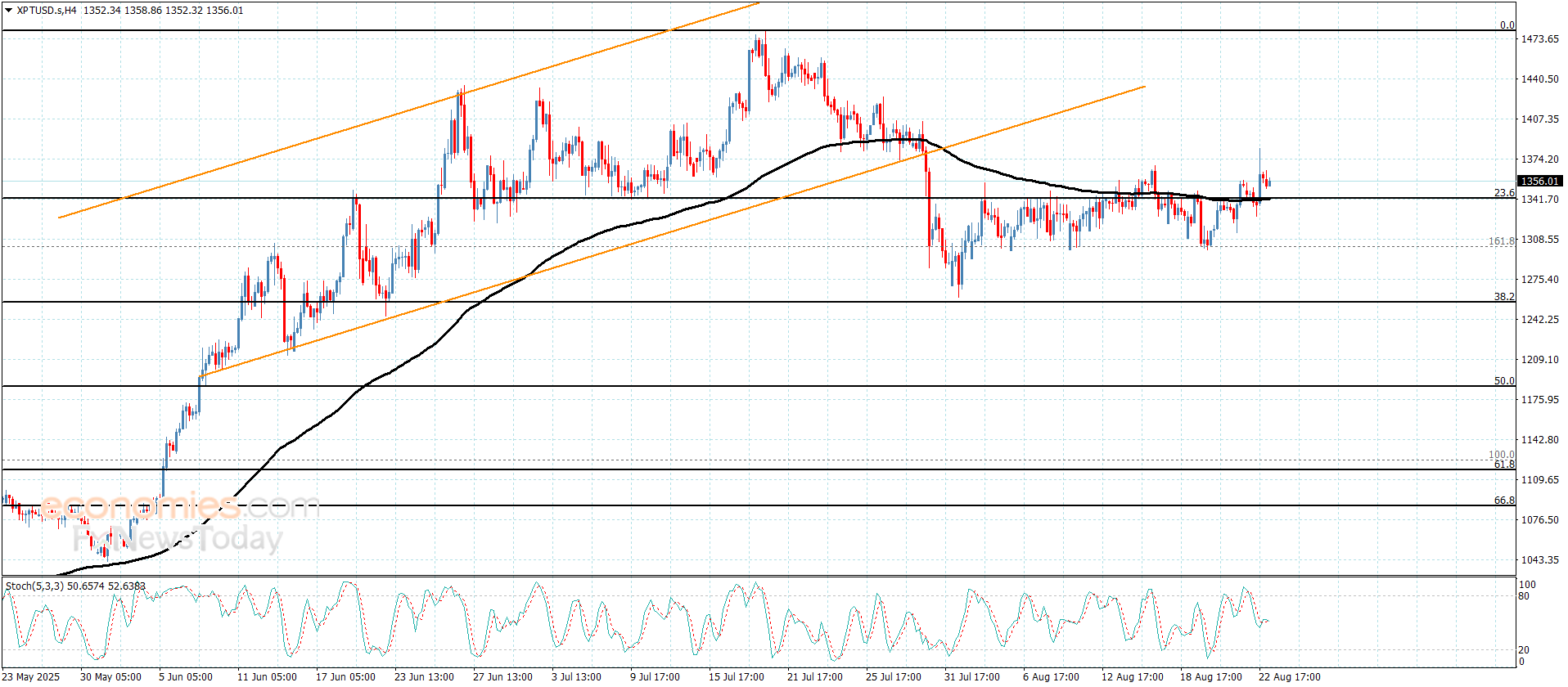
The price of gold (GOLD) has moved higher strongly in its recent intraday trading, supported by positive signals from relative strength indicators (RSI), reaching our first target to test the current resistance level of $3,053. This comes amid the dominance of the main upward trend, with trading occurring near the trend line.
To get our more detailed analysis and 100% accurate signals provided by Best Trading Signal, subscribe to Economies.com VIP Club through the link below!
Just two weeks ago, copper prices were climbing fast due to the US stockpiling ahead of new tariffs. Traders warned that new US tariffs on copper could squeeze global supply. But things turned around quickly. But now, the copper rally has reversed into a full-blown crash.
This is a direct outcome of President Donald Trump’s trade war, aka “Trump Tariffs,” that is shaking the global market. Investors now fear that the new tariffs will slow down demand for copper worldwide.
The Copper Price Shock: Traders Scramble, Markets Tumble
Bloomberg reported, on Friday, April 4, copper prices dropped sharply, along with stock markets. The fall continued till Monday. In the London Metal Exchange, copper prices sank as much as 7.7% before bouncing back slightly to $8,735 a ton.
Source: Bloomberg
Earlier, we saw how traders rushed to send copper to the US before tariffs hit, driving premiums as high as $500 a ton. Big players like Mercuria and Trafigura even predicted prices could reach $12,000 a ton. But things changed rapidly when Trump shortened the tariff timeline, giving buyers very few days in hand.
Because of this, copper is piling up outside the US. Global buyers have more to choose from, but many aren’t interested. With demand dropping due to tariffs, the extra supply doesn’t help.
Chile’s Price Cut Signals Looming Economic Strain
Chile, the world’s biggest copper producer, is preparing to lower its copper price estimate for 2025. It’s a telltale sign of growing global economic concerns.
According to the Wall Street Journal, Chile’s copper agency, Cochilco, held its 2025 price forecast at $4.25 per pound in February. This came after it raised the estimate from $3.85 back in May 2024.
It also kept the 2026 forecast at $4.25. Cochilco expects copper prices to stay above $4.00 per pound for the next ten years.
But the new data show copper prices to average between $3.90 and $4 per pound this year, which is below its previous forecast.
The final figure will be announced by the end of April. However, Juan Ignacio Guzman, head of Chilean mineral consulting firm GEM, said,
“If the trade war triggers a recession, prices could tumble to as low as $3 a pound — or about $6,600 a ton.”
CSource: Bloomberg
Chile, which produced 24% of the world’s copper last year, is now feeling the pressure.
Chilean Customs data showed that Chile exported 182,338 metric tons of refined copper, including 33,496 metric tons to China in March.
Exports of copper ore and concentrate totaled 1,304,782 metric tons, with China receiving 810,135 metric tons in the same month.
Earlier this year, in January and February, Chile’s copper production dropped compared to the previous month. Exports to China also declined during that period.
Analysts Warn of More Trouble Ahead
The Bloomberg report highlighted that the worst might not be over. Max Layton, global head of commodities research at Citigroup Inc., warned that the global trade shake-up could lead to a historic market correction. Citi now expects copper prices outside the US to average $8,500 this quarter — but they also say the risk of further drops is high.
BNP Paribas SA strategist David Wilson, who had warned prices could collapse, now sees the downtrend continuing in the short term. Goldman Sachs still believes in copper’s long-term value but admits that slower global growth could delay the expected supply shortage.
Meanwhile, JPMorgan now expects the US to fall into a recession this year. UBS estimates that every 1% drop in US GDP could cut output in export-driven Asian economies like Taiwan and South Korea by up to 2%.
China’s 34% Tariff Sparks Copper Stock Rout
Copper stocks have taken a beating amid falling prices, global slowdown fears, and rising trade tensions. The sharp selloff followed news from China’s Xinhua News Agency that Beijing will impose a 34% tariff on all US imports starting April 10.
Freeport-McMoRan: Shares dropped 13.1% in a single day. The stock is down 24.1% this week, bringing its market value to $41.9 billion.
BHP Group and Rio Tinto: BHP’s shares fell 9.5%, cutting its value to $107.3 billion. Rio Tinto’s dropped 6.4%, is now valued at $93.5 billion. Both saw trading volumes nearly triple the usual.
Southern Copper: Based in Mexico, the company fell 9.6% on Friday alone, pushing its weekly loss to 16.7%. Its market value now stands at $62.4 billion.
Zijin Mining: This Chinese mining giant lost 7.2%, dropping to a market cap of $56.9 billion. It’s one of the few firms producing over 1 million tonnes of copper a year.
Glencore and Anglo American: Glencore dropped 11.5%, while London-listed Anglo American fell 11%. Their market caps now stand at $36.9 billion and $28.6 billion, respectively. Both are down about 20% this week.
Canadian Miners (Teck Resources, Ivanhoe Mines, First Quantum): Canadian copper stocks saw sharp losses. Teck dropped 12.1%, Ivanhoe fell 12.6%, and First Quantum slid 12.8% as investors pulled back across the board.
Hindustan Copper: In India, shares fell 5.4% over the past five days and are down 15.7% so far in 2025.
What started as a bullish rush has turned into a brutal crash. With tariffs rising and demand shrinking, copper is now a symbol of deeper market fears. Global supply chains are out of sync, and the world’s top miners are feeling the heat. If trade tensions escalate, this copper price crash may face a difficult recovery.
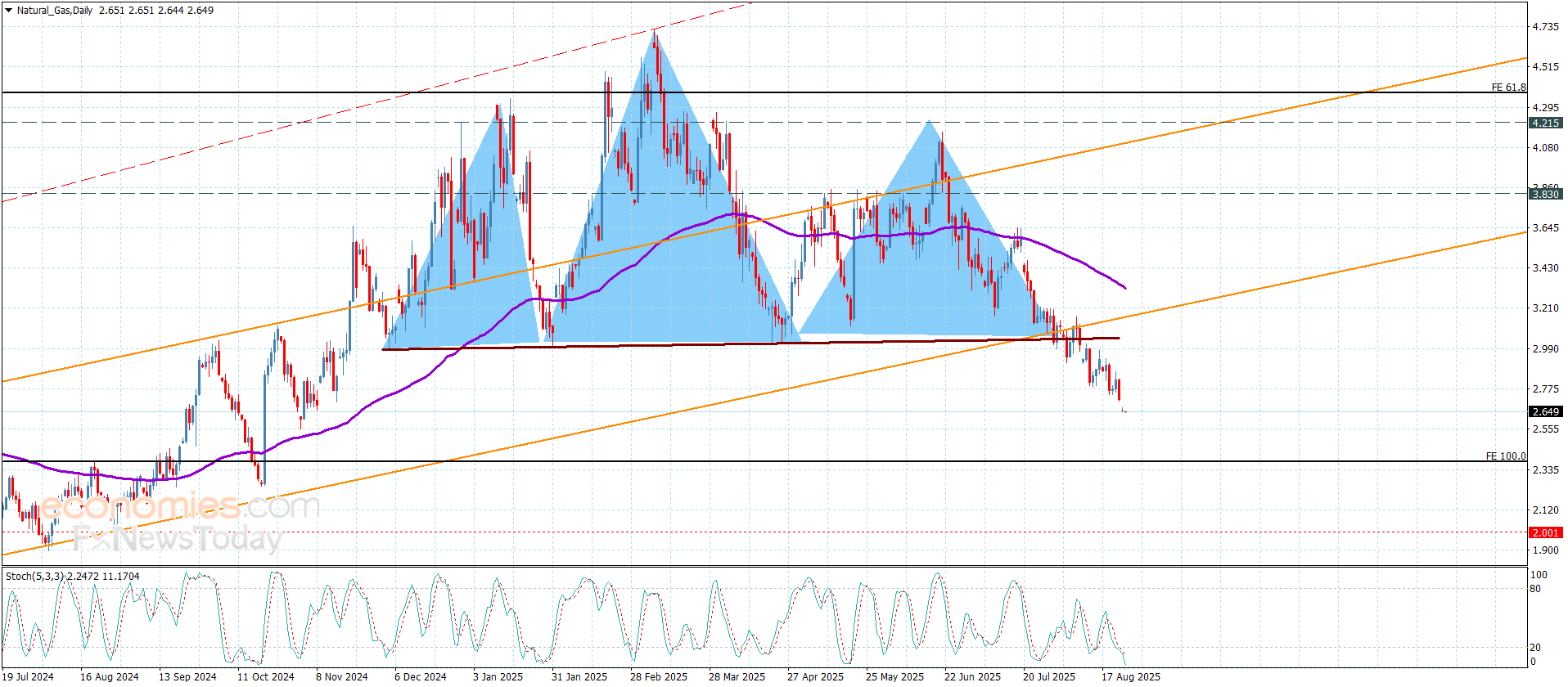
The short-term weather outlook offers only modest demand support. NatGasWeather reports a late-season chill pushing through the Great Lakes and East, with overnight lows in the 20s-30s. However, mild to warm conditions persist across the West, South, and Central U.S., with highs reaching the 50s to 90s. With this mix, demand is projected to remain moderate over the next seven days—insufficient on its own to drive a bullish breakout.
Storage Build Confirms Weak Shoulder Season Demand
Thursday’s EIA report showed a storage injection of 57 Bcf, aligning with consensus estimates of 55–56 Bcf. This build was significantly above the five-year average of +17 Bcf, underscoring muted residential and commercial demand. Total working gas in storage now stands at 1,830 Bcf—40 Bcf below the five-year average and 450 Bcf less than this time last year. While slightly tighter year-on-year, the surplus over five-year norms has evaporated, offering limited fundamental upside.
Will Macro Fears Drag Prices Lower Again?
Beyond domestic fundamentals, traders remain wary of broader risk-off sentiment, including renewed fears tied to the U.S.-China trade war. A breakdown in energy sector sentiment pressured natural gas alongside crude on Friday, suggesting further downside if macro headwinds intensify.
Market Forecast: Bearish Bias Below $3.361
Unless bulls defend $3.361 with conviction, natural gas futures are likely to probe lower technical levels. With no immediate weather or storage support and resistance levels still capping rallies, the short-term bias leans bearish. A move toward $2.995 could attract bargain hunters, but until then, sellers appear in control.
Bitcoin (BTCUSD) has risen in its recent intraday trading, surpassing the negative pressure from the EMA50, breaching the strong resistance level at $81,000, which supports the bullish scenario, especially with the positive signals that appearing on the Relative Strength Index (RSI).
To get our more detailed analysis and 100% accurate signals provided by Best Trading Signal, subscribe to Economies.com VIP Club through the link below!
At the time of this writing, natural gas continues to trade above the midpoint of the day’s trading range and looks likely to end the day with a potentially bullish hammer or doji hammer candlestick pattern. The high for the day was $3.58. Earlier in the session a breakdown of an inside day pattern from Thursday triggered, resulting in a test of support as mentioned above. Since a potentially bullish one-day pattern followed, today’s closing price is likely to be above Thursday’s low of $3.47. This sets up a potentially bullish pattern heading into next week.
Three-Day Bullish Combo Forms
Nonetheless, it is not just today’s pattern that is potentially bullish, it is also the combination with the patterns of the prior two days. Since natural gas is likely to close inside yesterday’s range and in the top half of today’s price range, the bearish breakdown shows signs of a failed pattern. The three-candle combination is a potentially bullish hikkake pattern. It can be both a reversal or continuation pattern and it will trigger on a rally above Thursday’s high of $3.75.
However, an advance above today’s high can provide an earlier valid bullish signal regardless of the hikkake pattern being present. Given the three-period combination, it is a potentially powerful short-term pattern. Of course, a drop below today’s low is short-term bearish and indicates a failure of the potentially bullish pattern
Potential Resistance at 50-Day Moving Average
Initial upside targets start with the four-day high of $3.83 and the 50-Day MA, now at $3.89. A declining trendline at the top of the channel may also be around the 50-Day line when approached, and it may provide clues. Subsequently, if an upside breakout of the downtrend line triggers the 50% retracement at $4.12 becomes a potential target, followed by an interim swing high and 61.8% Fibonacci retracement at $4.26 and $4.30, respectively.
For a look at all of today’s economic events, check out our economic calendar.
The CADCHF pair’s price kept the negative stability below 0.6020 barrier, affected by the negativity of the main indicators, to notice resuming the negative attack by reaching 0.5850.
No escape of the price from forming more of the bearish waves, due to the validation of the main negative factors, to expect reaching the extra target at 0.5785, and breaking it might extend the losses in the near period towards 0.5715 reaching to the support level of the bearish channel’s support at 0.5645.
The expected trading range for today is between 0.5715 and 0.5950.
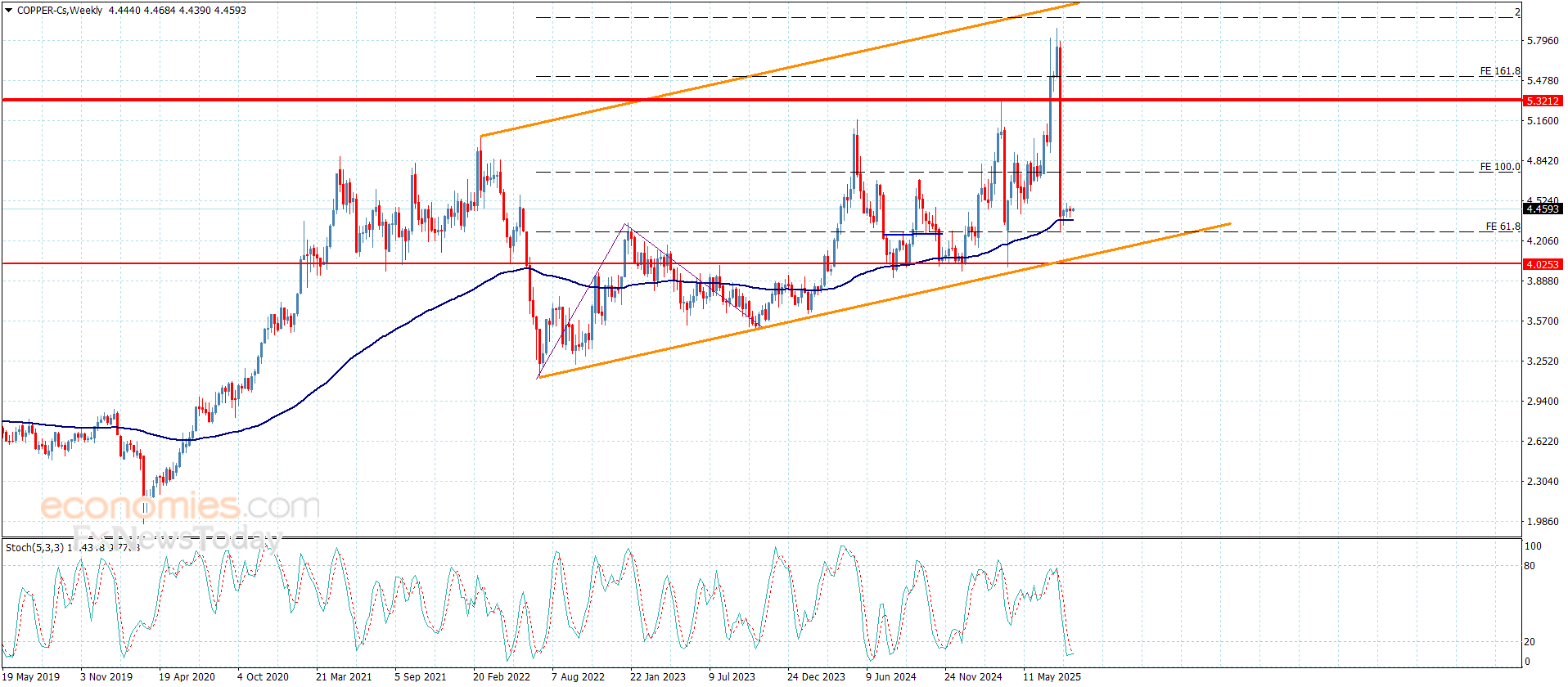
Copper price didn’t move anything since yesterday’s trading, delaying the bullish rally by its repeated fluctuation below 38.2%Fibonacci correction level, which represents an intraday obstacle by its stability near $4.4000.
The continuation of stochastic attempts to provide positive momentum and the repeated stability above the critical support at $4.000, these factors make us keep the bullish suggestion, to expect the mentioned obstacle and holding above it, targeting extra positive stations that begin at $4.5600 and $4.6800.
The expected trading range for today is between $4.2300 and $4.5600
The EURJPY pair provided several mixed waves since yesterday, due to the contradiction between the main indicators’ positivity and the overall stability below the bearish channel’s resistance at 163.20, to notice its stability near 161.85 without achieving any of the waited negative targets.
The price needs a new negative momentum, to reinforce the efficiency of the bearish track, which might target 160.60 level and 159.60, while the price surrender to the positivity of the main indicators and its rally above the main resistance will confirm its readiness to build a new bullish track, to begin targeting several positive stations by attacking 164.10 level initially, reaching 164.85.
The expected trading range for today is between 160.60 and 162.50
Silver attracts some intraday sellers following an intraday uptick to a fresh weekly high.
The technical setup favors bearish traders and supports prospects for additional losses.
A move beyond the 50% Fibo. hurdle is needed to negate the near-term negative bias.
Silver (XAG/USD) struggles to capitalize on its modest intraday uptick and retreats slightly after touching a fresh weekly high, around the $31.30 region during the early European session on Thursday. The intraday selling picks up pace in the last hour and drags the white metal back below the $31.00 mark as traders now look forward to the US consumer inflation figures before placing fresh directional bets.
From a technical perspective, the XAG/USD now seems to have found acceptance above the 38.2% Fibonacci retracement level of the recent slump from the March swing high to a fresh year-to-date low touched earlier this week. The subsequent move up, however, stalls ahead of the 50% Fibo. level. Moreover, oscillators on the daily chart – though they have been recovering from lower levels – are holding in negative territory. This, in turn, warrants some caution before positioning for an extension of the weekly uptrend from the $28.25 region, or the lowest level since September 2024.
In the meantime, any further slide below the 38.2% Fibo. level is likely to find some support near the $30.55 region. Some follow-through selling, however, could make the XAG/USD vulnerable to accelerate the fall towards the $30.00 psychological mark en route to the 23.6% Fibo. level, around the $29.80-$29.75 zone. Failure to defend the said support levels would shift the near-term bias back in favor of bearish traders. The white metal might then decline to the $29.35-$29.30 zone en route to the $29.00 mark and eventually aim towards retesting the multi-month low, around the $28.25 region.
On the flip side, bulls might now wait for a sustained strength beyond the daily swing high, around the $31.30 region, which nears the 50% Fibo. level, before placing fresh bets. The subsequent move-up should allow the XAG/USD to reclaim the $32.00 mark and climb further towards the 61.8% Fibo. level, around the $32.15-$32.20 zone. The latter should act as a key pivotal point, which if cleared decisively will be seen as a fresh trigger for bullish traders and lift the white metal beyond the $32.65 intermediate barrier, towards the $33.00 round figure.
Silver 4-hour chart
Silver FAQs
Silver is a precious metal highly traded among investors. It has been historically used as a store of value and a medium of exchange. Although less popular than Gold, traders may turn to Silver to diversify their investment portfolio, for its intrinsic value or as a potential hedge during high-inflation periods. Investors can buy physical Silver, in coins or in bars, or trade it through vehicles such as Exchange Traded Funds, which track its price on international markets.
Silver prices can move due to a wide range of factors. Geopolitical instability or fears of a deep recession can make Silver price escalate due to its safe-haven status, although to a lesser extent than Gold’s. As a yieldless asset, Silver tends to rise with lower interest rates. Its moves also depend on how the US Dollar (USD) behaves as the asset is priced in dollars (XAG/USD). A strong Dollar tends to keep the price of Silver at bay, whereas a weaker Dollar is likely to propel prices up. Other factors such as investment demand, mining supply – Silver is much more abundant than Gold – and recycling rates can also affect prices.
Silver is widely used in industry, particularly in sectors such as electronics or solar energy, as it has one of the highest electric conductivity of all metals – more than Copper and Gold. A surge in demand can increase prices, while a decline tends to lower them. Dynamics in the US, Chinese and Indian economies can also contribute to price swings: for the US and particularly China, their big industrial sectors use Silver in various processes; in India, consumers’ demand for the precious metal for jewellery also plays a key role in setting prices.
Silver prices tend to follow Gold’s moves. When Gold prices rise, Silver typically follows suit, as their status as safe-haven assets is similar. The Gold/Silver ratio, which shows the number of ounces of Silver needed to equal the value of one ounce of Gold, may help to determine the relative valuation between both metals. Some investors may consider a high ratio as an indicator that Silver is undervalued, or Gold is overvalued. On the contrary, a low ratio might suggest that Gold is undervalued relative to Silver.

The EURUSD price continues the rise during its recent intraday trading, amid the strong dominance of the main upward trend. The pair’s recent rise came despite the emergence of negative signals on the Relative Strength Index (RSI) indicators, after reaching highly overbought levels, which highlights the strength of this positive trend.
To get our more detailed analysis and 100% accurate signals provided by Best Trading Signal, subscribe to Economies.com VIP Club through the link below!