The main tag of GoldPrice Articles.
You can use the search box below to find what you need.
[wd_asp id=1]
The main tag of GoldPrice Articles.
You can use the search box below to find what you need.
[wd_asp id=1]
Natural Gas (NG=F) futures remain under heavy pressure, drifting around $2.94 per MMBtu after logging a 3.5% weekly decline. The latest U.S. Energy Information Administration (EIA) storage report showed a 71 Bcf injection for the week ending September 5, exceeding both market forecasts of 69 Bcf and the five-year average build of 56 Bcf. This elevated storage level pushed total inventories to 3,343 Bcf, 188 Bcf above the five-year norm, reinforcing a market well-supplied ahead of peak winter demand. With daily consumption slipping to 99.5 Bcf from 99.9 Bcf the prior week and LNG exports softening, the supply cushion is suppressing any immediate price rebound.
Beyond the near-term softness, a structural challenge looms. Global LNG supply capacity is set to surge, with more than 174 million metric tonnes per year of new projects under development, including Qatar’s North Field East and U.S. Gulf Coast expansions. The U.S. alone has revised its 2025 natural gas production forecast upward to 106.63 Bcf/day, near record highs, as active rigs reached a two-year peak. LNG output grew 19% in the first half of the year compared to 2024, underscoring the supply acceleration. While developers expected Europe and China to absorb additional cargoes, China’s LNG imports have slowed due to stronger domestic production and increased flows from Russia. This shift risks leaving the market in a state of surplus by 2026, creating a persistent cap on price rallies beyond the $3.25 ceiling seen earlier in the summer.
In Europe, benchmark Dutch TTF front-month gas slipped to €32.19 per MWh, equivalent to $11.07 per mmBtu, while the U.K. front-month dropped to 79.15 pence per therm. Strong LNG arrivals and storage levels already 80% full have weighed on pricing. Mild weather and high wind generation reduced power-sector gas demand, reinforcing downside pressure. Yet, geopolitical risks remain a potent upside driver. Germany’s Emden terminal will undergo maintenance, and U.S. sanctions on Russian Arctic LNG 2 exports could disrupt flows further, particularly as cargoes have continued to reach China. Any escalation in restrictions would tighten LNG supply chains globally, reversing the current softness in European benchmarks and potentially spilling over into U.S. pricing.
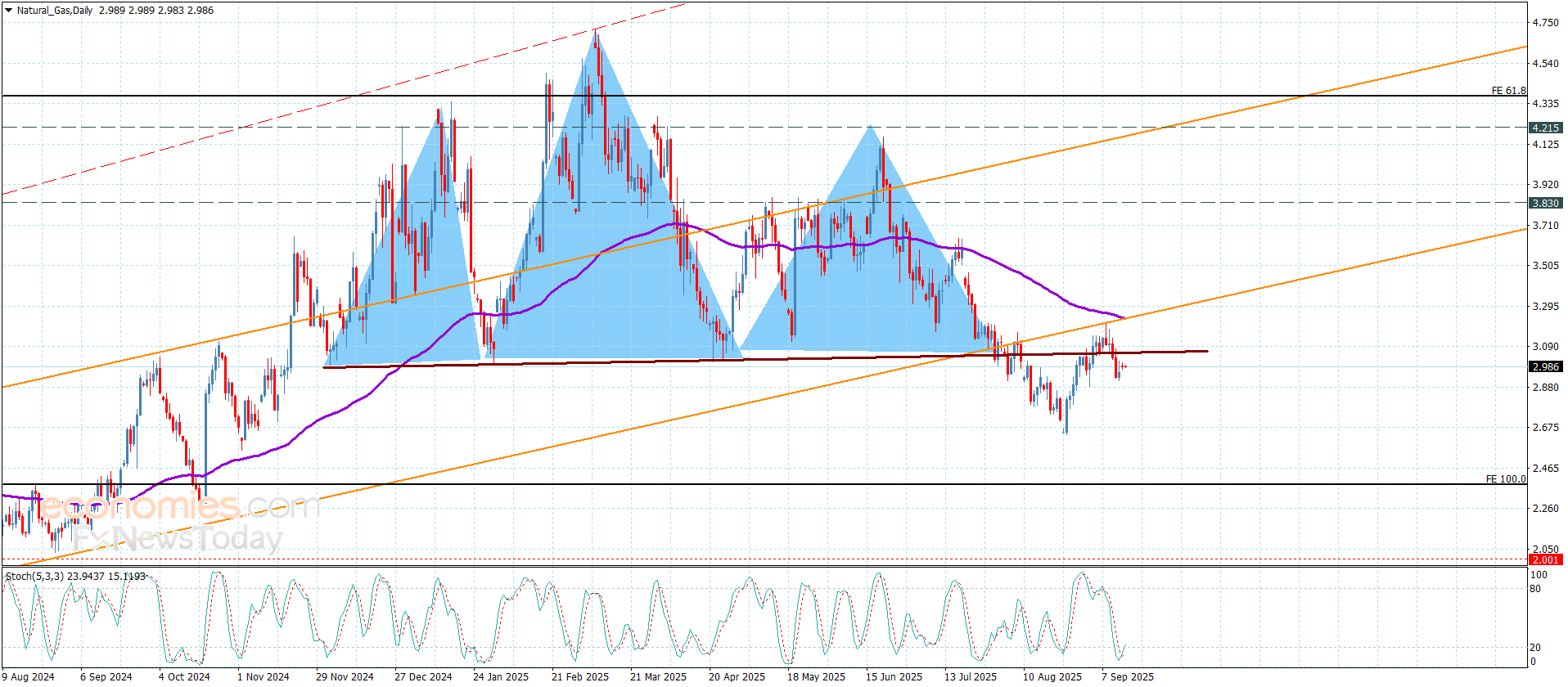
Technically, Natural Gas (NG=F) remains in a consolidation phase, trading just below the $3.00 psychological barrier. Resistance is defined at $3.23, a level repeatedly tested but not breached, while near-term support sits between $2.80 and $2.82. Momentum indicators reinforce this range-bound scenario: the RSI hovers near 51, showing neutrality, while the 25-day EMA provides short-term support against a 50-day EMA ceiling. The inability to close above $3.13 signals buyers lack conviction, and the formation of lower highs since March adds weight to the bearish case. If $2.80 fails, downside could accelerate toward $2.64, while a bullish break above $3.23 would open the path toward $3.50.
Looking toward winter, natural gas demand fundamentals remain a wild card. European inventories may appear comfortable now, but a colder-than-expected season could trigger strong withdrawals, lifting prices back toward $3.50. In the U.S., the growing power needs of hyperscale data centers add another layer of uncertainty. Forecasts diverge widely on how much gas these facilities will consume by decade’s end, with some projecting a material uplift in baseline demand. However, renewable energy expansion continues to compete with natural gas in the power stack, limiting longer-term price sustainability unless structural consumption rises meaningfully.
With NG=F pinned below $3.00 and fundamentals skewed by oversupply risk, the broader stance remains bearish. The strong inventory build, accelerating global LNG capacity, and seasonal demand lull point toward further weakness. However, the downside appears cushioned near $2.80 as the market transitions into the winter cycle, where unexpected cold spells or geopolitical shocks could ignite sharp rallies. For traders, the strategy is to respect the range: accumulation near $2.80 for short-term rebounds toward $3.10–$3.25, while avoiding aggressive long positions until a decisive break above $3.23 confirms momentum. Medium-term, the oversupply trajectory suggests Natural Gas is a Sell on rallies unless demand surprises shift the balance.
HSBC expects a big oil surplus of 1.7 million barrels per day (mbd) from the fourth quarter of 2025, and a surplus of 2.4 mbd in 2026, exacerbated by the return of OPEC+ barrels over the next 12 months, it said in a note on Monday.
At its meeting this month, OPEC+ opted to further increase oil production by 137,000 bpd in October, starting to unwind the 1.65 million bpd in cuts ahead of schedule.
HSBC’s latest oil market supply and demand model envisions OPEC+ gradually unwinding 1.65 million barrels per day in the “first-phase” voluntary production cuts over a 12-month period, HSBC said a week ago.
The bank also saw a downside risk to its 2026 $65 per barrel Brent price assumption if stockbuilds materialise in the West.
U.S. President Donald Trump urged EU officials last week to hit China with tariffs of up to 100% as part of a strategy to pressure Russian President Vladimir Putin.
The bank’s note on Monday stated that “outright losses in Russian supply are not in (HSBC’s) base case (but) Russia will struggle to increase its output in line with OPEC+ quotas.” The bank now expects only a modest production increase, lowering its end-2026 Russian production forecast by 300,000 bpd.
Spot Gold trades near fresh all-time highs just above the $3,680 mark, approaching its all-time high of $3,674.63 posted earlier this month. Absent demand for the US Dollar (USD) prompted the bright metal higher at the beginning of the new week, as market players gear up for central banks’ monetary policy announcements.
Of course, the main focus is the Federal Reserve (Fed) schedule to announce its decision on Wednesday. The Fed is largely anticipated to deliver its first interest rate cut for 2025, with financial markets anticipating a 25 basis points (bps) reduction. The odds for a larger cut decreased following the release of sticky United States (US) inflation data, but some market participants still believe it’s possible.
The central banks of Canada, England, and Japan will also announce their decisions on monetary policy in the upcoming days, while Canada and the United Kingdom (UK) will release fresh inflation data. Other than that, the US will publish August Retail Sales on Tuesday, while Australia will unveil the August employment report on Thursday.
Softer US Treasury yields add to Gold’s advance, with the 10-year note currently offering 4.03%, down from an intraday peak of 4.089%.
The daily chart for the XAU/USD pair shows it retains most of its intraday gains, with more advances in the docket, despite overbought conditions. The Relative Strength Index (RSI) indicator aims north at around 80, while the Momentum indicator approaches overbought territory, without signs of upward exhaustion. At the same time, Gold is rallying far above bullish moving averages, in line with the dominant upward trend. The 20 Simple Moving Average (SMA) currently stands at $3,497.
In the near term and according to the 4-hour chart, XAU/USD is set to extend its advance. Technical indicators head north almost vertically, approaching overbought readings but still with room to go. Meanwhile, a flat 20 SMA provides intraday support at around $3,642, while the 100 and 200 SMAs keep heading firmly north, far below the shorter one.
Support levels: 3,674.30 3,657.30 3,642.00
Resistance levels: 3,690.00 3,705.00 3,720.00
The EURJPY pair ended its last attempts with clear failure, to breach 173.50 barrier, which forces it to delay the bullish attack and begin forming bearish correctional waves, to settle near 172.90.
The price might keep forming correctional trading to gather some of the gains, to target 171.60, keeping its main stability within the bullish channel that appears in the above image, while its success in breaching the barrier and holding above it will allow it achieve more of the gains, to reach 174.25 followed by the next main target at 175.20.
The expected trading range for today is between 171.60 and 173.50
Trend forecast: Fluctuated within the bullish track
Gold failed to find acceptance above the $3,660 area and is trading lower on Thursday, returning to $3,620, as the US Dollar appreciates for the third consecutive day, with all eyes on the US Consumer Prices Index release.
XAU/USD islands tall at a short distance of the all-time high, at $3,675 on Monday. A weaker US Dollar, weighed by market expectations that the Fed will cut rates later this week, keeps precious metals buoyed, with deonside attemots contained above $3,615.
The US Dollar Index, which measures the US Dollar value against a basket of currencies, is trading 0.2% lower today, drifting closer to two-month lows. Investors are positioning for a 25 bps rate cut on Wednesday and also for a dovish turn on the interest rate projections, the so-called “dot plot” and on the bank’s forward guidance.
Gold’s consolidation pattern seen over the last few days has contributed to pulling the 4-hour Relative Strength Index down from the oversold levels seen last week, but it is still above the key 50 level. The MACD in the same timeframe is bearish yet with downside momentum fading.
Downside attempts have been contained above $3,615 so far. Further down, the $3,580 support (September 3 high, September 8 low) might provide some support ahead of the September 4 low, at $3,510.
To the upside, immediate resistance is the September 9 high, at $3,675. Beyond this, the psychological $3,700 level emerges as the next target, and then probably the 161.8% extension of last week’s rally, near $3,740.
The table below shows the percentage change of US Dollar (USD) against listed major currencies today. US Dollar was the strongest against the Canadian Dollar.
| USD | EUR | GBP | JPY | CAD | AUD | NZD | CHF | |
|---|---|---|---|---|---|---|---|---|
| USD | -0.17% | -0.37% | -0.21% | -0.09% | -0.22% | -0.09% | -0.19% | |
| EUR | 0.17% | -0.17% | -0.09% | 0.09% | 0.00% | 0.04% | -0.02% | |
| GBP | 0.37% | 0.17% | 0.16% | 0.27% | 0.17% | 0.21% | 0.04% | |
| JPY | 0.21% | 0.09% | -0.16% | 0.09% | 0.03% | 0.10% | 0.02% | |
| CAD | 0.09% | -0.09% | -0.27% | -0.09% | -0.03% | -0.05% | -0.22% | |
| AUD | 0.22% | -0.00% | -0.17% | -0.03% | 0.03% | 0.04% | -0.05% | |
| NZD | 0.09% | -0.04% | -0.21% | -0.10% | 0.05% | -0.04% | -0.17% | |
| CHF | 0.19% | 0.02% | -0.04% | -0.02% | 0.22% | 0.05% | 0.17% |
The heat map shows percentage changes of major currencies against each other. The base currency is picked from the left column, while the quote currency is picked from the top row. For example, if you pick the US Dollar from the left column and move along the horizontal line to the Japanese Yen, the percentage change displayed in the box will represent USD (base)/JPY (quote).
The EURJPY pair ended its last attempts with clear failure, to breach 173.50 barrier, which forces it to delay the bullish attack and begin forming bearish correctional waves, to settle near 172.90.
The price might keep forming correctional trading to gather some of the gains, to target 171.60, keeping its main stability within the bullish channel that appears in the above image, while its success in breaching the barrier and holding above it will allow it achieve more of the gains, to reach 174.25 followed by the next main target at 175.20.
The expected trading range for today is between 171.60 and 173.50
Trend forecast: Fluctuated within the bullish track
The (Brent) price rose in its last intraday trading, taking advantage of surpassing the negative pressure of EMA50, which helped it to achieve these gains, on the other hand, the price remains under the dominance of the main bearish trend on the short-term basis and its trading alongside bias line, with the emergence of the negative signals on the (RSI), to indicate forming negative divergence due to the difference between its peaks and those actually present on the price movement.
Get high-accuracy trading signals delivered directly to your Telegram. Subscribe to specialized packages tailored for the world’s top markets:
Full VIP signals performance report for September 1–5, 2025:
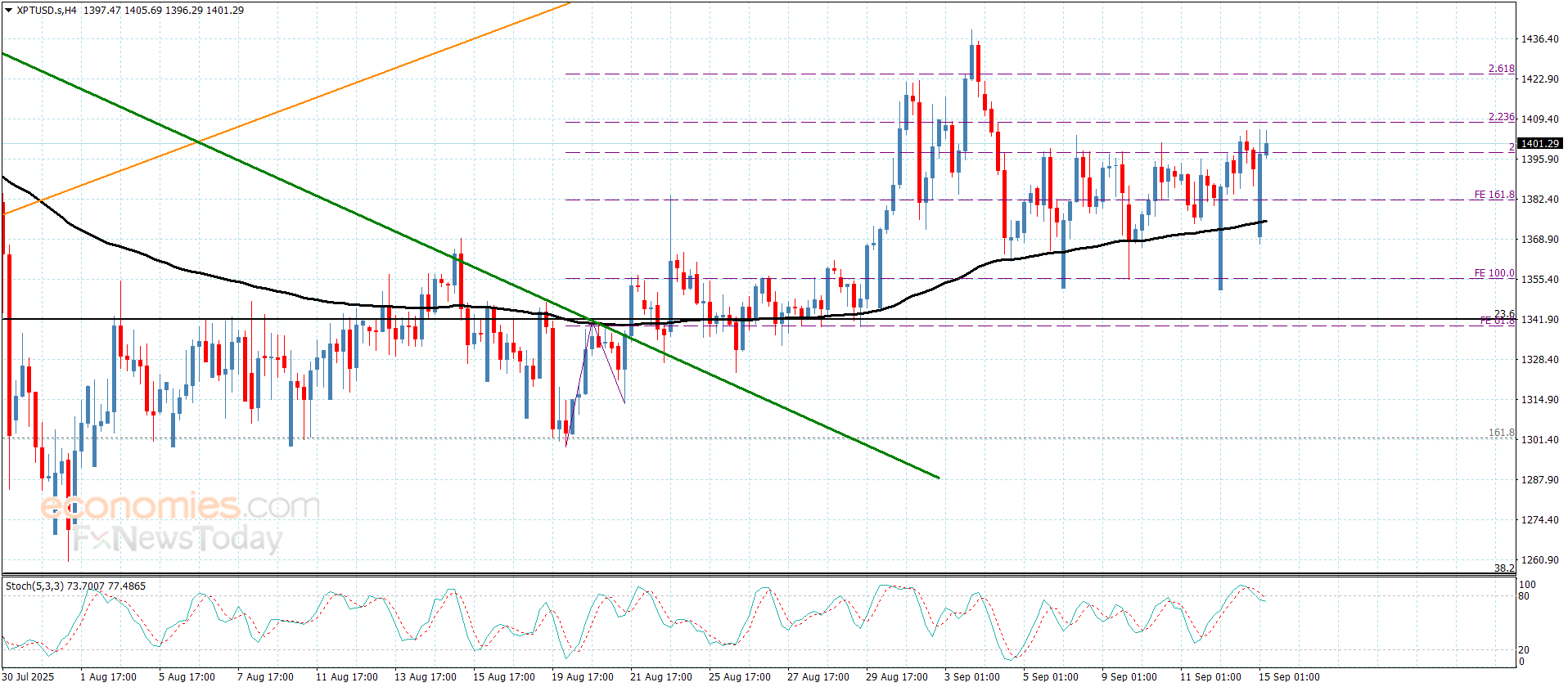
Platinum price confirmed the stability of the bullish track by its rally above the initial barrier at $1400.00, attempting to face stochastic attempt to exit the overbought level, attempting to target more of the positive stations, to expect its rally to $1412.00, then repeat the pressure on 2.618%Fibonacci extension level near $1435.00.
The risk of delaying the rise and activating the bearish correctional track is represented by the stability of the price below $1382.00, to attack the moving average 55 reaching the extra support near $1355.00.
The expected trading range for today is between $1390.00 and$1412.00.
Trend forecast: Bullish
The Gold price (XAU/USD) edges higher to near $3,640 during the early Asian session on Monday. The yellow metal gains traction as a weakening US labor market reinforces expectations that the Federal Reserve (Fed) will deliver its first rate cut of the year this week.
The US central bank is anticipated to deliver a quarter-point rate cut at its September meeting on Wednesday, with a small potential for a 50 basis points (bps) move amid signs US job growth is slowing rapidly.
Markets have also priced in rate reductions continuing deep into 2026 to ward off a recession. Lower interest rates could reduce the opportunity cost of holding Gold, supporting the non-yielding precious metal.
“Weaker employment and spotty inflation… priced in with the Fed having to cut rates is pushing metals higher because there is the risk of longer-term inflation,” said Daniel Pavilonis, senior market strategist at RJO Futures.
US and Chinese representatives, helmed by US Treasury Secretary Scott Bessent and Trade Representative Jamieson Greer and a Chinese official led by Vice Premier He Lifeng, discussed trade and the economy during high-level talks in Madrid. Traders will closely monitor the developments surrounding the US-China talks as the meeting heads into the second day. Any signs of easing trade tensions between the world’s two biggest economies could boost the risk sentiment, weighing on the safe-haven asset like Gold.
Gold has played a key role in human’s history as it has been widely used as a store of value and medium of exchange. Currently, apart from its shine and usage for jewelry, the precious metal is widely seen as a safe-haven asset, meaning that it is considered a good investment during turbulent times. Gold is also widely seen as a hedge against inflation and against depreciating currencies as it doesn’t rely on any specific issuer or government.
Central banks are the biggest Gold holders. In their aim to support their currencies in turbulent times, central banks tend to diversify their reserves and buy Gold to improve the perceived strength of the economy and the currency. High Gold reserves can be a source of trust for a country’s solvency. Central banks added 1,136 tonnes of Gold worth around $70 billion to their reserves in 2022, according to data from the World Gold Council. This is the highest yearly purchase since records began. Central banks from emerging economies such as China, India and Turkey are quickly increasing their Gold reserves.
Gold has an inverse correlation with the US Dollar and US Treasuries, which are both major reserve and safe-haven assets. When the Dollar depreciates, Gold tends to rise, enabling investors and central banks to diversify their assets in turbulent times. Gold is also inversely correlated with risk assets. A rally in the stock market tends to weaken Gold price, while sell-offs in riskier markets tend to favor the precious metal.
The price can move due to a wide range of factors. Geopolitical instability or fears of a deep recession can quickly make Gold price escalate due to its safe-haven status. As a yield-less asset, Gold tends to rise with lower interest rates, while higher cost of money usually weighs down on the yellow metal. Still, most moves depend on how the US Dollar (USD) behaves as the asset is priced in dollars (XAU/USD). A strong Dollar tends to keep the price of Gold controlled, whereas a weaker Dollar is likely to push Gold prices up.
Natural Gas futures (NG=F) entered mid-September under mixed pressures. On Friday, October contracts closed at $2.96 per MMBtu, up 0.24% from the prior session after forecasts pointed to hotter weather across the southern U.S. between September 17–21, spurring expectations of higher demand from power generators. That bounce came after a 1.5-week low earlier in the week, when the EIA reported a storage injection of +71 bcf, above consensus at +68 bcf and well above the five-year average of +56 bcf. Inventories now sit +6% above the five-year seasonal norm and only 1.3% lower year over year, signaling ample supply. Europe also sits comfortably at 80% storage levels against a historical 86%, another cap on price strength.
Dry gas production in the lower-48 reached 108 bcf/day, up 7.1% year on year and near record highs. The EIA revised its 2025 production forecast to 106.63 bcf/day, up from 106.40 in August. Rig counts touched a two-year high, underscoring the supply overhang. U.S. LNG exports remain solid but dipped slightly with net flows at 14.5 bcf/day, down 4.7% week over week due to pipeline maintenance. EQT, the Appalachian Basin’s largest producer, is attempting to bypass traditional middlemen by signing contracts to buy LNG from Gulf Coast terminals and sell directly to Europe and Asia. These volumes, totaling 4.5 million tons annually, amount to 5% of U.S. exports. While U.S. benchmark gas is priced around $3 per MMBtu, European and Asian buyers continue paying $11+, creating a wide arbitrage. EQT’s move raises competition against majors like Shell (SHEL), BP (BP), and ConocoPhillips (COP), but also underscores a structural push by U.S. producers to capture margin beyond Henry Hub pricing.
In Turkey’s spot market, 1,000 cubic meters of natural gas traded at 14,332 lira on Sept. 13, equal to $346 at prevailing FX rates. Spot trade volumes fell 18.7% to 11.68 million lira, with 816,000 cubic meters transacted. Meanwhile, pipeline deliveries into Turkey remained strong at 122 million cubic meters. Globally, LNG deals are expanding, with Turkey securing 15 bcm over three years through new contracts signed at Gastech 2025. These long-term arrangements highlight strong international demand even as regional spot markets soften.
Puerto Rico’s Fiscal Oversight Board is finalizing a 15-year, $20 billion LNG supply contract with New Fortress Energy (NFE) despite the company’s financial struggles, including a $557 million Q2 loss and a stock price collapse to $1.31 from $35.58 in 2024. NFE controls the San Juan dock, the island’s sole LNG gateway until 2038, giving it leverage despite balance-sheet distress. The deal reflects how infrastructure bottlenecks can sustain high-cost suppliers even in weak financial health, with direct implications for regional LNG pricing and reliability.
Egypt’s Ministry of Petroleum reported higher production rates as new seismic surveys and foreign partnerships accelerate. Floating storage and regasification units (FSRUs) have stabilized summer demand without load shedding. Egypt also aims to leverage its 3 trillion cubic feet reserves and petrochemical sector to secure export commitments. The government signed new exploration agreements, with international majors like TotalEnergies and ADNOC signaling interest. This positions Egypt as a regional hub, further shaping supply flows into Europe and Asia.
A new driver of domestic gas consumption is emerging from the AI boom. Data centers consumed 4.4% of total U.S. electricity in 2023, projected to rise to between 6.7% and 12% by 2028. Facilities under construction, some drawing power equivalent to 176,000 homes, are cementing natural gas as a backstop fuel as renewables struggle to scale at the pace of demand. Utilities have doubled natural gas capacity plans in just 18 months, adding 52 GW of new gas builds, while delays in connecting solar and wind projects—now averaging five years—leave fossil fuels dominant. Utilities favor gas plants because regulatory processes let them pass fuel costs to consumers directly, creating long-term reliance despite climate mandates.
Short-term demand is highly weather dependent. The warmer forecast through late September supports NG=F near $3.00, but bearish risks remain from production oversupply and above-average storage. European storage comfort adds downward pressure, with winter risk premium not yet built into pricing. If U.S. demand spikes from heat waves or if LNG flows recover post-maintenance, upside could test $3.20–$3.30 resistance. On the downside, sustained injections above 70 bcf per week could drag futures back toward $2.75–$2.80 support.
Natural Gas presents a complex mix of bullish catalysts—weather, LNG arbitrage, and data-center electricity demand—against heavy bearish forces from record production, high storage, and structural oversupply risks into 2027. EQT’s direct-to-Europe strategy shows producers’ push for margin capture but also highlights growing competition with supermajors. NFE’s contract saga underscores geopolitical supply chokepoints. With NG=F holding just below $3.00, the market is balanced but vulnerable to storage builds and production growth. Based on current fundamentals, the outlook leans Neutral to Bearish, and the call is Hold, with tactical trading opportunities on weather-driven spikes but limited sustained upside until winter heating demand tightens balances.