The main tag of GoldPrice Articles.
You can use the search box below to find what you need.
[wd_asp id=1]
The main tag of GoldPrice Articles.
You can use the search box below to find what you need.
[wd_asp id=1]
Spot Gold kept rallying into unexplored territory on Monday, briefly surpassing the $5,100 threshold before pulling back some. The XAU/USD pair is comfortable around $5,090 at the time of writing, paring gains amid the good performance of Wall Street.
The US Dollar (USD) collapsed at the weekly opening on headlines indicating that the United States (US) Federal Reserve (Fed) was asking New York banks about the USD/JPY’s exchange rate. Financial markets understood such an action as a first step into a US-Japan intervention of the Japanese Yen (JPY). The pair plummeted and resulted in a widespread USD sell-off, with the battered American currency also affected by persistent geopolitical drama and uncertainty.
On the one hand, market participants await the US President Donald Trump’s nominee to run the Fed once Jerome Powell’s mandate finalizes in May. Given that the Fed is scheduled to announce its decision on monetary policy next Wednesday, investors lifted bets on a soon-to-come announcement from President Trump to overshadow the Fed’s announcement, largely expected to be no changes to the current interest rate.
On the other hand, tensions between the US and Europe remain the same, despite Trump announcing the framework of a deal over Greenland. The EU has paused the approval of a trade deal with the US, and there has been mounting speculation that the Old Continent can use its Anti-Coercion Instrument (ACI), a mechanism that enables restrictions on the physical imports and exports of goods across EU borders, which could even be extended to services. Additionally, the EU holds about $8 trillion of US Treasury bonds, which can be used as leverage against Trump threats.
In an uncertain world, buying Gold is the number one defense.
In the 4-hour chart, XAU/USD is poised to extend its advance. The 20-period Simple Moving Average (SMA) rises above the 100 and 200 SMAs, with all three trending higher, underscoring the positive bias. The 20 SMA at $4,949.47 offers dynamic support. At the same time, the Momentum indicator holds above its midline but has lost strength, while the Relative Strength Index (RSI) indicator has flattened around 81. Extreme near-term overbought conditions are likely to be ignored by market players, with another leg north likely after a period of consolidation.
In the daily chart, XAU/USD is up for a sixth consecutive day. From a technical perspective, the risk skews to the upside, as technical indicators advance far above their midlines, without signs of upward exhaustion. At the same time, the 20-day SMA heads north almost vertically, far above the 100- and 200-day SMA, while way below the current level.
(The technical analysis of this story was written with the help of an AI tool.)
Important DisclaimersFXEmpire is owned and operated by Empire Media Network LTD., Company Registration Number 514641786, registered at 7 Jabotinsky Road, Ramat Gan 5252007, Israel. The content provided on this website includes general news and publications, our personal analysis and opinions, and materials provided by third parties. This content is intended for educational and research purposes only. It does not constitute, and should not be interpreted as, a recommendation or advice to take any action, including making any investment or purchasing any product. Before making any financial decision, you should conduct your own due diligence, exercise your own discretion, and consult with competent advisors. The content on this website is not personally directed to you, and we do not take into account your individual financial situation or needs. The information contained on this website is not necessarily provided in real time, nor is it guaranteed to be accurate. Prices displayed may be provided by market makers and not by exchanges. Any trading or other financial decision you make is entirely your own responsibility, and you must not rely solely on any information provided through the website. FXEmpire does not provide any warranty regarding the accuracy, completeness, or reliability of any information contained on the website and shall bear no responsibility for any trading losses you may incur as a result of using such information. The website may include advertisements and other promotional content. FXEmpire may receive compensation from third parties in connection with such content. FXEmpire does not endorse, recommend, or assume responsibility for the use of any third-party services or websites. Empire Media Network LTD., its employees, officers, subsidiaries, and affiliates shall not be liable for any loss or damage resulting from your use of the website or reliance on the information provided herein.Risk DisclaimersThis website contains information about cryptocurrencies, contracts for difference (CFDs), and other financial instruments, as well as about brokers, exchanges, and other entities trading in such instruments. Both cryptocurrencies and CFDs are complex instruments and involve a high risk of losing money. You should carefully consider whether you understand how these instruments work and whether you can afford to take the high risk of losing your money. FX Empire encourages you to conduct your own research before making any investment decision and to avoid investing in any financial instrument unless you fully understand how it works and the risks involved.
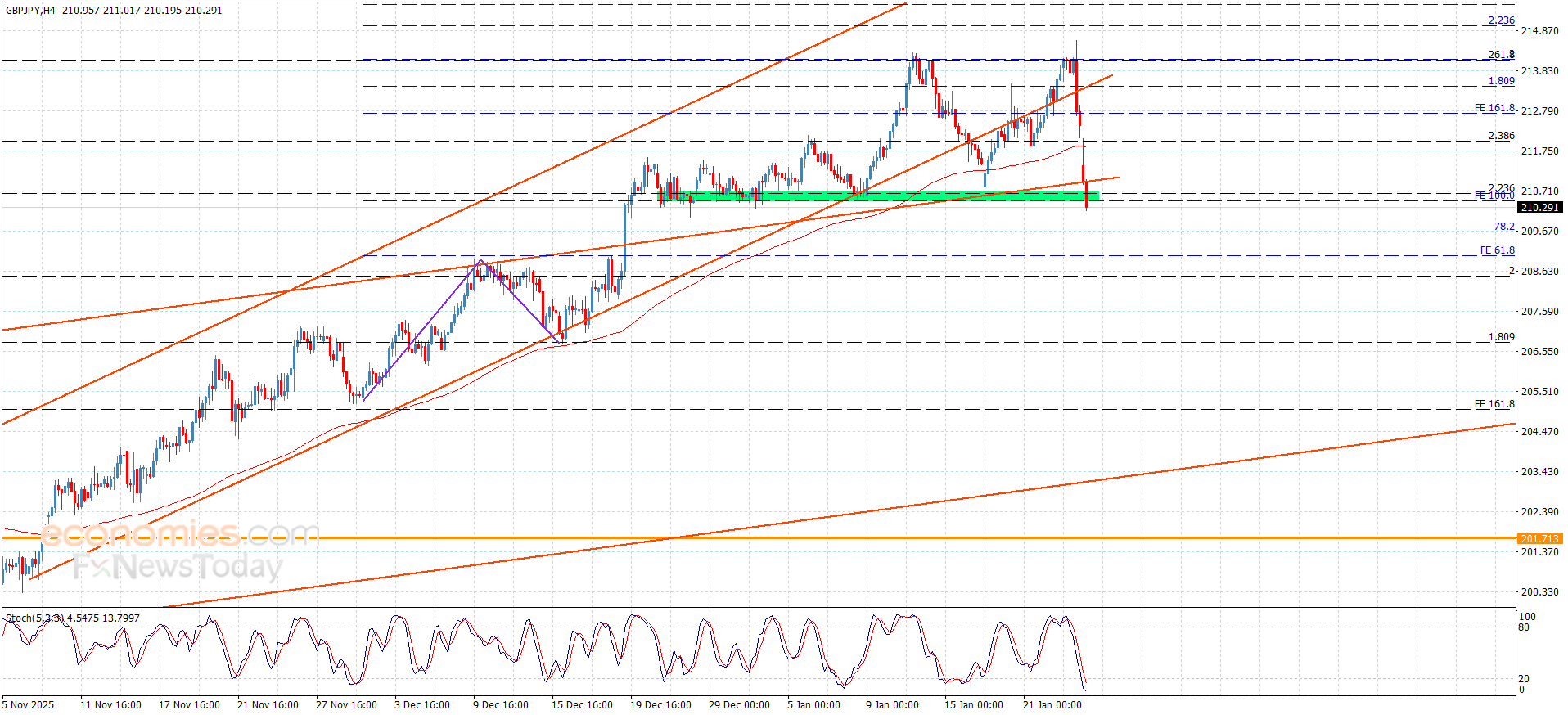
The GBPJPY pair approached from the main target at 215.00 level, forming strong barrier against the attempt of resuming the bullish attack, to force it form strong corrective decline, to resume forming bearish price gap this morning, to settle below the bullish channel’s support at 210.95 level.
The stability below the broken support and providing bearish momentum by the main indicators will confirm the dominance of the bearish bias, to expect suffering extra losses by reaching 209.65 followed by %200 Fibonacci extension level at 208.50.
The expected trading range for today is between 209.65 and 210.80
Trend forecast: Bearish by the stability of 211.00
Silver (XAG/USD) prolongs its recent well-established uptrend and continues scaling new all-time peaks for the third straight day, rising to the 109.45 region on Monday. The white metal sticks to bullish bias through the early European session and currently trades around mid-$108.00s, up nearly 6% for the day.
Last week’s breakout through the $96.00 horizontal barrier and a subsequent move beyond the $100 psychological mark were seen as key triggers for the XAG/USD bulls. Moreover, the ascending channel from $70.60 supports the uptrend, and the upper boundary at $107.13 has been breached, signaling an extension of the advance.
The Moving Average Convergence Divergence (MACD) line extends above the Signal line and holds in positive territory, and the widening histogram suggests strengthening bullish momentum. Sustained action above the former channel cap would keep buyers in control, suggesting that the path of least resistance for the XAG/USD is to the upside.
The Relative Strength Index at 83.57 is overbought and still rising, which warns of stretched conditions even as the broader tone stays firm. If momentum cools, pullbacks could find support toward the ascending channel floor near $95.26, while a series of higher lows would preserve the bullish structure and keep the focus on the upside.
(The technical analysis of this story was written with the help of an AI tool.)
Silver is a precious metal highly traded among investors. It has been historically used as a store of value and a medium of exchange. Although less popular than Gold, traders may turn to Silver to diversify their investment portfolio, for its intrinsic value or as a potential hedge during high-inflation periods. Investors can buy physical Silver, in coins or in bars, or trade it through vehicles such as Exchange Traded Funds, which track its price on international markets.
Silver prices can move due to a wide range of factors. Geopolitical instability or fears of a deep recession can make Silver price escalate due to its safe-haven status, although to a lesser extent than Gold’s. As a yieldless asset, Silver tends to rise with lower interest rates. Its moves also depend on how the US Dollar (USD) behaves as the asset is priced in dollars (XAG/USD). A strong Dollar tends to keep the price of Silver at bay, whereas a weaker Dollar is likely to propel prices up. Other factors such as investment demand, mining supply – Silver is much more abundant than Gold – and recycling rates can also affect prices.
Silver is widely used in industry, particularly in sectors such as electronics or solar energy, as it has one of the highest electric conductivity of all metals – more than Copper and Gold. A surge in demand can increase prices, while a decline tends to lower them. Dynamics in the US, Chinese and Indian economies can also contribute to price swings: for the US and particularly China, their big industrial sectors use Silver in various processes; in India, consumers’ demand for the precious metal for jewellery also plays a key role in setting prices.
Silver prices tend to follow Gold’s moves. When Gold prices rise, Silver typically follows suit, as their status as safe-haven assets is similar. The Gold/Silver ratio, which shows the number of ounces of Silver needed to equal the value of one ounce of Gold, may help to determine the relative valuation between both metals. Some investors may consider a high ratio as an indicator that Silver is undervalued, or Gold is overvalued. On the contrary, a low ratio might suggest that Gold is undervalued relative to Silver.
Gold price (XAU/USD) rises to a fresh record high near $5,045 during the early Asian session on Monday. The precious metal extends its upside amid geopolitical risks and concerns over the US Federal Reserve (Fed).
The first three-way peace talks between Russia, Ukraine, and the US have concluded in Abu Dhabi with no apparent breakthrough, as fighting continues, according to the BBC. Ukrainian President Volodymyr Zelensky proposed a second meeting as early as next week, while a US official said that a fresh round will begin on February 1.
The ongoing conflict between Russia and Ukraine, along with military intervention in Venezuela and threats to annex Greenland, has boosted traditional safe-haven assets such as Gold.
Traders await US President Donald Trump’s pick for the next Fed Chair after Trump said he has finished interviewing candidates. A more dovish chair would increase bets on further interest-rate cuts this year, which could underpin the Gold price. Lower interest rates could reduce the opportunity cost of holding Gold, supporting the non-yielding precious metal.
Gold has played a key role in human’s history as it has been widely used as a store of value and medium of exchange. Currently, apart from its shine and usage for jewelry, the precious metal is widely seen as a safe-haven asset, meaning that it is considered a good investment during turbulent times. Gold is also widely seen as a hedge against inflation and against depreciating currencies as it doesn’t rely on any specific issuer or government.
Central banks are the biggest Gold holders. In their aim to support their currencies in turbulent times, central banks tend to diversify their reserves and buy Gold to improve the perceived strength of the economy and the currency. High Gold reserves can be a source of trust for a country’s solvency. Central banks added 1,136 tonnes of Gold worth around $70 billion to their reserves in 2022, according to data from the World Gold Council. This is the highest yearly purchase since records began. Central banks from emerging economies such as China, India and Turkey are quickly increasing their Gold reserves.
Gold has an inverse correlation with the US Dollar and US Treasuries, which are both major reserve and safe-haven assets. When the Dollar depreciates, Gold tends to rise, enabling investors and central banks to diversify their assets in turbulent times. Gold is also inversely correlated with risk assets. A rally in the stock market tends to weaken Gold price, while sell-offs in riskier markets tend to favor the precious metal.
The price can move due to a wide range of factors. Geopolitical instability or fears of a deep recession can quickly make Gold price escalate due to its safe-haven status. As a yield-less asset, Gold tends to rise with lower interest rates, while higher cost of money usually weighs down on the yellow metal. Still, most moves depend on how the US Dollar (USD) behaves as the asset is priced in dollars (XAU/USD). A strong Dollar tends to keep the price of Gold controlled, whereas a weaker Dollar is likely to push Gold prices up.
The GBPJPY pair benefited from its stability within the bullish channel’s levels, forming strong bullish rally, achieving the waited target at 214.10, approaching the last peak at 214.30.
Despite the continuation of providing bullish momentum by the main indicators, waiting for surpassing the current peak and providing positive close is important to confirm moving to a new bullish station, to target 215.00 and 215.55.
The expected trading range for today is between 213.45 and 215.00
Trend forecast: Bullish
Silver (XAG/USD) hit a fresh all-time high at $99.39 earlier on Friday, before pulling back to levels around $98.25 at the time of writing. The precious metal has met resistance right ahead of the 100.00 psychological level, yet with downside attempts limited amid US Dollar’s (USD) weakness.
The US Dollar Index is on track for its worst weekly performance since June, as Trump’s obsession with Greenland boosted tensions with the US’s main trading partner, eroding the image of the US as a global leader as well as the status of the USD and a reserve currency.
XAG/USD maintains its bullish tone intact with technical indicators pointing higher. The Moving Average Convergence Divergence (MACD) line stands above zero and has extended higher, suggesting strengthening bullish momentum, while the Relative Strength Index (RSI) remains at levels consistent with a firm bullish trend.
The pair found sellers at the 127.2% Fiboinacci extension of the January 8-12 rally, at the 99.50 area, which, together with the mentioned $100.00 level, is likely challenge bulls. Further up, the target is the 161.8% extension of the same range, at 106.38.
On the downside, immediate support is seen at the previous record high of $95.90, ahead of the 100-period SMA, now art $92.60, and the January 21 low, at $90.40.
(The technical analysis of this story was written with the help of an AI tool.)
Silver is a precious metal highly traded among investors. It has been historically used as a store of value and a medium of exchange. Although less popular than Gold, traders may turn to Silver to diversify their investment portfolio, for its intrinsic value or as a potential hedge during high-inflation periods. Investors can buy physical Silver, in coins or in bars, or trade it through vehicles such as Exchange Traded Funds, which track its price on international markets.
Silver prices can move due to a wide range of factors. Geopolitical instability or fears of a deep recession can make Silver price escalate due to its safe-haven status, although to a lesser extent than Gold’s. As a yieldless asset, Silver tends to rise with lower interest rates. Its moves also depend on how the US Dollar (USD) behaves as the asset is priced in dollars (XAG/USD). A strong Dollar tends to keep the price of Silver at bay, whereas a weaker Dollar is likely to propel prices up. Other factors such as investment demand, mining supply – Silver is much more abundant than Gold – and recycling rates can also affect prices.
Silver is widely used in industry, particularly in sectors such as electronics or solar energy, as it has one of the highest electric conductivity of all metals – more than Copper and Gold. A surge in demand can increase prices, while a decline tends to lower them. Dynamics in the US, Chinese and Indian economies can also contribute to price swings: for the US and particularly China, their big industrial sectors use Silver in various processes; in India, consumers’ demand for the precious metal for jewellery also plays a key role in setting prices.
Silver prices tend to follow Gold’s moves. When Gold prices rise, Silver typically follows suit, as their status as safe-haven assets is similar. The Gold/Silver ratio, which shows the number of ounces of Silver needed to equal the value of one ounce of Gold, may help to determine the relative valuation between both metals. Some investors may consider a high ratio as an indicator that Silver is undervalued, or Gold is overvalued. On the contrary, a low ratio might suggest that Gold is undervalued relative to Silver.
The CHFJPY succeeded in resuming the bullish trend, taking advantage of its repeated stability within the bullish channel’s levels that appears in the above image, to surpass 198.80 then targeting new historical stations by reaching 200.90 directly.
The continuation of providing bullish momentum will provide a chance for resuming the bullish attack in the near period, to expect reaching 202.15 level to form initial extra target in the current trading, where surpassing it will push the price to reach the bullish channel’s resistance at 206.65.
The expected trading range for today is between 199.35 and 2202.15
Trend forecast: Bullish
One key driver of the commodity’s price is likely to be a mid-year decision from the US administration on refined copper tariffs, writes Goldman Sachs Research analyst Eoin Dinsmore. Buyers have been stockpiling copper in the US in advance of the expected import tax, creating expectations of temporary scarcity outside of the US.
“We do not expect the price above $13,000 to be sustained,” Dinsmore writes.
Why have copper prices risen so fast?
Goldman Sachs Research cites three themes as contributing to the recent run-up in prices. For one, copper buyers significantly increased their requests in December to take metal from LME warehouses, confirming the tightness in markets outside the US. The second theme was the anticipation of strong artificial intelligence (AI)-related demand from the construction of data centers, which use copper in cooling and power distribution.
There was also a narrative in markets that US policymaking for the economy was meant to “run it hot,” as copper and riskier assets rallied in the new year. While Goldman Sachs Research expects growth in consumption of US semi-finished copper products, our analysts don’t anticipate this to have a material impact on global demand growth since the US only accounts for 7% of the market.
How copper could be impacted by tariff uncertainty
Goldman Sachs Research’s copper forecast is based on the expectation that the Trump administration will announce a 15% tariff on refined copper by mid-2026. But there’s uncertainty around that outcome as affordability remains a key focus in the lead up to US mid-term elections which could cause the tariff decision to be delayed.
For now, uncertainty surrounding the US refined copper tariff is supporting the LME copper price as US stockpiles of the metals continue to rise. Goldman Sachs Research expects this to result in a decline in stocks elsewhere in 2026, therefore keeping a floor under prices over the coming months. A definitive tariff decision in mid-2026 should signal the end of US stockpiling, allowing the price to move lower.
But if the tariff announcement itself is delayed until 2027, that could be bearish for copper prices as the probability of a tariff reduces and focus shifts back to the well-supplied global market. The recent Critical Minerals Section 232 decision suggests that the Trump Administration is no longer solely relying on tariffs to enhance US security of supply in metals.
In the short term, the speculative peak in copper prices could still be ahead. Speculative positioning in the futures market is already at a record high, but the level of long positions as a share of total open interest on the Chicago Mercantile Exchange is not as extreme as prior speculative peaks.
“We are very likely in the late stages of this rally, but US economic growth, AI spending, and US stockpiling will likely remain supportive in the coming months,” Dinsmore writes.
The global copper surplus
Once the tariff uncertainty has passed, investors are likely to focus once again on the market’s underlying fundamentals, including a large overhang of global supply. The global copper market recorded a 600 kilotonne (kt) surplus in 2025, the largest absolute surplus since 2009, and inventory outside of the US is now rising, despite continued US stockpiling.
High prices are likely to dampen demand growth and lift scrap supply this year, and this expectation leads our researchers to boost their global surplus forecast for 2026 to 300 kt from a previous outlook for 160 kt.
They note that China’s consumption of refined copper has weakened materially, and that the pullback in Chinese demand is more acute than in 2024, when a “China buyers strike” ended the rally that year. They also reduced their forecast for US stockpiling in 2026 from 750 kt to 600 kt due to less attractive import arbitrage opportunities.
On a fundamental basis, Goldman Sachs Research estimates that copper’s fair price is around $11,500 per tonne, close to their price forecast of $11,200 per tonne for the fourth quarter of 2026.
“We feel that the price has overshot its fair fundamental level,” Dinsmore concludes. A clear decision on US refined copper tariffs should serve as a “catalyst for a correction.”
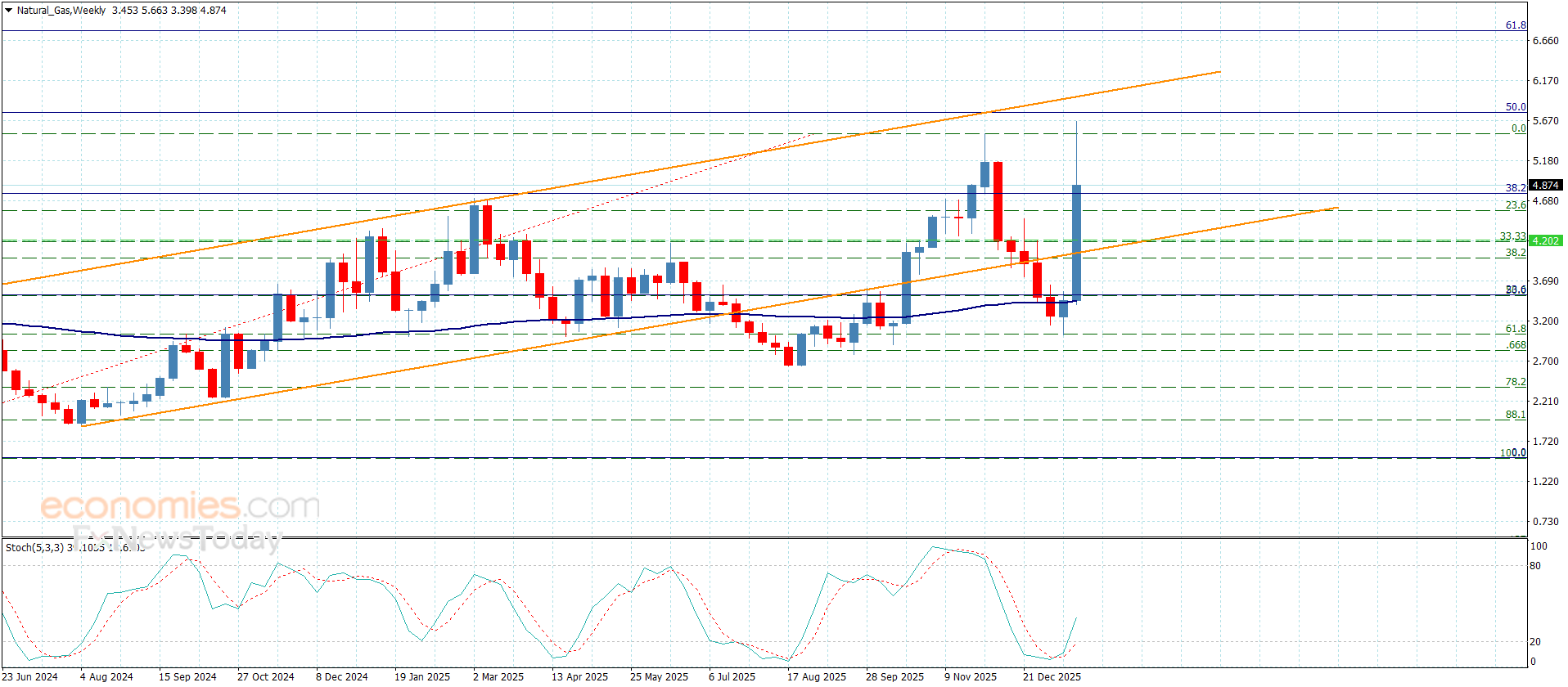
Natural gas price continued forming strong bullish waves since yesterday, to notice achieving the suggested targets by reaching $4.00 level, to reach the support of the broken bullish channel’s support, which represents a key resistance.
Noticing that stochastic begins to exit the oversold level, attempting to provide a new bullish momentum, to increase the chances of surpassing the current resistance, and its stability above this level will confirm its readiness to record new gains by its rally towards $4.185, while the failure to breach it will support the dominance of the sideways bias in the current trading, and there is a chance to retest $3.620 level before reaching extra bullish target.
The expected trading range for today is between $3.780 and $4.185
Trend forecast: Bullish