The main tag of GoldPrice Articles.
You can use the search box below to find what you need.
[wd_asp id=1]
The main tag of GoldPrice Articles.
You can use the search box below to find what you need.
[wd_asp id=1]
Gold’s (XAU/USD) is trading at $4,915 at the time of writing, practically flat on the daily chart following a 4-day rally that brought price action to a fresh all-time high of $4,967. The precious metal, however, maintains its broad bullish tone intact, on track for a 6.5% weekly gain.
Precious metals remain underpinned by a weak US Dollar, as the deterioration of the US-EU relationship amid the Greenland feud has eroded the US’s image as a global leader, triggering a “Sell America” trade. Trump eased the tone toward Europe at the Davos Forum and touted an agreement with NATO on the Arctic Island, but restoring the confidence of the US’s main trade partner will be difficult.
XAU/USD has pulled back from its highs but remains above previous highs, at the $4,880 area. Technical indicators are turning lower, yet still at levels consistent with bullish momentum, with the 100-period Simple Moving Average (SMA) rising steadily, with price holding well above it.
The Moving Average Convergence Divergence (MACD) histogram in the 4-hour chart remains positive despite a moderate contraction. The Relative Strength Index (RSI) eases, pulling back from overbought levels, all in all pointing to a healthy correction following the recent sharp rally.
Bulls have been halted at the 127.2% Fiboonacci expansion of the January 16-21 rally, at the $4,970 area, ahead of the $5,000 psychological level, which is likely to challenge the strength of the current rally. On the downside, immediate support is the previous record high, at $4,888, ahead of the January 21 low of $4,775.
(The technical analysis of this story was written with the help of an AI tool.)
The table below shows the percentage change of US Dollar (USD) against listed major currencies this week. US Dollar was the strongest against the Japanese Yen.
| USD | EUR | GBP | JPY | CAD | AUD | NZD | CHF | |
|---|---|---|---|---|---|---|---|---|
| USD | -1.31% | -1.29% | 0.28% | -0.94% | -2.64% | -2.78% | -1.29% | |
| EUR | 1.31% | 0.02% | 1.60% | 0.37% | -1.35% | -1.49% | 0.02% | |
| GBP | 1.29% | -0.02% | 1.35% | 0.36% | -1.37% | -1.51% | 0.00% | |
| JPY | -0.28% | -1.60% | -1.35% | -1.20% | -2.89% | -3.02% | -1.54% | |
| CAD | 0.94% | -0.37% | -0.36% | 1.20% | -1.69% | -1.84% | -0.35% | |
| AUD | 2.64% | 1.35% | 1.37% | 2.89% | 1.69% | -0.14% | 1.39% | |
| NZD | 2.78% | 1.49% | 1.51% | 3.02% | 1.84% | 0.14% | 1.54% | |
| CHF | 1.29% | -0.02% | -0.01% | 1.54% | 0.35% | -1.39% | -1.54% |
The heat map shows percentage changes of major currencies against each other. The base currency is picked from the left column, while the quote currency is picked from the top row. For example, if you pick the US Dollar from the left column and move along the horizontal line to the Japanese Yen, the percentage change displayed in the box will represent USD (base)/JPY (quote).
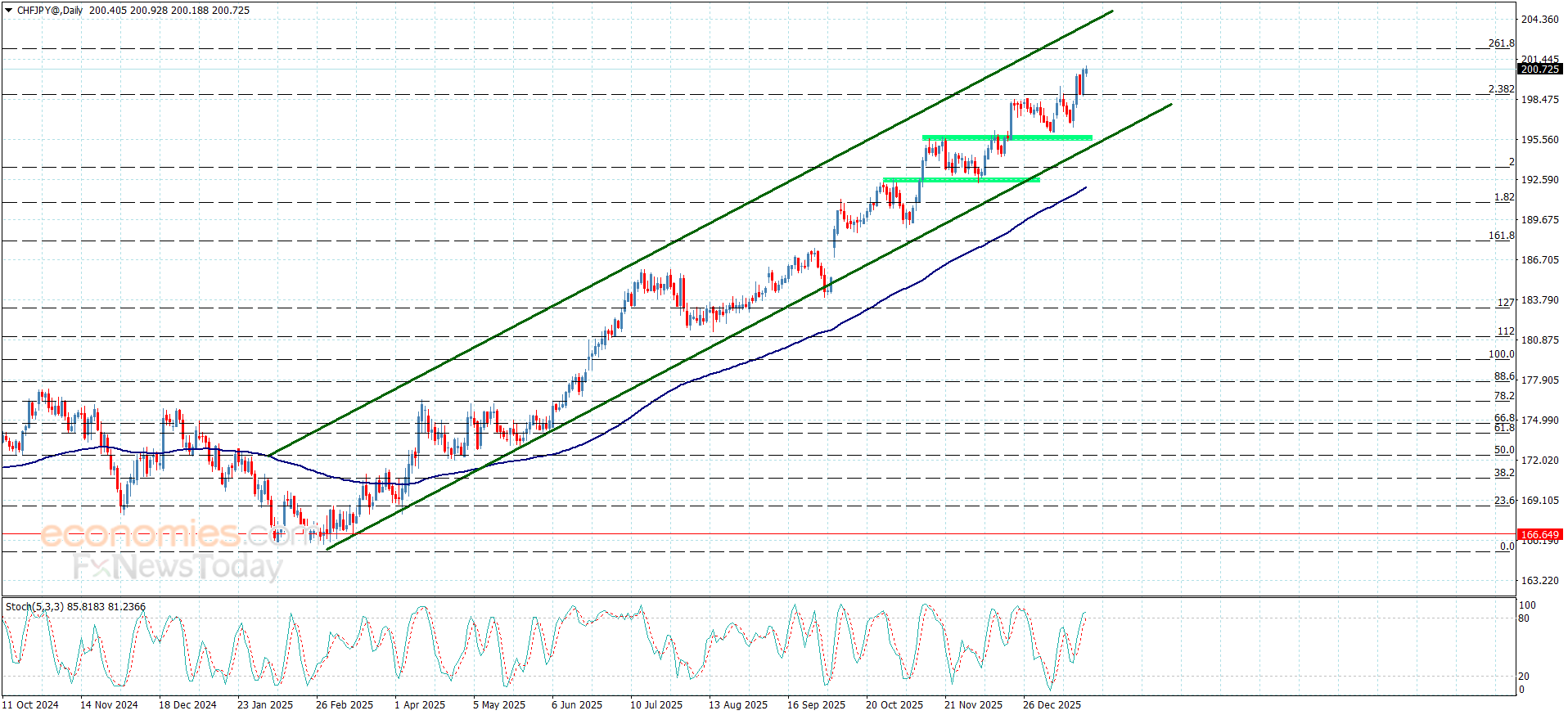
The CHFJPY succeeded in resuming the bullish trend, taking advantage of its repeated stability within the bullish channel’s levels that appears in the above image, to surpass 198.80 then targeting new historical stations by reaching 200.90 directly.
The continuation of providing bullish momentum will provide a chance for resuming the bullish attack in the near period, to expect reaching 202.15 level to form initial extra target in the current trading, where surpassing it will push the price to reach the bullish channel’s resistance at 206.65.
The expected trading range for today is between 199.35 and 2202.15
Trend forecast: Bullish
Silver price (XAG/USD) extends its gains for the second successive session, trading around $99.10 per troy ounce during the Asian hours on Friday. The XAG/USD pair hit a fresh high of $99.39 amid persistent bullish bias, indicated by the technical analysis of the daily chart timeframe, as the price of the precious metal rises to near the upper boundary of the ascending channel pattern.
Silver price holds above the rising nine-day EMA, while the 50-day EMA continues to advance and underpins the medium-term trend. Trend strength is confirmed by the widening gap between the 9-day EMA and 50-day EMA, keeping bulls in control.
The 14-day Relative Strength Index (RSI) at 74.66 (overbought) flags stretched momentum that could precede consolidation. Overbought conditions could trigger a pause, but the uptrend remains intact while above the short-term average. A defended dip would keep the topside bias intact and open scope for extension above the upper ascending channel boundary around $99.80, followed by the psychological level of $100.00.
Should price pull back, initial demand could emerge near the nine-day EMA at $92.42. A daily close below the short-term average would risk a correction toward the lower boundary of the ascending channel around $82.00. Further declines would put downward pressure on the Silver price to navigate the region around the 50-day EMA at $73.14.
(The technical analysis of this story was written with the help of an AI tool.)
Silver is a precious metal highly traded among investors. It has been historically used as a store of value and a medium of exchange. Although less popular than Gold, traders may turn to Silver to diversify their investment portfolio, for its intrinsic value or as a potential hedge during high-inflation periods. Investors can buy physical Silver, in coins or in bars, or trade it through vehicles such as Exchange Traded Funds, which track its price on international markets.
Silver prices can move due to a wide range of factors. Geopolitical instability or fears of a deep recession can make Silver price escalate due to its safe-haven status, although to a lesser extent than Gold’s. As a yieldless asset, Silver tends to rise with lower interest rates. Its moves also depend on how the US Dollar (USD) behaves as the asset is priced in dollars (XAG/USD). A strong Dollar tends to keep the price of Silver at bay, whereas a weaker Dollar is likely to propel prices up. Other factors such as investment demand, mining supply – Silver is much more abundant than Gold – and recycling rates can also affect prices.
Silver is widely used in industry, particularly in sectors such as electronics or solar energy, as it has one of the highest electric conductivity of all metals – more than Copper and Gold. A surge in demand can increase prices, while a decline tends to lower them. Dynamics in the US, Chinese and Indian economies can also contribute to price swings: for the US and particularly China, their big industrial sectors use Silver in various processes; in India, consumers’ demand for the precious metal for jewellery also plays a key role in setting prices.
Silver prices tend to follow Gold’s moves. When Gold prices rise, Silver typically follows suit, as their status as safe-haven assets is similar. The Gold/Silver ratio, which shows the number of ounces of Silver needed to equal the value of one ounce of Gold, may help to determine the relative valuation between both metals. Some investors may consider a high ratio as an indicator that Silver is undervalued, or Gold is overvalued. On the contrary, a low ratio might suggest that Gold is undervalued relative to Silver.
On January 20, 2026, crude oil trades nervously as WTI and Brent react to fresh geopolitical tensions and supply signals, sharpening Crude Oil Price Risk.
In early European and US trading, major benchmarks are oscillating rather than trending, with WTI and Brent both struggling to hold clear direction. This choppy tape means that a trader who is “right” on the bigger picture can still be forced out by intraday volatility if position size and margin are not handled with extreme discipline.
For risk-takers: Trade Oil volatility now
Todays oil market tone is being driven primarily by fresh news flow around supply expectations and geopolitical risk. Market participants are dissecting the latest indications from OPEC+ members about their production discipline and output plans, while also watching for any surprise commentary that could shift the balance between tightness and surplus in the months ahead. Even when there is no formal OPEC+ meeting, off-the-cuff remarks from key producers can move prices quickly as algorithms instantly re-price forward supply curves.
At the same time, traders are bracing for the next round of US inventory data, particularly crude and gasoline stockpile figures. Recent weeks have shown that surprise builds can rapidly cap rallies, while unexpected draws reignite fears of undersupply. That dynamic is visible again today in options pricing and intraday spreads: the market is clearly positioned for volatility around the next inventory release, and that uncertainty is feeding directly into intraday swings in both WTI and Brent.
Layered on top are ongoing geopolitical tensions in key producing and transit regions. Even without a fresh headline shock today, the risk premium from earlier disruptions and security concerns remains embedded in prices, keeping traders on edge. Shipping routes, infrastructure security, and sanctions policy are all under continuous scrutiny, and markets know that a single unexpected event can add dollars to the barrel price within minutes.
Many traders come into days like this armed with an Oil Price Forecast based on macro data, central bank expectations, and seasonal demand patterns. However, today underlines how fragile those forecasts can be when they meet real-time order flow, OPEC+ comments, and inventory surprises. A forecast that looked sensible yesterday evening can be out of date within hours if the next headline shifts expectations for supply or demand.
Energy Trading desks are therefore focusing less on fixed directional calls and more on risk management and scenario planning. Key questions include: how will prices react if US stockpiles show a larger-than-expected build, or if a major producer signals discomfort with current price levels? What happens to spread relationships between WTI and Brent if regional disruptions hit one benchmark harder than the other? The answers will not just move outright prices; they will also ripple through refining margins, crack spreads, and correlated assets such as energy equities and high-yield credit.
For those looking to Buy WTI Oil or trade Brent Price Live, today is an object lesson that direction alone is not enough. Volatility itself has become the core product, and effective participation requires precise control of leverage, stop-loss discipline, and realistic expectations about intraday drawdowns.
Crude oil is structurally exposed to sudden, binary geopolitical events. Attacks on infrastructure, unexpected sanctions decisions, or abrupt policy shifts by key producers can all trigger market gaps price jumps that occur between sessions or across illiquid periods, offering no chance to exit at intermediate levels. In such conditions, stops may fill far worse than expected, or not at all at the desired price, especially in highly leveraged CFD or derivative positions.
That gap risk is a central feature of Crude Oil Price Risk, not a rare exception. Even on a day like today, when markets may appear merely choppy rather than outright panicked, traders are effectively sitting on optionality: the constant possibility that a headline emerging from the Middle East, Eastern Europe, or a key shipping chokepoint could instantly reprice both WTI and Brent. This is doubly relevant for Energy Trading strategies that are heavily margined or concentrated in a single direction.
Because CFDs and other leveraged products magnify both gains and losses, a relatively modest adverse move in the underlying can wipe out the entire margin posted for the position. In volatile days, that margin can be consumed in minutes. Traders who ignore position sizing, correlation risk, and basic scenario analysis are effectively exposed to the possibility of a Total Loss of their invested capital.
Prudent participants therefore treat todays environment with caution: they stress-test positions against sudden $3$5 moves in crude, consider the impact of overnight gaps, and avoid assuming that current liquidity conditions will always allow a smooth exit. For those who instead want to embrace the turbulence, the key is to recognize that this is not a normal equity swing; crude oil is a globally strategic commodity whose price can be repriced by politics as quickly as by economics.
Ultimately, the combination of uncertain OPEC+ supply signals, upcoming inventory data, and ever-present geopolitical fragility means that Crude Oil Price Risk is elevated today, even if spot moves over the session end up looking modest on a percentage basis. The real story is the path, not just the destination and that path is jagged.
Risk Warning: Financial instruments, especially commodity CFDs, are complex and come with a high risk of losing money rapidly due to leverage. You should consider whether you understand how these instruments work and whether you can afford to take the high risk of losing your money. This content is for informational purposes only and does not constitute investment advice.
On January 20, 2026, Crude Oil Price Risk jumps as WTI and Brent climb on renewed Middle East tensions and tighter supply, rattling today’s energy markets.
The move is not a slow grind – it is a volatility shock that has caught many short-term traders wrong-footed. Against a backdrop of already tight inventories and fragile risk sentiment, today’s oil spike underlines how quickly energy markets can pivot from calm to panic, amplifying Crude Oil Price Risk for anyone exposed through futures, CFDs or related equities.
For risk-takers: Trade Oil volatility now
Today’s oil rally is being driven primarily by a combination of heightened Middle East tensions and renewed worries about physical supply disruption along key shipping lanes. Newswires today report additional security incidents and threats around critical maritime chokepoints, raising fears that seaborne crude flows could be disrupted or repriced with a higher risk premium.
At the same time, traders are still digesting the latest inventory and OPEC+ signals. Recent inventory data had already indicated that US crude stockpiles were not building as much as some expected, reinforcing a narrative of a gradually tightening market. Today, these fundamentals are colliding with geopolitics: when physical balances are tight, even the threat of disruption can trigger a sharp repricing of risk across the curve.
In addition, the market is watching OPEC+ messaging very closely. Any hint that the group might stick with – or even deepen – output restraint into the coming months magnifies upward pressure on prices when a geopolitical scare hits. Today’s headlines have pushed traders to reassess the balance between supply discipline, shipping risks, and still-resilient demand, particularly from Asia.
For active traders, the distinction between WTI and Brent benchmarks matters. Brent, as the seaborne global benchmark, is often more sensitive to shipping and Middle East risks, while WTI reflects inland US dynamics and the state of American inventories. Today, both benchmarks are moving higher together, but the spread between them is being watched closely as a barometer of how severe the international supply risk is perceived to be.
If you follow Brent Price Live feeds, you will see that each new headline on naval security, pipeline flows, or OPEC+ policy can trigger immediate jumps in quotes. Meanwhile, traders looking to Buy WTI Oil are confronting a similar volatility pattern, with fast price swings driven by algorithmic flows and options hedging. This is exactly the type of environment in which Crude Oil Price Risk can overshoot, both on the upside and, should tensions ease, violently back down.
Coming into this week, many analysts’ Oil Price Forecast scenarios were anchored on a relatively balanced market: moderate demand growth, steady OPEC+ discipline, and no major new geopolitical shock. Today’s news is forcing a rapid re-marking of those paths. Some desks are now flagging upside risks to near-term price targets if supply routes remain at risk or if OPEC+ doubles down on production management.
However, it is equally important to recognize that this new risk premium can evaporate quickly. If diplomatic efforts succeed or shipping flows normalize, the same speculative length that is chasing prices higher today can just as quickly exit, pressuring the market lower. For short-term Energy Trading strategies, this means elevated gap risk around headlines and data releases, as well as larger intraday ranges than we have seen in recent calmer sessions.
Crude oil is one of the most geopolitically sensitive assets in global markets. Prices can gap significantly on unexpected news: a surprise OPEC+ statement, an unplanned outage at a major field, a sudden escalation or de-escalation in the Middle East, or a shock inventory print from the US. Today’s reaction to geopolitical and supply headlines is a live example of how quickly conditions can change.
For leveraged traders in CFDs or futures, this heightened Crude Oil Price Risk means that stop-loss orders may not always fill at expected levels in fast markets. Overnight, or even over lunch, news can hit, spreads can widen, and positions can re-open at much worse levels than anticipated. This exposes you to the possibility of a total loss of your invested capital, and, depending on your broker and jurisdiction, potentially to losses beyond your initial deposit.
Energy Trading around major events such as OPEC+ meetings, key inventory releases, or geopolitical flare-ups should be approached with clear position sizing rules and a realistic assessment of worst-case scenarios. Today’s price action is a reminder that oil does not move in a straight line and that historical volatility can underestimate what is possible when multiple risk factors collide.
Some traders are attempting to fade today’s move, betting that diplomatic efforts will ease tensions and that the risk premium embedded in prices will shrink. Others see today as an opportunity to press the momentum, especially if they expect further escalations or additional supply constraints. Both approaches carry substantial risk in such a headline-driven market, where a single unexpected development can reverse intraday trends.
If you choose to participate in these moves – whether to Buy WTI Oil, trade the Brent Price Live swings, or express an Oil Price Forecast view through options or CFDs – you must be prepared for sudden, large mark-to-market swings and the real possibility of losing your entire stake.
Ultimately, today’s surge in crude prices is a clear signal: the combination of tight supply, sensitive shipping routes, and a hyper-connected news cycle keeps Crude Oil Price Risk elevated. Anyone engaging in short-term oil speculation should do so only with capital they can afford to lose and with a full understanding of leverage and gap risk.
Risk Warning: Financial instruments, especially commodity CFDs, are complex and come with a high risk of losing money rapidly due to leverage. You should consider whether you understand how these instruments work and whether you can afford to take the high risk of losing your money. This content is for informational purposes only and does not constitute investment advice.
A better market mood is not enough to take Gold price down, with the bright metal reaching yet another record high on Thursday. The XAU/USD pair reached yet another record high on Thursday, after sliding to $4,756 on Wednesday, following news that the United States (US) reached a framework of a deal with the North Atlantic Treaty Organization (NATO).
The battered US Dollar (USD) found some demand and trimmed part of its weekly losses as the sentiment improved. Not only did Gold retreat, but stocks also recovered their shine. As the market digested the news, however, the Greenback resumed its decline and Gold its run to records, despite a positive tone in global indexes.
The latest bout of optimism was fueled by encouraging US data, as the Bureau of Economic Analysis (BEA) revised Q3 Gross Domestic Product (GDP) to 4.4% annualized in the three months to September, up from the previously reported 4.3%.
The country also released Personal Consumption Expenditures (PCE) Price Index data for October and November. The report showed that annual inflation rose to 2.8% in November from 2.7% in October, while the core PCE Price Index rose by 2.8% in November, following the 2.7% increase recorded in October and matching the market expectation. The data showed the economy continued to grow at a solid pace, while inflation did not overheat, despite tariffs and political turmoil.
Additional hints on growth will be out on Friday, as S&P Global will publish the preliminary estimates of the January Purchasing Managers’ Indexes (PMIs). Market analysts forecast an uptick in manufacturing and services activity, which, if true, should further boost optimism.
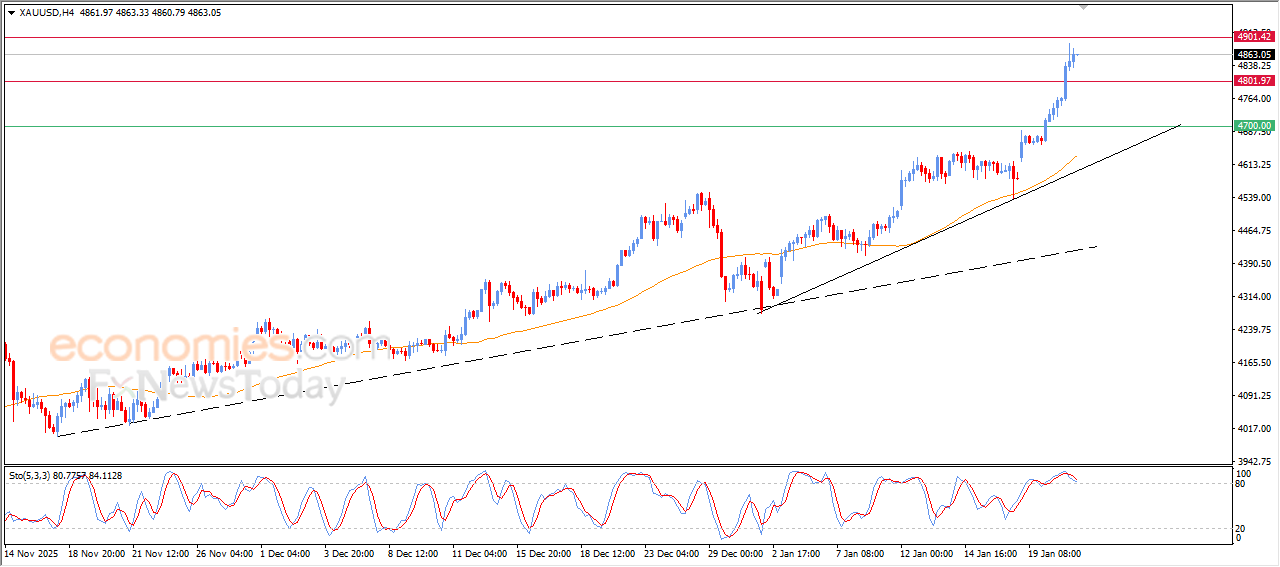
The near-term picture is bullish for XAU/USD, as the 4-hour chart shows that the 20-period Simple Moving Average (SMA) rises above the 100 and 200 SMAs, and all three slope higher, pointing to a robust uptrend. Price holds above these references, with the 20 SMA at $4,780.64 offering nearby dynamic support and the 100 SMA at $4,558.68 reinforcing the floor. At the same time, the Momentum indicator remains stable well above its midline, failing to provide directional clues. Nevertheless, the Relative Strength Index (RSI) resumed its advance after correcting extreme conditions, currently at 73, hinting at higher highs ahead.
In the daily chart, the bullish case is even stronger. XAU/USD is trading well above all bullish moving averages, with the 20-day SMA at $4,534.57 providing relevant dynamic support. Meanwhile, the Momentum indicator extends its advance into extreme levels, while the RSI does the same at around 79, without signs of upward exhaustion.
(The technical analysis of this story was written with the help of an AI tool.)
New York, January 22, 2026, 06:30 EST — Premarket
U.S. natural gas prices surged once more in early Thursday trading, with the Henry Hub benchmark climbing past $5 per million British thermal units (mmBtu). Front-month futures gained roughly 10%, hitting about $5.38 per mmBtu by 5:58 a.m. EST. (Businessinsider)
This matters because gas not only heats homes but also powers a significant share of U.S. electricity. When forecasts turn colder, demand often jumps quicker than supply can catch up.
Traders are also monitoring “freeze-offs” — those periods when extreme cold clogs wells and gathering systems — even as liquefied natural gas export plants continue pulling feedgas from the domestic market.
The February contract closed at $4.875 per mmBtu Wednesday, climbing 96.8 cents after a roughly 26% jump the day before. That two-day rally, about 57% in total, marked the biggest surge ever for the front-month contract and sent 30-day implied volatility up to 131.9%. Meanwhile, the spread between February and March contracts hit a record premium of $1.36. LSEG reported Lower 48 production at 108.7 billion cubic feet per day (bcfd) so far in January, down from 109.7 bcfd in December. Demand—including exports—is expected to increase next week. LNG feedgas has averaged 18.5 bcfd this month. Shares of gas producers EQT and Expand Energy gained roughly 6% and 4% Wednesday. (EnergyNow)
“The weather premium has kicked in hard,” Ole R. Hvalbye, commodities analyst at SEB, noted, as a cold snap forced traders to unwind heavy short bets. Eli Rubin from EBW Analytics described the jump as “highlighting the extent of short covering” amid thin market conditions. (Rigzone)
The U.S. Energy Information Administration reported that working gas in underground storage stood at 3,185 billion cubic feet (Bcf) for the week ending Jan. 9. This marks a decline of 71 Bcf from the previous week but remains roughly 106 Bcf above the five-year average. The next storage update is scheduled for Thursday at 10:30 a.m. (EIA Information Releases)
East Daley Analytics forecasts a 104 Bcf withdrawal for the week ending Jan. 16 but noted the market is mostly ignoring that potentially bearish figure. Instead, attention is shifting to colder weather forecasts and upcoming storage reports. (East Daley)
Pipeline operator Kinder Morgan outperformed Wall Street profit forecasts and reaffirmed confidence in sustained natural gas demand, pointing to increased electricity consumption from data centers. Shares climbed 1.4% after hours. CFO David Michels highlighted that higher transport volumes were boosted by fresh gas expansion projects and a recent acquisition in gathering and processing. (Reuters)
Aside from the recent cold snap, a surge of new LNG supply expected in 2026 could weigh on global gas prices and tighten export margins, depending on demand growth rates. Reuters forecasts about 35 million metric tons of additional LNG this year as projects in the U.S., Qatar, and other locations come online. (Reuters)
That said, the natural gas price rally hinges heavily on weather forecasts. If models swing toward milder conditions, freeze-offs fall short of expectations, or storage draws underperform, the rally could reverse just as fast.
Copper price approached the initial corrective target yesterday at $5.6500, to confirm delaying the attempts to resume the bullish trend due to its stability at $5.9700, besides providing negative momentum by its continued leaning below 80 level as appears in the above image.
Therefore, we will keep preferring the temporary negative attempts, which might target $5.6200 and $5.5100, while regaining the bullish trend requires a positive close above the mentioned barrier, to reinforce the chances of recording new historical gains that might begin at $5.6200 and $5.8500.
The expected trading range for today is between $5.6200 and $5.8500
Trend forecast: Bearish
Silver price (XAG/USD) retreats on Wednesday after reaching a daily high of $95.56 after US President Donald Trump eased his tone in his Davos speech, saying that he is ready to negotiate Greenland with Denmark. At the time of writing, XAG/USD trades at $93.57, down over 1% after reaching a record high of $95.89 on Tuesday.
Silver’s daily chart suggests the grey metal is upward biased, but the parabolic move seems to have paused as the Relative Strength Index (RSI) exited from overbought territory and shows signs of negative divergence.
Despite this, bears are not out of the woods as they must clear the $90.00 figure before challenging the latest cycle low of $86.45 reached on January 15. In that outcome, Silver could dive towards the 20-day SMA at $80.63.
On the flip side, if XAG/USD is to extend its gains, buyers need to push prices above the record high of $95.89, followed by the $100.00 milestone.
(This story was corrected on January 21 at 17:11 to say in the first paragraph that the $95.56 price is a daily high, not an all-time high.)
Silver is a precious metal highly traded among investors. It has been historically used as a store of value and a medium of exchange. Although less popular than Gold, traders may turn to Silver to diversify their investment portfolio, for its intrinsic value or as a potential hedge during high-inflation periods. Investors can buy physical Silver, in coins or in bars, or trade it through vehicles such as Exchange Traded Funds, which track its price on international markets.
Silver prices can move due to a wide range of factors. Geopolitical instability or fears of a deep recession can make Silver price escalate due to its safe-haven status, although to a lesser extent than Gold’s. As a yieldless asset, Silver tends to rise with lower interest rates. Its moves also depend on how the US Dollar (USD) behaves as the asset is priced in dollars (XAG/USD). A strong Dollar tends to keep the price of Silver at bay, whereas a weaker Dollar is likely to propel prices up. Other factors such as investment demand, mining supply – Silver is much more abundant than Gold – and recycling rates can also affect prices.
Silver is widely used in industry, particularly in sectors such as electronics or solar energy, as it has one of the highest electric conductivity of all metals – more than Copper and Gold. A surge in demand can increase prices, while a decline tends to lower them. Dynamics in the US, Chinese and Indian economies can also contribute to price swings: for the US and particularly China, their big industrial sectors use Silver in various processes; in India, consumers’ demand for the precious metal for jewellery also plays a key role in setting prices.
Silver prices tend to follow Gold’s moves. When Gold prices rise, Silver typically follows suit, as their status as safe-haven assets is similar. The Gold/Silver ratio, which shows the number of ounces of Silver needed to equal the value of one ounce of Gold, may help to determine the relative valuation between both metals. Some investors may consider a high ratio as an indicator that Silver is undervalued, or Gold is overvalued. On the contrary, a low ratio might suggest that Gold is undervalued relative to Silver.
Natural gas price continued forming strong bullish waves since yesterday, to notice achieving the suggested targets by reaching $4.00 level, to reach the support of the broken bullish channel’s support, which represents a key resistance.
Noticing that stochastic begins to exit the oversold level, attempting to provide a new bullish momentum, to increase the chances of surpassing the current resistance, and its stability above this level will confirm its readiness to record new gains by its rally towards $4.185, while the failure to breach it will support the dominance of the sideways bias in the current trading, and there is a chance to retest $3.620 level before reaching extra bullish target.
The expected trading range for today is between $3.780 and $4.185
Trend forecast: Bullish