The main tag of GoldPrice Articles.
You can use the search box below to find what you need.
[wd_asp id=1]
The main tag of GoldPrice Articles.
You can use the search box below to find what you need.
[wd_asp id=1]
Natural gas price succeeded in resuming the bearish corrective attack, targeting extra support level at $4.200, reminding you that monitoring the price behavior now to confirm the expected targets in the upcoming trading.
The stability above this support will push it to begin forming bullish waves, to target $4.550 level reaching 38.2%Fibonacci correction level near $4.750, while breaking the current support will ease the mission of pressing on the bullish channel’s support at $3.950, increasing the chances of moving to the negative scenario in the upcoming period trading.
The expected trading range for today is between $4.200 and $4.550
Trend forecast: Bullish
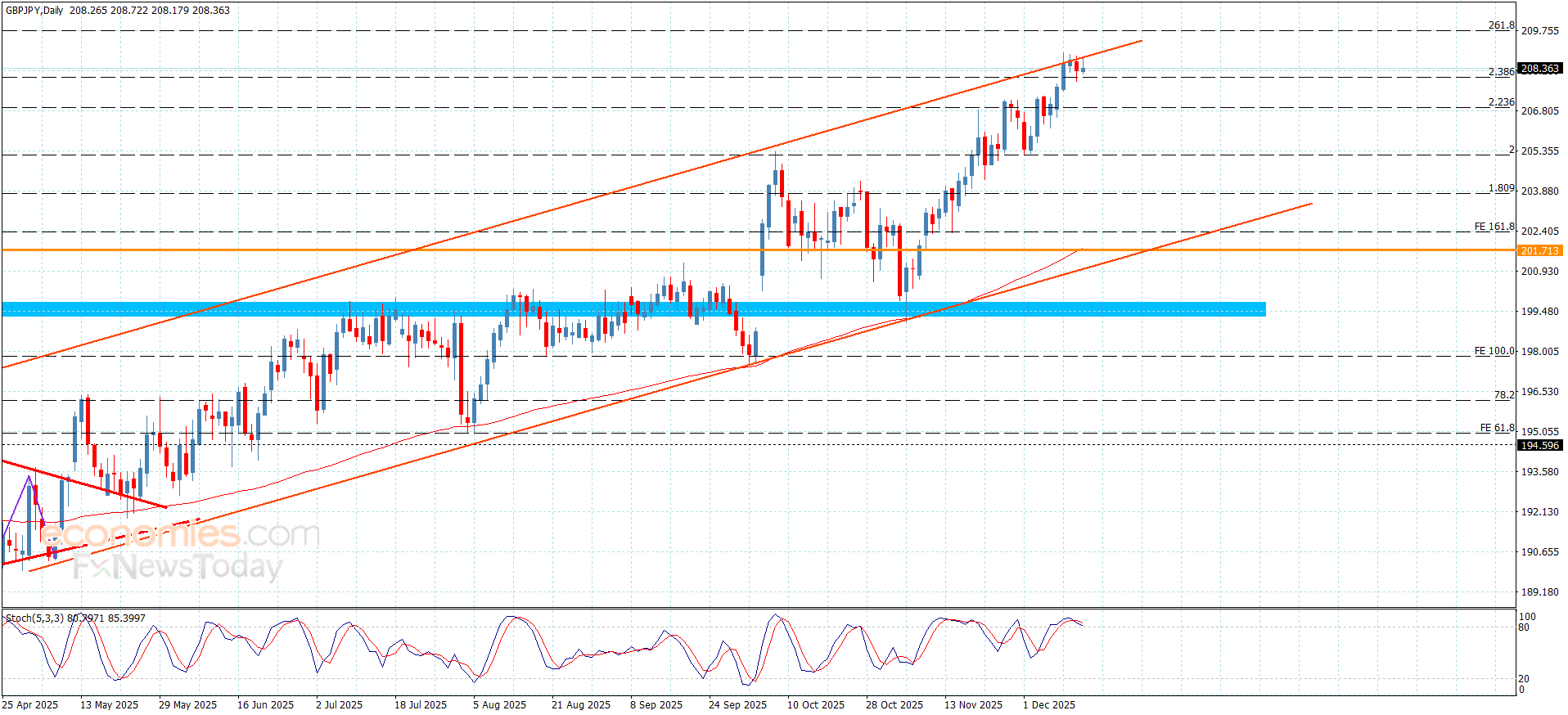
The GBPJPY pair didn’t move anything by forming sideways trading due to its stability continuously below the resistance at 208.80, forming an obstacle for resuming the bullish trend.
The price might form temporary corrective trading, but the stability within the bullish channel levels and the continuation of forming extra support at 206.90 level, these factors support the chances of renewing the bullish attack, to expect surpassing the current resistance by recording new gains that might extend 209.30 and 209.75.
The expected trading range for today is between 207.40 and 208.90
Trend forecast: Fluctuated within the bullish trend
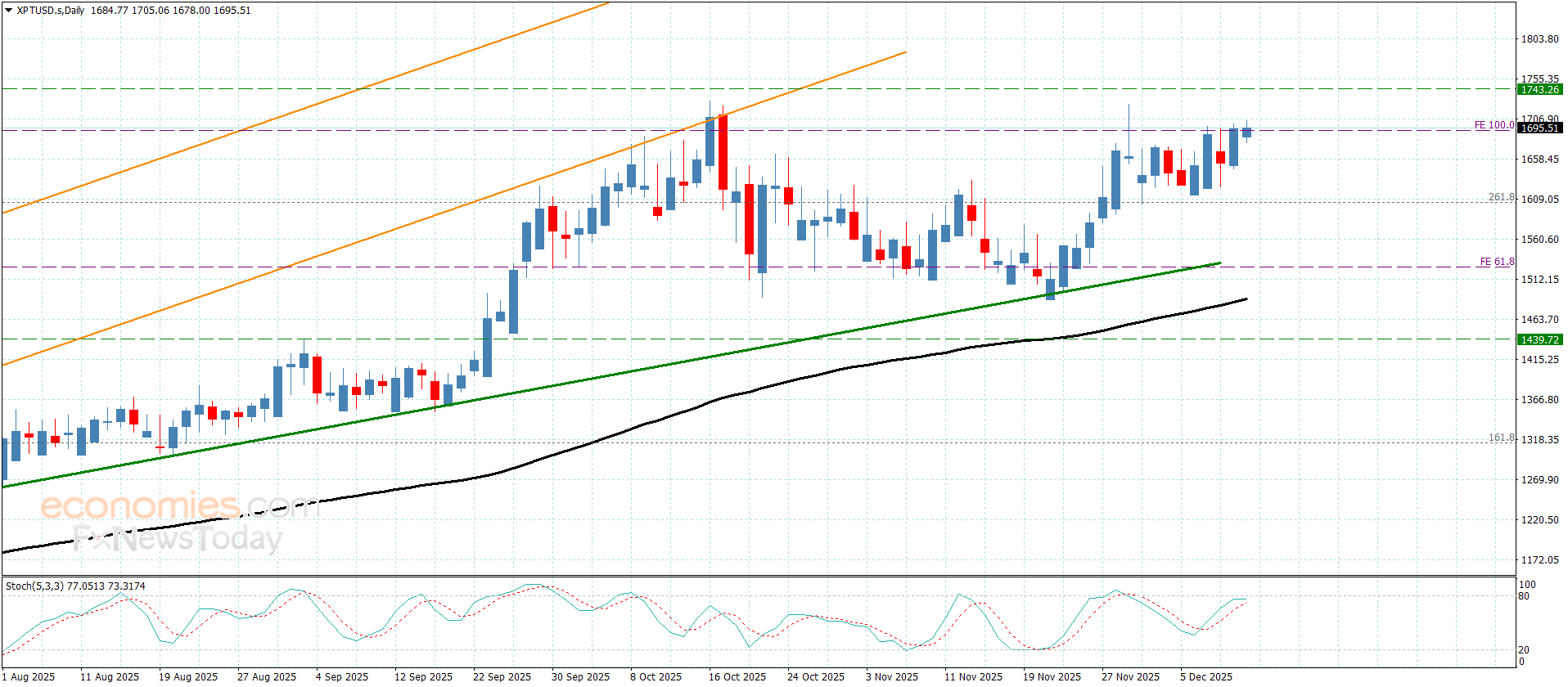
Platinum price renewed the attempts of pressing on $1695.00 barrier, attempting to find an exit to resume the previously waited bullish trend, the current contradiction between the main indicators makes us monitor the price behavior until achieving the required breach, to confirm its readiness to record extra gains by its rally to $1715,00 and $1745.00.
While the failure to breach it will force the price to form mixed trading and there is a chance to decline towards $1645.00 reaching the initial support at $1605.00.
The expected trading range for today is between $1665.00 and $1745.00
Trend forecast: Bullish
Last week’s low at $4.09 stands as a higher monthly low; a decisive break there would trigger a monthly reversal signal. Meanwhile, Thursday produced a five-week low hovering just above the rising 10-week average near $4.14, perfectly aligning with the current $4.24–$4.15 zone and dramatically increasing its technical importance as dynamic support.
This week marks the first weekly decline in eight weeks, ending the unbroken pattern of higher weekly highs and lows. That alone represents a major sentiment shift, with the weekly reversal now confirmed and opening risk of a deeper correction toward the 61.8% Fibonacci retracement at $3.89 and the 200-day average near $3.79—though a meaningful bounce appears probable first.
As natural gas has sold off from last week’s multi-year high of $5.50 (since December 2022), each successive dynamic support line has flipped to resistance: first the 10-day average, then the 20-day average—both confirmed by subsequent daily highs. This textbook progression reinforces the short-term downtrend and keeps bears in the driver’s seat.
The strongest and most likely bounce area remains the rising 50-day average at $4.05. Because it continues climbing, it may meet price closer to the lower end of the current $4.15 range, improving the odds of a successful defense and potential sustained bullish reaction into overhead resistance.
Natural gas has shifted decisively bearish on the weekly timeframe with the eight-week higher low structure broken and classic support-to-resistance flips in place. Expect the $4.24–$4.15 zone to slow the decline, but the 50-day/channel confluence near $4.05 stands as the highest-probability bounce point; failure there opens a fast move toward $3.89–$3.79, while any rebound faces immediate resistance at the flipped 20-day and 10-day averages.
For a look at all of today’s economic events, check out our economic calendar.
Gold is consolidating just below the seven-week highs of $4,286 early Friday, eyeing a roughly 2% weekly gain.
The record rally in Gold is seen reviving, courtesy of the sustained dovish expectations surrounding the US Federal Reserve (Fed), while the Bank of Japan (BoJ) is set to raise interest rates and the European Central Bank (ECB) seen on hold next week.
Despite Fed Chairman Jerome Powell sticking to his cautious rhetoric during the post-monetary policy meeting press conference on Wednesday and the Fed’s median expectation for a single quarter-percentage-point cut next year, markets continued to price in two more rate cuts, keeping the downside pressure intact on the US Dollar (USD).
This narrative provided the much-needed traction to Gold’s uptrend, as the yellow metal also tracked the record-setting rally in Silver.
Additionally, Gold was powered by a Reuters report that “India’s pension regulator on Wednesday issued revised investment rules for the country’s pension funds, permitting investments in gold and silver exchange-traded funds.”
Meanwhile, a weak US employment report and President Donald Trump’s threats of war in Venezuela provided a further boost to the safe-haven Gold.
The Labor Department said on Thursday, Initial Claims for state unemployment benefits jumped 44,000, the biggest increase since mid-July of 2021, to a seasonally adjusted 236,000 for the week ended December 6, adding to US labor market concerns.
Heading into the weekend, Gold takes a breather as traders resort to profit-taking, in anticipation of the end-of-the-week flows and next week’s delayed Nonfarm Payrolls and inflation data releases.
All in all, any pullback in Gold will likely be quickly bought in amid growing concerns over the US employment, dovish Fed bets and a constructive near-term technical outlook.
In the daily chart, the 21-day Simple Moving Average (SMA) rises above the 50-, 100- and 200-day ones, underscoring firm bullish momentum. The metal holds well above its key SMAs, with the 21-day at $4,165.40 offering nearby dynamic support. The Relative Strength Index (14) prints 65.94, signaling strong upside momentum without overbought conditions; a push above 70 would flag stretched levels.
Measured from the $4,381.17 high to the $3,885.84 low, the 78.6% retracement at $4,275.16 acts as immediate resistance. The 61.8% retracement at $4,191.95 marks a nearby downside pivot if the advance stalls. A daily close above $4,275.16 could extend the rally, while failure there would keep price consolidating toward its rising short-term average. Note that Gold closed Thursday above the latter, justifying its bullish potential.
(The technical analysis of this story was written with the help of an AI tool)
The Nonfarm Payrolls release presents the number of new jobs created in the US during the previous month in all non-agricultural businesses; it is released by the US Bureau of Labor Statistics (BLS). The monthly changes in payrolls can be extremely volatile. The number is also subject to strong reviews, which can also trigger volatility in the Forex board. Generally speaking, a high reading is seen as bullish for the US Dollar (USD), while a low reading is seen as bearish, although previous months’ reviews and the Unemployment Rate are as relevant as the headline figure. The market’s reaction, therefore, depends on how the market assesses all the data contained in the BLS report as a whole.
Front-month NG=F has given back the entire weather-driven spike and is now trading in the mid-$4s, around $4.28–$4.33 per mmBtu, after dropping roughly $0.85 in a single week, an 8–9% hit layered on top of a broader 20% retreat from the three-year high reached just a week earlier. A week ago, futures sat about $1 higher and briefly priced in an aggressive winter risk premium; today they trade near $4.25, even dipping to a five-week low as sellers force the market below key technical reference points. The price is now marginally under the Energy Information Administration’s updated heating-season average of $4.30 per mmBtu, despite that estimate itself being raised by roughly 10% versus the prior outlook to reflect early-season cold. The message is simple: the strip became too crowded on the upside, weather expectations flipped, and NG=F is repricing lower to reflect less urgent winter tightness.
The entire move is being driven by a violent swing in weather expectations. Last week’s pattern delivered exactly what bulls wanted: widespread cold across the Midwest and Northeast, with daytime highs in the 10s–30s °F and subfreezing overnight lows, pushing national demand sharply higher and justifying heavy storage withdrawals. That brief window of strong heating demand has now been eclipsed by models projecting above-normal temperatures across most of the Lower 48 from next week through at least December 26. Forecast houses now describe a cold weekend followed by a pronounced warm bias into Christmas, which effectively caps heating loads during what should be the peak of the season. Two-week heating degree days are sitting at 381 versus a 10-year norm of 382 but well below the 30-year norm of 429, signaling that the current cold is not exceptional on a historical basis and that the medium-term pattern is still structurally mild. Traders are no longer willing to pay a winter scarcity premium if the second half of December looks more like a shoulder period than a deep-freeze.
On the surface, the storage data looks bullish. The latest weekly report showed a 177 Bcf withdrawal for the week ended December 5, exceeding the consensus range around -166 to -174 Bcf and dwarfing the five-year average draw of roughly -89 Bcf for this time of year. Last year’s comparable withdrawal was 167 Bcf, so the current pull is larger than both the recent past and the medium-term norm. That confirms that last week’s cold snap genuinely bit into inventories. Yet even after this “massive pull,” total U.S. storage stands near 3,746 Bcf versus 3,774 Bcf a year ago and around 3,643 Bcf for the five-year average, leaving stocks roughly 2.8–3.0% above normal despite the outsized draw. The structural issue all year has been excessive storage: injections were fat through 2025 because production ran at record levels while demand never spiked enough to meaningfully erode the surplus. The current withdrawal merely trims an overhang that was 5.1% above the five-year norm just a week earlier. As long as inventories remain ahead of typical levels going into the core of winter, each large draw gets framed as a temporary weather echo rather than the start of a sustained tightening cycle.
The production side of the balance sheet is relentless. Lower-48 dry gas output is running at about 109.7 bcfd so far in December, marginally above the 109.6 bcfd record set in November and nearly 5 bcfd higher than the roughly 104.6 bcfd level seen a year earlier. When Canadian imports of roughly 10.2 bcfd and small LNG imports are included, total U.S. supply is around 120 bcfd, far above the 108.3 bcfd five-year average for this month. On the demand side, aggregate U.S. usage including exports is about 145.4 bcfd this week, projected to ease to 143.8 bcfd next week as the weather warms, compared with roughly 129.5 bcfd for the five-year average. So demand is robust, but supply is so strong that storage remains comfortable even with heavy withdrawals. LNG feedgas flows are near record territory at 18.7–18.9 bcfd, up from 18.2 bcfd in November and around 13.7 bcfd a year ago, with exports on track to hit a new high for the tenth consecutive year. Yet global benchmarks are not providing much relief: European TTF prices hover near $9.20 per mmBtu and Asian JKM around $10.78, while Henry Hub trades near $4.48–$4.62. That spread is healthy enough to support U.S. exports but not tight enough to trigger a panic bid. The combination of record domestic output, well-supplied global markets, and only moderately supportive international prices keeps a lid on any attempt by NG=F to sustain moves back above recent highs.
Technically, NG=F has shifted from an overextended bullish structure into a clear corrective phase. The first red flag was the decisive break below $4.495, a level aligning with the 50-day moving average and acting as a key pivot for systematic and trend-following flows. Once that floor gave way, algorithmic accounts and leveraged longs started liquidating, driving the contract through the prior swing low at $4.390 and exposing the late-October bottom around $4.052 as the next meaningful downside reference. The current tape around $4.28–$4.33 is uncomfortably close to that October low, and the recent price action has been characterized by big red candles and follow-through selling rather than sharp V-shaped reversals. Technicians now see the path of least resistance skewed toward at least a test of the $4.05 region and a realistic risk of a temporary break below $4.00 if weather models stay warm and storage draws continue to be framed as one-off events. The previous three-year high is now firmly established as resistance, and every failure to reclaim the $4.49–$4.60 congestion zone reinforces the view that the winter spike has already peaked.
Underlying regional price behavior confirms that the weakness in NG=F is not simply a benchmark anomaly. Spot Henry Hub has slipped to about $4.62 versus $4.76 recently, broadly aligned with the front-month futures slide. However, regional differentials highlight how localized constraints are distorting signals. New England’s Algonquin Citygate is printing extreme numbers near $20.50 per mmBtu, up from around $16.55, reflecting pipeline limitations and winter reliability concerns in that constrained market. At the same time, Permian Waha prices are deeply negative around -$1.31 versus -$0.98 the prior day, exposing severe takeaway bottlenecks and periodic dumping of associated gas at distressed levels. Chicago Citygate sits near $4.35, Transco Zone 6 New York around $5.63, and PG&E Citygate roughly $3.75, underscoring a patchwork of tightness in some load pockets and oversupply in others. For NG=F, which reflects Henry Hub rather than local stress, the key takeaway is that the national system is adequately supplied. New England’s price spikes are a seasonal, infrastructure-driven phenomenon, while Permian discounts signal surplus molecules searching for demand rather than scarcity.
On the consumption side, the demand stack is robust but not explosive. Commercial usage sits around 17.6–18.0 bcfd, residential demand approximately 29.6–30.3 bcfd, and industrial consumption near 26.0 bcfd. Power sector burn is roughly 32.7–34.9 bcfd, slightly down from last year’s record high and projected to soften as temperatures rise and coal, nuclear, wind and solar share some of the load. Gas still accounts for about 39–40% of U.S. power generation, but incremental growth from this segment is flattening for 2025 compared with the surge in 2024. Exports remain a bright spot: roughly 6.3 bcfd flows to Mexico, around 3.5 bcfd to Canada, and nearly 18.5–18.9 bcfd heads to LNG terminals. Even so, worries are emerging around the long-term trajectory of gas-fired power demand for data centers. A recent selloff in high-profile technology stocks linked to artificial intelligence infrastructure has raised questions about the pace and profitability of new data center build-out, which had been one of the pillars of bullish gas demand narratives. If power demand growth for data centers underperforms, gas burns for electricity could plateau or even decline at the margin, reducing one of the structural arguments for sustained high prices. For the current winter window, the dominant driver remains weather: national demand is projected to slip from about 145.4 bcfd this week to 143.8 bcfd next week, and that marginal downtick—from already elevated levels—matters more for price direction than the longer-term AI story.
The broader macro context supports a softer stance on NG=F for now. Degree-day data show that, while the recent cold was meaningful, the two-week total is not significantly above historical norms, and the forward projections are tilted toward warmth rather than sustained Arctic outbreaks. Global gas prices at roughly $9–$11 per mmBtu are far from crisis levels; they are high enough to keep U.S. LNG exports running hard but low enough to discourage panic hedging from overseas buyers. Domestically, the recent 20% price drop from the three-year high has real implications for heating bills: with NG=F around $4.25 instead of above $5, the implied cost trajectory for winter is easing, differing notably from early-season fears of a punishing heating season. For utilities and large end-users, this environment encourages more measured hedging rather than frantic procurement, which in turn removes one source of upside pressure from the futures curve.
From here, the near-term scenarios revolve around three interacting variables: weather, storage, and production discipline. In a continued warm-into-Christmas path with withdrawals roughly in line with the current 170 Bcf range, NG=F is likely to probe the $4.05 October low and may briefly crack below $4.00 as speculative longs capitulate. In a moderate scenario where the next storage print surprises on the high side of expectations and weather models reintroduce a colder pattern for late December and early January, the contract could stabilize in a $4.20–$4.70 band, with the $4.49–$4.60 region acting as a ceiling until evidence of sustained tightness emerges. Only in a more aggressive cold-reversion scenario—multiple weeks of below-normal temperatures, withdrawals persistently above the five-year average, and any sign of production flattening from the current 109.7 bcfd—does a retest of recent highs become plausible, with upside extensions back above $5.00. So far, none of those bullish conditions are firmly in place. Storage remains about 2.8–3.0% above the norm, output is at record levels, and medium-range forecasts favor warmth. That combination argues against paying up now for a weather risk that is not yet visible on the charts.
Putting all of the data together—20% price erosion from the three-year high to around $4.25, a weekly loss of roughly $0.85, a 177 Bcf draw that still leaves storage at 3,746 Bcf and about 3% above the five-year average, record Lower-48 production at 109.7 bcfd, LNG feedgas near 18.9 bcfd, global benchmarks at $9–$11, and a clearly broken technical structure below $4.495 and $4.390—the current setup for NG=F is short-term bearish with a medium-term equilibrium bias. For directional traders, the risk-reward does not justify a fresh long until either weather or supply conditions change meaningfully. For portfolio positioning, the stance is a tactical hold with a downside skew rather than an outright buy: the market is vulnerable to further tests of $4.05 and potentially sub-$4 levels if mild weather and heavy output persist, while any sustainable move back above $4.70–$4.90 will require a clear shift in either storage trends or production behavior. In other words, NG=F is not priced for disaster, but it is also not offering a compelling entry for bulls yet; the balance of evidence favors patience or cautious, short-biased strategies until the data stop confirming oversupply.
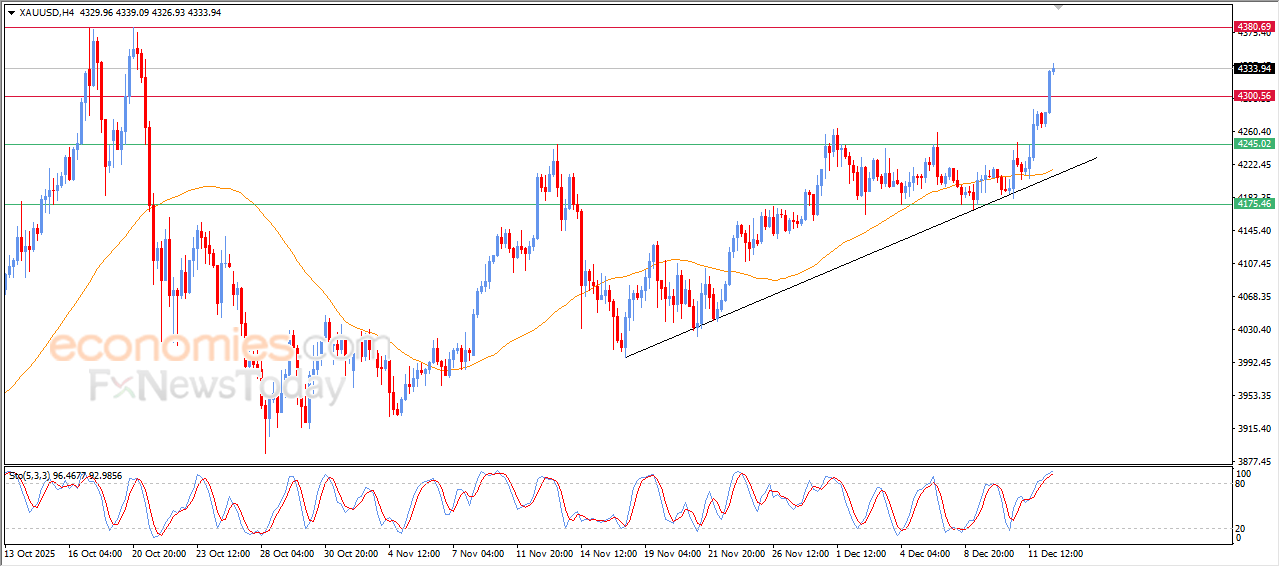
Thursday’s surge fully recovered the top boundaries of two rising trend channels that were briefly lost in the recent pullback. This marks the second successful breakout above both channels since October, distinguishing the current move from the earlier failed attempt and suggesting the market is no longer in an overbought exhaustion state but instead entering a fresh bullish leg across all timeframes.
A weekly close above $4,264 would seal bullish continuation on that timeframe and deliver the third-highest weekly settlement in history if gold finishes above $4,251 tomorrow. The next major objective is the measured move completion at $4,356, where the current second leg up from October exactly matches the price change of the first advance. The standing record high at $4,381 follows immediately, with a 127.2% projection of the second measured move at $4,454, followed by a 161.8% measured move projection.
The entire advance since October has repeatedly respected rising dynamic support. As long as the 20-day average at $4,159 and especially the rising 50-day average at $4,106 remain intact, the multi-timeframe bull trend stays fully on track with room to extend beyond the current record high.
Gold has delivered the highest-probability bullish signal in weeks by clearing $4,264, reclaiming both channel tops, and defending the uptrend line for a third day. A daily and weekly close above $4,264 confirms the new leg and targets $4,356 minimum, then $4,381–$4,454; only loss of the 20-day or 50-day averages would raise legitimate caution for the dominant uptrend.
For a look at all of today’s economic events, check out our economic calendar.
In the wake of the latest Federal Reserve decision to lower its benchmark rate by 25 basis points, bringing the federal funds rate range to 3.50%–3.75%, Gold (XAU/USD) extended its upside momentum. Spot gold climbed decisively above $4,200, with early Asian session trade showing levels near $4,235 — a meaningful move from the prior floor near the $4,200 psychological zone. This price expansion followed the dovish undertones embedded in the Fed’s communication, even though policymakers stopped short of signaling a clear pace of further easing. Lower interest rates decrease the opportunity cost of holding a non-yielding asset like gold, underpinning bullion’s advance into new territory.
The broader macroeconomic backdrop continues to bolster XAU/USD. The U.S. dollar index weakened to multi-week lows following the rate cut, easing downward pressure on gold and further validating bullion’s appeal as an alternative store of value. Real yields have compressed in response to both the rate move and nascent expectations for slower monetary tightening into 2026, enhancing gold’s relative attractiveness for investors seeking protection against currency depreciation and inflation threats.
Technical price action reflects a subtle shift from relentless rallying to measured consolidation. Despite the yield-friendly policy backdrop, traders observed a pause in upside conviction as XAU/USD hovered near the $4,210–$4,235 corridor. Intraday dips toward the $4,190–$4,200 range found buying support, indicating demand remains intact even amid short-term profit-taking. On shorter timeframes, gold dipped below $4,200 but reclaimed levels around $4,206, signaling that bidders are actively defending this zone, which might be crucial for sustaining a broader uptrend.
Medium-term technical setups underscore gold’s resilience. The 20-day exponential moving average (EMA) near $4,163 is acting as a dynamic support level, above which the uptrend remains structurally intact. The next major support tier, anchored by the 50-day EMA at approximately $4,051, serves as a deeper cushion should short-term consolidation evolve into a deeper pullback. Momentum indicators — including the daily RSI near 61 — reveal moderated but constructive strength, not exhaustion. These signals show that gold’s pullbacks are normal pauses within a larger bullish trajectory rather than shifts in trend direction.
Gold’s ascent has not occurred in macro isolation. Heightened geopolitical tensions — including the U.S. seizure of a sanctioned Venezuelan tanker and ongoing uncertainty around Russia-Ukraine peace negotiations — have continually bolstered safe-haven demand. These geopolitical risks amplify the appetite for non-yielding precious metals, helping gold maintain firm footing even when short-term market narratives grapple with mixed data.
While traders initially responded favorably to the 0.25% rate cut, doubts about the timeline for subsequent rate adjustments have clouded near-term sentiment. Fed Chair Jerome Powell’s cautious commentary — emphasizing a wait-and-see approach — left open the possibility of either pausing or adjusting the pace of policy ease in 2026. This ambiguity has given gold markets cause for caution around the $4,250 resistance level. Breaking and holding above this threshold would reinforce the path toward new record highs, while failure could invite deeper reversion toward key supports.
Looking at futures quotes on the CME for February gold contracts, the immediate upside targets remain entrenched above former highs. The contract’s near-term resistance resides at the previous overnight high near $4,277.70, followed by the psychological plateau around $4,300. Traders and technical models also point toward the all-time contract high at $4,433 as a marquee target should momentum reignite. On the flip side, downside risk objectives are defined by supports at $4,231.20 and deeper near $4,197.80, which mark key intraday lows from recent sessions.
Domestic price trends in India — one of the world’s largest gold consumers — reflect international spot pressures and currency and import tax effects. On December 11, 2025, 24K gold in major Indian cities such as Mumbai and Chennai traded near ₹130,630 per 10 grams, up approximately ₹1,080 (0.83%) from the previous close. Similarly, 22K gold hovered around ₹119,744 per 10 grams (0.83% gain), while 18K recorded ₹97,973 per 10 grams (0.83% gain). These increases underline the linkage between international bullion prices and domestic markets, where import costs, currency fluctuations, and local demand dynamics converge to shape retail pricing.
The upward trajectory in bullion extends beyond gold. Silver futures — exemplified by March contracts — surged with gains upward of $1.446 to $62.47, hitting fresh record highs amid the same macro support structures that buoy gold. This broad metals performance – driven by real-rate compression, safe-haven flows, and industrial demand – reinforces a growing narrative that both gold and silver are benefitting from dovish monetary policy mixed with persistent geopolitical risks.
A notable shift in the post-FOMC landscape was the Fed’s announcement of a $40 billion monthly Treasury bill purchase program, aimed at alleviating pressures in short-term funding markets. While this program hasn’t yet reverberated emphatically through gold prices, the added liquidity factor introduces another dimension to markets already digesting rate cuts and weakening yields. The interplay between quantitative measures and traditional monetary easing continues to shape expectations for real rates, a key driver for gold’s longer-term valuation.
Despite recent rallies, markets are eyeing consolidation as gold transitions from rapid rally to price digestion. Pullbacks toward the $4,190–$4,200 range reflect profit taking as traders recalibrate ahead of key macro announcements and potential geopolitical developments. Importantly, such retracements occur within a broader structural uptrend, supported by consistent EMAs and macro drivers.
The trajectory for XAU/USD now hinges on how markets interpret future Fed direction and the U.S. dollar’s behavior. A continuation of dollar weakness, accompanied by clear expectations of additional rate cuts, would likely fortify gold’s bid and accelerate momentum toward record territory. Conversely, if rate expectations stabilize or the dollar rebounds, gold may experience range-bound trading with support anchoring near critical EMAs.
Based on the interplay of macro data, price structure, and geopolitical inputs, gold’s rally shows structural strength but faces short-term resistance and consolidation. Key support levels near $4,190–$4,200 and medium-term EMAs offer potential entry points for disciplined buyers. A clean break above $4,250 would reinforce further upside, while failures to hold recent ranges may invite deeper tests. Given the persistence of safe-haven demand, real-rate support, and technical structure, a Hold bias with selective accumulation on dips — particularly under $4,150 — aligns with current market behavior.
At 15:15 GMT, January Natural Gas Futures are trading $4.326, down $0.269 or -5.85%.
Thursday’s EIA report is expected to show a sharply above-average storage withdrawal, reflecting last week’s colder-than-normal temperatures across the Midwest and Northeast. Forecast ranges are wide, from -167 Bcf to -174 Bcf, versus the five-year average draw of -89 Bcf.
While a draw of this magnitude would normally offer support, sentiment remains bearish due to the forecasted warmup. A strong print may provide only limited relief if traders believe next week’s milder pattern will suppress demand.
According to NatGasWeather, national demand will remain high through the weekend as frigid systems move through the Midwest and East. Highs in the 10s–30s and lows below freezing are expected to dominate through Sunday. However, next week’s forecast flips dramatically, with above-normal temperatures expected to spread across most of the Lower 48, sharply reducing heating demand into Christmas.
This warm bias has taken center stage for traders, undermining the impact of near-term cold and limiting upside momentum.
The break below $4.495, previously serving as the 50-day moving average, triggered heavy liquidation as algorithmic and technical traders exited long positions. A cascade of selling followed as the $4.390 level failed, leaving the October 29 low at $4.052 as the next downside marker. Without supportive weather or sustained demand, the market appears vulnerable to further retracement.
DocuSign, Inc. (DOCU) declined in its latest intraday trading after the stock collided with resistance at its 50-day simple moving average, exposing it to renewed downside pressure reinforced by the dominance of the main medium- and short-term bearish trend, with the price moving alongside a descending trendline. However, we note the beginning of a positive crossover on the RSI indicators after the stock successfully relieved its overbought saturation, which may provide some positive momentum to help counter current selling pressure—though this remains limited as long as the stock holds below its existing resistance levels.
Therefore we expect the stock to decline in its upcoming trading, as long as the pivotal resistance at $72.35 remains intact, targeting the support level of $63.40.
Today’s price forecast: Neutral