Silver price recovers some lost ground to near $30.05, adding 1.80% on the day.
The concerns over tariff wars and potential global recession boost the safe-haven flows, supporting the Silver price.
Traders will take more cues from the US March CPI inflation data, which is due later on Wednesday.
The Silver price (XAG/USD) recovers to around $30.05 during the early European trading hours on Monday. The white metal edges higher as the fear of tariff wars and the potential global recession boost the safe-haven demand.
Silver price has witnessed heightened volatility since last week in response to the US imposing reciprocal trade tariffs on key trading partners. Mounting fears of recession over the impact of a global trade war triggered by US President Donald Trump’s reciprocal tariffs dampen market sentiment and undermine the precious metals.
Furthermore, strong industrial demand, especially from new-age industries like EVs and solar energy, creates tailwinds for the white metal. Gains are also expected in the consumer electronics market, as the development of artificial intelligence systems will continue to boost product offerings.
Silver generally moves with gold, but industrial applications such as electronics and photovoltaics account for more than half of world demand, which is estimated to be approximately 700.2 million troy ounces by 2024, according to the Silver Institute industry association.
Traders will keep an eye on the US Consumer Price Index (CPI) inflation data for March, which will be published later on Thursday. If the report shows cooler-than-expected inflation in the US, this might lift the Greenback and drag the USD-denominated commodity price in the near term.
Silver FAQs
Silver is a precious metal highly traded among investors. It has been historically used as a store of value and a medium of exchange. Although less popular than Gold, traders may turn to Silver to diversify their investment portfolio, for its intrinsic value or as a potential hedge during high-inflation periods. Investors can buy physical Silver, in coins or in bars, or trade it through vehicles such as Exchange Traded Funds, which track its price on international markets.
Silver prices can move due to a wide range of factors. Geopolitical instability or fears of a deep recession can make Silver price escalate due to its safe-haven status, although to a lesser extent than Gold’s. As a yieldless asset, Silver tends to rise with lower interest rates. Its moves also depend on how the US Dollar (USD) behaves as the asset is priced in dollars (XAG/USD). A strong Dollar tends to keep the price of Silver at bay, whereas a weaker Dollar is likely to propel prices up. Other factors such as investment demand, mining supply – Silver is much more abundant than Gold – and recycling rates can also affect prices.
Silver is widely used in industry, particularly in sectors such as electronics or solar energy, as it has one of the highest electric conductivity of all metals – more than Copper and Gold. A surge in demand can increase prices, while a decline tends to lower them. Dynamics in the US, Chinese and Indian economies can also contribute to price swings: for the US and particularly China, their big industrial sectors use Silver in various processes; in India, consumers’ demand for the precious metal for jewellery also plays a key role in setting prices.
Silver prices tend to follow Gold’s moves. When Gold prices rise, Silver typically follows suit, as their status as safe-haven assets is similar. The Gold/Silver ratio, which shows the number of ounces of Silver needed to equal the value of one ounce of Gold, may help to determine the relative valuation between both metals. Some investors may consider a high ratio as an indicator that Silver is undervalued, or Gold is overvalued. On the contrary, a low ratio might suggest that Gold is undervalued relative to Silver.
The Euro to Dollar exchange rate (EUR/USD) was subject to extreme volatility after President Trump imposed widespread tariffs on global economies.
As fear stalks major markets, the European reaction will be a crucial test for market sentiment
After a surge to 6-month highs near 1.1150, there was a slide to below 1.0950 as equity markets came under heavy pressure and Fed Chair Powell ruled out an emergency interest rate cut.
There are likely to be big changes in investment bank forecasts over the next few weeks.
According to BNP Paribas; “Our base case is for moderate EURUSD gains in 2025 (to 1.12) and substantial gains in 2026 (to 1.20), as the Fed starts cutting rates in 2026.”
On a near-term view it also now forecasts that EUR/USD will strengthen to 1.14.
In contrast, HSBC expects that the dollar will regain ground.
Advertisement
Risk conditions deteriorated rapidly and heavily as fears over the global economy intensified and Fed Chair Powell ruled out any emergency rate cut.
There were sharp gains in defensive assets, notably the Swiss franc with the dollar initially under heavy pressure before recovering ground as China announced retaliation.
According to ING; “Remember that if investors don’t like the dollar – and the US is the epicentre of the story – then the next most liquid G10 currency is the euro.”
The US Administration announced a baseline 10% tariff on all imports into the US which came into effect on April 5th.
Many major countries, however, were given additional tariffs. Although labelled as reciprocal, the extra levies simply punished countries running trade surpluses with the US and were, therefore, also a designed as a political weapon.
The overall EU tariff was set at 20%, Japan at 24% and China at 34%. These are scheduled to come into effect on April 9th.
China announced retaliation on Friday with 34% tariffs on US exports.
Over the medium term, the relative economic impacts will be very important for markets and FX rates.
In this context, potential retaliation by the EU, diplomatic negotiations and the next US Administration moves will be crucial.
The EU Commission is planning to announce counter-tariffs this week, potentially on certain categories rather than universal tariffs.
A measured EU stance could underpin risk appetite.
MUFG also commented; “Hopefully, the deepening financial market sell-off will put pressure on President Trump and other countries to quickly reach deals to water down the proposed tariff hikes and provide some relief for financial markets.”
Investors will still be braced for a long-term impact.
According to HSBC; “Markets need to digest a global economic slowdown, not just a US one. When this reality sinks in, the US will likely regain its relative allure in this potential race to the bottom for economic activity.”
Monetary policy will also be a key element. There are now strong expectations that the ECB will cut rates this week with two further reductions over the remainder of the year.
Federal Reserve Chair Powell stated that it was too early to judge the economic impact of tariffs and stated that the committee would take its time in deciding on any policy changes.
Markets are, however, convinced that the Fed will cut rates by mid-year.
Deutsche Bank considers the risk of a slide in dollar confidence; “The safe haven properties of the dollar are being eroded.”
It added; “Our overall message is that there is a risk that major shift in capital flow allocations take over from currency fundamentals and that FX moves become disorderly.”
The bank also warned over implications for other countries; “The last thing the ECB wants is an externally imposed disinflationary shock from a loss in dollar confidence and a sharp appreciation in the euro on top of tariffs. Expect pushback. We are in the midst of dramatic regime change in markets.”
MUFG noted some hopes for the Euro; “Plans for significantly looser fiscal policy in Germany and reports of EU-wide support measures for growth to offset the negative impact from tariffs are helping to provide support for the EUR at the time when US tariffs will significantly tighten fiscal policy in the US.”
UBS expects the dollar will lose further ground; “First, the US is the focal point and will therefore likely bear the brunt of the economic fallout caused by waging a trade war on multiple fronts. This means US growth faces greater downside risks, implying lower US interest rates and a more dovish Federal Reserve; all of this weighs on the greenback.”
It did, however, note that; “while the focus has been mainly on the US economy over the past two days, the rest of the world will also suffer from increasing trade burdens.”
Like this piece? Please share with your friends and colleagues:
International Money Transfer? Ask our resident FX expert a money transfer question or try John’s new, free, no-obligation personal service! ,where he helps every step of the way,
ensuring you get the best exchange rates on your currency requirements.
The global Berberine Supplements Market has witnessed substantial growth over the past few years, spurred by rising consumer awareness regarding natural health remedies and the increasing prevalence of chronic diseases such as diabetes, cardiovascular issues, and obesity. According to Persistence Market Research, the market size stood at US$ 959 million in 2023, with projections estimating it will surpass US$ 2.1 billion by 2033, expanding at an impressive CAGR of 8%.
Get a Sample PDF Brochure of the Report (Use Corporate Email ID for a Quick Response):
Capsules have emerged as the leading segment, offering better bioavailability, consumer convenience, and compatibility with vegan preferences. Among geographical regions, North America dominates the market, driven by high supplement consumption rates, growing healthcare awareness, and a robust distribution network. The United States, in particular, reflects strong adoption owing to increasing health issues and a trend toward herbal alternatives.
Key Highlights from the Report
➤ The Berberine Supplements Market was valued at US$ 959 Million in 2023 and is expected to reach US$ 2.1 Billion by 2033.
➤ Capsule form of Berberine Supplements is projected to grow at a CAGR of 7.9% between 2023 and 2033.
➤ North America leads globally, with the U.S. market expected to hit US$ 640.4 Million by 2033.
➤ Berberine shows promising results in managing cholesterol, diabetes, and heart diseases naturally.
➤ The Chinese market reflects high growth due to traditional medicinal usage and rising diabetes prevalence.
➤ Recent partnerships and product innovations are fueling competitive advancements in the market.
Market Segmentation
The Berberine Supplements Market is segmented primarily by form and sales channel. By form, capsules dominate due to their ease of ingestion, high absorption rate, and suitability for vegetarians. Capsules are also more stable and preferred for long-term use. Other forms include tablets, softgels, caplets, powders, and liquids, each catering to specific consumer preferences and usage scenarios.
On the sales channel front, the market is split between online and retail sales. The online segment is growing rapidly due to digital transformation, convenience of doorstep delivery, and wide product availability. Retail sales still hold a significant share, especially in regions where personal interaction with pharmacists or nutritionists influences purchasing behavior.
Regional Insights
North America
North America remains the largest market, led by the United States, which had a market size of US$ 380.7 Million in 2023. A culture of preventive healthcare and high expenditure on dietary supplements drive growth. About 69% of U.S. adults consume dietary supplements, which includes berberine for managing heart health, obesity, and diabetes.
Europe
In Europe, countries like the United Kingdom are witnessing increased interest in herbal supplements. In London alone, average per-person spending on health supplements reached nearly US$ 993 in 2019. Rising health awareness and preference for plant-based solutions support regional growth.
Asia Pacific
The Asia Pacific region-especially China, Japan, and South Korea-exhibits high growth potential. In China, berberine has long been used in traditional medicine, and increasing diabetes cases are further boosting demand. Japan and South Korea are innovating with berberine chloride exports and herbal combinations, respectively, leading to a CAGR of over 8% across this region.
Market Drivers
The rise in chronic diseases such as diabetes, heart disease, and obesity is one of the primary growth drivers. Berberine supplements have shown the ability to improve insulin sensitivity by 33% and reduce LDL cholesterol by up to 26% in 12 weeks, offering a natural and safer alternative to conventional medications. The rising awareness about the side effects of synthetic drugs has prompted consumers to switch to plant-based treatments.
Further, during the COVID-19 pandemic, berberine demonstrated anti-inflammatory and antiviral properties, supporting respiratory health. This positioned it as a valuable supplement for managing viral infections, further expanding its use. Additionally, the growing demand for weight management solutions has made berberine a key component in fat-burning and obesity-reducing formulations.
Market Restraints
Despite its health benefits, lack of consumer education and limited clinical evidence in certain countries restrict the widespread adoption of berberine supplements. Moreover, the market faces hurdles in terms of regulatory approvals, especially in regions where traditional medicines still lack official validation. The taste and bioavailability challenges in some supplement forms also deter long-term usage by consumers.
Market Opportunities
The future holds strong potential for product innovation and formulation enhancements. Companies can explore combination supplements with probiotics or milk thistle to improve blood sugar regulation and digestion. Emerging markets like India, Brazil, and parts of Africa present untapped potential due to increasing urbanization and health-conscious population. The surge in e-commerce and direct-to-consumer (DTC) channels further provides brands an opportunity to reach a broader audience.
Additionally, leveraging clinical studies and collaborations with healthcare influencers can significantly enhance brand trust and market penetration. There is also a rising trend toward sustainable and vegan-friendly formulations, where berberine’s plant-derived nature gives it a distinct competitive edge.
Frequently Asked Questions (FAQs)
◆ How big is the Berberine Supplements Market globally?
◆ What is the projected growth rate of the Berberine Supplements Market through 2033?
◆ Who are the key players in the global Berberine Supplements Market?
◆ What is the market forecast for Berberine Supplements for 2032?
◆ Which region is estimated to dominate the industry through the forecast period?
Company Insights
• Horbaach
• Thorne
• Toniiq
• Now Foods
• Solaray
• Zhou Nutrition
• Swanson Health
• Amazing Nutrition
• Dr. Martins Nutrition
• Sunergetic
• Best Naturals
Contact Us:
Persistence Market Research
G04 Golden Mile House, Clayponds Lane
Brentford, London, TW8 0GU UK
USA Phone: +1 646-878-6329
UK Phone: +44 203-837-5656
Email: sales@persistencemarketresearch.com
Web: https://www.persistencemarketresearch.com
About Persistence Market Research:
At Persistence Market Research, we specialize in creating research studies that serve as strategic tools for driving business growth. Established as a proprietary firm in 25.92, we have evolved into a registered company in England and Wales in 2023 under the name Persistence Research & Consultancy Services Ltd. With a solid foundation, we have completed over 3600 custom and syndicate market research projects, and delivered more than 2700 projects for other leading market research companies’ clients.
Our approach combines traditional market research methods with modern tools to offer comprehensive research solutions. With a decade of experience, we pride ourselves on deriving actionable insights from data to help businesses stay ahead of the competition. Our client base spans multinational corporations, leading consulting firms, investment funds, and government departments. A significant portion of our sales comes from repeat clients, a testament to the value and trust we’ve built over the years.
As of April
7, 2025, XRP, the cryptocurrency tied to Ripple Labs, has plunged to $1.6775—its
lowest level since November 2024. This sharp decline has left investors
scrambling for answers: Why is XRP price falling and how far can it go? What’s
driving this sudden drop in a market that seemed poised for growth earlier this
year?
This
article dives deep into the reasons behind recent decline, analyzing the chart
from the technical perspective and checking the most up-to-date XRP price
prediction for 2025 and beyond.
XRP Price Today in USD Hits Lowest Level Since November 2025
XRP, the
fourth-largest cryptocurrency by market capitalization, has lost over 25% of
its value in the past month. As of the time of writing this text, Monday, April
7, 2025, one XRP is priced at $1.67—the lowest level since November 2024 (five
months ago).
The
cryptocurrency’s market cap has slid by 17% to $102.5 billion, though trading
volumes over the last 24 hours remain exceptionally high due to significant
selling activity, currently standing at $7.65 billion, up 261%.
On Sunday,
the XRP price fell by 10.4%, with an additional 12.3% drop on Monday.
XRP price today in USD is falling sharply. Source: CoinMarketCap.com
According
to Coinglass data, $968 million in bullish crypto wagers were liquidated in the
past 24 hours, including $321 million for Bitcoin and $269 million for Ether,
highlighting the scale of the market panic. For XRP, the liquidation figures
are smaller but still elevated, reaching $47 million.
On April 2,
2025, President Trump rolled out what he dubbed “Liberation Day”
tariffs, imposing steep duties on imports from major trading partners like
Canada, Mexico, and China. A blanket 20% tariff on Chinese goods, 25% on steel
and aluminum imports, and additional levies on automobiles have sparked fears
of a full-blown trade war. Bloomberg reports that these measures have
already “wiped trillions in value from U.S. equities,” with U.S.
equity-index futures slumping and the yen surging as investors flee risk
assets. CNBC notes that global stocks lost $7.46 trillion in market
value in just two sessions following the tariff announcement, including $5.87
trillion in the U.S. alone.
Trump’s new announced tariffs- basically add 20% to the cost of any product you buy. This is going to be horrible pic.twitter.com/1oHX2hx9Pt
Bloomberg’s
Suvashree Ghosh and Sidhartha Shukla highlight a “clear risk-off sentiment
across markets,” with options markets signaling continued selling
pressure. For instance, Sean McNulty of FalconX told Bloomberg that
Bitcoin’s key support level is $75,000, with growing demand for put options at
$70,000—a sign traders expect further declines.
Crypto markets in trade wars:
Since trade war worries began on January 20th, crypto markets have erased -$800 BILLION.
For 10+ years, Bitcoin was viewed as a decentralized HEDGE against uncertainty, but something changed.
XRP,
despite its utility in cross-border payments, isn’t immune. Its high
correlation with Bitcoin (often exceeding 0.8 since the Covid-19 pandemic)
means it moves in tandem with the broader crypto market. When Bitcoin routs, as
it has amid this trade war, XRP feels the ripple effects—pun intended.
XRP Price Technical
Analysis
From my
technical analysis, the price of XRP, following strong two-day declines on
Sunday and Monday, has once again reached the lower boundary of a bearish
regression channel, which has been drawn on the chart since the peaks of
January 2025. While this line has so far prevented steeper drops and acted as
support, it’s worth noting that XRP/USDT is currently also breaching the zone
of intraday lows established by the troughs on February 3. If Monday’s session
closes below the $1.77 level, there’s an increased risk that the trendline will
also “break.”
In such a
scenario, in my opinion, the price of XRP could pave the way for much sharper
declines toward 1.50, or even the psychological level of 1 dollar. Why do I
believe bears will dominate XRP? Primarily due to the breach of the $2.00–2.01 level,
which had been a key support zone uninterrupted since early December,
repeatedly tested—including at the beginning of April. However, Sunday brought
its dynamic breakdown, and Monday clearly confirmed its rejection.
For
journalistic integrity, I’ll also mention resistance levels, though there’s
currently no indication that XRP will rise. Beyond $2.01, I identify $2.92 on
the chart, which corresponds to February’s lows. The next level is around $2.86,
aligning with the highs from early December. The ultimate target for bulls,
should they regain market favor, would be $3.37—the January highs.
XRP Price Prediction 2025 Table
Despite the
current downturn, analysts, banks, and real people remain optimistic about
XRP’s long-term potential, driven by Ripple’s institutional adoption and
regulatory developments. Below is a table summarizing XRP price predictions for
2025 and beyond, followed by detailed insights.
Source
2025 Prediction
2030 Prediction
Notes
Changelly
$3.32 (avg)
$26.09 (avg)
Assumes
steady adoption and bullish market cycles.
DigitalCoinPrice
$3.51 (avg)
$80.57 (max)
Optimistic,
based on widespread market adoption.
Bitwise (via TheCryptoBasic)
$3.50–$4.00
$30 (max)
Conservative
estimate for institutional investors, post-ETF filing.
CoinPriceForecast
$2.05–$2.50
$50.00 (max)
Steady
growth model, factoring in Ripple’s payment network expansion.
Looking
further ahead, optimism grows. Changelly sees XRP averaging $26.09 by 2030,
while DigitalCoinPrice’s high-end projection of $80.57 assumes mass adoption.
Bitwise’s $30 maximum for 2030 aligns with institutional uptake, bolstered by
Ripple’s partnerships with banks like SBI Holdings and Bank of America.
CoinPriceForecast predicts $50, reflecting a strong but realistic growth
trajectory. Telegaon’s $48 maximum for 2030 and $235 average by 2040 hinge on
XRP becoming a cornerstone of global finance. Shannon Thorp, a former Citi
specialist, offers a speculative $100–$500 range, however the timeline was not
specified.
XRP’s fall
to $1.6775 on April 7, 2025, marks a challenging moment for the cryptocurrency,
driven by Trump’s tariffs and the ensuing trade war. The risk-off sentiment
battering crypto markets, has exposed XRP’s vulnerabilities—its reliance on
global trade and sensitivity to Bitcoin’s movements.
For
investors, the path forward requires vigilance. Monitor tariff developments,
Ripple’s regulatory progress, and technical levels like $1.70 support. Whether
you’re a beginner crypto enthusiast or a seasoned trader, now’s the time to
reassess your strategy—consider diversifying or holding steady for a potential
rebound.
XRP News and Price, FAQ
Why Is XRP Declining?
XRP is
declining primarily due to macroeconomic pressures from U.S. President Donald
Trump’s sweeping tariffs, which have triggered a global trade war and a
risk-off sentiment across financial markets. As of April 7, 2025, XRP has
fallen to $1.7504, losing over 25% in the past month, with a 10.4% drop on
Sunday and an additional 12.3% on Monday.
Will XRP Go Back Up?
Yes. XRP’s
potential recovery depends on resolving trade war tensions and crypto-specific
catalysts. Analysts remain cautiously optimistic: Changelly predicts an average
of $3.32 by year-end 2025. Ripple’s RLUSD stablecoin and potential U.S.
regulatory tailwinds could also lift prices.
Is It Worth Investing in
XRP Now?
Yes. However,
investing in XRP at $1.7504 carries both risks and opportunities. The current
price is a steep discount from its January 2025 peak of $3.37, appealing to
risk-tolerant investors betting on a rebound. With high selling volumes ($7.65
billion in 24 hours, up 261%) and a bearish technical outlook (possible drop to
1.50 if 1.77 fails), caution is advised.
Why Has XRP Just Crashed?
XRP’s
recent crash—down 10.4% on Sunday and 12.3% on Monday, hitting $1.7504—stems
from a broader crypto market rout fueled by Trump’s tariffs. CNBC reports
global stocks lost $7.46 trillion in two sessions, driving investors away from
risk assets like XRP. The breach of the 2.00–2.01 support, tested since
December, triggered a dynamic sell-off, with Monday confirming its rejection.
Coinglass data show $47 million in XRP bullish liquidations, reflecting panic
selling.
Stay
informed with the latest FinanceMagnates.com
market news, and don’t let fear dictate your decisions.
As of April
7, 2025, XRP, the cryptocurrency tied to Ripple Labs, has plunged to $1.6775—its
lowest level since November 2024. This sharp decline has left investors
scrambling for answers: Why is XRP price falling and how far can it go? What’s
driving this sudden drop in a market that seemed poised for growth earlier this
year?
This
article dives deep into the reasons behind recent decline, analyzing the chart
from the technical perspective and checking the most up-to-date XRP price
prediction for 2025 and beyond.
XRP Price Today in USD Hits Lowest Level Since November 2025
XRP, the
fourth-largest cryptocurrency by market capitalization, has lost over 25% of
its value in the past month. As of the time of writing this text, Monday, April
7, 2025, one XRP is priced at $1.67—the lowest level since November 2024 (five
months ago).
The
cryptocurrency’s market cap has slid by 17% to $102.5 billion, though trading
volumes over the last 24 hours remain exceptionally high due to significant
selling activity, currently standing at $7.65 billion, up 261%.
On Sunday,
the XRP price fell by 10.4%, with an additional 12.3% drop on Monday.
XRP price today in USD is falling sharply. Source: CoinMarketCap.com
According
to Coinglass data, $968 million in bullish crypto wagers were liquidated in the
past 24 hours, including $321 million for Bitcoin and $269 million for Ether,
highlighting the scale of the market panic. For XRP, the liquidation figures
are smaller but still elevated, reaching $47 million.
On April 2,
2025, President Trump rolled out what he dubbed “Liberation Day”
tariffs, imposing steep duties on imports from major trading partners like
Canada, Mexico, and China. A blanket 20% tariff on Chinese goods, 25% on steel
and aluminum imports, and additional levies on automobiles have sparked fears
of a full-blown trade war. Bloomberg reports that these measures have
already “wiped trillions in value from U.S. equities,” with U.S.
equity-index futures slumping and the yen surging as investors flee risk
assets. CNBC notes that global stocks lost $7.46 trillion in market
value in just two sessions following the tariff announcement, including $5.87
trillion in the U.S. alone.
Trump’s new announced tariffs- basically add 20% to the cost of any product you buy. This is going to be horrible pic.twitter.com/1oHX2hx9Pt
Bloomberg’s
Suvashree Ghosh and Sidhartha Shukla highlight a “clear risk-off sentiment
across markets,” with options markets signaling continued selling
pressure. For instance, Sean McNulty of FalconX told Bloomberg that
Bitcoin’s key support level is $75,000, with growing demand for put options at
$70,000—a sign traders expect further declines.
Crypto markets in trade wars:
Since trade war worries began on January 20th, crypto markets have erased -$800 BILLION.
For 10+ years, Bitcoin was viewed as a decentralized HEDGE against uncertainty, but something changed.
XRP,
despite its utility in cross-border payments, isn’t immune. Its high
correlation with Bitcoin (often exceeding 0.8 since the Covid-19 pandemic)
means it moves in tandem with the broader crypto market. When Bitcoin routs, as
it has amid this trade war, XRP feels the ripple effects—pun intended.
XRP Price Technical
Analysis
From my
technical analysis, the price of XRP, following strong two-day declines on
Sunday and Monday, has once again reached the lower boundary of a bearish
regression channel, which has been drawn on the chart since the peaks of
January 2025. While this line has so far prevented steeper drops and acted as
support, it’s worth noting that XRP/USDT is currently also breaching the zone
of intraday lows established by the troughs on February 3. If Monday’s session
closes below the $1.77 level, there’s an increased risk that the trendline will
also “break.”
In such a
scenario, in my opinion, the price of XRP could pave the way for much sharper
declines toward 1.50, or even the psychological level of 1 dollar. Why do I
believe bears will dominate XRP? Primarily due to the breach of the $2.00–2.01 level,
which had been a key support zone uninterrupted since early December,
repeatedly tested—including at the beginning of April. However, Sunday brought
its dynamic breakdown, and Monday clearly confirmed its rejection.
For
journalistic integrity, I’ll also mention resistance levels, though there’s
currently no indication that XRP will rise. Beyond $2.01, I identify $2.92 on
the chart, which corresponds to February’s lows. The next level is around $2.86,
aligning with the highs from early December. The ultimate target for bulls,
should they regain market favor, would be $3.37—the January highs.
XRP Price Prediction 2025 Table
Despite the
current downturn, analysts, banks, and real people remain optimistic about
XRP’s long-term potential, driven by Ripple’s institutional adoption and
regulatory developments. Below is a table summarizing XRP price predictions for
2025 and beyond, followed by detailed insights.
Source
2025 Prediction
2030 Prediction
Notes
Changelly
$3.32 (avg)
$26.09 (avg)
Assumes
steady adoption and bullish market cycles.
DigitalCoinPrice
$3.51 (avg)
$80.57 (max)
Optimistic,
based on widespread market adoption.
Bitwise (via TheCryptoBasic)
$3.50–$4.00
$30 (max)
Conservative
estimate for institutional investors, post-ETF filing.
CoinPriceForecast
$2.05–$2.50
$50.00 (max)
Steady
growth model, factoring in Ripple’s payment network expansion.
Looking
further ahead, optimism grows. Changelly sees XRP averaging $26.09 by 2030,
while DigitalCoinPrice’s high-end projection of $80.57 assumes mass adoption.
Bitwise’s $30 maximum for 2030 aligns with institutional uptake, bolstered by
Ripple’s partnerships with banks like SBI Holdings and Bank of America.
CoinPriceForecast predicts $50, reflecting a strong but realistic growth
trajectory. Telegaon’s $48 maximum for 2030 and $235 average by 2040 hinge on
XRP becoming a cornerstone of global finance. Shannon Thorp, a former Citi
specialist, offers a speculative $100–$500 range, however the timeline was not
specified.
XRP’s fall
to $1.6775 on April 7, 2025, marks a challenging moment for the cryptocurrency,
driven by Trump’s tariffs and the ensuing trade war. The risk-off sentiment
battering crypto markets, has exposed XRP’s vulnerabilities—its reliance on
global trade and sensitivity to Bitcoin’s movements.
For
investors, the path forward requires vigilance. Monitor tariff developments,
Ripple’s regulatory progress, and technical levels like $1.70 support. Whether
you’re a beginner crypto enthusiast or a seasoned trader, now’s the time to
reassess your strategy—consider diversifying or holding steady for a potential
rebound.
XRP News and Price, FAQ
Why Is XRP Declining?
XRP is
declining primarily due to macroeconomic pressures from U.S. President Donald
Trump’s sweeping tariffs, which have triggered a global trade war and a
risk-off sentiment across financial markets. As of April 7, 2025, XRP has
fallen to $1.7504, losing over 25% in the past month, with a 10.4% drop on
Sunday and an additional 12.3% on Monday.
Will XRP Go Back Up?
Yes. XRP’s
potential recovery depends on resolving trade war tensions and crypto-specific
catalysts. Analysts remain cautiously optimistic: Changelly predicts an average
of $3.32 by year-end 2025. Ripple’s RLUSD stablecoin and potential U.S.
regulatory tailwinds could also lift prices.
Is It Worth Investing in
XRP Now?
Yes. However,
investing in XRP at $1.7504 carries both risks and opportunities. The current
price is a steep discount from its January 2025 peak of $3.37, appealing to
risk-tolerant investors betting on a rebound. With high selling volumes ($7.65
billion in 24 hours, up 261%) and a bearish technical outlook (possible drop to
1.50 if 1.77 fails), caution is advised.
Why Has XRP Just Crashed?
XRP’s
recent crash—down 10.4% on Sunday and 12.3% on Monday, hitting $1.7504—stems
from a broader crypto market rout fueled by Trump’s tariffs. CNBC reports
global stocks lost $7.46 trillion in two sessions, driving investors away from
risk assets like XRP. The breach of the 2.00–2.01 support, tested since
December, triggered a dynamic sell-off, with Monday confirming its rejection.
Coinglass data show $47 million in XRP bullish liquidations, reflecting panic
selling.
Stay
informed with the latest FinanceMagnates.com
market news, and don’t let fear dictate your decisions.
Long of EUR/USD following a daily close above $1.0951. This set up on Thursday, but the week ended lower by 0.80%.
Long of US Copper futures following a daily close above $5.25. This did not set up.
The overall result was a loss of 2.58%, which was 0.86% per asset.
Last week saw the Presidency of the USA announce new tariffs on imports which were set at a flat 10% with many individual countries given higher rates, sometimes considerably so. The key USA trading partners tariffs were set at:
China 54%
Japan 24%
European Union 20%
Canada 25%
Mexico 25%
The tariffs have been justified as “reciprocal” by President Trump, with the White House publishing an infographic showing the tariffs imposed and the claimed related “tariffs and other barriers to trade” imposed on US exports by the same countries, which were invariably higher, hence Trump’s claim that he is being “kind”. However, the numbers given are extremely questionable and certainly cannot be verified as tariffs or taxes on imports but seem to have been calculated by comparing the balance of trade between the USA and the relevant nation.
No country except China has yet reacted by imposing retaliatory tariffs against the USA. The Trump administration will be hoping that the tariffs on both sides will be mostly negotiated away, which would likely provide a boost to US corporate profits and economic growth. However, if this does not happen, especially with the key US trading partners, it is hard to see how the world will escape a global recession and a renewed spike in inflation.
The tariffs were somewhat worse than expected and have triggered huge market moves which rival the coronavirus crash of 2020 and the market crash of 2008, especially in US stock markets and in certain currencies (especially the commodity currencies and the Japanese Yen) and major commodities, such as foodstuffs, energies, and metals. Markets are extremely volatile, and the usual technical factors will be mostly irrelevant, with the future of the tariffs being the only major question driving prices over the short term.
There were a few important data releases last week which should also be noted:
US Average Hourly Earnings – as expected.
US Non-Farm Employment Change – this was much better and stronger than expected, showing 228k net new jobs created when only 137k were expected, suggesting the US economy is stronger than thought.
US Unemployment Rate – this rose unexpectedly from 4.1% to 4.2%.
US JOLTS Job Openings – a bit worse than expected, suggesting a slowing economy.
US ISM Manufacturing PMI – this was slightly worse than expected.
German Preliminary CPI (inflation) – a 0.3% increase month on month, as expected.
Swiss CPI (inflation) – a tick lower than expected, completely flat month on month.
Reserve Bank of Australia Policy Meeting – the Cash Rate was left unchanged at 4.10% as expected.
US ISM Services PMI – this was worse than expected.
US Unemployment Claims –as expected.
Canadian Unemployment Rate – as expected, this rose from 6.6% to 6.7%.
The coming week has a lighter schedule of important releases, but the releases are the most important ones in the market. However, unless there is more news about the tariff issue, volatility is likely to be at least a little bit lower this week.
This week’s important data points, in order of likely importance, are:
US CPI (inflation)
US PPI (Purchasing Power Index)
US FOMC Meeting Minutes
US Preliminary UoM Inflation Expectations
US Preliminary UoM Consumer Sentiment
Reserve Bank of New Zealand Official Cash Rate and Rate Statement
UK GDP
US Unemployment Claims
For the month of April 2025, I again made no monthly forecast, as the Forex market was dull and there were only mixed long-term trends.
Last week, I made no weekly forecast, as there were no unusually strong movements in any weekly currency crosses.
This week, I make weekly forecasts as there have been very strong price movements in currency crosses:
GBP/JPY is likely to rise
AUD/JPY is likely to rise
GBP/CHF is likely to rise
NZD/JPY is likely to rise
EUR/NZD is likely to fall
EUR/AUD is likely to fall
GBP/AUD is likely to fall
AUD/CAD is likely to rise
NZD/CAD is likely to rise
NZD/CHF is likely to rise
The Japanese Yen and the Swiss Franc were the strongest major currencies last week, while Australian Dollar was the weakest. Volatility increased markedly last week, with more than 75% of the most important Forex currency pairs and crosses changing in value by more than 1%. Next week will likely see relatively high volatility as the tariff saga continues, but it will likely be at least a little lower than the volatility we saw last week.
Last week, the US Dollar Index printed a very large bearish candlestick, but the price regained most of its losses at the end of the week, leaving a large lower wick. There was a lot of movement in the Forex market last week due to the US announcing large tariffs on imports.
The price is well below its level of 3 months ago, invalidating its former long-term bullish trend. The price is still above its level from 6 months ago, but not by much. The support level at 102.25 held, and this level is starting to look like the last pivotal defense against the formation of a new long-term bearish trend in the greenback.
It is very difficult to say what will happen next, as the Dollar will be driven by political developments – whether the tariffs are negotiated away, or whether they stay or even increase, is likely to make all the difference.
The NASDAQ 100 Index fell very sharply last week, closing in bear market territory for the first time in almost 4 years. The price is more than 20% off its record high it made just a few months ago and is far below its 200-day moving average. It last saw these levels in August 2024.
The main reason for the strong drop in most global stock markets, and the major US indices in particular, is of course the large tariffs President Trump has imposed on US imports. This tech index is more strongly affected than the broader market, due partly to higher prices of chips which will result, especially from Taiwanese imports. However, the decline is mostly due to uncertainty and a fear of recession.
The price closed near the week’s low, and there is no bottom in sight yet.
The S&P 500 Index fell very sharply last week, closing near bear market territory for the first time in almost 4 years. The price is more than 15% off its record high it made just a few months ago and is far below its 200-day moving average. It last saw these levels in May 2024 almost a year ago.
The main reason for the strong drop in most global stock markets, and the major US indices in particular, is of course the large tariffs President Trump has imposed on US imports. There are many companies which rely upon strong domestic sales in the USA which manufacture abroad that are hard hit. A good example is NIKE, which fell by 14% in one day after the tariffs were announced.
The price closed near the week’s low, and there is no bottom in sight yet. Some analysts are looking to the big round number at 5000 as potential support.
Gold rose firmly last week to reach a new record high just below the round number at $3,200. However, after the new US tariffs were announced, the price see-sawed sharply, selling off strongly twice before closing the week significantly lower, almost three times the long-term average true range off its high closing price. Many trend traders will still be long but will be very close to being shaken out and exiting.
Gold can advance during periods of crisis like the one we are in now but seems to not be behaving as a hedge against risk, and this is common during strongly risk-off markets like we are seeing now.
So, I think it is wise to not be long of Gold right now, unless we get a new record high New York close over the coming week.
The AUD/JPY currency cross fell very strongly over the week, with the Australian Dollar extremely hard hit by Trump’s new tariffs as a major exporter of raw materials for manufacturing, and its close economic ties to China. The Japanese Yen was the week’s big gainer, along with the Swiss Franc, as a safe- haven.
This currency cross is often a barometer of market sentiment, and this is what we see happening here. The price has reached a new 2-year low.
There is a good chance we will see the price rebound somewhat over the coming week, especially if there are any signals of tariff negotiations getting underway, or even if there is no further tariff escalation.
Technically, the fact that we may be seeing a bottom at the big quarter-number of ¥87.50 could also be significant.
It may be wise to drill down and look for a long trade if this bottom continues to hold.
I see the best trades this week as:
Long of Gold following a daily close above $3,134.31.
Following these expected movements in the Forex market:
GBP/JPY is likely to rise
AUD/JPY is likely to rise
GBP/CHF is likely to rise
NZD/JPY is likely to rise
EUR/NZD is likely to fall
EUR/AUD is likely to fall
GBP/AUD is likely to fall
AUD/CAD is likely to rise
NZD/CAD is likely to rise
NZD/CHF is likely to rise
Although it might be tempting to short stock market indices or individual stocks, this is a very risky move for beginners. With such high levels of volatility and relevant political factors, stock markets might make a very strong recovery any day.
The brain health supplements market is experiencing significant growth as more consumers seek ways to improve cognitive function and maintain mental clarity. These supplements, often made from natural ingredients like herbs, vitamins, and minerals, are designed to enhance memory, focus, mental clarity, and overall brain health. The increasing awareness surrounding cognitive well-being, the aging population, and the rising incidence of mental health issues are driving the demand for brain health supplements worldwide.
Get a Free Sample Report – https://www.skyquestt.com/sample-request/brain-health-supplements-market
As of 2024, the global brain health supplements market is valued at USD 10.87 billion and is expected to witness strong growth through 2032. The market is projected to expand at a Compound Annual Growth Rate (CAGR) of around 13.10%, reaching an estimated value of USD 29.11 billion by the end of the forecast period.
Key Factors Driving Market Growth
1. Aging Population and Cognitive Decline: One of the most significant drivers for the growth of the brain health supplements market is the aging global population. As people age, they become more susceptible to cognitive decline and disorders like Alzheimer’s and dementia. Supplements that promise to improve brain health and memory retention are gaining popularity among older adults. According to the World Health Organization (WHO), the global population aged 60 years and older is expected to reach 2.1 billion by 2050, fueling the demand for brain health solutions.
2. Mental Health Awareness: The increasing focus on mental health and wellness, especially in the wake of the COVID-19 pandemic, has heightened demand for brain health supplements. Conditions like anxiety, depression, stress, and fatigue often lead to decreased cognitive function. Consumers are now turning to supplements like omega-3 fatty acids, ginseng, and bacopa monnieri to support cognitive performance and reduce mental fatigue.
3. Scientific Advancements: Research into the relationship between nutrition and brain health has led to the development of more effective and scientifically-backed supplements. Ingredients such as phosphatidylserine, ginkgo biloba, and curcumin are gaining popularity due to their proven effects on brain function. As more clinical studies validate the efficacy of these ingredients, consumer confidence in brain health supplements continues to grow.
4. Preventive Healthcare Trend: Preventive healthcare is becoming a global priority, as consumers increasingly seek ways to maintain health and wellness before issues arise. Brain health supplements are being embraced as part of a proactive approach to preventing cognitive decline and supporting mental clarity. This growing trend is expanding the market beyond just the elderly population, attracting younger individuals looking to improve focus, concentration, and memory.
5. Increasing Stress Levels and Lifestyle Changes: Modern lifestyles characterized by high stress, poor sleep patterns, and a lack of physical activity are contributing to mental fatigue and cognitive dysfunction. Supplements aimed at reducing stress and improving focus are becoming more popular, particularly in high-pressure environments such as corporate settings and academia.
Make an Inquiry to Address your Specific Business Needs – https://www.skyquestt.com/speak-with-analyst/brain-health-supplements-market
Market Segmentation
The brain health supplements market can be segmented based on product type, ingredient, distribution channel, and region.
The brain health supplements market is witnessing growth across various regions, with the North American, European, and Asia-Pacific markets leading the charge. Below is a closer look at the key markets:
North America: North America, particularly the United States, holds a dominant share of the global brain health supplements market. The rising incidence of age-related cognitive issues, coupled with a highly developed healthcare sector, is driving the demand for brain health products. Additionally, the increasing prevalence of mental health concerns, such as anxiety and stress, is further propelling market growth. The growing trend of preventive health care, coupled with the availability of a wide range of brain health supplements, is expected to keep North America at the forefront of the market through 2032.
Europe: Europe is another key region for the brain health supplements market, driven by an aging population and increasing focus on health and wellness. Countries like Germany, the UK, and France are witnessing strong demand for cognitive health supplements. The presence of well-established pharmaceutical companies and growing public awareness of mental health are likely to fuel continued market expansion in Europe.
Asia-Pacific: The Asia-Pacific region is expected to experience the fastest growth in the brain health supplements market due to a combination of factors. Countries like China, India, and Japan are witnessing increasing urbanization, rising disposable incomes, and a growing focus on preventive health care. The rise in mental health issues, coupled with a large aging population, is expected to lead to significant demand for cognitive-enhancing supplements in this region.
Latin America and Middle East & Africa: While relatively smaller in market size, Latin America and the Middle East & Africa (MEA) are emerging as key regions for brain health supplements. Increased awareness of mental health and cognitive wellness is gaining traction, and rising income levels are making supplements more accessible to consumers in these regions.
Take Action Now: Secure Your Brain Health Supplements Market Today – https://www.skyquestt.com/buy-now/brain-health-supplements-market
Top Countries to Watch by 2032
1. United States: As a leader in the global market, the U.S. will continue to dominate due to its large healthcare sector, increasing consumer awareness of cognitive health, and the growing demand for preventive supplements.
2. Germany: Germany is expected to remain a strong player in Europe, supported by its aging population and robust healthcare system. The demand for brain health supplements will continue to grow as consumers prioritize cognitive wellness.
3. China: China’s large population and rapidly aging demographic, coupled with increasing disposable incomes and changing lifestyles, will position it as a key market for brain health supplements in Asia-Pacific.
4. India: India’s growing middle class, urbanization, and rising health consciousness are expected to drive demand for cognitive supplements. As awareness about mental health improves, the market for brain health supplements will see substantial growth.
5. Japan: Japan’s aging population and strong focus on health and wellness will continue to make it a significant market for brain health products. The demand for supplements aimed at improving memory, mental clarity, and focus will remain high.
Cognizin Citicoline (Kyowa Hakko Bio Co., Ltd.) (Japan)
Neurohacker Collective, LLC (US)
AOR Inc. (Canada)
Life Extension Foundation (US)
TruBrain (US)
Nootrobox (HVMN) (US)
NeuroScience, Inc. (US)
Read Brain Health Supplements Market Report Today – https://www.skyquestt.com/report/brain-health-supplements-market
The global brain health supplements market is poised for significant growth between 2025 and 2032, driven by the aging population, increased mental health awareness, and a growing emphasis on preventive healthcare. With advancements in scientific research and the rising popularity of natural ingredients, brain health supplements are becoming a mainstream solution for enhancing cognitive function. Key markets such as North America, Europe, and Asia-Pacific will continue to lead, while emerging economies in Latin America and the Middle East & Africa will see rapid expansion in the coming years. As consumer demand for mental well-being continues to rise, the brain health supplements market will play an essential role in shaping the future of cognitive health.
Water and Wastewater Treatment Equipment Market – https://www.openpr.com/news/3955204/water-and-wastewater-treatment-equipment-market-set
Contact Us:
SkyQuest Technology
1 Apache Way, Westford,
Massachusetts 01886
USA (+1) 351-333-4748
Email: sales@skyquestt.com
Visit Our Website: https://www.skyquestt.com/
About Us:
SkyQuest is an IP focused Research and Investment Bank and Accelerator of Technology and assets. We provide access to technologies, markets and finance across sectors viz. Life Sciences, CleanTech, AgriTech, NanoTech and Information & Communication Technology.
We work closely with innovators, inventors, innovation seekers, entrepreneurs, companies and investors alike in leveraging external sources of R&D. Moreover, we help them in optimizing the economic potential of their intellectual assets. Our experiences with innovation management and commercialization have expanded our reach across North America, Europe, ASEAN and Asia Pacific.
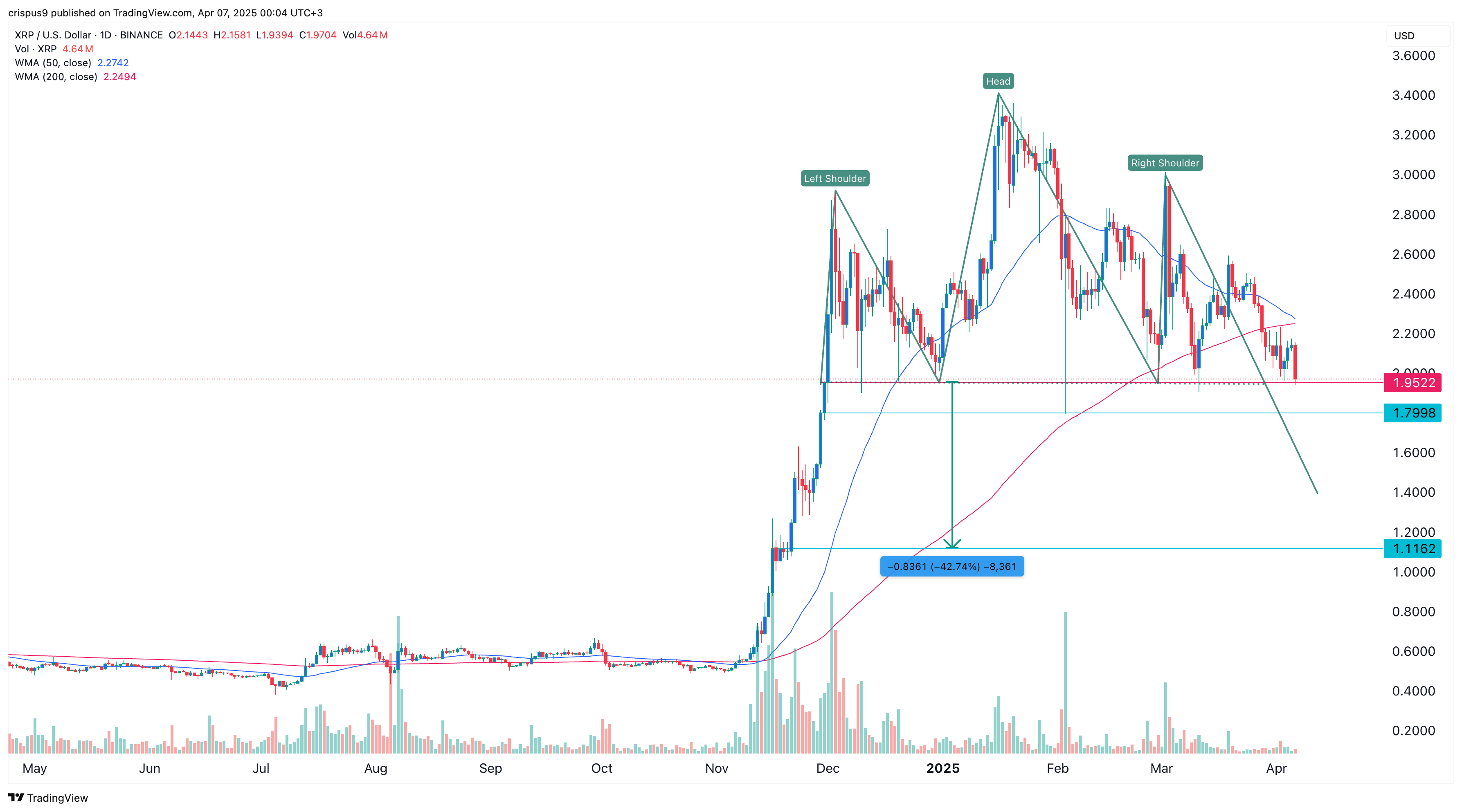
XRP price crashed to a crucial support level on Monday morning, signaling that bears are about to prevail and push it lower. Ripple plunged to a low of $1.9522, an essential support level where it has failed to move below several times since November last year. It has now retreated by 42% from its highest point this year.
XRP Price is at Risk of Having a Meltdown
There are three main reasons why the Ripple price is at risk of having a meltdown if it loses this crucial support level.
First, this support is significant since it is the neckline of the head and shoulders pattern, a popular bearish sign. This pattern comprises a head, two shoulders, and a neckline. A strong bearish breakout is usually confirmed when it drops below the neckline, which is about to happen.
The distance between the head and the neckline is 42%. Measuring that same distance from the neckline indicates an XRP price target of $1.1162, its lowest level since November of last year.
Second, there are signs that the XRP price has been in the Wyckoff Distribution Phase. This phase is usually characterized by sideways movements, preliminary supply, buying climax, automatic reaction, upthrusts, and the last point of supply. It is then followed by a breakdown, which ushers in the markdown phase.
The other risk is that the Ripple price is about to form a death cross, which happens when the 200-day and 50-day Weighted Moving Averages (WMA) cross each other. The spread between these averages has continued to narrow, meaning another leg down may lead to more downside.
The death cross can trigger a substantial meltdown in stocks and crypto. For example, in November, the last time the XRP price formed a golden cross—the opposite of the death cross—the coin staged a near 500% surge.
Still, all hope is not lost. Firstly, XRP has not yet moved below the neckline of the head and shoulders pattern. Also, it has not moved below the key support at $1.800, the false breakout on February 3rd.
The bearish breakdown will become invalidated if the XRP price moves above the right shoulder at $3. A move above that level will point to more gains, potentially to the YTD high of $3.4. Indeed, most traders on Kalshi expect the coin to end the year above $3.4.
Goldman Sachs revised down its annual average price forecasts again for Brent and WTI crude in 2026, citing increased recession risks and the possibility of higher-than-expected OPEC+ supply.
In a note dated April 6, the bank cut its 2026 average price forecast by $4 for Brent to $58 a barrel and WTI to $55.
The Wall Street brokerage initially trimmed on Friday its 2026 average price forecast for Brent to $62 and for WTI to $59, and warned that the new estimates could be further reduced.
Goldman Sachs now expects oil demand to grow by 300,000 barrels per day (bpd) in 2025, down from its previous forecast of 600,000 bpd, and to increase by 400,000 bpd in 2026.
The bank attributes the reduction in demand growth to the negative influence of a weaker GDP, which outweighs support from a weaker dollar and lower oil prices.
“Oil prices would likely exceed our forecast if the Administration were to reverse tariffs sharply and deliver a reassuring message to markets, consumers, and businesses,” Goldman said.
Oil prices slid on Monday, deepening last week’s losses, as escalating trade tensions between the United States and China stoked fears of a recession that would reduce demand for crude.
China on Friday struck back at the U.S tariffs imposed by President Donald Trump with a slew of counter-measures including extra levies of 34% on all U.S. goods and export curbs on some rare-earths.
Brent crude BRN1! was trading around $63.87 a barrel, as of 0321 GMT on Friday, while WTI CL1! was at $60.38.
“While the uncertainty around compliance and OPEC8+ production is very large, we still assume that the four months of OPEC8+ crude increases will total around 0.7-0.8 mb/d,” the bank added.
Design elements: Abbey Littlejohn and Getty Images. EatingWell design.
“Key Takeaways“
A healthy diet and hydration should be your first defense against constipation.
When these aren’t enough, certain supplements can provide safe, effective relief.
A gastroenterologist recommends psyllium, probiotics, magnesium and polyethylene glycol.
Constipation isn’t anyone’s ideal state of digestive affairs. The bloating, distension and overall discomfort of a gastrointestinal slow-down are a combo you’d probably prefer to skip. But for most of us, being backed up is an occasional fact of life (sometimes even a chronic one). Constipation is so common, in fact, that about 16% of U.S. adults say it’s a problem.
Fortunately, certain dietary supplements can help get things moving again. Though they may not work immediately, with a little patience, the right choices may make you feel lighter and brighter sooner than later. We tapped Sandhya Shukla, M.D., a board-certified gastroenterologist with Atlantic Coast Gastroenterology, a division of Allied Digestive Health, for her top supplement recommendations for constipation. She says the following five are worth a try.
1. Psyllium Husk
With its surging popularity on social media, psyllium husk may seem like a buzzy modern supplement. But it’s been used in Ayurvedic medicine as a natural remedy for constipation for thousands of years. What makes it so effective? Psyllium husk is rich in soluble fiber, which creates a slick, gel-like substance in the digestive tract that retains water. This, in turn, makes your poops easier to pass, Shukla says.
Besides psyllium’s ability to hold water, research reveals that it may also get things going by positively impacting gut microbiota. Those are the trillions of bacteria that regulate a healthy digestive tract. For instance, one small study found that supplementing with psyllium husk for four weeks led to beneficial changes in the gut microbiota of people with constipation. And another older study reported similar improvements in as little as one week.
Just note that psyllium husk can cause side effects in some people. (Shukla says a feeling of bloating is especially common.) You may want to start with a small dose to test your tolerance gradually. Also good to know: while supplements containing insoluble fiber may claim to ease constipation, they can actually make things worse. So, stick with soluble fiber-containing psyllium instead.
2. Probiotics
By now, you’ve probably heard of probiotics. These beneficial, live bacteria may be an inexpensive, over-the-counter means of maintaining a happy gut. Here’s a tip, though: don’t just choose any old strain you see. Current research shows that certain probiotic strains may be more helpful than others for specific health issues, including constipation.
One that has a solid track record is Lactobacillus reuteri. It works by getting your gut moving, helping you go more often., So, look for this strain specifically, or ask your doctor if another strain might be right for you.
3. Magnesium Oxide
Magnesium is often touted as a constipation preventer. However, with so many forms of this mineral on supplement shelves, it can be hard to distinguish which one is best. Shukla recommends magnesium oxide. Like psyllium husk, she says magnesium oxide draws more water into the stool, keeping things nice and soft to help with easier evacuation.
This form of magnesium may be particularly useful for treating chronic constipation that doesn’t have a known cause (also known as idiopathic constipation). In fact, the American Gastroenterological Association and American College of Gastroenterology recently released new guidelines recommending magnesium oxide as a pharmacological treatment for idiopathic constipation. But don’t be put off by the “pharmacological” terminology—magnesium oxide is available over the counter.
Shukla says you can find magnesium oxide in different strengths. “I usually recommend starting at 200 or 250 milligrams [per day] and increasing to a maximum of 1,000 milligrams per day.” She also notes that people with decreased kidney function should avoid taking magnesium, as it can build to dangerous levels if the kidneys are unable to filter it properly.
4. Polyethylene Glycol
Never heard of polyethylene glycol? You may have seen it in dietary supplements without realizing it’s there. This compound is the active ingredient in powdered supplements like MiraLax and its generic equivalents.
Shukla recommends polyethylene glycol for its ease of use and effectiveness in alleviating constipation. “It is tasteless and odorless and therefore well tolerated,” she says. “Its absorption from the gut is negligible, making it a safe and effective option for treating constipation.” And unlike over-the-counter laxatives that should only be used occasionally, it’s safe for longer-term use. For instance, one study found that polyethylene glycol was safe and effective in reducing the frequency of hard or lumpy stools in people with chronic idiopathic constipation over the course of 24 weeks.
5. Prunes and Prune Juice
Turns out, Grandma was onto something. While not a supplement per se, the old prune juice remedy really is a smart move for getting regular again. And there’s research to prove it. For instance, one study found that people with chronic constipation who drank slightly less than 2 ounces of prune juice daily for eight weeks experienced significantly fewer hard or lumpy stools. That makes it food as medicine for the win!
“Prunes have high dietary fiber and sorbitol, both helpful for treating constipation,” explains Shukla. “This contributes to increased stool bulk and improved bowel movements.” Just one-quarter cup of prunes (about 5 prunes) provides 3 grams of fiber. Sorbitol, on the other hand, is a naturally occurring sugar alcohol that offers some surprising benefits for digestive health. “Sorbitol has osmotic properties that draw water into the intestines, keeping stool soft and easy to expel,” says Shukla. In fact, some people with quick intestinal transit actually avoid sorbitol for this reason. So, if you want to give prunes or prune juice a try, start slowly.
The Bottom Line
When your digestive tract gets a bit sluggish, a healthy diet, proper hydration and exercise should be your first lines of defense. When they aren’t enough, the supplement aisle has safe, effective options for constipation relief. Psyllium husk, probiotics, magnesium oxidize and polyethylene glycol are all gastroenterologist-approved supplements for constipation relief. And if you’d prefer a more natural remedy, give prunes or prune juice a try. They may not be trendy, but they work!
The worldwide crypto market has witnessed a notable downturn over the past 24 hours. Diverse sectors like DeFi and NFTs have also experienced massive shocks in this respect. Particularly, the Fear & Greed Index has reached 34, indicating considerable “fear” in the market sentiment.
Crypto Market Experiences a Downturn as Top Crypto Assets Indicate
The latest statistics also present a bearish outlook for Bitcoin ($BTC) and Ethereum ($ETH). The key crypto assets stand at $83.5K and $1.81K, showing -0.4% and -0.2% price change. Additionally, the market capitalization ($2.77T) and 24-hour volume ($47.6B) of the crypto market have recorded -1.9% and -60% decrease.
The noteworthy mentions of the last 24 include Notcoin ($NOT), $GUNZ ($GUN), Particle ($PARTI), and RedStone ($RED). Specifically, Notcoin ($NOT) is the top crypto project on the CoinGecko. In addition to this, RedStone ($RED) is the top trending crypto project on CryptoRank.
What’s more, GUNZ ($GUN) has emerged as the top crypto gainer on the prominent crypto exchange Binance with a 62% price rise over 24 hours. On the other hand, Particle ($PARTI) has plunged by 17%, securing the position of the top loser crypto asset on Binance.
Taiko and Shadow Exchange Lead DeFi Ecosystem as Top Chain and Exchange
DeFi sector has gone through a slight decrease in its overall valuation. Based on the exclusive statistics, the total value locked (TVL) of the DeFi ecosystem has touched the $131B mark. This points out a plunge of up to 0.9%. The well-known DeFi projects have beheld notable changes in their TVL.
Taiko accounts for an 8.9% spike in TVL to become the top blockchain in terms of TVL growth. Nonetheless, NEO has slumped by 11% to get the position of top blockchain when it comes to TVL decrease. On the other hand, Shadow Exchange has become the top PJT in the case of TVL growth with a 7.2% rise.
Guild of Guardians, CryptoPunk #2200, and Yakuza Dominate NFT Sector
Concurrently, the NFT market also shows a 31% dip in its 24-hour volume which has reached the $3.1M spot. The key NFT performers include Guild of Guardians, CryptoPunk #2200, and Yakuza Pandas. Guild of Guardians denotes the top NFT collection in line with its volume which has touched $309K.
Along with that CryptoPunk #2200 stands as the most expensive NFT with its value reaching $92.9K. Moreover, Yakuza Pandas has recorded a 452% surge in volume, getting the place of top collection in terms of volume growth.
Institutional or Trending News
Bitcoin’s mining difficulty has gone through a 6.81% increase to touch the record-high spot of 121.51T. Parallelly, the tariff policy of Trump has removed $4.9T from the worldwide markets according to AJ Bell.
Apart from that, there is a possibility of a 2% increase in the US inflation during 2025 because of the anticipated economic slowdown. Keeping this in view, a recent Forbes poll highlights 72% votes categorizing Trump’s economic strategy ineffective.
Crypto journalist with years of experience providing in-depth analysis and news on blockchain and decentralized finance. With a keen eye for detail, Shahzaib delivers insightful articles that explore the latest trends, market movements, and innovations within the crypto and blockchain ecosystem. His work focuses on educating readers while offering expert commentary on the evolving landscape of digital assets, DeFi protocols, and the broader impact of blockchain technology.