Lymphedema is a build-up of a watery fluid in your body called lymph, causing chronic swelling, usually in an arm or leg. Lymph, which supports your overall health and your immune system function, flows from your tissues into the lymphatic vessels, and then through a cluster of nodes (lymph nodes) that filter out bacteria and other unwanted substances.
If any of the lymph nodes are removed or damaged as part of cancer treatment, the remaining nodes have to work harder to filter the lymph. They can then become inflamed or even blocked, so the lymph backs up into the tissue.
There’s no cure for lymphedema, but if you’re actively involved with your partner’s medical care, it’s helpful to know what you can do to help him manage the condition.There are actions you can take to help reduce your partner’s swelling, prevent infection, relieve discomfort and help improve their mobility.
“We want to make sure the [caregiver] is also aware of what’s going on, so that they can help with either massaging and helping the spouse, or arranging some ways of getting care,” said Pragnan Kancharla, MD, a medical oncologist and hematologist at MedStar Franklin Square Medical Center in Maryland.
Speaking with a specialized lymphedema specialist is helpful. But not everyone has access to one.
If your partner does develop lymphedema, it’s important to understand how you can help.
Lymphedema with prostate cancer
Where lymphedema occurs depends on where the affected lymph nodes are. For people with prostate cancer, lymphedema could affect the legs, penis, scrotum or lower body overall.
A radical prostatectomy, which removes the prostate and pelvic lymph nodes, is the most common cause of lymphedema among people who have prostate cancer. Radiation sometimes damages the nodes too. Men who have both surgery and radiation therapy are at higher risk of lymphedema, and the more nodes affected, the higher the risk.
Lymphedema could also be caused by:
Infection or other complications at the lymph node surgery site
A build-up of fluid near the wound, called a seroma
Advanced cancer
Diagnosing and starting treatment for lymphedema in the early stages can slow down its progress. Moderate to severe swelling can make it hard to walk and perform everyday activities.
Caring for someone with lymphedema at home
The simple act of elevating the affected leg can be quite helpful, Kancharla said. And doing some simple exercises can also help. Exercises move the lymph and encourage good range of motion around the joints — something that could become difficult if there is too much swelling.
A healthcare provider (HCP), physical therapist or lymphedema specialist can show you and your partner the best exercises to do. Many can even be done while sitting down.
Some exercises that are good for lymphedema include:
Marching on the spot or while sitting
Knee extension while seated, raising the leg and extending the knee
Toe extensions, also while seated, lifting your toes up as far as you can, then relaxing them
Here are some other tips you could assist your partner with to help reduce the swelling caused by lymphedema:
Manage weight: Having overweight or obesity can worsen lymphedema in the legs. It can also increase the risk of a skin infection called cellulitis. You or your partner could speak with a dietitian if you need help coming up with a healthier diet plan or if your partner could use some help getting to a healthy weight.
Decrease salt intake:Salt makes your body retain fluid, something to avoid if you have lymphedema. If you are preparing your partner’s food and flavor is a concern, many dishes taste good if you add fresh herbs instead of salt.
Drink plenty of water: The goal of lymphedema treatment is to reduce the fluid, but it’s still important for your partner to drink at least eight 8-ounce glasses of water each day. This helps flush out the unwanted fluids.
Wear loose clothing: Encourage your partner to avoid tight pants and socks (especially at the band). Well-fitting shoes are also important to prevent blisters or sores, which could become infected.
Protect skin: Remind your partner to keep his skin clean and dry to help prevent infection. If you help him with cutting toenails, be sure not to cut his cuticles. Also suggest long pants for gardening, walking or doing any activity where the legs could get scratched. Use sun protection (SPF 30 or higher) and insect repellents to stop bug bites.
Don’t ignore skin injuries: Treat any injuries to the skin right away by cleaning them, applying antibiotic ointment and covering them. Keep an eye on the site for any signs of infection, like redness or warmth. This will help reduce the risk of infections, cellulitis and a serious complication called sepsis
.
If your partner needs more help
If the first steps at home don’t work, there are other options. Your partner’s HCP can also refer him to other healthcare professionals, like occupational or physical therapists.
Compression stockings: According to Kancharla, sometimes patients must use compression stockings or massage for relief in addition to elevating the leg. Compression stockings are specially fitted for the leg to prevent fluid build-up in the tissue. A prescription is needed and the stockings must be fitted by a professional. Since these stockings can be hard to put on, ask the provider to show you the best way to do this and for any tips or tricks to make it easier. Compression stockings shouldn’t be borrowed from someone else because unfitted ones could worsen lymphedema.
Lymphatic drainage massage: Your partner’s HCP might recommend a special type of massage called manual lymphatic drainage. This isn’t the type of massage most of us are used to. A lymphatic drainage massage uses a gentle pressure to move the lymph fluid from the tissue toward the lymph nodes. Physical therapists and specially trained massage therapists and other HCPs can perform these massages. They can also be done at home by you or your partner, but it’s important to learn the technique from a qualified person.
Intermittent pneumatic compression: If the lymphedema is more severe, your partner’s HCP might prescribe intermittent pneumatic compression, which is done with a pump. A compression sleeve is wrapped around the leg and then inflated and deflated, stimulating the circulation. How long each session is depends on what the HCP recommends.
Managing costs
Exercises, doing lymphatic massages and eating a healthy diet are things that most people can do at home, butnot everyone can easily afford lymphatic massages done at a clinic or office, compression stockings, or pumps. Medicare does cover lymphedema compression treatment items though, as do some private insurance companies. Private insurance might also cover massages. It’s important that your partner apply for assistance if he needs it.
With you and your partner working as a team, you can help lessen anxiety and stress for both of you. By understanding your partner’s condition and treatment, you can also act as his advocate if necessary. “Lymphedema [with prostate cancer] is extremely rare now, something that we don’t see as often,” Kancharla said. “But if someone does have lymphedema, especially related to the tumor or cancer itself or post-surgery, we do have a lot of resources.”
This educational resource was created with support from Bayer and Merck.
Gold Price (XAU/USD) Rebounds to $4,085 as Shutdown Progress and Fed Dovish Bets Drive Bullish Momentum
Gold surged to $4,085 per ounce, extending last week’s recovery as investors priced in a near 70% chance of a December rate cut by the Federal Reserve. The rally comes amid weakening U.S. labor data, falling consumer sentiment, and signs of a possible end to the historic government shutdown — a combination that’s undermining the U.S. Dollar Index (DXY) and pushing safe-haven demand sharply higher.
The Senate’s 60–40 vote to reopen federal agencies reduced near-term political risk while triggering broad risk-on flows across markets. Yet, gold’s strength shows investors are betting that fiscal relief will lead to a weaker dollar and renewed liquidity — a classic setup that supports precious metals.
Weak U.S. Labor Market and Consumer Confidence Bolster Gold’s Upside
Fresh macro data from October revealed deep cracks in the U.S. job market. Over 150,000 layoffs were reported, marking the largest October job-cut total in over two decades. Meanwhile, the University of Michigan Consumer Sentiment Index plunged to 50.3, the lowest since mid-2022 and well below the forecasted 53.2.
The downturn reinforced investor conviction that the Fed will deliver another 25 basis point cut at the December meeting, reducing rates to the 3.50%–3.75% range. For XAU/USD, lower rates directly translate to reduced opportunity costs, making the metal more attractive than yield-bearing assets.
Traders note that the recent slowdown in Non-Farm Payroll growth, averaging just 95,000 per month in 2025 versus 200,000+ in 2023–2024, signals fading momentum across multiple sectors. These data points continue to anchor bullish sentiment around gold, as rate-sensitive investors hedge against further U.S. economic weakness.
Central Bank Demand and Emerging Market Buying Support Long-Term Bullish Structure
Central bank accumulation remains one of the most powerful undercurrents in gold’s rally. According to the World Gold Council, global central banks — led by China, India, and Turkey — have collectively added over 800 tonnes of gold in 2025 through Q3.
Emerging markets continue to diversify reserves away from U.S. Treasuries and into gold amid persistent currency volatility. This structural trend has created a floor under gold prices near the $3,900–$4,000 range, insulating the market from deeper corrections.
Institutional flows confirm similar behavior, with ETFs recording three consecutive weeks of inflows totaling over $3.1 billion. This surge reflects renewed conviction that XAU/USD remains undervalued relative to its inflation-hedge appeal and central bank hoarding pace.
Technical Outlook: XAU/USD Retests Resistance as Trend Turns Fully Bullish
Technically, gold has re-established its bullish trajectory. After bouncing off the 20-day EMA near $3,981, buyers defended the $4,000 psychological level and pushed prices toward the $4,085 zone, confirming renewed upward strength.
Key resistance now stands near $4,100–$4,130, with an extension target of $4,265, last month’s high. If momentum persists, the market could retest the October record near $4,380, before a broader advance toward $4,400–$4,500.
On the downside, immediate support is positioned at $4,025, followed by $3,900 at the 50-day EMA. Momentum indicators remain constructive — the RSI at 54 and a bullish MACD crossover signal a continued upward bias.
Shutdown Resolution and Fiscal Impact Create Double-Edged Reaction for Gold
While the Senate’s move to end the shutdown temporarily boosts investor confidence, the fiscal implications could paradoxically support gold further. Reopened federal spending raises long-term deficit projections, adding to structural debt concerns that historically fuel gold accumulation.
Analysts emphasize that the shutdown’s resolution is not inherently bearish for gold. Although it may cause a short-lived USD bounce, broader market interpretation leans toward higher fiscal outflows, delayed growth, and lower yields — all favorable for gold’s medium-term outlook.
Traders are now watching how the Treasury market absorbs the $125 billion in new issuance this week. Should yields remain subdued despite supply expansion, XAU/USD could see another leg higher toward $4,200 before mid-November.
Fed Policy Expectations Remain the Dominant Catalyst
Markets continue to price a 64%–70% chance of a December rate cut as inflation slows and growth data weaken. Fed officials’ tone has softened, with policymakers hinting that policy tightening has achieved sufficient disinflation.
Lower real rates historically create a twofold benefit for gold: they diminish the relative yield advantage of bonds and weaken the dollar’s purchasing power. The current DXY range around 99.5 underscores fading demand for the greenback, with multiple analysts projecting further downside toward 98.7 in Q4.
The bond market reinforces this narrative — the 10-year Treasury yield (BX:TMUBMUSD10Y) holding near 4.11% reflects stable nominal yields against falling inflation expectations, creating the ideal backdrop for sustained XAU/USD strength.
Institutional Strategies Shift Toward Defensive Positioning in Gold
Institutional traders are increasingly using bull call spreads and put-sell combinations to capture upside while managing volatility. With volatility metrics subdued and implied skew favoring calls, options desks indicate rising appetite for $4,200–$4,400 strike exposure through December.
Funds also appear to be rotating from equities into commodities — particularly gold and silver — amid valuation concerns in AI and tech sectors. Silver, gold’s industrial counterpart, has gained 1% this week, hovering near $50 per ounce with 65% year-to-date performance, reflecting broader precious metal strength.
Market data shows speculative long positions in COMEX gold futures increasing by over 8% week-on-week, the largest net build since March. These leveraged inflows align with strong ETF demand, confirming synchronized institutional optimism.
Dollar Devaluation Trade and Fiscal Risk Keep Gold’s Bullish Case Intact
Despite the brief recovery in risk assets, the dollar-devaluation trade remains the key macro narrative supporting gold. Analysts highlight persistent deficits, rising interest costs, and expanding debt-to-GDP ratios as the primary long-term drivers for gold’s appreciation.
Experts warn that even a temporary delay in the next rate cut won’t derail the bullish thesis, as the underlying real yield compression and fiscal imbalance maintain structural support for precious metals.
Forecasts from leading institutions reinforce this trajectory — Goldman Sachs targets $5,055, Bank of America $5,000, and UBS $4,700 under its upside scenario by 2026. Consensus targets for Q1 2026 cluster around $4,200–$4,400, implying moderate upside but strong retention above current levels.
TradingNews Verdict: BUY Bias Maintained
After analyzing labor weakness, rate expectations, central bank accumulation, and technical resilience, TradingNews maintains a decisive BUY outlook on Gold (XAU/USD). Support at $4,000 remains firm, while upside potential stretches toward $4,200–$4,400 in the short term and $5,000+ over the next 12 months.
Gold continues to stand as the preferred macro hedge in an environment of dovish monetary policy, fiscal expansion, and dollar devaluation. Unless the Fed surprises with hawkish rhetoric or DXY rebounds above 100.3, the path of least resistance remains upward.
The technical and fundamental alignment — from Fed expectations to central bank flows — confirms that gold’s bullish cycle remains intact, positioning XAU/USD as one of the most resilient trades heading into 2026.
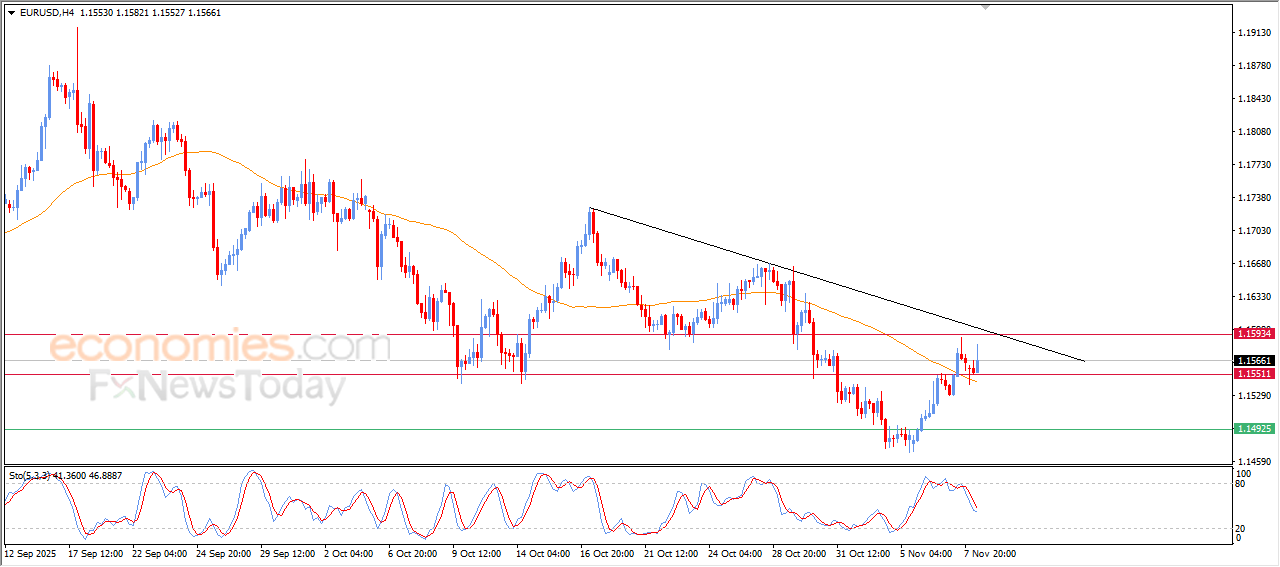
Support Levels for EUR/USD Today: 1.1520 – 1.1460 – 1.1390
Resistance Levels for EUR/USD Today: 1.1610 – 1.1690 – 1.1770
EUR/USD Trading Signals:
Buy EUR/USD from the support level of 1.1480 with a target of 1.1700 and a stop-loss at 1.1400.
Sell EUR/USD from the resistance level of 1.1700 with a target of 1.1500 and a stop-loss at 1.1780.
Technical Analysis of EUR/USD Today:
The ongoing US government shutdown and the divergent market expectations for the future policies of the US Federal Reserve continue to heavily influence the trajectory of the US Dollar against other major currencies, as well as the rest of the global financial markets. The US government shutdown is preventing the release of US jobs figures, which are the most important economic data affecting market expectations for the future of Federal Reserve policy. In addition to that report, US inflation readings are due to be announced this week.
Prior to that, the EUR/USD pair attempted to recover from its three-month lows when it plunged to the 1.1468 support level last week, but the cautious upward rebound gains did not exceed the 1.1592 resistance level before closing the week stabilized around the 1.1560 level.
Will the EUR/USD pair fall to the 1.1400 support level?
According to Forex currency trading experts’ forecasts, the bearish outlook for the EUR/USD pair was confirmed by its stabilization below the 1.1600 support. As I mentioned before, this opens the door for further downward pressure on the currency pair, which has happened. The continuation of the bearish outlook does not rule out a drop to the 1.1400 support level, especially since the technical indicators, which have turned bearish, have room to move downward before reaching the oversold zone. Currently, the 14-day Relative Strength Index (RSI) is around a reading of 44, below the neutral line, and at the same time, the MACD indicator lines are steadily leaning downward.
Conversely, on the same timeframe, the daily chart indicates a strong bullish scenario for the EUR/USD pair, requiring a move towards the psychological resistance level of 1.1800. Today’s EUR/USD trading is not focused on any major US economic releases; the only anticipated indicator is the Sentix Eurozone Consumer Confidence Index, due at 11:30 AM Cairo time.
Trading Tips:
The EUR/USD gains will remain vulnerable to rapid collapse until investor confidence returns to the market, which could happen with the end of the US government shutdown.
The future of US central bank policy is becoming increasingly uncertain.
The prospects for US monetary policy remained ambiguous following the recent wave of statements from Federal Reserve officials. Divisions among Fed policymakers persisted in the wake of last Wednesday’s US interest rate cut, raising doubts about their ability to agree on another cut at their anticipated meeting on December 9-10. While some officials openly supported further monetary easing, others expressed reluctance, if not opposition, to cutting US interest rates again next month.
In short, the overall tone of official statements on Thursday and earlier this week reinforced Federal Reserve Chair Jerome Powell’s assertion that a December US interest rate cut is “not a given.”
John Williams, President of the New York Fed, one of Powell’s most prominent aides as Vice Chair of the policy-making FOMC, had been supportive of policy easing in recent weeks to address labor market weakness, but last Thursday he limited his comments to saying the bank must adhere to its 2% inflation target and strive for “price stability.”
Meanwhile, Austin Goolsbee, president of the Federal Reserve Bank of Chicago, who voted for rate cuts in September and October, appeared less insistent on another rate cut on Thursday, particularly given the lack of economic data from the closed federal government. He saw “stabilization” in the labor market and expressed deep concern about inflation in the absence of statistics. Meanwhile, Beth Hammack, president of the Federal Reserve Bank of Cleveland, who will join the Federal Open Market Committee (FOMC) voting line next year, was more vocal in her opposition to another near-term rate cut, arguing that inflation is a greater concern than the struggling labor market and emphasizing the need for monetary policy to remain “in a fairly restrictive position to achieve the right balance of our objectives.”
Overall, for the second consecutive meeting, the FOMC lowered the US interest rate by 25 basis points on October 29 to a target range of 3.75% to 4.0%. However, in an unusually split decision, Federal Reserve Governor Stephen Miran opposed a 50-basis point cut, while Kansas City Fed President Jeffrey Schmid opposed the decision, favoring keeping rates unchanged.
In addition to this easing move, the FOMC moved faster than many expected to halt “quantitative tightening” by the end of this month. The FOMC had cut the interest rate by the same amount on September 17 to a target range of 4.0% to 4.25%. In its revised Summary of Economic Projections, published in September, FOMC participants anticipated another 25 basis points of monetary easing at the Committee’s final meeting in 2025.
Despite 25 basis points remaining in the September “dot plot,” Powell stressed in his October 29 press conference that a rate cut on December 9-10 “is not a foregone conclusion, far from it.” He noted “sharp differences in views on how to proceed in December.” He added that the FOMC has cut the federal funds rate by 150 basis points since it began easing monetary policy in September 2024, making policy now “150 basis points closer to neutral.” He added that this prompts some officials to “pause” and “wait” before easing policy further, while others wish to “move forward” with more easing.
Powell said the FOMC “will resume monetary easing at some point,” but added that it is trying to deal with a “difficult” and “complex” situation that requires “balancing” the two-sided risks—either in favor of inflation or in favor of jobs. In this climate, he said it is appropriate to be “cautious.” He added that if there is a “high degree of uncertainty” on December 10, “that might justify caution about moving.”
Iron deficiency is globally widespread. Women are particularly affected, with one in five in Europe suffering from iron deficiency. The consequences are anemia, constant fatigue, chronic headaches and a weakened immune system. Researchers led by ETH professor Raffaele Mezzenga have now developed a new dietary supplement that could efficiently treat iron deficiency and anemia. This development is being co-led by Michael B. Zimmermann, professor emeritus at ETH Zurich. The preparation consists of edible oat protein nanofibrils coated with iron nanoparticles. The corresponding study has just been published in the journal Nature Food.
The new iron compound is not only easy to produce but also extremely effective: the iron it contains is absorbed by the body almost twice as well as iron administered from iron sulphate – the currently most widely used standard for iron supplementation. This is shown by a rigorous clinical study conducted by Mezzenga’s project partners in Thailand. They administered the compound to 52 women aged 18 to 45 who were suffering from anemia due to iron deficiency.
Vegans and vegetarians could benefit
The novel preparation has several advantages. Being based on plant proteins means that it is suitable for vegetarians and vegans. “This is important because they are more likely to suffer from iron deficiency than meat-eaters: the body absorbs iron from animal foods better than iron from plant-based foods,” says ETH professor Mezzenga.
The new compound has further advantages: it is tasteless and colourless, meaning it does not substantially alter a food’s taste or appearance. Iron sulphate, in contrast, gives food a metallic aftertaste.
“Sensory properties play a major role in consumer acceptance of food additives,” says Jiangtao Zhou, the first author of the study and Mezzenga’s former postdoctoral researcher and currently an assistant professor at the National University of Singapore. The oat protein iron supplement is also very easy to take: it can either be dissolved in water or juice, or added to food in powder form – muesli, for instance.
“However, the clinical study shows that the supplement is best absorbed when it is dissolved in water,” says Mezzenga.
Those with an iron deficiency often take iron in the wrong form
Iron occurs naturally in red meat, lentils and whole grains. Premenopausal women have a particularly high iron requirement of 18 milligrams per day. The daily requirement for men is lower, at 11 milligrams. Nevertheless, around 15 percent of men also suffer from iron deficiency. To combat this, people resort to iron supplements that the body is often unable to absorb sufficiently and require iron infusions in the case of severe iron deficiency.
Patented technology and potential for further products
The researchers originally used animal proteins to develop their iron supplement process a few years ago; however, the same patent covers all food protein sources, including those that are plant based. It has by now been granted in Europe and the USA.
Mezzenga and his colleagues now hope that the iron-enriched oat protein fibres will soon be able to be used in a variety of ways. “The hurdles for launching a dietary supplement are lower than those for a pharmacological product,” explains the ETH professor, who aims to further develop the technology to combat other deficiencies, such as zinc and selenium.
Source:
Journal reference:
Zhou, J., et al. (2025). Oat protein nanofibril–iron hybrids offer a stable, high-absorption iron delivery platform for iron fortification. Nature Food. doi: 10.1038/s43016-025-01260-6. https://www.nature.com/articles/s43016-025-01260-6
Ethereum value, ethereum price. Photo by BeInCrypto
Welcome to the US Crypto News Morning Briefing—your essential rundown of the most important developments in crypto for the day ahead.
Grab a coffee as Ethereum takes back the headlines with big predictions flying. Some say the next surge is just around the corner, while others caution that hidden assumptions and long timelines could make the hype more complicated than it seems.
Fundstrat’s Tom Lee recently made headlines with a bold forecast that Ethereum (ETH) could reach $60,000 in the near future.
The crypto executive cited the migration of real-world assets (RWA) onto the blockchain as the primary catalyst for this shift.
“The total size of global financial markets is 200 trillion, maybe more. How much of that ends up on blockchains? According to Larry Fink, the idea is to move 100% of this onto the blockchain. So we’re talking trillions of dollars of assets moving onto layer one blockchains,” he stated.
Lee shared his perspective during an interview, framing Ethereum as a potential global financial settlement layer.
According to Lee, Ethereum’s market cap of around $440 billion pales in comparison to the $200–300 trillion in global financial assets, including stocks, bonds, and real estate.
Even a fraction of these assets, Lee suggests, 0.5% to 1%, moving on-chain could, in his view, multiply Ethereum’s network value several times. This, in his opinion, justifies his $60,000 target.
He also highlighted Ethereum’s strong validator network, decade-long uptime, and alignment with Wall Street’s growing interest in tokenization as key tailwinds supporting long-term growth.
However, crypto analyst BitWu critiqued Lee’s forecast, describing it as overly reliant on what he calls a “typical RWA narrative.” The analyst cautioned that Lee’s model rests on two hidden assumptions:
That all real-world assets will settle on Ethereum’s mainnet, and,
That Ethereum’s price will directly reflect settlement volume.
While both assumptions are “reasonable,” BitWu argues, they oversimplify the unique mix of macroeconomic factors, regulatory clarity, and infrastructure maturity that will ultimately determine Ethereum’s trajectory.
“ETH at $60,000 USD is no problem [but not this year]. In about three years, I think it’s possible! Why do I say that? The true breakout point for RWA, I believe may be in 2026-2028, depending on the macroeconomic interest rate cycle + regulatory clarity + maturity of on-chain infrastructure (especially L2 and compliant chains),” BitWu explained.
He emphasized that the RWA trend is less about short-term price spikes and more about Ethereum’s long-term status as a foundational financial infrastructure.
During the interview, Lee also stressed Ethereum’s unique position as a smart contract blockchain, enabling tokenization beyond simple digital dollars.
He highlighted stablecoins as a breakout product this year, allowing fractional payments and finality in transactions. Based on this, the Fundstrat executive suggested that future tokenization could extend to equities, bonds, real estate, and even prediction markets.
While both Lee and BitWu agree on Ethereum’s long-term potential, the divide lies in timing and scale.
On the one hand, Lee frames the opportunity as a mathematical certainty once adoption occurs. On the other hand, BitWu cautions that adoption will be gradual, constrained by regulatory, macroeconomic, and technological realities.
Meanwhile, this is not the first time Tom Lee’s Ethereum prediction is dismantled. A US Crypto News publication in late September saw Andrew Kang challenge Tom Lee’s bullish ETH thesis as “financially illiterate.”
The EURJPY pair affected by stochastic positivity, form bullish waves to retest the barrier at 177.85, to settle below it to keep the chances of activating the bearish corrective track, note that the initial corrective target in the current trading near 177.05 level, by providing negative momentum that might help it to reach near 175.85 support.
While confirming regaining the bullish bias requires forming a new bullish rally, to open the way a new chance to press on the top at 178.70. surpassing it will make it record new gains by its rally towards 179.30 and 180.00.
The expected trading range for today is between 177.00 and 178.15
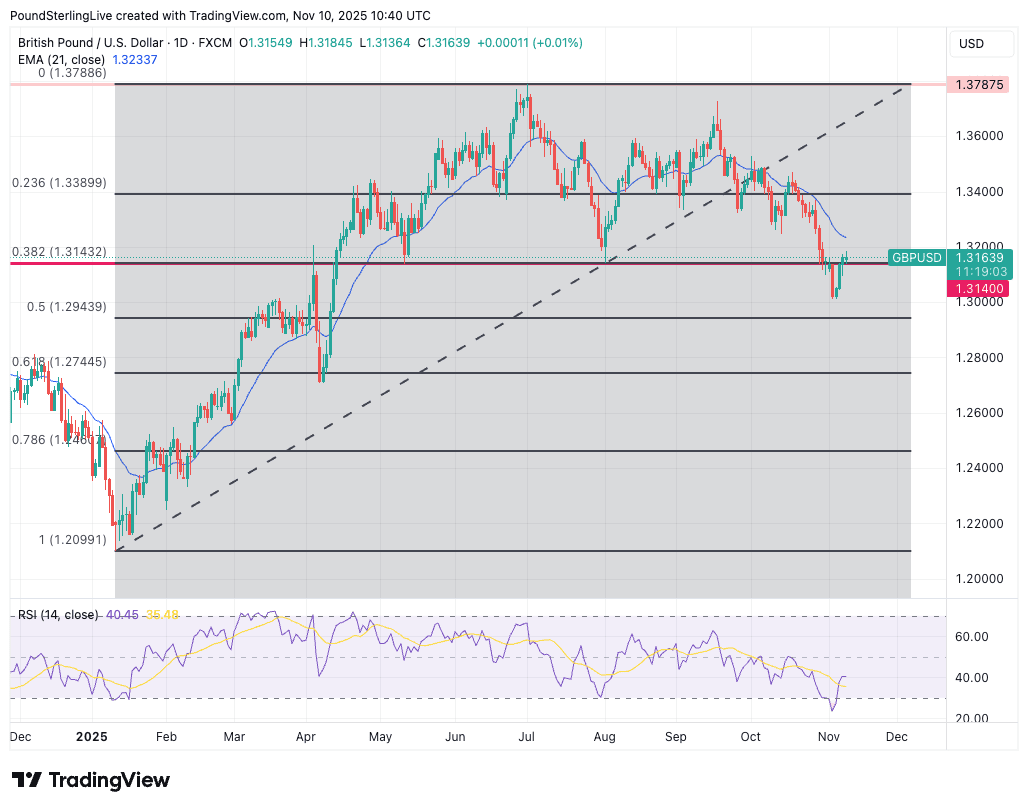
GBP/USD rebound reflects an unwinding of oversold conditions rather than the start of a sustained uptrend, with gains likely capped near 1.3235.
The pound to dollar exchange rate (GBP/USD) reached its lowest level since April last week at 1.3010, but has since recovered to 1.3170.
The recovery is shallow and lacks the vigour that would normally be associated with a bottoming pattern, leaving us wary of a continuation of the selloff.
This is why we would characterise the current rally as a mean reversion, and not the start of a renewed push higher.
The pair looks to be recovering from the oversold conditions seen at the start of the month, the culmination of the steady selling pressure seen through the course of October.
The RSI – lower panel in the chart – had fallen below 30, which triggers caution and indicates that those oversold conditions must unwind.
Exchange rates tend to mean-revert, and we are seeing that in GBP/USD. The week ahead forecast looks for that to play out a little further, targeting a move to the 21-day exponential moving average at 1.3235.
Above: GBP/USD looks to be eyeing a return to the 21-day EMA (blue line). Note the bounce out of oversold on the RSI in lower panel.
However, while below this EMA the pair is in a downtrend and the relief could attract more sellers, ready to target new multi-month lows.
1.3010 is the new post-April low, and below here is a potential support region; the 50% Fibonacci retracement of the Q1-2025 rally.
How far GBP/USD can travel will depend on Tuesday’s UK labour market data, where the unemployment rate is expected to have fallen to 4.9% in October from 4.8% in September, owing to rising unemployment and inactivity.
A more severe deterioration in the headline employment numbers would trigger a selloff in the pound, undermining our tactical expectation for a short-term recovery.
Also, keep an eye on the wage figures, as this is closely associated with inflation. The figure to beat is 4.6%.
Quarterly GDP is due Thursday, where the consensus looks for a 0.2% increase in Q3. The UK economy has actually been doing OK this quarter, according to the PMI surveys and retail sales data.
This means a beat on expectations can’t be ruled out. If it happens, then GBP/USD can end the week above 1.3235.
Stateside, there will be no official U.S. data owing to the government shutdown, which deprives us of a previously scheduled inflation data release.
This is one of the two marquee economic calendar events in any given month, the other being non-farm payroll data.
Nevertheless, “attention this week will turn to remarks from several Fed officials, which could provide new clues on how the central bank is balancing softening consumer confidence with a fragile labour market,” says Konstantinos Chrysikos, Head of Customer Relationship Management at Kudotrade.
Above: The Fed’s Waller speaks Wednesday.
“Dovish remarks could weigh on both the dollar and yields,” he adds.
Markets see a 65% probability of a December rate cut, which signals ample scope for a repricing in either direction, based on the tone of upcoming commentary and non-official data releases.
The weekend saw some progress towards ending the record-long government shutdown, with Senate Democrats voting through a procedural measure to advance a bill to pass funding.
“It looks like we’re getting closer to the shutdown ending,” President Donald Trump said Sunday.
Senate Majority Leader John Thune said over the weekend that a bipartisan budget framework is taking shape.
There’s no clear timeline for the reopening, which means the Fed’s December policy meeting will happen without official data to assess.
However, sentiment would receive a boost on a reopening of government, setting the scene for a recovery in stocks, which would weigh on the dollar.
Japan must assert its cultural claims to matcha to avoid it being buried in a landslide of Chinese tea powder
By David Fickling / Bloomberg Opinion
If you think it is hard work selling coal to Newcastle or ice to an Inuit, how about selling matcha to Japan?
That is what China is hoping to achieve, as the biggest tea producer spots an opportunity in the worldwide craze for putting Japan’s richly flavored green tea powder into everything from lattes and cookies to cheesecake and KitKats.
Japanese public broadcaster NHK last month visited a factory in China’s Guizhou Province that is producing 2,000 tonnes of matcha a year, almost half of Japan’s annual output. China is already by some measures the bigger grower: About 3,966 tonnes were processed in 2020, accounting for more than half of the tea sold in a market valued at US$4.53 billion.
Illustration: Yusha
With China dominating electric vehicles, smartphones, furniture and solar panels, it might feel inevitable that matcha would go the same way. Still, Japan could do more to defend itself against the onslaught. Adopting the more aggressive techniques used in Europe would be a good place to start.
In terms of mass-market production, the game has surely already been lost. China has 30 times as much farmland as Japan and produces about 50 times more green tea.
Matcha production can be labor-intensive: It has to be grown in the shade, and in Japan is often harvested with handheld machine cutters and processed in small-scale facilities that are struggling to keep up with the explosion in demand.
Judging by current trends, the vast majority of matcha is going to end up in soft-serve ice-cream, chiffon cakes, mochi and macarons. It would be a waste if Japan tried to chase that low-end business, when the opportunities at the top of the market are so much more alluring.
To take advantage, Japan’s tea industry needs to be far more assertive about what makes it special. Geographical indications (GI), the trademark-style laws that prevent Californian wine producers from calling their sparkling cuvees “champagne,” are still a relative novelty there. Europe has been protecting its unique agricultural products for more than a century, with early regulations even turning up in the 1919 Treaty of Versailles that ended World War I. Japan did not pass its first GI law until 2015, and still seems to be of two minds about it.
Kobe beef, the super-expensive, marbled meat farmed exclusively from the Tajima strain of cattle in Hyogo Prefecture northwest of Osaka, was one of the first products to be registered under the rules. Every kilogram exported is tracked by a local marketing association, but it is still common to find locally raised “Kobe beef” and “Kobe-style beef” on the shelves of US supermarkets, because the trademark is not recognized there.
You cannot sign a major trade agreement with the EU without recognizing its GI system, but Japan has progressively lowered its tariffs on US beef imports in the past few years, without winning any concessions on this point. The estate of basketballer Kobe Bryant enjoys better intellectual property protection in the US than the meat he was named after.
Matcha, to be sure, has a fundamental problem here. The term — “ground tea,” as opposed to the infused sencha — just describes a routine processing method, like the “cheddaring” of dairy curds which gives cheddar cheese its un-trademark-able name.
That is not insurmountable: There are numerous local varieties, such as Uji matcha and Fukuoka matcha, that could trade on their reputations, the way Bordeaux wine estates do.
It is not clear that Japan has an appetite for the fight. The EU has nearly 2,000 protected wines and spirits, according to its eAmbrosia register. Japan has designated just two types of tea, both of them sencha.
In Nishio, one of the most renowned matcha growing regions, the local growers’ cooperative got itself removed from the register in 2020, after finding that domestic drinkers were not prepared to pay prices to compensate for the laborious methods required by the geographical indication.
That is a defeatist approach. Matcha is a global craze and need not be limited by local appetites. Champagne is a case in point: It owes its origins as much to English glassblowers, chemists and consumers as to French farmers.
Japan has as much cultural capital now as it has had for decades. The stellar reputation of its food products is not being matched by commensurate efforts to protect and market them to international buyers.
Taking advantage of this is not an easy process, especially as a warming climate alters the unique local conditions that GI designations depend on (a record heat wave is one reason that matcha supplies are struggling to keep up with demand this year). However, in a world that would soon be buried under a drift of Chinese tea powder, it would be necessary. Some of the world’s great fortunes were built on the decades of efforts that turned champagne from a local oddity into a worldwide luxury good. In the matcha game, Japan has to be in it to win it.
David Fickling is a Bloomberg Opinion columnist covering climate change and energy. Previously, he worked for Bloomberg News, the Wall Street Journal and the Financial Times. This column reflects the personal views of the author and does not necessarily reflect the opinion of the editorial board or Bloomberg LP and its owners.
Bitcoin (BTC) price surged
above $106,000 and gold (XAU) jumped nearly 2% today (Monday), November 10,
2025, as the U.S. Senate voted 60-40 to advance legislation ending the longest
government shutdown in American history. The dual rally reflects dollar
weakness and improved risk sentiment as eight Democratic senators agreed to a
GOP funding deal, marking the 15th attempt by Senate Majority Leader John Thune
to secure bipartisan support.
I am looking in this article for an answer to why
Bitcoin and gold are surging today. I also provide a technical analysis of the
BTC/USDT and XAU/USD charts, based on more than ten years of experience as an
analyst and active retail investor.
The political
resolution triggered sharp improvements across crypto markets.
Ethereum surged over 7% to trade above $3,600, while XRP and Solana both
advanced approximately 6%. Total cryptocurrency market capitalization added
$156 billion in 24 hours, climbing to $3.57 trillion as long positions flooded
back into the market. Bitcoin open interest increased by nearly $700 million,
signaling aggressive position-building by traders anticipating further upside.
Markets
reacted swiftly to the temporal correlation between legislative advancement and
price movements. The Senate vote occurred Sunday, November 9, immediately
sparking the crypto rebound after weeks of suppressed sentiment due to
political gridlock and broader macroeconomic uncertainty. Bitcoin had tumbled
into bear market territory last week, falling over 20% from its October record
high of $126,080. The cryptocurrency remains more than 15% below that peak but
has recovered strongly from recent lows near $100,000.
Crypto prices are up today. Source: CoinMarketCapc.om
Joel
Kruger, crypto strategist at LMAX, noted: “The crypto market enters the
week on a solid footing, with Bitcoin closing last week above its 50-week
moving average and reaffirming the broader uptrend that has defined much of
this year. The mid-week dip we discussed proved to be another buying
opportunity rather than the start of any meaningful correction, with price
support at key technical levels attracting renewed demand across digital
assets.”
Why Gold Price Is Going Up
Today?
Gold prices
rallied nearly 2% on Monday, rebounding almost $80 per ounce to reach $4,085 as
the Senate shutdown vote pressured the U.S. dollar. According to my technical
analysis of the gold chart, XAU/USD is capitalizing on support just below the
$4,000 level, additionally reinforced by the 50-day exponential moving average,
and now has room to appreciate toward the historical highs tested in October
around $4,400 per ounce.
The only
scenario that would contradict this bullish outlook would be a breakdown of
current support, which would open the path to deeper correction toward the
$3,400 level where the 200 EMA also runs.
The dual
rally in both Bitcoin and gold represents a rare market phenomenon
where traditional safe havens and risk assets advance simultaneously. This
reflects the unique dynamics of the shutdown resolution, removing political
uncertainty (boosting risk assets) while simultaneously weakening the dollar
(supporting safe havens).
Why gold is going up today? Source: tradingview.com
Chris
Turner, ING analyst, observed: “Risk assets have been helped over the
weekend by news that a group of moderate Democrat senators are softening their
stance on the US government shutdown. There is still a long way to go here, but
we should know over the next couple of days whether the current compromise bill
has legs.”
FX markets
responded by pushing the risk-sensitive Australian dollar close to 0.5% higher,
while USD/JPY climbed over 154 as the yen served as funding currency for risk
trades. Turner explained: “While some might argue that the end of the
shutdown could be a risk-on, dollar-negative impulse for the FX markets, its
impact may be more mixed.”
The dollar
weakness stems from the shutdown resolution enabling federal spending
to resume, potentially increasing fiscal concerns that traditionally support
gold. Additionally, political stability allows the Federal Reserve to maintain
its dovish trajectory, with December rate cut probability still above 64%.
Lower rates reduce the opportunity cost of holding non-yielding gold while
typically weakening the dollar—a double benefit for precious metals.
According
to my technical analysis, Bitcoin’s price is rising 1.7% on Monday and testing
session highs at $106,670 on Binance exchange, adding to Sunday’s gains and
producing a 4% advance over the past 24 hours. As visible on the chart, price
is bouncing from the lower boundary of the consolidation drawn continuously
since May, coinciding
with psychological support at $100,000 and the 50% Fibonacci retracement.
Currently,
price is stalling at the resistance zone around 106,000-108,000 dollars,
supported by the 38.2% Fibonacci retracement and 200 EMA. From my analysis,
this zone may determine the future direction within the current consolidation
pattern.
If Bitcoin
breaks above the grid of 50 and 200 EMAs and current resistance, it will open
the path to retesting the October all-time high around $126,000. If it fails to
overcome this resistance, risk increases for a move back below $100,000, falling
ultimately to $74,000. The cryptocurrency is currently trading at
$106,403.31, still below its 50-day moving average of $112,050 but showing
strong recovery momentum.
Joel Kruger
emphasized: “Momentum has since spilled over into Ethereum and the broader
altcoin complex, reinforcing the view that the market remains well-anchored
within a strong medium-term bullish structure. This resilience comes against a
macro backdrop that is once again turning supportive.”
What Happens Next?
The Senate
bill now moves to a full floor vote in coming days, followed by House
consideration. Market observers assign high probability to passage, with
prediction market Myriad showing over 90% chance the government closure ends
before November 15—up from 37% just 24 hours earlier.
For Bitcoin,
according to my technical analysis, breaking decisively above the
106,000-108,000 resistance zone would open the path toward retesting October’s
$126,000 all-time high. Failure to overcome this resistance increases the risk
of retreat below $100,000, though most analysts view the technical and
fundamental backdrop as supportive.
Gold faces resistance at historical
highs around $4,400 per ounce. According to my analysis, support is holding at
the critical $4,000 level reinforced by the 50 EMA. Dollar weakness from
resumed government spending and Fed dovishness should provide tailwinds for
further precious metals appreciation.
Turner
cautioned: “If last week’s 100.36 high in DXY is to prove significant, it
should not really be making it back above the 99.90/100.00 area now.” This
suggests dollar downside may be limited, potentially capping gold’s immediate
upside while still supporting the broader bullish trend.
The coming
48 hours in Congress will determine whether the shutdown compromise “has
legs,” with markets positioned for positive resolution but prepared for
continued volatility if the deal falters.
Before you leave, I encourage you to also check my earlier analyses and forecasts on gold and Bitcoin:
Bitcoin and Gold Price
Analysis FAQ
Why is Bitcoin going up
today?
Bitcoin is
surging 4.38% to $106,274 on Monday, November 10, 2025, primarily due to the
U.S. Senate’s 60-40 vote advancing legislation to end the historic 40-day
government shutdown. The cryptocurrency bounced from support at the
psychological $100,000 level after eight Democratic senators agreed to a GOP
funding deal, removing political uncertainty that had weighed on risk assets.
Why is gold rising today?
Gold
rallied nearly 2% on Monday, rebounding almost $80 per ounce to reach $4,085,
as the Senate shutdown vote pressured the U.S. dollar. The precious metal is
benefiting from dollar weakness stemming from expectations that resumed
government spending will increase fiscal concerns, while political stability
allows the Federal Reserve to maintain its dovish trajectory with December rate
cut probability above 64%.
What is Bitcoin price
prediction for November 2025?
Bitcoin
price forecasts for November 2025 vary significantly across analysts. Changelly
predicts Bitcoin could reach $129,042 by November 13, representing a 26% gain
from current levels. CoinCodex forecasts BTC will rise 4.48% to $127,142 by
November 17 if it reaches upper price targets, with technical indicators
currently showing bearish sentiment despite the recent rally.
What is gold price
prediction for 2025-2026?
Major
institutions forecast gold between $4,200-$5,000 per ounce by late 2026. UBS
projects gold reaching $4,200 as the next baseline target, with an upside
scenario of $4,700 by Q1 2026 if geopolitical risks intensify. Goldman Sachs
forecasts $5,055 by Q4 2026, while Bank of America targets $5,000 (averaging
$4,400 for the full year). ING expects more conservative near-term targets of
$4,000 for Q4 2025 and $4,100 for Q1 2026, with further upside through 2026.
How high can Bitcoin go?
Industry
experts project Bitcoin could reach $180,000-$200,000 during 2025, according to
forecasts compiled by CNBC. Youwei Yang, chief economist at Bit Mining,
predicts Bitcoin’s price will range between $180,000 and $190,000 in 2025,
though he warns of potential corrections to around $80,000 during market
shocks.
What are the risks to
Bitcoin and gold rallies?
For
Bitcoin, primary risks include failure to break above the $106,000-$108,000
resistance zone (which would increase probability of retreat below $100,000),
Federal Reserve speakers signaling slower pace of rate cuts (December cut
probability has dropped to 64%), and potential for corrections to $80,000
during major market shocks according to analyst warnings.
Bitcoin (BTC) price surged
above $106,000 and gold (XAU) jumped nearly 2% today (Monday), November 10,
2025, as the U.S. Senate voted 60-40 to advance legislation ending the longest
government shutdown in American history. The dual rally reflects dollar
weakness and improved risk sentiment as eight Democratic senators agreed to a
GOP funding deal, marking the 15th attempt by Senate Majority Leader John Thune
to secure bipartisan support.
I am looking in this article for an answer to why
Bitcoin and gold are surging today. I also provide a technical analysis of the
BTC/USDT and XAU/USD charts, based on more than ten years of experience as an
analyst and active retail investor.
The political
resolution triggered sharp improvements across crypto markets.
Ethereum surged over 7% to trade above $3,600, while XRP and Solana both
advanced approximately 6%. Total cryptocurrency market capitalization added
$156 billion in 24 hours, climbing to $3.57 trillion as long positions flooded
back into the market. Bitcoin open interest increased by nearly $700 million,
signaling aggressive position-building by traders anticipating further upside.
Markets
reacted swiftly to the temporal correlation between legislative advancement and
price movements. The Senate vote occurred Sunday, November 9, immediately
sparking the crypto rebound after weeks of suppressed sentiment due to
political gridlock and broader macroeconomic uncertainty. Bitcoin had tumbled
into bear market territory last week, falling over 20% from its October record
high of $126,080. The cryptocurrency remains more than 15% below that peak but
has recovered strongly from recent lows near $100,000.
Crypto prices are up today. Source: CoinMarketCapc.om
Joel
Kruger, crypto strategist at LMAX, noted: “The crypto market enters the
week on a solid footing, with Bitcoin closing last week above its 50-week
moving average and reaffirming the broader uptrend that has defined much of
this year. The mid-week dip we discussed proved to be another buying
opportunity rather than the start of any meaningful correction, with price
support at key technical levels attracting renewed demand across digital
assets.”
Why Gold Price Is Going Up
Today?
Gold prices
rallied nearly 2% on Monday, rebounding almost $80 per ounce to reach $4,085 as
the Senate shutdown vote pressured the U.S. dollar. According to my technical
analysis of the gold chart, XAU/USD is capitalizing on support just below the
$4,000 level, additionally reinforced by the 50-day exponential moving average,
and now has room to appreciate toward the historical highs tested in October
around $4,400 per ounce.
The only
scenario that would contradict this bullish outlook would be a breakdown of
current support, which would open the path to deeper correction toward the
$3,400 level where the 200 EMA also runs.
The dual
rally in both Bitcoin and gold represents a rare market phenomenon
where traditional safe havens and risk assets advance simultaneously. This
reflects the unique dynamics of the shutdown resolution, removing political
uncertainty (boosting risk assets) while simultaneously weakening the dollar
(supporting safe havens).
Why gold is going up today? Source: tradingview.com
Chris
Turner, ING analyst, observed: “Risk assets have been helped over the
weekend by news that a group of moderate Democrat senators are softening their
stance on the US government shutdown. There is still a long way to go here, but
we should know over the next couple of days whether the current compromise bill
has legs.”
FX markets
responded by pushing the risk-sensitive Australian dollar close to 0.5% higher,
while USD/JPY climbed over 154 as the yen served as funding currency for risk
trades. Turner explained: “While some might argue that the end of the
shutdown could be a risk-on, dollar-negative impulse for the FX markets, its
impact may be more mixed.”
The dollar
weakness stems from the shutdown resolution enabling federal spending
to resume, potentially increasing fiscal concerns that traditionally support
gold. Additionally, political stability allows the Federal Reserve to maintain
its dovish trajectory, with December rate cut probability still above 64%.
Lower rates reduce the opportunity cost of holding non-yielding gold while
typically weakening the dollar—a double benefit for precious metals.
According
to my technical analysis, Bitcoin’s price is rising 1.7% on Monday and testing
session highs at $106,670 on Binance exchange, adding to Sunday’s gains and
producing a 4% advance over the past 24 hours. As visible on the chart, price
is bouncing from the lower boundary of the consolidation drawn continuously
since May, coinciding
with psychological support at $100,000 and the 50% Fibonacci retracement.
Currently,
price is stalling at the resistance zone around 106,000-108,000 dollars,
supported by the 38.2% Fibonacci retracement and 200 EMA. From my analysis,
this zone may determine the future direction within the current consolidation
pattern.
If Bitcoin
breaks above the grid of 50 and 200 EMAs and current resistance, it will open
the path to retesting the October all-time high around $126,000. If it fails to
overcome this resistance, risk increases for a move back below $100,000, falling
ultimately to $74,000. The cryptocurrency is currently trading at
$106,403.31, still below its 50-day moving average of $112,050 but showing
strong recovery momentum.
Joel Kruger
emphasized: “Momentum has since spilled over into Ethereum and the broader
altcoin complex, reinforcing the view that the market remains well-anchored
within a strong medium-term bullish structure. This resilience comes against a
macro backdrop that is once again turning supportive.”
What Happens Next?
The Senate
bill now moves to a full floor vote in coming days, followed by House
consideration. Market observers assign high probability to passage, with
prediction market Myriad showing over 90% chance the government closure ends
before November 15—up from 37% just 24 hours earlier.
For Bitcoin,
according to my technical analysis, breaking decisively above the
106,000-108,000 resistance zone would open the path toward retesting October’s
$126,000 all-time high. Failure to overcome this resistance increases the risk
of retreat below $100,000, though most analysts view the technical and
fundamental backdrop as supportive.
Gold faces resistance at historical
highs around $4,400 per ounce. According to my analysis, support is holding at
the critical $4,000 level reinforced by the 50 EMA. Dollar weakness from
resumed government spending and Fed dovishness should provide tailwinds for
further precious metals appreciation.
Turner
cautioned: “If last week’s 100.36 high in DXY is to prove significant, it
should not really be making it back above the 99.90/100.00 area now.” This
suggests dollar downside may be limited, potentially capping gold’s immediate
upside while still supporting the broader bullish trend.
The coming
48 hours in Congress will determine whether the shutdown compromise “has
legs,” with markets positioned for positive resolution but prepared for
continued volatility if the deal falters.
Before you leave, I encourage you to also check my earlier analyses and forecasts on gold and Bitcoin:
Bitcoin and Gold Price
Analysis FAQ
Why is Bitcoin going up
today?
Bitcoin is
surging 4.38% to $106,274 on Monday, November 10, 2025, primarily due to the
U.S. Senate’s 60-40 vote advancing legislation to end the historic 40-day
government shutdown. The cryptocurrency bounced from support at the
psychological $100,000 level after eight Democratic senators agreed to a GOP
funding deal, removing political uncertainty that had weighed on risk assets.
Why is gold rising today?
Gold
rallied nearly 2% on Monday, rebounding almost $80 per ounce to reach $4,085,
as the Senate shutdown vote pressured the U.S. dollar. The precious metal is
benefiting from dollar weakness stemming from expectations that resumed
government spending will increase fiscal concerns, while political stability
allows the Federal Reserve to maintain its dovish trajectory with December rate
cut probability above 64%.
What is Bitcoin price
prediction for November 2025?
Bitcoin
price forecasts for November 2025 vary significantly across analysts. Changelly
predicts Bitcoin could reach $129,042 by November 13, representing a 26% gain
from current levels. CoinCodex forecasts BTC will rise 4.48% to $127,142 by
November 17 if it reaches upper price targets, with technical indicators
currently showing bearish sentiment despite the recent rally.
What is gold price
prediction for 2025-2026?
Major
institutions forecast gold between $4,200-$5,000 per ounce by late 2026. UBS
projects gold reaching $4,200 as the next baseline target, with an upside
scenario of $4,700 by Q1 2026 if geopolitical risks intensify. Goldman Sachs
forecasts $5,055 by Q4 2026, while Bank of America targets $5,000 (averaging
$4,400 for the full year). ING expects more conservative near-term targets of
$4,000 for Q4 2025 and $4,100 for Q1 2026, with further upside through 2026.
How high can Bitcoin go?
Industry
experts project Bitcoin could reach $180,000-$200,000 during 2025, according to
forecasts compiled by CNBC. Youwei Yang, chief economist at Bit Mining,
predicts Bitcoin’s price will range between $180,000 and $190,000 in 2025,
though he warns of potential corrections to around $80,000 during market
shocks.
What are the risks to
Bitcoin and gold rallies?
For
Bitcoin, primary risks include failure to break above the $106,000-$108,000
resistance zone (which would increase probability of retreat below $100,000),
Federal Reserve speakers signaling slower pace of rate cuts (December cut
probability has dropped to 64%), and potential for corrections to $80,000
during major market shocks according to analyst warnings.
The Federal Reserve has held rates steady since September, but the combination of softer employment data and declining business confidence has prompted speculation that policymakers may ease monetary conditions to support demand heading into 2026.
Weak Labor Market Fuels Safe-Haven Demand
The latest labor data underscored the fragility of the US job market. Private employers cut 153,000 jobs in October, the steepest monthly decline in over two decades. Layoffs in the government and retail sectors, coupled with an uptick in corporate cost-cutting, heightened fears of a broader slowdown.
Consumer sentiment also dropped to its lowest level in nearly three and a half years, according to a University of Michigan survey, as Americans grew increasingly concerned about inflation, fiscal uncertainty, and the prolonged government shutdown.
These developments have pushed investors toward precious metals, which tend to perform well in times of economic uncertainty and falling interest-rate expectations.
Silver Tracks Gold Higher on Industrial Outlook
Silver followed gold higher, supported by its dual role as both a safe-haven and an industrial metal. Analysts at Metals Focus noted that expectations of weaker Treasury yields and a potential rebound in manufacturing activity could sustain silver’s momentum.
With market attention turning to Fed speeches and upcoming inflation data, traders are closely watching whether policymakers confirm growing market bets on a softer monetary path through year-end.