The main category of Forex News.
You can use the search box below to find what you need.
[wd_asp id=1]
The main category of Forex News.
You can use the search box below to find what you need.
[wd_asp id=1]
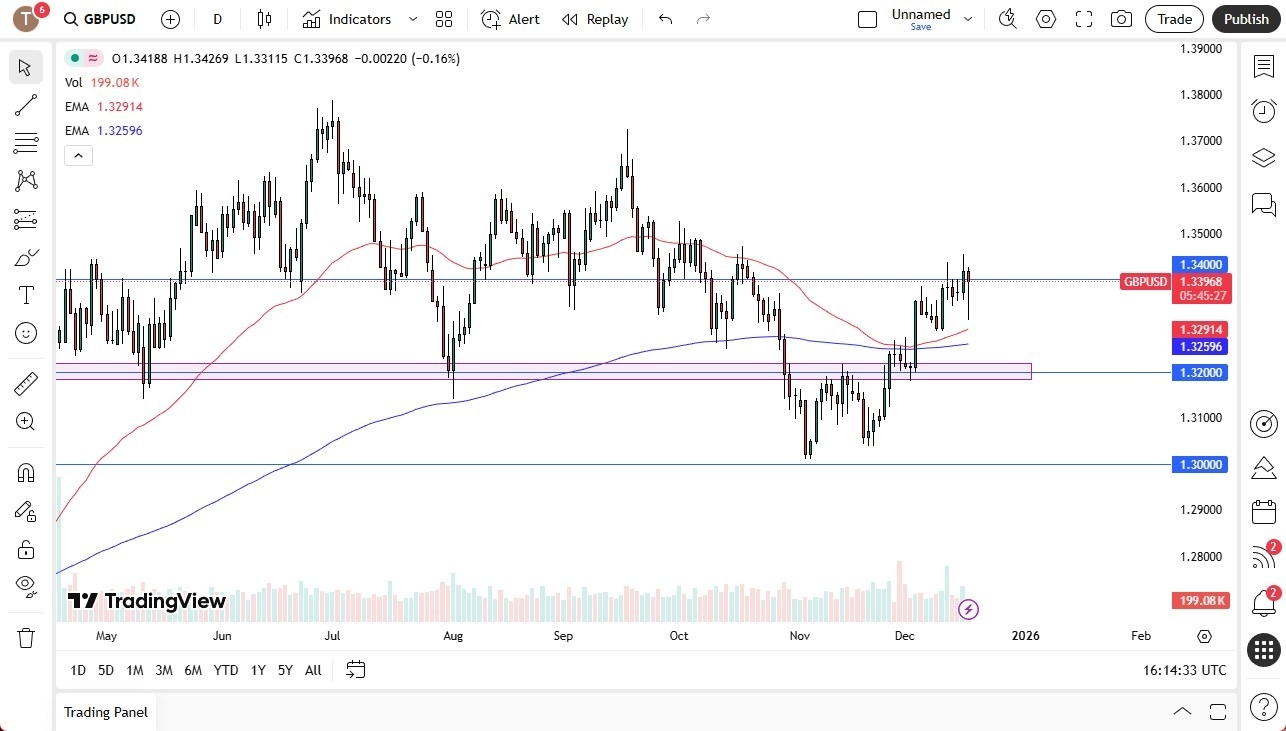
The British pound has been all over the place during the session on Wednesday, which is not a surprise considering that we have the Bank of England interest rate decision coming out on Thursday. With that being the case, I think it’s very difficult to get overly aggressive here. But I also recognize that market participants will continue to perhaps extract a little bit of momentum from the idea that although there’s probably going to be a rate cut coming out of London, it will be the statement and the press conference that will drive everything.

After all, people will want to know the forward guidance. It was interesting because the British pound sold pretty early during the day, but as soon as the Americans came on board, they started buying it back up, shorting the US dollar. This has been the pattern for a while, where the US dollar loses strength once the Americans start trading it. Europeans seem to want it, and at this point, I think there isn’t too much to read from this chart.
Going into the central bank decision, other than people are nervous. The 1.34 level has been like a significant magnet for price. And if we can break above the 1.35 level, then I think we clear resistance and start going much higher. If we turn around and fall from here, then we go looking at the 200-day EMA.
All things being equal, I do think that the British pound probably performs better than many other currencies against the dollar, be it up or down. While England does have an interest rate cut in its short-term future, the reality is that inflation has been a little sticky, so we’ll have to wait and see how that plays out. But this may be very much like about a year and a half ago, when, while the US dollar strengthened and the British pound fell, it didn’t fall as much as other currencies.
And then when the US dollar started weakening, the British pound was a huge winner. With all that being said, I think we see more of that. I think the US dollar will determine where we go next, not necessarily the British pound, but the British pound will outperform others. And therefore, I watch this chart quite closely.
Ready to trade our daily GBP/USD Forex forecast? Here’s some of the best forex broker UK reviews to check out.
Important DisclaimersFXEmpire is owned and operated by Empire Media Network LTD., Company Registration Number 514641786, registered at 7 Jabotinsky Road, Ramat Gan 5252007, Israel. The content provided on this website includes general news and publications, our personal analysis and opinions, and materials provided by third parties. This content is intended for educational and research purposes only. It does not constitute, and should not be interpreted as, a recommendation or advice to take any action, including making any investment or purchasing any product. Before making any financial decision, you should conduct your own due diligence, exercise your own discretion, and consult with competent advisors. The content on this website is not personally directed to you, and we do not take into account your individual financial situation or needs. The information contained on this website is not necessarily provided in real time, nor is it guaranteed to be accurate. Prices displayed may be provided by market makers and not by exchanges. Any trading or other financial decision you make is entirely your own responsibility, and you must not rely solely on any information provided through the website. FXEmpire does not provide any warranty regarding the accuracy, completeness, or reliability of any information contained on the website and shall bear no responsibility for any trading losses you may incur as a result of using such information. The website may include advertisements and other promotional content. FXEmpire may receive compensation from third parties in connection with such content. FXEmpire does not endorse, recommend, or assume responsibility for the use of any third-party services or websites. Empire Media Network LTD., its employees, officers, subsidiaries, and affiliates shall not be liable for any loss or damage resulting from your use of the website or reliance on the information provided herein.Risk DisclaimersThis website contains information about cryptocurrencies, contracts for difference (CFDs), and other financial instruments, as well as about brokers, exchanges, and other entities trading in such instruments. Both cryptocurrencies and CFDs are complex instruments and involve a high risk of losing money. You should carefully consider whether you understand how these instruments work and whether you can afford to take the high risk of losing your money. FX Empire encourages you to conduct your own research before making any investment decision and to avoid investing in any financial instrument unless you fully understand how it works and the risks involved.
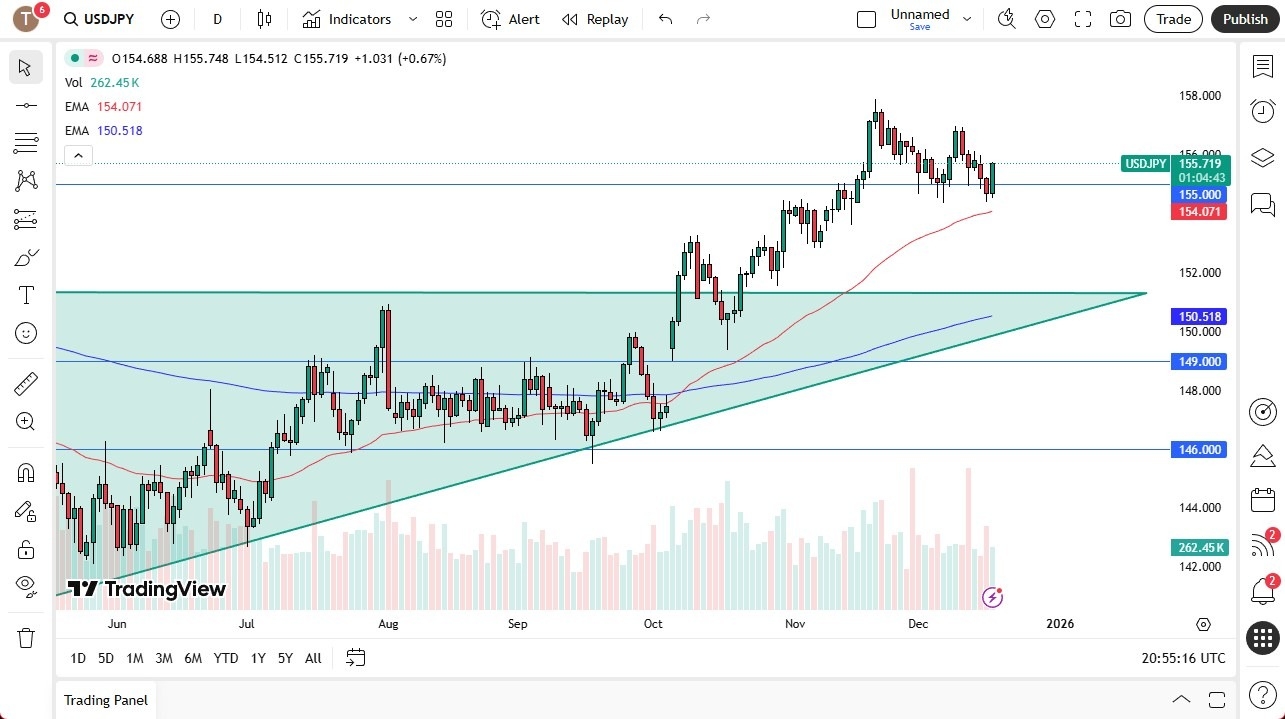
The US dollar has risen quite nicely against the Japanese yen during trading here on Wednesday as we continue to see the area just below the 155 yen level offer a bit of a floor. Furthermore, the 50-day EMA sits underneath there as well, offering support. So, really, at this point in time, I think you have a buy on the dip situation. If the market can rally from here, the 157 yen level is an area that I’ll be watching, but let’s also keep in the back of our mind that we have the Bank of Japan interest rate decision on Friday.
Now, while I fully anticipate that the interest rate differential will continue to favor the United States, the reality is that there could be a little bit of volatility around that interest rate decision. So be aware of that. I don’t necessarily think that is a good or bad thing. I think it’s just a thing. So, with this, I remain fairly confident in the overall trend of this market. I think it is probably only a matter of time before it goes higher.
But the question now is, will the 50-day EMA hold? We will probably know midday on Friday whether or not the market has the momentum to continue racing towards 158 yen or if we need to pull back a little further in order to start buying. I have no interest in shorting this pair. Quite frankly, there’s really nothing on this chart that even remotely suggests that you should be doing it. Although you can make an argument, maybe we can consolidate between 154 and 158 over the next several weeks, especially as we go into the holiday season. But beyond that, I don’t really see anything negative here.
Want to trade our USD/JPY forex analysis and predictions? Here’s a list of forex brokers in Japan to check out.
Christopher Lewis has been trading Forex and has over 20 years experience in financial markets. Chris has been a regular contributor to Daily Forex since the early days of the site. He writes about Forex for several online publications, including FX Empire, Investing.com, and his own site, aptly named The Trader Guy. Chris favours technical analysis methods to identify his trades and likes to trade equity indices and commodities as well as Forex. He favours a longer-term trading style, and his trades often last for days or weeks.
Natural gas price attempted to resist the negative pressures by ending the negative trading after testing the bullish channel’s support to $3.880, forming a positive rebound by its stability near $4.080.
We couldn’t confirm regaining the bullish attempts unless breaching the barrier at $4.200 and providing positive close above it, therefore, we expect providing mixed trading and there is a chance for providing new pressures on the main support, while breaching the barrier and holding above will provide strong chance to begin achieving several gains, to expect its rally initially towards $4.510.
The expected trading range for today is between $3.900 and $4.200
Trend forecast: Bearish
After spending the first half of the day under bearish pressure on Wednesday, EUR/USD stage a late rebound to close marginally lower. The pair stays quiet near 1.1750 in the European morning on Thursday as investors stay on the sidelines ahead of the European Central Bank’s (ECB) monetary policy announcements and November inflation data from the US.
The table below shows the percentage change of Euro (EUR) against listed major currencies this week. Euro was the strongest against the New Zealand Dollar.
| USD | EUR | GBP | JPY | CAD | AUD | NZD | CHF | |
|---|---|---|---|---|---|---|---|---|
| USD | -0.01% | 0.12% | 0.03% | 0.06% | 0.65% | 0.68% | -0.12% | |
| EUR | 0.00% | 0.13% | 0.02% | 0.06% | 0.69% | 0.69% | -0.10% | |
| GBP | -0.12% | -0.13% | 0.00% | -0.07% | 0.55% | 0.55% | -0.24% | |
| JPY | -0.03% | -0.02% | 0.00% | 0.04% | 0.64% | 0.64% | 0.08% | |
| CAD | -0.06% | -0.06% | 0.07% | -0.04% | 0.62% | 0.62% | -0.02% | |
| AUD | -0.65% | -0.69% | -0.55% | -0.64% | -0.62% | 0.00% | -0.79% | |
| NZD | -0.68% | -0.69% | -0.55% | -0.64% | -0.62% | -0.00% | -0.79% | |
| CHF | 0.12% | 0.10% | 0.24% | -0.08% | 0.02% | 0.79% | 0.79% |
The heat map shows percentage changes of major currencies against each other. The base currency is picked from the left column, while the quote currency is picked from the top row. For example, if you pick the Euro from the left column and move along the horizontal line to the US Dollar, the percentage change displayed in the box will represent EUR (base)/USD (quote).
The ECB is widely anticipated to leave key rates unchanged after the last meeting of the year. Revised macroeconomic projections could influence the Euro’s valuation. In case there is a positive revision to Eurozone growth expectations, investors could see this as a sign of a neutral/hawkish policy outlook next year. In this scenario, EUR/USD could regather its bullish momentum. Conversely, a downward revision to inflation forecasts, combined with a weaker growth outlook, could weigh on the Euro with the immediate reaction.
Following the ECB event, investors will pay close attention to the US inflation data. On a yearly basis, the Consumer Price Index (CPI) and the core CPI are forecast to rise by 3.1% and 3%, respectively, in November. In case the headline CPI comes in above the market expectation, the USD could hold its ground and cause EUR/USD to stretch lower. On the other hand, a soft CPI print could revive expectations for another Federal Reserve (Fed) rate cut in January and trigger another leg lower in the USD, opening the door for a bullish EUR/USD action in the American session.
According to the CME FedWatch Tool, markets are currently pricing in about a 25% probability of a 25-basis-points Fed rate cut next month.
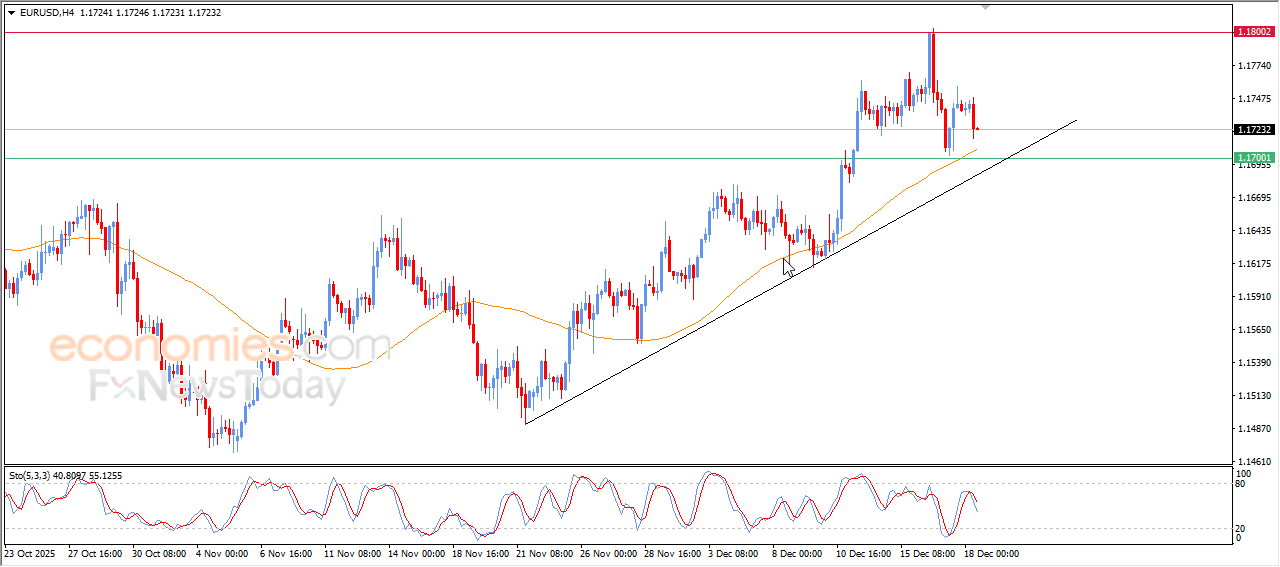
The 20-period Simple Moving Average (SMA) has flattened around price, while the 50-, 100- and 200-period SMAs rise at 1.1705, 1.1662 and 1.1608, keeping a bullish alignment with spot above them. The Relative Strength Index (14) stands at 54, neutral and edging higher.
Immediate resistance aligns at 1.1765 (mid-point of the ascending regression channel), followed by 1.1800-1.1810 (round level, upper limit of the ascending channel).
The lower limit of the ascending channel and the 50-period SMA form a support area at 1.1700-1.1700, followed immediately by the rising trend line near 1.1680. A close below the latter could attract technical sellers and trigger another lef lower toward the 100-period SMA near 1.1660.
(The technical analysis of this story was written with the help of an AI tool).
The Euro is the currency for the 20 European Union countries that belong to the Eurozone. It is the second most heavily traded currency in the world behind the US Dollar. In 2022, it accounted for 31% of all foreign exchange transactions, with an average daily turnover of over $2.2 trillion a day.
EUR/USD is the most heavily traded currency pair in the world, accounting for an estimated 30% off all transactions, followed by EUR/JPY (4%), EUR/GBP (3%) and EUR/AUD (2%).
The European Central Bank (ECB) in Frankfurt, Germany, is the reserve bank for the Eurozone. The ECB sets interest rates and manages monetary policy.
The ECB’s primary mandate is to maintain price stability, which means either controlling inflation or stimulating growth. Its primary tool is the raising or lowering of interest rates. Relatively high interest rates – or the expectation of higher rates – will usually benefit the Euro and vice versa.
The ECB Governing Council makes monetary policy decisions at meetings held eight times a year. Decisions are made by heads of the Eurozone national banks and six permanent members, including the President of the ECB, Christine Lagarde.
Eurozone inflation data, measured by the Harmonized Index of Consumer Prices (HICP), is an important econometric for the Euro. If inflation rises more than expected, especially if above the ECB’s 2% target, it obliges the ECB to raise interest rates to bring it back under control.
Relatively high interest rates compared to its counterparts will usually benefit the Euro, as it makes the region more attractive as a place for global investors to park their money.
Data releases gauge the health of the economy and can impact on the Euro. Indicators such as GDP, Manufacturing and Services PMIs, employment, and consumer sentiment surveys can all influence the direction of the single currency.
A strong economy is good for the Euro. Not only does it attract more foreign investment but it may encourage the ECB to put up interest rates, which will directly strengthen the Euro. Otherwise, if economic data is weak, the Euro is likely to fall.
Economic data for the four largest economies in the euro area (Germany, France, Italy and Spain) are especially significant, as they account for 75% of the Eurozone’s economy.
Another significant data release for the Euro is the Trade Balance. This indicator measures the difference between what a country earns from its exports and what it spends on imports over a given period.
If a country produces highly sought after exports then its currency will gain in value purely from the extra demand created from foreign buyers seeking to purchase these goods. Therefore, a positive net Trade Balance strengthens a currency and vice versa for a negative balance.
Hindustan Copper Ltd (NSE: HINDCOPPER, BSE: 513599) surged in Thursday’s trade (December 18, 2025), climbing about 5% and hovering just shy of its 52-week high zone. By early afternoon, the stock was trading around ₹387–₹388, while the broader metal pack also stayed positive. [1]
What made the move stand out wasn’t only the price: it was the activity. Hindustan Copper featured among the day’s most actively traded names by value, with turnover around ₹401.8 crore and volume above 1.06 crore shares in the session’s early hours—classic “crowd just showed up” behaviour. [2]
Below is a detailed news-and-analysis wrap of what’s happening as of 18.12.2025, plus the major forecasts (commodity and company-related), broker views, and the key risks market participants are watching.
Intraday data points were loud and clear: buyers were willing to chase the stock closer to its 52-week ceiling.
At the sector level, the BSE Metal index was also higher (around +0.7% at the time of reporting), which matters because metals rallies often move in packs—macro tailwinds first, stock-specific momentum second. [7]
One caution flag inside the excitement: MarketsMojo noted that delivery volume (a proxy for “I’m holding this overnight”) on Dec 17 was lower than the 5-day average, even as intraday turnover spiked—suggesting a meaningful chunk of the day’s action could be short-term trading rather than long-term accumulation. [8]
Hindustan Copper is, at heart, a copper-linked business—so the global copper tape matters even when there’s no company-specific announcement on the day.
Reuters reported copper moving toward $12,000/ton, driven by tightening supply and demand growth linked to AI data centers and power infrastructure, with analysts projecting deficits continuing into 2026. [9]
But forecasts are not unanimous in tone:
Translation: copper’s structural story (electrification + AI + grid buildout) remains compelling, but the “straight line up” narrative is contested—even among big-name research desks.
A key reason Hindustan Copper continues to get “re-rated” attention in 2025 is the capacity-expansion storyline.
Moneycontrol previously highlighted the company’s plan to increase mining capacity to 12.2 MT by FY31 (from 3.47 MT in FY25) and outlined ~₹2,000 crore in capex over 5–6 years. [12]
Separately, credit rating agency ICRA reiterated an expectation of healthy FY2026 performance and referenced ongoing capex plans (₹2,000 crore) aimed at scaling mine capacity, while also flagging the dependence on copper prices. [13]
When a commodity producer pairs a favourable tape with a credible multi-year volume ramp, markets tend to do what markets do: price the optionality early and argue about execution later.
One of the most concrete recent corporate developments is the 02.12.2025 MoU with NTPC Mining Ltd.
In its exchange intimation, Hindustan Copper said it executed an MoU to jointly participate in copper and critical minerals block auctions, develop/operationalize blocks, and explore collaboration across domestic and overseas copper/critical mineral projects. [14]
For investors, this matters less as an immediate earnings trigger and more as a signal: the company is positioning itself as a broader “critical minerals” participant, not only a legacy copper miner.
Hindustan Copper’s Chile angle has been building through 2025.
A Government of India Press Information Bureau release (June 2025) noted that a CODELCO delegation visited India, following an MoU focused on knowledge sharing in exploration, mining, beneficiation, and capacity building. [15]
On the deal-speculation/strategic front, NDTV Profit reported in October 2025 that Hindustan Copper was assessing acquisition of two Chile copper mines via a JV with CODELCO, citing sources and noting an HCL team would visit Chile for assessment. [16]
And Business Today also reported (Nov 2025) that India’s mines secretary said HCL was in discussions with CODELCO, describing the possibility of a JV framework. [17]
For the stock, offshore optionality tends to function like narrative leverage: it can amplify optimism during upcycles, but it also raises the bar for execution discipline and capital allocation.
Even “other-company” news can be a breadcrumb for HCL capex activity.
On Dec 11, 2025, The Economic Times (PTI) reported SEPC settled a dispute with Hindustan Copper (₹30.45 crore settlement) and received a supplementary work order worth ₹72.5 crore tied to an ongoing vertical shaft sinking project. [18]
This doesn’t automatically mean a meaningful earnings impact for HCL, but it does reinforce that mine-related project execution is actively progressing in the ecosystem around it.
Hindustan Copper’s most recent quarterly print helped keep sentiment buoyant going into year-end.
The Economic Times (PTI) reported that for Q2 FY26 (Sep quarter), the company posted consolidated net profit of ₹186.02 crore (up ~85% YoY), with income rising to ₹728.95 crore. [19]
The same report also noted that some smelting/refining operations at Jhagadia and Ghatsila have been suspended since 2019 due to business considerations—important context when modelling how the company participates across the copper value chain. [20]
According to Trendlyne’s aggregation of broker research, Hindustan Copper has an average share price target of ₹450, implying about 16% upside from ~₹386.85, based on 1 analyst / 1 report. [21]
A single-analyst consensus is not a “consensus” in the way Nifty50 mega-caps have one—so treat it as a reference point, not a crowd-sourced truth.
Investing.com’s daily technical read (timestamped Dec 18, 2025) showed a “Strong Buy” summary across both technical indicators and moving averages. At the same time, some oscillators flashed overbought conditions (for example, RSI(14) ~71 and StochRSI showing overbought). [22]
This combination—strong trend + overbought signals—often translates into two plausible near-term paths:
ICRA’s Oct 2025 report said the rating reaffirmation factors in an expectation of healthy financial performance in FY2026, supported by firm copper prices and improving operating performance, while also acknowledging exposure to copper-price fluctuations and execution factors. [23]
With the stock trading within striking distance of its 52-week high band, the chart conversation gets simple (and intense):
Also notable: the stock’s run-up is happening with significant intraday participation, which can exaggerate both breakouts and shakeouts. [26]
A rally this strong naturally raises the uncomfortable dinner-table question: “Is it getting expensive?”
Equitymaster pegged Hindustan Copper’s trailing P/E around 65.5 at the time of its Dec 18 market update. [27]
High multiples don’t automatically mean “overvalued” in a commodity-linked name—sometimes they reflect peak-cycle earnings skepticism, sometimes growth optionality, sometimes pure momentum. But they do mean expectations are elevated, and disappointment gets punished faster.
A non-exhaustive reality check (because markets love humility):
As of Dec 18, Hindustan Copper is behaving like a stock the market wants to own right now: strong sector tape, strong intraday demand, and price action pressing into the 52-week high ceiling. [33]
The bull case continues to lean on a powerful trio:
The bear case is equally classic:
1. www.equitymaster.com, 2. www.marketsmojo.com, 3. www.equitymaster.com, 4. www.marketsmojo.com, 5. www.tickertape.in, 6. www.marketsmojo.com, 7. www.equitymaster.com, 8. www.marketsmojo.com, 9. www.reuters.com, 10. www.reuters.com, 11. www.goldmansachs.com, 12. www.moneycontrol.com, 13. www.icra.in, 14. nsearchives.nseindia.com, 15. www.pib.gov.in, 16. www.ndtvprofit.com, 17. www.businesstoday.in, 18. m.economictimes.com, 19. m.economictimes.com, 20. m.economictimes.com, 21. trendlyne.com, 22. www.investing.com, 23. www.icra.in, 24. www.tickertape.in, 25. www.investing.com, 26. www.marketsmojo.com, 27. www.equitymaster.com, 28. www.reuters.com, 29. www.investing.com, 30. www.moneycontrol.com, 31. www.marketsmojo.com, 32. www.ndtvprofit.com, 33. www.equitymaster.com, 34. www.reuters.com, 35. www.investing.com
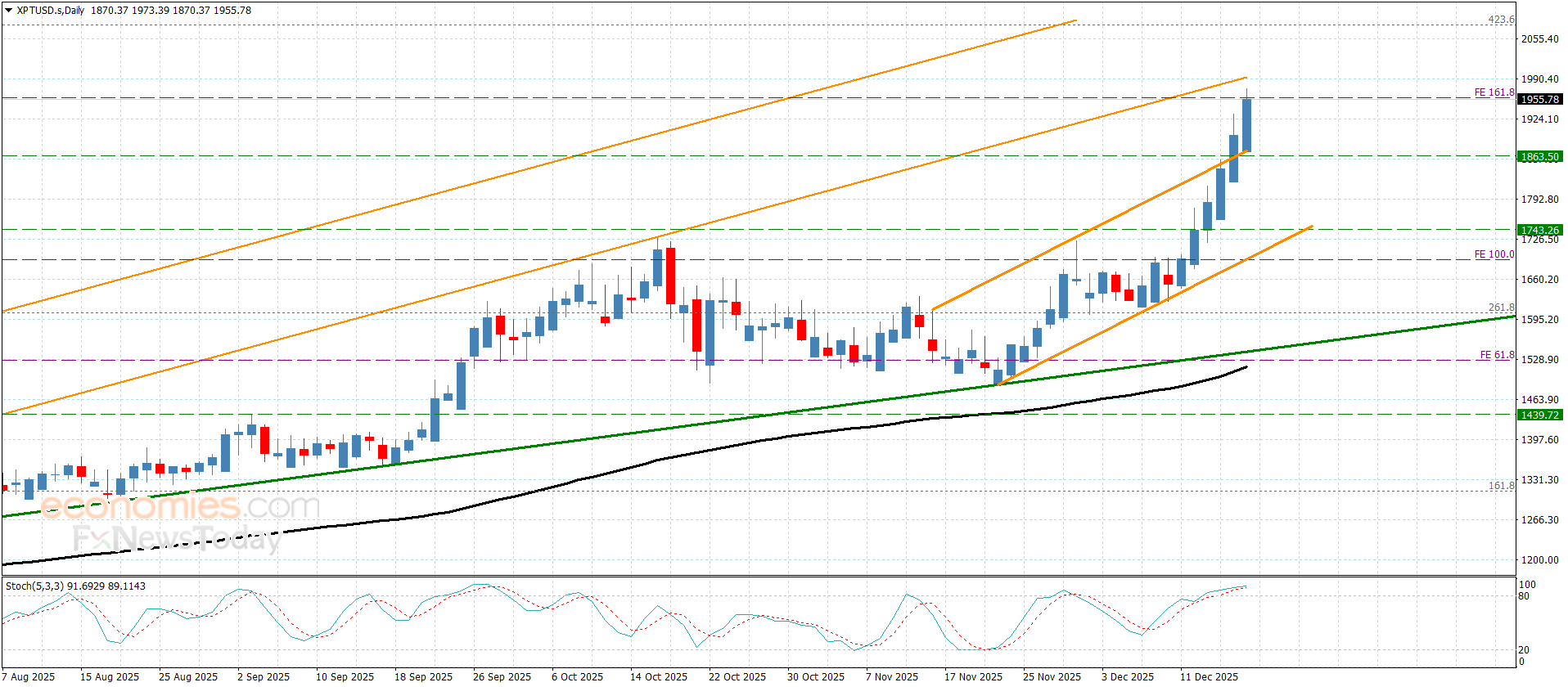
Platinum price succeeded in forming a new bullish rally this morning, achieving the previously suggested main target by reaching $1973.00, facing a %161.8 Fibonacci extension level which forms strong barrier against bullish trading.
The stability of the trading below this barrier might activate the attempts of gathering some gains, to reach $1900.00 then attempts to test the extra support at $1860.00, while breaching the barrier and holding above it will ease the mission of recording new historical gains that might extend towards 2000.00 psychological barrier.
The expected trading range for today is between $1890.00 and $1970.00
Trend forecast: Fluctuated within the bullish track
Platinum price succeeded in forming a new bullish rally this morning, achieving the previously suggested main target by reaching $1973.00, facing a %161.8 Fibonacci extension level which forms strong barrier against bullish trading.
The stability of the trading below this barrier might activate the attempts of gathering some gains, to reach $1900.00 then attempts to test the extra support at $1860.00, while breaching the barrier and holding above it will ease the mission of recording new historical gains that might extend towards 2000.00 psychological barrier.
The expected trading range for today is between $1890.00 and $1970.00
Trend forecast: Fluctuated within the bullish track
Platinum price succeeded in forming a new bullish rally this morning, achieving the previously suggested main target by reaching $1973.00, facing a %161.8 Fibonacci extension level which forms strong barrier against bullish trading.
The stability of the trading below this barrier might activate the attempts of gathering some gains, to reach $1900.00 then attempts to test the extra support at $1860.00, while breaching the barrier and holding above it will ease the mission of recording new historical gains that might extend towards 2000.00 psychological barrier.
The expected trading range for today is between $1890.00 and $1970.00
Trend forecast: Fluctuated within the bullish track
Silver continues to trade near all-time highs, showing resilience even as other precious metals experience rotational pullbacks. Unlike gold, which is predominantly driven by monetary policy expectations and geopolitical hedging, silver benefits from a dual demand profile—acting both as a precious metal and a critical industrial input.
This unique positioning allows silver to sustain momentum during periods when gold consolidates. Current price behavior reflects acceptance at elevated levels, not rejection. Rather than sharply selling off from the highs, silver has transitioned into controlled consolidation, a hallmark of strong trending markets.
From a broader macro perspective, silver’s strength remains supported by:
As a result, silver has been able to hold premium pricing, keeping it near record levels while gold digests earlier gains.
Silver’s outperformance relative to gold is structural, not coincidental.
Silver plays a crucial role in:
This means silver demand persists even during periods of macro stabilization. Gold, by contrast, relies more heavily on fear-based or policy-driven flows.
Silver supply growth remains structurally constrained, with mine output struggling to keep pace with demand. Gold markets are deeper and more liquid, making silver more responsive to demand shocks and allowing trends to persist longer once momentum builds.
While both metals respond to inflation expectations, silver tends to outperform when growth and inflation risks coexist. Gold typically leads during crisis hedging phases; silver leads during inflationary expansion phases, which better describes the current environment.

Previous expectations for silver emphasized continuation rather than reversal, with pullbacks expected to remain corrective as long as structure held.

That view has been validated:
This confirms that recent price action reflects acceptance at higher value, not speculative excess.

From a technical standpoint, silver continues to validate bullish structure.
After the most recent impulsive rally, XAG/USD retraced into a clearly defined 4-hour Fair Value Gap (FVG) and reacted precisely as expected. Buyers stepped in aggressively, rejecting lower prices and pushing the market back into balance above the FVG.
This reaction confirms that:
Following the bounce, silver entered a tight consolidation just below recent highs. Rather than breaking down, price is coiling—suggesting liquidity absorption and position building, not exit.
As long as silver continues to hold above the 4-hour FVG, the probability favors directional expansion, not deeper rotation.

The bullish scenario remains favored if silver:
In this scenario:
This outcome aligns with:
A clean upside resolution would reinforce silver’s role as the higher-beta expression of precious metals strength.

The bearish scenario only develops if silver fails to hold the 4-hour FVG and price begins accepting below it.
If that occurs:
Importantly, this would still be viewed as rebalancing, not reversal, unless daily structure breaks decisively. As long as silver remains above major breakout levels on the daily chart, downside moves remain corrective in nature.
|
Factor |
Silver |
Gold |
|---|---|---|
|
Industrial Demand |
High |
Minimal |
|
Inflation Sensitivity |
High |
Moderate |
|
Supply Constraints |
Tight |
More Flexible |
|
Volatility |
Higher |
Lower |
|
Trend Acceleration |
Faster |
Slower |
This structural advantage explains why silver continues to hold near all-time highs while gold consolidates.
Silver’s strength is not accidental. It is driven by structural demand, constrained supply, and favorable macro conditions.
The clean reaction from the 4-hour FVG and ongoing consolidation near highs suggest the market is preparing for its next expansion, not rolling over. As long as price holds above key value zones, the broader bullish narrative remains intact.
Silver continues to lead—not lag—the precious metals complex.