The main category of Forex News.
You can use the search box below to find what you need.
[wd_asp id=1]
The main category of Forex News.
You can use the search box below to find what you need.
[wd_asp id=1]
The British Pound (GBP) trims earlier losses against the Japanese Yen (JPY) on Wednesday after an initial sell-off triggered by softer-than-expected UK inflation data. At the time of writing, GBP/JPY is trading around 207.80, rebounding after buyers stepped in near the 207.00 psychological level.
The recovery, however, lacks conviction and appears driven by short-term repositioning, as traders remain reluctant to take aggressive bets ahead of the interest rate decisions from both the Bank of England (BoE) and the Bank of Japan (BoJ).
Looking ahead, most of the policy outcome is already priced in. The BoJ is expected to raise interest rates, while the BoE is seen cutting rates, leaving the focus firmly on forward guidance that could play a key role in setting the next move for GBP/JPY.
From a technical perspective, GBP/JPY remains in a strong uptrend on the daily chart, marked by a clear sequence of higher highs and higher lows. Prices continue to trade comfortably above key moving averages, reinforcing the broader bullish bias.
On the upside, the 208.00 psychological level acts as immediate resistance. A sustained break above this barrier could open the door for another leg higher toward a fresh year-to-date high above 209.00, with scope for further gains if bullish momentum strengthens.
On the downside, immediate support is seen near 207.00, which aligns with the 21-day Simple Moving Average (SMA). A break below this level would weaken the near-term outlook and expose the 204.00–205.00 support zone near the 50-day SMA. A decisive drop below the 50-day SMA would shift the tone toward a deeper corrective phase, with the 100-day SMA around 201.00 coming into focus.
Momentum indicators remain supportive, with the Relative Strength Index (RSI) holding near 60 and staying above its midline, suggesting that bullish momentum is still intact.
The Bank of Japan (BoJ) announces its interest rate decision after each of the Bank’s eight scheduled annual meetings. Generally, if the BoJ is hawkish about the inflationary outlook of the economy and raises interest rates it is bullish for the Japanese Yen (JPY). Likewise, if the BoJ has a dovish view on the Japanese economy and keeps interest rates unchanged, or cuts them, it is usually bearish for JPY.
Next release:
Fri Dec 19, 2025 03:00
Frequency:
Irregular
Consensus:
0.75%
Previous:
0.5%
Source:
Bank of Japan
Gold (XAU/USD) is posting marginal gains on Wednesday, but price action remains contained within previous ranges. Upside attempts remain capped below all-time highs at $4,350, and bears are contained above the $4,260-$4,270 so far. The doji candles in the daily chart highlight a hesitant market.
The US Dollar Index (DXY) is trimming some losses on Wednesday, and that is limiting Gold upside attempts so far. US data released on Tuesday maintain fears about a deteriorating labour market intact, but traders are waiting for Thursday’s US Consumer Prices Index report to reassess their expectations of further interest rate cuts by the Fed.
XAU/USD trades at $4,316.73, little changed daily, with recent price action forming a triangle pattern roughly around the $4,300 level, with an ascending parallel channel framing the broader uptrend. Triangles are considered continuation patterns and, in this case, they would signal a positive outcome.
Technical indicators, however, show mixed signals. The Moving Average Convergence Divergence (MACD) remains below zero with the histogram contracting, suggesting fading bearish pressure, while the Relative Strength Index (RSI) prints 57.77, maintaining a modest bullish tone.
Immediate resistance is at the top of the triangle, at $4,340 area and the December 12 and 15 highs, at $4,350 area. Further up, the top of the ascending channel, now around $4,385, emerges as the next target. Supports are at the $4,300 intraday low, ahead of the triangle bottom of $4,280 and the base of the channel, near $4,240.
(The technical analysis of this story was written with the help of an AI tool.)
Gold has played a key role in human’s history as it has been widely used as a store of value and medium of exchange. Currently, apart from its shine and usage for jewelry, the precious metal is widely seen as a safe-haven asset, meaning that it is considered a good investment during turbulent times. Gold is also widely seen as a hedge against inflation and against depreciating currencies as it doesn’t rely on any specific issuer or government.
Central banks are the biggest Gold holders. In their aim to support their currencies in turbulent times, central banks tend to diversify their reserves and buy Gold to improve the perceived strength of the economy and the currency. High Gold reserves can be a source of trust for a country’s solvency. Central banks added 1,136 tonnes of Gold worth around $70 billion to their reserves in 2022, according to data from the World Gold Council. This is the highest yearly purchase since records began. Central banks from emerging economies such as China, India and Turkey are quickly increasing their Gold reserves.
Gold has an inverse correlation with the US Dollar and US Treasuries, which are both major reserve and safe-haven assets. When the Dollar depreciates, Gold tends to rise, enabling investors and central banks to diversify their assets in turbulent times. Gold is also inversely correlated with risk assets. A rally in the stock market tends to weaken Gold price, while sell-offs in riskier markets tend to favor the precious metal.
The price can move due to a wide range of factors. Geopolitical instability or fears of a deep recession can quickly make Gold price escalate due to its safe-haven status. As a yield-less asset, Gold tends to rise with lower interest rates, while higher cost of money usually weighs down on the yellow metal. Still, most moves depend on how the US Dollar (USD) behaves as the asset is priced in dollars (XAU/USD). A strong Dollar tends to keep the price of Gold controlled, whereas a weaker Dollar is likely to push Gold prices up.
The British pound plummeted against the US Dollar on Wednesday following the weaker-than-anticipated UK inflation figures in November. The GBP/USD pair fell by over 0.5% towards the 1.3310 region, defying Tuesday’s gains when the pair briefly went above 1.3450.
–Are you interested in learning more about copy trading platforms? Check our detailed guide-
According to the Office for National Statistics, the headline consumer inflation decreased to 3.2% YoY, compared to the previous 3.6% and below the market expectations of 3.5%. This was the second monthly decrease, revealing steadily falling price pressures in the UK. The core inflation also slowed to 3.2% compared to 3.4% in the previous month. Prices decreased by 0.2% MoM, highlighting the softening trend.
The services inflation, a major indicator of the Bank of England, decreased marginally to 4.4%. Although this level is still well above the BoE target, the trend has lowered confidence in maintaining the restrictive policy.
Meanwhile, the UK labor market is still losing steam. The UK unemployment rate increased to 5.1%, the highest in nearly five years. Combined, tame inflation and growing unemployment have raised the probability of a BoE rate cut.
A recovery in the US Dollar further weighed on the sterling. The Dollar Index (DXY) regained ground to reach 98.60 after marking a 10-week low in the previous week. This was despite the mixed US employment report, which indicated job growth of 64k in November, but the unemployment rate increased to 4.6%. Investors largely disregarded the weaker aspects of the report due to distortions caused by the prolonged government shutdown.
Markets are currently anticipating the Fed to maintain rates in the 3.50-3.75% range in January. The focus has shifted to the US inflation statistics due on Thursday, which may impact the anticipation of a rate reduction in the latter part of the year.
Moving ahead, GBP/USD is under pressure in the short term as traders review the UK rate expectations. But the wider demerit could be confined. Inflation in the UK remains relatively high compared to other economies, and the BoE’s easing expectations are more cautious than those of the Fed. If US inflation slows down and the dollar regains its lost momentum, the pound may stabilize even after the recent setback.
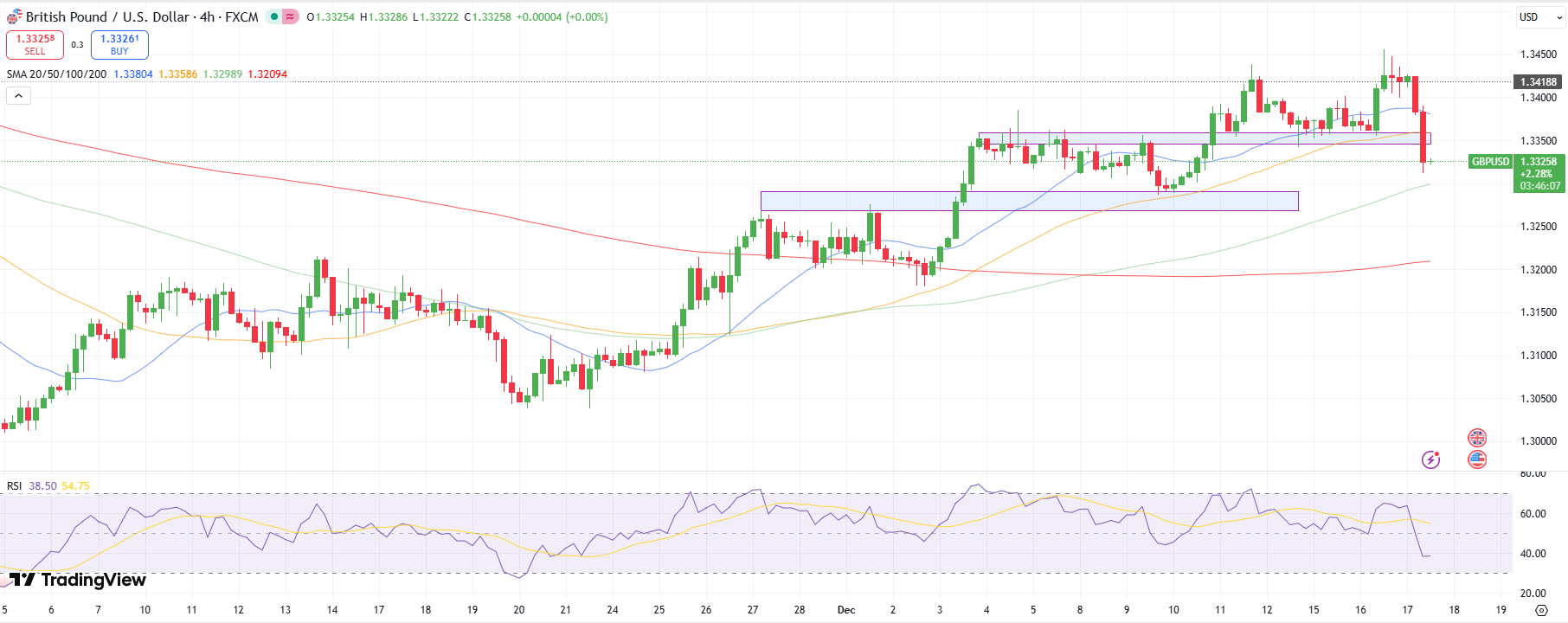
The GBP/USD broke below the demand zone around 1.3350, marking a fresh low at 1.3310 before recovering slightly. The price is expected to retest the broken zone before resuming its downward trend. However, the RSI under 40.0, approaching the oversold zone, suggests limited downside.
–Are you interested in learning more about scalping forex brokers? Check our detailed guide-
The immediate support for the pair lies at 1.3300 near the 100-period MA ahead of the next demand zone at 1.3270, and then the 200-period MA near 1.3200. On the upside, the 1.3350 support-turned-resistance could limit gains ahead of the daily pivot at 1.3378 and then 1.3400.
Looking to trade forex now? Invest at eToro!
68% of retail investor accounts lose money when trading CFDs with this provider. You should consider whether you can afford to take the high risk of losing your money.
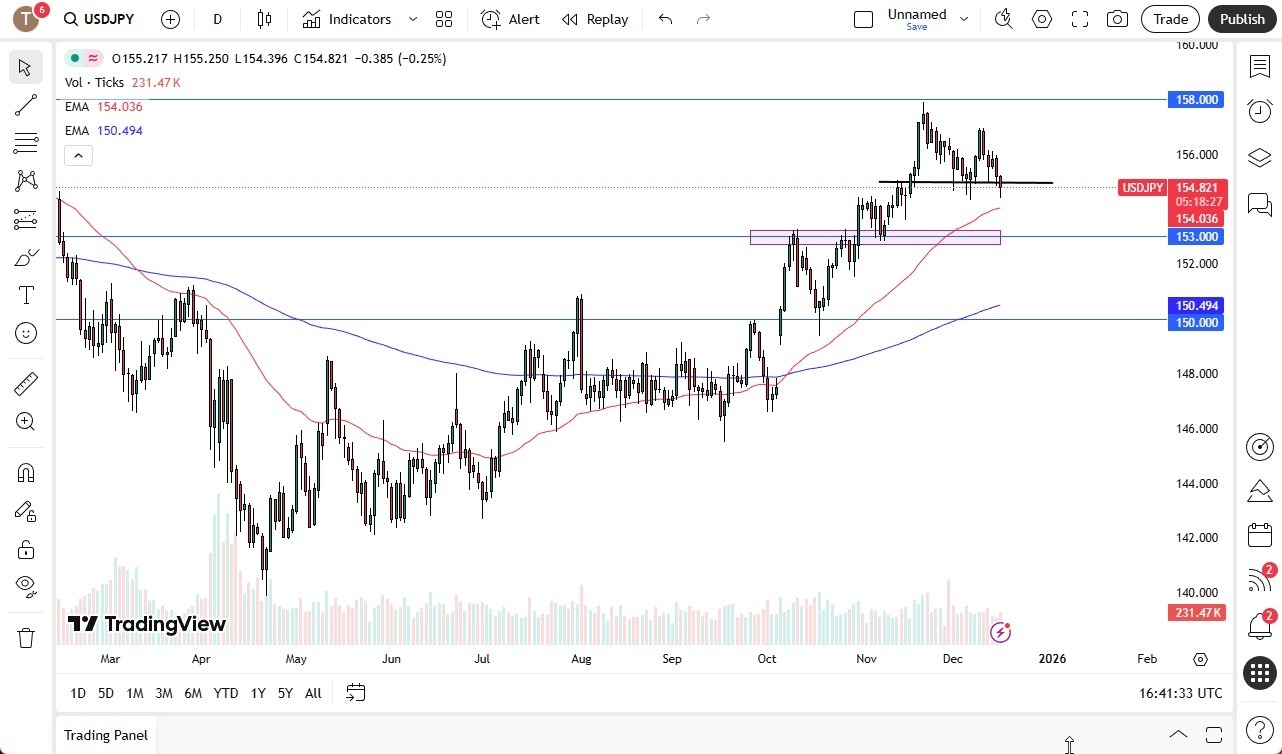
The US dollar spent the first few hours of the trading session on Tuesday falling against the Japanese yen. But as we have seen multiple times, there is a certain amount of interest in the US dollar below the 155 yen level. The 155 yen level, of course, is a large, round, psychologically significant figure, and it’s an area where I think you have a lot of noise out there waiting to come into the picture and perhaps support the greenback against the Japanese yen.

After all, the Bank of Japan, although it is having to deal with a little bit of inflation for the first time in ages, is still in a situation where it cannot tighten monetary policy too much. At the same time, you have the Federal Reserve, which is likely to cut rates sometime in 2026, but it is still very data dependent. Inflation in the United States isn’t going anywhere. That is a misnomer.
I think at this point in time, the markets will be heavily disappointed if they are looking for consecutive rate cuts coming out of the Federal Reserve. With that being the case, the interest rate differential continues to favor the US dollar, and given enough time, we should see renewed upward momentum in this market.
While you wait, you even get the ability to get paid at the end of every day via the carry trade. So all things being equal, I do like this pair, and I have liked this pair for most of the year. If we do break down from here, the 50-day EMA is currently at the 154 yen level, followed by another support level in the form of 153 yen, which has been important a couple of times.
To the upside, I still see the 158 yen level as a bit of a barrier to get above and probably something that takes some work to accomplish. But I do think eventually we will try to do that. I hold this pair and have been holding this pair since probably July or so, and as a result, I have built up quite a bit of cushion via swap to make this a profitable trade. The beauty of this setup is that it pays you, and every time the US dollar drops to offer a little bit of value, I suspect traders continue to think about that again.
Want to trade our USD/JPY forex analysis and predictions? Here’s a list of forex brokers in Japan to check out.
Natural gas price confirmed its surrender to the negative pressure by providing repeated closing below $4.200 level, suffering clear losses by approaching the initial negative target at $3.750 then rebounding to settle above the bullish channel’s support at $3.950.
We recommend waiting to confirm breaking the current break to confirm moving to the negative track, then attempts to target more negative stations by reaching $3.620 and $3.480, while its rally above $4.200 will cancel the negative overview, providing chance to begin forming bullish waves, to target $4.510 level initially.
The expected trading range for today is between $3.620 and $4.150
Trend forecast: Bearish by the stability of $4.200
After rising above 1.1800 for the first time since late September on Tuesday, EUR/USD lost its traction and closed the day marginally lower. The pair stays on the back foot early Wednesday and trades in negative territory below 1.1750.
The table below shows the percentage change of Euro (EUR) against listed major currencies today. Euro was the weakest against the US Dollar.
| USD | EUR | GBP | JPY | CAD | AUD | NZD | CHF | |
|---|---|---|---|---|---|---|---|---|
| USD | 0.22% | 0.31% | 0.33% | 0.16% | 0.23% | 0.23% | 0.21% | |
| EUR | -0.22% | 0.09% | 0.11% | -0.05% | 0.00% | 0.01% | -0.01% | |
| GBP | -0.31% | -0.09% | 0.04% | -0.14% | -0.08% | -0.08% | -0.10% | |
| JPY | -0.33% | -0.11% | -0.04% | -0.17% | -0.11% | -0.12% | -0.13% | |
| CAD | -0.16% | 0.05% | 0.14% | 0.17% | 0.06% | 0.06% | 0.04% | |
| AUD | -0.23% | -0.01% | 0.08% | 0.11% | -0.06% | 0.00% | -0.02% | |
| NZD | -0.23% | -0.01% | 0.08% | 0.12% | -0.06% | -0.00% | -0.02% | |
| CHF | -0.21% | 0.00% | 0.10% | 0.13% | -0.04% | 0.02% | 0.02% |
The heat map shows percentage changes of major currencies against each other. The base currency is picked from the left column, while the quote currency is picked from the top row. For example, if you pick the Euro from the left column and move along the horizontal line to the US Dollar, the percentage change displayed in the box will represent EUR (base)/USD (quote).
The data published by the US Bureau of Labor Statistics (BLS) showed on Tuesday that Nonfarm Payrolls (NFP) declined by 105,000 in October and increased by 64,000 in November. Although the immediate market reaction caused the US Dollar (USD) to weaken, the currency managed to stage a rebound later in the day.
The CME Group FedWatch Tool shows that markets are still pricing in about a 25% probability of a 25 basis points (bps) Federal Reserve (Fed) rate cut in January, virtually unchanged from before the release of the employment data. The significant NFP decrease in October was likely caused by the loss of government jobs during the shutdown. Hence, the negative impact of this data on the USD’s performance remained short-lived.
Additionally, in a blog post published on Tuesday, Atlanta Fed President Raphael Bostic argued that the jobs data painted a mix picture and did not change the outlook. He further noted that he preferred a policy hold in December, citing multiple surveys pointing to higher input costs.
The US economic calendar will not feature any high-tier data releases on Wednesday but multiple Fed policymakers will be delivering speeches. In case policymakers voice their support for a policy hold in early 2026, the USD could hold its ground and make it difficult for EUR/USD to regather its bullish momentum.
On Thursday, the European Central Bank (ECB) will announce rate decisions and publish the revised macroeconomic projections.
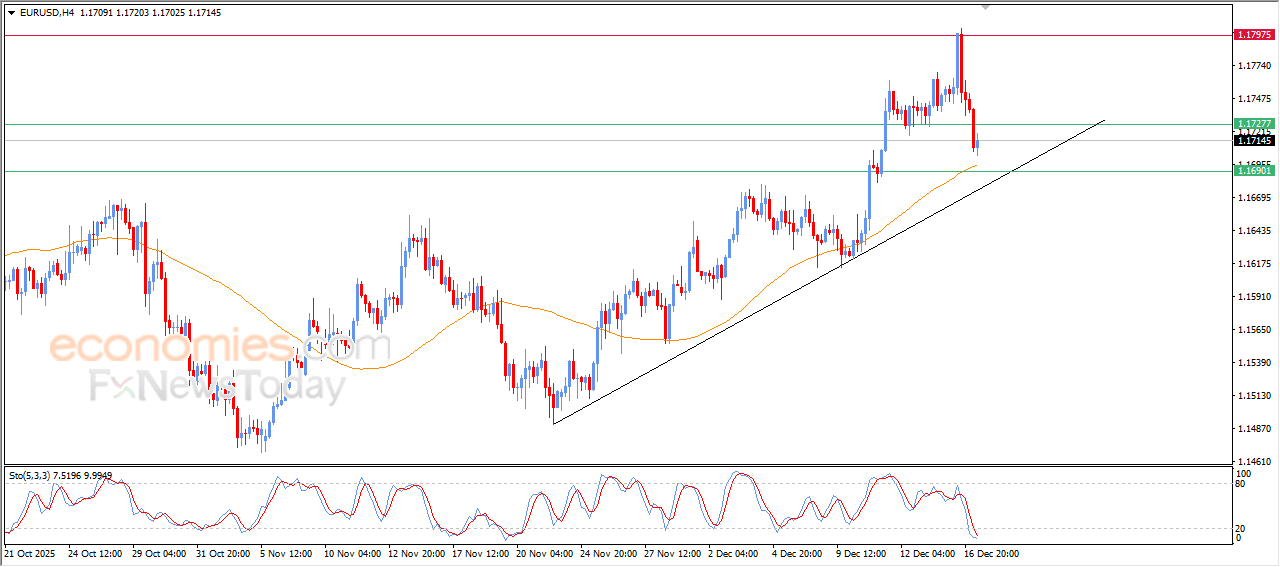
The 20-period Simple Moving Average (SMA) stands above the 50 and 200 SMAs, underscoring a bullish backdrop, while the pair holds above the 50 SMA near 1.1700 and the 200 SMA at 1.1600 but remains capped by the 20 SMA at 1.1745. The Relative Strength Index (14) slips to 48.83, neutral, signalling waning bullish momentum. Additionally, EUR/USD now trades in the lower half of the ascending regression channel, reaffirming buyers’ reluctance.
The rising trend line from 1.1500 remains intact and offers support near 1.1680, slightly below the 50-period SMA and the lower limit of the ascending channel near 1.1700. In case the pair breaks below the trend line, 1.1620 (static level) and 1.1600 (200-period SMA) could be seen as next support levels.
On the upside, 1.1750 (mid-point of the ascending channel) aligns as the immediate resistance level before 1.1800 (upper limit of the ascending channel).
(The technical analysis of this story was written with the help of an AI tool)
The Euro is the currency for the 20 European Union countries that belong to the Eurozone. It is the second most heavily traded currency in the world behind the US Dollar. In 2022, it accounted for 31% of all foreign exchange transactions, with an average daily turnover of over $2.2 trillion a day.
EUR/USD is the most heavily traded currency pair in the world, accounting for an estimated 30% off all transactions, followed by EUR/JPY (4%), EUR/GBP (3%) and EUR/AUD (2%).
The European Central Bank (ECB) in Frankfurt, Germany, is the reserve bank for the Eurozone. The ECB sets interest rates and manages monetary policy.
The ECB’s primary mandate is to maintain price stability, which means either controlling inflation or stimulating growth. Its primary tool is the raising or lowering of interest rates. Relatively high interest rates – or the expectation of higher rates – will usually benefit the Euro and vice versa.
The ECB Governing Council makes monetary policy decisions at meetings held eight times a year. Decisions are made by heads of the Eurozone national banks and six permanent members, including the President of the ECB, Christine Lagarde.
Eurozone inflation data, measured by the Harmonized Index of Consumer Prices (HICP), is an important econometric for the Euro. If inflation rises more than expected, especially if above the ECB’s 2% target, it obliges the ECB to raise interest rates to bring it back under control.
Relatively high interest rates compared to its counterparts will usually benefit the Euro, as it makes the region more attractive as a place for global investors to park their money.
Data releases gauge the health of the economy and can impact on the Euro. Indicators such as GDP, Manufacturing and Services PMIs, employment, and consumer sentiment surveys can all influence the direction of the single currency.
A strong economy is good for the Euro. Not only does it attract more foreign investment but it may encourage the ECB to put up interest rates, which will directly strengthen the Euro. Otherwise, if economic data is weak, the Euro is likely to fall.
Economic data for the four largest economies in the euro area (Germany, France, Italy and Spain) are especially significant, as they account for 75% of the Eurozone’s economy.
Another significant data release for the Euro is the Trade Balance. This indicator measures the difference between what a country earns from its exports and what it spends on imports over a given period.
If a country produces highly sought after exports then its currency will gain in value purely from the extra demand created from foreign buyers seeking to purchase these goods. Therefore, a positive net Trade Balance strengthens a currency and vice versa for a negative balance.
Fortescue Ltd (ASX:FMG) stock is ending 2025 in a familiar-but-weird place: near a 52-week high on the back of resilient iron ore prices, while investors simultaneously debate whether the next leg of the story is copper diversification, green metals, or a downcycle risk as new global supply looms. The result is a share price that looks strong in the rear-view mirror, but faces a forward-looking tug-of-war between commodity forecasts, project execution, and capital allocation.
Below is what matters for Fortescue shares right now—covering the latest price action, the Alta Copper acquisition, operational and decarbonisation updates, dividend outlook, and where analysts are landing on forecasts as of December 17, 2025.
Fortescue shares rose in the latest session, with FMG closing around A$22.42 on Dec. 17, 2025 (up ~1.45%), after opening near A$21.74 and trading up to about A$22.45. [1]
On Financial Times’ market data, FMG was trading around A$22.39 with a day range of roughly A$21.70–A$22.46, putting the stock about 4% below its 52-week high of A$23.38 set on Dec. 11, 2025. [2]
Those levels matter because they frame the current debate: is FMG priced for “iron ore stays firm,” or for “iron ore mean-reverts lower in 2026”? Analysts’ average price targets (covered below) suggest the market is leaning toward the second interpretation.
Fortescue confirmed it has entered a binding agreement to acquire the remaining 64% of Alta Copper Corp it does not already own, via a Canadian plan of arrangement. The offer is C$1.40 per share in cash, implying a total equity value of about C$139 million for Alta Copper. [3]
In the same ASX release, Fortescue highlighted that Alta Copper owns the Cañariaco Copper Project in northern Peru and cited a reported mineral resource of 1.1 billion tonnes at 0.42% copper equivalent (measured & indicated) and 0.9 billion tonnes at 0.29% copper equivalent (inferred), referencing an NI 43-101 technical report. [4]
Reuters reported the deal value at roughly $101 million, noting Fortescue’s offer price represents a premium and placing the move in the broader mining trend of diversifying into copper amid energy-transition demand. Reuters also noted Fortescue shares dipped after the announcement. [5]
Alta Copper’s own release adds two investor-relevant details: the deal is expected to be funded from Fortescue’s existing cash reserves, and the transaction was expected to close in February 2026 (subject to approvals). [6]
Fortescue’s ASX release, meanwhile, targeted closing in the March quarter of 2026 and laid out the voting thresholds and court approval process typical for this structure. [7]
Strategically, the Alta deal is small relative to Fortescue’s market value—but it’s large in “signal” terms. It reinforces a narrative that Fortescue is:
Copper prices have been highly volatile but strong, with reporting in December describing record-level pricing dynamics (including stockpiling and tariff uncertainty) that could influence miners’ appetite for copper exposure. [8]
The catch: early-stage copper projects can be long-dated, permitting-heavy, and politically sensitive. Investors will likely demand evidence that Fortescue can apply its execution discipline outside its Pilbara iron ore engine.
One of the clearest “show me” developments this month is Fortescue’s move from decarbonisation slide decks to physical kit on the ground.
Fortescue says it delivered its first large-scale Battery Energy Storage System (BESS) to North Star Junction in the Pilbara, using BYD Blade Battery technology. The installation is described as 250 MWh of storage delivering up to 50 MW for five hours, and the first step in a planned 4–5 GWh storage rollout to decarbonise Fortescue’s operational energy supply. [9]
Mining Weekly’s coverage aligns on the key specs (48 containers, 250 MWh, 50 MW) and describes the system’s role: storing renewable energy generated during the day and feeding power into the Pilbara Energy Connect network at night to displace diesel and gas generation. [10]
For investors, the battery rollout is important because it reframes “green ambition” away from speculative revenue and toward cost, reliability, and emissions reduction inside the core iron ore business—the part of Fortescue that actually pays dividends.
Fortescue’s most strategically interesting pathway isn’t necessarily hydrogen-as-a-product. It may be hydrogen-as-a-process—specifically, using hydrogen-based methods to produce lower-emissions metals.
Reuters reported that Fortescue agreed to work with Taiyuan Iron and Steel Group (TISCO), a subsidiary of China Baowu, on a trial project involving hydrogen-based plasma-enhanced metallurgical technology. The project includes designing and operating a trial line capable of producing 5,000 metric tons of hot metal, and Fortescue said it would provide capital for the project while using its Pilbara iron ore. [11]
Why investors should care: Reuters also pointed out that steel decarbonisation is expected to increase demand for higher-grade iron ore, which is a known strategic pressure point for Australian miners that largely supply low-to-medium grades. [12]
That helps explain why Fortescue continues to talk about “green iron” even as it has stepped back from some large hydrogen project timelines.
Another fresh data point: Renewables Now reported that Statkraft and Fortescue revised their power purchase agreement (PPA) for Fortescue’s planned Holmaneset green hydrogen/ammonia development in Norway.
Key details reported:
This fits a pattern investors have been watching: Fortescue is still keeping some green-fuels options alive, but stretching timelines and gating progress behind feasibility, permitting and financial close.
The sharper pivot came earlier in 2025. Reuters reported in July that Fortescue scrapped two green hydrogen projects (Arizona in the US and a Gladstone project in Australia) after a strategic review, flagging an expected ~$150 million preliminary pre-tax writedown related to those projects and investments. [14]
In the same report, Reuters noted Fortescue posted record iron ore shipments for fiscal 2025 and provided fiscal 2026 guidance (details below), which helped frame the market’s reaction: investors liked the operating performance and discipline, and were less enthusiastic about open-ended green capex. [15]
Fortescue shipped 198.4 million tonnes of iron ore in fiscal 2025 (record), and guided to 195–205 million tonnes in fiscal 2026, including up to 12 million tonnes from its Iron Bridge magnetite operation. Reuters also reported Fortescue’s FY26 metals capex guidance at $3.3–$4.0 billion. [16]
Fortescue itself highlights FY25 performance metrics including 198.4 Mt shipped, US$7.9bn underlying EBITDA, US$3.4bn NPAT, and A$3.4bn dividends paid. [17]
Argus reported earlier in 2025 that Fortescue expected Iron Bridge shipments to rise, with 10–12 million wet metric tonnes forecast for 2025–26 (up from prior expectations), as the company works toward a larger ramp-up. [18]
For FMG investors, Iron Bridge matters because it’s part of the response to the “grade problem” (global steel decarbonisation favors higher quality feedstock), but it has also been an execution-sensitive asset historically.
Benchmark iron ore prices have been holding above the psychological US$100/t level in late 2025. Reuters noted Singapore iron ore futures ended at $104.60 a ton in mid-November and traded in a relatively narrow $100–$108 range since early August. [19]
Market data sources in mid-December show iron ore around US$106/t. [20]
Westpac IQ’s December commodities update forecasts iron ore could fall ~20% to about US$83/t by end-2026, citing declining Chinese steel production trends, rising inventories, and conditions that historically preceded price corrections. [21]
ING’s commodity analysis also highlights the supply side: Simandou in Guinea made its first shipment in November and is expected to ship around 20 million tonnes in 2026, with full capacity of 120 million tonnes per year by 2030—a supply ramp that could shift market balance and pricing power over time. [22]
Reuters has similarly pointed to the widespread view that iron ore prices are likely to head lower in 2026 as Simandou ramps up, even while China’s imports remain robust and sentiment-driven at times. [23]
China’s steel sector affects iron ore demand—directly and brutally.
Reuters reported that China will introduce an export licence system starting Jan. 1, 2026 covering around 300 steel products, amid global trade barriers and protectionist pressures. Reuters also noted China’s steel exports were up 6.7% year-on-year to 107.72 million metric tons in the first 11 months of 2025, putting the country on track for a record year. [24]
For Fortescue shareholders, the key takeaway is not “licences equal lower iron ore demand tomorrow.” It’s that steel is increasingly political—and policy can move faster than mines can.
Fortescue remains one of the ASX’s most watched dividend stocks—because when iron ore prices are strong, the cash returns can be enormous. The company says it has delivered more than A$45 billion in dividends since inception. [25]
But dividends are ultimately downstream of iron ore pricing and costs, and the forward consensus is more conservative than the pandemic-era peak.
Translation: income investors are still watching FMG, but the market is no longer pricing “maximum payout forever.” It’s pricing a cycle.
Analyst targets are not destiny, but they are a useful mirror of what assumptions brokers are embedding—particularly around iron ore prices and Fortescue’s longer-run capital spend.
Investing.com’s consensus snapshot (based on 16 analysts) rates Fortescue “Neutral”, with an average 12‑month price target around A$19.08, a high estimate around A$23.03, and a low estimate around A$16.27—implying downside from the current ~A$22+ trading level. [29]
TradingView shows a similar shape, citing an average target around A$19.51 (range roughly A$16.28–A$23.02). [30]
MarketScreener’s timeline of broker actions highlights how divided views have been, including items such as an earlier UBS upgrade to Neutral from Sell with a stated target, and other upgrades/downgrades across 2025. [31]
This gap—stock near 52-week highs, consensus targets below spot—usually means one of two things:
Fortescue has a busy catalyst calendar in early 2026:
Beyond scheduled reporting, the swing factors are straightforward—even if the outcomes aren’t:
As of Dec. 17, 2025, Fortescue Ltd stock is being pulled by three forces:
The uncomfortable truth for both bulls and bears is that FMG remains, first and foremost, an iron ore equity—so the sharpest near-term driver is still whether iron ore holds its late‑2025 resilience, or whether 2026 brings the price correction that several forecasters are now openly modelling. [41]
1. www.investing.com, 2. markets.ft.com, 3. content.fortescue.com, 4. content.fortescue.com, 5. www.reuters.com, 6. altacopper.com, 7. content.fortescue.com, 8. www.businessinsider.com, 9. www.fortescue.com, 10. www.miningweekly.com, 11. www.reuters.com, 12. www.reuters.com, 13. renewablesnow.com, 14. www.reuters.com, 15. www.reuters.com, 16. www.reuters.com, 17. investors.fortescue.com, 18. www.argusmedia.com, 19. www.reuters.com, 20. tradingeconomics.com, 21. www.westpaciq.com.au, 22. think.ing.com, 23. www.reuters.com, 24. www.reuters.com, 25. investors.fortescue.com, 26. markets.ft.com, 27. www.fool.com.au, 28. fnarena.com, 29. www.investing.com, 30. www.tradingview.com, 31. www.marketscreener.com, 32. investors.fortescue.com, 33. www.westpaciq.com.au, 34. think.ing.com, 35. content.fortescue.com, 36. www.fortescue.com, 37. www.reuters.com, 38. www.reuters.com, 39. www.fortescue.com, 40. content.fortescue.com, 41. www.westpaciq.com.au
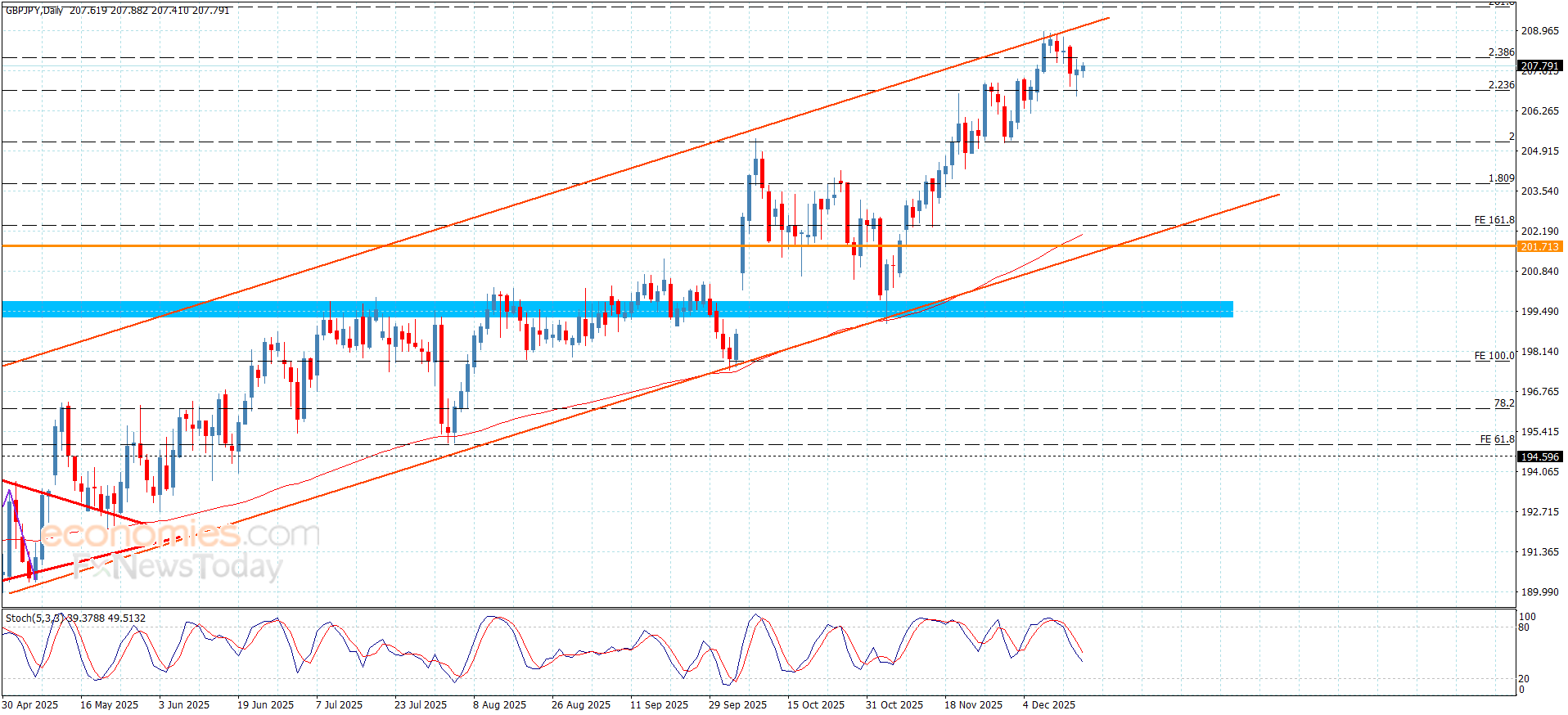
The GBPJPY pair succeeded in surpassing the negative pressure, keeping its stability above the initial support at 206.90, noticing the attempt of forming new bullish waves by its rally towards 208.10 barrier, announcing its surrender to the dominance of the sideways bias by the stability of the main levels.
The contradiction between the main indicators confirms the sideways trend in the current trading, to stay aside and monitor the price until surpassing the previously mentioned levels, breaching the barrier and holding above it will open the way for activating the bullish track again and holding below it will force it to force the price to resume the corrective decline, to expect reaching 206.25 and 205.80.
The expected trading range for today is between 207.00 and 208.10
Trend forecast: Neutral
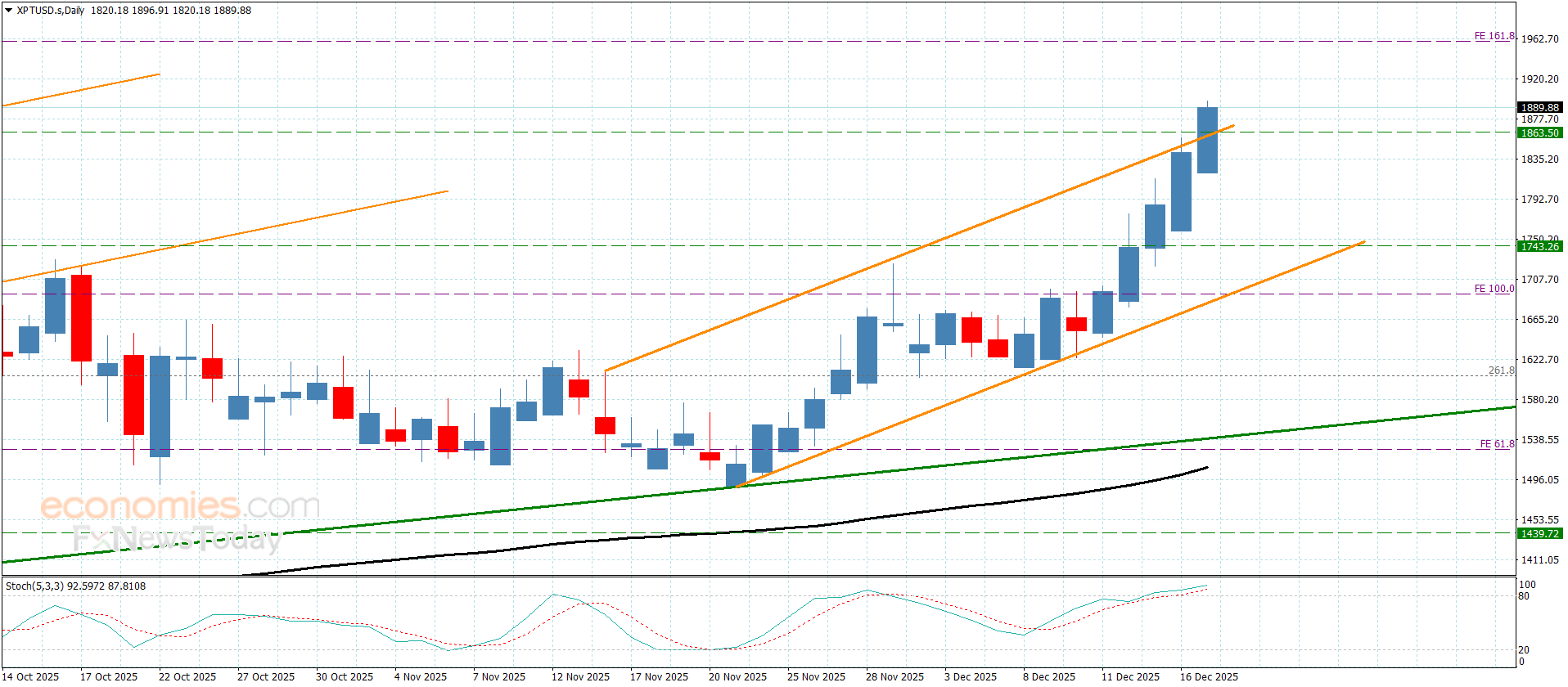
Platinum price began this morning trading with strong positive trading, surpassing the minor bullish channel’s resistance at $1865.00 level, taking advantage of the bullish momentum from the main indicators, to notice recording new historical gains by hitting $1898.00 level.
Note that forming extra support at $1860.00 level and providing bullish momentum by the main indicators, these factors confirm the continuation of the positivity in the near period, attempting to achieve extra gains by reaching $1925.00 followed by 161.8%Fibonacci extension level at $1959.00.
The expected trading range for today is between $1825.00 and $1925.00
Trend forecast: Bullish
The GBPJPY pair succeeded in surpassing the negative pressure, keeping its stability above the initial support at 206.90, noticing the attempt of forming new bullish waves by its rally towards 208.10 barrier, announcing its surrender to the dominance of the sideways bias by the stability of the main levels.
The contradiction between the main indicators confirms the sideways trend in the current trading, to stay aside and monitor the price until surpassing the previously mentioned levels, breaching the barrier and holding above it will open the way for activating the bullish track again and holding below it will force it to force the price to resume the corrective decline, to expect reaching 206.25 and 205.80.
The expected trading range for today is between 207.00 and 208.10
Trend forecast: Neutral