The main category of Forex News.
You can use the search box below to find what you need.
[wd_asp id=1]
The main category of Forex News.
You can use the search box below to find what you need.
[wd_asp id=1]
Silver price (XAG/USD) posts a fresh all-time high near $66 during the Asian trading session on Wednesday. The white metal extends its bull run as weak United States (US) employment data, Retail Sales, and flash S&P Global Purchasing Managers’ Index (PMI) data raise economic concerns.
The US Nonfarm Payrolls (NFP) report showed on Tuesday that the Unemployment Rate rose to 4.6% in November, the highest level seen since September 2021. In the same period, the economy created 64K fresh jobs, higher than estimates of 50K, but after firing 105K payrolls in October.
Month-on-month Retail Sales remained flat in October, while it was expected to grow steadily by 0.1%. Meanwhile, preliminary S&P Global PMI landed at 53.0, sharply lower than 54.2 in November.
Escalating US economic jitters have raised demand for safe-haven assets, such as Silver.
The broader outlook of the Silver price has remained upbeat due to expectations that the Federal Reserve (Fed) will deliver more interest rate cuts in 2026 than one projected by officials in December’s policy meeting. According to the CME FedWatch tool, there is a 67.6% chance that the Fed will deliver at least two interest rate cuts next year.
Silver price trades almost 3% higher around $66.00 during Asian trading hours. The 20-period Exponential Moving Average (EMA) rises at $63.28, with price holding above the average and keeping the short-term tone positive.
The 14-period Relative Strength Index (RSI) at 69.16 sits near the overbought threshold, signaling that momentum could cool before the next leg higher.
Bias remains firm while the market stays above the rising EMA, where pullbacks would be cushioned. A break below the 20-period EMA would turn the intraday bias down, making Silver fragile towards the psychological level of $60.00. While a persistent hold above it would preserve upside, and keep the odds of further upside towards $70.00
(The technical analysis of this story was written with the help of an AI tool)
Silver is a precious metal highly traded among investors. It has been historically used as a store of value and a medium of exchange. Although less popular than Gold, traders may turn to Silver to diversify their investment portfolio, for its intrinsic value or as a potential hedge during high-inflation periods. Investors can buy physical Silver, in coins or in bars, or trade it through vehicles such as Exchange Traded Funds, which track its price on international markets.
Silver prices can move due to a wide range of factors. Geopolitical instability or fears of a deep recession can make Silver price escalate due to its safe-haven status, although to a lesser extent than Gold’s. As a yieldless asset, Silver tends to rise with lower interest rates. Its moves also depend on how the US Dollar (USD) behaves as the asset is priced in dollars (XAG/USD). A strong Dollar tends to keep the price of Silver at bay, whereas a weaker Dollar is likely to propel prices up. Other factors such as investment demand, mining supply – Silver is much more abundant than Gold – and recycling rates can also affect prices.
Silver is widely used in industry, particularly in sectors such as electronics or solar energy, as it has one of the highest electric conductivity of all metals – more than Copper and Gold. A surge in demand can increase prices, while a decline tends to lower them. Dynamics in the US, Chinese and Indian economies can also contribute to price swings: for the US and particularly China, their big industrial sectors use Silver in various processes; in India, consumers’ demand for the precious metal for jewellery also plays a key role in setting prices.
Silver prices tend to follow Gold’s moves. When Gold prices rise, Silver typically follows suit, as their status as safe-haven assets is similar. The Gold/Silver ratio, which shows the number of ounces of Silver needed to equal the value of one ounce of Gold, may help to determine the relative valuation between both metals. Some investors may consider a high ratio as an indicator that Silver is undervalued, or Gold is overvalued. On the contrary, a low ratio might suggest that Gold is undervalued relative to Silver.
Stronger external demand and a pickup in economic momentum will likely strengthen the yen. Rising yen demand supports a bearish USD/JPY trajectory in the lead-up to the BoJ’s monetary policy decision, with 153 in view.
While market bets on a December BoJ rate hike have strengthened the yen, US retail sales data will give insights into the US economy, triggering USD/JPY volatility.
Later on Wednesday, US retail sales will fuel speculation about a March Fed rate cut, influencing the US dollar’s trajectory. Economists forecast retail sales to rise 0.3% month-on-month in November after stalling in October.
Stronger retail sales would boost the US economy, given that private consumption accounts for roughly 65% of the GDP. Additionally, consumer spending typically fuels demand-driven inflation, suggesting a more hawkish Fed rate path. Fading bets on a March Fed rate cut will likely lift US dollar demand, cushioning the near-term downside for USD/JPY.
Beyond the data, traders should monitor FOMC members’ speeches for reactions to November’s jobs report and the timeline for a rate cut. Fed Board of Governors Christopher Waller, New York Fed President John Williams, and Atlanta Fed President Raphael Bostic are due to speak mid-week. Support for further monetary policy easing would overshadow upbeat retail sales data, sending USD/JPY lower on weaker US dollar demand.
For context, US unemployment rose from 4.4% in October to 4.6% in November, while wage growth slowed from 3.7% YoY to 3.5% YoY in November. Rising unemployment and softer wage growth may curb consumer spending and dampen demand-driven inflation.
A cooler inflation outlook would support a more dovish Fed rate path and weaken US dollar demand.
According to the CME FedWatch Tool, the probability of a March Fed rate cut increased from 51% on December 15 to 53.3% on December 16 as markets reacted to the US jobs data. A BoJ rate hike and a March Fed rate cut would narrow the US-Japan rate differential, favoring the yen.
The BoJ and the Fed’s policy outlooks support a bearish short- to medium-term outlook for USD/JPY.
With markets focused on monetary policy, technical indicators, and fundamentals, they will offer critical insights into potential USD/JPY price trends.
Looking at the daily chart, USD/JPY remained above the 50-day and 200-day Exponential Moving Averages (EMAs), signaling a bullish bias. While technicals remained bullish, fundamentals are increasingly outweighing the technical structure, suggesting a bearish outlook.
A break below the Tuesday, December 16, low of 154.394 would bring the 50-day EMA into play. If breached, 153 would be the next key support level. Importantly, a sustained drop below the 50-day EMA would signal a bearish near-term trend reversal, exposing the 200-day EMA and 150.
Since gold only recently cleared above the 10-day average, the trend patterns in gold show a likely bull breakout above $4,353 on the horizon. The breakout above the prior interim swing high of $4,264 last Thursday was confirmed with a daily close above it. Short-term consolidation may continue for a few more days, giving the 10-day average a chance to catch up with price. Once it does, the chance for an upside breakout improves.
Potential dynamic support near the 10-day average, now at $4,243, is the first line of defense for the bulls. Its potential significance as a support zone is strengthened by the near-term rising trendline nearby. The 20-day average is a little lower at $4,195 and it too has been recently recognized by the market as a key area for possible support.
The key price level on the upside is the record high of $4,381. If last week’s high of $4,353 is broken to the upside and sustained, the record high becomes the next potential breakout level. A short-term upside target from the 127.2% projection of the measured move points to $4,454, while the first key target is at a 127.2% extension of the recent bearish correction, at $4,516.
Gold has lacked momentum recently despite further signs of strengthening of the bull trend and positioning as one of the strongest assets in 2025. This keeps it suspect for a possible surprise bearish correction. A drop through the 10-day average would be the first warning sign. Until then, expect continued range play with the 10-day and trendline confluence as the critical hold; clearance of $4,353 opens $4,381 minimum and the path to $4,454–$4,516.
For a look at all of today’s economic events, check out our economic calendar.
– Written by
Tim Boyer
STORY LINK Pound Sterling to Dollar Forecast: GBP/USD Rallies as US Labour Data Softens
The Pound-to-Dollar exchange rate (GBP/USD) surged on Tuesday, hitting a two-month high as a run of stronger-than-expected UK data fuelled demand for Sterling.
At the time of writing, GBP/USD was trading around $1.3427, up roughly 0.4% on the day, although it had eased slightly from an earlier two-month peak of $1.3451.
The Pound (GBP) climbed despite fresh signs that the UK labour market is cooling. While the latest employment report confirmed joblessness has risen to a four-year high and wage growth has slowed, the figures were notably less weak than markets had feared.
Average earnings growth eased from an upwardly revised 4.9% to 4.7%, comfortably outperforming expectations for a sharper slowdown to 4.4%. Employment also declined by just 16,000, far milder than the 60,000 drop forecast by economists. The data suggested the labour market remains relatively resilient, helping Sterling gain ground following the release.
Sterling’s momentum was reinforced by the UK’s preliminary PMI surveys. December’s services PMI was particularly supportive, showing activity strengthened as the index rose from 51.3 to 52.1. The improvement in the UK’s dominant services sector added to the positive tone and further underpinned the Pound.
The US Dollar (USD) struggled to attract support on Tuesday as markets awaited the long-delayed non-farm payrolls report.
Once released, the data painted a mixed picture of a softening US labour market. Payrolls rose by 64,000 in November, beating forecasts for a 50,000 increase, but followed a sharp 105,000 contraction in October. Job growth in August and September was also revised lower, while the unemployment rate climbed from 4.4% in September to 4.6% in November.
Get better rates and lower fees on your next international money transfer.
Compare TorFX with top UK banks in seconds and see how much you could save.
Several economists urged caution in interpreting the figures, noting distortions linked to the recent government shutdown, immigration policy changes and seasonal effects. Even so, the US Dollar experienced choppy trade after the release and remained on the back foot overall.
Looking ahead, attention turns to Wednesday’s UK consumer price index release, which may shape expectations for the Pound ahead of the Bank of England’s (BoE) interest rate decision on Thursday.
Headline CPI is forecast to ease from 3.6% in October to 3.5% in November. Evidence that inflation continues to cool would reinforce the view that price pressures have peaked, potentially strengthening expectations that the BoE will continue cutting interest rates next year and leaving Sterling vulnerable.
A downside surprise could intensify pressure on the Pound, while a firmer-than-expected reading may offer some short-term relief.
In the US, the economic calendar is relatively light on Wednesday, leaving the ‘Greenback’ sensitive to shifts in broader market sentiment. A risk-on mood could sap demand for the safe-haven currency, while any deterioration in confidence may help support USD.

International Money Transfer? Ask our resident FX expert a money transfer question or try John’s new, free, no-obligation personal service! ,where he helps every step of the way,
ensuring you get the best exchange rates on your currency requirements.
TAGS: Pound Dollar Forecasts
Gold prices extend their consolidative phase on Tuesday, with the bright metal holding above the $4,300 mark, but unable to run past the $4,350 weekly top. The bright metal found some near-term demand early in the American session, following the release of a batch of United States (US) data. The mixed figures put near-term pressure on the US Dollar (USD), although it also affected Wall Street’s performance. As a result, the USD intraday decline was quickly reversed, with the American currency still on the negative side.
The US published the ADP Employment Change 4-week survey, which showed that the private sector added 16.25K new positions on average in the week ending November 29, improving from the previous 4.75K. Additionally, the Nonfarm Payrolls (NFP) report indicated that the country added 64K in November, after losing 105K in October. The Unemployment Rate was higher than expected, up to 4.6%, from the previous 4.4%. Finally, the US also published October Retail Sales, which remained unchanged in the month, following a revised 0.1% gain in September.
Market players are still uncertain about whether the Federal Reserve (Fed) will be able to deliver more than one interest rate cut in 2026. Some extra light could be shed by data coming on Thursday, as the US will release an update on the Consumer Price Index (CPI). On the same day, the European Central Bank (ECB) and the Bank of England (BoE) will announce their decisions on monetary policy. The macroeconomic calendar has little to offer on Wednesday.
In the near term, XAU/USD maintains its modest bullish bias. The 4-hour chart shows that the pair is currently above all its moving averages, with the 20-period Simple Moving Average (SMA) climbing above the 100- and 200-period SMAs, and all three sloping higher. The pair is currently battling to remain above the 20-period SMA, while the 100-period SMA, which is further below, provides support at $4,215. Meanwhile, the Momentum indicator ticks higher within neutral levels, while the Relative Strength Index (RSI) indicator sits at 55, heading lower and hinting at limited gains ahead in the near term.
In the daily chart, XAU/USD is well above a bullish 20-day (SMA), which advances above the 100- and 200-day SMAs, all of which reinforce the bullish bias. The 20-day SMA at $4,195.66 offers nearby dynamic support. At the same time, the Momentum indicator holds above its midline but has eased, signaling that buying pressure is losing some steam, while the RSI stands at 69 with a modest upward slope.
(The technical analysis of this story was written with the help of an AI tool)
The coming winter (yes, it is still officially fall until Dec. 21) will have more of an impact on household and business energy expenses than the government initially predicted. In other words, get ready to throw another log on the fire!
The U.S. Energy Information Administration has changed its Winter Fuels Outlook forecast of the impact on electrical and gas bills, a forecast made in mid-October.
“We now expect a colder winter, and our retail energy price forecasts have risen, especially for natural gas and propane,” stated the EIA in a recent update.
As a result, it means higher thermostats resulting in higher electrical and natural gas bills.
Each October, we publish a Winter Fuels Outlook with forecasts for energy consumption, prices, and expenditures for U.S. households. We categorize homes based on their main heating fuel: natural gas, electricity, propane, or heating oil. Almost all U.S. homes use one of these four fuels as their main heating source.
In each month from November through March, we update these forecasts based on actual weather and prices and the most recent Short-Term Energy Outlook (STEO) forecasts for future weather and prices. As the winter progresses, we update our Winter Fuels Outlook forecasts concurrently with each STEO release through April 2026.
Weather is a key source of uncertainty in our forecasts, so we provide three forecasts with different weather assumptions. Retail energy prices—especially for propane and heating oil—are sensitive to weather-related effects on energy demand, supply, and wholesale prices.
Our weather assumptions are partially based on the National Oceanic and Atmospheric Administration’s (NOAA) forecast for the current month. NOAA now expects that this December will be about 8% colder than the average of the previous 10 Decembers. In our October Winter Fuels Outlook forecast, we expected this winter would be slightly warmer than last winter; we now expect generally similar weather to last winter.
Retail natural gas and propane prices for the residential sector have also surpassed our initial forecasts. For natural gas, our retail price forecast has increased concurrently with a change in wholesale natural gas prices. When we formed our October STEO forecast, the spot price of natural gas at Henry Hub was near $3.00 per million British thermal units (MMBtu). By late November, that price had increased to more than $4.00/MMBtu.
Revised forecasts for retail propane prices are attributable to new information from our Heating Oil and Propane Update, which collects data on a weekly basis in October through March. Retail propane prices in October and November have largely followed the previous winter’s price patterns despite wholesale propane prices that have been at least 10% less than the previous winter’s values.
The USD/JPY exchange rate has hovered at its highest level since July 17, after the latest Japanese wage income data. The pair, which is the third most popular forex cross, traded at 158.05, up by 13.25% from its lowest point in September 24. So, what next for the USD to JPY price ahead of the US NFP data?
According to Japan’s statistics agency, the average wage income data jumped from 2.2% in October to 3.0% in November.
Another report showed that the overtime pay rose from 0.70% to 1.60. These are important numbers because wages often has an impact on inflation, which then impacts the central bank’s decision.
The rising wages mean that Japan’s inflation may remain high in the coming months. Recent data showed that Japan’s inflation rose from 2.3% in October to 2.9% in November, the highest increase in three months. That figure was much higher than the Bank of Japan’s target of 2.0%.
Therefore, the strong wage numbers, high inflation rate, and the falling yen means that the Bank of Japan (BoJ) may continue to diverge from the Federal Reserve.
The BoJ raised interest rates twice in 2024, helping it exit negative rates. It pushed the benchmark rate to 0.25%, the highest number in years.
Therefore, there are rising odds that the bank will continue hiking interest rates later this year. Analysts see it hiking by 0.25% either in the January 24 meeting or later this year.
The main hindrance to BoJ hikes is Japan’s economy. A report released last month showed that the country’s GDP expanded by 0.7% in Q3, and analysts expect it to grow by 0.4% this year.
High interest rates hurts an economy by making the cost of borrowing capital for consumers and businesses higher.
The USD/JPY pair also reacted to Wednesday’s Federal Reserve minutes. These minutes provided more details about last month’s meeting in which officials had a hawkish tilt.
Fed officials are mostly concerned about inflation, which may increase soon after Donald Trump becomes president. Trump has made many promises, including raising tariffs on goods entering the US.
Fed officials expect to deliver just two interest rates cuts this year instead of the previous four. And analysts anticipate that the first cut will happen in July this year.
The next important USD/JPY news will be the upcoming US nonfarm payrolls (NFP) data scheduled on Friday. While these numbers are important, their impact on the greenback may be muted since the Fed now focuses on inflation.
Economists expect the upcoming data to show that the economy added over 150k jobs in December, while the jobless rate remained at 4.2%. ADP’s report released on Wednesday showed that the private sector added just 122,000 jobs, lower than expected. Another report on Tuesday showed that job vacancies increased to over 8 million in November, the highest level in months.

The daily chart shows that the USD to JPY exchange rate has been in a tight range in the past few days. It has constantly remained slightly above the important support level at 156.78, its highest swing on November 5.
The pair has moved above the 78.6% Fibonacci retracement level and the 50-day moving average. It has also formed a bullish flag pattern, often leading to a strong bullish breakout. Therefore, barring any interventions by the Bank of Japan, there is a risk that the USD/JPY pair will have a strong bullish breakout as buyers target the psychological point of 160.
The post USD/JPY forecast: Will the Japanese yen crash to 160 soon? appeared first on Invezz
Copper prices eased on Tuesday, December 16, 2025, extending the market’s pullback from last week’s record highs as traders weighed weaker signals from China’s economy, year-end liquidity conditions, and shifting expectations around U.S. trade policy.
After surging to an all-time high of $11,952 per metric ton on the London Metal Exchange (LME) last Friday, copper has turned more volatile—moving sharply on every new data point and headline about inventories, tariffs, and demand from AI-related infrastructure. [1]
Copper is traded globally across several benchmarks, and prices can differ by exchange and contract month. Here are the key reference points from today’s coverage:
Why the numbers don’t perfectly match: LME “three‑month copper” is typically quoted in $/ton, SHFE in yuan/ton, and COMEX in $/lb. On top of that, outlets reference different timestamps (Asian open vs. London morning vs. close), and some feeds are delayed or contract-specific. [7]
The day’s dominant macro driver was renewed concern about demand in China, the world’s largest copper consumer.
Reuters reporting cited slower factory output growth to a 15‑month low in November, with new home prices continuing to decline—a reminder that the property sector remains a persistent drag. [8]
At the same time, copper’s pullback is not just about China. The market has been wrestling with a second narrative: whether part of the late‑2025 rally has become overly “crowded” and speculative, tied to the idea that AI data centers and electrification will overwhelm supply. Reuters noted that renewed fears of an “AI bubble” contributed to a sharp sell-off after the recent record high. [9]
In plain terms: copper is being traded as both a growth metal and a theme trade. When investors feel confident about global growth and AI capex, copper can behave like a momentum asset. When doubts emerge—about China, tech valuations, or macro conditions—the market can snap back quickly.
Another important piece of today’s copper story is market structure rather than fundamentals.
A separate Reuters update described cautious trading ahead of U.S. jobs data and thinning year‑end liquidity, warning that reduced depth can exaggerate intraday moves. [10] In that report, analysts flagged that base‑metals price action is becoming more jumpy into late December—making copper especially vulnerable given how far it has run this year.
That same Reuters dispatch also highlighted a key “real economy” indicator watched closely by metals desks: the Yangshan copper premium (often used as a proxy for Chinese import demand) has stabilized around $42, described as a two‑month high. [11] This doesn’t erase the weak macro prints from China, but it does suggest that physical market signals are not uniformly bearish.
Even after today’s dip, copper remains one of the standout performers of 2025.
Reuters reporting said copper is up about 33% year-to-date, on track for its biggest annual rise since 2009, driven by a mix of mine disruptions, U.S.-linked inventory flows, and expectations for AI and energy-transition demand. [12]
Those drivers matter because they help explain why copper has been able to set records even while some traditional demand signals (like parts of China’s property market) remain weak.
If there is one theme that repeatedly shows up in today’s copper news cycle, it is this: U.S. tariff risk is influencing real-world copper flows—and, by extension, the price discovery process.
A Reuters item published today said Goldman Sachs raised its 2026 copper price forecast to $11,400 per metric ton(from $10,650). [13]
The same report described the bank’s view that the market is increasingly centered on the timing and design of potential U.S. copper import tariffs. Goldman discussed a scenario framework including:
Goldman also noted that the possibility of future tariffs can keep U.S. copper prices at a premium to the LME benchmark and encourage stockpiling, tightening availability outside the U.S. [15]
Reuters reported that daily inflows to COMEX copper stocks have continued, with inventories already at record highs, a dynamic linked to the price premium and tariff uncertainty. [16]
A Business Insider analysis published today makes a similar point in plain language: large U.S. inventories can become effectively “stuck” in-country, leaving the rest of the world with a tighter tradable pool—one reason the market can feel squeezed even when broader forecasts point to surplus conditions. [17]
One reason copper is so volatile right now is that major institutions disagree on the 2026 balance.
In the same Reuters piece on Goldman’s forecast, the bank lifted its forecast for the 2026 global market surplus to 300,000 tons (from 160,000 tons). [18]
That combination—a higher price forecast alongside a larger surplus estimate—sounds contradictory at first glance. But it becomes more coherent if you think in terms of regional dislocations: copper can be “surplus” globally while still feeling tight in the places that matter most for deliverable exchange stocks and spot premiums, especially if U.S. flows continue to distort availability elsewhere.
A separate Reuters excerpt on Morgan Stanley said the bank expects copper to post a 260,000‑ton deficit in 2025 and a much larger 600,000‑ton deficit in 2026. [19]
Morgan Stanley also flagged that copper inventories outside the United States are low and could shrink further if U.S. imports continue and data-center demand outpaces supply growth. [20]
Bottom line: On Dec. 16, the market is being pulled between two coherent—but different—stories:
Copper’s record pricing is also feeding back into corporate strategy and politics.
A Financial Times report today said the Canadian government has approved the $60 billion merger between Anglo American and Teck Resources, creating one of the world’s biggest copper producers (with the merged entity set to be headquartered in Vancouver, according to the report). [23]
M&A of this scale matters for price watchers because it reflects a broader reality: high-quality copper assets are scarce, project timelines are long, and governments increasingly treat copper supply as strategic—especially with electrification, grid buildouts, and data-center expansion all competing for the same material.
Copper’s direction into late December is likely to depend on a short list of fast-moving variables:
Copper price today is not being set by one single driver—it’s being set by the intersection of China’s uneven recovery, tight supply narratives, AI- and electrification-linked demand expectations, and a uniquely powerful swing factor: U.S. trade policy and stockpiling.
That mix helps explain why copper can sit near record territory while still selling off hard on a weak China print, and why 2026 forecasts can disagree so widely—even among top-tier institutions—without either side sounding unreasonable. [28]
1. www.tradingview.com, 2. www.tradingview.com, 3. www.brecorder.com, 4. www.lme.com, 5. www.tradingview.com, 6. www.investing.com, 7. www.brecorder.com, 8. www.tradingview.com, 9. www.tradingview.com, 10. www.brecorder.com, 11. www.brecorder.com, 12. www.brecorder.com, 13. www.tradingview.com, 14. www.tradingview.com, 15. www.tradingview.com, 16. www.tradingview.com, 17. www.businessinsider.com, 18. www.tradingview.com, 19. www.tradingview.com, 20. www.tradingview.com, 21. www.tradingview.com, 22. www.tradingview.com, 23. www.ft.com, 24. www.tradingview.com, 25. www.reuters.com, 26. www.tradingview.com, 27. www.brecorder.com, 28. www.tradingview.com
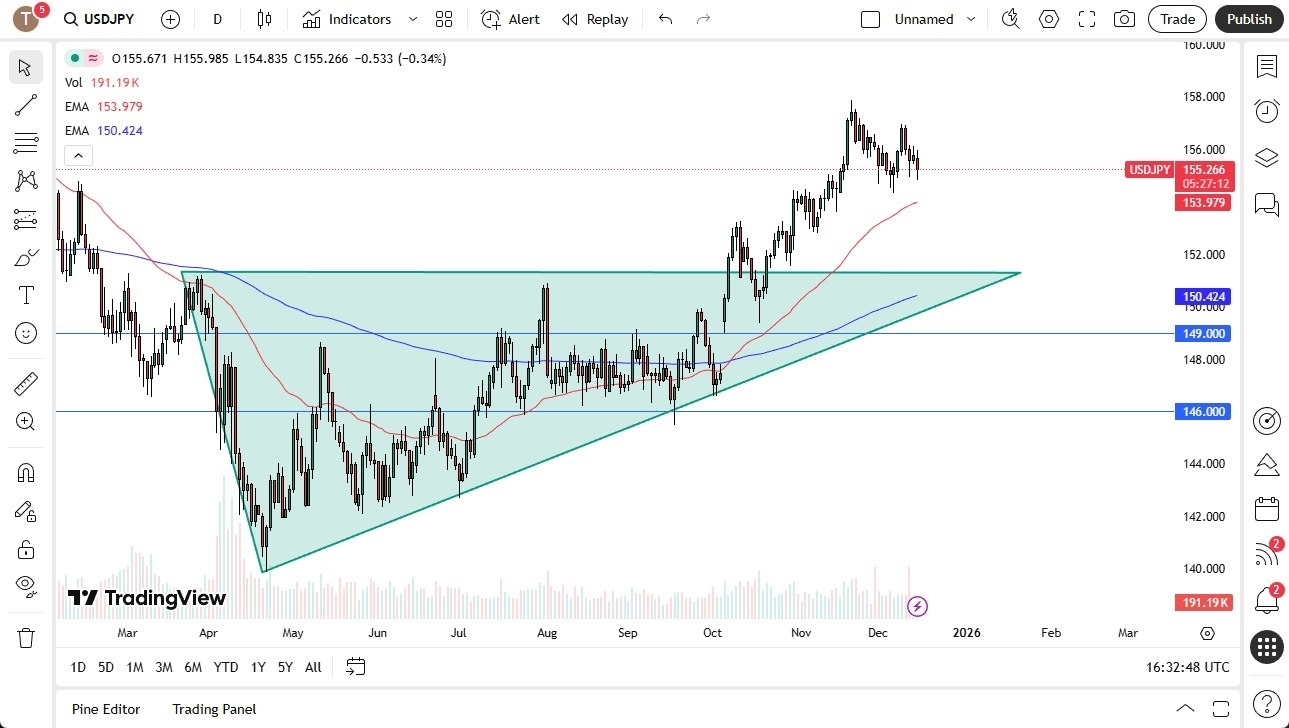
The US dollar initially tried to rally against the Japanese yen but then rolled over to show signs of hesitation on the bullish side. That being said, the 155 yen level does look like it’s trying to offer a little bit of support. And therefore, I think this could end up being a small buying opportunity. I recognize that there are a lot of questions right now about the Federal Reserve and what’s happening next. But at this point, the one thing that I do know is that the interest rate differential will continue to favor the US dollar.

Therefore, over the longer term, it should favor this pair going higher. Even if we were to break down from here, the 50-day EMA comes into the picture at just about 154 yen to offer support and then again at 152 yen, which I think is more likely than not, we do get a little bit of a pullback, but I think it ends up being a buying opportunity. That’ll be especially true once we get through the Bank of Japan later this week.
And therefore, I think a little bit of choppy sideways volatility makes a certain amount of sense. But as I’ve been saying for months, I’ve been holding this pair. I get paid every day to hold this pair. That’s the power of the carry trade. And the carry trade is expected to be a big thing again, especially if the United States remains a little more hawkish than originally thought.
And most of the leading economic numbers in the United States do suggest that 2026 may not be a bad year for the US economy at all. With this, and the fact that the Japanese have a structural problem with the ability to really tighten monetary policy, I think these dips continue to offer buying opportunities if you’re patient enough, probably a much longer-term one, but even shorter-term traders are jumping on this train.
Want to trade our USD/JPY forex analysis and predictions? Here’s a list of forex brokers in Japan to check out.
Christopher Lewis has been trading Forex and has over 20 years experience in financial markets. Chris has been a regular contributor to Daily Forex since the early days of the site. He writes about Forex for several online publications, including FX Empire, Investing.com, and his own site, aptly named The Trader Guy. Chris favours technical analysis methods to identify his trades and likes to trade equity indices and commodities as well as Forex. He favours a longer-term trading style, and his trades often last for days or weeks.
Platinum prices are extending a standout 2025 rally on Tuesday, December 16, 2025, with spot quotes hovering around the $1,800–$1,830 per ounce zone in early trading—levels last seen in 2011. Data from major bullion dealers showed spot platinum around $1,828/oz in the morning (U.S. time), up roughly 1.6% over 24 hours. [1]
Platinum’s move is notable because it’s happening even as gold cools from recent highs ahead of key U.S. labor-market releases. In one of the day’s most closely watched macro setups, Reuters reported that investors were positioned cautiously ahead of delayed U.S. jobs data, while platinum still pushed higher—helped by both tight-physical-market narratives and fresh focus on European auto-policy decisions that could influence long-term demand for catalytic converters. [2]
Below is a complete, publication-ready roundup of today’s platinum price action, the news drivers moving the market, and the latest forecasts and analyst views shaping expectations into 2026—all based on information available on 16.12.2025.
Because platinum trades around the clock and pricing differs slightly by venue (spot vs. futures), today’s headlines are best understood as a range rather than a single print.
What this means for readers: “Platinum price today” is best framed as roughly $1,810–$1,830 spot, while actively traded futures were probing the mid‑$1,800s, with the day’s top end brushing the $1,860 area. [6]
Reuters described platinum as hitting its highest level since September 2011, even while other precious metals were mixed. In Reuters’ pricing snapshot, spot platinum rose about 1.3% to $1,805.85 during the session, reinforcing the sense that platinum has become a new focal point in the broader precious-metals complex. [7]
That “multi‑year high” label matters in real markets: it tends to pull in momentum traders, systematic strategies, and generalist investors who previously ignored platinum because it spent years lagging gold.
On Tuesday, gold softened as markets waited for delayed U.S. employment reports (covering October and November) and later-week inflation releases—data that can shift expectations about the Federal Reserve’s 2026 rate path. Reuters noted that the jobs release would be missing some details due to disruptions in U.S. data collection following a government shutdown, but it still sits at the center of near-term rate expectations. [8]
Why this matters for platinum specifically:
One of the most platinum-relevant headlines in today’s news cycle is coming out of Brussels.
This doesn’t guarantee a sudden surge in platinum demand—policy details and timelines still matter—but it helps explain why platinum can rally on a day when investors are otherwise cautious ahead of U.S. macro data.
Platinum’s 2025 strength hasn’t been driven by one factor. A recurring theme is tightness in physical availability—and today’s analysis stream added fresh detail.
A Commerzbank note highlighted by FXStreet said Russia’s largest palladium producer published updated forecasts indicating:
That same note emphasized a key nuance: different organizations model “investment demand” differently, and conclusions about whether higher prices are justified can change depending on what you assume about ETFs, bars and coins, and exchange inventory flows. [12]
The World Platinum Investment Council (WPIC) recently projected:
WPIC also pointed to indicators of tightness in the market (lease rates and backwardation), arguing that tight conditions can persist even after a big price run. [14]
Bottom line: Today’s market is balancing two truths at once—(1) platinum has already rallied sharply, and (2) multiple credible outlooks still describe a market that is structurally constrained, even if 2026 trends toward balance.
In a broader precious-metals outlook published today, Reuters reported that Morgan Stanley forecasts platinum at $1,775/oz in 2026 (with palladium at $1,325), citing structural imbalances and different demand drivers across the complex. [15]
That projection is important for two reasons:
The FXStreet/Commerzbank commentary stressed that when you exclude investor demand, WPIC’s framework can even imply oversupply, which would not support further price gains—highlighting why the next phase for platinum may depend heavily on whether investors keep adding exposure via ETFs, bars, coins, and exchange inventory changes. [16]
Technical dashboards won’t tell you why platinum is moving, but they do reveal how crowded the trend may be.
With futures printing up to the mid‑$1,800s and the day’s trading range extending toward $1,861, traders are watching whether the market can hold above the psychologically important $1,800 zone without sharp pullbacks. [18]
Reuters emphasized that markets were focused on U.S. employment data (October and November) and upcoming inflation releases (CPI and PCE). These prints can quickly swing the U.S. dollar, real yields, and risk appetite—all of which can feed into platinum prices. [19]
If the European Commission’s auto-sector package or related political messaging materially changes expectations for the pace of ICE phaseouts, it could influence longer-run projections for catalytic converter demand—especially for platinum and palladium. [20]
The market is acutely sensitive to whether “tightness” is being eased by above-ground stocks, ETF flows, or exchange inventory movements—exactly the variables analysts are debating in today’s research notes. [21]
Platinum’s surge in 2025 is no longer flying under the radar. Today’s pricing shows a metal trading around $1,810–$1,830 spot and mid‑$1,800s in futures, holding near its highest levels since 2011. [22]
The day’s narrative is being driven by:
Meanwhile, the forecast picture is becoming more nuanced: Morgan Stanley’s $1,775/oz 2026 view implies a slower pace after the rally, even as structural constraints remain a core part of the bull case. [26]
Note: Prices are quoted in U.S. dollars per troy ounce and can change rapidly. This article is informational and not investment advice.
1. www.apmex.com, 2. www.reuters.com, 3. www.apmex.com, 4. www.kitco.com, 5. www.investing.com, 6. www.apmex.com, 7. www.reuters.com, 8. www.reuters.com, 9. www.reuters.com, 10. www.reuters.com, 11. www.fxstreet.com, 12. www.fxstreet.com, 13. www.prnewswire.com, 14. www.prnewswire.com, 15. www.reuters.com, 16. www.fxstreet.com, 17. www.investing.com, 18. www.investing.com, 19. www.reuters.com, 20. www.reuters.com, 21. www.fxstreet.com, 22. www.kitco.com, 23. www.reuters.com, 24. www.reuters.com, 25. www.fxstreet.com, 26. www.reuters.com