The main category of Forex News.
You can use the search box below to find what you need.
[wd_asp id=1]
The main category of Forex News.
You can use the search box below to find what you need.
[wd_asp id=1]
The , along with its European peers, has rebounded on Thursday after President Trump abandoned tariff threats linked to Greenland and also ruled out using force to take the territory.
Trump announced that he had withdrawn tariff threats after a meeting with NATO Secretary General Mark Rutte, during which they reached a framework for a deal on Greenland’s future.
While details are few and far between, reports suggest the framework may involve mineral rights and the golden dome, Trump’s most ambitious missile defence plan yet. Greenland is home to a large amount of rare earth elements, many of which are crucial to technologies such as mobile phones and EVs.
NATO Secretary General said there was no discussion over the key issue of Danish sovereignty over Greenland
Trump’s comments have been enough to boost risk sentiment, calming fears of a potential trade war.
Those sectors which had been badly beaten in recent days are rebounding, with German automakers leading the charge higher.
With the TACO (Trump Always Chickens Out) trade in full swing, attention is also turning to financial updates. Volkswagen Europe’s largest carmaker is up 4.3% after posting better-than-expected net cash flow for 2025.
Attention will also be on U.S. data later today, including , the Fed’s preferred gauge for inflation, for October and November, although this may seem like old news now, as well as Q3 .
The DAX rebounded lower from its record high of 25,500 to a low of 24,350, although crucially closed above the 24,700 support level and the July and October highs, keeping the uptrend intact.
Buyers, encouraged by recovering momentum, will look to extend gains towards the 25,000 round number and 25,500 to fresh record highs.
Sellers would need to break meaningfully below the 24,700 level to negate the near-term uptrend. Below here, the 50 SMA and 200 SMA come into play at 24,275 and 23,930, also the mid-December low.
is rising as the holds onto yesterday’s gains after Trump backpedalled on trade tariffs and on Greenland, announcing a framework for a deal. As a result, investors unwound the “Sell America” trade, and risk sentiment has returned.
In the absence of further updates regarding Greenland, attention will turn to US data and central banks. The US core PCE for October and November, the Fed’s preferred inflation gauge, will be released, helping to clear some of the haze left by the US government shutdown at the end of last year. US GDP for Q3, as well as jobless claims, will also be watched for clues over the Fed’s next move.
The market is pricing in two by the Fed this year.
The yen is weakening and remains in intervention territory at these levels. However, Japanese long-dated government bonds are extending gains on Thursday after a steep sell-off at the start of the week. Expectations are rising that the finance ministry could take some measures to contain further rises in yields.
Attention is turning to the Bank of Japan’s rate decision early on Friday. The central bank is expected to leave rates unchanged at 0.75% after raising them to the highest level since 1995 in the December meeting.
Attention will be on the extent to which BoJ governor Ueda provides hawkish signals at a time when the yen is on the brink of a key level versus the dollar at 160. This is the level considered a rough line in the sand, where authorities step in for multiple rounds of intervention, as in 2024.
The BoJ will be paying closer attention to the impact of the currency on inflation, as further weakening could accelerate the pace of future rate hikes.
USD/JPY eased lower from its 18-month high of 159.45, finding support on its multi-month rising trendline and recovering higher. The uptrend remains intact. The RSI supports further gains as long as it remains out of overbought territory.
Buyers will look to rise above 159.45 to create a higher high towards 160.00 and 162.00, the 2024 high.
Support is seen around 157.75, the November high and weekly low. A break below here and the 50 SMA at 156.50 opens the door to 145.50, the December low.
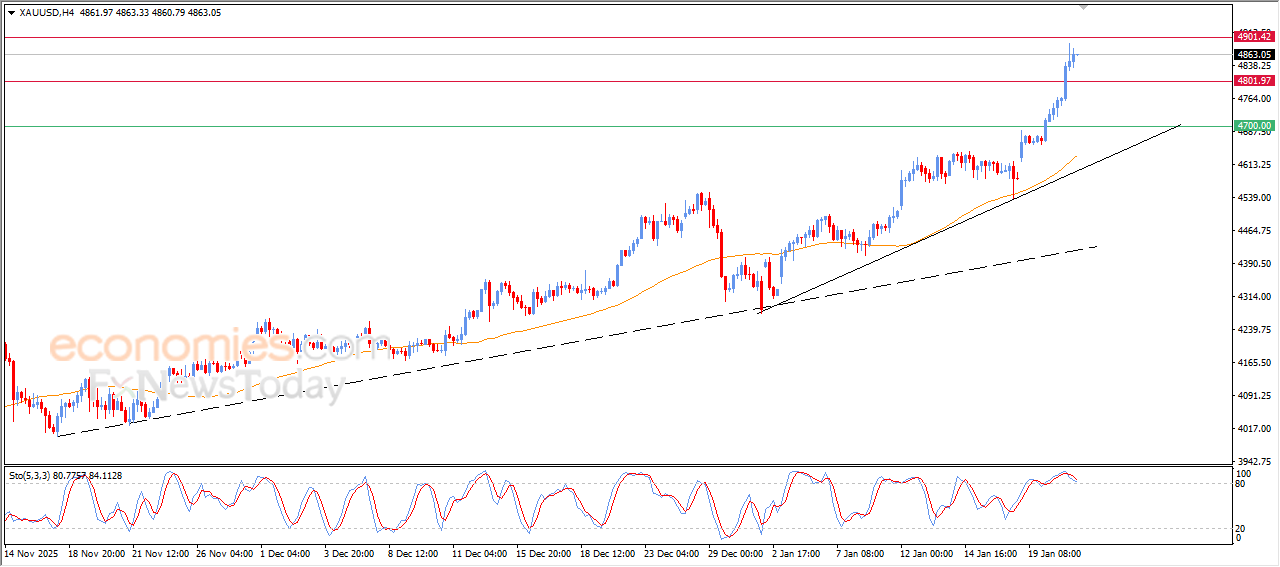
A better market mood is not enough to take Gold price down, with the bright metal reaching yet another record high on Thursday. The XAU/USD pair reached yet another record high on Thursday, after sliding to $4,756 on Wednesday, following news that the United States (US) reached a framework of a deal with the North Atlantic Treaty Organization (NATO).
The battered US Dollar (USD) found some demand and trimmed part of its weekly losses as the sentiment improved. Not only did Gold retreat, but stocks also recovered their shine. As the market digested the news, however, the Greenback resumed its decline and Gold its run to records, despite a positive tone in global indexes.
The latest bout of optimism was fueled by encouraging US data, as the Bureau of Economic Analysis (BEA) revised Q3 Gross Domestic Product (GDP) to 4.4% annualized in the three months to September, up from the previously reported 4.3%.
The country also released Personal Consumption Expenditures (PCE) Price Index data for October and November. The report showed that annual inflation rose to 2.8% in November from 2.7% in October, while the core PCE Price Index rose by 2.8% in November, following the 2.7% increase recorded in October and matching the market expectation. The data showed the economy continued to grow at a solid pace, while inflation did not overheat, despite tariffs and political turmoil.
Additional hints on growth will be out on Friday, as S&P Global will publish the preliminary estimates of the January Purchasing Managers’ Indexes (PMIs). Market analysts forecast an uptick in manufacturing and services activity, which, if true, should further boost optimism.
The near-term picture is bullish for XAU/USD, as the 4-hour chart shows that the 20-period Simple Moving Average (SMA) rises above the 100 and 200 SMAs, and all three slope higher, pointing to a robust uptrend. Price holds above these references, with the 20 SMA at $4,780.64 offering nearby dynamic support and the 100 SMA at $4,558.68 reinforcing the floor. At the same time, the Momentum indicator remains stable well above its midline, failing to provide directional clues. Nevertheless, the Relative Strength Index (RSI) resumed its advance after correcting extreme conditions, currently at 73, hinting at higher highs ahead.
In the daily chart, the bullish case is even stronger. XAU/USD is trading well above all bullish moving averages, with the 20-day SMA at $4,534.57 providing relevant dynamic support. Meanwhile, the Momentum indicator extends its advance into extreme levels, while the RSI does the same at around 79, without signs of upward exhaustion.
(The technical analysis of this story was written with the help of an AI tool.)
Natural gas price activated with the US data positively, to rally above the broken bullish channel’s support initially at $4.050 level, to settle above it and to open the way for today’s trading with strong positivity by its rally directly to $5.490.
The price might form corrective trading to attempt to gather some gains, but its stability above $4.750 level supports the continuation of the positivity, to expect resuming the bullish attack to reach $5.770, then press on the bullish channel’s resistance at $5.960.
The expected trading range for today is between $5.100 and $5.770
Trend forecast: Bullish
New York, January 22, 2026, 06:30 EST — Premarket
U.S. natural gas prices surged once more in early Thursday trading, with the Henry Hub benchmark climbing past $5 per million British thermal units (mmBtu). Front-month futures gained roughly 10%, hitting about $5.38 per mmBtu by 5:58 a.m. EST. (Businessinsider)
This matters because gas not only heats homes but also powers a significant share of U.S. electricity. When forecasts turn colder, demand often jumps quicker than supply can catch up.
Traders are also monitoring “freeze-offs” — those periods when extreme cold clogs wells and gathering systems — even as liquefied natural gas export plants continue pulling feedgas from the domestic market.
The February contract closed at $4.875 per mmBtu Wednesday, climbing 96.8 cents after a roughly 26% jump the day before. That two-day rally, about 57% in total, marked the biggest surge ever for the front-month contract and sent 30-day implied volatility up to 131.9%. Meanwhile, the spread between February and March contracts hit a record premium of $1.36. LSEG reported Lower 48 production at 108.7 billion cubic feet per day (bcfd) so far in January, down from 109.7 bcfd in December. Demand—including exports—is expected to increase next week. LNG feedgas has averaged 18.5 bcfd this month. Shares of gas producers EQT and Expand Energy gained roughly 6% and 4% Wednesday. (EnergyNow)
“The weather premium has kicked in hard,” Ole R. Hvalbye, commodities analyst at SEB, noted, as a cold snap forced traders to unwind heavy short bets. Eli Rubin from EBW Analytics described the jump as “highlighting the extent of short covering” amid thin market conditions. (Rigzone)
The U.S. Energy Information Administration reported that working gas in underground storage stood at 3,185 billion cubic feet (Bcf) for the week ending Jan. 9. This marks a decline of 71 Bcf from the previous week but remains roughly 106 Bcf above the five-year average. The next storage update is scheduled for Thursday at 10:30 a.m. (EIA Information Releases)
East Daley Analytics forecasts a 104 Bcf withdrawal for the week ending Jan. 16 but noted the market is mostly ignoring that potentially bearish figure. Instead, attention is shifting to colder weather forecasts and upcoming storage reports. (East Daley)
Pipeline operator Kinder Morgan outperformed Wall Street profit forecasts and reaffirmed confidence in sustained natural gas demand, pointing to increased electricity consumption from data centers. Shares climbed 1.4% after hours. CFO David Michels highlighted that higher transport volumes were boosted by fresh gas expansion projects and a recent acquisition in gathering and processing. (Reuters)
Aside from the recent cold snap, a surge of new LNG supply expected in 2026 could weigh on global gas prices and tighten export margins, depending on demand growth rates. Reuters forecasts about 35 million metric tons of additional LNG this year as projects in the U.S., Qatar, and other locations come online. (Reuters)
That said, the natural gas price rally hinges heavily on weather forecasts. If models swing toward milder conditions, freeze-offs fall short of expectations, or storage draws underperform, the rally could reverse just as fast.
Copper price approached the initial corrective target yesterday at $5.6500, to confirm delaying the attempts to resume the bullish trend due to its stability at $5.9700, besides providing negative momentum by its continued leaning below 80 level as appears in the above image.
Therefore, we will keep preferring the temporary negative attempts, which might target $5.6200 and $5.5100, while regaining the bullish trend requires a positive close above the mentioned barrier, to reinforce the chances of recording new historical gains that might begin at $5.6200 and $5.8500.
The expected trading range for today is between $5.6200 and $5.8500
Trend forecast: Bearish
Copper price approached the initial corrective target yesterday at $5.6500, to confirm delaying the attempts to resume the bullish trend due to its stability at $5.9700, besides providing negative momentum by its continued leaning below 80 level as appears in the above image.
Therefore, we will keep preferring the temporary negative attempts, which might target $5.6200 and $5.5100, while regaining the bullish trend requires a positive close above the mentioned barrier, to reinforce the chances of recording new historical gains that might begin at $5.6200 and $5.8500.
The expected trading range for today is between $5.6200 and $5.8500
Trend forecast: Bearish
– Written by
Frank Davies
STORY LINK Pound Sterling to Dollar Forecast: Is the Calm Temporary?
The Pound to Dollar exchange rate (GBP/USD) regained some composure after renewed equity market losses briefly dragged the pair back to key support levels.
After a calmer start, there were fresh losses in equities which hampered the Pound with the Pound to Dollar (GBP/USD) exchange rate dipping to re-test the 1.3400 level before a recovery to 1.3430 as the dollar lost ground.
According to UoB, there is scope for gains to 1.3505, but added; “On the downside, a breach of 1.3380 could indicate that GBP is likely to range-trade instead of trading with an upward bias.”
HSBC has an end-year GBP/USD forecast of 1.35.
There was no major impact from the latest UK inflation data with geo-political developments dominating domestic and global markets. Events in Davos will continue to be monitored very closely.
Macquarie Group global forex and rates strategist Thierry Wizman commented; “The next step in the ‘Greenland or Bust’ saga is to see whether a common ground, such as NATO joint administration of Greenland, can be reached, starting at Davos this week.”
Get better rates and lower fees on your next international money transfer.
Compare TorFX with top UK banks in seconds and see how much you could save.
He added; “Until that happens the so-called primacy of the U.S. remains at risk of further dissolution, and with it an upending of the geopolitical alignments that have upheld markets in recent years.”
As far as financial markets are concerned, the developments in bond markets will be a key element.
Upward pressure on bond yields unsettled the dollar on Tuesday and had a knock-on effect on the Pound as UK bond yields also moved higher.
According to ING; “Greenland will be the dominant theme today and there may be scope for de-escalation, offering the dollar some support. Trump is meeting EU leaders in Davos today, and if the past year has shown anything, it’s that face‑to‑face engagement tends to provide the best opportunity for tensions with the US president to ease.”
MUFG noted; “The news yesterday that the Danish pension fund Akademikerpension was exiting the US Treasury market certainly added to the speculation of further foreign investor selling.”
It notes that this is not a sum which would destabilise the markets.
Nevertheless, it added; “But another announcement like the Danish one can certainly reinforce the negative momentum and feed the speculation of a broader sell-off of US assets. Investors sense that the taking of Greenland could be a step too far and warrants a more serious flight of capital from the US than what took place in April last year. The selling then was fleeting.”

Rabobank commented on the potential lack of alternatives; “The question remains, however; if we see mass dumping from European institutions, where do the dollars go?”
Domestically, the headline UK inflation rate increased to 3.4% from 3.2% and marginally above consensus forecasts of 3.3% with the core rate held at 3.2%.
Markets continued to price in around a 20% chance of a Bank of England rate cut at the March meeting.
International Money Transfer? Ask our resident FX expert a money transfer question or try John’s new, free, no-obligation personal service! ,where he helps every step of the way,
ensuring you get the best exchange rates on your currency requirements.
TAGS: Pound Dollar Forecasts
Silver price (XAG/USD) retreats on Wednesday after reaching a daily high of $95.56 after US President Donald Trump eased his tone in his Davos speech, saying that he is ready to negotiate Greenland with Denmark. At the time of writing, XAG/USD trades at $93.57, down over 1% after reaching a record high of $95.89 on Tuesday.
Silver’s daily chart suggests the grey metal is upward biased, but the parabolic move seems to have paused as the Relative Strength Index (RSI) exited from overbought territory and shows signs of negative divergence.
Despite this, bears are not out of the woods as they must clear the $90.00 figure before challenging the latest cycle low of $86.45 reached on January 15. In that outcome, Silver could dive towards the 20-day SMA at $80.63.
On the flip side, if XAG/USD is to extend its gains, buyers need to push prices above the record high of $95.89, followed by the $100.00 milestone.
(This story was corrected on January 21 at 17:11 to say in the first paragraph that the $95.56 price is a daily high, not an all-time high.)
Silver is a precious metal highly traded among investors. It has been historically used as a store of value and a medium of exchange. Although less popular than Gold, traders may turn to Silver to diversify their investment portfolio, for its intrinsic value or as a potential hedge during high-inflation periods. Investors can buy physical Silver, in coins or in bars, or trade it through vehicles such as Exchange Traded Funds, which track its price on international markets.
Silver prices can move due to a wide range of factors. Geopolitical instability or fears of a deep recession can make Silver price escalate due to its safe-haven status, although to a lesser extent than Gold’s. As a yieldless asset, Silver tends to rise with lower interest rates. Its moves also depend on how the US Dollar (USD) behaves as the asset is priced in dollars (XAG/USD). A strong Dollar tends to keep the price of Silver at bay, whereas a weaker Dollar is likely to propel prices up. Other factors such as investment demand, mining supply – Silver is much more abundant than Gold – and recycling rates can also affect prices.
Silver is widely used in industry, particularly in sectors such as electronics or solar energy, as it has one of the highest electric conductivity of all metals – more than Copper and Gold. A surge in demand can increase prices, while a decline tends to lower them. Dynamics in the US, Chinese and Indian economies can also contribute to price swings: for the US and particularly China, their big industrial sectors use Silver in various processes; in India, consumers’ demand for the precious metal for jewellery also plays a key role in setting prices.
Silver prices tend to follow Gold’s moves. When Gold prices rise, Silver typically follows suit, as their status as safe-haven assets is similar. The Gold/Silver ratio, which shows the number of ounces of Silver needed to equal the value of one ounce of Gold, may help to determine the relative valuation between both metals. Some investors may consider a high ratio as an indicator that Silver is undervalued, or Gold is overvalued. On the contrary, a low ratio might suggest that Gold is undervalued relative to Silver.
The market has clearly spoken that it does not like the rising interest rates in Japan, as traders continue to punish the bond markets in Tokyo.
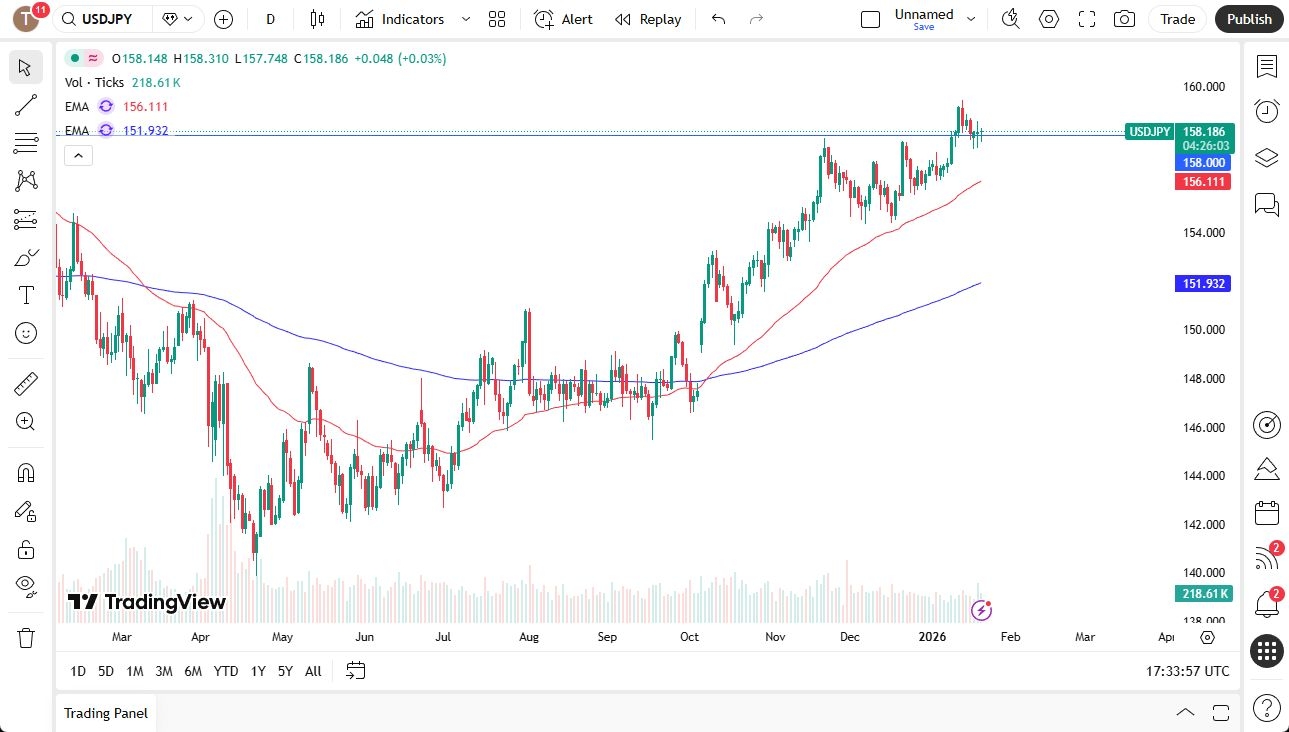
The US dollar has gone back and forth against the Japanese yen during trading on Wednesday as we continue to see a lot of choppiness right around this 158 yen level. It does make a certain amount of sense because we have the Bank of Japan interest rate decision happening on Friday, and that obviously will have a lot to do with where we go next.

While a cut or a hike isn’t necessarily expected, what people will be watching is the statement and the press conference. The Japanese are painted into a corner as they offer 75 basis points interest, but quite frankly, their bond market is starting to get out of control, and a lot of that comes down to the debt.
The market has clearly spoken that it does not like the interest rates rising in Japan and therefore continues to punish Japan via its bond market. If the central bank starts to talk about quantitative easing again, that probably helps the bond market but crushes the yen.
The interest rate differential, even after the Fed cuts a total of 50 basis points this year as expected, is still wide enough to drive a truck through, and therefore, you get paid at the end of every day to hold this currency pair. I think that continues to be one of the main drivers.
The 50-day EMA is down at the 156.11 level, and I think it is going to continue to offer a bit of a floor in the market. I like buying dips. I’ve been hanging on to this one for a while, adding occasionally, and building up a sizeable position that pays me at the end of every day. That’s how I think this continues. 160 yen will be the next target.
Want to trade our USD/JPY forex analysis and predictions? Here’s a list of forex brokers in Japan to check out.
Christopher Lewis has been trading Forex and has over 20 years experience in financial markets. Chris has been a regular contributor to Daily Forex since the early days of the site. He writes about Forex for several online publications, including FX Empire, Investing.com, and his own site, aptly named The Trader Guy. Chris favours technical analysis methods to identify his trades and likes to trade equity indices and commodities as well as Forex. He favours a longer-term trading style, and his trades often last for days or weeks.
Natural gas price continued forming strong bullish waves since yesterday, to notice achieving the suggested targets by reaching $4.00 level, to reach the support of the broken bullish channel’s support, which represents a key resistance.
Noticing that stochastic begins to exit the oversold level, attempting to provide a new bullish momentum, to increase the chances of surpassing the current resistance, and its stability above this level will confirm its readiness to record new gains by its rally towards $4.185, while the failure to breach it will support the dominance of the sideways bias in the current trading, and there is a chance to retest $3.620 level before reaching extra bullish target.
The expected trading range for today is between $3.780 and $4.185
Trend forecast: Bullish