The main category of All News Articles.
You can use the search box below to find what you need.
[wd_asp id=1]
The main category of All News Articles.
You can use the search box below to find what you need.
[wd_asp id=1]
I wrote on 8th March that the best trades for the week would be:
Long of Gold following a daily (New York) close above $5,418.55. This did not set up.
Long of Wheat.
A summary of last week’s most important data in the market:
USA CPI (inflation) – as expected at an annualized rate of 2.4%.
US Core PCE Price Index – as expected at 0.4% month-on-month.
US Preliminary GDP – lower than expected at 0.7% over the quarter when a reading as high as 1.4% was expected, which may contribute to bearish sentiment in the US stock market.
US JOLTS Job Openings – slightly higher than expected.
US Unemployment Claims – as expected.
UK GDP – lower than expected, with no change month-on-month while an increase of 0.2% was expected.
Canada Unemployment Rate – unexpectedly ticked higher to 6.7% while 6.6% was expected.
Last week’s data had very little effect on the market. What did affect the market was the ongoing and escalating war in the Middle East, which has pushed the price of crude oil higher, damaged the economies of the Gulf states which are suffering from attacks from Iran, and raised tension between the USA and China. There are open and frightening questions over how this war might end, with the parties on the bring of seriously escalating by targeting critical energy and infrastructure.
Clearly, the USA and Israel are successfully striking all the targets they want to inside Iran, while suffering very few casualties themselves. There is damage to US bases and facilities near the Gulf, and relatively minor damage in Israel. There is massive damage to Iran’s regime and military. What is far from clear is the fate of the Iranian regime and the large supply of enriched uranium which is somewhere in Iran.
Prediction markets see this war continuing for at least another two weeks. It is very unlikely to stop quickly, which increases the potential for it to disrupt or influence markets.
A large-scale Israeli invasion of Lebanon is also on the table, after Hezbollah entered the war on Iran’s side and began attacking Israel, although this is unlikely to affect markets much.
Iran has begun striking economic targets in the Gulf states, as well as certain oil infrastructure.
We are on the brink of a serious escalation.

The middle east war is likely to remain more influential that any economic data releases which are scheduled over the coming week. Having said that, we will see an unprecedented seven major central bank policy meetings within the same week!
The coming week’s most important data points, in order of likely importance, are:
US Federal Reserve Policy Meeting
US PPI
Reserve Bank of Australia Policy Meeting (rate hike of 0.25% is expected)
Bank of Japan Policy Meeting
European Central Bank Policy Meeting
Bank of England Policy Meeting
Bank of Canada Policy Meeting
Canadian CPI (inflation)
Swiss National Bank Policy Meeting
US Unemployment Claims
New Zealand GDP
Australia Unemployment Rate
UK Unemployment Claims
It will be a public holiday in Japan on Friday.
Currency Price Changes and Interest Rates
For the month of March, I made no monthly Forex forecast as the US Dollar was not in a clear trend at the start of the month.
Last week saw no currency crosses with excessive volatility, so I am making no forecast for the coming week.
The US Dollar was again the strongest major currency last week, while the New Zealand Dollar was the weakest. Directional volatility decreased slightly last week, with 37% of all major pairs and crosses changing in value by more than 1%.
Next week’s volatility is likely to increase and might be exceptionally high due to the escalation of the war in the Middle East, which is now threatening oil facilities, which might generate volatility in the US Dollar, the Japanese Yen, and the Canadian Dollar, not to mention stock markets. There could also be unforeseen side effects which might affect other currencies.
You can trade these forecasts in a real or demo Forex brokerage account.
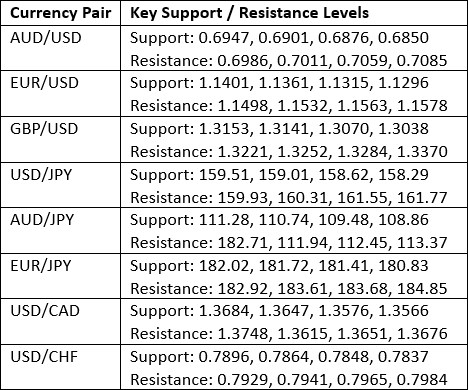
Key Support and Resistance Levels
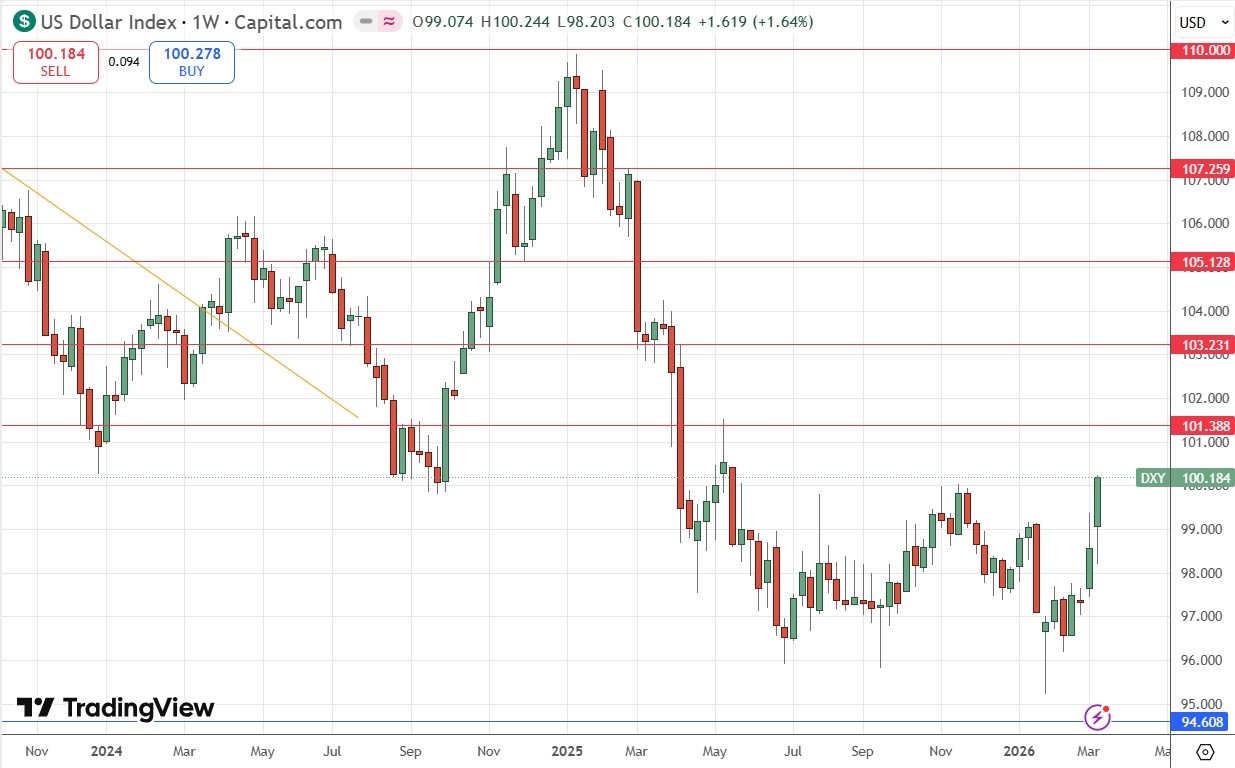
The US Dollar had its strongest week since November, powering higher to close at a fresh 9-month high price with an unusually large candlestick which closed right on the high of its range. These are very bullish signs. The price is obviously in a valid long-term trend and has further room to rise before reaching the key resistance level at 101.39.
There are three reasons for the greenback’s strength:
The Fed is looking less likely to cut rates in 2026, with the CME FedWatch tool now showing the markets are barely expecting a single cut of 0.25%, at the Fed’s December meeting. The 2-Year Treasury Yield has risen to a level not seen since August 2025.
The escalating war in the Middle East which is now seriously threatening to meaningfully restrict global supplies of crude oil and potentially trigger a more hostile relationship between the USA and China, is generating a flight into the US Dollar. The war is also starting to impact Gulf states such as the U.A.E. which are increasingly being targeted by Iran.
Nervous markets are seeing liquidation of American stock positions, meaning American equity is being redeemed into Dollars, raising demand for Dollars.
It is very hard to see this situation changing over the coming week, unless there will be a highly surprising sudden end to the war in the Middle East. I will be very confident being long of the US Dollar over the coming week.
US Dollar Index Weekly Price Chart
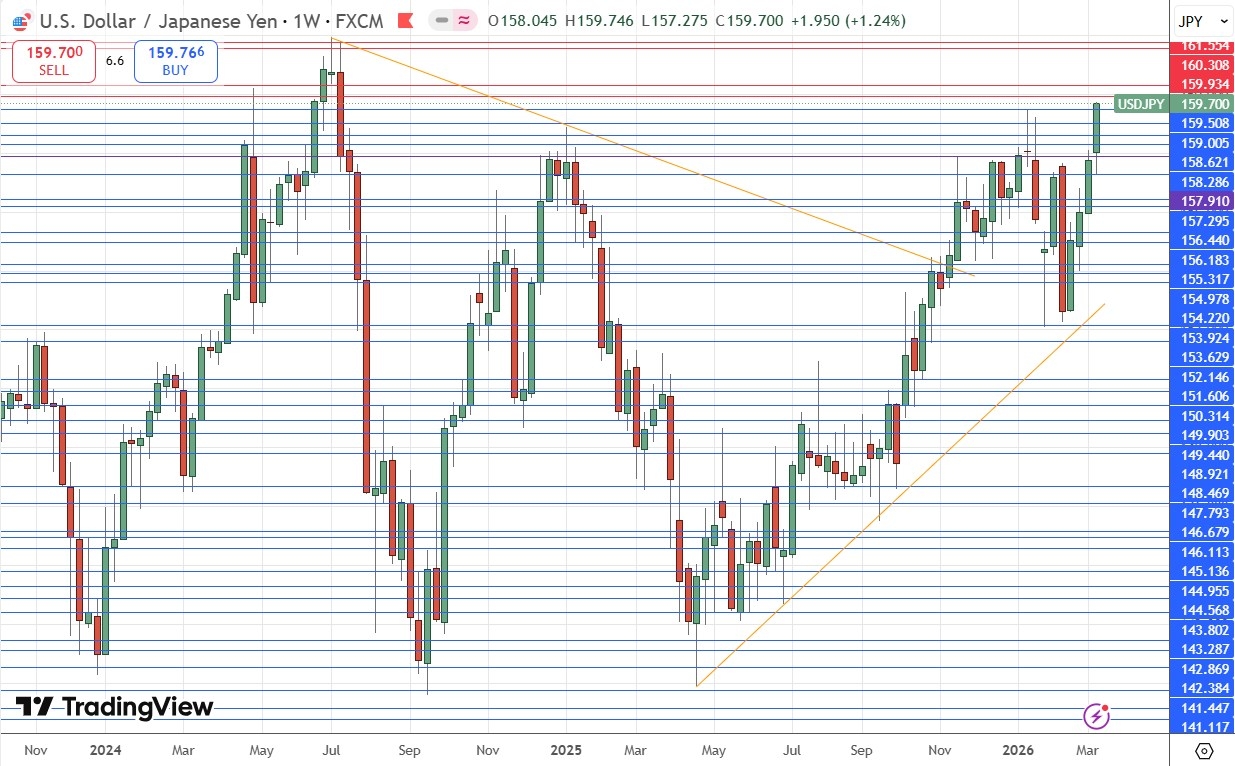
The USD/JPY currency pair gained strongly last week, closing right on the high of its range with a reasonably large bullish candlestick at an 18-month high. These are bullish signs and I am long of this currency pair. The only doubt I have is that we have not yet cleared the big round number at ¥160 which has acted as resistance for a long time.
Another technically encouraging sign is the bullish breakout we saw a few weeks ago from the narrowing triangle formation that can be seen within the price chart below, although this does not prove much for the future, just that we have had a nice technical breakout which now continues into blue sky.
I explained above why the US Dollar is the strongest of all the major currencies, and why this is likely to continue over the coming week. As for the Japanese Yen, although the Bank of Japan would like to raise its rates, it is having great difficulty in doing so due to the high level of debt in Japan. The Japanese Yen has been in a long-term bearish trend.
There are excellent fundamental, sentimental, and technical reasons to be long here, but more cautious traders might want to wait for a New York close above ¥160 before going long.
USD/JPY Weekly Price Chart
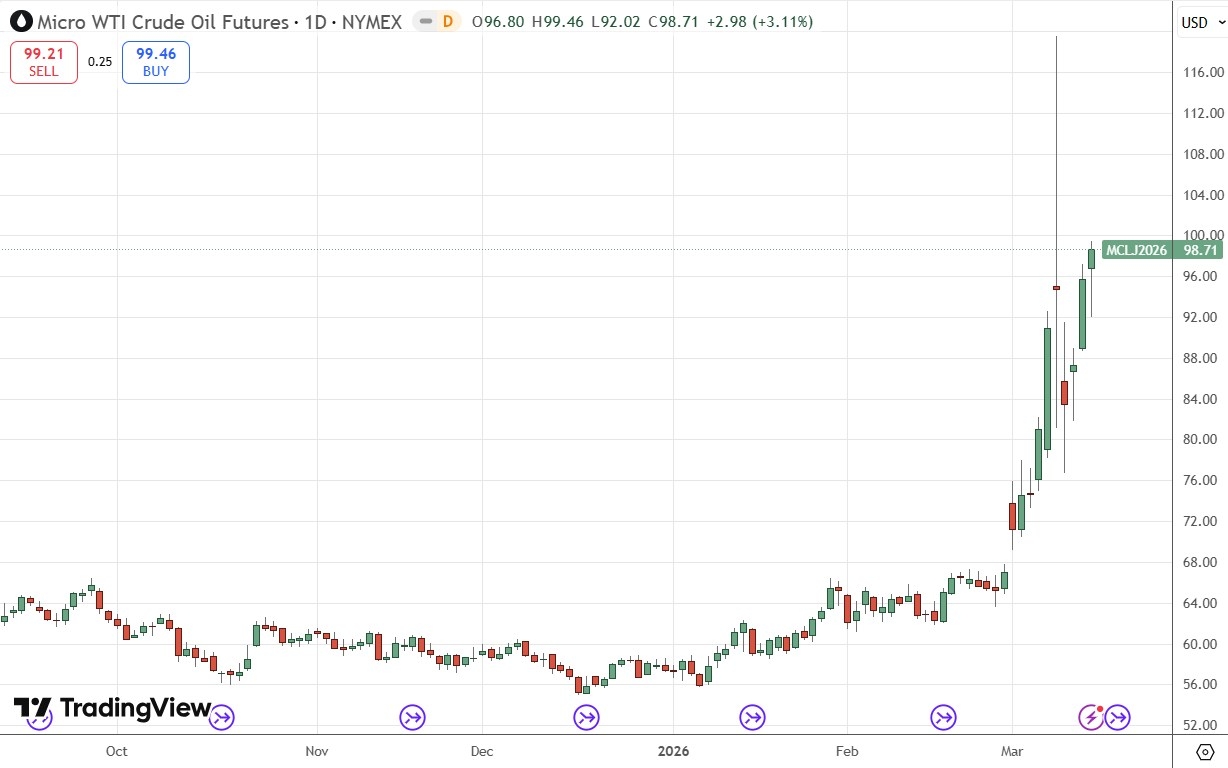
WTI Crude Oil rose last week, but not by much, as President Trump had some success in talking the price down by hinting the war would end soon, even though there was really no such early end on the table at all.
Despite the small rise overall, the price briefly reached $120 on Monday before falling back, but as the daily chart below shows, it is rising again, and the price action looks bullish.
The war in the middle east was showing signs of escalating during the second half of last week, with the rumour that Iran had begun mining the Strait of Hormuz through which about 20% of the world’s crude oil transits keeping a bid in the price.
However, after markets closed on Friday for the weekend, news came that the US sent in heavy bombers to wipe out all the military defenses on Kargh Island, an island just off the coast of Iran near Iraq and Kuwait at the end of the Gulf, which processes 90% of Iran’s crude oil exports. President Trump has publicly threatened to devastate the oil facilities there, or at least to “reconsider” his decision to spare them, if Iran does not start to allow free passage through the Strait of Hormuz. However, President Trump has also made it clear that he expects other nations to step up and help in opening the Strait. Effectively, Trump knows that the USA is not affected directly by the closure of the Strait, so he is expecting other countries to take care of their own problem. Ironically, this might calm the price of crude oil as nobody really expects other countries to do much about Hormuz. However, the effective closure of Hormuz is going to eventually send the price well above $100 if it persists.
It is likely to be dangerous to enter now as we could easily see a fast and huge move in the price either up or down. However, the price action does look bullish, and the long trend trade from the breakout near $65 will have survived for most trend following systems, so longs will still be dominating orders.
If you do go long, do it with a very small position size that reflects the enormously high volatility which we see in the price now.
WTI Crude Oil Daily Price Chart
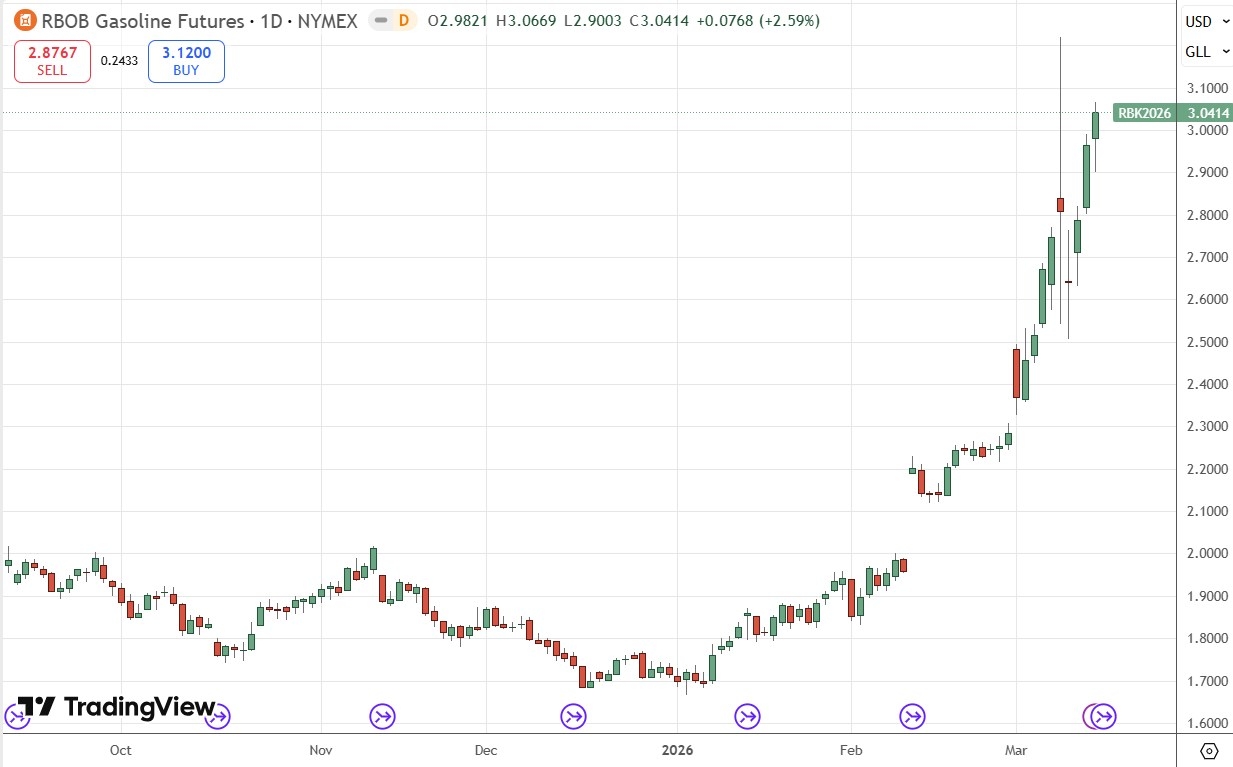
RBOB Gasoline futures briefly traded at a new 3-year high last week before falling back, but like Crude Oil, the price action remains bullish.
This is all about what I wrote just above concerning WTI Crude Oil. As the price of crude oil rises, so the price of Gasoline is almost certain to rise with high positive correlation between the two assets, as gasoline is derived by refining crude oil.
As I wrote above, it might be too late for a long trade, and if you do feel you have to go long here, use a very small position size (respect the very high volatility) and a trailing stop to avoid a catastrophic loss. Remember that what goes up very hard and very fast can come down just the same way.
RBOB Gasoline Futures Daily Price Chart
ZW Wheat futures are slightly lower over the week, after reaching their highest price in a year during the previous week but ended the week on a strong note with bullish price action which suggests technically that new highs are going to be reached. Many analysts see the ongoing middle east war as pushing the price of grains up but there are deeper reasons relating to supply issues in the grain markets and changes to the wheat business in the USA.
If Wheat futures are too big for you (and they probably are), you can get exposure to US Wheat by buying the Teacrium Wheat Fund (WEAT) which is an ETF and very affordable.
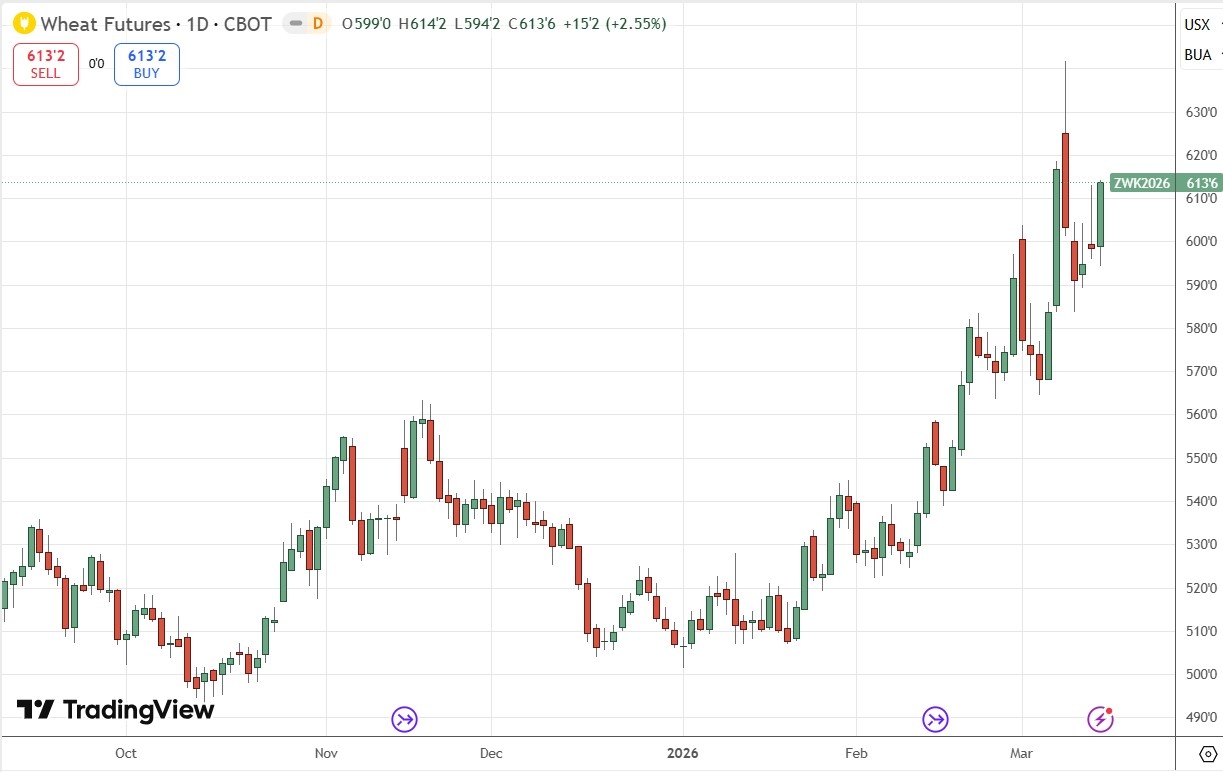
Wheat Futures Daily Price Chart
Last week was poor for the US stock market, with the S&P 500 Index not only closing lower, but ending the week right on its low of the week after breaking below the long-term support level at 6,737.
Technically, things are looking firmly bearish. Look at the topping price action underneath and just touching the big round number at 7,000 which we have seen over recent weeks, and the way the price has started to move lower from there with growing momentum.
I see the price quite quickly reaching the other significant round number at 6,500 or possibly stopping at the horizontal support at 6,522. This area is likely to be strong support and the 200-day moving average is not far below which gives even more supportive confluence. If the price breaks below all that, the market really will be in big trouble.
The US stock market, and stock markets generally, are looking bearish for two reasons:
The over-extended and massive bull market which ran for a long time.
The escalating war in the Middle East which is threatening to cause serious damage to global oil supplies and the economies of the Gulf states.
Despite the bearish outlook, shorting the US stock market, especially an Index, is not easy, and should only be attempted by experienced traders.
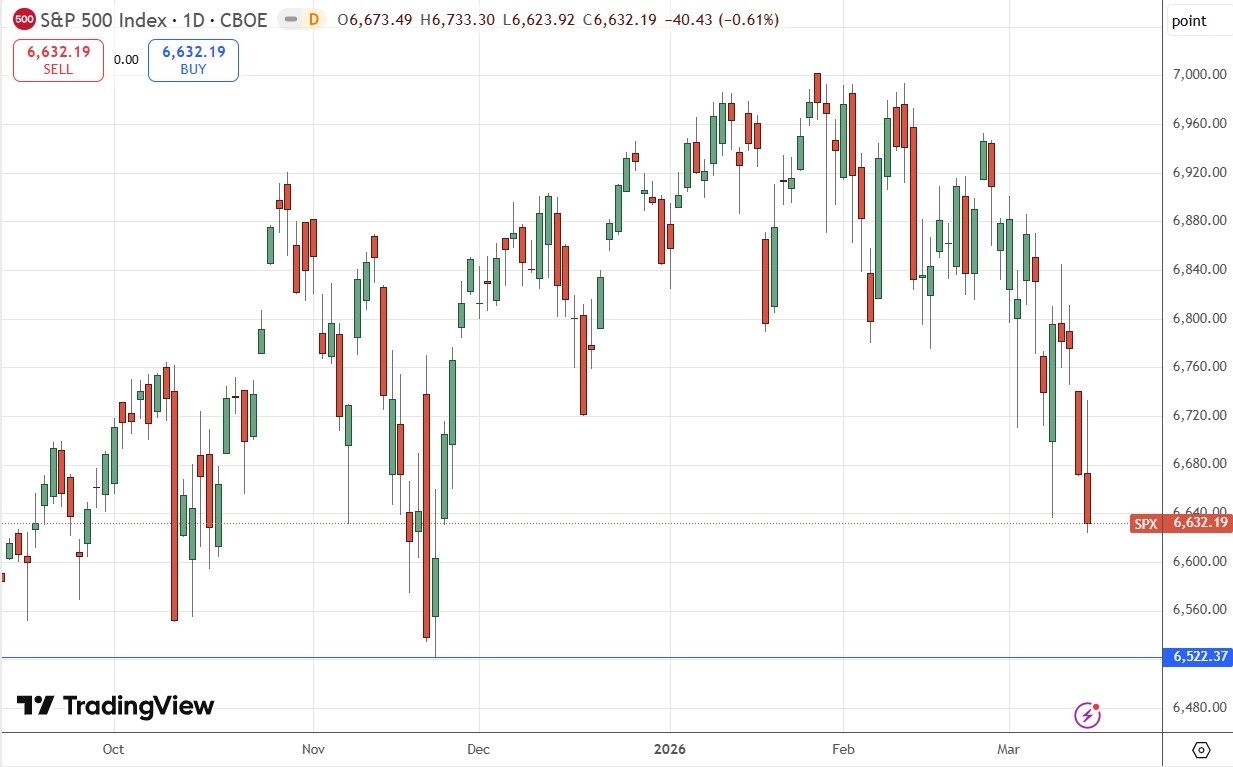
S&P 500 Index Daily Price Chart
I see the best trades this week as:
Long of the USD/JPY currency pair.
Long of Wheat.
Ready to trade our weekly Forex forecast? Check out our list of the top 10 Forex brokers in the world.
NEW YORK, March 14, 2026, 14:17 (EDT)
Regular gasoline in the U.S. hit an average of $3.675 a gallon on Saturday, building on a sharp jump seen in March as Brent crude closed above $100 a barrel Friday. Early attempts to tamp down the surge haven’t done much so far. AAA’s state-by-state numbers show the national average climbing further past $3.60—a threshold not seen since May 2024, first crossed just this Thursday. AAA Fuel Prices
Spring travel is ramping up right as pump prices climb, pressuring household confidence. In March, the University of Michigan reported that consumer sentiment slipped—gasoline costs have surged over 21% since the start of the conflict with Iran. Reuters
Gas prices are feeling the squeeze as market signals turn tighter. AAA reported the national average at $3.598 on March 12, pointing to Energy Information Administration figures showing gasoline demand hitting 9.24 million barrels per day last week. Domestic supply dropped to 249.5 million barrels, just as spring break travel kicked off. AAA Fuel Prices
Crude remains the key. Brent, the global benchmark, finished Friday at $103.14 a barrel. Goldman Sachs is now projecting Brent to stay over $100 through March, with a drop to $85 expected for April. The bank still anticipates a slide to the low $70s later in the year—if the situation at the Strait of Hormuz, which handles roughly a fifth of global oil flows, calms down. Reuters
Quick relief at the pump isn’t likely. Analysts noted a U.S. shipping-rule waiver and tapping emergency reserves could help break up some regional logjams, but they won’t halt climbing retail gasoline prices. Joe Brusuelas at RSM described the reserve release as just a “temporary salve.” GasBuddy’s Patrick De Haan estimated a waiver might only trim price hikes by “around a nickel a gallon” in areas that depend on imports. Reuters
Gas prices hit harder in some states than others. On Saturday, California drivers were paying an average of $5.483 a gallon, AAA data showed, while Washington stood at $4.837 and Texas at $3.350. A day earlier, California’s average reached $5.42. Last year, Chevron’s Richmond and El Segundo facilities, along with Marathon Petroleum’s Los Angeles plant, led the state for crude imports. Energy economist Philip Verleger called the West Coast the possible “poster child” for the price shock. And according to Matt Smith at Kpler, there just isn’t “a great deal of incremental supply” for the region. AAA Fuel Prices
China tightened the pressure Thursday, imposing an outright March ban on refined fuel exports—gasoline and diesel—aimed at preventing domestic shortfalls. The move threatens to thin out available export barrels in the Pacific, right as U.S. coastal buyers scramble to secure supply. Reuters
The U.S. government said Friday it expects initial shipments from the Strategic Petroleum Reserve—America’s emergency crude stash—to hit the market before next week wraps up. The Energy Department has put out a call for bids on 86 million barrels, marking the first tranche of the planned 172 million-barrel U.S. release. This move is part of the wider International Energy Agency’s 400 million-barrel coordinated effort. Reuters
Gasoline prices are still likely to climb in the short run, though gains could come more gradually. Most analysts see oil holding its ground, and De Haan expects fuel costs to keep tracking crude higher. If Brent hangs around $100, drivers should brace for further pump pain heading into late March. Reuters
This is a rough market to read. Goldman sees oil prices pulling back later if supply issues ease off. Barclays figures Brent at $85 in 2026 if the Strait of Hormuz stabilizes within two to three weeks. But if traders begin to factor in a four-to-six week jam, Barclays puts Brent at $100. For drivers, it comes down to this: a pump price spike for spring, and maybe, just maybe, some relief down the road—if the vital shipping route clears.
The oil futures paper market is likely underestimating the massive supply disruption that a closed Strait of Hormuz is creating in physical crude and fuel supply globally.
Crude futures prices briefly spiked early this week to $119 per barrel, before retreating to the $90s and trading at $100 a barrel early on Friday in Asian trade.
However, the premium of physical Dubai crude has surged to $38 per barrel over its paper equivalent, according to data compiled by Reuters columnist Clyde Russell.
The wide gap between paper and physical prices suggests that supply is being immediately choked off.
But traders on the paper market appear to believe that the record-high emergency stocks release and the U.S. Administration’s scrambling to calm the markets with comments that the war will end soon would ease the upward pressure on oil prices.
Analysts started expressing views that $200 oil is not a fantasy anymore—with 20% of global oil supply choked at the Strait of Hormuz buyers are racing to procure physical cargoes, refiners in Asia consider cutting processing rates, and Asian countries restrict fuel exports.
As a result, jet and diesel cracks soared to never-seen highs, leaving entire regions such as Europe in a shocking shortfall of middle distillates.
Related: Little-Known US Company Lands Important Pentagon Contract in Rare Earth Race
Hours after announcing the biggest-ever coordinated emergency release of oil stocks, of 400 million barrels, from reserves, the International Energy Agency warned that the Middle East war is creating the biggest supply disruption in the history of the oil market.
The IEA-coordinated release will take weeks and possibly months to reach the market. The U.S. release of stocks as part of the IEA action will take about 120 days to complete, ING’s commodities strategists Warren Patterson and Ewa Manthey said.
“If you assume a similar timeline for other countries, that works out to 3.3m b/d – far short of the supply losses we are seeing from the Persian Gulf,” they noted.
With limited capacity available to bypass the crucial Strait of Hormuz and storage filling up, Gulf producers have slashed their combined oil output by at least 10 million barrels per day, the IEA said in its monthly Oil Market Report on Thursday.
In addition, over 3 million barrels per day of refining capacity in the Gulf region has already shut due to attacks and a lack of viable export outlets.
“Runs elsewhere will be increasingly limited due to feedstock availability,” the IEA warned.
The coordinated stocks release, while a record-high since the agency was created in the 1970s, wouldn’t go far to help supply in most of developing Asia, where neither China nor India, the top crude importers, are IEA members. China has some buffer to withstand part of the supply shock, but Indian stockpiles are among the lowest in the region.
The U.S. Treasury moved to allow, until April 11, purchases of Russian crude stuck in tankers in floating storage. China and India will likely compete fiercely for this supply. And still, it will not come close to offsetting the massive loss of Middle Eastern supply, most of which goes to Asia.
Related: No Magnets, No Drones: How China Controls the Future of Warfare
“Asia’s alternative crude supply sources are severely limited, with both China and India competing for Russian crude,” said Sushant Gupta, Research Director, Asia Pacific Refining and Oils at Wood Mackenzie.
“Asian refiners will struggle to fulfil crude buying requirements for April, leading to run cuts across the region. Refiners will be dipping into their buffer stocks, which is typically up to 15 days of their needs,” Gupta added.
“Eventually, most countries will need to fall back on strategic petroleum reserves if the conflict continues.”
The conflict doesn’t look to be ending soon, despite the Trump Administration’s efforts to convince the market of the contrary and play down the spike in oil and gasoline prices.
Early this week, analysts at Wood Mackenzie said that Brent Crude prices could surge to $150 per barrel in the coming weeks.
“However, supply volumes at risk this time are dimensionally bigger – and real,” unlike in the 2022 Russian invasion of Ukraine, when supply was free flowing and just had to redirect to China and India, according to WoodMac.
“In our view, US$200/bbl is not outside the realms of possibility in 2026,” the analysts said.
The Trump Administration is scrambling to contain the fallout on prices. Energy Secretary Chris Wright on Thursday told CNN that oil prices are unlikely to hit $200 per barrel, “but we are focused on the military operation and solving a problem.”
At the same time, Wright told CNBC that the U.S. Navy is not ready to begin escorting oil tankers through the Strait of Hormuz.
While the paper market reacts to comments and attempts at assurances, the physical crude market is flashing signs of stress and distress as a large portion of global oil supply is now off the market for weeks, possibly months.
By Tsvetana Paraskova for Oilprice.com
– Written by
Ben Hughes
STORY LINK Pound to Dollar Forecast: GBP/USD Crashes to 1.32 as Oil Fears Surge
The Pound to Dollar exchange rate (GBP/USD) remained under pressure into the weekly close, slipping to 1.32248 as renewed energy fears and rising oil prices boosted demand for the US dollar.
Sterling struggled to hold earlier support levels as concerns over Middle East oil supply disruptions intensified, while higher UK bond yields provided only limited relief amid mounting global risk aversion.
According to UoB; “A test of 1.3355 will not be surprising, but currently, it does not appear to have sufficient momentum to threaten the major support at 1.3325.”
It did add; “should GBP break and hold below 1.3325, it could trigger the next down-leg.” This would put the focus on support around 1.3250.
Energy prices remain a key focus after fresh concerns overnight surrounding Middle East developments. Equity markets hurt the Pound to some extent, offset by higher yields.
MUFG notes that the dollar’s positive correlation with oil prices has tended to increase. In this context, the dollar has made net gains on Thursday with Brent crude strengthening to near $100 p/b before trading around $96.
Get better rates and lower fees on your next international money transfer.
Compare TorFX with top UK banks in seconds and see how much you could save.
The supply of crude from the Middle East remains a key concern, especially with no shipments through the Straits of Hormuz.
MUFG noted the risk of wider disruption; “The evacuation at Mina Al Fahal, which sits outside the Strait of Hormuz, highlights how the conflict is now threatening the few ports from which Middle Eastern oil can still be shipped from while the Strait of Hormuz remains effectively closed.”
The IEA announced the release of 400mn barrels from the strategic reserve which provided only limited relief to oil markets.
MUFG commented; Bloomberg has reported that traders and analysts have estimated that between 2 million and 4 million barrels per day may hit the market this time around. That would still represent only a small proportion of lost daily flow that has been taken off the market considering that around 15-20 million barrels/day normally passed through the Strait of Hormuz. As a result, we are not confident that we have seen the worst of the oil price spike.
In this context, the bank still sees the risk of further short-term dollar gains.
UK monetary policy will also be an important factor for the Pound with markets now pricing in just over a 50% chance of a Bank of England rate hike by year-end.
City Index strategist Fiona Cincotta commented; “The aggressive repricing of BoE rate-cut expectations is providing some support to sterling.”

The 10-year yield also increased to near 4.70% and close to 5-month highs. Higher yields remain a double-edged sword for the Pound with potential support offset by the implications for government borrowing.
ING commented on BoE expectations; “Our concern remains that markets have priced out BoE easing too aggressively. The two-year GBP swap rate has jumped 50bp since the Iran conflict started, with now no rate changes expected by year-end.”
International Money Transfer? Ask our resident FX expert a money transfer question or try John’s new, free, no-obligation personal service! ,where he helps every step of the way,
ensuring you get the best exchange rates on your currency requirements.
TAGS: Pound Dollar Forecasts

The latest flashpoint is Iran’s Kharg Island, a small coral island in the northern Persian Gulf, roughly 15 miles off Iran’s mainland coast. Despite its size, the island is the single most important export hub in Iran’s oil industry. Nearly 90% of Iran’s crude oil exports pass through Kharg Island, making it a vital artery for global energy markets.
The facility can load roughly 7 million barrels of oil per day onto tankers and has storage capacity of around 30 million barrels. Pipelines carry crude from Iran’s giant fields — Ahvaz, Marun, and Gachsaran — directly to the island’s loading terminals.
Iran currently produces about 3.3 million barrels of crude oil daily and roughly 1.3 million barrels of condensate and liquids, accounting for about 4.5% of global oil supply. Most of that oil moves through Kharg Island before tankers sail through the Strait of Hormuz, the world’s most important oil shipping lane.
Trump said American forces had “totally obliterated every military target” on Kharg Island, but deliberately chose not to strike the oil infrastructure — at least for now. Targets included air defences, a naval base, and airport facilities, with Iranian state media confirming more than 15 explosions but no damage to oil infrastructure.
With about 20% of global oil and gas shipments passing through the Strait of Hormuz, any military escalation involving Kharg Island could send shockwaves through global energy markets. Analysts say a direct strike on the island’s oil infrastructure could trigger one of the biggest oil price spikes in years, pushing Brent crude and WTI crude futures well above $100 per barrel.
Energy analysts often describe Kharg Island as the choke point of Iran’s oil export system. That label reflects the island’s extraordinary role in the country’s energy economy. Every day, millions of barrels of crude flow through pipelines from Iran’s largest oil fields to massive storage tanks on the island. Tankers dock along long jetties that extend into deep water, allowing super tankers to load quickly and transport crude to Asia and global markets.
Satellite tracking services report that oil tankers have been loading almost continuously at Kharg Island since the war began. In the weeks before the latest military strikes, Iran reportedly increased exports sharply, attempting to move as much oil as possible before potential disruptions.
Current estimates suggest around 18 million barrels of crude are stored on the island, ready to be shipped.
Because almost all Iranian exports depend on this facility, destroying or disabling it could immediately halt most Iranian oil exports. For global markets, the result would be a sudden supply shock.
Even though Iran represents roughly 4–5% of global oil supply, losing those barrels would tighten an already fragile market.
Oil markets react quickly to geopolitical shocks. The latest US and Israeli strikes on Iranian energy and military sites have already triggered a sharp response.
After the attacks, Brent crude futures surged above $103 per barrel, while WTI crude oil jumped above $101, reaching the highest levels since mid-2022.
Even though the recent US bombing raids targeted military facilities on Kharg Island, officials confirmed that oil infrastructure and export terminals were not hit. However, the threat remains very real.
President Donald Trump warned that the US could strike Iran’s oil infrastructure if Tehran continues blocking ships through the Strait of Hormuz. That warning alone has injected enormous uncertainty into energy markets.
Oil traders know that Kharg Island represents a critical vulnerability in Iran’s energy system. If its export terminals were destroyed or severely damaged, global oil supply could tighten dramatically.
That risk explains why oil prices today remain extremely sensitive to every development in the Middle East conflict.
The Kharg Island crisis cannot be separated from the Strait of Hormuz, which serves as the main gateway for oil shipments from the Middle East to global markets.
Under normal conditions, roughly 20% of the world’s oil and liquefied natural gas flows through this narrow maritime corridor. The route connects major producers such as Saudi Arabia, Iraq, Kuwait, the United Arab Emirates, and Iran with customers across Asia, Europe, and the United States.
However, since the conflict escalated, shipping traffic through the Strait of Hormuz has slowed dramatically, with many tankers avoiding the region due to security risks.
If Iran continues threatening or blocking vessels, the market could lose access to millions of barrels per day of crude supply.
Energy strategists warn that the combination of Strait of Hormuz disruption and potential damage to Kharg Island could create one of the most severe oil supply crises in recent history.
In such a scenario, analysts believe oil prices could surge far beyond $120 per barrel, particularly if regional energy infrastructure becomes a target.
The biggest question facing energy markets today is simple: what happens if Kharg Island’s oil facilities are directly attacked?
Many analysts believe the price impact could be dramatic. Destroying the island’s export infrastructure would effectively cut off Iran’s main oil revenue stream and remove millions of barrels from global supply.
Some forecasts suggest oil prices could spike above $120 per barrel in the short term. In a worst-case scenario involving broader regional escalation, crude prices could climb even higher.
Rebuilding Kharg Island’s oil facilities would not be easy either. Experts estimate repairs could take many months or even more than a year, especially because international sanctions limit Iran’s access to technology, funding, and engineering support.
That means any disruption could have long-lasting consequences for global oil supply.
Right now, the global oil market is watching one small island in the Persian Gulf.
Kharg Island processes roughly 90% of Iran’s oil exports, making it one of the most important energy hubs in the Middle East. With Brent crude and WTI crude already trading near $100, the threat to this facility has become one of the biggest risks facing global markets.
If Kharg Island remains operational, oil prices may stabilize as traders wait for geopolitical clarity. But if the conflict escalates and the island’s oil infrastructure becomes a target, the world could face a major supply shock.
That outcome would push global oil prices sharply higher, increase gasoline costs worldwide, and intensify inflation pressures across major economies.
Where is Kharg Island located?
Kharg Island lies in the northern Persian Gulf, about 15 miles (25 km) off Iran’s southern coast. It sits near the entrance to the Strait of Hormuz, one of the world’s most important oil shipping routes.
Why is Kharg Island so important for global oil markets?
Kharg Island handles around 90% of Iran’s crude oil exports. The terminal can load up to 7 million barrels of oil per day and store roughly 30 million barrels. Any disruption there can quickly affect global oil supply and oil prices.
What did the US attack on Kharg Island target?
The US strikes targeted military facilities, including runways, missile storage sites, and naval infrastructure on the island. Officials said oil export terminals and storage tanks were not directly hit.
Important DisclaimersFXEmpire is owned and operated by Empire Media Network LTD., Company Registration Number 514641786, registered at 7 Jabotinsky Road, Ramat Gan 5252007, Israel. The content provided on this website includes general news and publications, our personal analysis and opinions, and materials provided by third parties. This content is intended for educational and research purposes only. It does not constitute, and should not be interpreted as, a recommendation or advice to take any action, including making any investment or purchasing any product. Before making any financial decision, you should conduct your own due diligence, exercise your own discretion, and consult with competent advisors. The content on this website is not personally directed to you, and we do not take into account your individual financial situation or needs. The information contained on this website is not necessarily provided in real time, nor is it guaranteed to be accurate. Prices displayed may be provided by market makers and not by exchanges. Any trading or other financial decision you make is entirely your own responsibility, and you must not rely solely on any information provided through the website. FXEmpire does not provide any warranty regarding the accuracy, completeness, or reliability of any information contained on the website and shall bear no responsibility for any trading losses you may incur as a result of using such information. The website may include advertisements and other promotional content. FXEmpire may receive compensation from third parties in connection with such content. FXEmpire does not endorse, recommend, or assume responsibility for the use of any third-party services or websites. Empire Media Network LTD., its employees, officers, subsidiaries, and affiliates shall not be liable for any loss or damage resulting from your use of the website or reliance on the information provided herein.Risk DisclaimersThis website contains information about cryptocurrencies, contracts for difference (CFDs), and other financial instruments, as well as about brokers, exchanges, and other entities trading in such instruments. Both cryptocurrencies and CFDs are complex instruments and involve a high risk of losing money. You should carefully consider whether you understand how these instruments work and whether you can afford to take the high risk of losing your money. FX Empire encourages you to conduct your own research before making any investment decision and to avoid investing in any financial instrument unless you fully understand how it works and the risks involved.
Important DisclaimersFXEmpire is owned and operated by Empire Media Network LTD., Company Registration Number 514641786, registered at 7 Jabotinsky Road, Ramat Gan 5252007, Israel. The content provided on this website includes general news and publications, our personal analysis and opinions, and materials provided by third parties. This content is intended for educational and research purposes only. It does not constitute, and should not be interpreted as, a recommendation or advice to take any action, including making any investment or purchasing any product. Before making any financial decision, you should conduct your own due diligence, exercise your own discretion, and consult with competent advisors. The content on this website is not personally directed to you, and we do not take into account your individual financial situation or needs. The information contained on this website is not necessarily provided in real time, nor is it guaranteed to be accurate. Prices displayed may be provided by market makers and not by exchanges. Any trading or other financial decision you make is entirely your own responsibility, and you must not rely solely on any information provided through the website. FXEmpire does not provide any warranty regarding the accuracy, completeness, or reliability of any information contained on the website and shall bear no responsibility for any trading losses you may incur as a result of using such information. The website may include advertisements and other promotional content. FXEmpire may receive compensation from third parties in connection with such content. FXEmpire does not endorse, recommend, or assume responsibility for the use of any third-party services or websites. Empire Media Network LTD., its employees, officers, subsidiaries, and affiliates shall not be liable for any loss or damage resulting from your use of the website or reliance on the information provided herein.Risk DisclaimersThis website contains information about cryptocurrencies, contracts for difference (CFDs), and other financial instruments, as well as about brokers, exchanges, and other entities trading in such instruments. Both cryptocurrencies and CFDs are complex instruments and involve a high risk of losing money. You should carefully consider whether you understand how these instruments work and whether you can afford to take the high risk of losing your money. FX Empire encourages you to conduct your own research before making any investment decision and to avoid investing in any financial instrument unless you fully understand how it works and the risks involved.
EUR/USD stays under bearish pressure after posting losses for three consecutive days and trades at its lowest level since August below 1.1500. The technical outlook points to oversold conditions but sellers could refrain from betting on a steady rebound in the near term.
The table below shows the percentage change of Euro (EUR) against listed major currencies this week. Euro was the weakest against the Australian Dollar.
| USD | EUR | GBP | JPY | CAD | AUD | NZD | CHF | |
|---|---|---|---|---|---|---|---|---|
| USD | 0.69% | 0.37% | 0.83% | 0.44% | -0.66% | 0.96% | 1.07% | |
| EUR | -0.69% | -0.33% | 0.15% | -0.26% | -1.35% | 0.26% | 0.37% | |
| GBP | -0.37% | 0.33% | 0.49% | 0.07% | -1.02% | 0.60% | 0.70% | |
| JPY | -0.83% | -0.15% | -0.49% | -0.37% | -1.46% | 0.15% | 0.25% | |
| CAD | -0.44% | 0.26% | -0.07% | 0.37% | -1.11% | 0.52% | 0.63% | |
| AUD | 0.66% | 1.35% | 1.02% | 1.46% | 1.11% | 1.63% | 1.74% | |
| NZD | -0.96% | -0.26% | -0.60% | -0.15% | -0.52% | -1.63% | 0.10% | |
| CHF | -1.07% | -0.37% | -0.70% | -0.25% | -0.63% | -1.74% | -0.10% |
The heat map shows percentage changes of major currencies against each other. The base currency is picked from the left column, while the quote currency is picked from the top row. For example, if you pick the Euro from the left column and move along the horizontal line to the US Dollar, the percentage change displayed in the box will represent EUR (base)/USD (quote).
Crude Oil prices rose sharply on Thursday and fed into inflation fears as the crisis in the Middle East escalated further. Iran’s new supreme leader, Mojtaba Khamenei, said in his first public statement that the closure of the Strait of Hormuz maritime passage should be continued as a “tool to pressure the enemy,” while the Islamic Revolutionary Guard Corps has reportedly threatened to set the region’s oil and gas infrastructure on fire if Iranian energy sites are attacked.
According to the CME FedWatch Tool, the probability of the Federal Reserve (Fed) leaving the policy rate unchanged in the next three consecutive meetings climbed above 75% from about 63% early Thursday. In turn, the US Dollar (USD) gathered strength, forcing EUR/USD to stretch lower.
The US economic calendar will feature Personal Consumption Expenditures (PCE) Price Index data for January and the US Bureau of Economic Analysis (BEA) will publish the second estimate of the annualized Gross Domestic Product (GDP) growth for the fourth quarter.
Investors are likely to ignore these data and stay focused on changes in Oil prices and the market mood. At the time of press, US stock index futures were down between 0.2% and 0.4%. In case safe-haven flows dominate the action in financial markets in the second half of the day, EUR/USD could extend its slide heading into the weekend. Conversely, a sharp correction in Oil prices could help the risk mood improve and open the door for a rebound in the pair.
In the 4-hour chart, EUR/USD trades at 1.1470. The near-term bias turns bearish as the pair slips below the clustered 20- and 50-period Moving Averages (MAs), while the 100- and 200-period MAs above price around 1.17 reinforce a broader downside context. Price holds near the lower Bollinger Band, indicating persistent selling pressure and compressed downside volatility rather than an oversold snapback. The Relative Strength Index (RSI) at 29.99 moves into oversold territory, aligning with the bearish tone but also flagging the risk of short-covering bounces within a declining structure.
Immediate resistance is now seen at 1.1500, where a prior horizontal barrier aligns just above price and would cap any corrective upticks, followed by the higher resistance at 1.1670 near the descending longer-term averages. On the downside, the next key support sits at 1.1460, with a break lower exposing the more distant 1.1400 level as the next bearish target. As long as EUR/USD trades below 1.1500, rallies are set to face selling interest, and the path of least resistance remains to the downside toward the lower support band.
(The technical analysis of this story was written with the help of an AI tool.)
The Euro is the currency for the 20 European Union countries that belong to the Eurozone. It is the second most heavily traded currency in the world behind the US Dollar. In 2022, it accounted for 31% of all foreign exchange transactions, with an average daily turnover of over $2.2 trillion a day.
EUR/USD is the most heavily traded currency pair in the world, accounting for an estimated 30% off all transactions, followed by EUR/JPY (4%), EUR/GBP (3%) and EUR/AUD (2%).
The European Central Bank (ECB) in Frankfurt, Germany, is the reserve bank for the Eurozone. The ECB sets interest rates and manages monetary policy.
The ECB’s primary mandate is to maintain price stability, which means either controlling inflation or stimulating growth. Its primary tool is the raising or lowering of interest rates. Relatively high interest rates – or the expectation of higher rates – will usually benefit the Euro and vice versa.
The ECB Governing Council makes monetary policy decisions at meetings held eight times a year. Decisions are made by heads of the Eurozone national banks and six permanent members, including the President of the ECB, Christine Lagarde.
Eurozone inflation data, measured by the Harmonized Index of Consumer Prices (HICP), is an important econometric for the Euro. If inflation rises more than expected, especially if above the ECB’s 2% target, it obliges the ECB to raise interest rates to bring it back under control.
Relatively high interest rates compared to its counterparts will usually benefit the Euro, as it makes the region more attractive as a place for global investors to park their money.
Data releases gauge the health of the economy and can impact on the Euro. Indicators such as GDP, Manufacturing and Services PMIs, employment, and consumer sentiment surveys can all influence the direction of the single currency.
A strong economy is good for the Euro. Not only does it attract more foreign investment but it may encourage the ECB to put up interest rates, which will directly strengthen the Euro. Otherwise, if economic data is weak, the Euro is likely to fall.
Economic data for the four largest economies in the euro area (Germany, France, Italy and Spain) are especially significant, as they account for 75% of the Eurozone’s economy.
Another significant data release for the Euro is the Trade Balance. This indicator measures the difference between what a country earns from its exports and what it spends on imports over a given period.
If a country produces highly sought after exports then its currency will gain in value purely from the extra demand created from foreign buyers seeking to purchase these goods. Therefore, a positive net Trade Balance strengthens a currency and vice versa for a negative balance.
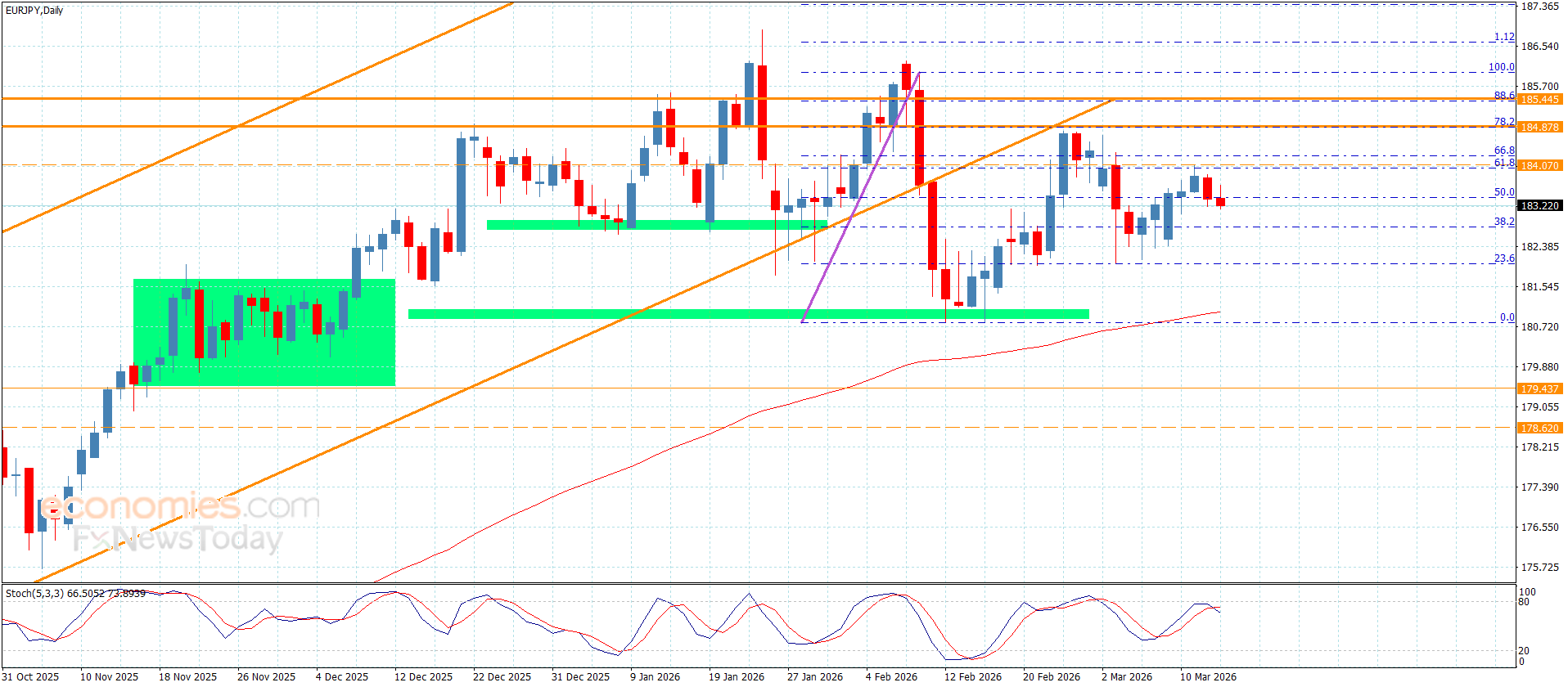
The EURJPY pair is affected by the stability at 184.40 barrier in the last period, which forces it to form new negative trading, approaching the initial negative target at 182.90 as appears in the above image.
Note that stochastic stability below 80 level might push the price to provide more negative trading, to attempt to target 182.45 level reaching %23.6 Fibonacci correction level near 182.00, while its rally again above 184.40 will confirm its move to the bullish track, to attempt to achieve several gains by its rally towards 184.80 and 185.45.
The expected trading range for today is between 182.00 and 183.65
Trend forecast: Fluctuated within the bearish trend
The EURJPY pair is affected by the stability at 184.40 barrier in the last period, which forces it to form new negative trading, approaching the initial negative target at 182.90 as appears in the above image.
Note that stochastic stability below 80 level might push the price to provide more negative trading, to attempt to target 182.45 level reaching %23.6 Fibonacci correction level near 182.00, while its rally again above 184.40 will confirm its move to the bullish track, to attempt to achieve several gains by its rally towards 184.80 and 185.45.
The expected trading range for today is between 182.00 and 183.65
Trend forecast: Fluctuated within the bearish trend