The main category of All News Articles.
You can use the search box below to find what you need.
[wd_asp id=1]
The main category of All News Articles.
You can use the search box below to find what you need.
[wd_asp id=1]
The Pound to Dollar (GBP/USD) exchange rate edged lower on Wednesday as concerns over prolonged disruption to Middle East energy supplies supported the US Dollar.
At the time of writing, GBP/USD was trading around $1.3491, down close to 0.2% on the day.
DAILY RECAP:
The US Dollar (USD) firmed on Wednesday as markets reacted to reports suggesting the US is preparing for a prolonged blockade involving Iran.
Rising concerns over extended disruption to Middle East energy exports unsettled investors, boosting demand for safe-haven assets such as the ‘Greenback’.
However, gains in the US Dollar were tempered by caution ahead of the Federal Reserve’s latest interest rate decision, with markets awaiting signals on the future path of monetary policy.
Meanwhile, the Pound (GBP) remained under pressure amid growing concerns over the UK’s fiscal outlook.
UK borrowing costs climbed to their highest levels since 2008, with benchmark gilt yields holding above 5%, reflecting persistent inflation worries and unease around public finances.

Investors are increasingly concerned that elevated borrowing costs could constrain fiscal flexibility, limiting the government’s ability to support households in the face of rising energy prices.
Looking ahead, attention will turn to the Bank of England’s (BoE) interest rate decision.
While policymakers are expected to leave rates unchanged, forward guidance will be key, with a more cautious tone potentially weighing on Sterling.
Following the BoE announcement, the latest US GDP figures will also be in focus.
A stronger-than-expected reading could reinforce demand for the US Dollar, particularly if it supports expectations that US economic momentum remains intact despite rising energy costs.
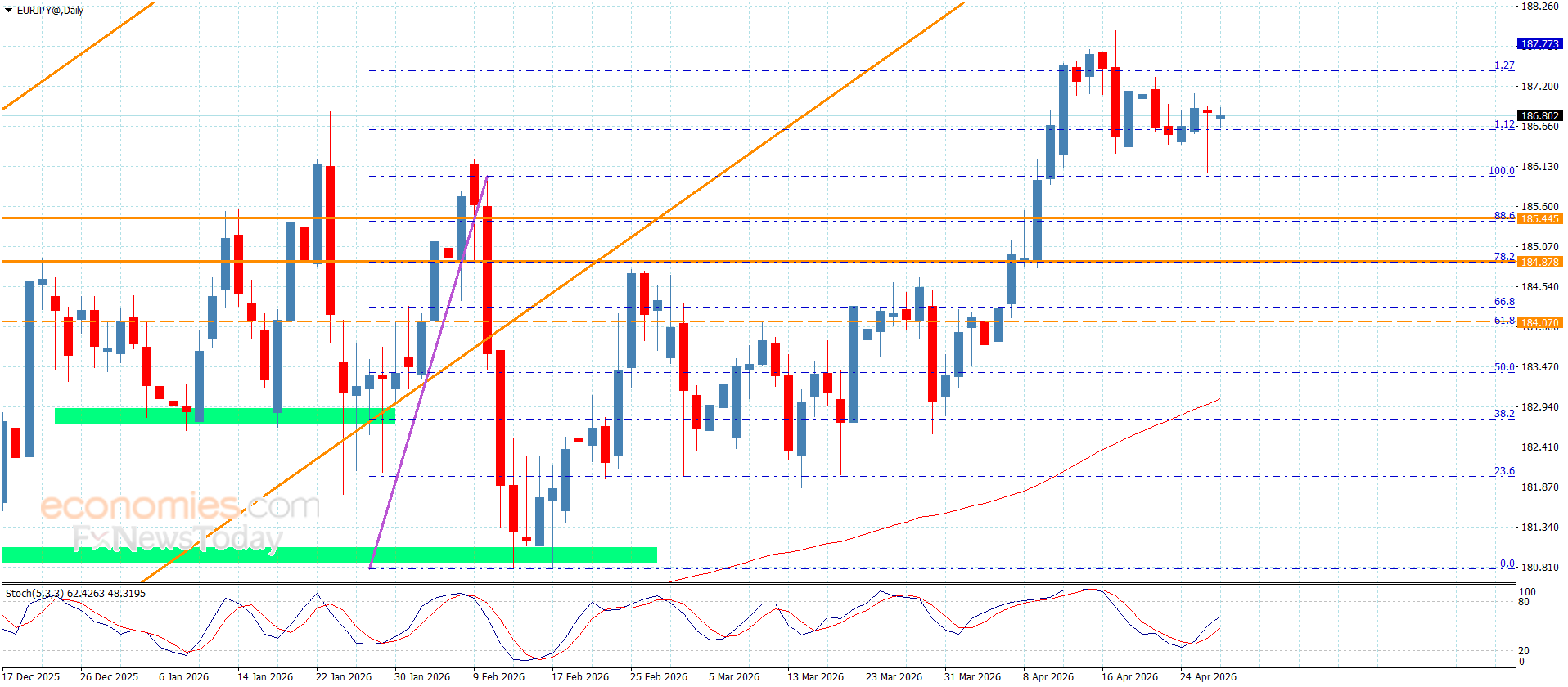
The EURJPY pair ended the last corrective decline by targeting 186.05 level, activating with the main indicators’ positivity, to rally towards 186.90, announcing its attempt to renew the bullish attempts.
Our bullish scenario depends on forming initial support level at 185.65 level, and surpassing 50 level by stochastic will increase the chances of gathering positive momentum, to ease the mission of targeting 187.40 level, to press on 187.75 barrier again, to find an exit for recording extra gains in the upcoming period.
The expected trading range for today is between 186.40 and 187.75
Trend forecast: Bullish
This morning saw the US dollar push further higher ahead of the FOMC meeting, as climbed even more with breaking the $115 handle. This greenback is looking strong as investors price out the odds of rate cuts from the Fed because of concerns about sticky inflation. The mild risk-off tone is also adding some upward pressure on USD, especially against the more risk-sensitive commodity dollars.
The USD/JPY currency pair, which has been confined to a relatively narrow range through much of April, could now stage a breakout. With the BoJ refusing to hike yesterday and oil continuing to push higher, the pressure is building for a potential break above 160.00, which, in turn, is raising the risk of government intervention to stem the yen’s drop.
Investors will keep a close eye on oil prices as they show no desire to fall amid stalled US-Iran talks. Also in focus will be the FOMC rate decision later on Wednesday as well as key US tech earnings and economic data on Thursday. For now, it is all about oil prices, and after we didn’t get any major surprises from the Japanese central bank, the risks remain tilted to the upside for the USD/JPY.
This was always going to be a busy week for the yen. As well as renewed gains for crude oil prices and the Bank of Japan meeting, we also have the set to announce it policy decision this week, alongside several other major central banks, while it is also a heavy earnings and data calendar week for the USD.
A slightly dollar-supportive Fed outcome combined with rising oil prices could tilt USD/JPY above recent resistance in the 159.50 to 160.00 region.
In fact, a move back towards 160.46, this year’s high, looks quite plausible. And if it gets there, why stop rising? The pair could extend even more. That said, any sharp move higher would likely bring increased volatility, as markets remain alert to the risk of Japanese FX intervention.
Support levels to watch include 159.00, 158.50 and 158.00.
As mentioned, the Bank of Japan left rates unchanged yesterday, pointing to ongoing uncertainty in the Middle East as a key reason for standing pat. Even so, pressure for another hike is clearly building, with three board members dissenting in favour of tighter policy.
On paper, the meeting carried a fairly hawkish feel. Both the statement and the quarterly outlook report pointed to mounting inflation concerns and a growing willingness within the Board to keep normalising policy. But Governor Ueda struck a more measured tone in his press conference, stopping short of giving markets a clear hawkish steer. That softer messaging allowed USD/JPY to recover after the initial reaction.
Ueda stressed that the situation in the Middle East remains highly fluid and said the BoJ would rather avoid committing to a firm timetable for the next move. Instead, he reiterated the broader message that the Bank remains on a gradual path towards a more neutral policy setting. As long as the economy avoids a material slowdown, further rate hikes remain on the table.
The updated macro outlook underlines the Bank’s growing concern over inflation, although Ueda again avoided signalling when the next increase could come. My base case is for the next hike in June, possibly followed by one more in the fourth quarter.
Going into the meeting, there had been some speculation that the BoJ might spring a surprise after a run of stronger inflation data, persistently deep negative real rates, and robust wage negotiations. Today’s outcome suggests that while inflation concerns are clearly intensifying, most policymakers still favour a cautious wait-and-see approach.
***
1,200+ Financial Metrics at Your Fingertips: From debt ratios and profitability to analyst earnings revisions, you’ll have everything professional investors use to analyze stocks in one clean dashboard.
Institutional-Grade News & Market Insights: Stay ahead of market moves with exclusive headlines and data-driven analysis.
A Distraction-Free Research Experience: No pop-ups. No clutter. No ads. Just streamlined tools built for smart decision-making.
Vision AI: InvestingPro’s newest addition. It analyzes any asset’s chart with professional-grade market intelligence, identifying key timeframes, technical patterns, and indicators — then delivers a clear trading playbook with the levels, scenarios, and risks that matter most in under a minute.
Not a Pro member yet?
Disclaimer: This article is written for informational purposes only; it does not constitute a solicitation, offer, advice, counsel or recommendation to invest as such it is not intended to incentivize the purchase of assets in any way. I would like to remind you that any type of asset, is evaluated from multiple perspectives and is highly risky and therefore, any investment decision and the associated risk remains with the investor.
Copper price activated the corrective decline by reaching below $5.9700 level, activating with the negativity of the indicators by reaching $5.850, approaching the suggested targets in the previous report.
Note that holding above $5.8100 level might allow it to begin forming bullish waves, to target $6.0200 level, to press at $6.1200 barrier, while facing new bearish pressures might force it to resume the corrective decline by reaching below $5.8100, to expect targeting $5.7000 and $5.5900 level.
The expected trading range for today is between $5.8100 and $6.0200
Trend forecast: Fluctuating within the bullish trend
The EURJPY pair ended the last corrective decline by targeting 186.05 level, activating with the main indicators’ positivity, to rally towards 186.90, announcing its attempt to renew the bullish attempts.
Our bullish scenario depends on forming initial support level at 185.65 level, and surpassing 50 level by stochastic will increase the chances of gathering positive momentum, to ease the mission of targeting 187.40 level, to press on 187.75 barrier again, to find an exit for recording extra gains in the upcoming period.
The expected trading range for today is between 186.40 and 187.75
Trend forecast: Bullish
Domestic coffee prices today
The domestic coffee market this morning, April 29th, recorded very strong growth momentum in all key growing areas of the Central Highlands.
According to surveys, the average purchase price throughout the region has jumped up by another 1,700 VND/kg, bringing the average price level to the threshold of 88,700 VND/kg.
In Dak Nong province (old), coffee prices recorded the highest increase with 1,800 VND, pushing the purchase price to the mark of 88,800 VND/kg.
Dak Lak and Gia Lai provinces both have an increase of 1,600 VND, currently trading stably at 88,600 VND/kg.
Lam Dong area listed a price of 88. 100 VND/kg after recovering by another 1,600 VND compared to yesterday’s session. This increase shows that the market is reacting positively to signals of tightening supply from international reserves.
World coffee prices today
Developments on world exchanges last night were also brilliantly green as the decline in inventory triggered a buying wave. Robusta coffee prices on the London exchange for July delivery increased by another 53 USD (equivalent to 1.55%), closing the session at 3,481 USD/ton.
At the same time, the New York exchange witnessed the price of Arabica for July delivery increase by another 2.20 cent (equivalent to 0.76%), closing at 290.70 cents/lb. Arabica inventories monitored by ICE have fallen to a 2-month low of 494,508 bags, while Robusta inventories also anchored at a 16-month record low of only 3,755 lots. These figures show that actual supply is being significantly tightened, creating a solid momentum for futures prices to break through.
Besides the inventory factor, geopolitical tensions in the Middle East continue to be an important pillar for coffee prices. Concerns about a prolonged war between the US and Iran that would cause the Hormuz Strait to be closed are disrupting the global supply chain. The blockade of this vital sea route has directly pushed up freight rates, insurance costs, fuel and fertilizer prices, putting great pressure on the cost of goods from roasters and international importers.
In South America, Brazil’s coffee exports in March recorded a sharp drop of 10% to 31% depending on the report, showing that the volume of goods pushed into the market from the world’s number one producer is showing signs of slowing down.
However, investors are still cautious about the prospect of Brazil’s record crop season next crop year with expected output reaching 75.9 million bags. At the same time, the global coffee surplus report for 2026 expanding to 10 million bags according to StoneX is still a factor hindering the overheated increase in the long term.
In Vietnam, export growth in the first quarter reached 14% with 585,000 tons, which is also a barrier preventing Robusta prices from breaking out of high resistance zones.
It is forecasted that in the coming sessions, domestic coffee prices will continue to fluctuate strongly around the 87. 500 – 89. 500 VND/kg range.
Note: The actual prices in localities may differ depending on the quality of the seeds and actual transaction agreements.
EUR/JPY depreciates after three days of gains, trading around 186.70 during European hours on Wednesday. The technical analysis of the daily chart indicates the currency cross is positioned slightly below the ascending channel, signaling a possible bearish reversal.
However, the EUR/JPY cross maintains a constructive bullish bias as it holds above the 50-period Exponential Moving Average (EMA), while oscillating just under the nine-period EMA, which acts as immediate resistance.
The 14-day Relative Strength Index is around 59 points to firm but not overextended upside momentum, suggesting dips may continue to attract buyers while the EUR/JPY cross consolidates beneath the recent highs.
The successful rebound above the nine-day EMA at 186.77 and a return within the ascending channel would reinforce the bullish bias and lead the EUR/JPY cross to test the all-time high of 187.95, which was recorded on April 17. A break above this level would lead the currency cross to explore the region around the upper boundary of the channel, around 190.20.
On the downside, the EUR/JPY cross may navigate the region around the initial support, which lies at the 50-day EMA at 185.09.
(The technical analysis of this story was written with the help of an AI tool.)
The table below shows the percentage change of Euro (EUR) against listed major currencies today. Euro was the weakest against the Swiss Franc.
| USD | EUR | GBP | JPY | CAD | AUD | NZD | CHF | |
|---|---|---|---|---|---|---|---|---|
| USD | 0.09% | 0.11% | 0.02% | 0.05% | 0.28% | 0.34% | -0.04% | |
| EUR | -0.09% | 0.02% | -0.07% | -0.04% | 0.18% | 0.27% | -0.14% | |
| GBP | -0.11% | -0.02% | -0.09% | -0.06% | 0.15% | 0.24% | -0.16% | |
| JPY | -0.02% | 0.07% | 0.09% | 0.03% | 0.27% | 0.35% | -0.01% | |
| CAD | -0.05% | 0.04% | 0.06% | -0.03% | 0.25% | 0.31% | -0.09% | |
| AUD | -0.28% | -0.18% | -0.15% | -0.27% | -0.25% | 0.07% | -0.35% | |
| NZD | -0.34% | -0.27% | -0.24% | -0.35% | -0.31% | -0.07% | -0.40% | |
| CHF | 0.04% | 0.14% | 0.16% | 0.01% | 0.09% | 0.35% | 0.40% |
The heat map shows percentage changes of major currencies against each other. The base currency is picked from the left column, while the quote currency is picked from the top row. For example, if you pick the Euro from the left column and move along the horizontal line to the US Dollar, the percentage change displayed in the box will represent EUR (base)/USD (quote).
Brent crude oil price continued rising on Wednesday after a new report suggested that President Donald Trump was considering a prolonged blockade in a bid to pressure Iran. It jumped to $110, up sharply from this month’s low of $87.
Trump considers prolonged blockade
A media report by Bloomberg suggests that President Trump is considering a prolonged blockade in a bid to put pressure on the Iranians as storage space runs out.
This is a reaction to a recent report in which Iranians submitted an offer to the US. Its offer was to reopen the Strait of Hormuz in exchange for deferred talks on the nuclear program.
A continued closure of the Strait will lead to higher crude oil prices since 20% of all crude oil passes there.
Worse, there is a risk that the ceasefire will end, leading to the resumption of fighting. Analysts believe that the next phase of fighting will be worse as it will involve critical infrastructure.
In a recent post, Iran’s parliamentary speaker highlighted some of the cards, including bombing a critical Saudi Arabian pipeline that is delivering over 7 million barrels of oil per day.
He also pointed out that Houthis may help to close the Red Sea, which accounts for 12% of all oil shipments. This disruption will likely not be offset by the soaring US exports,which have jumped sharply in the past few weeks.
Therefore, the most likely scenario is where the West Texas Intermediate and Brent benchmarks continue rising in the coming months as long as the crisis continues.
Trump’s preparation for a prolonged ceasefire comes two weeks after he hinted at a long war by comparing the operation with other conflicts like Vietnam and Afghanistan.
Meanwhile, Brent crude oil price is reacting to the major breaking news that the United Arab Emirates (UAE) was exiting the OPEC cartel after decades.
Analysts believe that the country hopes to boost oil production, with estimates being that it can move from 3 million today to 5 million in the next few months. It is unclear whether other countries will follow the footsteps and exit the organization.
Brent crude oil price technical analysis
Crude oil price chart | Source: TradingView
The daily chart shows that the price of Brent bottomed at $87.47 on April 17th after the two sides announced their ceasefire. It then rebounded to the current $110 as the blockade continues.
The price has remained above the Supertrend indicator since January 12 this year, a sign that bulls remain in control. It also jumped above the 50-day and 100-day Exponential Moving Averages (EMA).
The Relative Strength Index (RSI) has moved above the neutral point at 50 and is pointing upwards.
Therefore, the most likely crude oil price forecast is bullish, with the next key target being at the year-to-date high of $119. A move above that price will point to more gains towards $120.
The bullish outlook aligns with the recent Goldman Sachs forecast. In their report, the analysts pointed to the ongoing tapping of oil reserves by the US and its allies.
On the flip side, a drop below the support at $100 will invalidate the bullish outlook and point to more downside.
– Written by
David Woodsmith
STORY LINK GBP/USD Forecast: Pound Sterling Slips as Iran Talks Stall
The Pound US Dollar (GBP/USD) exchange rate came under pressure on Tuesday, as optimism over a diplomatic breakthrough in the US–Iran conflict faded.
At the time of writing, GBP/USD was trading at roughly $1.3487, slipping by around 0.3% compared with Tuesday’s opening levels.
The US Dollar (USD) moved higher on Tuesday, benefiting from a more cautious market backdrop as geopolitical risks re-emerged.
Sentiment soured after reports indicated that US President Donald Trump was unimpressed by Iran’s latest proposal to reopen the Strait of Hormuz, particularly as Tehran remains reluctant to broker talks on its nuclear ambitions.
Despite this, gains in the US Dollar were somewhat restrained, with investors hesitant to take strong positions ahead of the Federal Reserve’s upcoming interest rate announcement.
The Pound (GBP) struggled to gain traction on Tuesday, amid renewed anxiety over the UK’s inflation outlook.
These concerns were fuelled by a sharp rise in global energy prices, with Brent crude climbing to a one-month high and briefly surpassing $110 per barrel.
Get better rates and lower fees on your next international money transfer.
Compare TorFX with top UK banks in seconds and see how much you could save.
Although higher inflation could strengthen the case for tighter policy from the Bank of England (BoE), markets remain wary that elevated costs will squeeze household spending and dampen economic momentum.
Looking ahead, attention is expected to shift toward the Federal Reserve’s policy decision, which is likely to act as the main driver of GBP/USD movement midweek.
While no immediate change in rates is anticipated, any indication that borrowing costs will remain elevated for longer could lend support to the US Dollar.
At the same time, Sterling may remain rangebound as traders await the Bank of England’s own announcement on Thursday, with policymakers expected to strike a more measured tone to avoid fuelling further speculation over aggressive tightening.

International Money Transfer? Ask our resident FX expert a money transfer question or try John’s new, free, no-obligation personal service! ,where he helps every step of the way,
ensuring you get the best exchange rates on your currency requirements.
TAGS: Pound Dollar Forecasts
Gold is consolidating the previous sell-off to monthly lows of $4,555 set on Tuesday, as traders turn to the sidelines and refrain from placing fresh bets ahead of the Federal Reserve (Fed) monetary policy decision due later on Wednesday.
Gold came under intense selling pressure on Tuesday as the Oil price surge resumed on the back of the continued stand-off between the United States (US) and Iran, especially after US President Donald Trump expressed his displeasure with the new Iranian proposal toward ending the war.
Additionally, the United Arab Emirates’ (UAE) decision to leave OPEC and OPEC+ after nearly six decades also contributed to the renewed upside in the black gold.
The uptrend in Oil keeps expectations of rising inflation alive, bolstering hawkish bets surrounding the Fed, as the US central bank’s two-day monetary meeting concludes on Wednesday. Gold tends to thrive in a low-interest-rate environment.
Markets are widely expecting the Fed to hold rates steady in the range of 3.5% to 3.75% on Wednesday, but the message from outgoing Chairman Jerome Powell will be closely scrutinized for any hints on the possibility of a rate hike this year. Powell’s take on inflation amidst the Middle East conflict will also be dissected for future policy implications.
If Powell sticks to his patient and data-dependent rhetoric, prioritizing supporting the labor market, it would be perceived as dovish. In such a case, the US Dollar (USD) could come under intense selling pressure, fuelling a solid Gold price recovery.
Conversely, Gold could extend the recent decline if the Fed chair hints at a hawkish pivot, reviving bets for a rate hike by end-2026. Powell’s comments will hold the key as its his last post-monetary policy meeting press conference. Kevin Warsh will lead the Fed as the new Chair from May 15.
In the lead-up to the Fed event risks, fresh developments around the US-Iran stalemate, and some profit-taking sprints could influence the Gold price action.
In the daily chart, XAU/USD trades at $4,596.48, keeping a bearish near-term bias as it holds below the short- and medium-term simple moving averages (SMAs). The 21-day SMA at roughly $4,726 and the 100-day SMA near $4,754 sit overhead as dynamic resistance, while the longer-term 200-day SMA around $4,270 remains a distant underlying support. A downward resistance trend line capped near $4,684 reinforces the topside constraint, and the Relative Strength Index (14) hovering around 40 hints at still-soft momentum, limiting recovery attempts for now.
On the topside, initial resistance is seen at the descending trend-line area around $4,685, followed by the 21-day SMA at $4,726 and the 100-day SMA near $4,754; a sustained break above these levels would be needed to ease the current bearish pressure and reopen the path toward the 50-day SMA around $4,850. On the downside, immediate focus stays on the recent pivot region around the current price, with the rising trend-line support near $4,381 next in line, ahead of the 200-day SMA clustered around $4,270, where stronger buyers could attempt to reassert the broader uptrend.
(The technical analysis of this story was written with the help of an AI tool.)
Monetary policy in the US is shaped by the Federal Reserve (Fed). The Fed has two mandates: to achieve price stability and foster full employment. Its primary tool to achieve these goals is by adjusting interest rates.
When prices are rising too quickly and inflation is above the Fed’s 2% target, it raises interest rates, increasing borrowing costs throughout the economy. This results in a stronger US Dollar (USD) as it makes the US a more attractive place for international investors to park their money.
When inflation falls below 2% or the Unemployment Rate is too high, the Fed may lower interest rates to encourage borrowing, which weighs on the Greenback.
The Federal Reserve (Fed) holds eight policy meetings a year, where the Federal Open Market Committee (FOMC) assesses economic conditions and makes monetary policy decisions.
The FOMC is attended by twelve Fed officials – the seven members of the Board of Governors, the president of the Federal Reserve Bank of New York, and four of the remaining eleven regional Reserve Bank presidents, who serve one-year terms on a rotating basis.
In extreme situations, the Federal Reserve may resort to a policy named Quantitative Easing (QE). QE is the process by which the Fed substantially increases the flow of credit in a stuck financial system.
It is a non-standard policy measure used during crises or when inflation is extremely low. It was the Fed’s weapon of choice during the Great Financial Crisis in 2008. It involves the Fed printing more Dollars and using them to buy high grade bonds from financial institutions. QE usually weakens the US Dollar.
Quantitative tightening (QT) is the reverse process of QE, whereby the Federal Reserve stops buying bonds from financial institutions and does not reinvest the principal from the bonds it holds maturing, to purchase new bonds. It is usually positive for the value of the US Dollar.