The main category of All News Articles.
You can use the search box below to find what you need.
[wd_asp id=1]
The main category of All News Articles.
You can use the search box below to find what you need.
[wd_asp id=1]
Gold is consolidating the previous sell-off to monthly lows of $4,555 set on Tuesday, as traders turn to the sidelines and refrain from placing fresh bets ahead of the Federal Reserve (Fed) monetary policy decision due later on Wednesday.
Gold came under intense selling pressure on Tuesday as the Oil price surge resumed on the back of the continued stand-off between the United States (US) and Iran, especially after US President Donald Trump expressed his displeasure with the new Iranian proposal toward ending the war.
Additionally, the United Arab Emirates’ (UAE) decision to leave OPEC and OPEC+ after nearly six decades also contributed to the renewed upside in the black gold.
The uptrend in Oil keeps expectations of rising inflation alive, bolstering hawkish bets surrounding the Fed, as the US central bank’s two-day monetary meeting concludes on Wednesday. Gold tends to thrive in a low-interest-rate environment.
Markets are widely expecting the Fed to hold rates steady in the range of 3.5% to 3.75% on Wednesday, but the message from outgoing Chairman Jerome Powell will be closely scrutinized for any hints on the possibility of a rate hike this year. Powell’s take on inflation amidst the Middle East conflict will also be dissected for future policy implications.
If Powell sticks to his patient and data-dependent rhetoric, prioritizing supporting the labor market, it would be perceived as dovish. In such a case, the US Dollar (USD) could come under intense selling pressure, fuelling a solid Gold price recovery.
Conversely, Gold could extend the recent decline if the Fed chair hints at a hawkish pivot, reviving bets for a rate hike by end-2026. Powell’s comments will hold the key as its his last post-monetary policy meeting press conference. Kevin Warsh will lead the Fed as the new Chair from May 15.
In the lead-up to the Fed event risks, fresh developments around the US-Iran stalemate, and some profit-taking sprints could influence the Gold price action.
In the daily chart, XAU/USD trades at $4,596.48, keeping a bearish near-term bias as it holds below the short- and medium-term simple moving averages (SMAs). The 21-day SMA at roughly $4,726 and the 100-day SMA near $4,754 sit overhead as dynamic resistance, while the longer-term 200-day SMA around $4,270 remains a distant underlying support. A downward resistance trend line capped near $4,684 reinforces the topside constraint, and the Relative Strength Index (14) hovering around 40 hints at still-soft momentum, limiting recovery attempts for now.
On the topside, initial resistance is seen at the descending trend-line area around $4,685, followed by the 21-day SMA at $4,726 and the 100-day SMA near $4,754; a sustained break above these levels would be needed to ease the current bearish pressure and reopen the path toward the 50-day SMA around $4,850. On the downside, immediate focus stays on the recent pivot region around the current price, with the rising trend-line support near $4,381 next in line, ahead of the 200-day SMA clustered around $4,270, where stronger buyers could attempt to reassert the broader uptrend.
(The technical analysis of this story was written with the help of an AI tool.)
Monetary policy in the US is shaped by the Federal Reserve (Fed). The Fed has two mandates: to achieve price stability and foster full employment. Its primary tool to achieve these goals is by adjusting interest rates.
When prices are rising too quickly and inflation is above the Fed’s 2% target, it raises interest rates, increasing borrowing costs throughout the economy. This results in a stronger US Dollar (USD) as it makes the US a more attractive place for international investors to park their money.
When inflation falls below 2% or the Unemployment Rate is too high, the Fed may lower interest rates to encourage borrowing, which weighs on the Greenback.
The Federal Reserve (Fed) holds eight policy meetings a year, where the Federal Open Market Committee (FOMC) assesses economic conditions and makes monetary policy decisions.
The FOMC is attended by twelve Fed officials – the seven members of the Board of Governors, the president of the Federal Reserve Bank of New York, and four of the remaining eleven regional Reserve Bank presidents, who serve one-year terms on a rotating basis.
In extreme situations, the Federal Reserve may resort to a policy named Quantitative Easing (QE). QE is the process by which the Fed substantially increases the flow of credit in a stuck financial system.
It is a non-standard policy measure used during crises or when inflation is extremely low. It was the Fed’s weapon of choice during the Great Financial Crisis in 2008. It involves the Fed printing more Dollars and using them to buy high grade bonds from financial institutions. QE usually weakens the US Dollar.
Quantitative tightening (QT) is the reverse process of QE, whereby the Federal Reserve stops buying bonds from financial institutions and does not reinvest the principal from the bonds it holds maturing, to purchase new bonds. It is usually positive for the value of the US Dollar.
The USD/JPY pair struggles to capitalize on the previous day’s goodish rebound from sub-159.00 levels, touched in reaction to the Bank of Japan’s (BoJ) hawkish pause, and oscillates in a range during the Asian session on Wednesday. Spot prices hold steady above the 159.50 region as traders look to the crucial FOMC decision for some meaningful impetus amid mixed cues.
Heading into the key central bank event risk, the uncertainty over US-Iran peace talks continues to act as a tailwind for the safe-haven US Dollar (USD). Furthermore, economic concerns stemming from continued energy supply disruptions through the Strait of Hormuz undermine the Japanese Yen (JPY) and support the USD/JPY pair. However, intervention fears help limit deeper JPY losses and cap the currency pair.
From a technical perspective, spot prices, barring a few knee-jerk reactions, have been oscillating in a familiar band over the past one-and-a-half months or so. Against the backdrop of a solid rebound from the 200-day Exponential Moving Average (EMA) touched in February, the range-bound price action might still be categorized as a bullish consolidation phase, which backs the case for a further USD/JPY appreciating move.
Meanwhile, the daily Relative Strength Index (RSI) around 56 hints at moderate upside momentum. That said, a slightly negative Moving Average Convergence Divergence (MACD) reading points to some lingering consolidation risk. Mixed momentum oscillators, in turn, make it prudent to wait for a sustained strength and acceptance above the 160.00 psychological mark before traders start placing fresh bullish on the USD/JPY pair.
On the downside, initial support emerges around 159.60 ahead of the 159.00 mark and the 158.50-158.45 horizontal zone, with stronger underlying demand seen at the lower boundary of the trading range below 158.00. A daily close back under the latter would weaken the bullish structure, whereas holding above it keeps the broader uptrend intact and leaves the USD/JPY pair poised to resume gains once the near-term consolidation phase eases.
(The technical analysis of this story was written with the help of an AI tool.)
Monetary policy in the US is shaped by the Federal Reserve (Fed). The Fed has two mandates: to achieve price stability and foster full employment. Its primary tool to achieve these goals is by adjusting interest rates.
When prices are rising too quickly and inflation is above the Fed’s 2% target, it raises interest rates, increasing borrowing costs throughout the economy. This results in a stronger US Dollar (USD) as it makes the US a more attractive place for international investors to park their money.
When inflation falls below 2% or the Unemployment Rate is too high, the Fed may lower interest rates to encourage borrowing, which weighs on the Greenback.
The Federal Reserve (Fed) holds eight policy meetings a year, where the Federal Open Market Committee (FOMC) assesses economic conditions and makes monetary policy decisions.
The FOMC is attended by twelve Fed officials – the seven members of the Board of Governors, the president of the Federal Reserve Bank of New York, and four of the remaining eleven regional Reserve Bank presidents, who serve one-year terms on a rotating basis.
In extreme situations, the Federal Reserve may resort to a policy named Quantitative Easing (QE). QE is the process by which the Fed substantially increases the flow of credit in a stuck financial system.
It is a non-standard policy measure used during crises or when inflation is extremely low. It was the Fed’s weapon of choice during the Great Financial Crisis in 2008. It involves the Fed printing more Dollars and using them to buy high grade bonds from financial institutions. QE usually weakens the US Dollar.
Quantitative tightening (QT) is the reverse process of QE, whereby the Federal Reserve stops buying bonds from financial institutions and does not reinvest the principal from the bonds it holds maturing, to purchase new bonds. It is usually positive for the value of the US Dollar.
Silver (XAG/USD) trades with a downside bias on Tuesday, down over 2.5%, as a higher-for-longer interest rate outlook continues to weigh on price action. Rising inflation risks, driven by elevated Oil prices amid ongoing Middle East supply disruptions, are pushing US Treasury yields higher, reducing the appeal of the non-yielding metal. At the time of writing, XAG/USD is trading around $73.25, its lowest level since April 13.
Meanwhile, a lack of progress in US-Iran talks to end the war keeps the US Dollar (USD) firmly supported, adding further pressure on XAG/USD. While Silver typically benefits from geopolitical tensions, rising expectations of tighter monetary policy by global central banks remain a key headwind for the metal, which is currently down over 20% since the US-Iran war began, despite recovering from its March low.
Attention now turns to the Federal Reserve’s (Fed) monetary policy decision due on Wednesday, where traders widely expect the central bank to keep interest rates unchanged. Inflation in the US remains sticky and above the Fed’s 2% target, with the recent surge in Oil prices adding further pressure. As a result, the focus will be on forward guidance, with markets awaiting clarity on the future path of interest rates. Higher borrowing costs increase the opportunity cost of holding non-yielding assets like Silver.
In the daily chart, XAG/USD maintains a bearish near-term bias as it trades below both the 100-day and 50-day Simple Moving Averages (SMAs), which are closely aligned and showing early signs of a bearish crossover, keeping the near-term bias tilted to the downside.
Momentum indicators echo this soft tone, with the Relative Strength Index (RSI) hovering near 42 and the Moving Average Convergence Divergence (MACD) line slipping just below zero, while a subdued Average Directional Index (ADX) around 12 suggests a weak and potentially range-bound trend.
On the upside, the moving average cluster between $78.50-$79.50, where the 50-day and 100-day SMAs converge, marks initial resistance and would need to be reclaimed to ease the current bearish pressure. The next meaningful resistance is seen near the $90 psychological level.
On the downside, the $70 level marks initial support, followed by the 200-day SMA near $62.40, which stands out as the next major structural support.
(The technical analysis of this story was written with the help of an AI tool.)
Silver is a precious metal highly traded among investors. It has been historically used as a store of value and a medium of exchange. Although less popular than Gold, traders may turn to Silver to diversify their investment portfolio, for its intrinsic value or as a potential hedge during high-inflation periods. Investors can buy physical Silver, in coins or in bars, or trade it through vehicles such as Exchange Traded Funds, which track its price on international markets.
Silver prices can move due to a wide range of factors. Geopolitical instability or fears of a deep recession can make Silver price escalate due to its safe-haven status, although to a lesser extent than Gold’s. As a yieldless asset, Silver tends to rise with lower interest rates. Its moves also depend on how the US Dollar (USD) behaves as the asset is priced in dollars (XAG/USD). A strong Dollar tends to keep the price of Silver at bay, whereas a weaker Dollar is likely to propel prices up. Other factors such as investment demand, mining supply – Silver is much more abundant than Gold – and recycling rates can also affect prices.
Silver is widely used in industry, particularly in sectors such as electronics or solar energy, as it has one of the highest electric conductivity of all metals – more than Copper and Gold. A surge in demand can increase prices, while a decline tends to lower them. Dynamics in the US, Chinese and Indian economies can also contribute to price swings: for the US and particularly China, their big industrial sectors use Silver in various processes; in India, consumers’ demand for the precious metal for jewellery also plays a key role in setting prices.
Silver prices tend to follow Gold’s moves. When Gold prices rise, Silver typically follows suit, as their status as safe-haven assets is similar. The Gold/Silver ratio, which shows the number of ounces of Silver needed to equal the value of one ounce of Gold, may help to determine the relative valuation between both metals. Some investors may consider a high ratio as an indicator that Silver is undervalued, or Gold is overvalued. On the contrary, a low ratio might suggest that Gold is undervalued relative to Silver.
Oil prices are rising, with Brent moving above $110 per barrel and WTI approaching $100, as geopolitical tensions in the Middle East continue to drive supply concerns.
Markets are awaiting clarity on US–Iran negotiations, particularly around the Strait of Hormuz, which remains closed. The US is reviewing Tehran’s latest proposal to resolve the conflict, but Donald Trump has so far rejected it, citing concerns that it does not sufficiently address Iran’s nuclear programme.
This leaves the two-month-long conflict at a stalemate. The longer the Strait remains closed, the greater the upside risk to oil prices. However, a sudden de-escalation, government intervention, or demand destruction could trigger a pullback.
Warnings of demand destruction are already emerging. The supply shock—disrupting up to 13 million barrels per day—is beginning to weigh on consumption, particularly in Asia. The International Energy Agency has warned that high prices could force reduced demand, either through affordability constraints or policy intervention.
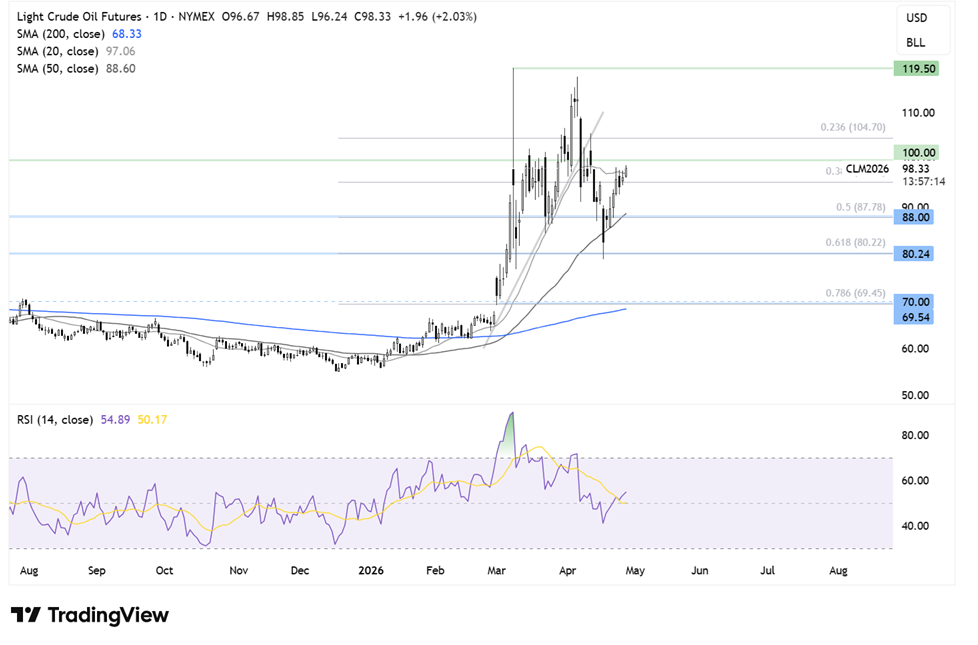
Oil recovered from the 78.00 April low, rising above the 50 SMA and the 20 SMA around 98.00, which, combined with the RSI above 50, keeps buyers hopeful of further upside.
Buyers would need to extend gains towards 100.00, the psychological level, and look towards 105.00, the 23.6% Fib retracement of the 55 low and 120 high.
Support can be seen at 95.00, the 38.2% Fib retracement level to bring 88.00 into focus, the 50 SMA, and the 50% Fib retracement level. Below here, sellers could gain traction towards 80.00, the round number.
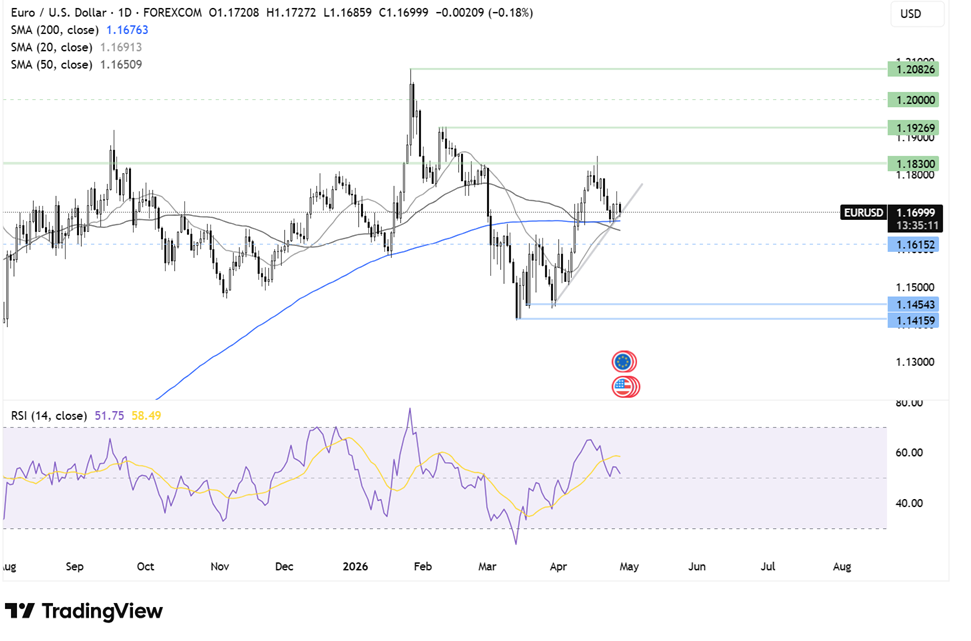
EUR/USD is slipping below 1.17, hitting a two-week low, as investors assess ongoing uncertainty around Iran negotiations and prepare for a busy week of central bank decisions and key data releases.
Eurozone inflation and GDP figures are due on Thursday, just ahead of the European Central Bank rate decision. The ECB is expected to leave rates unchanged, adopting a wait-and-see approach as it monitors the impact of rising energy prices. While headline inflation is expected to increase due to higher fuel costs, policymakers may wait for signs of broader underlying price pressures before acting. Markets are currently pricing in two rate hikes this year.
Attention is also on the Federal Reserve policy decision. The Fed is expected to keep rates unchanged at 3.50%–3.75%, as policymakers assess the economic impact of the conflict.
Chair Jerome Powell is likely to emphasise a “wait-and-see” approach, balancing rising inflation driven by higher energy prices against risks to growth and employment. The conflict is pushing up fuel costs—adding to inflation—while also increasing uncertainty for businesses, which could weigh on hiring.
These opposing forces complicate the Fed’s policy path. Keeping rates higher for longer could help contain inflation, while easing policy could support growth. Powell is expected to address this trade-off in his press conference, likely reinforcing expectations that rates will remain on hold for an extended period.
The meeting may also bring attention to Fed leadership. Powell’s term as Chair ends in May, although he remains on the Board of Governors until 2028. Meanwhile, Kevin Warsh is progressing through the confirmation process as a potential successor.
EUR/USD recovered from the 1.1410 low, rising to a peak of 1.1850 before easing back to the 200 SMA at 1.1680. The price holds above the near-term rising trendline and the 200 SMA, keeping a bullish bias, although momentum is slowing.
Buyers will need to rise above 1.1850 resistance to create a higher high and extend gains towards 1.1830, the February high.
Support is at 1.1675, the 200 SMA, and trendline support. A break below here opens the door to 1.16, the round number ahead of 1.1450.
Silver price (XAG/USD) falls around 1.5%, trading around $74.40 per troy ounce during the Asian hours on Tuesday. The non-yielding metal declines as the US–Iran conflict fuels an energy-driven inflation shock, raising expectations of prolonged or tighter central banks’ policy.
However, markets weigh prospects of a lasting ceasefire and a potential reopening after Iran’s fresh proposal to the United States (US). Tehran reportedly signaled via Pakistan that hostilities could end if Washington lifts its naval blockade, revises transit rules through Hormuz, and guarantees against future military action.
On the contrary, a US official said on Monday that President Donald Trump is dissatisfied with Iran’s proposal. Iranian sources added that Tehran avoided addressing its nuclear program until hostilities cease and Gulf shipping disputes are resolved.
Traders are also looking ahead to policy decisions from key central banks this week, including the US Federal Reserve (Fed), European Central Bank (ECB), and Bank of Japan (BoJ). The Federal Reserve (Fed) is widely expected to keep interest rates unchanged at its upcoming April policy meeting on Wednesday, maintaining the federal funds target range at 3.50% to 3.75%. This would mark the third consecutive hold.
The Bank of Japan is expected to hold rates at 0.75% later in the day amid economic concerns from the US–Iran war, while the European Central Bank is also likely to keep its deposit rate unchanged at 2.0% on Thursday.
Silver is a precious metal highly traded among investors. It has been historically used as a store of value and a medium of exchange. Although less popular than Gold, traders may turn to Silver to diversify their investment portfolio, for its intrinsic value or as a potential hedge during high-inflation periods. Investors can buy physical Silver, in coins or in bars, or trade it through vehicles such as Exchange Traded Funds, which track its price on international markets.
Silver prices can move due to a wide range of factors. Geopolitical instability or fears of a deep recession can make Silver price escalate due to its safe-haven status, although to a lesser extent than Gold’s. As a yieldless asset, Silver tends to rise with lower interest rates. Its moves also depend on how the US Dollar (USD) behaves as the asset is priced in dollars (XAG/USD). A strong Dollar tends to keep the price of Silver at bay, whereas a weaker Dollar is likely to propel prices up. Other factors such as investment demand, mining supply – Silver is much more abundant than Gold – and recycling rates can also affect prices.
Silver is widely used in industry, particularly in sectors such as electronics or solar energy, as it has one of the highest electric conductivity of all metals – more than Copper and Gold. A surge in demand can increase prices, while a decline tends to lower them. Dynamics in the US, Chinese and Indian economies can also contribute to price swings: for the US and particularly China, their big industrial sectors use Silver in various processes; in India, consumers’ demand for the precious metal for jewellery also plays a key role in setting prices.
Silver prices tend to follow Gold’s moves. When Gold prices rise, Silver typically follows suit, as their status as safe-haven assets is similar. The Gold/Silver ratio, which shows the number of ounces of Silver needed to equal the value of one ounce of Gold, may help to determine the relative valuation between both metals. Some investors may consider a high ratio as an indicator that Silver is undervalued, or Gold is overvalued. On the contrary, a low ratio might suggest that Gold is undervalued relative to Silver.
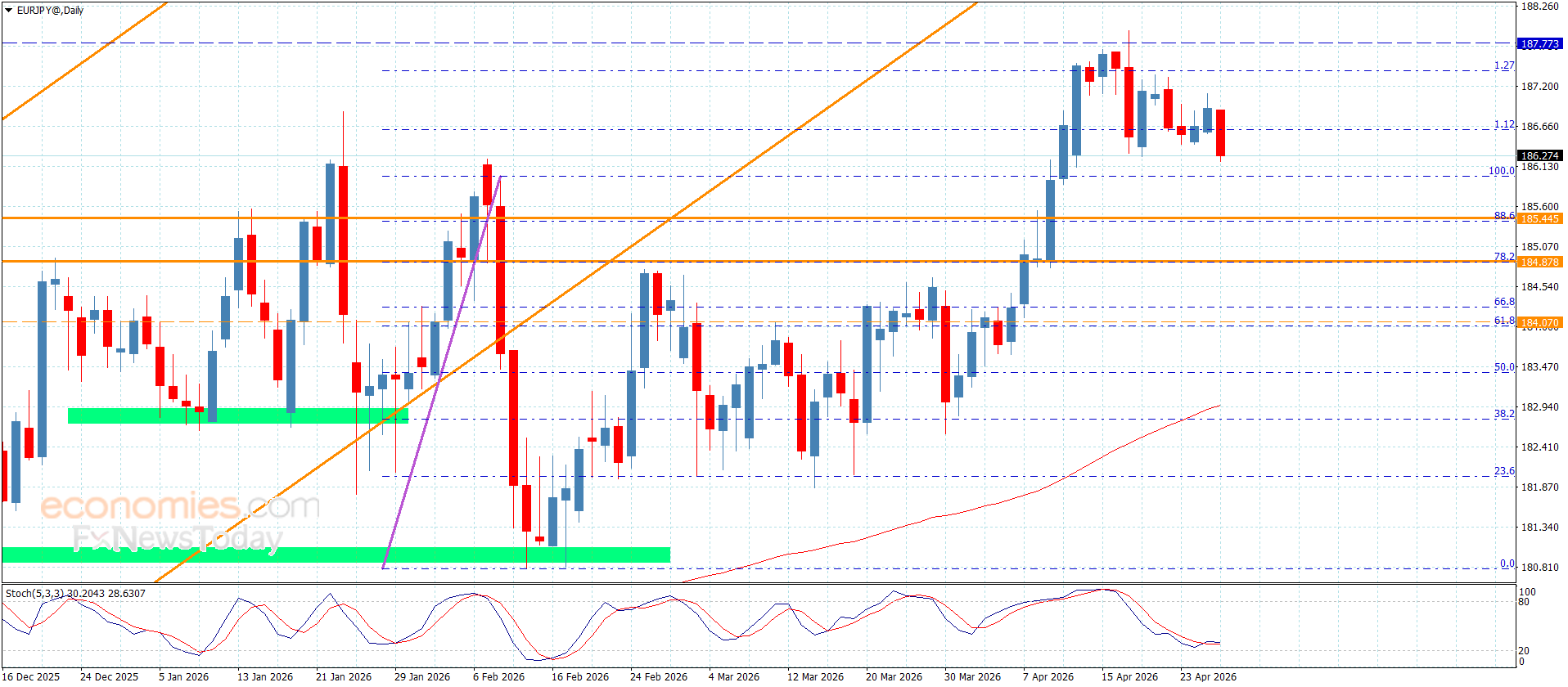
The EURJPY pair began providing slow negative trading, confirming its surrender to the dominance of the bearish corrective trend, to settle near 186.25 reminding you that the main stability below 187.50 barrier, due to the negative momentum of stochastic supports the chances of resuming the corrective attempts, to keep waiting for reaching 185.65, where breaking it will open the way for suffering extra losses that might extend towards 185.30 and 184.85.
Activating the bullish trend requires a strong positive momentum, which allows it to settle above 187.75 level, to begin targeting new positive stations by its rally towards 188.40 reaching 189.20.
The expected trading range for today is between 185.65 and 187.1000
Trend forecast: Bearish
Domestic coffee prices today
The domestic coffee market on April 27 recorded a sideways state after strong fluctuations last week. In key growing regions of the Central Highlands, the average purchase price for the whole region is anchored at the threshold of 88,000 VND/kg. This is a price level reflecting the caution of both buyers and sellers as the international market continuously sends signals about long-term surplus supply.
Detailed purchase prices in specific localities are as follows:
Dak Lak and Gia Lai: Trading simultaneously at 88,000 VND/kg.
Lam Dong: Keeping the lowest level in the region at 87,500 VND/kg.
In addition, pepper prices still maintained stability at a high level of 141,000 VND/kg, while the USD/VND exchange rate was listed at 26,108.
World coffee prices today
On the world exchange, red color covered both futures exchanges in the closing session on Monday. Arabica futures for July (KCN26) fell sharply by 6.40 cents (-2.17%), while Robusta futures for July (RMN26) in London also lost another 55 USD (-1.58%). This decline was mainly due to concerns about global coffee surplus as Brazil prepares to enter a new harvest with record production forecasts.
Coffee price assessment
The market is suffering “cushions” from surplus reports. Marex Group and StoneX both gave impressive figures for the Brazilian crop season 2026/27, which are 75.9 million bags and 75.3 million bags respectively. In particular, the global coffee surplus in 2026 is expected to reach 10 million bags, the highest level in the past 6 years. In Vietnam, exports in the first quarter increased by 14% (reaching 585,000 tons) is also a significant “bearish” (devaluation) factor for the London exchange.
However, there are still “bright spots” supporting prices that are not falling too deeply. The fact that the Hormuz Strait is still closed due to geopolitical tensions has sharply increased transportation, insurance and fertilizer costs, directly pushing up the cost of goods sold by roasters. In addition, Robusta inventories on the ICE floor hit a 16-month low and record low rainfall in Brazil (only reaching 20% of the historical average) are still variables that could trigger short-term technical recovery waves.
Note: The actual price may differ depending on the quality of the seeds and the actual transaction agreement.
TradingKey – On April 26, ET, Citigroup raised its Brent crude oil price forecast for 2026 to $150. Given the stalemate in U.S.-Iran negotiations leading to the continued blockade of the Strait of Hormuz, Citi believes the Middle East situation has evolved from a short-term risk into a structural variable that could persistently disrupt global supply.
According to its latest assessment, Brent could first enter the $110 to $120 range over the next four to six weeks; if more widespread energy infrastructure continues to be damaged, or if normal passage through the Strait of Hormuz remains unrestored by June, the probability of Brent surging to $150 will rise significantly.
Oil prices gapped higher again at the open today (April 27). As of the European session, Brent crude has stabilized above the $100 mark, trading at $101.50, while WTI rose to $96.53.
The crux of Citi’s decision to raise its oil price forecasts lies in its assessment that supply disruptions are persisting for an extended period.
On April 20, Citi’s research team noted that even if the ceasefire is extended, global crude inventories could shrink by approximately 900 million barrels due to delayed production ramp-ups, logistical bottlenecks, and conflict-related damage, suggesting the market has not truly eased despite the truce.
On April 26, Citi’s latest projections raised Brent forecasts for the second, third, and fourth quarters to $110, $95, and $80, respectively; under a bull case scenario assuming the strait remains blocked through late June, prices could surge to $150.
By April 27, Brent crude prices climbed back above $100, indicating that traders are continuing to price in a geopolitical risk premium, as market logic remains dominated by geopolitical tensions.
The Strait of Hormuz remains the focal point of geopolitical risk; any prolonged restriction would affect not just crude exports but also shipping, insurance, port logistics, and downstream refinery procurement cycles, while sustained pressure on physical supply chains continues to support elevated oil prices.
Institutional sentiment remains largely aligned. J.P. Morgan stated that if disruptions in the Strait of Hormuz persist past mid-May, Brent could initially climb to $120–$130, with $150 not out of the question if the outage is prolonged. Goldman Sachs emphasized that current Middle East production cuts will push the global oil market into a significant deficit in the second quarter, suggesting that upside risks are not only present but could exceed baseline projections.
Currently, there are three aspects that require attention. The first is the transit situation in the Strait of Hormuz; as long as there is no substantial improvement in the restoration of this passage, the duration for which oil prices remain elevated will continue to lengthen.
The second is the inventory and spot structure of the crude oil market. According to Reuters, global crude inventories may continue to decline, and even a phased extension of the ceasefire may not necessarily bridge the supply gap quickly. The widening spread between spot and futures prices implies that the market is already paying for prolonged supply pressure.
The third point to note is the macro transmission of high oil prices. If oil prices continue to surge, the first to be affected will not be energy stocks, but rather inflation and interest rate expectations. J.P. Morgan points out that persistent high oil prices will heighten global recession risks. For investors, this means that the upside in oil prices is not only a positive for the crude oil sector but also compresses the room for the equity market, bond market, and high-valuation growth assets.
Consequently, when Citi raised its oil price forecast to $150, it was not conveying a conclusion that oil prices would definitely hit $150, but rather that geopolitical risks have not yet concluded and the market must continue to pay for uncertainty.
If subsequent negotiations truly advance, transit through the strait is restored, and inventories begin to be replenished, only then will oil prices have the opportunity to move from a high-risk premium model back to more conventional supply-and-demand pricing.
This content was translated using AI and reviewed for clarity. It is for informational purposes only.
– Written by
Ben Hughes
STORY LINK Pound Sterling to Dollar Forecast: GBP Climbs Above 1.3550 as USD Retreats
The Pound to Dollar exchange rate (GBP/USD) has climbed to 10-day highs above 1.3550, as the dollar softened ahead of key central bank decisions and shifting expectations for Federal Reserve policy.
Sterling has also drawn support from expectations of a relatively hawkish Bank of England stance, although elevated energy prices, geopolitical uncertainty, and weak UK retail data continue to pose risks to further gains.
The Pound to Dollar (GBP/USd) exchange rate advanced to 10-day highs just above 1.3550 on Monday. The dollar index retreated to around 98.30 as the US currency lost ground.
The Pound also held firm amid expectations of a relatively hawkish Bank of England policy statement on Thursday. There are, however, also significant UK economic risks, illustrated by a notably downbeat CBI retail sales survey with the headline reading at a record low.
SEB has a year-end GBP/USD forecast of 1.36 with the dollar and Pound both posting notable losses in global markets.
Markets were continuing to monitor Iran developments and energy prices. Formal negotiations have not resumed, but there are reports that Iran had proposed opening the Strait of Hormuz if nuclear talks are delayed.
Get better rates and lower fees on your next international money transfer.
Compare TorFX with top UK banks in seconds and see how much you could save.
European equities secured limited gains, but oil prices increased again.
According to ING; “DXY is offered again on the Iranian news, but with oil prices staying high and central banks yet to react, we caution against chasing it lower again too soon.”
Bank of America commented; “we expect more 2-way risks from here as progress is elusive and oil supply remains an issue.”
Federal Reserve policy and guidance will also be a key element this week with the latest interest rate decision due on Wednesday. At the end of last week, the US Justice Department announced that it had dropped its criminal investigation into Federal Reserve Chair Jerome Powell.
MUFG commented; “The developments make it more likely that Kevin Warsh will replace Jerome Powell as Fed Chair when his term expires on 15th May, although it remains unclear if Jerome Powell will also step down from the Board of Governors given the lingering threat to re-open a criminal investigation.
It added; “The US rate market still judges that there is a higher probability that the next Fed policy move will be a cut rather than a hike remaining a headwind for the US dollar.”
International Money Transfer? Ask our resident FX expert a money transfer question or try John’s new, free, no-obligation personal service! ,where he helps every step of the way,
ensuring you get the best exchange rates on your currency requirements.
TAGS: Pound Dollar Forecasts