The main category of All News Articles.
You can use the search box below to find what you need.
[wd_asp id=1]
The main category of All News Articles.
You can use the search box below to find what you need.
[wd_asp id=1]
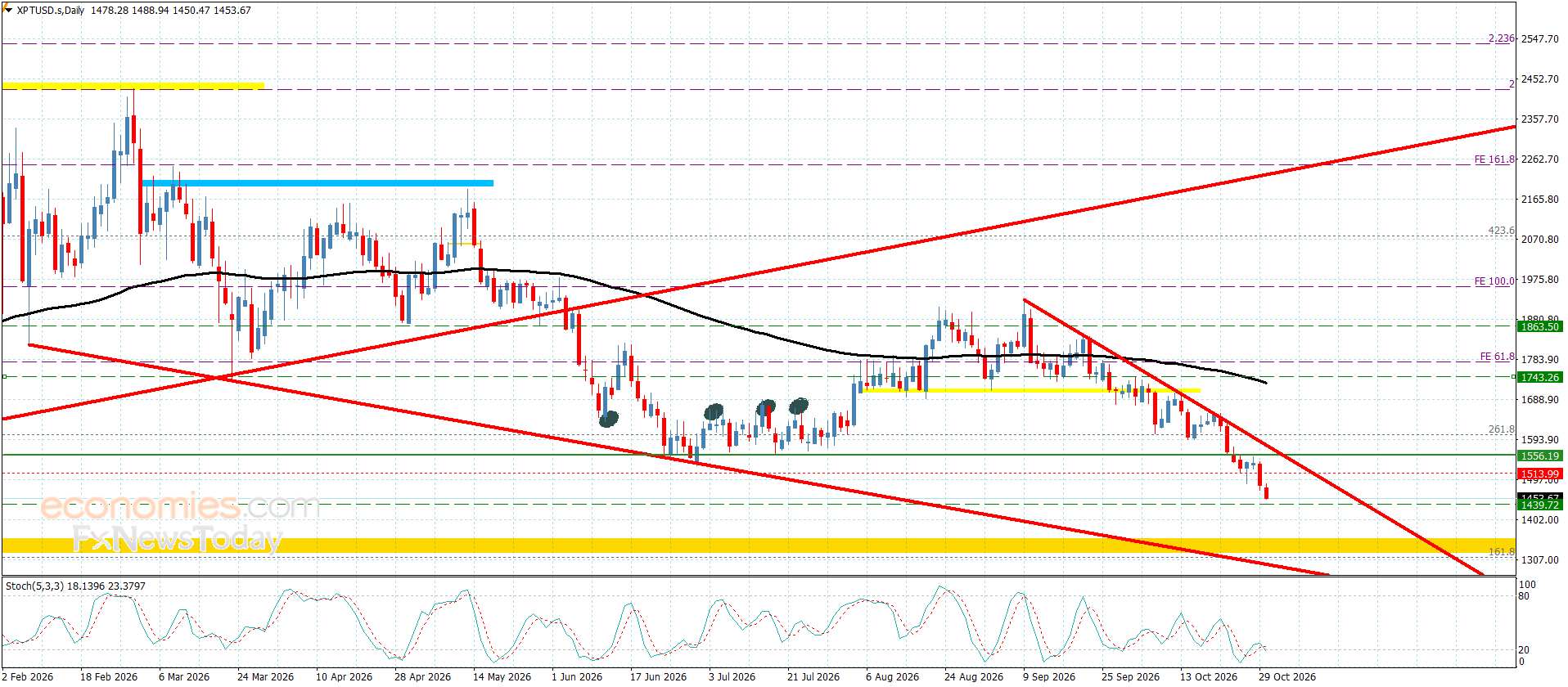
Platinum prices have succumbed to repeated negative pressure, forcing the price to break below the $1505.00 support level and incur further losses, currently settling near $1450.00, as shown in the attached chart.
The continued negative momentum signals from the main indicators, coupled with the $1565.00 level extending the current resistance, will reinforce the bearish trend. We therefore expect the price to break below the obstacle around $1440.00 soon, paving the way for further gradual declines toward the next targets at $1400.00 and $1365.00.
The expected trading range for today is between $1400.00 and $1500.00
Trend forecast: Bearish
Brent crude oil prices have surged to levels not seen in years, with analyst forecasts for 2026 now exceeding $90 per barrel for the first time since May. The U.S. Energy Information Administration recently raised its fourth-quarter 2026 Brent forecast to $105 per barrel, a staggering $14 increase from its previous projection. This dramatic revision reflects a fundamental shift in global oil market dynamics, driven by persistent supply constraints from OPEC+ production cuts, severe disruptions in Middle East energy flows, and an acute shortage of refined products like diesel and marine fuel.
For investors, the implications extend far beyond commodity markets. Major integrated oil companies including ExxonMobil, Chevron, and BP are reporting soaring third-quarter profits fueled by higher refining margins and elevated crude prices. Energy stocks have become one of the best-performing sectors in 2026, outpacing the broader market even as technology names face headwinds. However, the rally is occurring against a backdrop of significant geopolitical risk, with U.S. midterm elections looming and the Strategic Petroleum Reserve depleted to multi-decade lows. Understanding the drivers behind this oil price surge is essential for anyone positioning their portfolio in the current environment.
The trajectory of Brent crude throughout 2026 has defied earlier expectations of a gradual price moderation. At the end of October, Brent settled near $117 per barrel while West Texas Intermediate traded above $104, levels that seemed improbable just six months ago when many analysts expected prices to stabilize in the $70 to $80 range. The disconnect between forecasts and reality stems from a convergence of supply-side shocks that have overwhelmed any demand weakness in the global economy.
Analyst surveys conducted by Reuters and the Wall Street Journal now project Brent to average $92.88 per barrel for the full year 2026, with some institutions forecasting even higher averages closer to $96. The EIA’s October Short-Term Energy Outlook represents perhaps the most bullish official forecast, calling for $105 Brent in the fourth quarter and a full-year average of $96 before moderating to $84 in 2027 as flows recover and inventories rebuild. These upward revisions are not merely speculative; they reflect tangible constraints on global supply that show few signs of easing in the near term.
The price rally has been accompanied by a steepening backwardation in the futures curve, a market structure indicating tight near-term supply relative to longer-dated contracts. This structure rewards holders of physical crude while signaling to refiners and consumers that relief may be months away. For commodity traders and investors in oil-linked instruments, understanding this curve dynamic is critical, as it influences everything from inventory valuations to hedging costs across the energy complex.
For investors seeking to analyze energy sector opportunities with data-driven insights, consider using the AI-powered stock screener to filter and evaluate oil and gas stocks based on real-time financial metrics and market trends.
The Organization of Petroleum Exporting Countries and its allies, collectively known as OPEC+, have emerged as the single most influential factor supporting oil prices in 2026. The group maintains approximately 2 million barrels per day of production cuts across most participating countries, restrictions that are scheduled to remain in place through the end of the year. When OPEC+ convened on November 1, 2026, market participants widely expected the coalition to hold December production quotas unchanged, and early reports confirmed that seven key producing nations reached a preliminary agreement to do exactly that.
Saudi Arabia, the de facto leader of OPEC+, has been particularly disciplined in managing its output. The kingdom holds a production quota of 10.478 million barrels per day but has been producing approximately 2.1 million barrels below that ceiling. This voluntary restraint goes beyond the formal OPEC+ agreement and reflects Saudi Arabia’s strategic priority of supporting prices rather than maximizing market share. Russia, Iraq, Kuwait, Algeria, Kazakhstan, and Oman have similarly signaled their intention to maintain current production levels through the remainder of 2026, with discussions now shifting toward production baselines for 2027.
The significance of OPEC+ discipline cannot be overstated. Global oil demand is projected to decline by approximately 2.5 million barrels per day in the fourth quarter of 2026, yet the market is expected to remain in deficit by roughly 2.7 million barrels per day due to the combined effect of OPEC+ cuts and involuntary supply losses from other regions. This imbalance between shrinking supply and moderating demand is precisely what has driven prices to their current elevated levels. Investors monitoring the energy sector should watch closely for any signals of OPEC+ policy shifts in early 2027, as even modest production increases could substantially alter the price outlook.
Beyond the deliberate production management by OPEC+, the global oil market has been severely disrupted by geopolitical events in the Middle East that have constrained both crude production and refined product exports from the region. The Strait of Hormuz, through which roughly one-fifth of global oil shipments pass, has been declared effectively closed for commercial traffic, creating a logistical bottleneck that no amount of production quota adjustments can resolve. Saudi Arabia’s East-West pipeline, an alternative export route to the Red Sea, has also come under attack, further limiting the kingdom’s ability to deliver crude to Asian buyers.
The supply impact has been substantial. Compared to pre-conflict levels of approximately 4.7 million barrels per day of Middle East refined fuel supply, the world is currently lacking roughly 2.8 million barrels per day of gasoline, jet fuel, and diesel from the region. These losses compound existing constraints from Russian refinery outages, which have reduced another major source of refined product supply to global markets. The result is a tightness in physical oil markets that extends well beyond crude availability into the refined products that consumers and industries actually use.
Marine fuel and diesel markets have been particularly affected, with ICE Low Sulfur Gas Oil front-month contracts for November 2026 settling above $1,500 per ton. The diesel curve remains downward-sloping but at extraordinarily elevated absolute levels, underlining acute tightness in heating and transport fuels as the Northern Hemisphere enters winter. This product market tightness has direct implications for inflation, transportation costs, and industrial activity across the global economy, making the oil price surge a macroeconomic concern rather than merely a commodity market story.
One of the most underappreciated aspects of the current oil market crisis is the severe shortage of middle distillates, a category that includes diesel, heating oil, and jet fuel. Despite reports of falling global oil demand in 2026, diesel buyers in Europe, Latin America, and Africa have spent much of the year scrambling for cargoes. This apparent contradiction makes sense only when one recognizes that diesel markets operate somewhat independently of crude oil balances, driven by refinery capacity, feedstock quality, and regional inventory levels.
The International Energy Agency has warned that middle distillate supply constraints are likely to persist well beyond 2027, even as crude oil flows eventually recover. This extended timeline reflects the structural challenges facing global refining capacity, which has not kept pace with demand growth in emerging markets. New refinery projects take years to complete, and existing facilities face maintenance backlogs, feedstock limitations, and environmental regulations that constrain their ability to ramp up output quickly.
For the trucking, agriculture, shipping, and aviation sectors, the diesel shortage translates into higher operating costs that are difficult to pass through to end consumers immediately. This cost pressure is already visible in freight rates, airline ticket prices, and agricultural commodity markets. The so-called “diesel crisis” is therefore not a temporary phenomenon but a structural feature of the energy landscape that will influence investment decisions across multiple sectors for years to come.
The surge in oil and refined product prices has translated directly into exceptional financial performance for the world’s largest integrated oil companies. ExxonMobil, Chevron, and BP all reported third-quarter 2026 earnings in late October, and the results significantly exceeded analyst expectations across the board. These companies have benefited not only from higher crude prices but also from expanded refining margins, which have widened dramatically due to the product shortages described above.
ExxonMobil expects higher refining margins to boost third-quarter Energy Products earnings by $4.5 billion compared with the second quarter of 2026, illustrating how quickly downstream profitability can improve in a tight product market. Chevron and BP have similarly reported significant increases in their quarterly profits, driven by the combination of elevated oil prices and strong refinery throughput. The energy sector as a whole has outperformed the broader market in 2026, with oil giants taking control of market leadership from technology names that had dominated the previous several years.
From a valuation perspective, the integrated oil majors present an interesting case study. BP trades at a trailing price-to-earnings ratio of approximately 3.21x, while Chevron sits at 8.68x and ExxonMobil at a higher premium relative to the industry average of 6.68x. These varying valuations reflect differences in production growth profiles, capital allocation strategies, and geographic exposure. For investors evaluating energy sector opportunities, these metrics suggest that selective exposure to the oil majors may offer both income through dividends and potential capital appreciation if commodity prices remain elevated.
As oil prices have become a political flashpoint in the United States, the approaching midterm elections on November 3, 2026, have added another layer of uncertainty to energy market dynamics. Energy analysts have noted that crude oil has become the political pressure point of the U.S. midterm elections, carrying more weight for macro markets than central bank meetings or employment reports. The irony is palpable: campaign promises to slash energy costs have collided with a reality in which gasoline, diesel, and jet fuel prices have all soared instead.
The U.S. government enters the midterm cycle with a depleted Strategic Petroleum Reserve, which has been drawn down to historic multi-decade lows through aggressive emergency releases in recent years. This diminished buffer leaves the administration with limited tools to respond to further price spikes, should they occur. Macquarie Energy strategists have warned that energy markets remain on edge ahead of the elections, beholden to concerns of escalation in the Middle East either before or after the November 3 event horizon.
Morgan Stanley Research has estimated that even under optimistic scenarios, full recovery of disrupted Middle East supply would extend well into 2027, with logistical and technical bottlenecks keeping oil and fuel supplies tight in the interim. This timeline suggests that energy policy will remain a contentious issue regardless of the election outcome, and that market volatility around political developments may persist for months to come. For investors, this policy uncertainty reinforces the case for maintaining diversified exposure across the energy value chain rather than concentrating bets on any single outcome.
Looking beyond the immediate crisis, the outlook for oil markets in 2027 depends critically on several variables that remain unresolved. The EIA currently projects Brent to moderate to approximately $84 per barrel in 2027, assuming that Middle East flows recover and global inventories rebuild from their current depleted levels. However, this forecast hinges on geopolitical stabilization that is by no means guaranteed, and on OPEC+ choosing to increase production rather than maintain its current disciplined posture.
The IEA’s assessment that middle distillate supply constraints will persist well beyond 2027 suggests that even if crude oil prices moderate, refined product markets may remain tight. This structural tightness in products could support refining margins even in a lower crude price environment, creating a favorable operating backdrop for integrated oil companies with substantial downstream operations. Conversely, pure-play upstream producers could face margin compression if crude prices decline while their operating costs remain elevated.
For commodity investors, exchange-traded products tracking oil prices may offer exposure to the prevailing trend while limiting single-stock risk. The United States Oil Fund and similar instruments have seen renewed interest as investors seek to capitalize on the current price environment. However, the contango and backwardation dynamics in the futures curve can significantly impact returns on these products, making them more suitable for tactical rather than long-term strategic allocations.
The Brent crude oil price forecast for 2026 has been transformed by a convergence of supply-side shocks that have overwhelmed demand concerns and driven prices to multi-year highs. With analyst consensus now projecting averages above $90 per barrel and the EIA forecasting $105 in the fourth quarter, the energy complex is pricing in a prolonged period of tight supply that extends from crude production through refined product availability. OPEC+ discipline, Middle East disruptions, and structural constraints in global refining capacity have combined to create a market environment that favors energy producers and challenges consumers across the global economy.
For investors, the current environment presents both opportunities and risks. Major integrated oil companies like ExxonMobil, Chevron, and BP are generating exceptional profits and outperforming the broader market, yet their valuations vary significantly depending on production profiles and capital allocation strategies. The approaching U.S. midterm elections add a layer of policy uncertainty that could influence everything from drilling permits to export restrictions, while the depleted Strategic Petroleum Reserve limits the government’s ability to manage prices through intervention.
To navigate this complex landscape, investors need access to real-time data, intelligent analysis, and tools that can identify opportunities across the energy sector. The AI stock picker can help you discover energy stocks with strong fundamentals and favorable technical setups, while the comprehensive pricing plans provide access to advanced screening and portfolio analysis tools. Whether you are looking to capitalize on the oil price rally or hedge against potential downside, now is the time to equip yourself with the analytical capabilities that can make the difference in volatile markets.

Ready to take control of your energy investments? Sign up today and start analyzing oil stocks with AI-powered insights that help you stay ahead of market movements.
The Pound to Dollar exchange rate finished Friday at $1.3389, leaving Pound Sterling 0.94% higher over October after a Budget that avoided the disruption investors had feared.
Pound to Euro (GBP/EUR): 1.199748 (+0.28%)
Pound to Dollar (GBP/USD): 1.3389 (+0.08%)
Euro to Dollar (EUR/USD): 1.115984 (-0.20%)
Rabobank’s post-Budget currency projections allow little further upside over three months, with GBP/USD at $1.34 around late January 2027, before a retreat to $1.30 over 12 months, around late October 2027.
Those projections accompanied a view that markets expected too many Bank of England rate increases.
Since then, Rabobank’s economists have added another hike to their own outlook, changing an important assumption behind the currency analysis without supplying replacement exchange-rate targets in that update.
Before Friday’s policy revision, Rabobank senior FX strategist Jane Foley wrote:
“In RaboResearch’s view, the market continues to price in too much BoE policy tightening. Our central view is that the Bank is unlikely to hike more than once more this cycle. If the market unwinds rate hike speculation, GBP is at risk of being undermined into 2027.”
Lower expected UK rates would reduce the prospective return on Pound Sterling assets, potentially offsetting the reassurance delivered by the Budget.
But on Friday, Rabobank economist Stefan Koopman forecast a quarter-point increase in November to 4.00% and added another in February to 4.25%, citing persistent energy inflation despite limited evidence of wider wage and price spillovers.
That later assessment gives Pound Sterling more interest-rate support than the one-hike assumption in Foley’s analysis.
It does not establish that the currency forecasts have changed, or that all the tightening investors expect will materialise.
The BoE’s next decision and economic forecasts arrive on 5 November, providing an early test of how far policymakers believe rates need to rise.
Foley wrote: “The silver lining of the Truss budget is that no other UK politician wants to repeat the same mistake. In contrast to the situation in some other G7 countries, it is clear to both politicians and the electorate that government spending is constrained by the country’s high level of debt.”
She also identified a vulnerability in the ownership of UK government bonds:
“The fact that around 30% of gilts are held by foreign investors naturally implies that the pound is sensitive to a selloff in government debt.”
If overseas investors reduce exposure to British bonds and convert the proceeds into other currencies, that selling can put pressure on Pound Sterling as well as raise government financing costs.
Avoiding such a shock matters particularly when investors have already positioned for weakness.
Foley’s analysis showed speculators holding net short Pound Sterling positions ahead of the Budget, leaving scope for buying if they closed those bets.
Foley wrote: “Indeed, the lack of any market drama around the budget could give way to a little near-term relief in the pound.”
The published fiscal plans leave £15 billion of headroom against the current-budget rule in 2029/30, down from £23.6 billion in March.
That is the forecast cushion for meeting the rule, rather than money held in reserve.
Foley acknowledged the deterioration: “A reduction in the fiscal headroom is not good news, but crucially this is a self-imposed discipline. Compared with some other G7 countries, at least the UK has a budget consolidation plan in place.”
Foley points to competing demands: “On top of that, the experience of former PM Starmer suggests that welfare reform will be tough particularly given the ageing demographic. At the same time Healey has announced that defence spending will rise to 3% of GDP by 2030.”
Delivering that plan remains difficult, as the spending pressures left for 2027 make clear.
The Institute for Fiscal Studies’ Budget response warns that tight public-service spending assumptions leave the planned reduction in borrowing vulnerable.
The Pound-to-Euro exchange rate finished Friday at €1.1997, having gained 2.45% over October.
Foley wrote:
“EUR/GBP has trended lower over the last month as French budget concerns triggered fears of contagion in other highly indebted European nations. These events have weighed on the EUR and cast a relatively positive light on the pound.”
Rabobank’s three-month EUR/GBP forecast of 0.84 translates to approximately €1.1905 per Pound, calculated by Exchange Rates UK, slightly below Friday’s level.
GBP/USD has already reached the vicinity of Rabobank’s three-month projection. Its projections leave little additional near-term upside, while its added February hike makes next week’s BoE guidance particularly relevant.
GBP/EUR has benefited from a comparison between two strained fiscal positions. Progress towards a credible French budget could weaken that advantage even if confidence in UK policy holds.
For Pound Sterling, the risk is that inflation keeps interest rates and debt-servicing costs high while spending commitments erode the government’s smaller fiscal cushion.
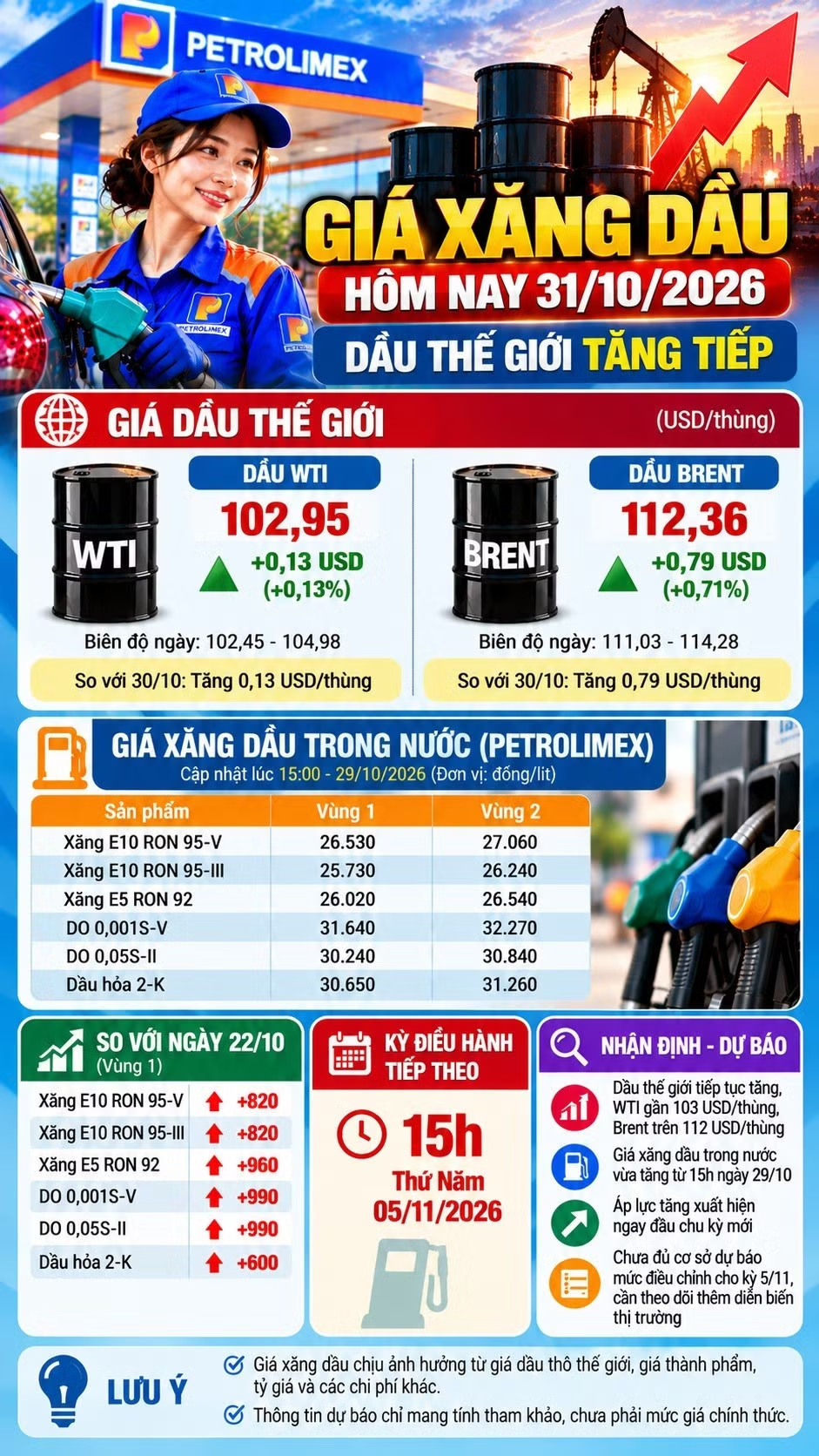
Global oil prices ended the week at a high level, while domestic gasoline and diesel prices have just increased across the board. This development puts pressure on the price adjustment scheduled for November 5th quite early, although there is currently insufficient data to predict the specific increase.
According to the updated data used in this article, the WTI benchmark price on October 31st was $102.95 per barrel, an increase of $0.13 compared to $102.82 per barrel on October 30th, equivalent to approximately 0.13%.
Brent crude rose from $111.57 per barrel to $112.36 per barrel, an increase of $0.79, or approximately 0.71%.
| Type of oil | October 30, 2026 | October 31, 2026 | Change | Proportion |
|---|---|---|---|---|
| WTI | $102.82 per barrel | $102.95 per barrel | +0.13 USD | +0.13% |
| Brent | $111.57 per barrel | $112.36 per barrel | +0.79 USD | +0.71% |
According to the data set, the most recent range for WTI was $102.45 – $104.98 per barrel, while Brent fluctuated between $111.03 – $114.28 per barrel.
Since October 31st is a Saturday, this is not a new oil futures trading session. The data should be interpreted as the weekend benchmark following Friday’s session.
International data shows that the October 30th session actually saw a stronger increase. WTI closed at $104.12 per barrel, up more than 2%; Brent closed at $117.64 per barrel, up about 2.4%, both reaching their highest levels in about 6 months. For the entire month of October, Brent increased by approximately 13.6%, while WTI increased by 15.2%.
The main drivers remain concerns about oil supply and transportation in the Middle East, while the physical market continues to be quite strained. A new Reuters survey shows that experts have also raised their 2026 oil price forecasts amid continued pressures on supply, inventories, and shipping costs.
Thus, despite price differences between sources due to contracts and recording times, the trend at the end of the week was quite clear: international crude oil remained at high levels and showed no signs of sustained cooling.
Domestically, Petrolimex’s retail prices will continue to apply the price list effective from 3 PM on October 29, 2026. Petrolimex confirms that the new prices will be applied from this time until the next price adjustment period.
Unit: VND/liter
| Product | Region 1 | Region 2 |
|---|---|---|
| E10 RON 95-V gasoline | 26,530 | 27,060 |
| E10 RON 95-III gasoline | 25,730 | 26,240 |
| E5 RON 92 gasoline | 26.020 | 26,540 |
| DO 0.001SV | 31,640 | 32,270 |
| DO 0.05S-II | 30,240 | 30,840 |
| 2-K kerosene | 30,650 | 31,260 |
Compared to the price list on October 22nd, all items at Petrolimex have increased in price:
| Product | October 22nd | October 29th | Change |
|---|---|---|---|
| E10 RON 95-V | 25,710 | 26,530 | +820 |
| E10 RON 95-III | 24,910 | 25,730 | +820 |
| E5 RON 92 | 25,060 | 26.020 | +960 |
| DO 0.001SV | 30,650 | 31,640 | +990 |
| DO 0.05S-II | 29,250 | 30,240 | +990 |
| 2-K kerosene | 30,050 | 30,650 | +600 |
According to the general price adjustment on October 29th, E5 RON92 increased by 666 VND/liter to a maximum of 26,027 VND/liter; E10 RON95-III increased by 521 VND/liter to 25,734 VND/liter; and diesel 0.05S increased by 696 VND/liter to 30,246 VND/liter.
The average prices of refined products during the period of October 22-29 also increased significantly: RON92 increased by 4.68%, RON95 by 4.22%, and 0.05S diesel by 2.71%. This is the main reason why retail prices reversed their downward trend after two consecutive periods of decline.
The actual price increase on Petrolimex’s price list is higher than the regulated price increase for some items because, from October 30th, the company no longer applies the policy of further reducing prices by 300 VND/liter/kg as in the previous period.
Unless the operating schedule changes, domestic fuel prices will be updated again at 3 PM on Thursday, November 5, 2026.
Early-cycle signals currently point toward the downside for retail prices.
International crude oil prices closed the week at high levels, with WTI exceeding $104/barrel and Brent surpassing $117/barrel according to international closing data. If this level persists into the beginning of next week and pushes up the prices of RON92, RON95, and diesel, the upward pressure on prices for the November 5th period will become clearer.
However, it is still too early to give a specific increase figure.
The new cycle only begins after October 29th. The sessions from November 2nd to 4th, and especially the average price of finished products, are more important bases for forecasting the adjustment level.
One factor to watch is supply. The market is still being affected by transportation risks and Middle Eastern oil supply, but improved production or supply flows could cause a rapid price reversal. OPEC+ is also expected by the market to maintain relatively stable short-term production targets.
Therefore, based on the data from the weekend of October 31st, it can be concluded that upward pressure has appeared quite clearly at the beginning of the cycle. However, there is not enough basis to confirm whether gasoline and diesel prices will continue to rise on November 5th, or by how much.
In the European market, the euro tried to rally a bit during the trading session. Today, third-quarter euro area GDP was released, with the flash estimate coming in at 0.4% quarter-on-quarter, down from 0.6% during the previous quarter. That being said, it’s also worth noting that the ECB held its deposit rate at 2.5% yesterday. That was not a huge surprise; it was expected.
Its statement did warn that higher energy prices posed upward inflation risk and downward growth risk—not a combination we want. So, with that being the case, this is a market that I think we should continue to fade rallies. We’ve already seen that today. If we can break below 1.11, I’ll be aiming for 1.10. Full disclosure: I’m already short of this market and have no interest in buying it.
The article covers the following subjects:
Consider short positions below 4,420.00 with a target of 3,593.00–3,127.70 once the correction is completed.
Breakout and consolidation above the level of 4,420.00 will allow the price to continue rising to the levels of 4,708.00–4,900.00.
An ascending third wave of larger degree (3) has likely formed on the weekly chart, and a bearish correction is developing as the fourth wave (4). On the daily time frame, wave A of (4) has apparently formed, and a correction has been completed as wave B of (4). On the H4 time frame, wave C of (4) is developing, with the first wave of smaller degree i of C nearing completion as its part. If the presumption is correct, XAU/USD will resume declining to 3,593.00–3,127.70 once the local correction has been completed as the second wave ii of C. The level of 4,420.00 is critical in this scenario as a breakout above it will enable the asset to continue rising to the levels of 4,708.00–4,900.00.
This forecast is based on the Elliott Wave Theory. When developing trading strategies, it is essential to consider fundamental factors, as the market situation can change at any time.
The content of this article reflects the author’s opinion and does not necessarily reflect the official position of LiteFinance broker. The material published on this page is provided for informational purposes only and should not be considered as the provision of investment advice for the purposes of Directive 2014/65/EU.
According to copyright law, this article is considered intellectual property, which includes a prohibition on copying and distributing it without consent.
Retail Sales increased by +2.3% year-over-year in September, compared to analyst consensus of +3.3%. Industrial Production grew by +2.2%, while analysts expected that it would increase by +1.3%. The report did not have a material impact on market dynamics as traders have mostly focused on BoJ decision.
Both Fed and BoJ decided to take a pause, and USD/JPY traders remained in wait-and-see mode. The Japanese yen remains fundamentally weak, but bulls are worried that BoJ may intervene in case USD/JPY climbs towards the 160.00 level.
In case USD/JPY stays below the 50 MA at 157.57, it will head towards the 157.00 level. A move below 157.00 will push USD/JPY towards recent lows near 156.00.
If you’d like to know more about how to trade forex, please visit our educational area.
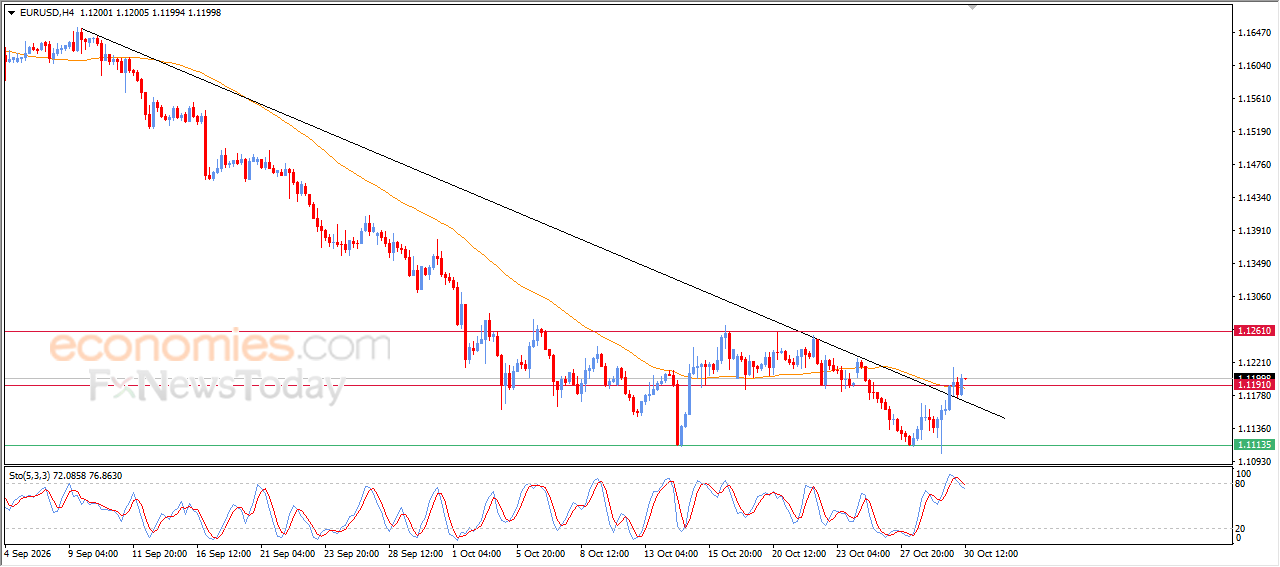
The EURUSD pair moved higher in its latest intraday trading, following an early attempt to take profits and ease some of its overbought conditions, particularly amid positive signals emerging from the relative strength indicators. However, the positive momentum gained after breaking above a main short-term bearish trend line helped the pair rebound and resume its upward movement, supported by dynamic support provided by trading above EMA50, strengthening the chances of further gains in the near term.
The ECB kept its deposit rate at 2.5% on Thursday, hours after President Christine Lagarde said she will step down on February 7, 2027, nine months before her term ends, because she can no longer “remain neutral.” Lagarde said the Governing Council debated a hike before holding unanimously, and signaled the pause may only last until December. She noted the average eurozone 10-year bond yield has risen about 35 basis points, or 0.35 percentage point, since the September projections, and told high-debt governments to plan for rates staying higher for some time and keep budgets within EU rules, Euronews reported. She avoided naming France, blaming global factors instead.
The euro briefly fell to its lowest since May 2025 on Thursday and is on track for a 1.2% monthly drop, Reuters said, even though the ECB just talked about hiking. That shows the French bond problem and the leadership gap matter more to traders than one extra rate move. Eurozone third-quarter GDP data are due Friday.
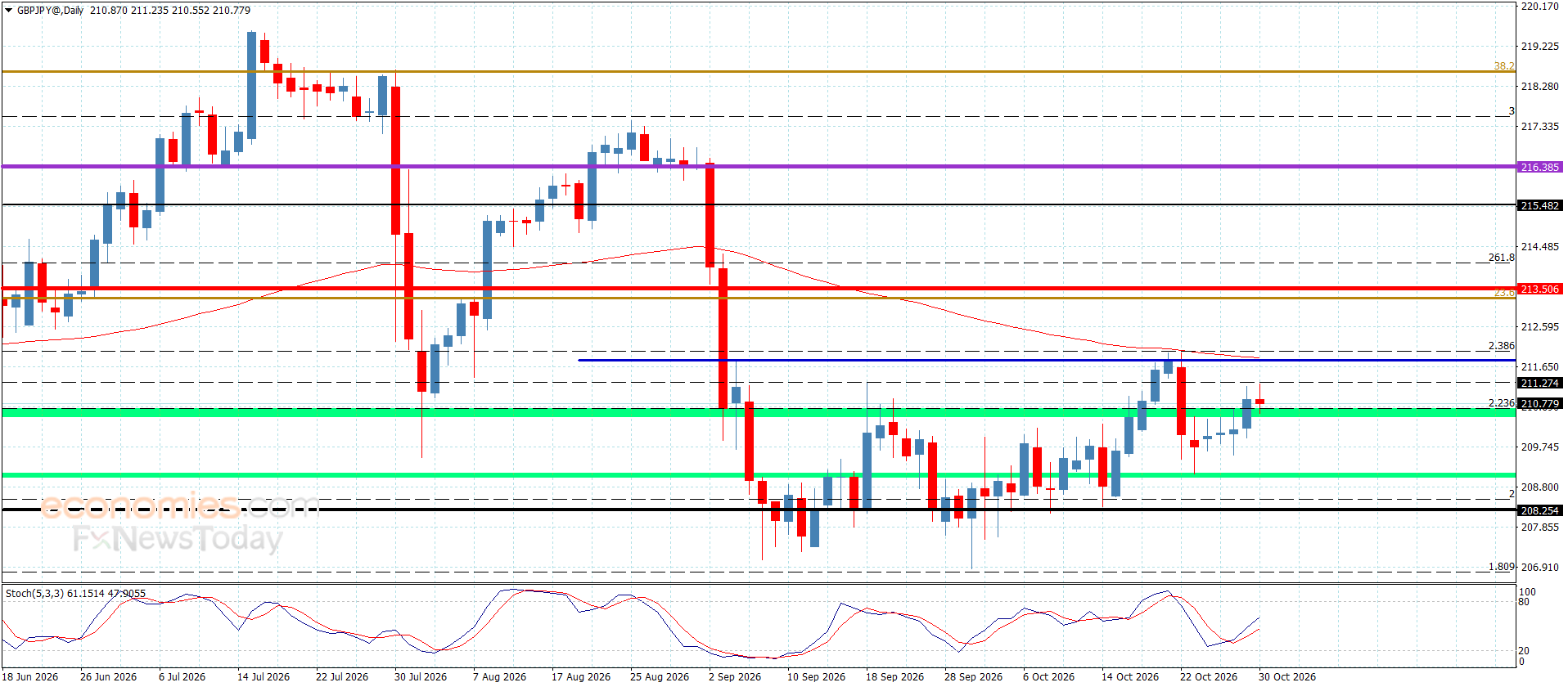
The pair reacted to yesterday’s positive Stochastic signals by forming some upward trades, currently approaching 211.25. However, this will not affect the main bearish scenario, which remains valid as long as resistance holds near 212.00.
The conflicting signals from the main indicators may push the price into some sideways trading. We will therefore wait for the price to gather negative momentum soon, paving the way for bearish waves targeting 210.10 initially, followed by another attempt to renew pressure on the obstacle at 209.10.
The expected trading range for today is between 210.10 and 211.65
Trend forecast: Fluctuating