The main category of All News Articles.
You can use the search box below to find what you need.
[wd_asp id=1]
The main category of All News Articles.
You can use the search box below to find what you need.
[wd_asp id=1]
Silver (XAG/USD) trades with a positive bias for the second straight day on Thursday, though it lacks follow-through buying and remains confined in the previous day’s broader range. The white metal holds above the $84.00 mark during the Asian session, up over 1% for the day.
The near-term bias is mildly bearish as the XAG/USD retreats from last week’s $86 area while holding below the rising 100-period Simple Moving Average (SMA) on the 1-hour chart. The said SMA is pegged near $88 and should now act as overarching dynamic resistance.
The Moving Average Convergence Divergence (MACD) indicator edges back toward the zero line after a prior positive phase. The Relative Strength Index (RSI) is hovering just below 50, reinforcing a consolidative-to-soft downside tone rather than an impulsive selloff.
Initial resistance emerges at the recent intraday highs around $85.00, followed by a stronger cap near $86.20, where prior peaks align with fading upside momentum. A break above the latter would open the way toward the $88.00 region, where the 100-hour SMA is clustered and would be expected to attract renewed selling interest.
On the downside, immediate support sits at $83.50, with a deeper floor at $82.00, close to the latest reaction low and trend-line proximity. A clear drop through $82.00 would expose the $80.95 trend-line break area as the next bearish target, signalling a more decisive shift away from the prevailing medium-term uptrend.
Meanwhile, the upward support trend line from around $64 remains intact, yet the recent pullback toward the low-$80s shows buyers losing immediate control.
(The technical analysis of this story was written with the help of an AI tool.)
Silver is a precious metal highly traded among investors. It has been historically used as a store of value and a medium of exchange. Although less popular than Gold, traders may turn to Silver to diversify their investment portfolio, for its intrinsic value or as a potential hedge during high-inflation periods. Investors can buy physical Silver, in coins or in bars, or trade it through vehicles such as Exchange Traded Funds, which track its price on international markets.
Silver prices can move due to a wide range of factors. Geopolitical instability or fears of a deep recession can make Silver price escalate due to its safe-haven status, although to a lesser extent than Gold’s. As a yieldless asset, Silver tends to rise with lower interest rates. Its moves also depend on how the US Dollar (USD) behaves as the asset is priced in dollars (XAG/USD). A strong Dollar tends to keep the price of Silver at bay, whereas a weaker Dollar is likely to propel prices up. Other factors such as investment demand, mining supply – Silver is much more abundant than Gold – and recycling rates can also affect prices.
Silver is widely used in industry, particularly in sectors such as electronics or solar energy, as it has one of the highest electric conductivity of all metals – more than Copper and Gold. A surge in demand can increase prices, while a decline tends to lower them. Dynamics in the US, Chinese and Indian economies can also contribute to price swings: for the US and particularly China, their big industrial sectors use Silver in various processes; in India, consumers’ demand for the precious metal for jewellery also plays a key role in setting prices.
Silver prices tend to follow Gold’s moves. When Gold prices rise, Silver typically follows suit, as their status as safe-haven assets is similar. The Gold/Silver ratio, which shows the number of ounces of Silver needed to equal the value of one ounce of Gold, may help to determine the relative valuation between both metals. Some investors may consider a high ratio as an indicator that Silver is undervalued, or Gold is overvalued. On the contrary, a low ratio might suggest that Gold is undervalued relative to Silver.
– Written by
David Woodsmith
STORY LINK Pound to Dollar Forecast: Iran War Sends GBP to 11-Week Lows
The Pound to Dollar exchange rate (GBP/USD) has dropped to 11-week lows below 1.3300 as escalating conflict involving Iran triggered a sharp deterioration in global risk appetite and a renewed surge in energy prices.
With oil and LNG costs jumping and investors flocking to safe-haven assets, the US dollar has strengthened broadly while Sterling faces additional pressure from the UK economy’s vulnerability to rising gas prices and slowing global growth.
The Pound to Dollar (GBP/USD) exchange rate rallied from lows on Monday, but failed to hold the gains and was subjected to renewed selling on Tuesday with a slide to 11-week lows just below 1.3300.
The dollar was boosted by renewed defensive demand while the slide in risk appetite undermined the Pound.
According to UoB; “Looking ahead, if GBP breaks below 1.3315, the focus will shift to 1.3250.” There is the potential for further support on any dip to the 1.3200 area.
MUFG now sees a risk of a slide to below 1.31 this month on dollar strength before a solid recovery to 1.37 later in the year.
Get better rates and lower fees on your next international money transfer.
Compare TorFX with top UK banks in seconds and see how much you could save.
Energy-sector fears have intensified as Iran has attacked regional energy facilities and threatened to close the Straits of Hormuz. Oil prices have increased further while LNG prices have spiked again with close to a 100% increase from last week.
The UK economy remains vulnerable to higher gas prices and the Pound tends to remain under pressure when risk conditions slide.
ING noted the importance of energy prices; “FX traders will remain transfixed on gas and oil prices. The longer they stay elevated, the more the external accounts of the oil importers are damaged and the greater the drag on global growth from elevated inflation and curtailed monetary easing cycles.”
Scotiabank FX strategist Eric Theoret commented; “Today is, I would say, a classic risk-off day from a U.S. dollar perspective.”
He added; “If you’re looking to de-risk and de-risk in size, the U.S. Treasury market is really the only one that can handle those flows,” Theoret said. When global investors flood into Treasuries during a crisis, that drives up demand for the dollar.”
According to Rabobank; “While USD has not been behaving as a safe-haven traditionally would, given the dramatic USD sell-off in H1 2025, we have long argued that this was more about positioning. Indeed, recent price action makes it clear that when the going gets rough, investors still flee to the warm embrace of greenback liquidity.
ING added; “Europe is also on the wrong side of the ledger. The dollar looks the best currency to take advantage of this energy shock.”

MUFG noted; “We have made the assumption that the bulk of the negative impact on European currencies will occur this month before fading as the year progresses. It follows comments from President Trump that US military action in Iran could last for four to five weeks or so.
It added; “A more protracted conflict and/or much greater disruption to global energy supply would further increase downside risks to our forecasts for weaker European currencies against the US dollar.”
International Money Transfer? Ask our resident FX expert a money transfer question or try John’s new, free, no-obligation personal service! ,where he helps every step of the way,
ensuring you get the best exchange rates on your currency requirements.
TAGS: Pound Dollar Forecasts
This material (Material) is provided for your information only and does not constitute: (i) an offer to sell, a solicitation of an offer to buy, or a recommendation for any investment product or strategy, or (ii) any investment, legal or tax advice. The information contained herein is as of the date and time referenced in the Material and J.P. Morgan does not undertake any obligation to update such information. J.P. Morgan disclaims any responsibility or liability, whether in contract, tort (including, without limitation, negligence), equity or otherwise, for the quality, accuracy or completeness of the information contained in this Material, and for any reliance on, or uses to which, this Material, is put, and you are solely responsible for any use to which you put such information. Without limiting any of the foregoing, to the fullest extent permitted by applicable law, in no event shall J.P. Morgan have any liability for any special, punitive, indirect, or consequential damages (including lost profits or lost opportunity), in connection with the information contained in this Material, even if notified of the possibility of such damages. Any comments or statements made herein do not necessarily reflect those of J.P. Morgan, its subsidiaries or its affiliates.
All materials and information shared with you are, unless otherwise indicated to you, proprietary and confidential to J.P. Morgan. You are hereby notified that any disclosure, dissemination, copying, distribution, or use of the information provided to you, in whole or in part, other than as expressly permitted by J.P. Morgan, is STRICTLY PROHIBITED. You are permitted to disclose the materials and information to your officers and employees on a need to know basis. Should you have any questions regarding this, please contact your usual J.P. Morgan contact. For further information please visit: https://www.jpmorgan.com/pages/disclosures/materialdisclaimer.
© 2026 JPMorgan Chase & Co. All rights reserved. J.P. Morgan is a marketing name for businesses of JPMorgan Chase & Co. and its subsidiaries and affiliates worldwide.
JPMorgan Chase Bank N.A. (member of FDIC), J.P. Morgan Securities LLC (member of FINRA, NYSE and SIPC), J.P. Morgan Securities plc (member of the London Stock Exchange and authorized by the Prudential Regulation Authority (PRA) and regulated by the Financial Conduct Authority and the PRA) and J.P. Morgan SE (authorised by the BaFin and regulated by the BaFin, the German Central Bank and the European Central Bank) are principal subsidiaries of JPMorgan Chase & Co. For legal entity and regulatory disclosures, visit: www.jpmorgan.com/disclosures. For additional regulatory disclosures, please consult: www.jpmorgan.com/disclosures.
Important DisclaimersFXEmpire is owned and operated by Empire Media Network LTD., Company Registration Number 514641786, registered at 7 Jabotinsky Road, Ramat Gan 5252007, Israel. The content provided on this website includes general news and publications, our personal analysis and opinions, and materials provided by third parties. This content is intended for educational and research purposes only. It does not constitute, and should not be interpreted as, a recommendation or advice to take any action, including making any investment or purchasing any product. Before making any financial decision, you should conduct your own due diligence, exercise your own discretion, and consult with competent advisors. The content on this website is not personally directed to you, and we do not take into account your individual financial situation or needs. The information contained on this website is not necessarily provided in real time, nor is it guaranteed to be accurate. Prices displayed may be provided by market makers and not by exchanges. Any trading or other financial decision you make is entirely your own responsibility, and you must not rely solely on any information provided through the website. FXEmpire does not provide any warranty regarding the accuracy, completeness, or reliability of any information contained on the website and shall bear no responsibility for any trading losses you may incur as a result of using such information. The website may include advertisements and other promotional content. FXEmpire may receive compensation from third parties in connection with such content. FXEmpire does not endorse, recommend, or assume responsibility for the use of any third-party services or websites. Empire Media Network LTD., its employees, officers, subsidiaries, and affiliates shall not be liable for any loss or damage resulting from your use of the website or reliance on the information provided herein.Risk DisclaimersThis website contains information about cryptocurrencies, contracts for difference (CFDs), and other financial instruments, as well as about brokers, exchanges, and other entities trading in such instruments. Both cryptocurrencies and CFDs are complex instruments and involve a high risk of losing money. You should carefully consider whether you understand how these instruments work and whether you can afford to take the high risk of losing your money. FX Empire encourages you to conduct your own research before making any investment decision and to avoid investing in any financial instrument unless you fully understand how it works and the risks involved.
Silver (XAG/USD) extends losses on Tuesday, falling nearly 10% as a stronger US Dollar (USD) and rising US Treasury yields temper demand for safe-haven assets despite fragile market sentiment linked to the ongoing US-Iran conflict.
At the time of writing, XAG/USD is trading around $80.68, hovering near its lowest level in over a week.
The pullback suggests markets are weighing escalating Middle East tensions against their potential economic consequences. Disruptions to Oil flows through the Strait of Hormuz have added a geopolitical risk premium to crude prices.
Higher Oil prices could fuel global inflation pressures and potentially complicate the Federal Reserve’s (Fed) monetary policy easing path. Higher interest rates typically reduce the appeal of precious metals, which tend to perform better in lower-rate environments.
From a technical perspective, the near-term outlook for XAG/USD has turned decisively bearish following a sharp reversal from Monday’s peak near $96.50.
The 4-hour chart shows the metal trading near the lower boundary of a rising wedge pattern, increasing the risk of a downside breakout.
Momentum indicators reinforce the negative bias. The Relative Strength Index (RSI) has dropped toward the 30 level, approaching oversold territory and reflecting strong selling pressure.
Meanwhile, the Moving Average Convergence Divergence (MACD) remains below the signal line in negative territory, with the histogram widening to the downside.
On the downside, a decisive break below the wedge support could intensify selling pressure, exposing the next support near $72.32, corresponding to the February 18 low. A deeper decline could then target the $64.08 region, marked by the February swing low.
On the upside, immediate resistance is seen at the 100-period SMA near $83.20, followed by the 200-period SMA around $88.80. A sustained move above the 200-period SMA would be needed to restore bullish momentum and signal a potential resumption of the broader uptrend.
Silver is a precious metal highly traded among investors. It has been historically used as a store of value and a medium of exchange. Although less popular than Gold, traders may turn to Silver to diversify their investment portfolio, for its intrinsic value or as a potential hedge during high-inflation periods. Investors can buy physical Silver, in coins or in bars, or trade it through vehicles such as Exchange Traded Funds, which track its price on international markets.
Silver prices can move due to a wide range of factors. Geopolitical instability or fears of a deep recession can make Silver price escalate due to its safe-haven status, although to a lesser extent than Gold’s. As a yieldless asset, Silver tends to rise with lower interest rates. Its moves also depend on how the US Dollar (USD) behaves as the asset is priced in dollars (XAG/USD). A strong Dollar tends to keep the price of Silver at bay, whereas a weaker Dollar is likely to propel prices up. Other factors such as investment demand, mining supply – Silver is much more abundant than Gold – and recycling rates can also affect prices.
Silver is widely used in industry, particularly in sectors such as electronics or solar energy, as it has one of the highest electric conductivity of all metals – more than Copper and Gold. A surge in demand can increase prices, while a decline tends to lower them. Dynamics in the US, Chinese and Indian economies can also contribute to price swings: for the US and particularly China, their big industrial sectors use Silver in various processes; in India, consumers’ demand for the precious metal for jewellery also plays a key role in setting prices.
Silver prices tend to follow Gold’s moves. When Gold prices rise, Silver typically follows suit, as their status as safe-haven assets is similar. The Gold/Silver ratio, which shows the number of ounces of Silver needed to equal the value of one ounce of Gold, may help to determine the relative valuation between both metals. Some investors may consider a high ratio as an indicator that Silver is undervalued, or Gold is overvalued. On the contrary, a low ratio might suggest that Gold is undervalued relative to Silver.
EUR/USD remained under heavy bearish pressure for the second consecutive day on Tuesday and closed deep in negative territory. Following a short-lasting recovery attempt in the Asian trading hours on Wednesday, the pair struggles to hold its ground and trades at around 1.1600 in the European session.
The table below shows the percentage change of Euro (EUR) against listed major currencies this week. Euro was the weakest against the US Dollar.
| USD | EUR | GBP | JPY | CAD | AUD | NZD | CHF | |
|---|---|---|---|---|---|---|---|---|
| USD | 1.45% | 0.60% | 0.90% | 0.23% | 0.46% | 0.93% | 1.93% | |
| EUR | -1.45% | -0.86% | -0.53% | -1.20% | -0.98% | -0.50% | 0.47% | |
| GBP | -0.60% | 0.86% | 0.13% | -0.36% | -0.13% | 0.35% | 1.33% | |
| JPY | -0.90% | 0.53% | -0.13% | -0.62% | -0.40% | 0.13% | 1.04% | |
| CAD | -0.23% | 1.20% | 0.36% | 0.62% | 0.19% | 0.76% | 1.69% | |
| AUD | -0.46% | 0.98% | 0.13% | 0.40% | -0.19% | 0.47% | 1.46% | |
| NZD | -0.93% | 0.50% | -0.35% | -0.13% | -0.76% | -0.47% | 0.98% | |
| CHF | -1.93% | -0.47% | -1.33% | -1.04% | -1.69% | -1.46% | -0.98% |
The heat map shows percentage changes of major currencies against each other. The base currency is picked from the left column, while the quote currency is picked from the top row. For example, if you pick the Euro from the left column and move along the horizontal line to the US Dollar, the percentage change displayed in the box will represent EUR (base)/USD (quote).
The US Dollar (USD) continued to capitalize on safe-haven flows on Tuesday, causing EUR/USD to push lower. While there are no signs of a de-escalation of the conflict in the Middle East, the USD stays resilient against its peers midweek and makes it difficult for the pair to gain traction.
In the second half of the day, the Automatic Data Processing (ADP) will publish the Employment Change data for February. Additionally, the Institute for Supply Management (ISM) will release the Services Purchasing Managers’ Index (PMI) report.
Growing concerns over rising energy prices feeding into inflation causes market participants to price in a further delay in the next Federal Reserve (Fed) interest rate cut. According to the CME FedWatch Tool, the probability of the Fed holding the policy rate steady in the next three meetings climbed above 60% from about 50% in the previous week.
In case the ADP data shows a stronger-than-forecast increase in private sector employment, the USD could continue to gather strength and trigger another leg lower in EUR/USD. On the flip side, a significant decline in either the ADP data or the Employment Index component of the ISM Services PMI could limit the USD’s gains and help EUR/USD find a foothold with the immediate reaction.
In the meantime, investors will continue to pay close attention to the action in stock markets. As of writing, US stock index futures were down between 0.25% and 0.4% on the day. Another risk-off action in Wall Street could support the USD later in the American session and weigh on EUR/USD.
The near-term bias is bearish as the pair holds below the 20- and 50-period Simple Moving Averages (SMAs), while the 100- and 200-period SMAs cap higher around 1.18, reinforcing a downside-skewed backdrop. Price is tracking near the lower Bollinger Band, and the Relative Strength Index (RSI) at 30.4 sits just above oversold territory, signalling persistent selling pressure with only tentative signs of exhaustion. This configuration points to sellers remaining in control, with any rebounds seen as corrective while the price stays beneath the short- and medium-term averages.
Immediate resistance emerges at 1.1651, aligning with a nearby Bollinger mid-band region around 1.17, and a break above this barrier would be needed to ease current downside pressure and open the way toward the 1.17–1.18 congestion where the longer SMAs reside. On the downside, initial support is seen at $1.1531, followed by $1.1500 and then $1.1460, levels that coincide with previous reaction lows and sit well below the lower Bollinger Band zone, where a decisive breach would confirm an extension of the prevailing downtrend.
(The technical analysis of this story was written with the help of an AI tool.)
The Euro is the currency for the 20 European Union countries that belong to the Eurozone. It is the second most heavily traded currency in the world behind the US Dollar. In 2022, it accounted for 31% of all foreign exchange transactions, with an average daily turnover of over $2.2 trillion a day.
EUR/USD is the most heavily traded currency pair in the world, accounting for an estimated 30% off all transactions, followed by EUR/JPY (4%), EUR/GBP (3%) and EUR/AUD (2%).
The European Central Bank (ECB) in Frankfurt, Germany, is the reserve bank for the Eurozone. The ECB sets interest rates and manages monetary policy.
The ECB’s primary mandate is to maintain price stability, which means either controlling inflation or stimulating growth. Its primary tool is the raising or lowering of interest rates. Relatively high interest rates – or the expectation of higher rates – will usually benefit the Euro and vice versa.
The ECB Governing Council makes monetary policy decisions at meetings held eight times a year. Decisions are made by heads of the Eurozone national banks and six permanent members, including the President of the ECB, Christine Lagarde.
Eurozone inflation data, measured by the Harmonized Index of Consumer Prices (HICP), is an important econometric for the Euro. If inflation rises more than expected, especially if above the ECB’s 2% target, it obliges the ECB to raise interest rates to bring it back under control.
Relatively high interest rates compared to its counterparts will usually benefit the Euro, as it makes the region more attractive as a place for global investors to park their money.
Data releases gauge the health of the economy and can impact on the Euro. Indicators such as GDP, Manufacturing and Services PMIs, employment, and consumer sentiment surveys can all influence the direction of the single currency.
A strong economy is good for the Euro. Not only does it attract more foreign investment but it may encourage the ECB to put up interest rates, which will directly strengthen the Euro. Otherwise, if economic data is weak, the Euro is likely to fall.
Economic data for the four largest economies in the euro area (Germany, France, Italy and Spain) are especially significant, as they account for 75% of the Eurozone’s economy.
Another significant data release for the Euro is the Trade Balance. This indicator measures the difference between what a country earns from its exports and what it spends on imports over a given period.
If a country produces highly sought after exports then its currency will gain in value purely from the extra demand created from foreign buyers seeking to purchase these goods. Therefore, a positive net Trade Balance strengthens a currency and vice versa for a negative balance.
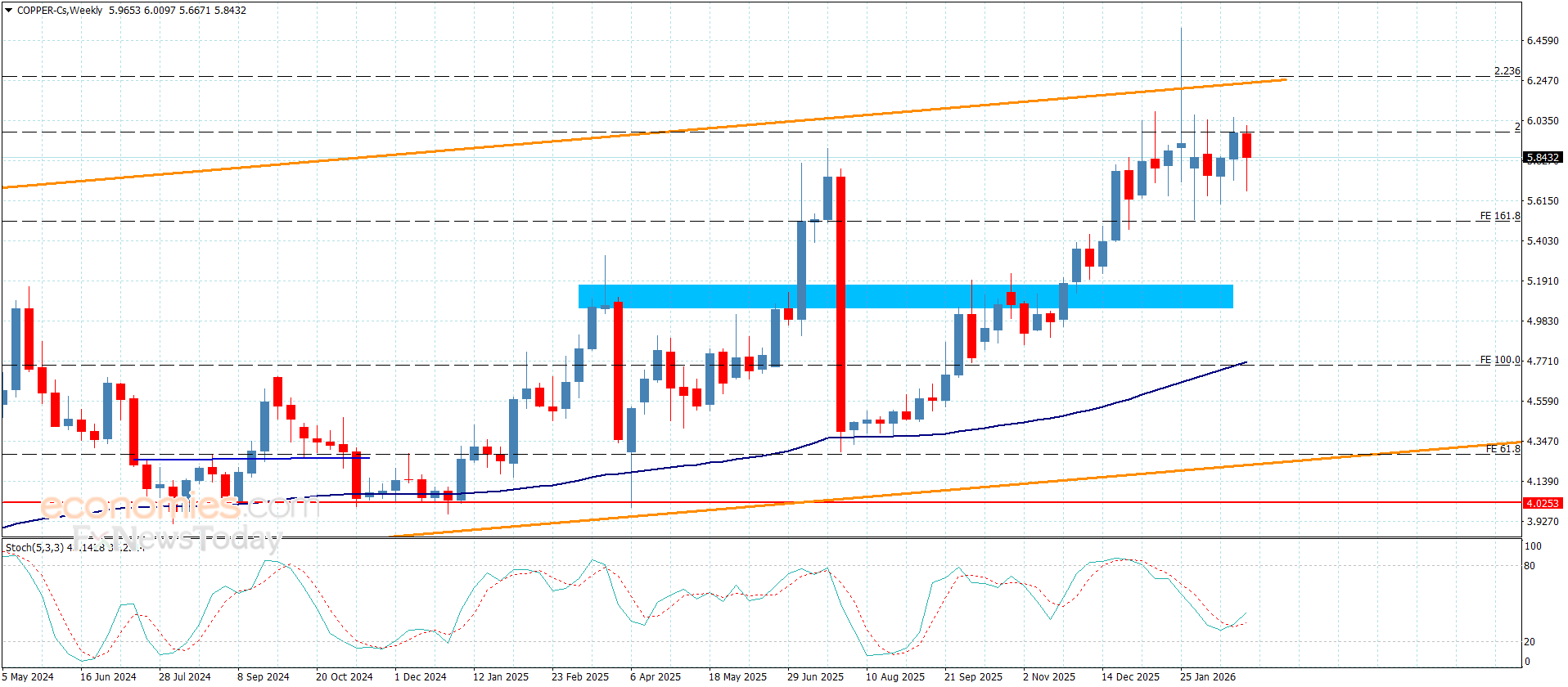
Copper price lost the positive momentum in yesterday’s trading, to force it to settle below $5.9700 barrier, forming some bearish corrective trading by targeting $5.6700 level, to provide some mixed trading.
Note that stochastic attempts to provide extra negative momentum will increase the bearish corrective track in the current period, and the stability of the price below the previously mentioned barrier is important to make us expect targeting $5.6200 level, to attempt to press on the extra support near $5.5100.
The expected trading range for today is between $5.5100 and $5.8500
Trend forecast: Bearish
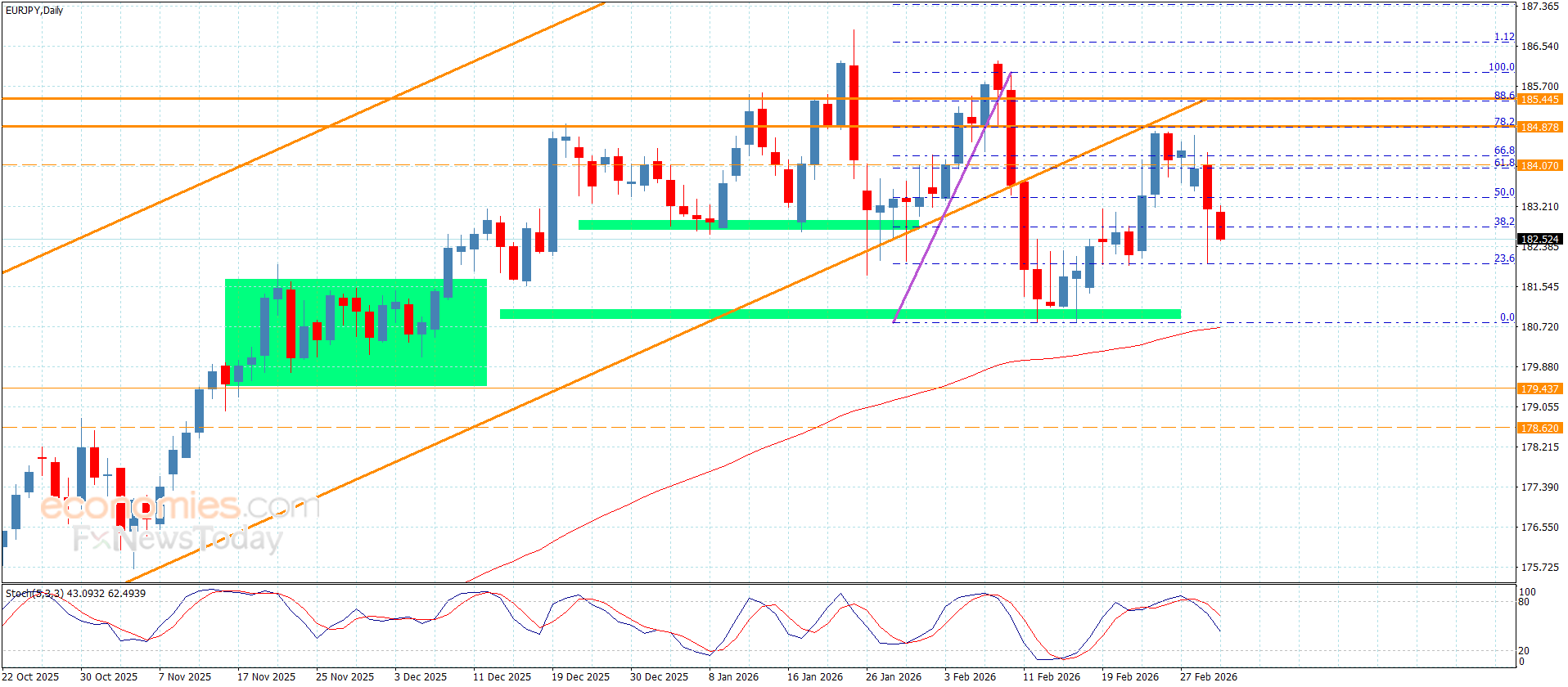
The EURJPY pair formed several bearish waves, affected by the stability below 184.85 barrier, activating with the main indicators’ negativity, achieving the previously suggested targets by reaching 182.05 level, which keeps forming an obstacle against the negative trading.
The last intraday positive rebound doesn’t threaten changing the negative track, to keep waiting for extra negative momentum to gather, to ease the mission of breaking 182.05 level and holding below it to confirm its readiness to target new bearish stations that might begin at 181.55 and 181.10.
The expected trading range for today is between 181.55 and 183.20
Trend forecast: Bearish
Copper price lost the positive momentum in yesterday’s trading, to force it to settle below $5.9700 barrier, forming some bearish corrective trading by targeting $5.6700 level, to provide some mixed trading.
Note that stochastic attempts to provide extra negative momentum will increase the bearish corrective track in the current period, and the stability of the price below the previously mentioned barrier is important to make us expect targeting $5.6200 level, to attempt to press on the extra support near $5.5100.
The expected trading range for today is between $5.5100 and $5.8500
Trend forecast: Bearish
BitcoinWorld
USD/JPY Price Forecast: Resilient Pair Holds Critical Gains Near 157.00 Monthly Peak
TOKYO, May 2025 – The USD/JPY currency pair demonstrates remarkable resilience in Asian trading sessions, maintaining its position near monthly highs above the psychologically significant 157.00 level. This sustained strength follows a period of heightened volatility driven by divergent monetary policies between the Federal Reserve and Bank of Japan. Market participants now closely monitor technical indicators and fundamental developments that could determine the pair’s next directional move. The current consolidation near monthly peaks suggests potential for further appreciation, though several critical resistance levels loom overhead.
Technical analysis reveals the USD/JPY pair has established a firm foothold above the 157.00 handle, a level that previously served as both support and resistance throughout April 2025. The daily chart shows the pair trading approximately 1.2% above its 50-day moving average, indicating sustained bullish momentum. Furthermore, the Relative Strength Index (RSI) currently reads 62, placing it in bullish territory while remaining below overbought conditions. This technical positioning suggests room for additional upside movement before encountering significant selling pressure.
Several critical technical levels now define the trading landscape. Immediate resistance appears at 157.50, followed by the more substantial 158.00 psychological barrier. On the downside, support clusters emerge at 156.80, 156.30, and the crucial 155.50 level. The 155.50 mark represents the pair’s 100-day moving average and has provided reliable support during previous pullbacks. Market analysts note that a decisive break above 158.00 could trigger accelerated buying, potentially targeting the 160.00 handle last tested in late 2024.
Recent price action reveals the formation of an ascending triangle pattern on the four-hour chart, typically considered a continuation pattern in technical analysis. This pattern features a flat upper resistance near 157.50 and rising lower trendline support. Trading volume has remained consistent during this consolidation phase, suggesting genuine accumulation rather than speculative positioning. The measured move target from this pattern’s completion projects toward the 159.00-159.50 region, aligning with previous areas of historical resistance.
The fundamental backdrop continues to favor US dollar strength against the Japanese yen, primarily driven by widening interest rate differentials. The Federal Reserve maintains its benchmark rate within the 5.25%-5.50% range as of May 2025, while the Bank of Japan has only cautiously normalized its negative interest rate policy. This substantial rate gap, exceeding 500 basis points, creates powerful carry trade incentives that naturally support USD/JPY appreciation. Institutional investors frequently borrow in low-yielding yen to purchase higher-yielding dollar assets, generating consistent demand for the currency pair.
Recent economic data releases have further reinforced this dynamic. United States inflation metrics, particularly core PCE, remain persistently above the Fed’s 2% target, suggesting continued restrictive monetary policy. Conversely, Japan’s core inflation has moderated to approximately 2.2% year-over-year, reducing pressure on the Bank of Japan to implement aggressive tightening measures. This policy divergence represents the primary fundamental driver behind the pair’s sustained upward trajectory since 2022.
Market expectations regarding future central bank actions significantly influence USD/JPY price dynamics. According to CME FedWatch Tool data, traders currently price in approximately 50 basis points of Federal Reserve rate cuts through December 2025. Meanwhile, expectations for additional Bank of Japan rate hikes remain modest, with most analysts projecting only 10-25 basis points of tightening during the same period. This anticipated policy path suggests interest rate differentials will remain historically wide, continuing to support USD/JPY strength throughout 2025.
The Bank of Japan faces particular challenges in normalizing policy without triggering excessive yen appreciation that could harm export competitiveness. Governor Kazuo Ueda has repeatedly emphasized a data-dependent approach with gradual adjustments. This cautious stance contrasts with the Federal Reserve’s continued focus on inflation containment, creating what analysts describe as a “perfect storm” for USD/JPY appreciation. The table below summarizes key policy differences:
| Central Bank | Current Policy Rate | 2025 Projected Changes | Primary Policy Focus |
|---|---|---|---|
| Federal Reserve | 5.25%-5.50% | 50 bps cuts expected | Inflation containment |
| Bank of Japan | 0.00%-0.10% | 10-25 bps hikes expected | Gradual normalization |
Commitment of Traders (COT) reports from the Commodity Futures Trading Commission reveal substantial net short positioning in Japanese yen futures, reaching near-extreme levels not seen since 2022. This positioning data indicates that professional traders maintain overwhelmingly bearish views on the yen relative to the US dollar. However, some analysts caution that such extreme positioning often precedes sharp reversals when sentiment eventually shifts. The current structure suggests that any dovish Federal Reserve signals or unexpectedly hawkish Bank of Japan communications could trigger rapid yen appreciation as traders unwind crowded positions.
Meanwhile, options market data shows increased demand for USD/JPY call options at strike prices of 158.00 and 159.00, suggesting institutional expectations for further near-term appreciation. The one-month risk reversal, which measures the premium of calls over puts, remains positive at +0.85%, confirming continued bullish bias among options traders. This derivatives market activity provides valuable insight into professional expectations beyond simple spot price movements.
Geopolitical developments frequently influence USD/JPY dynamics through safe-haven flows. The Japanese yen traditionally strengthens during periods of market stress or geopolitical uncertainty, while the US dollar benefits from its status as the global reserve currency. Recent tensions in the Asia-Pacific region have created competing influences on the currency pair. On one hand, regional instability typically supports yen strength. On the other hand, dollar demand increases during global uncertainty. The net effect has been relatively balanced, allowing interest rate differentials to remain the dominant driver of USD/JPY price action.
The USD/JPY pair has experienced significant appreciation since 2021, rising from approximately 103.00 to current levels near 157.00—a remarkable 52% increase over four years. This sustained uptrend represents the pair’s most substantial rally since the Plaza Accord era of the mid-1980s. Historical analysis reveals that USD/JPY typically experiences multi-year trending periods followed by extended consolidation phases. The current rally has now exceeded the duration of the 2012-2015 uptrend, suggesting increased potential for either acceleration or correction in coming months.
Previous periods of extreme USD/JPY valuation have often prompted coordinated intervention by Japanese monetary authorities. The Ministry of Finance last intervened in currency markets during September and October 2022 when USD/JPY approached 152.00. With the pair now trading approximately 500 pips above those intervention levels, market participants carefully monitor official communications for any hints of renewed currency stabilization efforts. Japanese Finance Minister Shunichi Suzuki recently stated that authorities would take “appropriate action against excessive moves” without specifying particular levels.
The USD/JPY’s performance significantly outperforms other major dollar pairs in 2025. While EUR/USD has declined approximately 4% year-to-date and GBP/USD has fallen roughly 3%, USD/JPY has appreciated nearly 8% during the same period. This relative strength highlights the unique dynamics between US and Japanese monetary policies compared to other developed economies. The European Central Bank and Bank of England have implemented more aggressive tightening cycles than the Bank of Japan, resulting in narrower interest rate differentials with the Federal Reserve.
Key factors distinguishing USD/JPY from other major pairs include:
Despite the prevailing bullish trend, several risk factors could trigger USD/JPY correction or reversal. First, any acceleration in Bank of Japan policy normalization would immediately narrow interest rate differentials, reducing the pair’s fundamental support. Second, unexpected Federal Reserve dovishness, perhaps in response to weakening labor market data, could diminish dollar appeal. Third, coordinated G7 currency intervention remains a possibility if officials deem yen weakness excessive or disorderly. Fourth, deteriorating risk sentiment in global equity markets typically benefits the yen as a traditional safe-haven currency.
Technical analysts identify additional warning signs that could precede trend changes. A daily close below the 155.50 support level would break the 100-day moving average and potentially signal deeper correction toward 153.00. Furthermore, bearish divergence on momentum oscillators, where price makes higher highs while indicators make lower highs, would suggest weakening underlying strength. Market participants should monitor these technical developments alongside fundamental catalysts for comprehensive risk assessment.
Historical analysis reveals distinct seasonal patterns in USD/JPY price action. The pair typically demonstrates strength during the first and fourth quarters, while experiencing more mixed performance during mid-year months. This pattern correlates with Japanese corporate repatriation flows ahead of fiscal year-end in March and semi-annual dividend payments in September. Additionally, the pair often exhibits increased volatility during Bank of Japan policy meetings, which occur eight times annually. The next scheduled meeting in June 2025 represents a potential catalyst for renewed directional movement depending on policy communications.
The USD/JPY price forecast remains cautiously bullish as the pair maintains gains near monthly highs above 157.00. Technical analysis suggests potential for further appreciation toward 158.00-159.00 resistance zones, though overextended positioning increases vulnerability to corrections. Fundamentally, persistent policy divergence between the Federal Reserve and Bank of Japan continues to provide structural support for dollar strength against the yen. Market participants should monitor upcoming economic data releases, central bank communications, and technical developments around key levels. The USD/JPY forecast ultimately depends on the evolving balance between interest rate differentials, risk sentiment, and potential currency intervention by Japanese authorities.
Q1: What key technical levels should traders watch for USD/JPY?
A1: Immediate resistance appears at 157.50 and 158.00, while support clusters at 156.80, 156.30, and the crucial 155.50 level representing the 100-day moving average.
Q2: Why does USD/JPY remain strong despite potential Federal Reserve rate cuts?
A2: Interest rate differentials remain historically wide even with expected Fed cuts, as the Bank of Japan maintains ultra-accommodative policy with only gradual normalization anticipated.
Q3: What would trigger Japanese currency intervention in USD/JPY?
A3: Japanese authorities typically intervene when they perceive “excessive volatility” or “disorderly moves” rather than specific levels, though previous intervention occurred near 152.00 in 2022.
Q4: How do carry trades influence USD/JPY price action?
A4: Investors borrow low-yielding yen to purchase higher-yielding dollar assets, creating consistent demand for USD/JPY that strengthens during periods of market stability and risk appetite.
Q5: What economic indicators most impact USD/JPY direction?
A5: US inflation data (CPI, PCE), Federal Reserve communications, Japanese wage growth figures, and Bank of Japan policy decisions represent the most significant fundamental drivers.
This post USD/JPY Price Forecast: Resilient Pair Holds Critical Gains Near 157.00 Monthly Peak first appeared on BitcoinWorld.