The main category of All News Articles.
You can use the search box below to find what you need.
[wd_asp id=1]
The main category of All News Articles.
You can use the search box below to find what you need.
[wd_asp id=1]
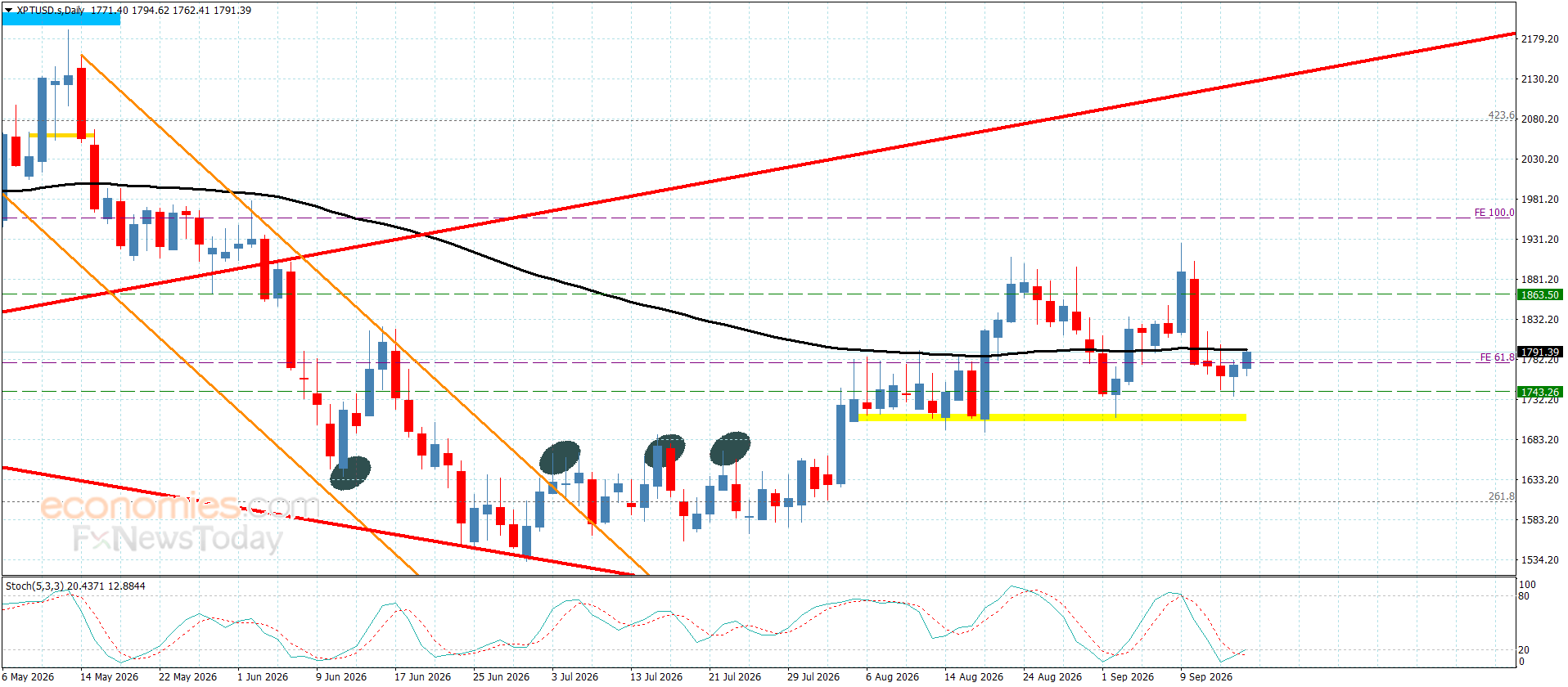
Platinum price remains affected by stochastic positivity, which contradicts the bearish corrective scenario, recording some extra gains by reaching $1913.00 level, the price keeps providing positive trading until testing the bearish channel’s resistance at $1968.00, to begin forming new bearish waves to activate the bearish corrective scenario again.
The moving average 55 stability is near the previously mentioned resistance, to support the stability of the chances of targeting the negative stations, holding near $1835.00 and $1745.00 level.
The expected trading range for today is between $1775.00 and $1950.00
Trend forecast: Bearish
on
Gold (XAU/USD) reversal from early March highs at $5,420 seems to have found support at $4,100 last week, and the pair has been showing a moderate positive tone over the last few days.
The US Dollar Index maintains a strong trend, favoured by higher US Treasury yields amid rising hopes that the US Federal Reserve (Fed) will be forced to change course and hike interest rates at least once this year. The DXY, however, is nearing a key resistance area at 100.50. If bulls fail again at that level, we might see a deeper correction in Gold.
The 4-hour chart shows XAU/USD trading at $4,532. The near-term bias is mildly bullish as price rebounds from last week’s lows, with technical indicators coming up from heavily oversold levels, and the higher low suggesting that the bearish trend has lost steam.
The Relative Strength Index (RSI) has climbed to 53.58, edging above the 50 midline and suggesting improving upside momentum. The Moving Average Convergence Divergence (MACD) line stands above the Signal line in positive territory with a modestly positive histogram, which reinforces a moderate bullish momentum.
Price action suggests that we are in a C-D leg of a Gartley pattern, with immediate resistance at the 38.2% Fobonacci retracement of the March sell-off, around $4,610. A confirmation above here would expose the March 20 high at the $4,735 area, although the most plausible target for a bullish correction is the $5,040 area, a previous support-turned-resistance on March 16 and 17.
On the downside, initial support is at the March 26 low of $4,355, ahead of the mentioned March 23 low at the $4,100 area.
(The technical analysis of this story was written with the help of an AI tool.)
(This story was corrected on March 30 at 11:40 GMT to say that $4,735 was the March 20 high, and not the March 20 low, and that the $4,355 low was hit on March 26 and not last Friday as previously stated)
Gold has played a key role in human’s history as it has been widely used as a store of value and medium of exchange. Currently, apart from its shine and usage for jewelry, the precious metal is widely seen as a safe-haven asset, meaning that it is considered a good investment during turbulent times. Gold is also widely seen as a hedge against inflation and against depreciating currencies as it doesn’t rely on any specific issuer or government.
Central banks are the biggest Gold holders. In their aim to support their currencies in turbulent times, central banks tend to diversify their reserves and buy Gold to improve the perceived strength of the economy and the currency. High Gold reserves can be a source of trust for a country’s solvency. Central banks added 1,136 tonnes of Gold worth around $70 billion to their reserves in 2022, according to data from the World Gold Council. This is the highest yearly purchase since records began. Central banks from emerging economies such as China, India and Turkey are quickly increasing their Gold reserves.
Gold has an inverse correlation with the US Dollar and US Treasuries, which are both major reserve and safe-haven assets. When the Dollar depreciates, Gold tends to rise, enabling investors and central banks to diversify their assets in turbulent times. Gold is also inversely correlated with risk assets. A rally in the stock market tends to weaken Gold price, while sell-offs in riskier markets tend to favor the precious metal.
The price can move due to a wide range of factors. Geopolitical instability or fears of a deep recession can quickly make Gold price escalate due to its safe-haven status. As a yield-less asset, Gold tends to rise with lower interest rates, while higher cost of money usually weighs down on the yellow metal. Still, most moves depend on how the US Dollar (USD) behaves as the asset is priced in dollars (XAU/USD). A strong Dollar tends to keep the price of Gold controlled, whereas a weaker Dollar is likely to push Gold prices up.
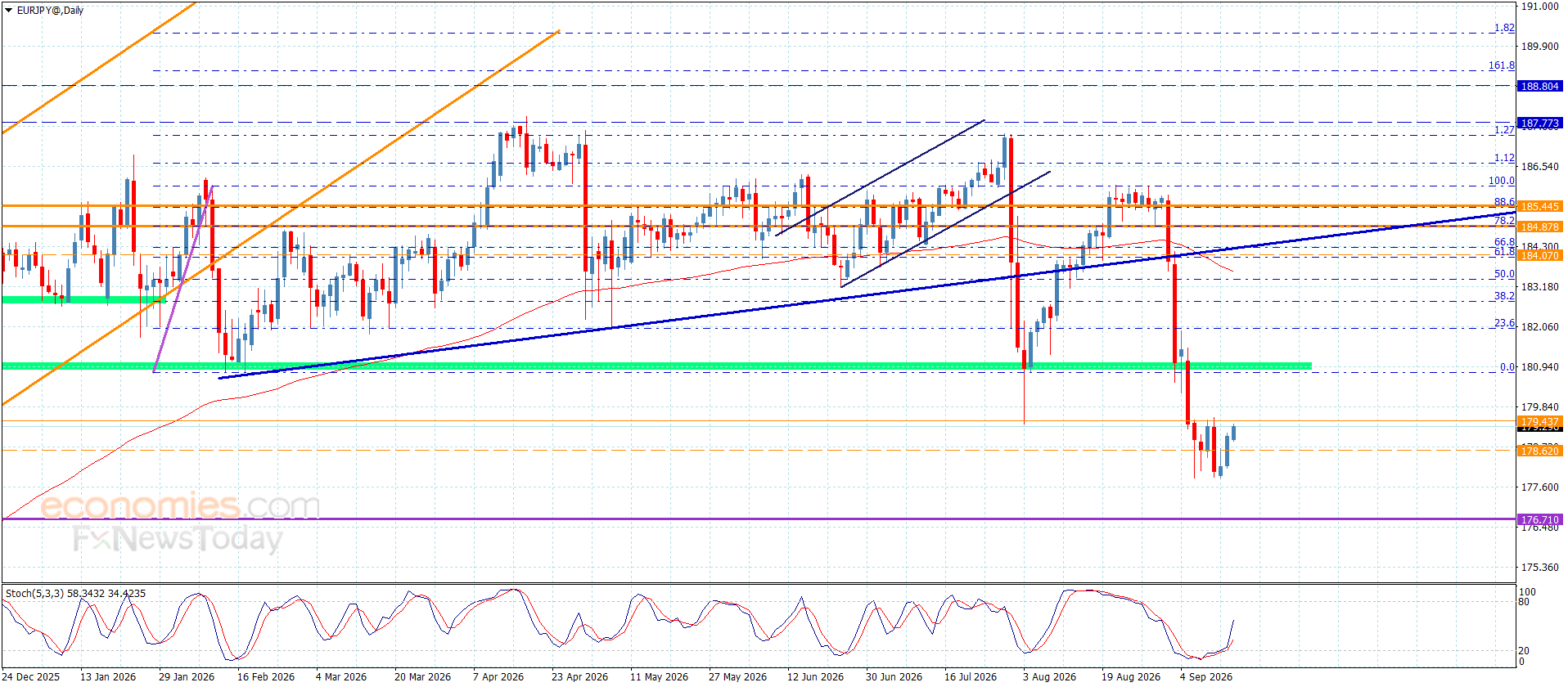
EUR/JPY depreciates after registering modest gains in the previous trading day, hovering around 183.60 during the European hours on Monday. The technical analysis of the daily chart suggests the currency cross remains within the upper boundary of the ascending triangle pattern, reflecting rising buying pressure.
The near-term bias is mildly bullish as the EUR/JPY cross holds above the 50-day Exponential Moving Average (EMA) while the nine-day EMA rises above it, signaling short-term upside pressure. The pair has rebounded from the 180.81 support area and continues to print higher lows, keeping the broader uptrend intact.
The Relative Strength Index (RSI) has slipped back toward the 50 line, showing fading upside momentum but not yet signaling bearish pressure, which keeps the focus on dip-buying interest while the EUR/JPY cross trades above nearby support.
The immediate barrier lies at the nine-day EMA of 183.91, followed by the upper ascending triangle boundary around 184.60. A successful breakout above the triangle would reinforce the bullish bias and lead the currency cross to explore the region around the all-time high of 186.88, reached on January 23.
On the downside, the primary support lies at the 50-day EMA at 183.37, followed by the lower boundary of the ascending triangle around 182.50. A break below the channel would expose the three-month low of 180.81, recorded on February 12.
(The technical analysis of this story was written with the help of an AI tool.)
The table below shows the percentage change of Euro (EUR) against listed major currencies today. Euro was the weakest against the Japanese Yen.
| USD | EUR | GBP | JPY | CAD | AUD | NZD | CHF | |
|---|---|---|---|---|---|---|---|---|
| USD | 0.09% | 0.11% | -0.40% | 0.10% | 0.36% | 0.39% | 0.12% | |
| EUR | -0.09% | 0.00% | -0.48% | 0.00% | 0.31% | 0.30% | 0.02% | |
| GBP | -0.11% | 0.00% | -0.51% | 0.00% | 0.29% | 0.29% | 0.01% | |
| JPY | 0.40% | 0.48% | 0.51% | 0.50% | 0.77% | 0.77% | 0.50% | |
| CAD | -0.10% | -0.00% | -0.00% | -0.50% | 0.27% | 0.22% | -0.00% | |
| AUD | -0.36% | -0.31% | -0.29% | -0.77% | -0.27% | 0.00% | -0.26% | |
| NZD | -0.39% | -0.30% | -0.29% | -0.77% | -0.22% | -0.01% | -0.29% | |
| CHF | -0.12% | -0.02% | -0.01% | -0.50% | 0.00% | 0.26% | 0.29% |
The heat map shows percentage changes of major currencies against each other. The base currency is picked from the left column, while the quote currency is picked from the top row. For example, if you pick the Euro from the left column and move along the horizontal line to the US Dollar, the percentage change displayed in the box will represent EUR (base)/USD (quote).
Platinum price remains affected by stochastic positivity, which contradicts the bearish corrective scenario, recording some extra gains by reaching $1913.00 level, the price keeps providing positive trading until testing the bearish channel’s resistance at $1968.00, to begin forming new bearish waves to activate the bearish corrective scenario again.
The moving average 55 stability is near the previously mentioned resistance, to support the stability of the chances of targeting the negative stations, holding near $1835.00 and $1745.00 level.
The expected trading range for today is between $1775.00 and $1950.00
Trend forecast: Bearish
The USD/JPY pair retreats sharply from the vicinity of mid-160.00s, or a fresh high since July 2024, touched during the Asian session on Monday, and for now, seems to have snapped a four-day winning streak. Spot prices drop to a fresh daily trough, around the 159.70-159.65 region in the last hour, though the downside potential seems limited.
Comments from Bank of Japan (BoJ) Governor Kazuo Ueda and Japan’s Vice Finance Minister for International Affairs, Atsushi Mimura, fueled speculations that authorities would step in to stem weakness in the domestic currency. This, in turn, prompts aggressive short-covering around the Japanese Yen (JPY) and weighs on the USD/JPY pair. That said, economic concerns on the back of the escalating conflicts in the Middle East might keep a lid on any meaningful JPY appreciation.
The near-term bias is mildly bullish as the USD/JPY pair holds well above the rising 100-period Exponential Moving Average (EMA) on the 4-hour chart. Moreover, spot prices continue to respect the ascending support trend line that originated around 157.20, reinforcing a pattern of higher lows. Adding to this, the Relative Strength Index (RSI) around 54 keeps momentum in neutral-to-positive territory, consistent with a grind higher rather than a sharp impulsive move.
Furthermore, the Moving Average Convergence Divergence (MACD) line stays marginally above its signal line in positive territory, though with a contracting histogram, which suggests upside momentum is present but not accelerating. Hence, any subsequent slide is likely to find some support near 159.40, and a break would expose the 159.00 region, followed by a deeper support at the 100-period EMA around 158.70.
As long as these levels hold, buyers could focus on resistance at 160.20, followed by the recent high zone around 160.30. A clear move above 160.30 would open the way toward the 160.80 area, while a sustained drop below 158.70 would negate the upside bias and signal a broader corrective phase.
(The technical analysis of this story was written with the help of an AI tool.)
The Japanese Yen (JPY) is one of the world’s most traded currencies. Its value is broadly determined by the performance of the Japanese economy, but more specifically by the Bank of Japan’s policy, the differential between Japanese and US bond yields, or risk sentiment among traders, among other factors.
One of the Bank of Japan’s mandates is currency control, so its moves are key for the Yen. The BoJ has directly intervened in currency markets sometimes, generally to lower the value of the Yen, although it refrains from doing it often due to political concerns of its main trading partners. The BoJ ultra-loose monetary policy between 2013 and 2024 caused the Yen to depreciate against its main currency peers due to an increasing policy divergence between the Bank of Japan and other main central banks. More recently, the gradually unwinding of this ultra-loose policy has given some support to the Yen.
Over the last decade, the BoJ’s stance of sticking to ultra-loose monetary policy has led to a widening policy divergence with other central banks, particularly with the US Federal Reserve. This supported a widening of the differential between the 10-year US and Japanese bonds, which favored the US Dollar against the Japanese Yen. The BoJ decision in 2024 to gradually abandon the ultra-loose policy, coupled with interest-rate cuts in other major central banks, is narrowing this differential.
The Japanese Yen is often seen as a safe-haven investment. This means that in times of market stress, investors are more likely to put their money in the Japanese currency due to its supposed reliability and stability. Turbulent times are likely to strengthen the Yen’s value against other currencies seen as more risky to invest in.
Domestic coffee prices
The domestic coffee market this morning, March 30, did not have much fluctuation compared to Sunday’s holiday. The average purchase price in the Central Highlands region is still anchored at 92,400 VND/kg. Notably, the Lam Dong area recorded a slight increase of 200 VND/kg, while other localities kept prices unchanged to listen to signals from international exchanges that will reopen tonight.
Detailed purchase prices in regions:
Dak Nong (old): Continuing to maintain the highest price in the region at 92,500 VND/kg.
Dak Lak and Gia Lai: Stable trading at 92,300 VND/kg.
Lam Dong: Slightly increased by 200 VND, pushing the price to 91,700 VND/kg.
In general, the current price level has moved away from the peak of over 96,000 VND/kg in early March due to unfavorable information about global supply in the long term.
World coffee prices
At the end of last week’s trading session, coffee prices on both London and New York exchanges closed in the red.
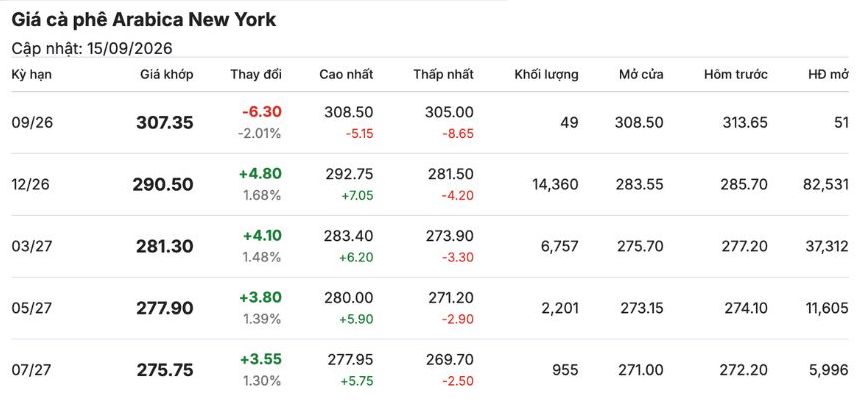
New York Stock Exchange (Arabica): May 2026 term fell sharply 5.95 cents (-1.93%), closing at 301.70 cents/lb. Oversupply pressure surged after Marex Group Plc raised its Brazilian production forecast for the 2026/27 crop to a record level of 75.9 million bags (up 15.5% y/y), higher than Sucafina’s forecast (75.4 million bags) and StoneX’s (75.3 million bags).
London Stock Exchange (Robusta): May 2026 term slightly decreased by 3 USD (-0.08%), closing the session at 3,593 USD/ton. Robusta’s decline was curbed thanks to inventories on the ICE exchange continuing to fall to the lowest level in 3.25 months, leaving only 4,127 lots.
Market opinion
The coffee market is facing great supply pressure from South America. The continuous appearance of “super crop” forecast reports in Brazil along with Arabica’s ICE floor inventory reaching a 6-month peak (585.621 bags) is a major barrier to price increases.
However, supporting factors are still present as tensions in the Strait of Hormuz disrupt maritime transport, increase logistics costs and tighten short-term supply for international roasters. In Vietnam, exports in the first 2 months of the year increased by 14% to 360,000 tons, showing that the volume of goods is still being pushed to the market quite steadily.
It is forecasted that in the first sessions of this week, coffee prices will continue to be in a state of fluctuation in the range of 91,500 – 93,000 VND/kg. Farmers should closely monitor the technical recovery of the London exchange when inventories are still at a low level to balance sales.
Note: The actual price may vary depending on quality and locality.
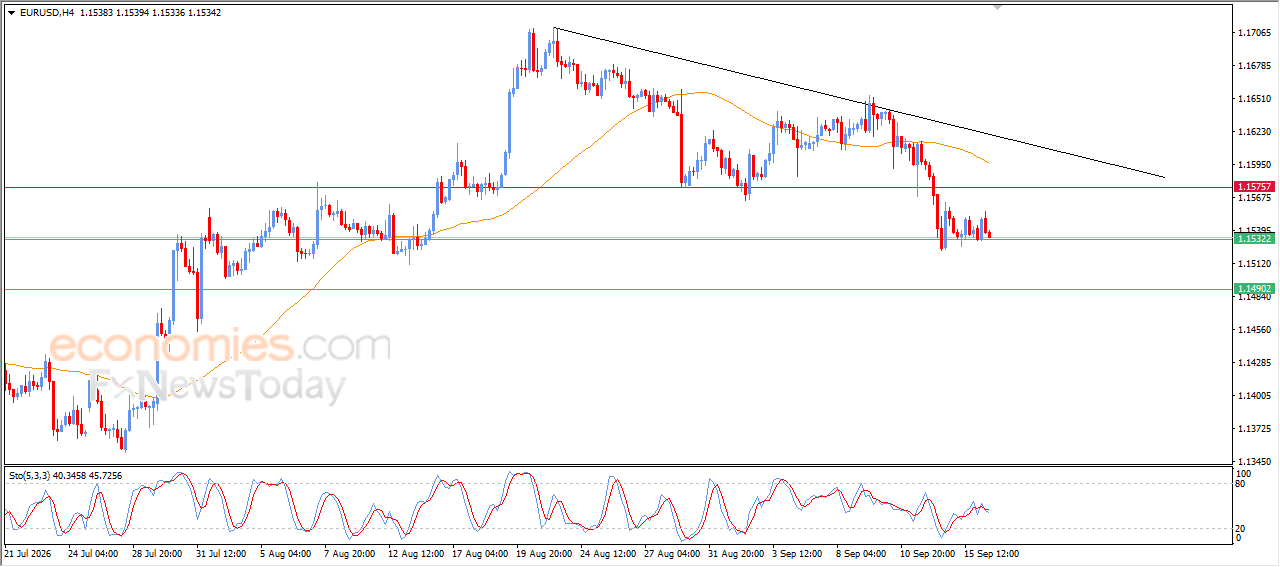
The EUR/USD pair recovers a few pips after retesting a one-week low earlier this Monday and holds steady around the 1.1500 psychological mark during the Asian session. The upside, however, seems limited as rising geopolitical tensions might continue to benefit the safe-haven US Dollar (USD) and act as a headwind for spot prices.
Reports suggest that the Pentagon is preparing for weeks of ground operations in Iran. Adding to this, the entry of the Iran-backed militant group in Yemen, the Houthis, raises the risk of a further escalation of the conflict in the Middle East. This continues to weigh on investors’ sentiment. Furthermore, inflation fears stemming from elevated energy prices continue to fuel hawkish Federal Reserve (Fed) expectations, which could further underpin the USD and cap the upside for the EUR/USD pair.
From a technical perspective, the near-term bias is mildly bearish as spot prices hold beneath the flat 200-hour Exponential Moving Average (EMA) around 1.1550, keeping upside attempts capped. The Moving Average Convergence Divergence (MACD) line fluctuates tightly around the signal and the zero line, and the muted histogram highlights a lack of strong directional momentum. The Relative Strength Index (RSI) near 43 remains below the 50 midline, suggesting sellers retain a modest advantage despite the absence of impulsive downside.
Meanwhile, immediate resistance emerges at 1.1535, with a break exposing 1.1550 as the next barrier in line with the 200-hour EMA. A sustained move above 1.1550 would ease bearish pressure and open the door toward 1.1580. On the downside, initial support stands at 1.1490, followed by 1.1475 if selling pressure extends. A clear drop through 1.1475 would strengthen the bearish bias and target the 1.1450 area next.
(The technical analysis of this story was written with the help of an AI tool.)
The US Dollar (USD) is the official currency of the United States of America, and the ‘de facto’ currency of a significant number of other countries where it is found in circulation alongside local notes. It is the most heavily traded currency in the world, accounting for over 88% of all global foreign exchange turnover, or an average of $6.6 trillion in transactions per day, according to data from 2022.
Following the second world war, the USD took over from the British Pound as the world’s reserve currency. For most of its history, the US Dollar was backed by Gold, until the Bretton Woods Agreement in 1971 when the Gold Standard went away.
The most important single factor impacting on the value of the US Dollar is monetary policy, which is shaped by the Federal Reserve (Fed). The Fed has two mandates: to achieve price stability (control inflation) and foster full employment. Its primary tool to achieve these two goals is by adjusting interest rates.
When prices are rising too quickly and inflation is above the Fed’s 2% target, the Fed will raise rates, which helps the USD value. When inflation falls below 2% or the Unemployment Rate is too high, the Fed may lower interest rates, which weighs on the Greenback.
In extreme situations, the Federal Reserve can also print more Dollars and enact quantitative easing (QE). QE is the process by which the Fed substantially increases the flow of credit in a stuck financial system.
It is a non-standard policy measure used when credit has dried up because banks will not lend to each other (out of the fear of counterparty default). It is a last resort when simply lowering interest rates is unlikely to achieve the necessary result. It was the Fed’s weapon of choice to combat the credit crunch that occurred during the Great Financial Crisis in 2008. It involves the Fed printing more Dollars and using them to buy US government bonds predominantly from financial institutions. QE usually leads to a weaker US Dollar.
Quantitative tightening (QT) is the reverse process whereby the Federal Reserve stops buying bonds from financial institutions and does not reinvest the principal from the bonds it holds maturing in new purchases. It is usually positive for the US Dollar.
Gold price (XAU/USD) opens over 1% lower to near $4,445.00 on Monday, as oil prices have rallied further on fears of further widening of conflicts in the Middle East. WTI Oil price is up almost 3% above $102.50 in the opening trade, increasing fears of higher inflation expectations globally.
Theoretically, accelerating global inflation expectations force central banks to hold interest rates steady for a longer term or tighten monetary conditions, which diminishes demand for non-yielding assets, such as Gold.
Fears of further escalation in the Middle East war are prompted by the expectation that the United States (US) is considering a ground invasion of Iran. On Thursday, a report from the Wall Street Journal (WSJ) showed that the US Pentagon will send 10,000 additional troops to Iran.
In response, Iran’s Brigadier General Ebrahim Zolfaqari warned on the Iranian state TV that “US troops will be good food for sharks of the Persian Gulf”.
Meanwhile, a report from Reuters has shown that US President Donald Trump remains confident, while interviewed by the Financial Times (FT), that Washington could reach a deal with Iran soon. “Indirect talks via emissaries progressing well,” Trump said, and added, “A deal could be made fairly quickly.”
XAU/USD trades lower at around $4,445 in the opening trade. The near-term bias is bearish, with price extending below the 20-day Exponential Moving Average (EMA) that now tracks well above the market and acts as dynamic resistance around $4,735. The sequence of lower closes from the $5,300 area underscores a downside trend after losing the prior consolidation band around $4,900.
The 14-day Relative Strength Index (RSI) continues to stay inside the 20.00-40.00 range, indicating persistent selling pressure while leaving room for further downside before momentum exhausts.
Immediate resistance emerges at $4,736, where the 20-day EMA converges with the recent breakdown reference, followed by $4,915 as the next upside barrier if a corrective bounce develops. A daily close back above $4,915 would weaken the current bearish structure and open the path toward $5,080. On the downside, initial support is located at the March 24 low near $4,307, with a break below exposing the next bearish objective at the March 23 low around $4,100. As long as price holds beneath the $4,736–4,915 resistance band, sellers retain control of the short-term outlook.
(The technical analysis of this story was written with the help of an AI tool.)
Gold has played a key role in human’s history as it has been widely used as a store of value and medium of exchange. Currently, apart from its shine and usage for jewelry, the precious metal is widely seen as a safe-haven asset, meaning that it is considered a good investment during turbulent times. Gold is also widely seen as a hedge against inflation and against depreciating currencies as it doesn’t rely on any specific issuer or government.
Central banks are the biggest Gold holders. In their aim to support their currencies in turbulent times, central banks tend to diversify their reserves and buy Gold to improve the perceived strength of the economy and the currency. High Gold reserves can be a source of trust for a country’s solvency. Central banks added 1,136 tonnes of Gold worth around $70 billion to their reserves in 2022, according to data from the World Gold Council. This is the highest yearly purchase since records began. Central banks from emerging economies such as China, India and Turkey are quickly increasing their Gold reserves.
Gold has an inverse correlation with the US Dollar and US Treasuries, which are both major reserve and safe-haven assets. When the Dollar depreciates, Gold tends to rise, enabling investors and central banks to diversify their assets in turbulent times. Gold is also inversely correlated with risk assets. A rally in the stock market tends to weaken Gold price, while sell-offs in riskier markets tend to favor the precious metal.
The price can move due to a wide range of factors. Geopolitical instability or fears of a deep recession can quickly make Gold price escalate due to its safe-haven status. As a yield-less asset, Gold tends to rise with lower interest rates, while higher cost of money usually weighs down on the yellow metal. Still, most moves depend on how the US Dollar (USD) behaves as the asset is priced in dollars (XAU/USD). A strong Dollar tends to keep the price of Gold controlled, whereas a weaker Dollar is likely to push Gold prices up.
BitcoinWorld
Silver Price Forecast: XAG/USD Braces for Third Consecutive Weekly Decline as Charts Signal Caution
Global silver markets face mounting pressure as the XAG/USD pair prepares for its third consecutive negative weekly close, according to technical chart analysis from major financial hubs on Friday, March 14, 2025. This persistent downward movement marks one of the longest weekly losing streaks for the precious metal this year, consequently prompting renewed analysis from commodity strategists and institutional traders. The current price action reflects broader macroeconomic shifts that are influencing precious metal valuations worldwide.
Technical charts for XAG/USD reveal a clear pattern of sustained selling pressure. The weekly chart, a crucial tool for institutional investors, shows silver failing to hold above key support levels established earlier in the quarter. Furthermore, moving averages have begun to realign in a bearish configuration, with the 50-week average converging downward toward the 200-week average. This convergence often signals a potential shift in long-term momentum. Meanwhile, daily timeframes indicate that each rally attempt has met with immediate resistance, creating a series of lower highs and lower lows—a classic technical downtrend structure.
Volume analysis provides additional context for the price movement. Notably, trading volume has expanded during down days and contracted during minor recovery attempts. This volume profile suggests stronger conviction among sellers than buyers in the current environment. Key technical indicators also support the cautious outlook:
The silver market does not operate in isolation. Consequently, several interconnected economic factors are contributing to the current pressure on XAG/USD. Primarily, shifting expectations around central bank policy, particularly from the U.S. Federal Reserve, have reduced the appeal of non-yielding assets like silver. As interest rate expectations firm, the opportunity cost of holding precious metals increases for institutional portfolios. Simultaneously, the U.S. dollar index (DXY) has shown resilience, creating natural headwinds for dollar-denominated commodities.
Industrial demand considerations also play a significant role in silver’s unique dual identity as both a monetary and industrial metal. Recent manufacturing data from major economies, including Purchasing Managers’ Index (PMI) reports, have shown mixed signals. While certain technology sectors maintain steady demand for silver in components, broader industrial slowdown concerns in some regions are tempering bullish forecasts. The following table summarizes recent influential data points:
| Factor | Current Influence | Market Impact |
|---|---|---|
| U.S. Treasury Yields | Rising 10-year yields | Negative for precious metals |
| Dollar Strength (DXY) | Consolidating near highs | Downward pressure on XAG/USD |
| Global PMI Data | Mixed regional signals | Neutral to slightly negative |
| ETF Holdings | Moderate outflows recorded | Reflective of investor caution |
Market analysts from leading commodity research firms point to structural changes in trader positioning. According to recent Commitments of Traders (COT) reports published by regulatory authorities, managed money accounts have reduced their net-long positions in silver futures for four consecutive weeks. This systematic reduction in speculative interest often precedes or accompanies sustained price declines. Meanwhile, physical market premiums have remained stable in key regions like North America and Europe, suggesting that retail and industrial physical demand is absorbing some of the selling pressure from paper markets.
Historical context provides another layer of understanding. Silver has experienced similar multi-week declines approximately twelve times in the past decade. In eight of those instances, the metal found a consolidation floor within four to six weeks before establishing its next directional move. Seasonality patterns also offer insight, as the period following the first quarter has historically shown mixed performance for silver, with industrial demand cycles often dictating the medium-term trend.
Silver’s performance must be evaluated relative to other asset classes. Notably, the gold-silver ratio—a closely watched metric by precious metal traders—has widened during this period. This widening indicates that silver is underperforming gold, which often occurs during risk-off periods or when industrial concerns outweigh monetary demand. The ratio’s movement suggests that silver’s industrial attributes are currently weighing more heavily on its price than its safe-haven characteristics.
The mining sector provides a real-world reflection of these price movements. Share prices for primary silver producers and diversified miners with significant silver exposure have generally underperformed broad equity indices this month. However, production cost analysis indicates that most major producers remain profitable at current price levels, reducing the immediate risk of supply contraction. This fundamental support could help establish a price floor if the decline continues.
Several upcoming events and data releases could serve as catalysts for the next significant move in silver prices. Central bank meetings, particularly those with updated economic projections, will be scrutinized for hints about future liquidity conditions. Additionally, inflation data from major economies will influence real yield calculations, a critical driver for precious metal valuations. Geopolitical developments, which traditionally boost safe-haven demand, remain a variable that could rapidly alter market sentiment.
Technically, market participants are watching for either a decisive breakdown below the current weekly support zone or a reversal pattern that could signal exhaustion of the selling pressure. A sustained close above the recent weekly high would be the first technical indication that the downward momentum is abating. Until such signals emerge, the prevailing trend suggests caution for momentum-based traders while potentially creating accumulation opportunities for long-term value investors.
The silver price forecast remains cautious as XAG/USD approaches its third consecutive negative weekly close. Technical charts clearly depict a bearish momentum structure, supported by macroeconomic headwinds including dollar strength and shifting rate expectations. However, stable physical demand and production economics provide underlying support. Market participants should monitor upcoming economic data and key technical levels for signals of either trend continuation or reversal. This period of consolidation and testing may ultimately establish the foundation for silver’s next significant directional move in 2025.
Q1: What does a third consecutive negative weekly close mean for silver?
A third weekly decline typically indicates sustained selling pressure and a shift in medium-term momentum. It often leads technical analysts to adjust their support levels and watch for potential trend acceleration or exhaustion.
Q2: How does the U.S. dollar affect XAG/USD prices?
Since silver is priced in U.S. dollars globally, a stronger dollar makes it more expensive for holders of other currencies, potentially reducing international demand and putting downward pressure on the XAG/USD pair.
Q3: Are silver mining companies affected by this price decline?
Yes, mining equity valuations generally correlate with metal prices. However, most established producers maintain healthy margins above production costs, providing some fundamental price support.
Q4: What technical level is most important to watch now?
Analysts are closely monitoring the $24.50 support zone on weekly charts. A decisive break below this level could trigger further technical selling, while holding above it might signal consolidation.
Q5: Does this decline affect physical silver investment differently than paper markets?
Physical bullion markets often show different dynamics, with premiums sometimes increasing during price declines as retail buying interest emerges, while paper futures and ETF markets may react more directly to financial flows and leverage.
This post Silver Price Forecast: XAG/USD Braces for Third Consecutive Weekly Decline as Charts Signal Caution first appeared on BitcoinWorld.
I wrote on 22nd March that the best trades for the week would be:
Long of the USD/JPY currency pair. This gave a win of 0.95%.
Long of Brent Crude Oil but with ¼ of the normal position size. This gave a loss of 1.85%.
Last week’s overall loss of 0.90% is 0.80% per asset.
A summary of last week’s most important data in the market:
UK CPI (inflation) – as expected at 3.0%.
Australian CPI (inflation) – unexpectedly ticked lower to 3.7%, producing a slight weakening in the Aussie.
USA, Germany, UK Flash Services & Manufacturing PMI – manufacturing did better than expected, services did worse.
US Unemployment Claims – as expected.
UK Retail Sales – slightly better than expected, showing a month-on-month decrease by only 0.4% when a decline of 0.6% was expected.
Last week’s data had little effect on the market. Generally, we are seeing hawkish central banks against the backdrop of a potentially inflationary energy price shock generated by the ongoing war in the Middle East. There are open and frightening questions over how this war might end, and what its global economic effects might be, although reports of imminent catastrophes are exaggerated.
An element of the war took the headlines early last week when President Trump successfully suppressed energy prices by extending the deadline to this earlier threat to begin destroying Iranian power plants by five days, as the USA and Iran were in talks. This immediately triggered a 10% reduction in the price of energies, and the S&P 500 Index jumped by almost 200 points. However, the euphoria was somewhat short lived, as Iran denied any ongoing talks, and gaps between the parties remained reportedly huge and unbridgeable. As the week went on, the price of energies began to rise again, while remaining off recent highs. However, the earlier gains in the stock market evaporated completely, with the S&P 500 Index closing sharply lower at a new 7-month low price.
US politicians have been talking about the war ending soon, but not for a little while, or words to this effect. This tactic of talking up an end to the war while pressing on with as total a destruction as possible of the regime, its nuclear and missile programs, its other military assets, and its financial assets. Tactically, the war has been a stunning success for the USA and Israel, with this destruction having been pressed home.
Although president Trump has pushed it off twice, it is worth remembering that his threat to destroy Iran’s power plants is still live, with a deadline of 6th April.
Prediction markets such as Polymarket suggest that the war will last until May, when after using US troops on the ground in some capacity starting in April, President Trump will likely order a unilateral halt to operations in coordination with Israel. Markets then expect some kind of formal ceasefire deal by the end of May. Concerning US ground troops, there is speculation that they might be used to seize Kharg Island and/or possibly other strategic Islands, or the Hormuz coast, which might provide further economic leverage over the regime. An operation to remove the highly enriched uranium which is still located in Iran is also a possibility.
It seems very likely that the war will end with the regime remaining in power but nearly stripped of its military equipment and programs, facing its people. The regime will probably survive for a while and possibly indefinitely but may not survive the anger of the people and its own weakening. Two issues that will remain to be resolved will be the full opening of the Strait of Hormuz (there are rumours about countries making their own individual deals with Iran about that) and the enriched uranium. Apart from these two issues, it looks as if in two or three weeks from now the US and Israel will announce a halt and hope that Iran stops firing or at least desires to negotiate a ceasefire. It will then remain to be seen whether the USA and Israel will be able to translate a huge tactical gain into a long-term strategic gain.
The price of energies will likely decline when the US and Israel cease fire, and the stock market will probably get a boost, although it seems like the stock market has a bigger underlying problem.
The middle east war is likely to remain more influential that any economic data releases which are scheduled over the coming week, especially if it escalates towards increased targeting of infrastructure. The top three items have realistic potential to move the market a bit, especially in the US Dollar.
The coming week’s most important data points, in order of likely importance, are:
US Average Hourly Earnings
US Non-Farm Employment Change
US JOLTS Jobs Openings
US Retail Sales
ADP Non-Farm Employment
Canadian GDP
US ISM Manufacturing PMI
US Unemployment Rate
US Unemployment Claims
Friday will be a public holiday in Australia, New Zealand, Germany, Switzerland, the UK, and Canada.
Currency Price Changes and Interest Rates
For the month of March, I made no monthly Forex forecast as the US Dollar was not in a clear trend at the start of the month.
For the month of April, I forecast that the USD/JPY currency pair will rise in value.
Last week saw no currency crosses with excessive volatility, so I am making no forecast for the coming week.
The US Dollar was the strongest major currency last week, while the Australian Dollar was the weakest. Directional volatility increased significantly last week, with 30% of all major pairs and crosses changing in value by more than 1%.
Next week’s volatility is likely to remain the same or possibly decline as the week will end a bit early for some due to the Easter holiday. However, the ongoing war in the Middle East retains the ability to roil the market if there are any surprises. This could generate volatility in the US Dollar, the Japanese Yen, and the Canadian Dollar, not to mention stock markets.
You can trade these forecasts in a real or demo Forex brokerage account.
Key Support and Resistance Levels
The US Dollar printed a bullish candlestick, with a large lower wick, and a close that was right on the high of its range. It was almost the highest weekly close in the past ten months, so we are very close to a significant bullish breakout after a relatively consolidative period.
Other bullish factors are the long-term bullish trend in the Dollar, and rising US Treasury Yields which are also breaking to new long-term highs, pushing the greenback higher.
I think expecting the greenback to rise is the correct approach. It is very difficult to imagine the Middle East war ending surprisingly soon, so we will likely continue to see the same kind of flow which benefits the US Dollar over the coming week.
US Dollar Index Weekly Price Chart
The USD/JPY currency pair gained firmly last week, finally making the long-anticipated bullish breakout beyond the big round number at ¥160. This is the highest price seen here in over 1.5 years, and the weekly candlestick was a bullish one which closed very near the high of its range. These are bullish signs, as is the fact that the price chart below shows an orderly bullish trend supported by an obvious trend line for about one year now.
I am happy to be long of this currency pair, especially now that we are above ¥160.
The US Dollar was the biggest gainer of all the major currencies last week and seems poised to break higher. The Japanese Yen is relatively weak as markets are still not convinced the Bank of Japan is really going to be able to start getting serious about hiking rates due to massive Japanese debt.
USD/JPY Daily Price Chart
The AUD/USD currency pair was at the heart of the Forex market last week, with the greenback gaining by more than any other major currency, while the Australian Dollar was the biggest lower. There has been a very long-term bullish trend in the Aussie, which seemed to have decoupled from risk sentiment to some extent, but we see the Aussie getting hit hard as the world faces up to the fact that the Middle East war may now drag out for several more weeks and even escalate, potentially disrupting shipping and raising insurance premiums.
Looking technically at the weekly price chart below, we can see we have a strong bearish U-shaped top, and now the bearish leg has really gained momentum, ending the week very near the low of its range – a bearish sign of bearish momentum.
It is hard to see the current picture changing, barring a sudden surprise end to the war in the Middle East.
I won’t be trading in this currency pair yet, but day traders might want to look for shorts in this currency pair if the week opens with similar bearish momentum as was seen last week.
AUD/USD Weekly Price Chart
Brent Crude Oil is tending to outperform WTI Crude Oil during this crisis, so if I am looking to the long side which I am here, I will focus on Brent and not WTI.
The price here was looking very bullish last weekend, which is why I saw a long trade, albeit a very small-sized one with only a quarter of normal position size. This trade would have been a big loser at full size, after President Trump talked the price down last Monday by extending the deadline for his threat to destroy Iran’s power plants.
The price has since recovered somewhat, and the action is bullish, but a bit muted.
There is still a potential for escalation and supply disruption within this ongoing war, which prediction markets do not see ending before May, so I remain ready to go long here if we see a new long-term high daily (New York) closing price above $112.
I continue to recommend a small position size, but I would move that up from one quarter of normal size to one half.
Brent Crude Oil Futures Daily Price Chart
RBOB Gasoline futures can be understood by reading what I wrote above for Crude Oil. One thing that is particular to Gasoline is that the price action is even more bullish, and the price is even more sensitive to what is going on in the Middle East, as gasoline companies are very quick to pass on their anticipated higher costs to consumers.
There is still scope here for higher prices due to the war, and the price is much closer to making a breakout to new highs than crude oil is.
I will go long here if we see a daily (New York) closing price above $3.2319 but with only half my usual position size.
If Gasoline futures are expensive for you, and they probably are as there are no Gasoline micro futures, you might try using the ETF UGA or one outside the USA if you prefer – these are much more affordable.
RBOB Gasoline Futures Daily Price Chart
Last week was poor again for the US stock market, with the S&P 500 Index falling heavily, especially on the final two days of the week, to reach a new 7-month low, with the daily chart closing quite far below both the SMA 200 and the EMA 200. These are bearish signs, with the market now almost 10% below its recent all-time high which it reached just a few weeks ago – that would be formal correction territory.
By some metrics – notably the 200-day moving averages and the fact we are at a 7-month low, not to mention the recent strong bearish momentum – you could call this a bear market.
The ongoing war in the Middle East has spooked an already nervous and overbought stock market, especially in the USA, probably hastening (but not causing) its fall.
This is not an environment to buy stocks or the market index. If you want to buy a dip, you should really wait for a sign that the dip has ended, and the price is heading up again.
I am bearish and I can see the price reaching 6,250 or even lower over the next week. However, it is extremely hard to exploit bearish markets on the short side. It is best just to get out and stay on the sidelines until things stabilize.
S&P 500 Index Daily Price Chart
Treasury Yield instruments have tended to trend very reliably and can be an excellent instrument to bring profit to trend followers. There is a micro future available here sized at only about $4,000 so it can be affordable.
We have seen US Treasury Yield rise with quite strong momentum over the past month, enough to completely reverse the technical picture from long-term bearish breakdown to long-term bullish breakout, with the price here making a new 18-month plus high. Although there is a fairly large upper wick on Friday’s daily candle, I still feel trend trading US yields is an excellent thing to be involved in. Also, it is hard to see what might change this picture of rising US yields, it really takes a change in some macro input or sentiment, which is why these can be so great for trend followers.
I will be entering a long trade here on Monday with a normal position size.
If a $4,000 future is too much for you, some brokers might offer it as a CFD, but then you must watch the overnight rates closely and make sure it is still worth it.
US 10 Year Treasury Yield Futures
I see the best trades this week as:
Long of the USD/JPY currency pair.
Long of the 10Y US Treasury Yield Future.
Ready to trade our weekly Forex forecast? Check out our list of the top 10 Forex trading platforms.