The main category of All News Articles.
You can use the search box below to find what you need.
[wd_asp id=1]
The main category of All News Articles.
You can use the search box below to find what you need.
[wd_asp id=1]
BitcoinWorld
USD/JPY Forecast: Critical Bullish Breakout Looms as Technical Setup Hints at Surge Beyond 156.00
TOKYO, May 2025 – The USD/JPY currency pair, a critical barometer of global risk sentiment and East-West monetary policy divergence, approaches a decisive technical juncture. Market participants now closely monitor the 156.00 resistance level, as a confluence of bullish chart patterns and fundamental drivers suggests a potential sustained upward move for the Dollar-Yen exchange rate. This analysis examines the constructive technical setup, its underlying catalysts, and the implications for traders and the broader financial landscape.
The daily chart for USD/JPY reveals a compelling narrative of consolidation giving way to potential expansion. Following a period of sideways movement between 154.50 and 156.00, the pair has formed a recognizable ascending triangle pattern. This pattern, characterized by a flat upper resistance near 156.00 and a series of higher lows, typically precedes a bullish breakout. Furthermore, the 50-day and 200-day simple moving averages maintain a bullish alignment, with the shorter-term average positioned above the longer-term one, providing dynamic support on any dips. The Relative Strength Index (RSI) currently reads near 58, comfortably within bullish territory but not yet overbought, indicating room for further appreciation.
Key technical levels are now firmly in focus. A confirmed daily close above the 156.00 handle would signal a breakout, with immediate projected targets near 157.50, a previous area of congestion. Conversely, a failure to breach this ceiling could see the pair retest support around the 154.50-155.00 zone, where the rising trendline and key moving averages converge. Volume analysis will be crucial; a breakout accompanied by above-average trading volume would significantly strengthen the validity of the move.
The technical bullishness finds a powerful fundamental counterpart in the stark divergence between the Federal Reserve and the Bank of Japan (BoJ). While the Fed has maintained a restrictive stance to combat inflation, only recently hinting at a slower pace of quantitative tightening, the BoJ continues its ultra-accommodative policy framework. This policy chasm creates a persistent yield advantage for US assets, driving capital flows that support the US Dollar against the Japanese Yen. Recent commentary from BoJ Governor Kazuo Ueda has emphasized a data-dependent, cautious approach to policy normalization, tempering market expectations for rapid interest rate hikes.
Meanwhile, US economic data, particularly labor market strength and persistent services inflation, has allowed the Fed to remain patient. The resulting interest rate differential keeps the cost of holding Yen-funded carry trades low, incentivizing investors to sell JPY to buy higher-yielding assets. This fundamental backdrop provides a sturdy floor for USD/JPY and fuels the momentum needed for technical breakouts. Geopolitical tensions and global risk appetite also play a role, often amplifying the pair’s movements.
Senior analysts from major financial institutions highlight the significance of the 156.00 level. “The market has tested this resistance multiple times, which builds energy like a coiled spring,” notes a chief currency strategist at a leading Japanese bank, who prefers to remain anonymous for compliance reasons. “A breakout here isn’t just about a few pips; it would confirm the market’s conviction in the policy divergence narrative for the medium term and could trigger algorithmic buying programs.” The impact extends beyond spot Forex. A sustained move higher in USD/JPY affects Japanese import costs, corporate earnings for exporters, and the valuation of trillions in cross-border investments.
The timeline of this setup is immediate. With the BoJ’s next policy meeting on the horizon and fresh US inflation data due, the catalysts for volatility are present. Historical data shows that breaks from such prolonged consolidations often lead to trending moves that last for several weeks. For multinational corporations, this forecasts higher hedging costs. For retail traders, it underscores the importance of risk management around key technical levels.
Despite the constructive setup, several risk factors could derail the bullish forecast. An unexpected, hawkish shift in BoJ rhetoric—perhaps in response to a sharp decline in the Yen’s value—could trigger a rapid short-covering rally in JPY. Similarly, a sudden dovish pivot from the Fed, prompted by weaker-than-expected economic data, would narrow the yield differential. Market sentiment is also fragile; a sharp downturn in global equity markets could spark a flight to safety, benefiting the Japanese Yen traditionally seen as a haven during turmoil.
It is essential to consider these alternative scenarios. A false breakout above 156.00, followed by a swift rejection and close back below, would constitute a bearish signal and likely lead to a deeper correction toward 153.00. Therefore, traders await not just a test, but a confirmed and sustained break, often defined as two consecutive daily closes above the resistance level with conviction.
The USD/JPY forecast hinges on the pair’s ability to convert its constructive technical setup into a decisive breakout above the 156.00 resistance. This potential move is underpinned by the deep-seated fundamental divergence between US and Japanese monetary policy. While the path of least resistance appears higher, market participants must remain vigilant to central bank communications and macroeconomic data releases that could alter the landscape. A successful breach of 156.00 would open the door for a significant bullish phase, reinforcing the current trend and setting new benchmarks for the Dollar-Yen exchange rate in the weeks ahead.
Q1: What does a “constructive technical setup” mean for USD/JPY?
A constructive technical setup refers to the alignment of multiple bullish chart indicators—such as an ascending triangle pattern, supportive moving averages, and strong momentum—that suggest a high probability of an upward price breakout.
Q2: Why is the 156.00 level so significant for USD/JPY?
The 156.00 level represents a major psychological and technical resistance barrier that the pair has tested several times. A confirmed break above it is viewed by traders as a signal that buying pressure has finally overwhelmed selling pressure, potentially leading to a sustained rally.
Q3: How does Bank of Japan policy affect the USD/JPY exchange rate?
The BoJ’s ultra-loose monetary policy, characterized by negative short-term interest rates and yield curve control, keeps Japanese yields low. This widens the interest rate differential with the higher-yielding US Dollar, making the Yen a favored currency to sell in carry trades, thereby pressuring USD/JPY higher.
Q4: What would invalidate the bullish USD/JPY forecast?
The forecast would be invalidated by a daily close back below key support near 154.50, a hawkish surprise from the BoJ, a sudden dovish shift from the Fed, or a major spike in global risk aversion that triggers safe-haven flows into the Japanese Yen.
Q5: What are the immediate targets if USD/JPY breaks above 156.00?
Initial technical targets following a confirmed breakout above 156.00 are located near 157.50 and 158.50, which correspond to previous highs and Fibonacci extension levels. The move could extend further if accompanied by strong fundamental drivers.
This post USD/JPY Forecast: Critical Bullish Breakout Looms as Technical Setup Hints at Surge Beyond 156.00 first appeared on BitcoinWorld.
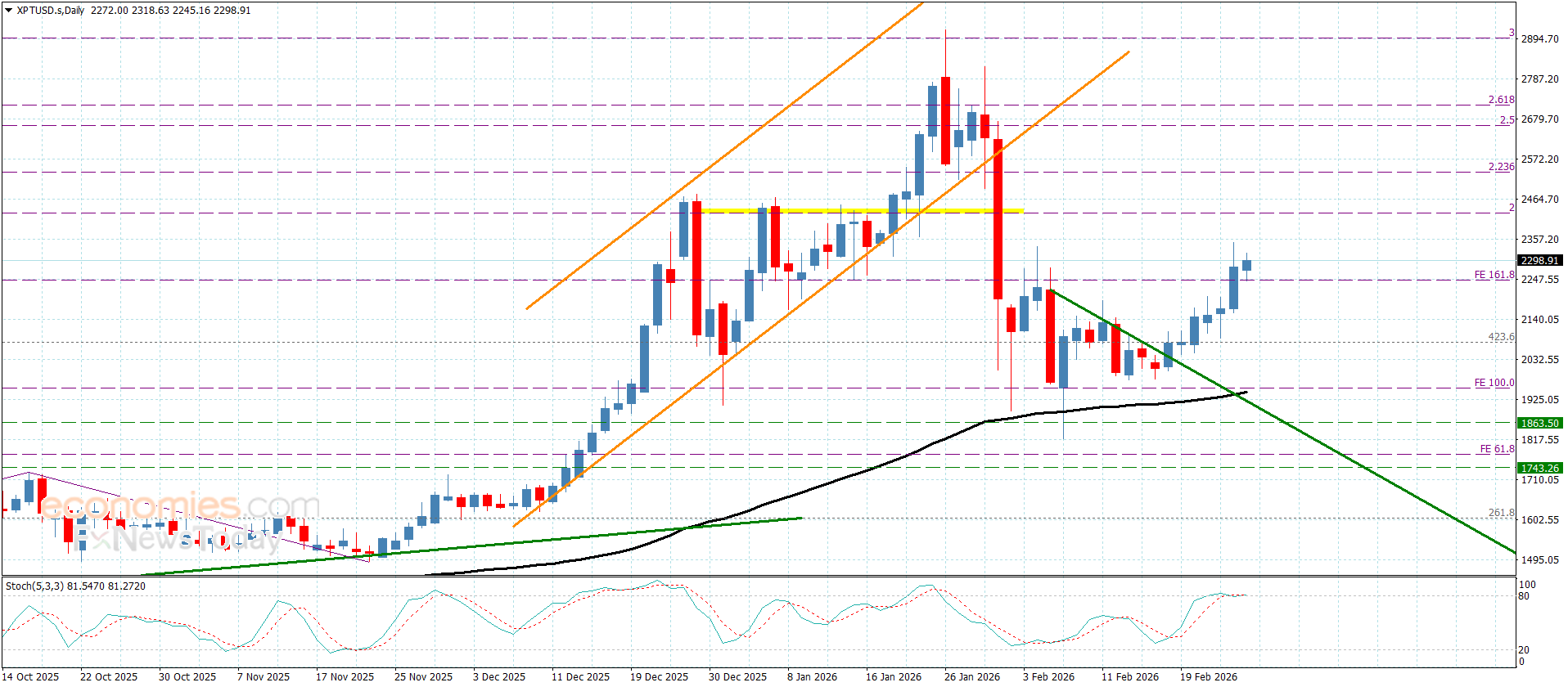
Platinum price succeeded in confirming its readiness to regain the bullish bias by surpassing the barrier at$2245.00, achieving some of the previously suggested extra targets by reaching $2348.00 level.
The stability of the price above $2245.00 level, attempting to form extra support level, attempting to provide extra positive momentum by the main indicators support the chances of resuming the bullish trend, to expect its rally towards $2365.00 reaching the next main target near $2465.00
The expected trading range for today is between $2250.00 and $2365.00
Trend forecast: Bullish
EUR/USD gained about 0.3% on Wednesday and snapped a two-day losing streak. The pair stays relatively quiet early Thursday and moves above 1.1800.
The table below shows the percentage change of Euro (EUR) against listed major currencies this week. Euro was the strongest against the Japanese Yen.
| USD | EUR | GBP | JPY | CAD | AUD | NZD | CHF | |
|---|---|---|---|---|---|---|---|---|
| USD | -0.13% | -0.40% | 0.70% | -0.08% | -0.54% | -0.25% | -0.34% | |
| EUR | 0.13% | -0.25% | 0.83% | 0.06% | -0.42% | -0.12% | -0.19% | |
| GBP | 0.40% | 0.25% | 1.27% | 0.31% | -0.20% | 0.14% | 0.08% | |
| JPY | -0.70% | -0.83% | -1.27% | -0.77% | -1.22% | -0.89% | -1.03% | |
| CAD | 0.08% | -0.06% | -0.31% | 0.77% | -0.46% | -0.12% | -0.25% | |
| AUD | 0.54% | 0.42% | 0.20% | 1.22% | 0.46% | 0.31% | 0.24% | |
| NZD | 0.25% | 0.12% | -0.14% | 0.89% | 0.12% | -0.31% | -0.07% | |
| CHF | 0.34% | 0.19% | -0.08% | 1.03% | 0.25% | -0.24% | 0.07% |
The heat map shows percentage changes of major currencies against each other. The base currency is picked from the left column, while the quote currency is picked from the top row. For example, if you pick the Euro from the left column and move along the horizontal line to the US Dollar, the percentage change displayed in the box will represent EUR (base)/USD (quote).
The risk-positive market atmosphere caused the US Dollar (USD) to lose interest midweek, allowing EUR/USD to edge higher.
Ahead of the next round of US-Iran nuclear talks in Geneva, markets adopt a cautious stance early Thursday and help the USD limit its losses. At the time of press, US stock index futures were down about 0.2% on the day.
Later in the session, European Central Bank (ECB) President Christine Lagarde will testify before European Parliament. In case Lagarde warns that further Euro strength could heighten the risks of inflation falling below target, EUR/USD could come under renewed bearish pressure.
In the second half of the day, the US Department of Labor will publish the weekly Initial Jobless Claims data. Nevertheless, market participants will keep a close eye on headlines coming out of US-Iran talks. If there is an agreement, risk flows could dominate the action in financial markets and hurt the USD. On the flip side, safe-haven flows could return in case sides fail to make a deal, reviving fears over a military conflict between the US and Iran.
In the 4-hour chart, EUR/USD trades at 1.1813. The near-term bias is mildly bullish as the pair holds above the 20- and 50-period Simple Moving Averages (SMAs) while challenging the 100-period SMA near 1.1828, signalling buyers are gradually regaining control above the 200-period SMA around 1.1796. The Relative Strength Index (RSI) hovers in the mid-50s, confirming improving upside momentum rather than overbought conditions. Price action also presses against a descending resistance trend line that was broken around 1.1819, with the current consolidation just above that break area reinforcing a tentative upside tilt.
Immediate support emerges at 1.1809, aligned with the 50.0% Fibonacci retracement measured from the 1.1590 low to the 1.2027 high, followed by 1.1757 at the 61.8% retracement, where the 200-period SMA provides an additional cushion nearby. A sustained hold above these levels would keep attention on initial resistance at the 100-period SMA near 1.1828, with the 38.2% retracement at 1.1860 as the next upside barrier. A clear break above 1.1860 would open the way toward the 23.6% retracement at 1.1924, while a drop back below 1.1757 would undermine the nascent bullish setup and shift the focus toward the broader range lows.
(The technical analysis of this story was written with the help of an AI tool.)
The Euro is the currency for the 20 European Union countries that belong to the Eurozone. It is the second most heavily traded currency in the world behind the US Dollar. In 2022, it accounted for 31% of all foreign exchange transactions, with an average daily turnover of over $2.2 trillion a day.
EUR/USD is the most heavily traded currency pair in the world, accounting for an estimated 30% off all transactions, followed by EUR/JPY (4%), EUR/GBP (3%) and EUR/AUD (2%).
The European Central Bank (ECB) in Frankfurt, Germany, is the reserve bank for the Eurozone. The ECB sets interest rates and manages monetary policy.
The ECB’s primary mandate is to maintain price stability, which means either controlling inflation or stimulating growth. Its primary tool is the raising or lowering of interest rates. Relatively high interest rates – or the expectation of higher rates – will usually benefit the Euro and vice versa.
The ECB Governing Council makes monetary policy decisions at meetings held eight times a year. Decisions are made by heads of the Eurozone national banks and six permanent members, including the President of the ECB, Christine Lagarde.
Eurozone inflation data, measured by the Harmonized Index of Consumer Prices (HICP), is an important econometric for the Euro. If inflation rises more than expected, especially if above the ECB’s 2% target, it obliges the ECB to raise interest rates to bring it back under control.
Relatively high interest rates compared to its counterparts will usually benefit the Euro, as it makes the region more attractive as a place for global investors to park their money.
Data releases gauge the health of the economy and can impact on the Euro. Indicators such as GDP, Manufacturing and Services PMIs, employment, and consumer sentiment surveys can all influence the direction of the single currency.
A strong economy is good for the Euro. Not only does it attract more foreign investment but it may encourage the ECB to put up interest rates, which will directly strengthen the Euro. Otherwise, if economic data is weak, the Euro is likely to fall.
Economic data for the four largest economies in the euro area (Germany, France, Italy and Spain) are especially significant, as they account for 75% of the Eurozone’s economy.
Another significant data release for the Euro is the Trade Balance. This indicator measures the difference between what a country earns from its exports and what it spends on imports over a given period.
If a country produces highly sought after exports then its currency will gain in value purely from the extra demand created from foreign buyers seeking to purchase these goods. Therefore, a positive net Trade Balance strengthens a currency and vice versa for a negative balance.
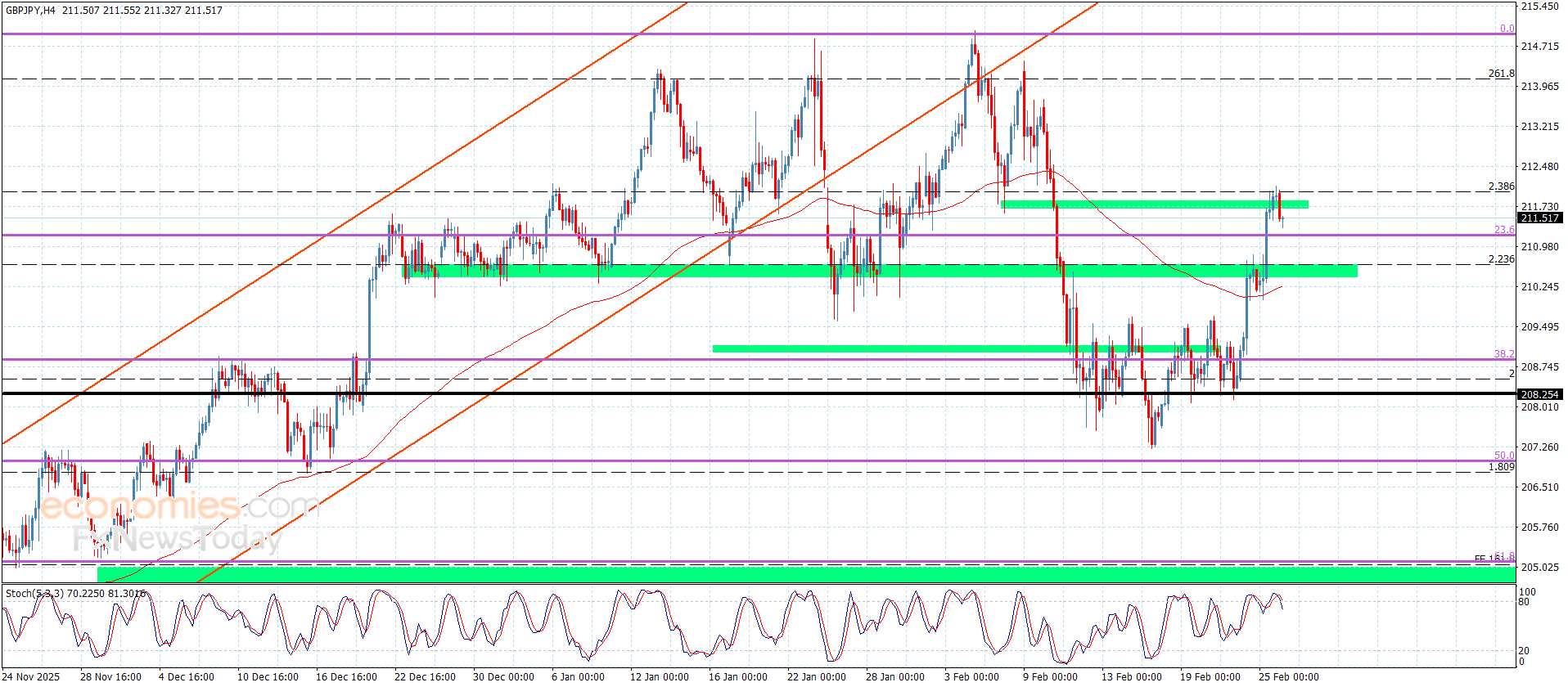
The GBPJPY pair resumed the bullish rally by surpassing the barrier at 110.65, activating with the main indicators’ positivity, forming strong bullish rally and achieving the second target by reaching 212.10, to face strong barrier then form quick negative rebound towards 211.45.
Note that the stability below 212.10 by stochastic exit from the overbought level might push the price to form new bearish waves, to target 210.65 level again, while its success by breaching 212.10 will open the way for recording extra gains that might begin at 212.60 and 213.10.
The expected trading range for today is between 210.65 and 212.85
Trend forecast: Bearish
Despite providing bullish momentum by stochastic, however the fluctuation below the initial barrier at $3.520 level, which pushed it to form new bearish waves, repeating the pressure on the main support at $3.000.
The current support forms detecting key for the main trend in the upcoming trading, to expect its stability to begin forming new bullish waves, motivating it to surpass $3.520 barrier, to record new gains by its rally towards $3.750 and $4.000, while breaking the support and holding below it will force it to suffer big losses, to expect reaching $2.850 and $2.660 initially.
The expected trading range for today is between $3.000 and $3.520
Trend forecast: Bullish
Important DisclaimersFXEmpire is owned and operated by Empire Media Network LTD., Company Registration Number 514641786, registered at 7 Jabotinsky Road, Ramat Gan 5252007, Israel. The content provided on this website includes general news and publications, our personal analysis and opinions, and materials provided by third parties. This content is intended for educational and research purposes only. It does not constitute, and should not be interpreted as, a recommendation or advice to take any action, including making any investment or purchasing any product. Before making any financial decision, you should conduct your own due diligence, exercise your own discretion, and consult with competent advisors. The content on this website is not personally directed to you, and we do not take into account your individual financial situation or needs. The information contained on this website is not necessarily provided in real time, nor is it guaranteed to be accurate. Prices displayed may be provided by market makers and not by exchanges. Any trading or other financial decision you make is entirely your own responsibility, and you must not rely solely on any information provided through the website. FXEmpire does not provide any warranty regarding the accuracy, completeness, or reliability of any information contained on the website and shall bear no responsibility for any trading losses you may incur as a result of using such information. The website may include advertisements and other promotional content. FXEmpire may receive compensation from third parties in connection with such content. FXEmpire does not endorse, recommend, or assume responsibility for the use of any third-party services or websites. Empire Media Network LTD., its employees, officers, subsidiaries, and affiliates shall not be liable for any loss or damage resulting from your use of the website or reliance on the information provided herein.Risk DisclaimersThis website contains information about cryptocurrencies, contracts for difference (CFDs), and other financial instruments, as well as about brokers, exchanges, and other entities trading in such instruments. Both cryptocurrencies and CFDs are complex instruments and involve a high risk of losing money. You should carefully consider whether you understand how these instruments work and whether you can afford to take the high risk of losing your money. FX Empire encourages you to conduct your own research before making any investment decision and to avoid investing in any financial instrument unless you fully understand how it works and the risks involved.
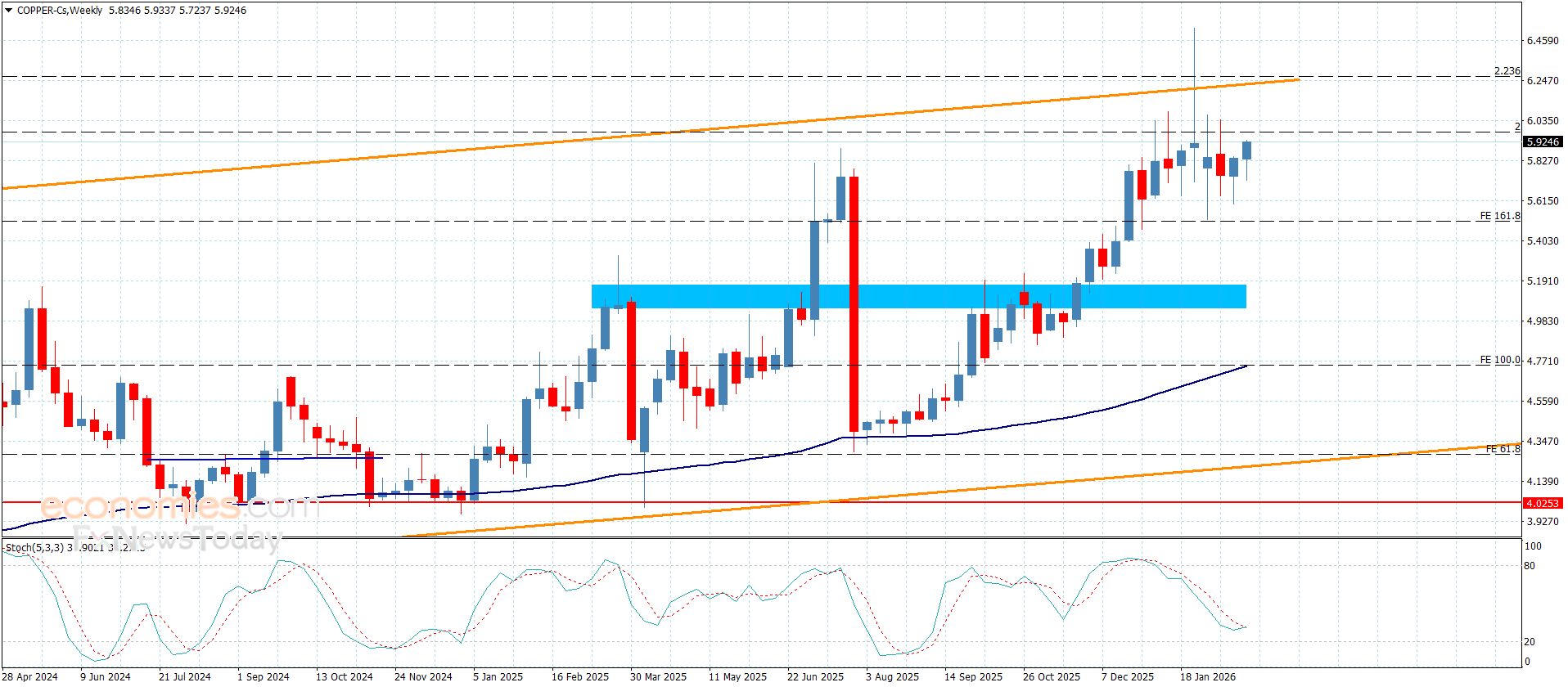
Copper price activated again with the positivity of the main indicators, forming more bullish waves, approaching $5.9700 level which formed strong obstacle against confirming the continuation of the positivity in the last period.
We recommend waiting for breaching the barrier and holding above it to reinforce the chances of recording new gains, to expect forming initial target at $6.1200 level, to extend the trading towards $6.2400, while the failure of the breach will force the price to form bearish corrective wave, and there is a chance to target $5.7200 and $5.5100 level.
The expected trading range for today is between $5.8000 and $6.1200
Trend forecast: Bullish
– Written by
Tim Boyer
STORY LINK GBP/USD Price Forecast: Pound Sterling Climbs after Trump Address
The Pound to US Dollar (GBP/USD) exchange rate rose on Wednesday as the US Dollar weakened following market reaction to President Donald Trump’s State of the Union address.
At the time of writing, GBP/USD was trading near $1.3517, representing a gain of roughly 0.2% compared with the start of the session.
The US Dollar came under pressure midweek as investors assessed the implications of Donald Trump’s State of the Union address.
During what became the longest speech of its kind, Trump defended his administration’s economic record and strongly promoted his trade policies. He criticised the Supreme Court’s decision to overturn his earlier IEEPA tariff framework while arguing that the newly introduced global tariff structure could ultimately prove more effective.
The president also floated the idea that tariff revenues might one day offset income taxes, adding another layer of uncertainty for markets already grappling with shifting US trade policy.
Geopolitical concerns also lingered after Trump again referenced the possibility of military action against Iran, although he emphasised a diplomatic solution remained his preferred outcome.
The Pound traded with relative stability as investors adjusted their expectations for the Bank of England’s upcoming policy decision.
Get better rates and lower fees on your next international money transfer.
Compare TorFX with top UK banks in seconds and see how much you could save.
Remarks from Governor Andrew Bailey a day earlier prompted markets to dial back certainty surrounding a March interest rate cut after he suggested policymakers had yet to reach a firm conclusion.
While traders still broadly anticipate monetary easing in the near term, the perception that next month’s decision is not guaranteed helped lend Sterling some underlying support.
Domestic political developments could inject volatility into the Pound later in the week as the Greater Manchester by-election approaches.
A disappointing outcome for Labour may reignite concerns over Prime Minister Keir Starmer’s leadership prospects, potentially weighing on investor confidence in UK assets.
At the same time, the US Dollar’s direction may hinge on the release of the latest US producer price index figures. Evidence of easing pipeline inflation could reinforce expectations that the Federal Reserve will continue loosening monetary policy, which may limit demand for the ‘Greenback’.

International Money Transfer? Ask our resident FX expert a money transfer question or try John’s new, free, no-obligation personal service! ,where he helps every step of the way,
ensuring you get the best exchange rates on your currency requirements.
TAGS: Pound Dollar Forecasts
Gold price (XAU/USD) trades 0.6% higher to near $5,200 during the European trading session on Wednesday. The precious metal gains as tensions between the United States (US) and Iran over Tehran’s intentions to build nuclear infrastructure and uncertainty surrounding Washington’s trade policy have improved demand for safe-haven assets.
Safe-haven assets, such as Gold, perform better in a worsening geopolitical environment.
Meanwhile, investors await nuclear talks between the US and Iran, which are scheduled for Thursday, to get cues on how the Middle East situation will shape going forward. Ahead of the meeting, US President Donald Trump has also warned of military action in Tehran if it doesn’t drop its nuclear programme plans. Trump threatened Tehran through a post on Truth.Social on Monday that it will be a very bad day for the country and its people if they don’t reach a deal.
In the US, the Supreme Court’s (SC) ruling against additional duties imposed by Washington has upended the trade policy outlook. On Friday, the SC accused President Donald Trump of exceeding his authority to back his tariff agenda by invoking economic emergency powers.
Although US President Trump has announced 10% global tariffs to offset the SC’s verdict, which could be increased to 15%, and he has also warned of steeper tariffs in case countries dishonour trade deals, investors still worry that nations could demand deal revision.
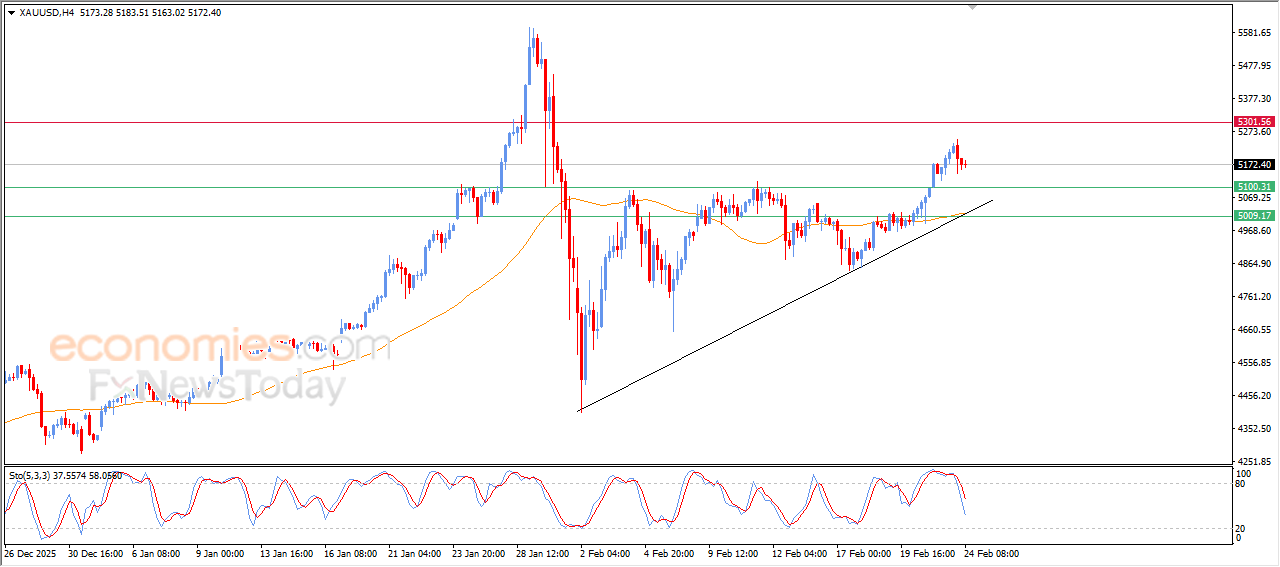
XAU/USD trades higher to near $5,200 as of writing. The near-term bias is bullish as price continues to respect the rising support trend line from about $4,400 and holds well above the 20-day Exponential Moving Average near $5,010. The sequence of higher lows along this trend line keeps the uptrend intact despite recent volatility, while the EMA cluster under price confirms underlying demand on dips.
The 14-day Relative Strength Index (RSI) around 60.00 stays in positive territory, signaling sustained upside momentum rather than exhaustion after the earlier overbought readings have eased.
Immediate support emerges at the trend-line area around $5,120, followed by the 20-day EMA near $5,010 and then the recent reaction low at $4,880. A break below this support band would weaken the bullish structure and expose deeper retracements toward $4,750. On the upside, initial resistance sits near the recent peak at $5,240, and a daily close above this level would open the way toward the $5,380 region. As long as price holds above the EMA and the rising trend line, dips are positioned to attract buyers within the prevailing uptrend.
(The technical analysis of this story was written with the help of an AI tool.)
Gold has played a key role in human’s history as it has been widely used as a store of value and medium of exchange. Currently, apart from its shine and usage for jewelry, the precious metal is widely seen as a safe-haven asset, meaning that it is considered a good investment during turbulent times. Gold is also widely seen as a hedge against inflation and against depreciating currencies as it doesn’t rely on any specific issuer or government.
Central banks are the biggest Gold holders. In their aim to support their currencies in turbulent times, central banks tend to diversify their reserves and buy Gold to improve the perceived strength of the economy and the currency. High Gold reserves can be a source of trust for a country’s solvency. Central banks added 1,136 tonnes of Gold worth around $70 billion to their reserves in 2022, according to data from the World Gold Council. This is the highest yearly purchase since records began. Central banks from emerging economies such as China, India and Turkey are quickly increasing their Gold reserves.
Gold has an inverse correlation with the US Dollar and US Treasuries, which are both major reserve and safe-haven assets. When the Dollar depreciates, Gold tends to rise, enabling investors and central banks to diversify their assets in turbulent times. Gold is also inversely correlated with risk assets. A rally in the stock market tends to weaken Gold price, while sell-offs in riskier markets tend to favor the precious metal.
The price can move due to a wide range of factors. Geopolitical instability or fears of a deep recession can quickly make Gold price escalate due to its safe-haven status. As a yield-less asset, Gold tends to rise with lower interest rates, while higher cost of money usually weighs down on the yellow metal. Still, most moves depend on how the US Dollar (USD) behaves as the asset is priced in dollars (XAU/USD). A strong Dollar tends to keep the price of Gold controlled, whereas a weaker Dollar is likely to push Gold prices up.